
Eyewitness testimony is the backbone of most UAP cases, but human perception and memory are systematically biased in ways that can help or hurt truth-finding. Four pillars matter most:
- Attention is selective. People routinely miss salient events (inattentional/change blindness), especially under task load or divided attention. PubMed
- Memory is reconstructive. After an event, exposure to leading questions, co-witness discussion, or media alters what people later recall (misinformation and memory-conformity effects). ResearchGate ResearchGate
- Judgment uses heuristics. Availability, representativeness, and anchoring speed decisions but can distort probability estimates and identifications. cs.tufts.edu
- Interview methods change outcomes. Procedure matters: “pristine” identification/line-up protocols, the PEACE investigative-interview model, and the Cognitive Interview enhance accuracy while reducing contamination; suggestive or coercive methods degrade it. elineup.org College of Policing
This explainer distills the most robust findings from psychology and policing standards, connects them to UAP witness work, and ends with ready-to-use field checklists, speculation labels, and a transparent claims taxonomy.
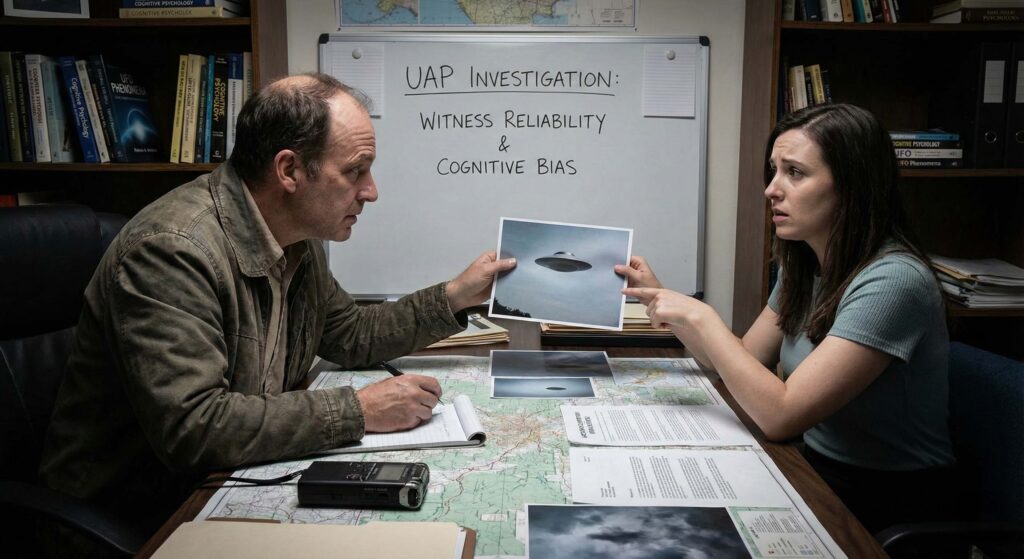
The foundations: what the data say about human perception and memory
Attention: why people miss the obvious
- Inattentional blindness: When attention is engaged on a demanding task, observers often fail to notice unexpected, even dramatic events. The classic “gorilla” experiment showed that over half of focused viewers never saw a person in a gorilla suit walk through the scene. UAP relevance: busy drivers, pilots monitoring instruments, or controllers scanning screens may miss simultaneous aerial details. PubMed
- Change blindness: Even large visual changes can go unnoticed when they occur during a brief disruption, a saccade, or a distraction, reminding us that visual continuity is an illusion. UAP relevance: intermittent views of lights/objects, on-off sensor contact, and camera zooms make reliable comparison across frames harder than it feels. PubMed
Memory: not a video recorder
- Misinformation effect: Post-event suggestions (from media, interviewers, or co-witnesses) overwrite details, inflating confidence in incorrect memories. This is among the most replicated findings in psychology. ResearchGate
- Memory conformity / social contagion: Co-witness discussions make people adopt details they never saw, especially when the other person is confident or seen as credible. For UAP mass sightings, community chatter can standardize details into a shared script within hours. Wiley Online Library
- Confidence ≠ accuracy (unless procedures are pristine): Confidence can be inflated by feedback (“Yes, that matches what others saw”). Under pristine procedures, initial high confidence can track accuracy; otherwise, the metric is easily contaminated. Williams College
Judgment under uncertainty: the heuristics that help and hurt
- Availability: Vivid, recent, or media-amplified cases feel more likely; in UAP contexts, a viral “triangle” clip can bias witnesses to interpret ambiguous lights as triangles.
- Representativeness: If an observation “fits” a prototype (e.g., “erratic motion → non-human”), observers may underweight base rates (satellites, drones, aircraft).
- Anchoring: Early labels (from a dispatcher, influencer, or investigator) anchor later estimates of speed, distance, and size. These effects were established in classic work by Tversky & Kahneman and replicate across domains. cs.tufts.edu
Stress/arousal and detail capture
- Yerkes–Dodson: Arousal has an inverted-U relation with performance; too low or too high impairs. High stress narrows attention (“tunnel vision”) useful for survival, poor for peripheral details. Psych Classics
- Weapon-focus analogue: In crimes, the presence of a weapon reduces memory for a perpetrator’s face; by analogy, a bright light source or dazzling exhaust can absorb attention and suppress peripheral cues (shape, distance). Meta-analyses support the weapon-focus effect in general. ResearchGate+1
What works: evidence-based interviewing for UAP witnesses
Core principles from policing and psychology
- PEACE model (Plan/Engage/Account/Closure/Evaluate): emphasizes rapport, open-ended prompts, and non-confrontational interviewing. It’s the U.K.’s policing standard and widely taught internationally. College of Policing
- Cognitive Interview (CI): empirically validated technique (Fisher & Geiselman) that improves recall by reinstating context, encouraging free narrative, varied recall orders, and multiple retrieval cues, without leading questions. hptc-pro.com
- U.S. DOJ / NIJ “pristine procedures”: double-blind administration, proper filler selection, clear pre-lineup instructions, immediate confidence statements, and comprehensive documentation. While designed for suspect IDs, the logic applies to object/aircraft photo arrays and cue sheets in UAP cases. National Institute of Justice elineup.org
A minimal-contamination UAP witness protocol
Before the interview
- Quarantine information: avoid exposing the witness to other reports, social media, or speculative commentary.
- Pre-register: write down your question list; plan to start with free recall before any prompts.
During the interview
- Rapport & ground rules: explain that “It’s OK to say ‘I don’t know’ or ‘I’m unsure’.”
- Free narrative: “Tell me everything from the beginning, in your own words.” Let the witness monologue, do not interrupt except to encourage continued recall.
- Context reinstatement (CI): sensory details (weather, sounds), vantage point, what the witness was doing before noticing the UAP.
- Non-leading probes: “What did you notice about its motion?” (not “How fast did it accelerate?”)
- Reverse/varied order (CI): ask for a retell backwards or from a different starting point, often yields new, independent details.
- Sketch & map overlays: capture angles, distances, and occlusions; mark landmarks or stars and the object’s path relative to them.
- Immediate confidence: after each critical detail or identification (e.g., “Was it triangular?”), capture a verbatim confidence rating before any feedback.
After the interview
- Evidence capture: obtain device logs (photos, EXIF, dashcam clips), saved browser tabs (what they saw after the event), and a timeline of who they spoke to, and when.
- Do not share your interpretations; thank and close.
- Independent co-witness interviews: never group witnesses; separate immediately to avoid memory conformity. Wiley Online Library
What to avoid (because data say it harms accuracy)
- Leading or forced-choice questions (“Was it like a drone or a triangle?”).
- Feedback (“Others saw the same thing”), which inflates subsequent confidence. Williams College
- Show-ups (showing a single image/clip and asking “Was it this?”) instead of properly constructed arrays. elineup.org
- Hypnosis/guided imagery as memory recovery tools: professional bodies warn of suggestibility and confabulation. Use only with extreme caution and clear disclaimers; hypnotically retrieved content is not evidence without independent corroboration. APA Dictionary
Casework: where witness reliability helps, and where it breaks
High-value witness data often arrive early and uncontaminated
- In several historical UAP cases, the most probative human data are the earliest, pre-media statements: e.g., the 1976 Tehran incident’s immediate, structured reporting captured who saw what, when (civilians → tower → interceptors) before global coverage could contaminate accounts. Declassified cables summarize multiple independent observations and associated systems effects. U.S. Department of War
- For the 2004 Nimitz encounters, contemporaneous logs and early pilot statements have enduring weight; later retellings are valuable but inevitably colored by public narratives. Executive summaries and technical digests help anchor the timeline. handprint.com
Lesson: If you’re collecting UAP witness data, time-stamp everything and lock down first accounts before community discussion creates a shared script (memory conformity). Wiley Online Library
Where biases plausibly explain parts of a UAP report
- Task load & divided attention (aircrew/controllers) → inattentional blindness to peripheral tracks or stars/planets; change blindness across sensor mode switches. PubMed
- Arousal & tunnel vision → fixation on the brightest element (weapon-focus analogue), yielding poor shape/size estimates. ResearchGate
- Availability/anchoring → after a viral “triangle lights” clip in the area, new observers may retrospectively “remember” triangularity in three light points that could also be a formation or perspective effect. cs.tufts.edu
Where biases cannot do all the work
Data-first UAP analysis does not assume all sightings are misidentifications. Cross-corroborated events with multi-sensor data, independent witnesses, and early uncontaminated records (e.g., Iran 1976’s tower logs + aircrew avionics notes) exceed what bias alone can explain, even though human factors still shape how those events are described. U.S. Department of War
Building a better UAP interview kit
A. Interview template (one page)
- Header: Date/Time (local & UTC), Location, Interviewer ID, Recording ID.
- Free-recall transcript section (verbatim).
- CI prompts: context reinstatement cues; reverse order; change perspective (“Describe it as if filmed from above”). hptc-pro.com
- Confidence log (0–100%) for each critical claim at time of first mention. Williams College
- Map/sketch grid (with cardinal directions and an angular scale).
- “Contact tree” (who the witness told, in what order, with timestamps) to diagnose memory conformity risk. Wiley Online Library
B. Photo/clip identification arrays
- If you must show comparison images (e.g., aerial platforms, astronomical objects), emulate line-up best practices: double-blind administration, fair fillers, clear “the right answer may be absent,” and a recorded, immediate confidence statement. elineup.org
C. Post-interview hygiene
- Provide no feedback; secure recordings and notes; write a process memo noting any deviations from protocol; schedule independent interviews for other witnesses.
Bias catalog for UAP work
| Bias / Effect | What it does | UAP example | Mitigation |
|---|---|---|---|
| Inattentional blindness | Miss unexpected events under load | Pilot misses stationary star while tracking a fast mover | Ask about what the witness was doing at onset; probe for missed cues. PubMed |
| Change blindness | Fail to notice scene changes | Camera zoom/IR polarity flip hides a movement | Keep continuous video, note all mode changes; avoid comparing non-adjacent frames casually. PubMed |
| Misinformation & feedback | Alters memory; inflates confidence | “Others saw a triangle” witness later “remembers” three lights as a solid craft | Separate witnesses; avoid feedback; take initial confidence. ResearchGate |
| Memory conformity | Co-witness details adopted | Neighborhood Facebook thread standardizes a description | Interview individually; log contact tree; capture time to first post. Wiley Online Library |
| Availability | Vivid events feel common | Viral “tic tac” primes acceleration estimates | Use base-rate prompts: “What else in this sky looks like this?” cs.tufts.edu |
| Anchoring | Early label skews later judgments | Dispatcher calls it a “drone,” witness sticks to short distance | Avoid labels; elicit raw descriptors (angles, sizes in fingers at arm’s length). cs.tufts.edu |
| Arousal / tunnel vision | Narrow focus, poor periphery | Dazzling glare hides wings/rotor | Ask about peripheral scene; request reverse-order recall. Psych Classics |
Frequently asked questions, answered with data
Q1: “If multiple people see it, doesn’t that prove accuracy?”
A: Multiple independent witnesses increase probative value, but only when they’re separated and documented before discussion. Co-witness discussion causes memory convergence, sometimes toward wrong details. Wiley Online Library
Q2: “A confident witness is a reliable witness, right?”
A: Not by default. Confidence grows with feedback. Under pristine procedures, initial high confidence correlates with accuracy; otherwise, treat later confidence cautiously. Williams College
Q3: “Isn’t it all misperception?”
A: No. Biases explain some reports and some features of otherwise solid cases; they do not explain away independent, multi-sensor, well-documented events. See declassified summaries from Tehran (1976) or technical dossiers for Nimitz (2004) as examples where human factors are one layer of a richer data stack. U.S. Department of War
Implications for UAP investigation
- Interview quality is as important as sensor quality. A sloppy first interview can permanently distort a case; using PEACE/CI methods preserves signal. College of Policing
- Treat confidence as a measurement with a timestamp. Always capture immediate confidence ratings before any comparison or feedback. Williams College
- Design “line-ups” for objects. When showing comparison imagery (airliners, drones, planets), follow NIJ/DOJ line-up guidance to avoid suggestion. National Institute of Justice
- Plan for attention limits. Ask structured questions about what the witness was doing at onset (driving, scanning, filming), which predicts attention/bias profiles. PubMed
- Quarantine co-witnesses. Even a short conversation can create memory conformity; separate, record, and document contact histories. Wiley Online Library
- Anchor cases with declass docs. When possible, cross-reference witness narratives with declassified government materials (e.g., Joint Chiefs’ 1976 Tehran cable; Nimitz executive summaries), which set objective timelines. U.S. Department of War
Further reading
- Investigative interviewing standards
- U.K. College of Policing – Investigative Interviewing (PEACE). College of Policing
- NIJ/DoJ: Eyewitness Evidence: A Guide for Law Enforcement (procedures). National Institute of Justice
- DoJ 2017 memo on identification procedures. elineup.org
- NY State Model Policy for line-ups/photo arrays. NYS Criminal Justice Services
- Cognitive Interview overview and validation summary. hptc-pro.com
- Cognitive science foundations
- Inattentional blindness (Simons & Chabris). PubMed
- Change blindness (Simons review). PubMed
- Misinformation & false memory (Laney & Loftus; Frenda et al.). ResearchGate
- Confidence–accuracy relations (Wixted & Wells). Williams College
- Heuristics & biases (Tversky & Kahneman, 1974). cs.tufts.edu
- Weapon-focus meta-analysis (Steblay; review updates). ResearchGate
- Yerkes–Dodson original source. Psych Classics
- Declassified or official UAP context
- Tehran (1976) – Joint Chiefs/DIA materials (declassified). U.S. Department of War
- Nimitz (2004) – Executive summaries and AATIP/DoD materials. handprint.com
Conclusion
For UAP studies to mature, human-factors literacy must be standard kit. The scientific record shows, beyond any reasonable doubt, that perception is selective, memory is reconstructive, and judgment relies on heuristics that can be predictably biased. That does not trivialize UAP. Instead, it gives us tools to separate the portion of witness testimony that is method-sensitive from the portion that remains anomalous even after best practices.
Adopting PEACE and Cognitive Interview methods, enforcing pristine identification procedures for comparison imagery, and capturing initial confidence time-stamped against first recall will raise the evidentiary floor. With that discipline, the cases that still stand, especially those with independent, early, uncontaminated accounts and sensor corroboration, become stronger candidates for serious analysis and policy attention.
The UAP field does not need to choose between dismissing witnesses and canonizing them. It needs to interview better, document earlier, and measure bias, so that what remains is worthy of the global attention the topic now receives.
Claims taxonomy
Verified:
- Inattentional blindness, change blindness, misinformation, and memory-conformity effects are well-replicated and robust across settings. Wiley Online Library
- PEACE and Cognitive Interview techniques improve information yield while reducing contamination in interviews. College of Policing
- DOJ/NIJ guidance for pristine procedures and lineups exists and is publicly accessible. National Institute of Justice
Probable:
- A significant fraction of late-reported UAP details (especially shape and speed estimates) are modulated by availability, anchoring, arousal, and feedback. cs.tufts.edu
- Properly captured initial high confidence, under pristine procedures, can be a useful accuracy cue. Williams College
Disputed:
- The extent to which weapon-focus analogues (e.g., dazzling lights) generalize quantitatively to UAP scenarios (beyond human-target contexts) remains under study. ScienceDirect
Legend:
- “Human memory is like a video recorder.” The evidence shows memory is reconstructive, not a literal playback. ResearchGate
Misidentification:
- Some UAP shape/speed descriptions are plausibly by-products of attention and heuristics, but such mechanisms do not explain away documented multi-sensor cases; they address witness reports, not the full phenomenon. U.S. Department of War
Speculation labels
- Hypothesis (two-track model):
UAP witness data typically sort into two tracks:
Track A (human-factors dominant): events whose core can be modeled by attention limits, heuristics, or memory contamination, often single-witness, post-hoc interviews, or cases with heavy social-media exposure.
Track B (data-rich): cases with independent witnesses, early uncontaminated statements, multi-sensor corroboration, and procedural rigor, where human factors still matter but do not exhaust the observations. The size of Track B is unknown; it must be measured, not assumed.
Rationale: This integrates robust cognitive science with the existence of well-documented UAP events in declassified records. U.S. Department of War - Witness Interpretation (meaning-making):
Experiences labeled “UAP” often carry high emotional salience; witnesses may interpret ambiguous stimuli according to cultural priors (availability/representativeness). That does not make them unreliable people, it makes them human observers operating under uncertainty. cs.tufts.edu - Researcher Opinion:
Normally rejects the blanket view that “most UAP sightings are misidentifications.” Instead, they advocate procedural upgrades that separate bias-explainable reports from durable residuals. If Track B survives best-practice interviewing and sensor fusion, it merits serious analysis without stigma.
References
Investigative interviewing & procedures: College of Policing PEACE; NIJ Eyewitness Evidence; DOJ memo (2017); NY State model lineup policy; Cognitive Interview summary. College of Policing
Perception & memory: Simons & Chabris 1999; Simons 2005; Laney & Loftus review; Frenda et al. 2011; Wixted & Wells 2017; Tversky & Kahneman 1974; Steblay 1992; Fawcett et al. 2016; Yerkes & Dodson 1908. Psych Classics PubMed
Declassified UAP context (for timeline anchoring): Joint Chiefs/DIA cable on Tehran 1976; Nimitz 2004 executive summaries/AATIP report. U.S. Department of War
SEO keywords
UAP witness reliability, cognitive bias and UAP, inattentional blindness UAP, change blindness eyewitness, misinformation effect witnesses, memory conformity co-witness, PEACE model interviewing UAP, Cognitive Interview Fisher Geiselman, eyewitness confidence accuracy, DOJ eyewitness identification guidelines, Tversky Kahneman heuristics UAP, weapon focus effect bright lights, Yerkes–Dodson arousal UAP, declassified Tehran 1976 cable, Nimitz 2004 executive summary