Hoyt Sanford Vandenberg (1899–1954) stands at the crossroads of several formative stories in U.S. military and intelligence history, and by extension, at the heart of early United States engagement with what we now call UAP.
He was the second Director of Central Intelligence in 1946–47 and the second Chief of Staff of the U.S. Air Force in 1948–53, a period that coincided with the first major UAP flaps, the creation of Project SIGN and its successors, and a public reckoning after the 1952 Washington, D.C. radar-visual incidents.
His name later became entangled in the Majestic 12 narrative and in lore surrounding a lost “Estimate of the Situation,” which many in the field still treat as a keystone moment in the government’s early encounter with anomalous technology.
As a figure, Vandenberg embodies the tensions of the era: the need to create new institutions, the instinct to control narratives in a Cold War, and the pressure to find unambiguous explanations for ambiguous data. (Air Force)
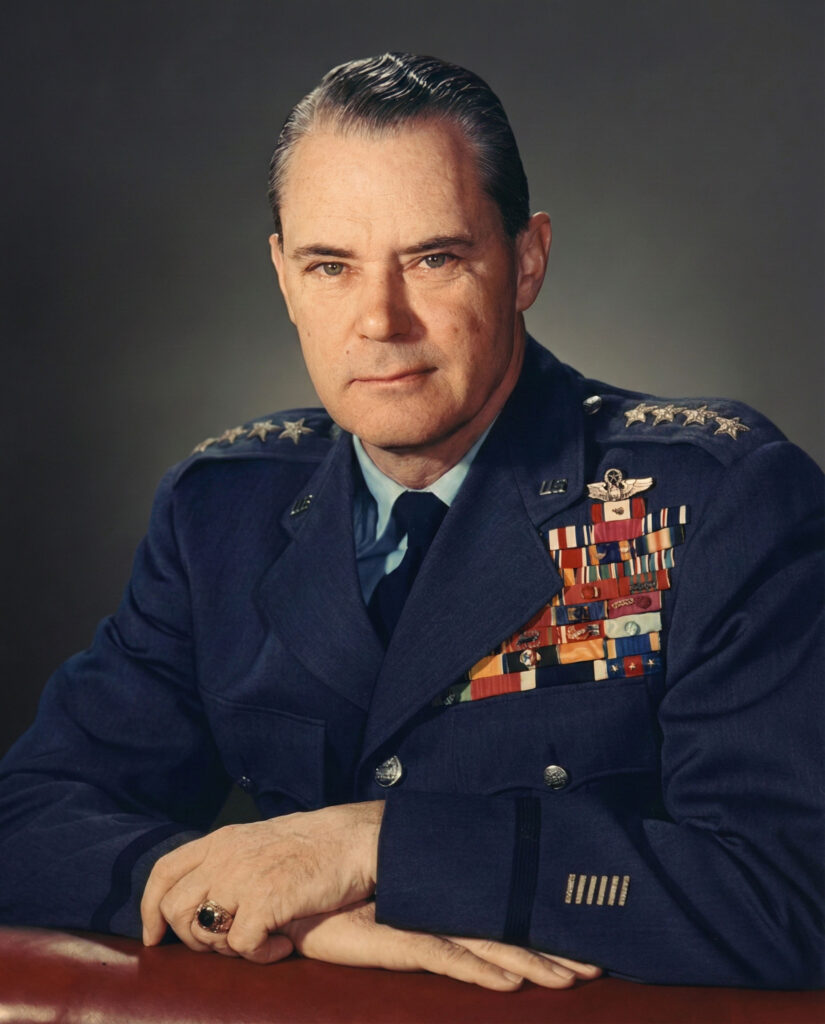
Early life, training, and rise through the Air Arm
Vandenberg was born in Milwaukee, Wisconsin, on January 24, 1899. He graduated from the U.S. Military Academy in 1923, trained as an Army Air Service pilot at Brooks and Kelly Fields, then cycled through operational and instructional posts that shaped him into a planner and a commander comfortable with both cockpit and staff.
His first unit command came at the 90th Attack Squadron, followed by a key tour in Hawaii with the 6th Pursuit Squadron. He then taught at the Air Corps Tactical School and completed the Command and General Staff School and the Army War College just as global tensions were hardening into a world war.
These details matter for UAP history because they produced a general who valued disciplined analysis and cross-branch coordination, the same skills he would later bring to bear on the early UAP problem. (Air Force)
World War II command experience
During the war, Vandenberg helped organize the air campaign in the Mediterranean, served as chief of staff of the Twelfth Air Force and of the Northwest African Strategic Air Force, and in August 1944 took command of the U.S. Ninth Air Force in Europe.
That command provided tactical air support across France and into Germany, giving him direct experience synchronizing intelligence, operations, and technology in dynamic conditions. For this work he received multiple decorations and a reputation as an exacting, modern air commander.
The way the Ninth Air Force integrated radar, observation, and rapid decision-making would echo later in how the Air Force framed and centralized UAP reporting. (Air Force)
Architect of modern U.S. intelligence
Second Director of Central Intelligence (1946–1947)
After the war, Vandenberg became Director of Central Intelligence when the Central Intelligence Group (CIG) was still evolving toward the CIA.
Under his tenure the CIG secured its own budget and personnel authority, assumed responsibility for collecting foreign intelligence across the government, and coordinated interdepartmental intelligence activities.
Those reforms crystallized a community approach that, for better or worse, later shaped how UAP cases were triaged between the services and the intelligence agencies.
Chief of Staff of the U.S. Air Force (1948–1953)
With the independent U.S. Air Force formed in 1947, Vandenberg became Vice Chief that October and then Chief of Staff in April 1948. His tour spanned the Berlin Crisis aftermath, the Korean War, and an arms race that prioritized strategic warning and air defense.
The Air Force’s policy approach to aerial anomalies matured during these same years, as institutional energy moved from ad hoc case files to named projects with mission statements, reporting rules, and public-affairs guidance. (Air Force)
Vandenberg and the birth of official UAP inquiry
From Project SAUCER/SIGN to GRUDGE and BLUE BOOK
A Department of Defense historical review in 2024 laid out the early government lineage of UAP inquiries. It described a loose “Project SAUCER” evolving into the formal Project SIGN in January 1948 at the Air Technical Intelligence Center.
SIGN reviewed 243 cases and in early 1949 concluded that while many reports were misinterpretations, a small remainder lacked an ordinary explanation, and it kept extraterrestrial possibilities on the table.
Crucially for Vandenberg’s biography, that review also recounted the oft-told story that a late-1948 “Estimate of the Situation,” arguing some UAP were interplanetary, was forwarded up the military chain and was rejected by the Chief of Staff, General Hoyt S. Vandenberg, as lacking proof.
The account flagged this “Estimate” as unsubstantiated in the surviving record, yet it repeated the central point: the Air Force Chief was not persuaded by the evidence presented at the time.
Following SIGN, the Air Force rebranded the effort as Project GRUDGE in 1949. GRUDGE recommended de-emphasizing the topic publicly to reduce “war hysteria,” but reporting and analysis continued inside the Air Force.
The next substantive reorganization came with the revival of GRUDGE under Capt. Edward Ruppelt in late 1951, which in 1952 became Project BLUE BOOK. Over 1947–1969 BLUE BOOK cataloged 12,618 cases, with 701 officially listed as “unidentified.”
These numbers anchor the quantitative backbone of the era and show that Vandenberg’s years coincided with the period when the Air Force moved from scattered files to professionalized case handling.
The 1952 Washington “flap” and the press-policy inflection
In July 1952, while Vandenberg was Chief of Staff, radar and visual sightings over the nation’s capital produced a political and public communications crisis.
The Pentagon convened what became the largest Air Force press conference since World War II, led by Director of Intelligence Maj. Gen. John Samford, who emphasized that the Air Force had found no threat to national security and that many radar returns were consistent with temperature inversions.
The transcript and film of Samford’s statements remain key primary sources for the government’s public stance during Vandenberg’s tenure. The incident also catalyzed a CIA-sponsored scientific review known as the Robertson Panel in early 1953, whose recommendations included improved data vetting and media handling.
Vandenberg’s fingerprints do not appear on the transcripts, yet the event unfolded within a service culture and leadership team he steered. (Wikimedia Commons)
Reporting rules and institutional posture
Across these years, U.S. Air Force policy on “unidentified flying objects” hardened into standardized reporting and triage.
The Air Force’s later public fact sheets summarize that across 22 years of official study the service found no evidence of a national security threat from the unidentified subset, and no confirmed signs of technology beyond contemporary scientific knowledge.
Although those statements were drafted after Vandenberg retired, they describe an institutional through-line that began during his stewardship and that shaped how later generations encountered early case files. (Air Force)
The “Estimate of the Situation” and Vandenberg’s judgment
No document has had a longer afterlife in ufology than the rumored 1948 “Estimate of the Situation.” The basic story holds that analysts in Project SIGN assembled a case that some UAP were “interplanetary” and that the paper went up the chain to the Chief of Staff.
According to multiple retellings, Vandenberg rejected the Estimate for insufficient proof. A 2024 Department of Defense historical review summarized this tradition, flagged the Estimate’s documentary status as unsubstantiated, and nonetheless recorded the core memory within the Air Force: the Chief of Staff was not convinced by the evidence.
For historians of UAP, that single sentence fixes Vandenberg at the hinge of early institutional skepticism.
It is fair to say there is no verifiable copy of the Estimate today, yet the narrative has shaped interpretations of the entire 1947–49 period.
Ruppelt’s later book, based on his experience leading BLUE BOOK, also recounts tensions between field investigators who sometimes favored extraordinary hypotheses and senior leadership who demanded robust, shareable proof.
Whatever the precise fate of the Estimate, Vandenberg’s stance, as remembered by those who worked the problem, reinforced a high evidentiary bar and a preference for measured public messaging. That posture influenced the culture of GRUDGE and BLUE BOOK that followed. (Project Gutenberg)
Majestic 12 and Vandenberg’s posthumous entanglement
What the MJ-12 papers claim
Beginning in the mid-1980s, a set of anonymously circulated papers asserted that President Truman had created a secret oversight group, “Majestic 12,” in 1947 to manage crash recoveries and exploitation of non-human technology.
The so-called Eisenhower Briefing Document lists twelve members said to include Hoyt S. Vandenberg. In 1985, researchers also publicized a “Cutler to Twining” memo referencing “MJ-12,” and later documents, such as the alleged “Interplanetary Phenomenon Unit” report, placed Vandenberg in briefings connected to 1947 events.
These texts would recast Vandenberg from a demanding skeptic into a central insider tasked with coordinating a clandestine program. (Majestic Documents)
What the archives and agencies say
The FBI reviewed MJ-12 materials in 1988 and reported that an Air Force inquiry had determined the documents to be fake.
The National Archives built a dedicated reference page in which archivists recorded extensive negative searches for “MJ-12” across the Eisenhower and Truman holdings, enumerated anomalies in the “Cutler/Twining” memo’s format and timing, and noted that Cutler was overseas on the day the memo was supposedly written.
A 1995 GAO letter to Congress summarized interagency views: there were no executive-branch records supporting the MJ-12 materials, and agencies advised they should not be treated as documents that had ever been properly classified by the government. That is the official posture. (FBI)
Why the controversy persists
Proponents point to stylistic details, cross-document echoes, and the early timing of some releases.
Detractors stress the historical and documentary problems archived by NARA and the FBI. Vandenberg’s presence on the alleged membership list is a major reason the controversy endures in ufology, since his real-world roles in intelligence and Air Force leadership would have made him an obvious choice for such an inner circle if it existed.
The result is a peculiar biographical afterimage. In the authenticated record, Vandenberg appears as a proceduralist insisting on proof. In the MJ-12 corpus, he appears as a custodian of a secret. The weight of public documentation favors the former picture, yet the latter continues to animate debate, precisely because it draws on a plausible casting of the man. (National Archives)
Claims he made, and claims made about him
Direct statements from Vandenberg on UAP
There is no documented, on-the-record public statement by Vandenberg endorsing extraordinary hypotheses about UAP. His connection to the topic in the official record is through institutional decisions and the chain of command.
The 2024 historical review attributes the rejection of the rumored 1948 Estimate to him, noting a lack of proof. That is more a procedural decision than a public “claim.”
At the height of the 1952 wave, it was his Director of Intelligence who spoke to the press, underlining that unidentified reports did not imply a threat and could often be explained by ordinary effects like inversions.
Vandenberg left behind no press conference of his own about UAP, and his official biographies contain no quoted belief statements on the subject.
Claims about Vandenberg’s role
Two important claims about Vandenberg circulate widely.
First, that he “ordered all copies” of the 1948 Estimate destroyed. The surviving record does not verify destruction orders, although Ruppelt and others described a climate in which the Estimate did not survive, and AARO cautions that the Estimate itself remains unconfirmed in the archives.
Second, he was a member of MJ-12. The FBI, NARA, and GAO material above shows why the government treats the MJ-12 papers as non-authentic. These clarifications do not settle the debate for everyone, but they set the evidentiary baseline. (Project Gutenberg)
Influence and impact on ufology
Setting the evidentiary threshold
Because Vandenberg was cited as the senior who rejected an interplanetary Estimate, he has become emblematic of an evidentiary line in early UAP analysis.
His approach arguably preserved analytic discipline during a period of public excitement. It also encouraged later critics to view the Air Force’s early programs as culturally biased toward dismissing extraordinary interpretations.
The 1952 communications pivot
The Washington radar-visual incidents forced the Air Force to balance transparency and reassurance.
The Samford press conference set a template for public responses that persisted through the 1960s: acknowledge an unexplained residue, emphasize conventional explanations where available, assert no threat to national security, and underscore that the Air Force would continue to investigate.
That posture influenced not only public opinion but also how future researchers read BLUE BOOK files. Vandenberg’s leadership context frames this pivot in communications policy, which remains part of his indirect impact on the field. (Wikimedia Commons)
MJ-12 and the magnetism of plausible casting
Vandenberg’s insertion into MJ-12 lists gave those papers a seductive plausibility, precisely because his résumé fits the role the documents imagine.
As a result, his name still anchors many discussions about U.S. crash retrieval and reverse-engineering claims.
Even researchers who doubt the documents’ authenticity often use “Would Vandenberg have been on such a committee?” as a thought experiment for how a real oversight group might have looked. That persistent gravitational field around his name is itself an impact on ufology. (Majestic Documents)
Other legacies, and why they matter to the UAP story
Vandenberg’s biography is not coterminous with UAP, and the broader picture informs how we read his actions. He helped build the modern intelligence community in 1946–47 and led the Air Force through a transformation that included nuclear posture, continental defense, and the institutionalization of scientific advising.
The California missile and space base at Camp Cooke was renamed for him in 1958, and in 2021 it was redesignated Vandenberg Space Force Base, a symbolic connection between his legacy and space-domain operations that now host many of the sensors relevant to modern UAP detection.
His and his wife Gladys’s role in starting the Arlington Ladies tradition reflects a leadership ethos attentive to institutional dignity and public trust. Those threads, taken together, complicate any simplistic portrait of him as either a “debunker” or a “keeper of secrets.” (Vandenberg Space Force Base)
Controversies and contested interpretations
- The “Estimate of the Situation.”
The claim that Vandenberg rejected an interplanetary Estimate is widely repeated. The AARO report treats the Estimate as a single-source, unverified historical account, yet it records the tradition that Vandenberg turned it back for insufficient proof. For historians, the episode illuminates how institutional memory can outlive documents and shape a field’s mythology. - The MJ-12 corpus.
The strongest arguments for authenticity are internal stylistic cues and the “plausible cast” of signatories, including Vandenberg. The strongest arguments against are documentary anomalies, archival negatives, and agency judgments recorded by NARA, the FBI, and the GAO. Vandenberg’s presence in the alleged membership is thus a Rorschach test. Believers view him as the natural choice for a crash-retrieval committee. Skeptics cite the lack of provenance and the official determinations. Any balanced biography should present both aspects, while noting where the public record currently stands. (National Archives) - Public messaging in 1952.
Some researchers argue that the Samford press conference sanded down anomalies too quickly. Others note that BLUE BOOK left hundreds of cases unidentified and that data quality, not dismissal, was the limiting factor. In either reading, the event under Vandenberg’s watch helped codify how the Air Force would speak about UAP, and how the public would expect the government to speak. (Wikimedia Commons)
Assessment
From a UAPedia perspective, Vandenberg is best understood as a builder and a gatekeeper.
As DCI he built mechanisms for centralized collection and analysis. As Air Force Chief he presided over the professionalization of UAP handling, where analytical rigor and public communications became policy matters rather than curiosities. He appears in the AARO historical survey as the senior officer who was unwilling to endorse extraordinary conclusions without extraordinary evidence.
That decision point still reverberates in the community’s memory. Simultaneously, his posthumous appearance in MJ-12 lists keeps him at the center of a parallel, highly charged narrative in which the government did recover craft and bodies, then placed oversight in the hands of men exactly like him.
Vandenberg died on April 2, 1954, after retiring the previous year. The Air Force named its West Coast missile and space base in his honor in 1958, and in May 2021 it was redesignated Vandenberg Space Force Base, which keeps his name attached to the frontier where modern sensor systems, space operations, and UAP detection increasingly meet. His complex legacy, both documented and disputed, has made him one of the defining personalities in the origin story of U.S. UAP study. (Air Force)
References
All-domain Anomaly Resolution Office. (2024, February). Report on the Historical Record of U.S. Government Involvement with Unidentified Anomalous Phenomena (UAP), Volume I. U.S. Department of Defense. https://media.defense.gov/2024/Mar/08/2003409233/-1/-1/0/DOPSR-CLEARED-508-COMPLIANT-HRRV1-08-MAR-2024-FINAL.PDF
Central Intelligence Agency. (n.d.). Directors of Central Intelligence, 1946–2005. Center for the Study of Intelligence. https://www.cia.gov/resources/csi/static/directors-of-central-intel.pdf
Federal Bureau of Investigation. (n.d.). Majestic 12. FBI Vault. https://vault.fbi.gov/Majestic%2012 (FBI)
National Archives and Records Administration. (2024, June 25). Project BLUE BOOK – Unidentified Flying Objects [including “Majestic 12” reference report]. https://www.archives.gov/research/military/air-force/ufos (National Archives)
National Archives and Records Administration. (2018, February 9). Do records show proof of UFOs? https://www.archives.gov/news/articles/do-records-show-proof-of-ufos (National Archives)
Ruppelt, E. J. (1956). The report on unidentified flying objects. (Public domain text edition). Project Gutenberg. https://www.gutenberg.org/ebooks/17346 (Project Gutenberg)
Samford, J. A. (1952, July 29). Minutes of press conference held by Major General John A. Samford, Director of Intelligence, U.S. Air Force. Department of Defense transcript. https://upload.wikimedia.org/wikipedia/commons/7/78/General_Samford_Press_Conference%2C_July_29%2C_1952.pdf (Wikimedia Commons)
U.S. Air Force. (n.d.). General Hoyt S. Vandenberg [official biography]. https://www.af.mil/About-Us/Biographies/Display/Article/105311/general-hoyt-s-vandenberg/ (Air Force)
U.S. Air Force. (n.d.). Unidentified Flying Objects and Air Force Project Blue Book. Fact Sheet 95-03. https://www.af.mil/About-Us/Fact-Sheets/Display/Article/104590/unidentified-flying-objects-and-air-force-project-blue-book/ (Air Force)
U.S. Government Accountability Office. (1995, July 11). Comments on Majestic 12 material [Letter to Rep. Steven Schiff]. https://www.gao.gov/assets/154832.pdf (Government Accountability Office)
Vandenberg Space Force Base Public Affairs. (2021, May 14). Vandenberg AFB gets new U.S. Space Force name. https://www.vandenberg.spaceforce.mil/News/Article-Display/Article/2607448/vandenberg-afb-gets-new-us-space-force-name/ (Vandenberg Space Force Base)
Arlington National Cemetery. (n.d.). Arlington Ladies. https://www.arlingtoncemetery.mil/Funerals/Funeral-Information/Arlington-Ladies (Arlington National Cemetery)
NICAP. (1947, September 23). Lt. Gen. Nathan F. Twining’s memo on “flying discs” [PDF reproduction]. https://www.nicap.org/docs/470923.pdf (NICAP)
Majestic Documents Project. (1952/1984). Eisenhower Briefing Document: Operation Majestic-12 [PDF reproduction]. https://majesticdocuments.com/pdf/eisenhower_briefing.pdf (Majestic Documents)
Majestic Documents Project. (undated/1980s). Interplanetary Phenomenon Unit Report [PDF reproduction]. https://majesticdocuments.com/pdf/ipu_report.pdf (Majestic Documents)
Note on contested sources. MJ-12 related PDFs are cited above to document what the texts claim about Vandenberg’s role. Official positions from the FBI, NARA, and GAO are also cited to show why U.S. agencies do not accept those documents as authentic. Readers should weigh these pairs together.
SEO keywords
Hoyt S. Vandenberg biography, Majestic 12 Vandenberg, Vandenberg UAP history, Project SIGN Estimate of the Situation, 1952 Washington radar visual incidents, Project GRUDGE, Project BLUE BOOK statistics, Cutler Twining memo analysis, AARO Historical Record Report, Vandenberg Space Force Base history.