
Time window: 1896-11 to 1897-05 (peak clusters: Northern California in late 1896; Great Plains/Midwest and Texas in spring 1897).
Geographic footprint: West Coast → Great Plains/Midwest → Texas (plus scattered reports elsewhere).
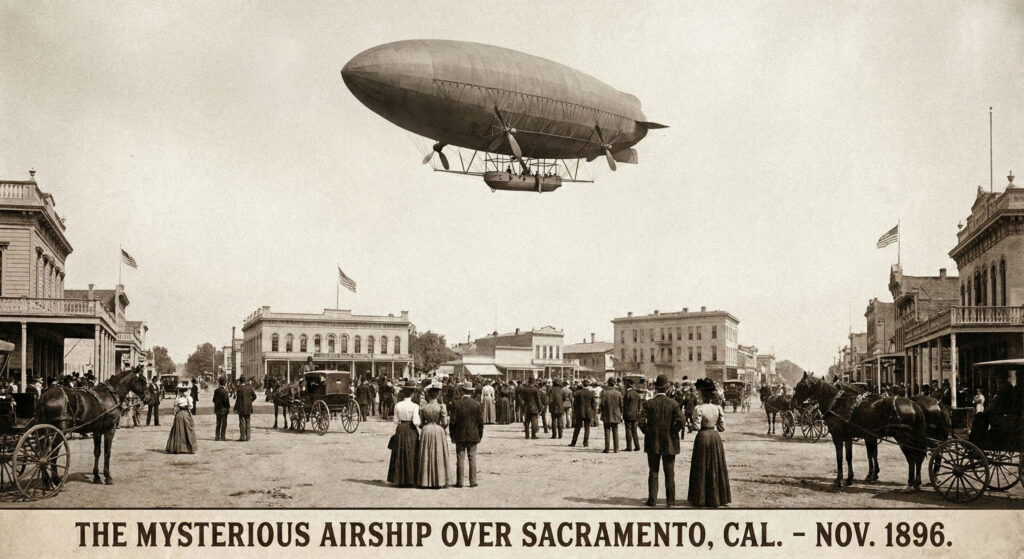
What people reported: a bright “headlight” or multiple lights; sometimes a structured “cigar-shaped” craft with propellers/wings; rarer “occupant” encounters; a few “crash/debris” narratives.
Scale (contemporary & historical summaries): “thousands” of claims during the wave; later historians suggest the witness count may have been extremely large, potentially >100,000 (an estimate attributed to historian Mike Dash via secondary reporting).
Dossier rules and labels
Because the airship wave sits at the intersection of newspaper sensationalism, pre-aviation technological optimism, and folklore-in-the-making, this dossier uses explicit labels.
Evidence Grade (EG)
- EG-A: Primary source exists and is directly viewable (digitized newspaper page, archival scan).
- EG-B: Primary source is cited/quoted in a reputable secondary source (history journal, state historical agency), but the original is not directly included here.
- EG-C: Secondary retellings dominate (later books/articles summarize, but primary is thin or inconsistent).
- EG-D: Folklore/legend status; strong indications of fabrication or deliberate hoax.
Speculation Label (SL)
- SL-0 (Minimal): Straight description of records and reporting patterns.
- SL-1 (Low): Conventional explanations (mis-ID, balloons/kites/lanterns, astronomical).
- SL-2 (Medium): Socio-media dynamics and hoax ecology (boosterism, prank networks, “journalistic invention”).
- SL-3 (High): Non-human intelligence / extraterrestrial interpretations.
Data snapshot
This wave behaves like a classic multi-peak “flap”:
Phase pattern
| Phase | Date band | Reporting center | Typical description | Notes |
|---|---|---|---|---|
| California ignition | Nov–Dec 1896 | Bay Area & Central Valley | bright moving light; “airship” rumors; occasional structure | Hundreds of witnesses reported an “airship” in the Bay Area press environment. |
| Great Plains / Midwest expansion | Feb–May 1897 | Nebraska → region-wide | lights; structured craft; occasional occupants | Newspaper discourse becomes contagious across state lines. |
| Texas spike | Apr 13–17, 1897 | North Central Texas | repeated “airship” sightings | Texas Almanac tally: 38 reports in 23 counties in this short window. |
Why the Texas number matters
A five-day window with dozens of county-level reports is the kind of burst statistic that’s hard to explain purely by a single physical craft moving through geography, unless you assume extraordinary logistics.
It is, however, highly compatible with information spread (reprinting, local rivalry, copycat accounts), and with multiple small “light sources” (e.g., lantern-kites/balloons) generating local clusters. SL-2
Map: key localities and “corridors”
Below is a curated, non-exhaustive map set of frequently cited nodes in the 1896–97 wave (California ignition; Nebraska trigger; Kansas/Texas/Upper Midwest echoes). These points are intended for visualization and cross-referencing—not as a complete census.
Quick-view map table (sample nodes)
| Node | State | Why it’s here |
|---|---|---|
| Sacramento | CA | Early ignition reports; iconic illustration in later retellings |
| San Francisco | CA | major press amplification; repeated Bay Area reports |
| Oakland | CA | Bay Area cluster |
| Tulare | CA | Mass-witness light reports in late 1896 |
| Hastings | NE | Early 1897 Great Plains trigger reporting |
| Inavale | NE | Detailed Nebraska “airship” description in secondary quoting |
| York | NE | Nebraska continuity reports (as discussed in NE history material) |
| Le Roy | KS | Famous “cattle lifting” narrative attributed to Alexander Hamilton |
| Aurora | TX | Famous “crash” story widely treated as hoax/boosterism |
| Weatherford / region | TX | Texas “invasion” sketch tradition and clustered reports |
| Barnesville | MN | Upper Midwest example of 1897 reporting |
Witness register
This section treats “witness” as a media role: the person named, the authority implied, and the narrative function.
Witness Type taxonomy (people-as-evidence)
- Civic authority witnesses (mayor’s staff, deputies, attorneys): high persuasive value in newspapers.
- Rural witnesses (farmers, ranch hands): often attached to “landing/interaction” tales.
- Professional witnesses (doctors, lawyers): used to lend seriousness to extraordinary accounts.
- Crowd witnesses (“hundreds,” “thousands”): strongest as social proof, weakest in detail quality.
Named witnesses frequently repeated in the literature
Caution: many names persist because they were printable and memorable, not because they were thoroughly investigated.
- R. L. Lowery (Sacramento area reports; voice-from-craft claim appears in later summaries). EG-B / SL-0
- George D. Collins (San Francisco attorney linked to “secret inventor near Oroville” narrative). EG-C / SL-0
- Alexander Hamilton (Le Roy, Kansas; cattle-pen “lifting” story widely repeated). EG-C / SL-0 (ThriftBooks)
- S. E. Haydon (Aurora, Texas story author; modern historical agency frames it as fictional booster-story). EG-B→D / SL-0
Case Capsules
A wave is not one event. Below are representative claim-shapes that recur.
Capsule 1 – The Bay Area ignition (Nov 1896): press + uncertainty
- Location: San Francisco Bay Area (San Francisco/Oakland/Sacramento reporting sphere)
- Claim shape: bright aerial “light” becomes “airship,” then accumulates details (speed, structure, intent).
- Data anchor: KQED describes the Bay Area being “excited and united” by repeated airship sightings with “hundreds of witnesses.” EG-B / SL-0
- Primary-page evidence: The San Francisco Call (Nov 28, 1896) carries a front-page storyline framing an “aerial exhibition” and “mystery” around an airship narrative. EG-A / SL-0
What’s notable (SL-1): in a period where practical powered flight was not yet a normal lived reality, a bright moving light could be interpreted through multiple lenses: astronomy, prank devices, secret inventors, or “visitors.” The press frequently picked the most narratively productive one.
Capsule 2 – Nebraska trigger (Feb 1897): the “airship” jumps regions
- Location: Hastings / Inavale, Nebraska
- Claim shape: multiple sightings, observers described as respectable; the account becomes a “watch for reappearance” story.
- Source support: Nebraska history publication quotes Omaha Daily Bee reporting that the ship was seen at Inavale and mentions a “pious party…returning from a prayer meeting.” EG-B / SL-0
- Primary container record: the Omaha Daily Bee issue (Feb 6, 1897) is cataloged and viewable via the Library of Congress newspaper interface. EG-A (as artifact) / SL-0
Investigator’s note (SL-2): Nebraska is a perfect “wave amplifier” setting, high visibility skies, close communities, and newspapers eager to localize a national curiosity.
Capsule 3 – Texas spike (Apr 13–17, 1897): density and “invasion” framing
- Location: North Central Texas
- Claim shape: repeated reports across many counties in a tight window; the phenomenon is framed as a roaming craft or “fleet.”
- Data anchor: Texas Almanac reports 38 sightings in 23 counties between April 13 and 17, 1897, with multiple counties reporting multiple sightings. EG-B / SL-0
Interpretation (SL-1 to SL-2):
- SL-1: multiple misidentifications or local lantern/kite/balloon pranks could create real “lights in the sky” experiences.
- SL-2: once a community expects an airship, each ambiguous light becomes legible as “the airship,” and each paper has incentive to publish its own version.
Capsule 4 – Aurora, Texas “crash” narrative (Apr 1897): boosterism-as-UAP lore
- Location: Aurora, Wise County, Texas
- Claim shape: crash into a windmill; exotic pilot; burial story; “materials” claims.
- Modern historical framing: Texas State Historical Association explicitly describes the Aurora crash story as fictional “news” released by S. E. Haydon in the Dallas Morning News to revive interest in the town. EG-B / SL-0
- Status: Probable hoax / civic myth engine (EG-D), though later folklore layers persist.
Why it matters (SL-2): Aurora demonstrates a repeatable pattern in UAP history: a story can be born as publicity, then later reinterpreted as suppressed evidence, especially when the original media context is forgotten.
News Dossier
This is a starter index, focused on sources that are either primary-digitized or strongly curated by reputable institutions.
Primary newspaper artifacts (EG-A)
- The San Francisco Call – Nov 28, 1896 – OCR page (Library of Congress / Chronicling America) (front-page framing of the “mystery” airship).
- Omaha Daily Bee – Feb 6, 1897 – Library of Congress issue record (use page navigation to reach the relevant page).
Curated secondary sources quoting newspapers (EG-B)
- Nebraska History publication quoting Omaha Daily Bee language about Inavale and the “prayer meeting” group.
- Texas State Historical Association on Aurora: frames the Dallas Morning News item as an intentional fictional story.
- Grand Forks Herald (Vault feature) on a Minnesota “air ship” case; includes framing via Mike Dash’s work and an illustration attribution to the St. Paul Globe.
Contextual interpretive journalism (modern)
- KQED (Bay Area 1896 wave overview and cultural context).
- JSTOR Daily (historical framing: phantom flying machines; links the episode to hoaxes and press dynamics; references Whalen & Bartholomew).
Books & scholarship dossier
Below are commonly referenced works that shape modern interpretation of the 1896–97 wave.
Academic / critical takes (press dynamics, social contagion)
- Robert E. Bartholomew, “The Airship Hysteria of 1896–97” (Skeptical Inquirer; also available as PDF through CFI). Frames the wave as a social phenomenon; emphasizes “thousands” of claims and the role of the press.
- Whalen & Bartholomew are discussed in modern summaries for how belief can cascade via media (see JSTOR Daily overview).
UAP-history framing
- The airship wave as a predecessor to modern UFO culture is widely noted in UAP reference writing and summaries.
- Mike Dash’s historical writing is often used for macro-scale estimates and narrative synthesis (as referenced in secondary reporting).
Regional quantification
- Texas Almanac provides a rare compact numeric summary for the Texas spike (38 sightings, 23 counties, Apr 13–17).
Implications
It’s an early template for modern “flap mechanics”
The wave shows the familiar rhythm: initial ambiguous stimulus → authoritative repetition → narrative elaboration → geographic spread → peak → decay. That’s a structural cousin of many 20th/21st century UAP waves—even when the underlying causes differ.
It demonstrates how “technology expectation” shapes perception
In 1896, powered flight was imaginable but not routine. The “airship” was the perfect container for mystery: plausible enough to print, futuristic enough to thrill. Today’s equivalent containers might be “drones,” “black projects,” or “non-human tech.”
It offers a cautionary lesson for crash narratives
Aurora illustrates a key methodological hazard: a compelling crash story can be culturally true (important locally) while historically false (fabricated as news). Modern investigators should treat “crash + body + burial” story-shapes as high-risk until primary documentation is strong.
It suggests that “counting reports” is not the same as “counting events”
Texas Almanac’s county-by-county spike is valuable precisely because it is countable. But counts are not neutral: they measure reporting, not necessarily occurrence. A data-first approach should always model the media layer as part of the phenomenon.
Conclusion
The wave is real as a reporting event: newspapers across regions carried “airship” items and the topic propagated. EG-A overall (as a media artifact).
The most common claim-type is light-only (low information, high ambiguity), which is consistent with misidentification and/or small local hoaxes. SL-1 favored for many cases.
At least some famous high-drama stories are strongly implicated as fiction/boosterism, with Aurora the standout example in modern historical framing. EG-D for the crash-as-fact claim.
The Texas spike is one of the best “quantified sub-waves” and deserves dedicated dataset work (county-level mapping, newspaper provenance, duplication analysis).
Claims taxonomy
To analyze a wave, you need a consistent way to label claims. Here’s a taxonomy tailored to the airship era.
Axis A — Phenomenology (what was perceived)
- A1: Light-only (single bright light; sometimes multiple).
- A2: Structured silhouette (“cigar shape,” “conical,” “winged”).
- A3: Navigation-light array (colored lights “along the side”).
- A4: Audible craft (engine/propeller sounds reported).
- A5: Close-range craft (near-ground hover/landing narrative).
Axis B — Interaction (did the story include contact?)
- B0: No interaction (pure sighting).
- B1: Voices heard (commands, conversation).
- B2: Communication (pilot speaks; “destination” claims).
- B3: Coercion/medical aid (doctor summoned; abduction-like elements).
Axis C — Aftermath (did anything remain?)
- C0: No trace
- C1: Physical trace claimed (marks, dropped parts)
- C2: Debris / crash narrative
- C3: Burial / body narrative (highest folklore risk)
Axis D — Narrative “attribution hook” (what the story says it was)
- D1: Secret inventor / private airship
- D2: Military / spy / war destination
- D3: Hoax/prank/booster story
- D4: Otherworldly / Mars / non-human
Why this taxonomy helps: It separates what was seen from what it was said to mean. In 1896–97 those two layers often diverge quickly once a newspaper frame (“airship!”) takes hold.
Hypotheses board
H1 – Misidentification of lights and sky objects (SL-1)
Claim: A meaningful fraction of reports were bright celestial objects, meteors, or ordinary lights interpreted through “airship expectation.”
Pros: Fits the dominance of nighttime light-only reports and the era’s limited aviation reality.
Cons: Does not fully explain detailed structured craft narratives unless those are embellished or hoaxed.
H2 – Lantern-kites, balloons, and local pranks (SL-1)
Claim: Some communities created the phenomenon physically (small airborne lights), then newspapers created it culturally.
Pros: Explains localized spikes and “repeat appearances” without requiring long-range flight tech.
Cons: Not every report can be neatly reduced, and prank evidence is unevenly documented.
H3 – Press contagion + journalistic invention (SL-2)
Claim: The wave is primarily an information event: reprints, rivals, sensational copy, and occasional outright fabricated “interviews” with pilots.
Pros: Strongly consistent with the era’s sensational press environment and the wave-like spread across states. Bartholomew’s framing emphasizes the social mechanics of mass belief.
Cons: Hard to prove case-by-case without deep local archival work; some witnesses likely did see something unusual (even if mundane).
H4 – Prototype airship(s) ahead of public aviation (SL-2)
Claim: An inventor (or multiple inventors) flew experimental craft secretly.
Pros: Period imagination strongly favored this explanation; many reports explicitly invoke it.
Cons: Long-distance, repeated multi-state flights are hard to square with what is known about practical aviation capability and secrecy constraints of the era (a point often raised by historians and skeptics).
H5 – Non-human technology (SL-3)
Claim: Some craft were not human-made (the “Mars/otherworld” variants).
Pros: Explains the “occupant” and “exotic” motifs if one accepts them at face value.
Cons: The Aurora case, one of the most famous “crash” narratives—has strong modern historical framing as deliberate fiction, highlighting how quickly extraordinary motifs can be manufactured.
References
Library of Congress. (1896, November 28). San Francisco Call [Newspaper page]. Chronicling America: Historic American Newspapers.
https://chroniclingamerica.loc.gov/lccn/sn85066387/1896-11-28/ed-1/seq-1/
KQED News. (2017, November 22). The mysterious airship sightings that swept the Bay Area in 1896.
https://www.kqed.org/news/10943690/the-mysterious-airship-sightings-that-swept-the-bay-area-in-1896
Bartholomew, R. E. (1998). The airship hysteria of 1896–97 [PDF]. Committee for Skeptical Inquiry.
https://cdn.centerforinquiry.org/wp-content/uploads/sites/29/1998/07/22164841/p15.pdf
Bartholomew, R. E. (1998). The airship hysteria of 1896–97. Skeptical Inquirer, 22(4).
https://skepticalinquirer.org/1998/07/the_airship_hysteria_of_1896_97/
Nebraska State Historical Society. (1997). The airship mystery [PDF]. Nebraska History.
https://history.nebraska.gov/wp-content/uploads/2020/04/NH1997Airship.pdf
Texas State Historical Association. (n.d.). Aurora UFO incident. Handbook of Texas Online.
https://www.tshaonline.org/handbook/entries/aurora-ufo-incident
Texas Almanac. (n.d.). The 1897 Texas airship mystery.
https://www.texasalmanac.com/articles/the-1897-texas-airship-mysteryLibrary of Congress / Chronicling America OCR page
SEO keywords
American Airship Wave, Mystery Airship 1896, Phantom Airship 1897, Airship flap, 19th century UAP, Historical UFO waves, Aurora Texas airship, Dallas Morning News 1897, Nebraska airship sightings, San Francisco Call airship, UAP taxonomy, Mass media contagion, Fortean history, Pre-Wright Brothers aviation myths