For decades, fragments tied to UAP encounters have circulated through a messy ecosystem of private collectors, journalists, laboratories, defense contractors, and occasional government touchpoints. The central claim is simple and profound: some fragments might be engineered substances whose microstructure, functional behavior, or isotopic “fingerprints” fall outside normal terrestrial manufacturing.
If that claim is ever established at high confidence, it changes the UAP question from “What did witnesses see?” to “What device shed this material, and what does it do?” That is the difference between folklore and forensic engineering.
But materials cases also have a brutal weakness: they are easy to contaminate, easy to misattribute, and easy to over-interpret. A layer stack that looks “manufactured” under a microscope may still be terrestrial. A “mystery alloy” identified by handheld XRF may simply be surface transfer from drilling tools, handling, or corrosion. A dramatic lab clip on television can be an instrument artifact.
So UAPedia’s approach is deliberately courtroom-like: weigh testimony and provenance honestly, but elevate what survives strict chain-of-custody and replicable measurement.
What “metamaterial” means in an aerospace context
A metamaterial is not defined by chemistry alone. In materials science, a metamaterial is defined by engineered microstructure that produces emergent properties. Think stacked or patterned layers at micron or sub-micron scales that manipulate electromagnetic waves, heat flow, acoustic vibration, or mechanical stiffness in ways bulk alloys cannot.
In the UAP materials discussion, “metamaterial” is used in at least three overlapping ways:
- Electromagnetic metamaterial: Layered or patterned stacks that steer, confine, or reshape fields. Example claims include alternating layers of magnesium alloy and bismuth conceived as a terahertz waveguide. (To The Stars*)
- Structural or thermally functional metamaterial: Architected matter that is unusually light, rigid, or thermally directional (heat-channeling) beyond common composites.
- Isotope-flagged material: Material alleged to show anomalous isotopic ratios that would be hard to produce accidentally, and expensive to fake at scale.
Modern UAP materials work, including the Nolan–Vallée methods paper, effectively treats isotopes plus microstructure as the decisive combination. (ScienceDirect)
The state of the field: methods are converging even when interpretations diverge
A key shift in the last few years is that serious teams increasingly agree on how unusual materials must be tested, even when they disagree on what the results mean.
The Nolan–Vallée aerospace forensics playbook
Nolan, Vallée and colleagues published a methods roadmap for unusual materials analysis in Progress in Aerospace Sciences (2022). It does not declare non-human origin. It lays out what a credible analysis pipeline looks like: SIMS/nanoSIMS for isotope mapping, multi-collector ICP-MS for high-precision bulk isotopes, TEM/EDS for phase and defect analysis, LA-ICP-MS mapping for trace elements, and rigorous controls and documentation. (ScienceDirect)
The crucial point is that a “metamaterial” claim is not settled by a single microscope image or an elemental list. It is settled by converging evidence across techniques, with custody and contamination controls good enough that another lab could reproduce the finding.
The ORNL/AARO layered-specimen result as a benchmark
In July 2024, the U.S. All-domain Anomaly Resolution Office published an ORNL-based synopsis of a famous layered magnesium specimen often discussed as a UAP “metamaterial.” ORNL’s methods included SEM-EDS, TEM, CT, LA-ICP-MS mapping and high-precision isotope measurements. The synopsis reports that magnesium and lead isotopes are consistent with terrestrial manufacture and use. (AARO)
AARO also published a supplement discussing the specimen’s microstructure, including bismuth co-located with nearly equal parts lead, and structural details that weigh against the specific “high-performance terahertz waveguide” framing for the tested specimen. (AARO)
This is not “trust the government.” It is “here is the most comprehensive public data package on the best-known UAP materials specimen, and it did not validate the non-terrestrial claim.” The implication for every other case family is clear: if the most famous sample can resolve to terrestrial under rigorous analysis, then every new sample must clear the same bar.
The dossier: principal case families and what the evidence shows
This section preserves the UAPedia dossier structure and expands it to incorporate the Skinwalker Ranch Season 6 (2025) mesa fragments.
Case Family A: Layered magnesium-zinc-bismuth pieces (“Art’s Parts” → TTSA ADAM)
A.1 Provenance and handling
The best-known layered sample entered public view in 1996 through anonymous letters and parcels sent to radio host Art Bell. The sender claimed a family link to a 1947 retrieval. The fragments later went to journalist Linda Moulton Howe, who publicized a stack with alternating dark bismuth and lighter magnesium-zinc alloy layers, from a few microns to hundreds of microns thick.
In 2019, To The Stars Academy (TTSA) promoted its ADAM materials program and highlighted a magnesium-zinc-bismuth sample “on loan,” explicitly stating that provenance could not be independently verified, while emphasizing micro-layering and a theoretical analysis suggesting terahertz waveguiding. (To The Stars*)
Also in 2019, a Cooperative Research and Development Agreement (CRADA) between the U.S. Army’s Ground Vehicle Systems Center and TTSA became public through reporting. The document lists a piece described as micron-layered bismuth magnesium zinc among the materials TTSA committed to provide for evaluation. (The War Zone)
A.2 What the lab work says in 2024
The 2024 ORNL synopsis (published by AARO) reports that magnesium and lead isotopes are consistent with terrestrial manufacture and use for the tested specimen. It also describes the specimen as primarily magnesium with a small zinc fraction, with minor lead and bismuth and trace iron and manganese. (AARO)
AARO’s supplement discusses microstructural details, including repeated banding and the bismuth/lead association, and evaluates the waveguide framing against observed structure. (AARO)
A.3 What this means for the larger UAP question
A terrestrial result for one famous specimen does not prove that no exotic fragments exist. It does mean that the most cited UAP “metamaterial” has not carried the non-human claim across the finish line in public data. Any future layered sample will need (at minimum) comparable isotope rigor and stronger provenance than a decades-long private chain.
Interim assessment (Case Family A):
- Verified: the Army-TTSA CRADA exists; ORNL/AARO published analyses. (The War Zone)
- Misidentification: the specific tested layered specimen is non-terrestrial. The public isotope results do not support that. (AARO)
Case Family B: The Ubatuba magnesium fragment and other historical magnesium samples
B.1 The story, and the evidentiary problem
The Ubatuba story describes an object exploding over the Brazilian coast in 1957 and fragments being passed to investigators. For decades, it hovered between legend and laboratory, with many secondary analyses and shifting claims about purity and origin.
Older cases like Ubatuba reveal a consistent pattern: extraordinary narratives often coexist with ordinary metallurgy, and decades-late testing often begins with custody already compromised. That does not make witnesses liars. It makes the physical claim hard to prove.
B.2 The 2022 isotopic reevaluation
In 2022, a team associated with CUFOS/SCU analyzed the Ubatuba fragment with modern high-resolution methods to examine isotope ratios of magnesium (primary element) and several trace elements. The key finding was that magnesium isotope ratios fell within terrestrial limits, with trace element isotope results not decisive. (Journal of Scientific Exploration)
B.3 Why “terrestrial magnesium” does not erase a UAP report
This is a recurring trap in the public discussion. If a UAP event is real, it does not follow that any recovered metal must be “impossible.” Advanced systems can shed ordinary materials, or the fragment may be unrelated debris mistakenly associated with the event.
The modern conclusion is narrower and more honest: the Ubatuba specimen tested in 2022 does not provide isotope-based evidence for non-terrestrial origin. (Journal of Scientific Exploration)
Interim assessment (Case Family B):
- Verified: a peer-reviewed 2022 isotopic analysis exists. (Journal of Scientific Exploration)
- Misidentification: “Ubatuba proves non-terrestrial isotopes.” It does not, based on published measurements. (Journal of Scientific Exploration)
Case Family C: “Slag-like” droplet and puddle residues from mid-century cases
C.1 The recurring motif: molten falls, spherules, puddles
Across the historical record, investigators repeatedly report molten metal “falls” that cool into puddles, droplets, and spherules. Jacques Vallée’s “ten cases” survey highlights how often these residues resolve into familiar elements. (Jacques Vallée)
A notable example is the Council Bluffs, Iowa event (1977), which produced residues characterized by Iowa State University as iron with small amounts of nickel and chromium, plus ash phases heavy in calcium. Vallée framed this as excluding meteoritic origin and resembling industrial slag. (Jacques Vallée)
C.2 The maddening implication
If such residues are connected to genuine UAP events, they demonstrate the possibility that a highly advanced system could expel material whose chemistry looks disarmingly ordinary once it hits the ground. That would be a claim about process, not about exotic elements.
But because these samples often enter collections with incomplete custody, the burden remains on investigators to prove linkage: contemporaneous documentation, environmental controls, and replicable lab work.
Interim assessment (Case Family C):
- Verified: Vallée’s published survey and the presence of mundane elemental profiles in multiple cases. (Jacques Vallée)
- Disputed: that these residues are propulsion byproducts of a non-human craft. The chemistry alone does not establish that. (Jacques Vallée)
Case Family D: Skinwalker Ranch mesa fragments (Season 6, 2025)
This is the major 2025 update prompted by The Secret of Skinwalker Ranch “last season,” which, as of December 2025, is Season 6 (premiered June 3, 2025). (HISTORY)
D.1 What was shown on screen
Season 6 presented fragments recovered from mesa drilling spoils and nearby areas, with emphasis on two classes: a patterned, porous “ceramic” shard and metal-bearing fragments. Episodes and clips describe “high-tech materials discovered deep in the mesa.” (HISTORY)
A widely circulated recap of Season 6 Episode 11 (“Hard to Handle”) describes an XRF scan that “reveals nickel, iron and cobalt,” followed by magnet tests framed as suggestive of unusual behavior, and discussion of interior composition consistent with oxygen, silicon, magnesium, potassium and aluminum. (25YL)
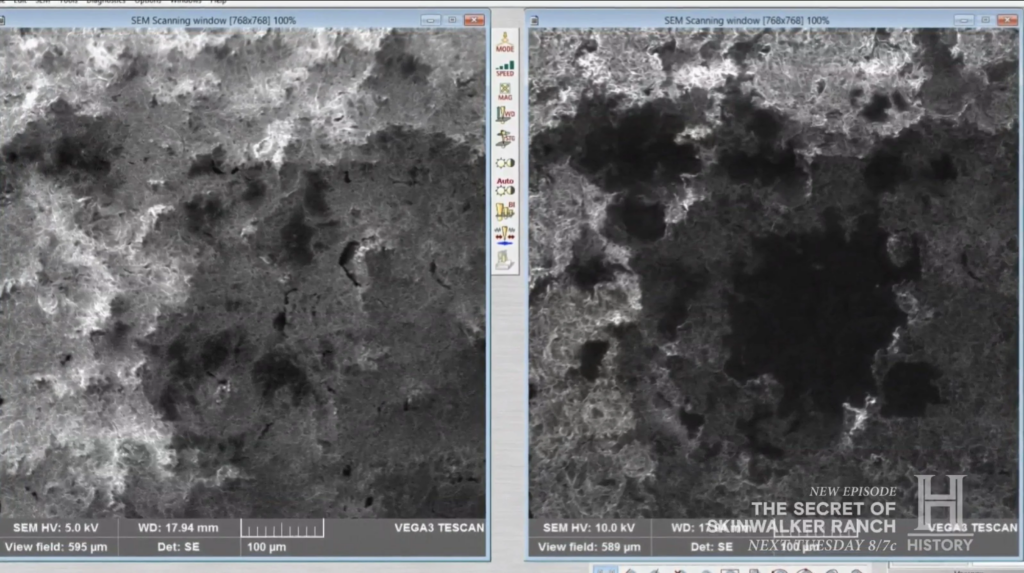
A Season 6 clip also focuses on SEM inspection of the ceramic shard at Utah Valley University, where the show frames a “self-healing” effect under SEM imaging. (youtube.com)
D.2 Why these results are interesting even before they are “exotic”
Even if every mesa fragment resolves to terrestrial origin, Season 6 adds something real to the UAP materials conversation: it shows what happens when a public-facing team tries to compress a decade of materials forensics into a television arc.
In materials science terms, what the show presented is a bundle of leads:
- A structured surface pattern that looks manufactured. (youtube.com)
- Surface XRF signals that suggest ferromagnetic components (Ni-Fe-Co). (25YL)
- A claimed “hole closes up” effect under an electron beam, interpreted as self-healing. (youtube.com)
- Magnet behavior described in language that drifts toward “superconductor-like” without presenting the measurements needed to establish that.
In UAPedia terms, this is exactly where the field must be most disciplined: the moment where “unusual” can become “otherworldly” by rhetorical acceleration.
D.3 The chain-of-custody problem, made explicit on screen
The show’s mesa finds face a serious forensic challenge: many fragments appear to be collected from drilling spoils. That is not a minor weakness. Spoils are post-disturbance materials: they have been mechanically fractured, rubbed against tools and casing, mixed with surface material, and exposed to modern contaminants.
Independent observers also highlighted a particularly damaging detail: a 1964 U.S. nickel reportedly appearing in drill spoils at depth, implying earlier human disturbance or backfill. Even if the coin itself is not central, the implication is that the mesa context may not be pristine. (25YL)
This does not disprove anything unusual in the mesa. It does mean that extraordinary provenance claims cannot be carried by spoils-pile finds alone.
D.4 The “self-healing ceramic” claim and likely instrument artifacts
The on-air SEM “self-healing” framing has a plausible mundane interpretation: charging effects in insulating ceramics can cause apparent changes in surface features between frames, especially if accelerating voltage, beam current, working distance, or imaging mode changes between shots.
A detailed technical critique notes that insulating specimens can accumulate charge under the electron beam; differences in scan parameters can make voids appear to grow or “heal.” It also notes that the patterned texture resembles common manufactured ceramic tile backing patterns. (Metabunk)
UAPedia’s stance here is strict and fair: the “self-healing” effect must be replicated under controlled SEM conditions, with full instrument metadata and raw image sequences, before it can be treated as evidence of a novel property.
D.5 Magnet behavior and the “superconductor” word
Hand-magnet attraction or repulsion in ambient conditions does not establish superconductivity. To claim superconductivity, investigators must demonstrate (at minimum) temperature-dependent susceptibility consistent with a superconducting transition, plus credible Meissner-effect behavior under controlled conditions.
What the show presented, as summarized by recaps, is consistent with magnetic material behavior in Ni-Fe-Co systems and with orientation effects. (25YL)
If the shard is truly exotic, there is a straightforward path: publish a full susceptibility vs temperature dataset and a four-probe transport measurement with stated thresholds. Until then, UAPedia treats “superconductor-like” as witness interpretation, not evidence.
Interim assessment (Case Family D):
- Probable: manufactured ceramic and alloy fragments exist in mesa spoils and warrant study. (youtube.com)
- Disputed: the “self-healing” effect and superconductor framing, given chain-of-custody weaknesses and instrument-artifact explanations. (Metabunk)
How the case families intertwine
A useful way to see the 2025 landscape is as three repeating tensions that recur across all families:
The “ordinary composition” paradox
Case Family A’s famous layered specimen is manufactured, but isotope-consistent with terrestrial origin in the published ORNL synopsis. (AARO)
Case Family B’s magnesium fragments can be extremely pure, but still terrestrial in isotopes. (Journal of Scientific Exploration)
Case Family C’s residues can look like industrial slag even in dramatic events. (Jacques Vallée)
Case Family D’s mesa fragments can look “high-tech,” but still plausibly resolve into modern ceramics, common alloys, and contamination patterns. (25YL)
If UAP are real, this pattern suggests at least one of the following is true:
- Many collected fragments are misattributed debris.
- Some UAP-linked fragments are ordinary materials that served a function in a larger system.
- Or the truly exotic fragments do exist, but they are rarely captured in public chains of custody.
That last possibility brings us to the policy layer.
Microstructure can seduce the eye
Layering, banding, and strange textures are visually persuasive. Humans are pattern-recognizers. But microstructure alone does not prove purpose or origin. ORNL’s discussion of defective nanocrystalline bands is a reminder that the functional hypothesis must be tied to actual measured structure quality, not just the existence of layers. (AARO)
Skinwalker Ranch Season 6 illustrates this in real time: a patterned ceramic surface is treated as evidence of manufacture (reasonable), then rapidly treated as evidence of exotic capability (not yet justified).
Chain of custody is the difference between a specimen and a story
Across all case families, the strongest claims falter at the same hinge point: where, exactly, did the material come from, and can that be demonstrated independently?
This is why the Nolan–Vallée methods paper emphasizes custody and controls as heavily as it emphasizes instruments. (ScienceDirect)
The missing half of the conversation: the U.S. secrecy ecosystem
The user’s prompt calls for two linked topics often missing from pop discussions of UAP materials:
- The U.S. government’s constant vigilance over sensitive technologies since the early 20th century.
- The legal and institutional apparatus that can classify or suppress inventions and materials (reverse-engineered or not), keeping them away from academics and the public.
This is not a claim that “everything is hidden.” It is a claim that there are well-documented mechanisms by which strategically sensitive technologies can be restricted for long periods, even when privately invented.
Patent secrecy began before the Invention Secrecy Act, and accelerated during World Wars
U.S. invention secrecy did not start in 1951. The National Archives record for interservice agencies notes that the Army and Navy Patent Advisory Board was established in August 1940 pursuant to a 1917 act (as amended), with responsibility for examining patent applications of national defense interest and recommending which should be kept secret. (National Archives)
Academic work on the USPTO secrecy program documents that WWII-era secrecy orders were issued widely, to over 11,000 patent applications, spanning inventions such as radar, cryptography, and synthetic materials, with many orders later rescinded after the war. (NBER)
The key UAPedia takeaway is simple: the U.S. has a century-deep tradition of suppressing invention disclosure during periods of perceived security risk, and it has built durable administrative machinery to do it.
The Invention Secrecy Act of 1951 made secrecy orders a standing peacetime tool
The Invention Secrecy Act of 1951 (enacted as Public Law 82-256) created a framework for withholding patents and restricting disclosure when publication would be detrimental to national security. (Congress.gov)
The operative statutory mechanism lives in 35 U.S.C. § 181. It states that secrecy orders cannot exceed one year without renewal, and renewal can occur upon agency notification that the national interest requires it. (Legal Information Institute)
The USPTO’s Manual of Patent Examining Procedure (MPEP) documents the secrecy and foreign filing chapter and the renewal logic. (uspto.gov)
The Federation of American Scientists provides a clear overview of invention secrecy and publishes the official USPTO-reported statistics. At the end of fiscal year 2025, there were 6,543 secrecy orders in effect, with 102 new secrecy orders imposed in FY2025 and 356 in FY2024. (FAS Project on Government Secrecy)
This has two direct implications for “exotic materials” narratives:
- If a novel material is recognized as strategically significant, the legal mechanism exists to keep the underlying invention out of open patent literature.
- The mechanism can apply even to private inventors without government sponsorship. (FAS Project on Government Secrecy)
The Patent Security Category Review List is a gatekeeping map, and DoD updates it
Patent secrecy is not random. DoD policy documents discuss coordination of the Patent Security Category Review List, a list of technologies for which DoD components request review for secrecy order recommendations. (Electronic Service Delivery)
This matters in the UAP materials context because many “metamaterial-adjacent” domains overlap with patent-review sensitivity: advanced ceramics, sensors, EM devices, energetic materials, stealth and signature control, and high-performance alloys.
The National Security Act of 1947 created the architecture in which classification lives
The National Security Act of 1947 mandated a major reorganization of U.S. defense and intelligence institutions, including the creation of the National Security Council, and aimed to establish integrated policies and procedures relating to national security. (Office of the Historian)
This is relevant because “classification” is rarely a single decision by a single office. It is an ecosystem that integrates DoD, intelligence, and interagency processes, and it supports a consistent pattern: sensitive results tend to flow inward (classified channels), not outward (academic journals).
Aerogel as the “boring truth” of how advanced materials move
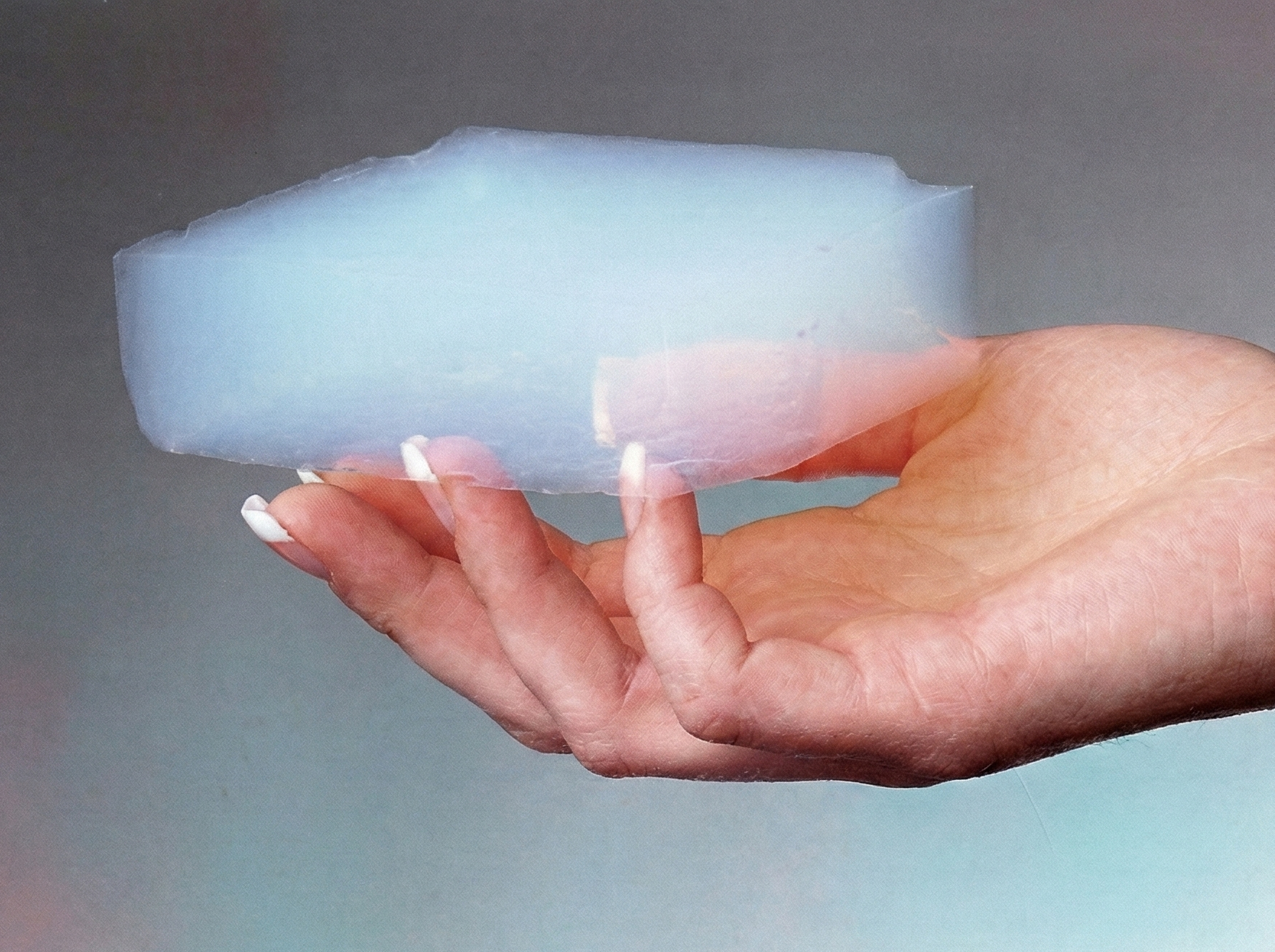
The user offered aerogel as an analogy: Samuel S. Kistler’s foundational aerogel work appears in a 1931 Nature publication (“Coherent Expanded Aerogels and Jellies”). (Nature)
Aerogels later became aerospace-relevant in public, documented ways. NASA’s 2008 Spinoff describes aerogel used in the Stardust mission to capture high-speed comet particles without destroying them. (NASA Spinoff)
NASA Technical Reports discuss aerogel tile composites for thermal protection system applications, including work framed around shuttle tile composites and spacecraft thermal protection. (NASA Technical Reports Server)
Aerogel illustrates two key points that temper extremes on both sides:
- Some advanced materials are not “hidden,” they simply mature inside government-funded mission pipelines before they diffuse.
- Yet the same pipeline culture also supports long periods where specialized fabrication, performance details, and certain application domains are effectively inaccessible to the public.
In other words: not every absence is suppression, but suppression is an established capability. UAP materials claims must be evaluated in that realistic middle zone.
A typology of claimed UAP meta-material classes
This typology is updated with the Skinwalker Ranch family.
- Alternating metal laminates for field control
- Composition: Mg-Zn matrix with Bi-rich bands and trace elements
- Claimed function: terahertz waveguiding, field confinement
- Data: ORNL synopsis reports terrestrial isotopes for the tested specimen; microstructure issues weigh against the proposed waveguide framing for that specimen (AARO)
- Ultra-pure magnesium fragments
- Composition: very high-purity Mg with unusual trace profiles in historical cases
- Data: Ubatuba isotopes within terrestrial ranges (Journal of Scientific Exploration)
- Slag-like residues and metallic spherules
- Composition: Fe with Ni/Cr, Si/Mn, calcium-heavy ash phases; sometimes Al-rich puddles
- Data: multiple cases resolve into industrial-like compositions; linkage to UAP remains the contested step (Jacques Vallée)
- Mesa ceramic and alloy fragments (Skinwalker Ranch, Season 6)
- Composition: surface XRF suggests Ni-Fe-Co for at least one shard; interior reads as common ceramic-adjacent elements
- Claims: SEM “self-healing,” magnet behavior framed as exotic
- Data quality: interesting, but chain-of-custody weak; instrument-artifact explanations credible; requires multi-lab replication with raw data (25YL)
What counts as a convincing “exotic meta-material”
A truly persuasive case would look less like a TV segment and more like a forensic package:
- Documented provenance: in situ imaging, GPS/depth context, sealed custody, negative controls (local soil, drill dust, tool swabs), logged transfers.
- Round-robin labs: blinded subsamples sent to independent labs with preregistered analysis plans.
- Multi-technique convergence: TEM/EDS + EBSD + LA-ICP-MS + isotope systems (multi-collector ICP-MS), with raw data released. (ScienceDirect)
- Function tied to structure: if a waveguide is claimed, demonstrate S-parameters at relevant frequencies on properly prepared cross-sections, correlated with crystalline continuity and defect density. If superconductivity is claimed, show transition behavior and Meissner-consistent measurements.
Until a UAP materials claim meets this standard, UAPedia treats it as provisional, even when the narrative is compelling.
Claims Taxonomy
This section applies UAPedia’s required taxonomy across the claims most commonly cited in public discussions, including the Skinwalker Ranch Season 6 additions.
Verified:
- Army-TTSA CRADA to evaluate claimed metamaterials exists as a matter of record through published reporting. (The War Zone)
- ORNL/AARO public analysis package exists for a layered magnesium specimen, with described methods and isotope conclusions for the tested sample. (AARO)
- Invention secrecy orders exist in large ongoing numbers, with 6,543 in effect at end of FY2025 (USPTO-reported via FAS). (FAS Project on Government Secrecy)
- Patent security review infrastructure exists, including DoD coordination of the Patent Security Category Review List. (Electronic Service Delivery)
- Aerogel’s 1931 origin and NASA’s documented uses (Stardust capture; thermal protection composites) are publicly documented. (Nature)
Probable:
- Skinwalker Ranch mesa drilling recovers manufactured ceramics and common alloys mixed into spoils and fragments worthy of formal analysis, even if origin is unresolved. (youtube.com)
Disputed:
- Layered Mg-Zn-Bi stacks function as high-performance terahertz waveguides in the tested specimen. ORNL/AARO results weigh against that functional framing for the tested sample. (AARO)
- Skinwalker Ranch “self-healing ceramic” demonstrates exotic capability. Instrument artifacts and chain-of-custody weaknesses are credible alternatives; replication required. (Metabunk)
- Skinwalker Ranch magnet behavior indicates superconductivity. Evidence shown publicly is insufficient for that claim. (25YL)
- Slag-like residues prove exotic craft. Chemistry often looks industrial; linkage to UAP remains unproven by chemistry alone. (Jacques Vallée)
Legend:
- Crash-retrieval origin stories attached to privately circulated fragments remain narrative unless independently validated by custody and documentation. (Contextual, not dismissive.)
Misidentification:
- “ORNL-tested layered specimen is non-terrestrial.” Published isotopes place it in terrestrial manufacture for that sample. (AARO)
- “Ubatuba isotopes prove non-terrestrial origin.” Published magnesium isotopes fall within terrestrial ranges. (Journal of Scientific Exploration)
Hoax:
- None assigned at dossier level in 2025 without specific evidence of intentional fabrication. (UAPedia avoids casual hoax labeling.)
Speculation labels
Hypothesis
Layered laminates and patterned ceramics could, in principle, be engineered as terahertz waveguides, metasurfaces, or non-reciprocal devices for signature control or compact sensing. This is consistent with the broader metamaterials research landscape and does not require non-human origin.
Witness interpretation
Anonymous correspondence linking layered fragments to a 1947 retrieval is interpretive narrative unless independently verified. (The War Zone)
On-air interpretations of magnet behavior as “superconductor-like” remain interpretive unless backed by full controlled measurements. (25YL)
Researcher opinion
The data-driven frontier is pre-registered, multi-lab, blinded testing with raw datasets released. This is the only path that converts UAP materials from anecdotes into cumulative knowledge. (ScienceDirect)
References
All-domain Anomaly Resolution Office. (2024, July 10). Synopsis: Analysis of a metallic specimen [PDF]. U.S. Department of Defense. (AARO)
All-domain Anomaly Resolution Office. (2024). AARO’s supplement to Oak Ridge National Laboratory’s analysis of a metallic specimen [PDF]. U.S. Department of Defense. (AARO)
Gross, D. P. (2019). Evidence from the USPTO patent secrecy program in WWII [Working paper]. Harvard Business School. (Harvard Business School)
History Channel. (2025). The Secret of Skinwalker Ranch: Season 6 (episode and streaming listings). (HISTORY)
Kistler, S. S. (1931). Coherent expanded aerogels and jellies. Nature, 127, 741. (Nature)
National Archives. (n.d.). Records of interservice agencies: Army and Navy Patent Advisory Board history. (National Archives)
Nolan, G. P., Vallée, J. F., Jiang, S., & Lemke, L. G. (2022). Improved instrumental techniques, including isotopic analysis, applicable to the characterization of unusual materials with potential relevance to aerospace forensics. Progress in Aerospace Sciences, 128, 100788. (ScienceDirect)
Office of the Director of National Intelligence. (n.d.). National Security Act of 1947 (legal reference). (Director of National Intelligence)
Powell, R., Swords, M., Rodeghier, M., & Budinger, P. (2022). Isotope ratios and chemical analysis of the 1957 Brazilian Ubatuba fragment. Journal of Scientific Exploration, 36(1). (Journal of Scientific Exploration)
To The Stars Academy of Arts & Science. (2018/2019). Material of interest: Magnesium-zinc-bismuth (ADAM materials page). (To The Stars*)
Trevithick, J., & Tingley, B. (2019, October 20). The Army wants to verify To The Stars Academy’s mystery material claims. The War Zone. (The War Zone)
U.S. Congress. (1951/1952). Invention Secrecy Act of 1951 (H.R. 4687), became Public Law 82-256. Congress.gov. (Congress.gov)
U.S. Patent and Trademark Office. (2024). Manual of Patent Examining Procedure (MPEP), Chapter 0100: Secrecy, access, national security, and foreign filing [PDF]. (uspto.gov)
Federation of American Scientists. (n.d.). Invention secrecy statistics (through FY2025). (FAS Project on Government Secrecy)
Vallée, J. (1998/2016). Physical analyses in ten cases of unexplained aerial objects with material samples [PDF]. (Jacques Vallée)
White, S. (1998). Aerogel: Tile composites toughen a brittle superinsulation [NASA Technical Report]. NASA NTRS. (NASA Technical Reports Server)
NASA. (2008). Aerogels insulate missions and consumer products. NASA Spinoff 2008. (NASA Spinoff)
NASA. (n.d.). Stardust / Stardust NExT mission overview. (NASA Science)
U.S. Department of Defense. (2010). DoDD 5535.02, DoD patent security review process [PDF]. (Electronic Service Delivery)
25 Years Later. (2025, August 14). The Secret of Skinwalker Ranch: Hard to Handle (S6E11) (episode recap). (25YL)
SEO keywords
UAP metamaterials; UAP meta-materials; recovered UAP fragments; magnesium zinc bismuth layered sample; ORNL AARO metallic specimen; Garry Nolan Jacques Vallée aerospace forensics; Ubatuba magnesium isotopes; Council Bluffs 1977 molten residue; Skinwalker Ranch Season 6 mesa materials; self-healing ceramic SEM; XRF nickel iron cobalt shard; invention secrecy orders FY2025; Invention Secrecy Act 1951; Patent Security Category Review List; National Security Act 1947; NASA aerogel Stardust collector; aerogel thermal protection composites.