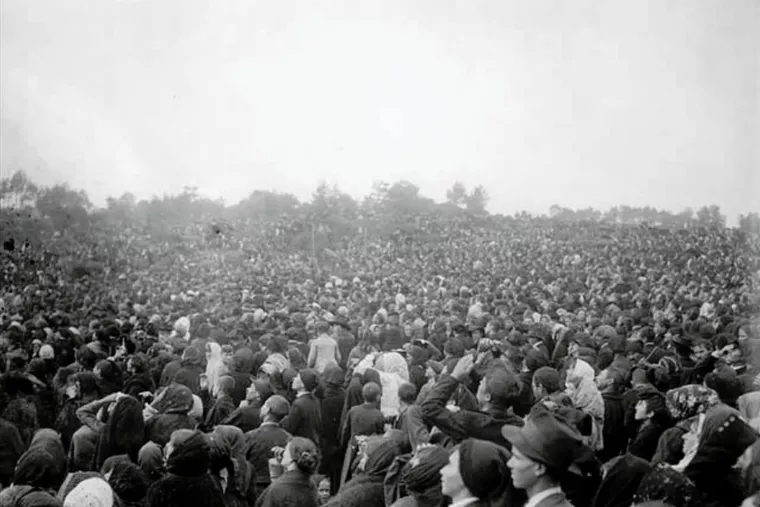
On 13 October 1917, tens of thousands of people stood in a rain-soaked field in central Portugal, staring at the sky. Some prayed. Some mocked. Some came to witness what three children had promised would happen: a sign “so everyone can believe.” The crowd did not leave with a single unified description. But they did leave with a shared conviction that something happened.
If you strip away later myth-making and focus on what we can actually inventory, Fátima becomes one of the most important early “mass event” dossiers for UAP studies. Not because it can be neatly solved, but because it gives us a rare, messy convergence of:
- a predicted public event
- a large multi-witness crowd
- contemporary press coverage including skeptical outlets
- institutional documentation and long-term social impact
- a lasting interpretive fork: Marian miracle vs. natural phenomenon vs. anomalous aerial event
UAPedia’s editorial stance treats credible testimony as real data and does not default to prosaic dismissal. With Fátima, that means taking the record seriously without forcing it into a single frame.
The data deck: what we can state before interpretation
| Variable | What we can document | Why it matters for UAP analysis |
|---|---|---|
| Location | Shrine of Our Lady of the Rosary of Fátima, Cova da Iria region; GPS listed by the Shrine: 39º37’52.06″N, 8º40’23.47″W | A stable geo-anchor for mapping, sky modeling, and archival cross-checking. |
| Date range | Apparitions reported monthly May–October 1917 (with the culminating event on 13 Oct 1917); earlier “Angel” experiences in 1916 are part of the canonical narrative | A timeline with repeated events helps distinguish one-off rumor from persistent patterning. |
| Crowd size | Estimates vary; commonly ~70,000 cited in Church documentation and later summaries | Mass witness events are rare in the UAP record; they stress-test witness reliability models. |
| Contemporary press | Reported by O Século (15 Oct 1917), including journalist Avelino de Almeida’s eyewitness narrative (often noted as coming from an anticlerical paper) | A skeptical-leaning press witness reduces the “only believers saw it” objection. |
| Phenomenology reported | “Dull silver disk,” apparent rotation, color changes, “dancing,” sudden motions; mixed witness reports including “nothing unusual” from some observers | These descriptors overlap with modern UAP “luminous disk” reports, but may also match perception artifacts. |
| Long-term impact | Fátima becomes a global pilgrimage center; the Shrine reports 6.2 million participants in at least one celebration in 2024 | Regardless of ontology, this is an enduring sociocultural aftereffect on the scale of major religions. |
That’s the spine. Now we investigate.
Scene reconstruction: the field, the forecast, the expectation
The Shrine’s own materials preserve a crucial detail: people were not arriving at a neutral experiment. They arrived primed, wet, and emotionally loaded.
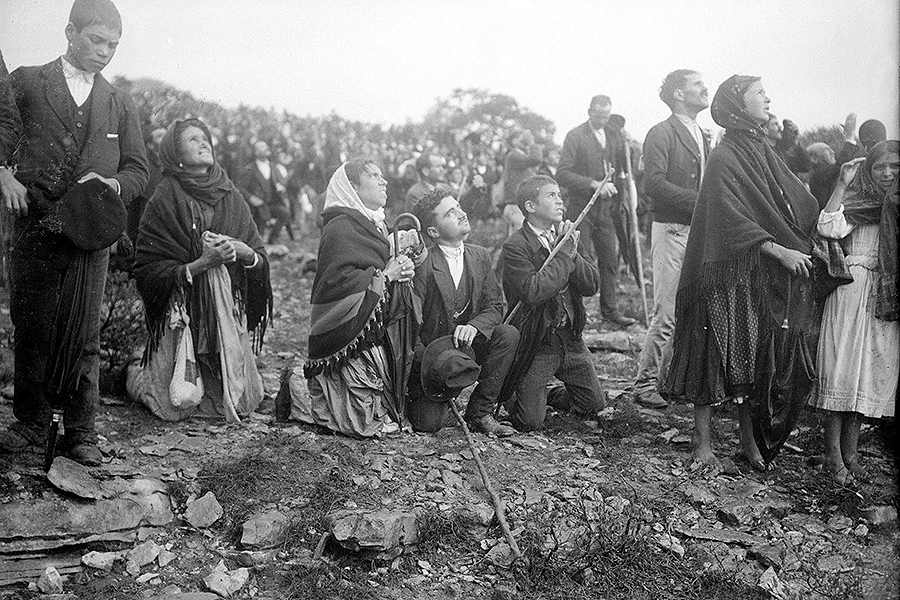
A Sister Lúcia memoir excerpt reproduced by the Shrine describes roads packed with people, “rain [falling] in torrents,” and the crowd kneeling in mud, umbrellas closed, praying the rosary. The meteorology matters less than the psychology: discomfort, anticipation, and collective focus.
In UAP research, you rarely get this level of situational context. Most sightings are sudden and private. Fátima is the opposite: a scheduled appointment with the unknown.
Witness accounts: three lanes of testimony
A data-first approach doesn’t treat “testimony” as one thing. Fátima gives us three distinct lanes:
The child seers: a sustained contact narrative
The official Catholic narrative centers on Lúcia dos Santos and her cousins Francisco and Jacinta Marto, who reported a series of encounters culminating in October 1917.
The Shrine’s “Narrative of the Apparitions” situates these events within a broader sequence that includes earlier anomalous experiences (including luminous phenomena and a figure framed as an “Angel”).
From a UAP perspective, this resembles a classic contact pattern: repeated encounters, messaging, behavioral instructions, prediction of a public sign, and the eventual emergence of a mass witness event.
The journalist witness: an observer who did not need to cooperate
Avelino de Almeida’s account is often treated as the “hardest-to-ignore” contemporary narrative because it is not easily reduced to devotional enthusiasm.
In a publisher-released excerpt of Luís Filipe Torgal’s historical work, Almeida’s description includes a key perception claim: the sun appeared like a dull silver plate and was possible to look at without strain, followed by a collective roar and cries of “milagre”. Another blunt phrase attributed to the same account, “it does not burn, it does not blind,” is a direct challenge to normal solar viewing conditions.
For UAP investigators, this is a familiar motif: a luminous object that is visually tolerable, as if filtered, structured, or perceptually altered.
The skeptical counter-witness: “we saw it too, and it wasn’t extraordinary”
A modern investigation also has to honor negative testimony. In the same excerpted dossier, Domingos Pinto Coelho (writing in A Ordem shortly after the event) claimed he observed the same successions of colors and rotational movement under similar conditions on another day, concluding that once the “extraordinary fact” is removed, you are left with “three children’s affirmations”.
This is not a trivial objection. It is a built-in control witness arguing for replicability under ordinary circumstances.
The investigative takeaway: the event produced both “something impossible happened” and “this can happen naturally” witness tracks immediately, not decades later.
What, exactly, was the “Miracle of the Sun” as a UAP-like report?
If you translate the press-era descriptions into modern UAP field categories, you get a striking cluster:
- Apparent disk morphology (often described as plate-like)
- Rotation / spinning behavior
- Color cycling / spectral effects
- Sudden motion (“dancing,” abrupt shifts)
- Group fixation on a single sky target
- Emotional escalation: fear, awe, collective shouting
The uncomfortable point for both skeptics and believers is that this list is interpretable in multiple ways:
- A structured aerial phenomenon could create these perceptions.
- Atmospheric optics plus mass sun-gazing could create these perceptions.
- A consciousness-mediated event could create these perceptions.
- Some mixture could create these perceptions.
A UAPedia-style approach is not to pick the most socially comfortable explanation. It is to map which hypothesis best accounts for the full pattern, including the prediction, the crowd, the press, and the aftereffects.
The “mass UAP” question: why crowd size both helps and hurts
A crowd is not a truth machine. But it is also not nothing.
What mass witnessing strengthens
- You reduce single-witness idiosyncrasy.
- You increase the odds of independent reporting.
- You create immediate documentation pressure (press, clergy, officials, diaries).
Fátima did generate that pressure, including prominent newspaper coverage and later institutional documentation.
What mass witnessing weakens
- Contagion effects: people copy attention and language.
- Expectation bias: a predicted sign invites pattern-filling.
- Perceptual convergence: if you stare at the sun, you can induce shared artifacts.
Fátima is the rare case where both sides can point to the same dataset and say: “See? This proves my model.” That is exactly why it remains useful.
Diana Pasulka’s bridge: “the event” vs. “the frame”
Diana Walsh Pasulka’s work is relevant to Fátima because she treats modern UAP narratives and historic religious miracle narratives as structurally similar human encounters with the anomalous, filtered through cultural permission.
In an interview conversation that explicitly references Fátima, Pasulka notes the 1917 Marian apparition report and the associated “miracle of the sun,” adding that it is plausible that something happened while emphasizing that people interpret extraordinary events through their available frameworks.
This is not a debunking move. It is an interpretive warning: the same stimulus can generate different realities depending on who is looking, what they believe is allowed to be real, and what language their culture provides.
In American Cosmic (Oxford University Press), Pasulka argues that UAP experiences can function like a new form of religiosity in a technologically saturated culture, with institutions and narratives forming around encounters that destabilize the everyday world.
Fátima may be the inverse: a technologically interpretable event embedded in a religious culture that already had an interpretive container ready.
The modern UAP reinterpretation literature: “the being who descended from the sky”
The strongest “explicit UAP” reading of Fátima is associated with Portuguese historians Joaquim Fernandes and Fina D’Armada, whose book Heavenly Lights: The Apparitions of Fátima and the UFO Phenomenon is marketed as an evidentiary analysis grounded in original case documents, with a foreword by Jacques Vallée.
Two points matter for investigators:
- Their framing treats the central figure as an “unidentified being,” not automatically as a Marian entity.
- Their table of contents shows a systematic attempt to map reported phenomena (lightning, buzzing, thunder, clouds) to what they call parallels in ufology.
You do not have to accept their conclusion to recognize the method: take the old dossier and re-read it using modern anomaly categories. This is exactly what UAP studies needs more of, provided it is done carefully and without cherry-picking.
Religious groups: who carried the signal forward, and why that matters
Even if you bracket the ontology, Fátima’s aftereffects are measurable at civilizational scale.
The institutional Church
The Vatican’s official materials situate the Fátima events as Marian apparitions tied to the lives of the three child witnesses and subsequent devotional developments. Church structures, by design, preserve continuity, not novelty. That means the archive is both a resource and a biasing instrument.
The Shrine as a living data engine
The Shrine of Fátima functions like a long-running observatory of belief-in-action. It produces calendars, pilgrim infrastructure, documentation, and, importantly, statistics.
In a 2025 report about the prior year, the Shrine stated that 6.2 million faithful participated in at least one celebration in 2024, with detailed breakdowns of registered groups and countries of origin. It also publishes logistical details like GPS coordinates and pilgrimage guidance, showing the scale and routinization of the phenomenon.
Lay movements
Fátima-inspired lay organizations (often international) have historically acted as amplifiers, translating the event into prayer programs, political meanings, and public ritual.
For UAP analysts, these movements are not side stories. They show how anomalous encounters, once culturally authorized, become self-sustaining.
This is one reason “mass UAP events” are strategically important: they do not only produce sightings; they produce institutions.
Aftereffects: the overlooked half of the case file
UAP case files often end at the sighting. Fátima begins there.
Individual aftereffects (micro scale)
- The child witnesses became focal points of interrogation, reverence, skepticism, and institutional management (a pattern many modern experiencers recognize).
- The event shaped life trajectories, health narratives, and identity in ways that are difficult to reduce to a single moment.
Cultural aftereffects (macro scale)
- A rainy field becomes a devotional geography, then a global pilgrimage economy.
- The event becomes a repeating calendar cycle, with anniversary pilgrimages drawing massive crowds across decades.
- The Shrine’s own statistics show how the phenomenon persists into the present in quantifiable ways.
For UAPedia, this matters because the “reality” of a phenomenon is not only physical. It is also sociological. Some UAP events change the world even when the object remains undefined.
Implications: what Fátima teaches UAP research that sensor cases do not
Prediction is a rare and valuable variable
Most UAP events are unpredicted. Fátima’s core drama is a predicted sign and a crowd that arrives to test it. That is a structural advantage for any anomaly investigation, even if the event is contaminated by expectation.
“Religious vs. UAP” may be a false binary
Fátima is often treated as a battleground: miracle or misperception. A third option is that the event is genuinely anomalous while the “Mary” interpretation is a culturally available interface.
This is not an attempt to flatten Catholic meaning. It is an attempt to describe how anomalous encounters repeatedly acquire local identities across cultures.
Longitudinal impact is part of the evidence
In modern UAP studies, we often privilege “hardware” data. Fátima reminds us that enduring aftereffects, institutions, and repeat pilgrimage behavior are themselves a form of signal.
A phenomenon that can mobilize millions across a century is not nothing.
Mixed testimony is a feature, not a flaw
Fátima contains believers, skeptics, and witnesses who claim normality. That pattern is familiar in UAP events: a single stimulus can produce divergent reports, and the divergence itself can be diagnostic.
Claims taxonomy
Verified:
- A large-scale gathering occurred at Fátima in October 1917 and generated contemporary press accounts, including detailed descriptions of unusual solar-like visuals.
- The Shrine of Fátima exists as a major global pilgrimage site and reports participation statistics in the millions, including 6.2 million participants in at least one celebration in 2024.
- The Shrine publishes precise geographic coordinates for the site, anchoring it for mapping and study.
Probable:
- At least a substantial fraction of attendees experienced unusual visual phenomena described as a rotating, color-shifting disk with abnormal motion, with many reports converging on those motifs.
- Interpretation was strongly shaped by expectation, ritual framing, and the cultural availability of Marian categories, as suggested by both historical context and modern analytical frameworks.
Disputed:
- Whether the observed phenomena were caused by atmospheric optics, perceptual artifacts from sun-gazing, a structured aerial object, or a consciousness-mediated anomaly remains unresolved in the historical record.
- Whether the “being” reported by the children should be treated as a Marian entity, an unidentified intelligence, or a narrative interface is contested across religious and ufological literatures.
Legend:
- Later layers of Fátima interpretation that are primarily devotional or polemical, and which expand beyond contemporaneous documentation, should be treated as cultural narrative unless anchored to primary sources.
Misidentification:
- Not applicable as a definitive category at the whole-case level because no single prosaic identification is universally demonstrated across the dataset.
Hoax:
- Not established. The existence of skeptics and dissenting witnesses does not, by itself, demonstrate intentional fabrication, and the press record includes observers who did not have an incentive to stage belief.
Speculation labels
Hypothesis
A localized anomalous aerial phenomenon occurred over Cova da Iria on 13 October 1917, producing disk-like visuals, color cycling, and apparent motion consistent with modern UAP reports, and triggering large-scale collective response.
Witness Interpretation
The child seers and many in the crowd interpreted the phenomenon through Catholic Marian symbolism, framing the “being” as the Virgin Mary and the sky display as a miracle. Some observers interpreted similar visuals as ordinary atmospheric or perceptual effects, treating the event as non-anomalous.
Researcher Opinion
Pasulka’s framework suggests that extraordinary events can be real while interpretation is culturally shaped, and that modern UAP culture may be generating an equivalent “religious” infrastructure around anomaly today. Fernandes and D’Armada argue for an explicitly ufological reading, treating the central entity as unidentified and mapping reported effects to parallels in ufology.
References
Primary institutional sources
Vatican: “The Message of Fátima”. https://www.vatican.va/roman_curia/congregations/cfaith/documents/rc_con_cfaith_doc_20000626_message-fatima_en.html?utm_source=uapedia.ai
Shrine of Fátima: Narrative of the Apparitions. https://www.fatima.pt/en/pages/narrative-of-the-apparitions?utm_source=uapedia.ai
Shrine of Fátima: “The Shrine of Fatima welcomed 6.2 million pilgrims in 2024” (06 Feb 2025). https://www.fatima.pt/en/news/the-shrine-of-fatima-welcomed-62-million-pilgrims-in-2024?utm_source=uapedia.ai
Shrine of Fátima: Instructions for pilgrims on foot (includes GPS coordinates and a Lúcia memoir excerpt). https://www.fatima.pt/en/pages/instructions-for-pilgrims-on-foot?utm_source=uapedia.ai
Historical and investigative books
Torgal, L. F. (2011). O Sol Bailou ao Meio-dia: A criação de Fátima (publisher PDF excerpt; includes press-era quotations). https://tintadachina.pt/wp-content/uploads/SOL-BAILOU-AO-MEIO-DIA.pdf?utm_source=uapedia.ai
Bennett, J. S. (University of Virginia Press). When the Sun Danced: Myth, Miracles, and Modernity in Early Twentieth-Century Portugal. https://www.upress.virginia.edu/title/5165/?utm_source=uapedia.ai
UAP reinterpretation literature
Anomalist Books: Fernandes, J., & D’Armada, F. Heavenly Lights: The Apparitions of Fátima and the UFO Phenomenon (publisher page, contents). https://www.anomalistbooks.com/book.cfm?id=30&utm_source=uapedia.ai
Pasulka sources and interviews. Oxford University Press: Pasulka, D. W. American Cosmic: UFOs, Religion, Technology. https://global.oup.com/academic/product/american-cosmic-9780190692889?utm_source=uapedia.ai
Lex Fridman Podcast transcript (Pasulka references Fátima and interpretive framing). https://lexfridman.com/diana-pasulka-transcript/?utm_source=uapedia.ai
Images and archival context
Crowd photo at Cova da Iria (Judah Ruah / O Século, public domain credit as commonly reproduced). https://www.ncregister.com/commentaries/st-joseph-s-celestial-appearance-at-fatima?utm_source=uapedia.ai
Shrine multimedia image gallery (example page used above). https://www.fatima.pt/en/multimedia/images/our-lady-of-the-rosary-of-fatima-?utm_source=uapedia.ai
Podcasts (for modern investigative context)
Podcast UFO (episode page about Fatima and the Vatican). https://podcastufo.com/show-323-fatima-events-and-the-vatican/?utm_source=uapedia.ai
SEO keywords
Fátima UAP, Miracle of the Sun UAP interpretation, Marian apparitions and UAP, mass UAP sighting Portugal 1917, Cova da Iria anomaly, Diana Walsh Pasulka Fátima, American Cosmic Fátima, Jacques Vallée Fátima, Heavenly Lights Fernandes D’Armada, historical UAP religious encounters