
If there is a single person who sits at the junction of fringe propulsion research, classified military projects, and the birth of modern UAP advocacy, it is Thomas Townsend Brown.
He was:
- an American inventor who believed he had found a way to couple electricity and gravity;
- a Navy researcher who handled sonar, minesweeping and radar during the Second World War;
- the founding chairman of NICAP, one of the most influential civilian UAP investigation groups in history; and
- and the man whose devices still inspire “lifter” hobbyists and electrogravitics experimenters around the world.
Brown’s story has been wrapped in myth for decades. Some portray him as the “man who mastered gravity”. Others dismiss his life’s work as misunderstood ion wind. The data tell a more interesting story.
This UAPedia article takes a data-first, investigative look at Brown’s life and his entanglement with UAP. We track what is documented, what is plausible, and what slides into legend, using UAPedia’s Claims Taxonomy and Speculation Labels throughout.
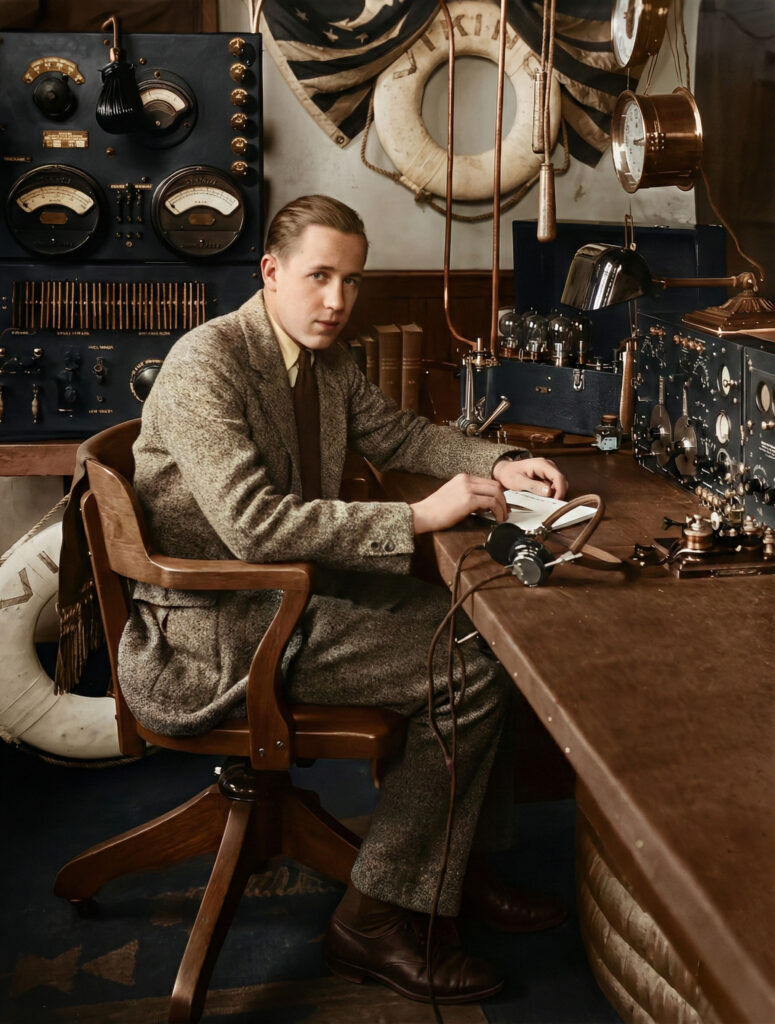
Timeline: A Data Snapshot Of Brown’s Life
1905–1920s: Early experiments and “gravitors”
- 1905 – Born March 18 in Zanesville, Ohio, into a wealthy construction family.
- Early teens – Builds radios and experiments with high voltage equipment, supported by his parents.
- 1921–1924 – While still in school, experiments with a Coolidge X-ray tube on a balance and observes a small thrust correlated with high voltage. He becomes convinced gravity can be influenced electrically. A 1924 Los Angeles Evening Express article runs under the headline “Claims Gravity is a Push, not a Pull”.
- 1928 – Secures British patent GB300311, “A method of and an apparatus or machine for producing force or motion”, describing a dielectric “gravitator” that moves when charged.
- 1929 – Publishes “How I Control Gravitation” in Science and Invention, predicting large “gravitators” will one day propel ships and “space cars”.
1930s–1940s: Navy research and war work
- 1931–1933 – Joins the U.S. Naval Research Laboratory. Serves as sonar and radio operator on the Navy–Princeton gravity expedition and on the Johnson-Smithsonian Deep Sea Expedition aboard the yacht Caroline, taking sonic soundings of the Puerto Rico Trench.
- Late 1930s–1942 – Works on magnetic and acoustic minesweeping and later radar training for the Atlantic Fleet Radar School in Norfolk.
- 1944 – Serves as a radar consultant to Lockheed-Vega Aircraft Corporation.
Late 1940s–mid-1950s: Electrogravitics, Pearl Harbor, and Europe
- Late 1940s – Moves to Hawaii and becomes a consultant to Pearl Harbor Navy Yard after Admiral Arthur Radford takes interest in his “Gravitor” device. Brown’s own notebooks later describe gravity-related experiments at Pearl Harbor in 1950–51.
- 1952 – Relocates to Cleveland and drafts Project Winterhaven, a formal proposal to develop electrogravitics for advanced aircraft and communications.
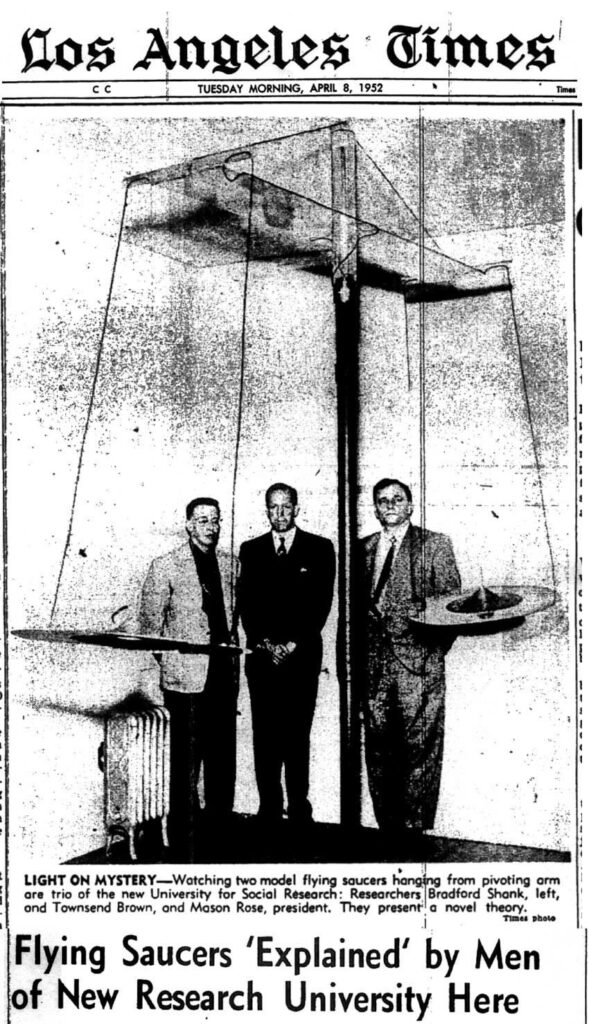
- 1955–1956 – Demonstrates disc-shaped, high-voltage devices in the United States, the United Kingdom and France. At French aerospace firm SNCASO, he reports an effect even in partial vacuum, although later technical critiques challenge this.
1956–1960s: NICAP, patents and the electrogravitics “boom”
- 1956 – Files U.S. patent US 2,949,550, “Electrokinetic apparatus”, describing “thrust producing apparatus” using asymmetric electrodes in an ionizable medium.
- Oct 24, 1956 – Founds the National Investigations Committee on Aerial Phenomena (NICAP) in Washington, D.C., serving as its first chairman. The board includes Donald Keyhoe, Admiral Delmer Fahrney and later former CIA Director Roscoe Hillenkoetter.
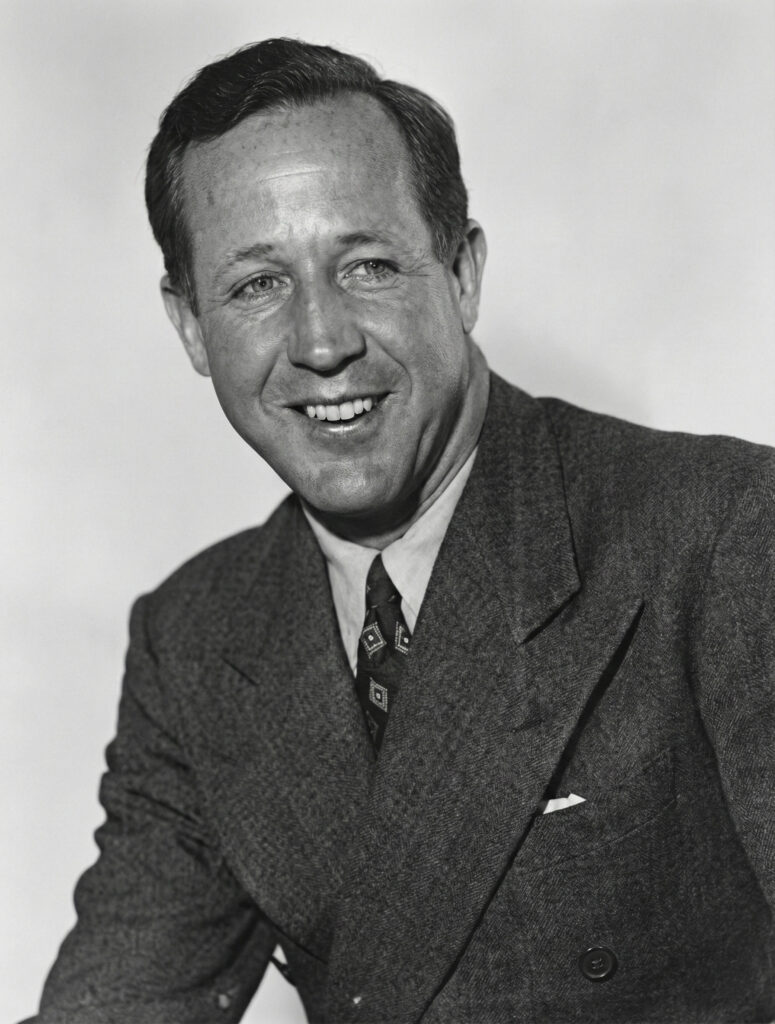
- Jan 1957 – Forced out of NICAP after only a few months, amid concerns that organization funds could be diverted into his electrogravity research.
- 1958 – Acts as R&D consultant for Agnew Bahnson’s Whitehall Rand Project in North Carolina, one of several small antigravity ventures of the period.
- Late 1950s–early 1960s – Works for Electrokinetics Inc. and continues filing electrokinetic patents, then drifts into semi-retirement in California.
1970s–1985: UAP lore and late-life obscurity
- 1978 – William L. Moore publishes “The Wizard of Electro-gravity” in Saga UFO Report, explicitly framing Brown’s work as a leading candidate for UAP propulsion.
- 1979 – Charles Berlitz and Moore’s book The Philadelphia Experiment: Project Invisibility devotes a chapter to Brown, implying a link between his work and alleged field-manipulation Navy experiments.
- Oct 27, 1985 – Brown dies in California, little known in mainstream physics but increasingly mythologized within UAP and “antigravity” circles.
What Brown Claimed To Have Found
At the core of Brown’s legacy is what later became known as the Biefeld–Brown effect or electrogravitics.
From his early Coolidge tube tests onward, Brown argued that:
- a high-voltage electric field applied across a dielectric mass produces a net thrust
- the direction of motion is toward the positive electrode
- the effect increases with voltage, dielectric constant and electrode asymmetry
In his 1928 British patent and later U.S. patents, Brown consistently describes “thrust producing apparatus” in which an ionizable medium (air, gas or fluid) around asymmetric electrodes is accelerated, moving the device in the opposite direction.
Later, Brown increasingly framed his thinking not as simple “antigravity” but as “stress in dielectrics”, suggesting that the energy density in a high-voltage dielectric might distort space in a way analogous to how mass curves spacetime in general relativity.
In private writings like Structure of Space, now available through researcher Paul Schatzkin, Brown tries to tie his effect into a broader unified-field style picture rather than a single weird laboratory trick.
Government Involvement: What The Record Actually Shows
UAPedia treats government-linked material as “inputs, not verdicts”. Official records, declassified documents and later reconstructions can tell us what Brown was doing, but not necessarily the full story of why or under whose sponsorship.
From available data we can say:
- Brown did serve at the U.S. Naval Research Laboratory, including gravity-related expeditions and deep-sea survey work in 1932–33;
- He did later become a Navy officer in charge of magnetic and acoustic minesweeping research, then work on radar training under the National Defense Research Committee/OSRD wartime structure; and
- After the war he was given consultant status at Pearl Harbor, apparently thanks to Admiral Arthur Radford’s curiosity about his “Gravitor” device, though Navy colleagues mostly treated it as a curiosity.
Brown’s own lab notebooks, partially published, describe Pearl Harbor experiments in 1950–51 on “gravitational isotopes” and electric stress effects, which he believed showed measurable anomalies.
Separately, the wider 1950s antigravity “boom” in industry and defense is now documented. A 1956 industry study titled Electrogravitics Systems, declassified decades later, surveyed antigravity research at major aerospace firms and drew heavily on Brown’s work.
Later journalism and books, such as Nick Cook’s The Hunt for Zero Point and Clive Thompson’s Wired piece “The Antigravity Underground”, argue that interest waned in the open literature just as classified programs could have taken over.
Applying UAPedia’s secrecy weighting, it is important to stress that no declassified document yet proves that Brown’s devices became an operational propulsion system within the U.S. military. But the paper trail does confirm he sustained official curiosity, he had multiple technical reviews published and at least some funded exploratory work., which is already more than most “wild propulsion” ideas ever receive.
Brown And UAP: From Electrogravitics To NICAP
Brown did not approach UAP as a casual onlooker. He was one of the few early inventors who explicitly asked whether the objects in the sky might be using his principle.
By the early 1950s, after following flying-saucer reports, he began to speculate that UAP might be using electrogravitic propulsion, and that systematic research could both explain the phenomenon and replicate it. William L. Moore’s 1978 profile notes that Brown saw UAP as a natural proving ground for his “electro-gravity” ideas.
This mindset fed directly into the creation of NICAP in 1956:
- Brown incorporated NICAP as a Washington-based nonprofit on October 24, 1956.
- The board gathered highly credible names, including retired Rear Admiral Delmer Fahrney, Donald Keyhoe, and later former CIA Director Roscoe Hillenkoetter.
- Contemporary descriptions say Brown envisioned NICAP as a “fact-finding body” supported by dues-paying members, capable of lobbying and building a high-quality case file system for UAP.
Within months, however, Brown was pushed out. Multiple historical reconstructions converge on the same basic storyline:
- Board members became concerned that NICAP’s scarce funds might be diverted into Brown’s electrogravity experiments.
- James Moseley and later researchers describe pressure from Donald Keyhoe and others that led to Brown’s resignation in early 1957.
In the UAPedia Claims Taxonomy, Brown’s role as founding chairman of NICAP is clearly Verified. The allegation that he tried to route money into his own labs is Probable but not definitively documented, as no surviving financial records publicly confirm it.
NICAP itself went on to become a key civilian UAP organization, but under Keyhoe rather than Brown. That split meant the closest thing to a formal “UAP propulsion research lobby” led by an inventor evaporated almost as soon as it formed.
Public Appearances And Media Footprint
For someone whose work has become central to antigravity discussions, Brown’s mainstream media footprint is surprisingly thin.
Key public-facing moments include:
- 1924 newspaper coverage of his early gravitation claims in California, presenting him as a young “Edison-type” experimenter trying to push on gravity with electricity.
- Occasional human-interest pieces in the 1930s highlighting his “gravity control” ideas while he worked in more conventional roles.
- 1950s demonstrations of pendulum-mounted electrodes and rotating disc rigs before small groups of military and industrial observers in the United States and Europe, which were reported in technical circles but did not break into mass media beyond short items.
- 1978 Saga UFO Report article “The Wizard of Electro-gravity”, which is still one of the most detailed mass-market narratives of his life and explicitly links his work to UAP propulsion.
More recently, Brown’s story has lived mostly through:
- Paul Schatzkin’s ongoing biography project and website ttbrown.com
- Thomas Valone’s books on electrogravitics
- Joseph Farrell, Paul LaViolette, Nick Cook and others who incorporate Brown into broader discussions of advanced propulsion and hidden aerospace programs
Mainstream physics, when it notices Brown at all, usually does so to point out that his devices can be explained by electrohydrodynamics and ion wind. That leads us directly into the controversy.Scientific Controversy: Ion Wind Or Gravity?
From a conventional physics perspective, Brown’s effect is usually described as:
asymmetric capacitors creating a neutral wind of air ions that push the device
Modern analyses by researchers such as M. Tajmar and studies referenced by NASA have found that when Brown-type devices are operated in a hard vacuum, the anomalous thrust essentially disappears. This strongly supports the interpretation that the force is produced by ionized air rather than a new interaction with gravity.
On the other hand:
- A 2002 Army Research Laboratory technical report by Bahder and Fazi examined asymmetric capacitors and argued that simple ion wind estimates did not fully match the observed forces, leaving the detailed mechanism somewhat open.
- Hobbyist and independent lab tests repeatedly confirm non-trivial thrust in atmospheric conditions, often with performance beyond what naive electrostatic calculations would predict, although not beyond what a complex ion-drift model might allow.
From a UAPedia editorial standpoint, we classify this as:
- Verified: Brown’s devices produce thrust in a gaseous medium when high voltage is applied.
- Probable: Most, and perhaps all, of this thrust can be modeled as electrohydrodynamics/ion wind, with no convincing evidence of gravity modification in modern vacuum experiments.
- Disputed: Brown’s own interpretation that his effect represented a direct coupling to gravity or spacetime curvature.
None of this closes the book on advanced propulsion. It simply means that Brown’s specific lab effect is not, by itself, the smoking gun for gravity control that many enthusiasts hoped for. But as an existence proof that field-based thrust is real, and as a conceptual leap tying high-voltage systems to craft behavior, his work still matters.
Known Connections
One way to gauge Brown’s potential impact on UAP-related programs is to look at who moved through his orbit:
- Paul Alfred Biefeld – The Denison University astronomer whose name is forever attached to the “Biefeld–Brown effect”, though Denison’s records do not confirm joint experiments.
- Robert Millikan – Nobel-winning physicist at Caltech who dismissed Brown’s early ideas in the 1920s.
- Admiral Arthur W. Radford – Commander in Chief, Pacific Fleet, and later Chairman of the Joint Chiefs of Staff. His interest in Brown’s “Gravitor” helped secure the Pearl Harbor consultancy.
- Vannevar Bush’s wartime R&D ecosystem – Brown worked within the National Defense Research Committee and Office of Scientific Research & Development environment that Bush led, though there is no hard evidence of direct involvement by Bush in Brown’s electrogravitics.
- Agnew Bahnson – North Carolina industrialist who funded the Whitehall Rand Project, where Brown pursued electrogravitic experiments in the late 1950s.
- Donald Keyhoe, Delmer Fahrney, Roscoe Hillenkoetter – Key NICAP figures, linking Brown to a network of retired military and intelligence officers central to early UAP activism.
- William L. Moore, Thomas Valone, Paul Schatzkin, Paul LaViolette – Later writers and researchers who amplified and re-interpreted Brown’s work within the broader context of UAP and advanced propulsion.
This network matters because it bridges three worlds:
- Conventional defense R&D
- Emerging UAP advocacy
- Fringe or exploratory propulsion physics
Even if Brown’s own devices never left the lab, the ideas and anecdotes that flowed through these networks helped shape how later insiders and whistleblowers thought about UAP propulsion.
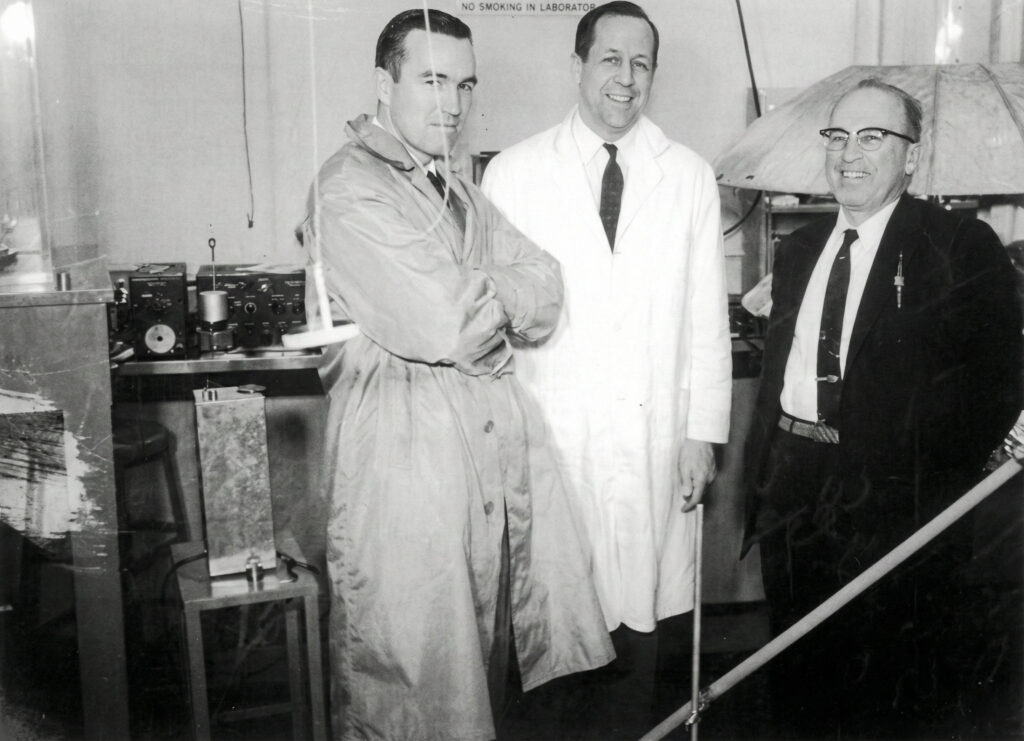
Brown In UAP Lore: Philadelphia Experiment And Beyond
From the late 1970s onward, Brown’s name became entangled with much more speculative narratives.
Philadelphia Experiment
Charles Berlitz and William L. Moore’s 1979 book The Philadelphia Experiment: Project Invisibility includes a chapter titled “The Force Fields of Townsend Brown”, implying that his electrogravitics might have been involved in alleged Navy field-manipulation tests on the destroyer escort USS Eldridge.
No primary Navy record confirms Brown’s involvement in such an experiment, and the broader Philadelphia Experiment narrative is heavily contested. Within UAPedia’s taxonomy this sits firmly in the Legend category, and Brown’s connection is Speculative at best.
B-2 bomber and “field-enhanced” aircraft
Some authors have argued that Brown-like ion-control systems might be embedded in craft such as the B-2 bomber or black-triangle style platforms. These ideas usually rely on:
- analogies to Brown’s patents
- later reports on plasma or charge control around aircraft
- and the unexplained performance of some observed UAP
However, there is no declassified technical data explicitly linking Brown’s designs to operational aircraft. This is Disputed, with current evidence insufficient to elevate it beyond Hypothesis (Researcher Opinion).
Implications For UAP Propulsion
Even if we treat Brown’s “gravity control” claims cautiously, his framework offers a coherent way to think about several recurring UAP observables:
- Silent or near-silent flight – Field-based propulsion without combustion or propellers.
- High acceleration and sharp turns – Forces generated by altering the local field environment rather than pushing reaction mass.
- Atmospheric ionization and glow – High-voltage systems can create corona discharges, visible plasmas and EM interference, all frequently reported in UAP encounters.
In a Brown-style picture, an advanced craft might:
- Use very high voltages to polarize a dense dielectric skin or surrounding plasma.
- Create a strong gradient in energy density, effectively “tilting” the local potential landscape.
- Ride that gradient like a surfer on a wave, converting electrical potential directly into motion.
Laboratory devices today sit on the crude edge of this idea, with ion wind being the main observable effect. However, modern materials, metamaterials and high-energy pulsed systems could, in principle, push into regimes Brown could only sketch.
Within UAPedia’s speculation labels:
- The notion that some UAP exhibit field-based propulsion consonant with electrogravitic concepts is a hypothesis (analytical inference), grounded in consistent behavioral patterns in high-quality cases.
- Brown’s belief that his specific hardware explained the entire UAP phenomenon is best treated as Witness Interpretation / Researcher Opinion, reflecting his personal framework more than a complete explanation of the data.
Claims Taxonomy
Applying UAPedia’s Claims Taxonomy to Brown’s UAP-relevant life:
Verified
- Brown invented and patented multiple electrokinetic / electrogravitic devices including GB300311 and US 2,949,550, describing thrust from high-voltage asymmetric electrodes in an ionizable medium.
- He served at the U.S. Naval Research Laboratory, took part in deep-sea expeditions and wartime research on minesweeping and radar.
- He founded NICAP and was removed as its first chairman within months.
- His devices generate measurable thrust in air and other ionizable media.
Probable
- NICAP board members were concerned that Brown might use organizational funds for electrogravity research, contributing to his ouster.
- Project Winterhaven, drafted in 1952, proposed systematic study of electrogravitics with potential applications to propulsion, communications and nuclear-explosion detection.
- From 1958 to 1959, Brown’s work at Agnew Bahnson’s Whitehall Rand Project took place under a degree of corporate secrecy that may account for gaps in his public notebooks between 1958 and 1967.
Disputed
- Brown’s claim that his effect persisted in meaningful form under high-quality vacuum conditions. Modern tests usually fail to replicate this.
- Assertions that Brown’s specific designs were directly implemented in classified U.S. aircraft such as the B-2.
Legend
- Brown as a central figure in the Philadelphia Experiment, or as the architect of large-scale invisibility or teleportation technology for the U.S. Navy.
- The idea that he “fully mastered gravity” in a way that modern science cannot reproduce.
Misidentification / Hoax
- There is no strong evidence that Brown himself fabricated data in the sense of a deliberate hoax, though some biographical work notes that he could be loose with details when promoting his ideas. Where the public has inflated his achievements into total gravity control, this is better seen as cultural myth-building than as Brown’s own deception.
Impact Assessment And Speculation Labels
Technical impact
Brown did not deliver operational antigravity in the open literature. Yet he:
- provided a concrete class of lab devices that merge electrostatics and thrust
- seeded a long chain of patents and research on asymmetric capacitors and ion-wind propulsion, many of which are now used in air movers and experimental micro-thrusters
- inspired continuing research in electrogravitics and related geometrical theories, as seen in works collected by Valone and others
UAP ecosystem impact
- As NICAP’s first chairman, Brown helped create the organizational vessel that would give mid-century UAP cases a serious investigative home. That is a concrete historical contribution, even if his chairmanship was short.
- By insisting that UAP might be technological and field-propelled, Brown’s frame set the stage for later discussions of UAP as craft employing advanced physics rather than as purely psychological or atmospheric phenomena.
- His story has become a lens through which many contemporary UAP researchers think about the gap between what is acknowledged in public and what might be hidden in classified programs.
Speculation labels:
- Hypothesis (analytical inference)
Some field-propelled craft observed in high-quality UAP cases may exploit principles adjacent to or overlapping with the kind of high-field, dielectric stress Brown explored, even if not using his exact hardware. - Witness Interpretation (human meaning-making)
Brown’s own belief that he was “seeing” UAP propulsion in his lab is best read as a human attempt to map large mysteries onto personal discoveries. It tells us as much about his mindset as about the phenomenon itself. - Researcher Opinion (expert-generated perspective)
Authors such as Valone, LaViolette and Cook view Brown as a key stepping stone toward a broader family of advanced field propulsion concepts that could be relevant to non-human or undisclosed human technologies. Their interpretations are valuable but remain opinions, not established fact.
Implications
- A case study in how unconventional physics interacts with secrecy and UAP.
His career sits right where wartime R&D, classified programs and anomalous claims rub against one another. - An anchor for the “Electrogravitics & Townsend Brown Experiments” node within the Technologies & Propulsion taxonomy, linking to both scientific critiques and high-strangeness claims.
- A reminder of why government and corporate sources must be contextualized.
The 1950s antigravity boom briefly acknowledged Brown, then essentially wrote him out of official histories. That silence, in a domain known to be touched by waivable SAPs, is itself a data point that must be handled as UAPedia’s editorial standard prescribes.
Whether Brown truly nudged open a door into gravity control, or mainly demonstrated that plasma and ion drift can be harnessed in clever ways, his story is inseparable from how the UAP community has come to imagine advanced propulsion.
References
Brown, T. T. (1960). Electrokinetic apparatus (U.S. Patent No. 2,949,550). Retrieved from https://patents.google.com/patent/US2949550A/en?utm_source=uapedia.ai
Brown, T. T. (1928). A method of and an apparatus or machine for producing force or motion (GB300311). Retrieved from https://worldwide.espacenet.com/publicationDetails/biblio?CC=GB&NR=300311A&KC=A&utm_source=uapedia.ai
Moore, W. L. (1978). The wizard of electro-gravity: The man who discovered how UFOs are powered. Saga UFO Report. Retrieved from https://irp.cdn-website.com/6b820530/files/uploaded/The%20Wizard%20of%20Electrogravity%20.PDF?utm_source=uapedia.ai
Schatzkin, P. (2023). Thomas Townsend Brown: Who was he? Retrieved from https://www.ttbrown.com/thomas-townsend-brown-who-was-he/?utm_source=uapedia.ai
Schatzkin, P. (n.d.). Structure of space [archival note]. Retrieved from https://www.ttbrown.com/structure-of-space/?utm_source=uapedia.ai
Tajmar, M. (2004). Biefeld–Brown effect: Misinterpretation of corona wind phenomena. AIAA Journal, 42(2), 315–318.
Bahder, T. B., & Fazi, C. (2002). Force on an asymmetric capacitor (ARL-TR-3005). U.S. Army Research Laboratory. Retrieved from https://arxiv.org/pdf/physics/0211001.pdf?utm_source=uapedia.ai
Thompson, C. (2003, August). The antigravity underground. Wired. Retrieved from https://www.wired.com/2003/08/pwr-antigravity/?utm_source=uapedia.ai
Valone, T. (Ed.). (1994). Electrogravitics systems: An examination of electrostatic motion, dynamic counterbary and barycentric control. Integrity Research Institute. Retrieved from https://ia801507.us.archive.org/6/items/thomas-valone-electrogravitics-systems/Thomas%20Valone%20-%20Electrogravitics%20Systems_text.pdf?utm_source=uapedia.ai
“Electrogravitics.” (n.d.). In Wikipedia. Retrieved 2025, from https://en.wikipedia.org/wiki/Thomas_Townsend_Brown?utm_source=uapedia.ai
National UFO Historical Records Center. (n.d.). NICAP collection overview. Retrieved from https://nufohrc.org/collections?utm_source=uapedia.ai
Enigma Labs. (n.d.). The National Investigations Committee on Aerial Phenomena (NICAP). Retrieved from https://enigmalabs.io/library/0913a909-84a2-48fd-a9f8-dfaabdf97303?utm_source=uapedia.ai
UAPedia. (2025, December 5). How UAPedia treats government sources. Retrieved from https://uapedia.ai/wiki/how-uapedia-treats-government-sources/?utm_source=uapedia.ai
The Scientific Notebooks of Thomas Townsend Brown. (n.d.). Retrieved from https://archive.org/details/townsend-brown-electrogravitics-notebooks?utm_source=uapedia.ai
SEO keywords
T. Townsend Brown, Thomas Townsend Brown, Biefeld Brown effect, electrogravitics, electrokinetic apparatus, antigravity inventor, NICAP founder, UAP propulsion, anti-gravity research, Pearl Harbor experiments, Project Winterhaven, Whitehall Rand Project, Johnson-Smithsonian Deep Sea Expedition, UAP technology, gravity control, asymmetric capacitor thrust, ion wind controversy, Philadelphia Experiment Brown, UAPedia electrogravitics