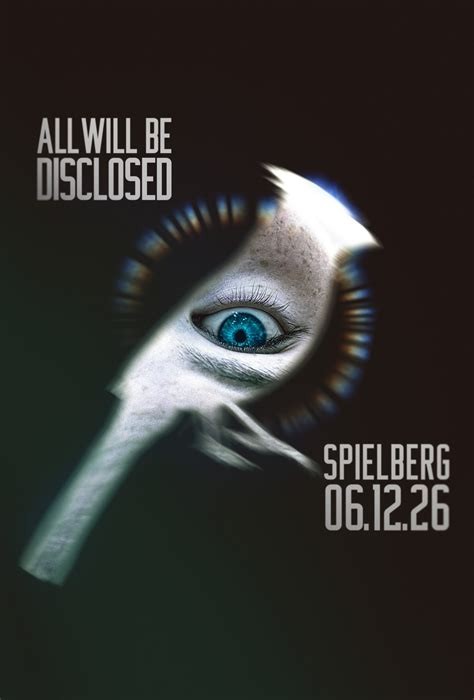
This is a pre-release review based on the official synopsis, poster art, teaser footage, and first-look promotional material released ahead of the film’s June 12, 2026 theatrical debut, not on a screening of the finished feature. Disclosure Day is officially billed as a thriller, created and directed by Steven Spielberg, written by David Koepp, and led by Emily Blunt, Josh O’Connor, Colin Firth, Eve Hewson, and Colman Domingo. (Disclosure Day)
Premise
Based on what has been released so far, Disclosure Day is not framing contact as a private encounter or a localized incident. Its premise is much larger. The latest official trailer now confirms a clearer plot spine: Daniel Kellner has stolen protected data about extraterrestrial life, Emily Blunt’s Kansas City weather broadcast becomes the public rupture point, and the film is explicitly organized around whether that truth should be released at all. (SYFY) The teaser material points to Emily Blunt becoming entangled with that revelation, while Josh O’Connor appears to embody the figure who believes the public has a right to know. That is a strong setup because it shifts the drama from “What did a few witnesses see?” to “What happens when certainty goes public?” (Disclosure Day)
What makes that premise especially potent is its choice of messenger. A meteorologist is already a translator of the sky. She stands between data, public trust, and atmospheric uncertainty. In other words, Spielberg seems to be turning the most ordinary form of sky interpretation, the weather report, into the vehicle for an ontological rupture. That is a very Spielbergian move: begin with the familiar, then let the impossible arrive through it. Even before release, the film looks less like a conventional invasion story and more like a revelation thriller about mediation, authority, and mass psychological shock. (People.com)
Unlike Close Encounters of the Third Kind, which portrayed contact as intimate and transcendent, Disclosure Day appears to examine mass psychological, political, and institutional reactions to revelation. Spielberg himself has stated that he has long believed extraterrestrial life is a “guarantee,” and the film engages with the modern public demand for transparency about what is happening in our skies. (gamesradar.com)
Cultural context
Disclosure Day emerges during a period of unprecedented public discourse about UAP. Since the U.S. government’s formal acknowledgment of unidentified aerial phenomena beginning in 2017 and subsequent congressional hearings, the subject has moved from fringe to mainstream geopolitical discussion. The film’s marketing, including a Super Bowl spot and cryptic urban billboards, positions it as an “event” centered on revelation rather than invasion. (hypebeast.com)
The title itself evokes the concept of “disclosure,” a term deeply embedded in modern UAP culture, referring to the moment governments publicly confirm non-human intelligence. Spielberg’s framing suggests a cinematic exploration of that threshold moment: not simply contact, but confirmation.
The film lands in a very specific cultural moment. In the 2020s, UAP discussion moved further into mainstream institutional life through open congressional hearings, bipartisan efforts to push UAP records into the public sphere, NASA’s independent UAP study, and ODNI’s annual reporting framework. At the same time, film and documentary culture adopted the same language of disclosure, including Dan Farah’s The Age of Disclosure. Spielberg himself has said public fascination with what is happening in the skies, and in our broader reality, has reached a “critical mass.” That makes the film feel less like a nostalgic return to 1977 and more like a cinematic response to a culture already primed for a disclosure narrative. (Reuters)
That context matters because Spielberg helped build the modern cinematic grammar of UAP awe in Close Encounters of the Third Kind, then later explored familial terror and collapse in War of the Worlds. Here, the available material suggests a synthesis of both modes. Josh O’Connor has already described the project as “old-school Spielberg,” while the trailer imagery leans toward secrecy, panic, and systems under stress rather than pure wonder. The result, at least in pre-release form, looks like a film about the social consequences of revelation rather than the simple spectacle of arrival. (People.com)
The first teaser leaned more toward awe and civilizational revelation. The official trailer leans harder into paranoia, secrecy, leak culture, and postwar buried truth. That means a stronger comparison not only to Close Encounters, but also to Roswell-inflected American myth and 1990s disclosure paranoia in the mold of The X-Files. That is one of the clearest evolutions in how the film is now being marketed. (Den of Geek)
Analytical perspective
Spielberg has historically treated extraterrestrials as mirrors reflecting human morality, fear, and wonder. Close Encounters framed contact as awe. E.T. framed it as empathy. War of the Worlds framed it as terror. Disclosure Day appears to synthesize these themes into a geopolitical and psychological drama about collective realization. If earlier films asked, “What if they arrive?” this one asks, “What happens when we are officially told they are already here?”
Analytically, Disclosure Day appears to be about information before it is about entities. The real subject may not be non-human intelligence itself, but how institutions manage the threshold between rumor and proof. That is why the teaser reportedly places a weather studio, a command center, police movement, folk-symbolic signs like crop circles, and religious witnesses such as nuns into the same visual field. The film seems interested in what happens when every explanatory system, media, government, science, religion, and ordinary domestic life, receives the same impossible signal at once. (People.com)
That is where the film feels culturally sharp. A classic contact narrative asks whether humanity is ready. Disclosure Day seems to ask a more contemporary question: which institution gets to narrate reality first? In a world of live feeds, leaks, hearings, expert panels, and competing truth claims, disclosure is no longer just a metaphysical event. It is also a crisis of authority. From a UAPedia perspective, that makes the film interesting not simply as entertainment, but as a cultural artifact of the disclosure era. It dramatizes the collision between witness experience, official messaging, public fear, and symbolic contagion. (NASA Science)
For UAP studies, this film is culturally significant regardless of its fictional status. Cinema shapes public expectation. Close Encounters influenced generations of witnesses. War of the Worlds reshaped invasion imagery in the post‑9/11 era. Disclosure Day arrives at a time when UAP are formally acknowledged by defense institutions.
In mythological terms, this is an apocalypse narrative in the literal Greek sense of the word: apokalypsis, meaning unveiling.
Symbolism
The poster is the clearest symbolic key so far. Its dominant image is a single blue, almost irradiated eye, partially obscured by a pale aperture or veil, accompanied by the command phrase “All Will Be Disclosed.” The eye works on several levels at once: witness, surveillance, awakening, exposure, and vulnerability. It also reverses the normal genre question. Instead of asking what we are seeing, the image suggests that we are the ones being seen. That is a subtle but powerful shift, because it relocates the drama from curiosity to judgment.
The trailer imagery deepens that symbolic system. The weather broadcast suggests the sky as public text. The breakdown of speech during a live report suggests language itself being interrupted by the unknown. Crop circles point to inscription, not just visitation. Wild animals entering bedrooms collapse the boundary between civilization and instinct. The nuns looking upward bring in the old theological question of annunciation, except here the “message from above” is coded as destabilizing rather than redemptive. Even the title matters. “Disclosure Day” sounds like a hybrid of policy language and apocalyptic calendar language, a date after which history is divided into before and after. (People.com)
Disclosure Day trailer and teaser symbolism
Steven Spielberg’s Disclosure Day teaser and Super Bowl trailer are constructed as symbolic architecture rather than simple promotion. Every frame appears calibrated to explore revelation, faith, psychological shock, and planetary scale disclosure.
Below is a structured decoding grounded in trailer details.
1. The Opening Question: Existential Initiation
The teaser begins with the question:
“If you found out we weren’t alone… would that frighten you?”
This is not framed as invasion. It is framed as knowledge. The emphasis is epistemological. The terror lies not in attack, but in confirmation. This aligns with Spielberg’s recent statements that Disclosure Day is about why people are now demanding answers about “what’s happening in our skies.”
Symbolically, the trailer begins with initiation. In religious literature, divine encounters begin with a destabilizing question. Here, the destabilizing agent is truth itself.
2. Religious Imagery: Crisis of Meaning
Early montage images include a crucifix clutched in someone’s hand. (gamesradar.com)
This is deliberate. The crucifix represents established cosmology. The question becomes whether contact destabilizes theology or fulfills it. Spielberg has long fused transcendence with extraterrestrial motifs, particularly in Close Encounters.
In Disclosure Day, faith appears reactive rather than welcoming. The imagery implies that institutional belief systems are about to be stress tested.
Apocalypse in Greek means unveiling. The trailer positions disclosure as theological rupture.
3. Roswell UFO Crash and Alien Bodies (NHI)
The official trailer shifts Roswell from background reference to probable narrative origin point. What earlier marketing left ambiguous now appears more structured: a 1947 desert recovery, a hidden chain of custody, and a secrecy apparatus that has endured for decades. In this framing, Roswell is not merely a familiar UAP symbol. It is the foundational concealment event from which the film’s modern crisis of disclosure emerges. That matters because Disclosure Day no longer reads simply as a story about first contact. It reads as a story about delayed truth, inherited secrecy, and the political instability created when a buried historical rupture can no longer be contained.
4. Emily Blunt’s Broadcast Interruption: Remote Interference
In the trailer Emily Blunt’s character appears to be overtaken during a live broadcast in a way that audiences around the world witness, and at least some coverage reads this as the surfacing of a hidden alien language.
This one of the most discussed scenes shows Emily Blunt’s meteorologist freezing mid broadcast and emitting inhuman sounds. This is typical of channeling, a remote connection technique that is a phenomena being reported since antiquity, and the sounds remind those emitted by Darryl Anka as he in starting to channel Bashar. (Note from the Editors)
This moment is critical. The interruption occurs during a weather report, an attempt to predict and control the sky. Symbolically, humanity believes it understands the heavens. The sky then overrides the messenger.
The inhuman vocalization suggests signal intrusion or neurological override rather than physical attack. It also suggests a translation of sorts. This theme is reinforced by reports of persistent clicking sounds associated with the unseen beings in later footage. (gamesradar.com)
Silence and sound design are emphasized in the Super Bowl breakdown, noting hovering craft with no audible propulsion. (disclosureday.nicedreamzwholesale.com)
The unknown communicates through distortion, not language. In mythic traditions, divine contact often overwhelms the nervous system before conveying message.
5. Crop Circles: Geometric Intelligence
The Super Bowl trailer shows massive geometric crop formations appearing overnight across farmland. (disclosureday.nicedreamzwholesale.com)
This is a direct invocation of decades of UAP lore. Geometric precision symbolizes intentional mathematics. Geometry historically functions as sacred language in both religious architecture and esoteric cosmology.
The juxtaposition of silent hovering craft and ground level geometric inscriptions suggests multi-channel communication. Sky presence plus terrestrial imprint.
It is revelation encoded spatially.
6. The Whistleblower Motif: Disclosure as Moral Imperative
Josh O’Connor’s character states:
“People have a right to know the truth. It belongs to 7 billion people.”
The phrasing reframes contact as withheld knowledge rather than surprise arrival. The number seven billion emphasizes planetary inclusion. Disclosure is democratized revelation.
This connects directly to contemporary cultural momentum around UAP transparency, which the film’s marketing reportedly coincided with during the rise of disclosure focused documentaries. (theguardian.com)
The central tension appears not to be aliens versus humanity. It is secrecy versus humanity.
7. Hovering Craft and Close Encounters Echo
Reports note visual resemblance between the mothership imagery and the luminous rounded craft of Close Encounters of the Third Kind. (disclosureday.nicedreamzwholesale.com)
This is not nostalgia alone. It creates intertextual continuity. In 1977, contact was intimate and musical. In 2026, contact is public and geopolitical.
Spielberg appears to be evolving his own mythology.
Close Encounters asked what if they arrive.
Disclosure Day asks what if we are officially told.
8. The Tagline: Ownership of Truth
The Super Bowl spot closes with the title and the line:
“The truth belongs to seven billion people.”
This is a sovereignty statement. It implies knowledge has been centralized. The ethical frame is transparency.
In mythological structure, this mirrors Promethean themes. Fire once restricted becomes universal.
9. Silence as Presence
The Super Bowl trailer emphasizes hovering vessels with no attack and no sound.
Silence becomes the dominant signal. Historically in UAP accounts, witnesses often report suppressed ambient sound or altered acoustics. Spielberg weaponizes that psychological cue.
The absence of overt hostility destabilizes conventional invasion expectations.
Ambiguity produces fear.
10. The Human Core
Despite the unsettling imagery, cast members have described the script as deeply emotional and centered on humanity. (theguardian.com)
This is essential. Spielberg consistently uses extraterrestrial presence to interrogate human moral capacity. Disclosure Day appears to test whether humanity can metabolize planetary scale truth without fracturing.
11. The Animals and the House in the Forest
The trailer’s final scene works less as a literal abduction and more as Spielberg invoking abduction imagery without fully committing to it. Throughout the teaser, deer and a cardinal appear as uncanny figures, culminating in a child approaching a glowing house in the snow. This imagery echoes the “screen memory” concept in abduction lore, where comforting symbols soften overwhelming events. However, unlike typical accounts where screen memories conceal something that already occurred, here the animals seem to guide the child toward a threshold. This shift reframes the moment as a ritual crossing, with a child’s imagination transforming the unknown into something survivable. (The Direct)
Seen this way, the scene draws on shared symbolism where abduction lore, fairy tales, and initiation myths intersect. The snow evokes silence and erasure; the animals act as guides between worlds; and the bright house feels less like true refuge and more like a false promise of safety at the edge of the unknown. If tied to Emily Blunt’s character’s childhood, Spielberg may be portraying not the event itself but the mind’s first symbolic version of it. The shot’s power lies in this ambiguity, blending the emotional truth of screen memories with mythic initiation rather than a straightforward abduction reenactment.
Integrated interpretation
The trailer encodes four layered themes:
- Epistemological shock;
- Religious destabilization;
- Neurological or consciousness interference; and
- Institutional secrecy versus global transparency.
It is structured not as invasion cinema but as unveiling cinema.
The beings are less visually defined than their psychological impact. That restraint suggests Spielberg understands that the most destabilizing contact scenario is not destruction. It is undeniable confirmation.
Preliminary verdict
On pre-release evidence alone, Disclosure Day looks promising because it appears to understand that the deepest modern fear is not merely contact. It is uncontestable proof. Spielberg seems to be returning to UAP cinema with less innocence than in Close Encounters, less brute catastrophe than in War of the Worlds, and more interest in the psychic and political consequences of revelation itself. If the finished film sustains the tension implied by the poster, the trailer, and the synopsis, it could become one of the defining pop-cultural meditations on the disclosure age. If it fails, it will likely fail by over-explaining what is currently most compelling about it: the instability of certainty. Either way, its premise is strong, its symbolic vocabulary is rich, and its timing is exceptionally intelligent. (Disclosure Day)
Additional Details
In the latest official trailer released on March 12, 2026, Disclosure Day now appears less like a purely abstract meditation on revelation and more like a Roswell-anchored secrecy thriller. The trailer frames Daniel Kellner as a leaker carrying protected data about non-human life, while Emily Blunt’s Kansas City meteorologist becomes the medium through which an apparently non-human language breaks into public view. That sharpens the film’s core theme: disclosure is not just about contact, but about translation, legitimacy, and who has controlled the truth since the postwar era. Colin Firth’s character appears to embody the order-preserving response, arguing that full disclosure would destabilize the world itself. (Motion Picture Association)
There also appears to be Remote Viewing and Projection in the interjection between Colin Firth’s and Eve Hewson’s characters. A reminder of Stargate Project from the US Government and SRI (Stanford Research Institute) led by Hal Puthoff and Russell Targ, and the techniques developed by Robert Monroe now used by his Institute near Washington D.C.. (Note from the Editors)
References
Universal Pictures. (2025, December 16). Disclosure Day | Official teaser [Trailer]. YouTube. (YouTube)
Universal Pictures. (n.d.). Disclosure Day | Synopsis. Disclosure Day official movie site. Retrieved March 6, 2026. (Disclosure Day)
Johnson, N. (2025, December 16). Disclosure Day’s animal twist hints at the movie’s true plot. The Direct. (The Direct)
McArdle, T. (2025, December 16). Steven Spielberg drops first trailer for his mysterious UFO movie with Emily Blunt and Josh O’Connor. People. (People.com)
Blackwood, E. (2025, December 20). Disclosure Day: Everything we know so far about Steven Spielberg’s mysterious alien movie. People. (People.com)
McArdle, T. (2026, February 9). Steven Spielberg says belief in aliens has reached a “critical mass”. People. (People.com)
National Aeronautics and Space Administration. (2023). Unidentified Anomalous Phenomena Independent Study Team final report. NASA. (NASA Science)
Office of the Director of National Intelligence. (2024, November 14). 2024 consolidated annual report on Unidentified Anomalous Phenomena. ODNI. (ODNI)
Reuters. (2022, May 17). U.S. officials say Pentagon committed to understanding UAP. Reuters. (Reuters)
Reuters. (2023, July 14). Senators move to require release of U.S. government UAP records. Reuters. (Reuters)
Universal Pictures. (n.d.). Disclosure Day | Synopsis. Disclosure Day official movie site. Retrieved March 6, 2026. (Disclosure Day)
Johnson, N. (2025, December 16). Disclosure Day’s animal twist hints at the movie’s true plot. The Direct. (The Direct)
Associated Press. (2023, September 14). NASA says more science and less stigma are needed to understand UAP. AP News. (AP News)
Amblin Entertainment. (2026, March 12). Disclosure Day | Official Trailer. (Amblin Official Site)
ABC Audio. (2026, March 12). ‘Disclosure Day’: Watch official trailer for Steven Spielberg film. (B107 The Blaze)
The Credits. (2026, March 12). Steven Spielberg’s “Disclosure Day” trailer teases aliens, secrets, and a world-shaking reveal. (Motion Picture Association)
George, J. (2026, March 12). Disclosure Day trailer: Steven Spielberg brings ’90s paranoia into 2026. Den of Geek. (Den of Geek)
UAPedia. (2026, updated February 25). UAPedia Editorial Standards – Navigating the Mystery. (UAPedia – Unlocking New Realities)
UAPedia. (2025, December 5). How UAPedia Treats Government Sources. (UAPedia – Unlocking New Realities)
SEO keywords
Disclosure Day review, Steven Spielberg Disclosure Day, pre-release review Disclosure Day, UAP cinema Spielberg, disclosure narrative film, Emily Blunt Disclosure Day, UAP symbolism in film, Disclosure Day cultural context, Spielberg non-human intelligence thriller, Disclosure Day poster analysis, Colin Firth Disclosure Day, Disclosure Day revelations