Biblical visions are not modern incident reports. They are older, stranger, and in some ways more useful than that.
Useful, because they preserve recurring human reactions to overwhelming anomalies: light, fear, collapse, voices, altered perception, the sense of a presence with intent. Useless, if we force them into the wrong genre and start treating prophetic literature like cockpit video. Our own editorial standard is blunt about this.
It requires explicit separation between evidence and interpretation, and it classifies cultural or religious narratives presented as such under “Legend” unless stronger evidentiary grounding exists. It also warns that government sources are inputs, not verdicts.
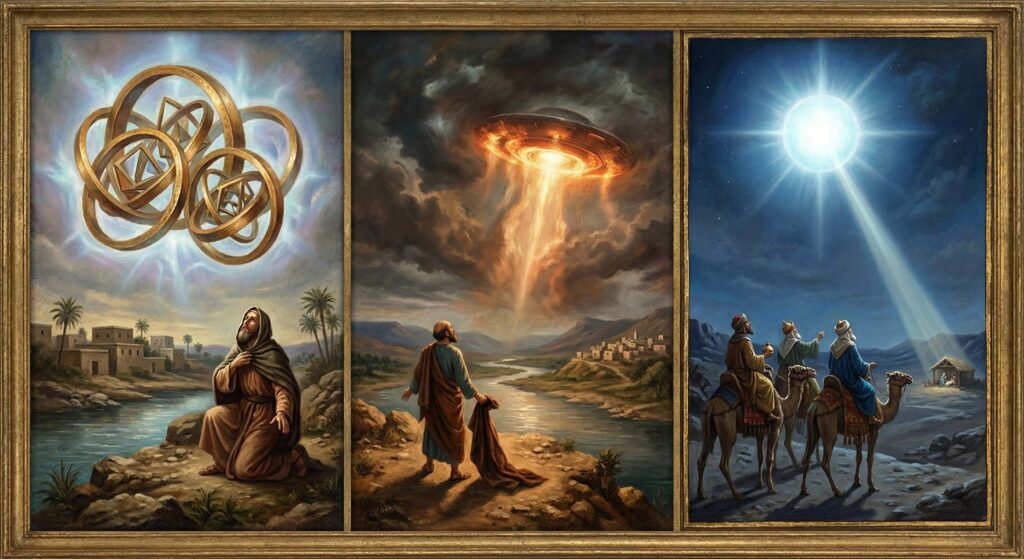
So the right claim is not “the Bible proves UAP.” The right claim is narrower: Biblical vision narratives can be read as comparative phenomenology. They preserve recurring encounter motifs that overlap, sometimes strikingly, with motifs found in modern UAP witness literature. That overlap is worth studying. It is not the same thing as proving a shared cause.
Start with a transparent sample, not a mystical spreadsheet
To keep this honest, we use a small anchor sample of eight passages rather than a sprawling “everything biblical” corpus: Ezekiel 1, Exodus 19–20, Exodus 3, 2 Kings 2, Daniel 10:4–9, Acts 9, Matthew 17, and Revelation 1. I am only coding four features that are comparatively clean: luminous manifestation, explicit communication, strong witness impact, and shared scene or multiple witnesses. I am not using “structured form” as a main variable here because it blends vehicles, thrones, clouds, and visionary architecture into one bucket, and that is exactly the sort of category inflation that muddies analysis.
Here is the small data deck:
| Passage | Luminous manifestation | Communication | Strong witness impact | Shared scene / multiple witnesses |
|---|---|---|---|---|
| Ezekiel 1 | Yes | Yes | Yes | No |
| Exodus 19–20 | Yes | Yes | Yes | Yes |
| Exodus 3 | Yes | Yes | Yes | No |
| 2 Kings 2 | Yes | No explicit message | Yes | Yes |
| Daniel 10:4–9 | Yes | Yes | Yes | Yes |
| Acts 9 | Yes | Yes | Yes | Yes |
| Matthew 17 | Yes | Yes | Yes | Yes |
| Revelation 1 | Yes | Yes | Yes | No |
Under this rubric, light appears in all eight cases, explicit communication in seven, strong witness impact in all eight, and shared or group witnessing in five. That is not a hard scientific finding. It is a reproducible textual coding judgment under a stated rubric, and I would still want a second coder before treating the counts as anything more than a disciplined first pass.
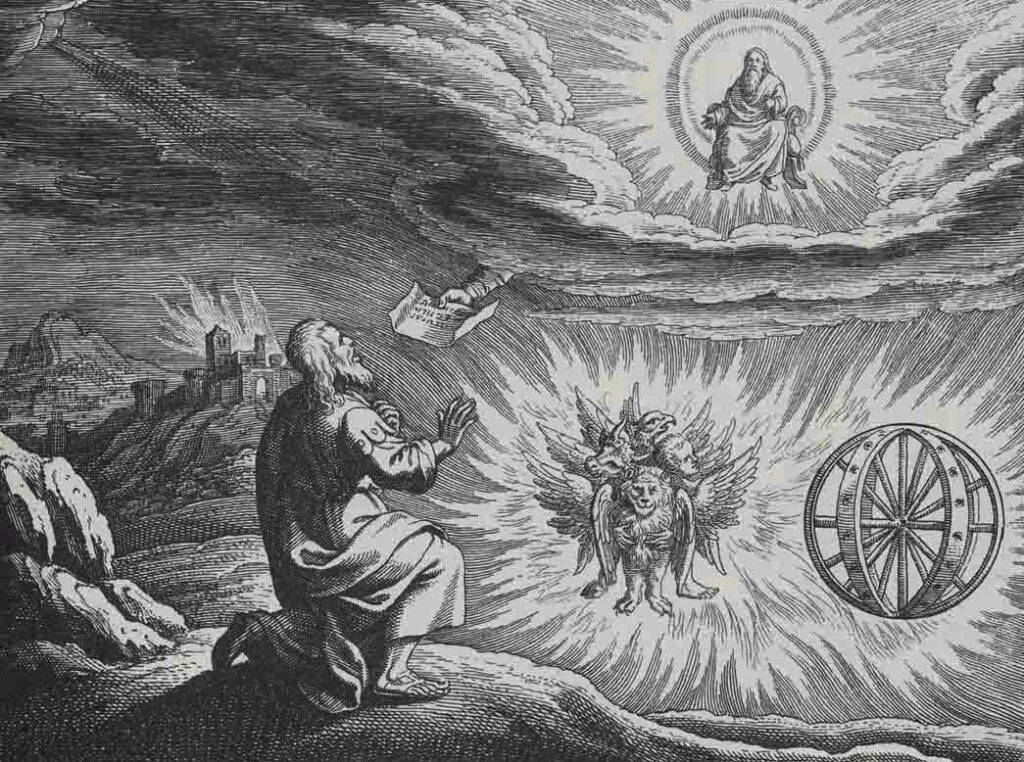
The underlying passages are not subtle. Ezekiel’s inaugural vision gives fire, brightness, living beings, and the famous wheel imagery; Sinai gives thunder, lightning, cloud, smoke, fire, trumpet-sound, and collective trembling; the burning bush gives localized flame, voice, and fear; Elijah’s departure gives a chariot of fire and whirlwind; Daniel 10 preserves differential perception in a group; Acts 9 gives light, voice, collapse, and temporary blindness; the Transfiguration gives bright cloud, voice, and terror; Revelation 1 gives radiant appearance and collapse “as though dead.” (biblegateway.com)
That, by itself, is already interesting. It says the overlap is strongest not at the level of “craft shape,” but at the level of luminous manifestation, message transfer, and bodily disruption.
Ezekiel: the case everyone reaches for, and why context matters more than novelty
If you ask people for the most UAP-like Biblical vision, they almost always say Ezekiel. The instinct is understandable. The scene moves. It glows. It has complex forms. It feels engineered even when read devotionally.
But the most important thing about Ezekiel is not that later readers thought it looked mechanical. It is that mainstream scholarship places him firmly in an exilic Babylonian context. Oxford’s Handbook of Ezekiel notes that the book explicitly locates its material in Babylon between 593 and 571 BCE. Laurie Pearce’s essay for TheTorah adds that Ezekiel lived and prophesied much of his adult life in Babylonia, in contact with cuneiform scholars and scribes, and that Akkadian loanwords and Mesopotamian cosmological influence matter for interpretation. (OUP Academic)
That changes the conversation. Ezekiel is not best read as a primitive observer groping for “spaceship” language. He is a highly symbolic, culturally saturated witness working inside a world of thrones, divine transport, cosmic imagery, and imperial spectacle. In other words, the text is dense with meaning before any UAP reader touches it.
Still, the phenomenological overlap remains. Ezekiel preserves a storm-front opening, intense radiance, nonhuman figures, synchronized motion, and a witness who is physically overwhelmed. What can responsibly be said is this: Ezekiel is one of the strongest ancient examples of a narrative that combines sensory intensity, structured movement, and message-bearing presence in one scene. What cannot responsibly be said is that the passage has thereby become a verified technological case.
Evidence
The text describes brightness, fire, motion, beings, and the wheels. That is straight from the passage. (biblegateway.com)
Witness interpretation
Ezekiel frames the event as a divine vision. That frame is part of the data, not a nuisance to be stripped away.
Researcher opinion
Scholarly interpretation anchors the passage in Babylonian exile context and symbolic tradition, not in modern aerospace categories. (OUP Academic)
Hypothesis
A UAP comparison remains legitimate at the level of recurring encounter form: luminous manifestation, agency, and bodily overload. Ontology remains open.
Mount Sinai and the mass-event problem
Mount Sinai matters because it is not a solitary prophet by a river. It is a crowd event. The narrative stacks thunder, lightning, thick clouds, smoke, fire, loud sound, trembling ground, and intense communal fear. Even if you read it strictly as theology, it behaves like a collective anomaly narrative. (biblegateway.com)
That makes the event at Mount Sinai valuable for UAP-style analysis for one reason: shared witness scenes are rare and analytically messy. They are stronger than purely private visions in one sense, but they are also vulnerable to social amplification, expectation, and religious framing. Our own handling of Fátima takes exactly that line. The crowd size helps, but it does not solve interpretation; it just changes the kind of problem you are looking at. (UAPedia – Fatima)
Sinai also reminds us that the lasting impact may be more important than the visible stimulus. The event is followed by law, boundary, hierarchy, ritual, and durable collective memory. In modern UAP terms, aftereffects matter. A strange light in the sky is one thing. A strange light that reorganizes a people is another.
Elijah, Daniel, and Paul: three different anomaly profiles
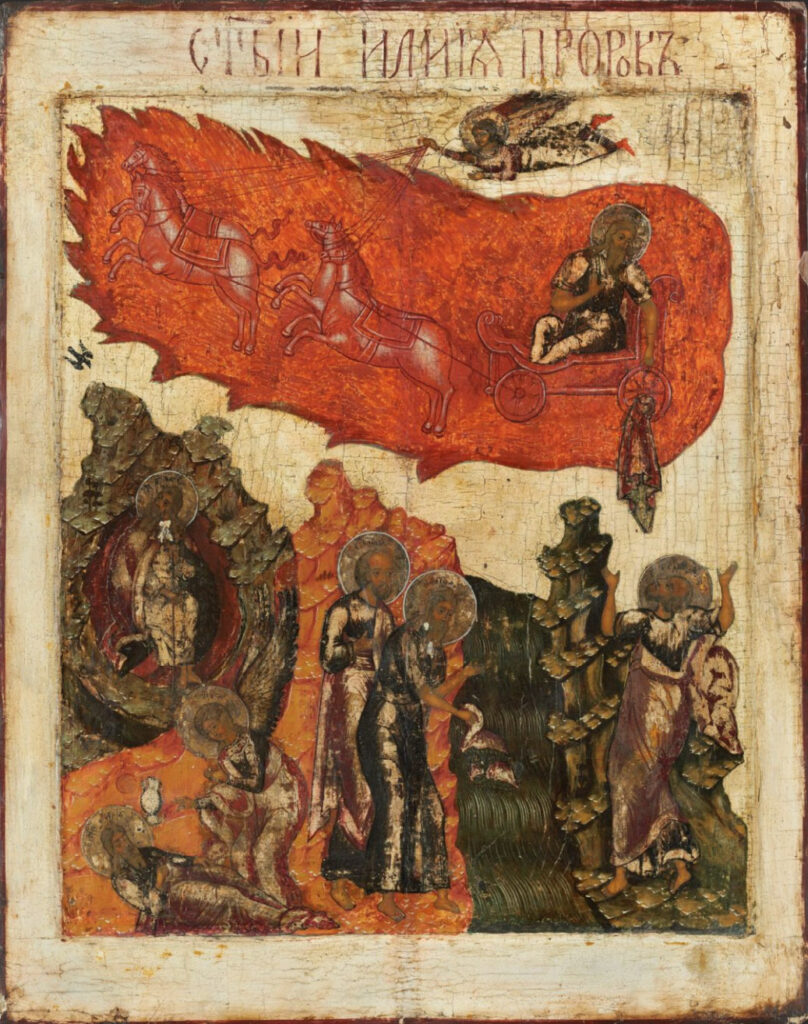
Elijah’s ascent in 2 Kings 2 is the cleanest “vehicle-like” scene in the Biblical corpus. The narrative gives a chariot of fire, horses of fire, separation of two witnesses, and a whirlwind translation. If one insists on discussing Biblical “conveyance” motifs, this is the passage to do it with. Yet even here, caution matters. The text is still a sacred narrative, not a chain-of-custody document. (biblegateway.com)
Daniel 10 is fascinating for a different reason. Daniel reports the vision, but the men with him do not see it. They do, however, panic and flee. That uneven distribution of perception is one of the most intriguing overlaps with later anomalous reports, where a group agrees something happened but not all witnesses share the same sensory content. The passage explicitly preserves terror in the group and collapse in the primary witness. (biblegateway.com)
Acts 9, the Damascus Road account, is where the discussion shifts from spectacle to transformation. The text gives a flash of light, a voice, a fall to the ground, companions present, and afterward, temporary blindness and a life-altering conversion. Whatever explanation a reader prefers, this is not a throwaway scene. It preserves a stimulus, an intelligible message, a physiological effect, and a permanent behavioral aftermath. (biblegateway.com)
The common thread across Elijah, Daniel, and Paul is not “craft.” It is an encounter structure. A scene breaks ordinary perception, carries intent, and leaves a marked human consequence.
Merkabah: when a vision becomes a method
The afterlife of Ezekiel is almost as important as Ezekiel himself. A Merkava, or Merkabah, is the throne or chariot of God described in Ezekiel 1, and says it became an object of visionary contemplation for early Jewish mystics. That is a major historical clue. An encounter narrative did not remain an isolated text. It became a contemplative technology. (Encyclopedia Britannica)
That matters for UAP studies because it shows a recurring human pattern. When people believe an anomaly opens onto a deeper intelligence, they do not simply archive the report. They build practices around re-contact. Merkabah mysticism is one of the clearest ancient examples of that move.
This is also where the comparative lens becomes genuinely useful. Modern contact culture, remote-viewing culture, and older ascent traditions all circle the same human question: can consciousness become a channel, and if so, what is on the other side?
Publications that keep this conversation out of the theological basement
Several modern works matter here, not because they “prove” Biblical visions are UAP, but because they legitimize the comparative frame.
Jacques Vallée and Chris Aubeck’s Wonders in the Sky surveys more than 500 historical reports from biblical-age antiquity through 1879, which is precisely the sort of time-depth that keeps the subject from collapsing into a purely post-1947 conversation. Diana Walsh Pasulka’s American Cosmic examines how belief in extraterrestrial intelligence, technology, and the sacred can function in overlapping cultural space. Rice University’s Archives of the Impossible explicitly frames the UAP problem as historical, cultural, religious, and scientific, not merely technological. (Google Books)
That intellectual shift matters. It says the question is no longer, “are religious narratives too embarrassing to compare?” The better question is, “how do we compare them without flattening them?”
The controversies are where the article becomes honest
The first controversy is genre. Ezekiel is not Sinai, Sinai is not Acts, and Acts is not Revelation. Dream reports, call narratives, public theophanies, and apocalyptic visions should not be mashed into one undifferentiated folder.
The second is coding. Even in a careful rubric, the moment you create a column called “vehicle,” “entity,” or “structured form,” interpretation rushes in. That is why I kept the coding deck narrow and treated the result as probable and reproducible under a stated rubric, not as verified fact.
The third is an explanation. A phenomenological overlap does not prove a common source. Shared human neurobiology, shared religious archetypes, genuine anomalies, environmental triggers, and cultural transmission can all contribute.
The fourth is social effect. Reframing Biblical visions through UAP comparison can be illuminating, but it also tempts readers into overconfidence. Ancient texts are not weaker because they are theological. They are harder because meaning is built into the report from the start.
What follows if the overlap is real
If the overlap between Biblical visions and modern UAP encounters is not accidental, three implications follow.
First, the UAP problem may be older than the aerospace age, but not older in a simplistic “ancient astronauts” sense. Older, rather, in the sense that human beings may have been encountering recurring luminous, intelligence-bearing anomalies for a very long time, then translating them through the symbolic languages available to them.
Second, the communication layer may matter more than the display layer. In the small sample above, voice or message is almost as persistent as light. That should get more attention in UAP studies, which often over-focus on objects and under-focus on information transfer.
Third, institutions form around anomalies. Sinai becomes covenant. Ezekiel becomes Merkabah. Paul’s encounter becomes mission. Modern UAP events become programs, archives, hearings, and policy. The anomaly is not just what appears. It is what gets built afterward.
Claims taxonomy
| Claim | Classification | Why |
|---|---|---|
| The selected passages can be coded for recurring motifs under the rubric used here | Probable | Reproducible under a stated rubric, but still interpretive and not strong enough for “Verified” |
| Ezekiel is situated in Babylonian exile context in mainstream scholarship | Verified | Supported by Oxford and TheTorah treatments of Ezekiel’s Babylonian setting and cultural milieu (OUP Academic) |
| Merkabah contemplation grew historically out of Ezekiel’s chariot imagery | Probable | Strongly supported reception-history claim, but still a historical development rather than an instrument-verified event claim (Encyclopedia Britannica) |
| The CIA contracted AIR to supervise and conduct the remote-viewing evaluation | Verified | Stated directly in the AIR report (alice.id.tue.nl) |
| Biblical visions and modern UAP encounters share meaningful phenomenological overlap | Probable | The overlap is visible in light, communication, and witness-impact motifs, but cause remains unresolved |
| Biblical visions are best explained as literal technological contact by nonhuman craft | Disputed | Possible as an interpretive model, but not demonstrated by the textual record |
| Biblical visions, when used as direct historical proof of ancient technological visitation, exceed the evidentiary threshold | Legend | UAPedia’s taxonomy reserves stronger labels for better-corroborated event claims (UAPedia – Unlocking New Realities) |
Speculation labels
Evidence
The selected passages preserve repeated motifs of light, communication, and strong witness impact. That is a textual observation under the stated rubric, not a claim about ultimate cause. (biblegateway.com)
Witness Interpretation
The witnesses themselves interpret these scenes as divine presence, revelation, judgment, commissioning, or transformation. In Biblical material, interpretation is part of the event record, not an optional gloss.
Researcher Opinion
Historical scholarship strongly supports Ezekiel’s Babylonian context, and reception history strongly supports Merkabah’s development out of Ezekiel’s chariot imagery. Modern UAP-adjacent scholarship and archiving have increasingly treated religious and anomalous experience as overlapping cultural fields worth studying together. (OUP Academic)
Hypothesis
Some Biblical vision narratives may preserve culturally translated reports of anomalous encounters whose phenomenology overlaps with modern UAP witness narratives. That remains a hypothesis. The overlap is real at the motif level; the ontology is still disputed.
References
Bodi, D. (2020). The Mesopotamian context of Ezekiel. In The Oxford Handbook of Ezekiel. Oxford University Press. (OUP Academic)
Encyclopaedia Britannica. (2026). Merkava. (Encyclopedia Britannica)
Mumford, M. D., Rose, A. M., & Goslin, D. A. (1995). An evaluation of remote viewing: Research and applications. American Institutes for Research. (alice.id.tue.nl)
Pasulka, D. W. (2019). American Cosmic: UFOs, religion, technology. Oxford University Press. (Google Books)
Pearce, L. (2017). Ezekiel: A Jewish priest and a Babylonian intellectual. TheTorah.com. (The Torah)
Rice University. (2025). Archives of the Impossible. (Title of Site | Rice University)
Vallée, J., & Aubeck, C. (2010). Wonders in the sky: Unexplained aerial objects from antiquity to modern times. (Google Books)
SEO keywords
Biblical visions UAP, Ezekiel wheel comparative phenomenology, Merkabah mysticism Ezekiel, Sinai theophany anomaly analysis, Elijah chariot of fire UAP, Daniel 10 differential witness perception, Damascus Road light voice event, Revelation 1 radiant encounter, religious experiences UAPedia, ancient anomalous encounters, consciousness and UAP, Biblical visions and nonhuman intelligence, witness impact in scripture, comparative UAP phenomenology