
In February 2007, the Daily Princetonian described a small laboratory “nestled in the austere depths” of Princeton’s Engineering Quadrangle, decorated with new-age posters, experimental apparatus, and stuffed animals. Then it reported the moment the spell broke: university staff dismantled the space and the doors closed “for good.” (The Princetonian)
For nearly three decades, Princeton Engineering Anomalies Research (PEAR) operated as an anomaly inside one of the world’s most status-sensitive ecosystems: an Ivy League engineering school. Its founder, Robert G. Jahn, was not a fringe outsider. He was Princeton engineering faculty, former dean, and a recognized pioneer in electric propulsion. (Princeton University)
PEAR’s wager was simple to state and hard to defend: a human mind, under controlled conditions, could correlate with or slightly bias physical systems designed to behave randomly. The lab built random event generators (REGs), used mechanical “cascade” devices (ball bearings dropping through channels), and ran a long series of experiments in “remote perception” (a protocol adjacent to remote viewing). (Princeton University)
The reason PEAR still matters is not that it “proved” anything to everyone. It did not. The reason it matters is that it produced one of the most persistent, quantified, and publicly debated datasets in modern mind–matter research, and it did so under a famous university name. (Princeton University)

The baseline facts we can report with high confidence
PEAR existed, Princeton housed it, and Princeton constrained it
Princeton’s own obituary for Jahn states that PEAR began by 1979, that Jahn hired Brenda Dunne to run it, and that it pursued experiments testing whether intention could affect physical randomness (including ball-bearing cascade devices). (Princeton University)
That same obituary also records the institutional compromise that defined PEAR’s later years: Jahn reached an agreement with administrators so he could continue, but only with private funding and without graduate students. (Princeton University)
The Daily Princetonian likewise reported that PEAR received “almost no funding” from the university and survived on private donations, naming several benefactors in its account of the lab’s final weeks. (The Princetonian)
Those three points (existence, housing, and constraint) are the spine. They are not speculative.
What PEAR actually published (and how big the effects were)
A central weakness in many write-ups about PEAR is the leap from “statistically significant” to “scientifically settled.” PEAR’s own material repeatedly indicates small effect sizes, made visible by very large trial counts, and interpreted through statistical aggregation. (pear-lab.com)
Below is a snapshot using PEAR’s reported numbers, with the appropriate caveat: these are largely PEAR-authored primary sources, often hosted on PEAR/ICRL-affiliated archives. They are valuable as records of what PEAR claimed and how PEAR computed it, but they are not independent audits. (Princeton University)
REG experiments: intention vs. randomness
Key PEAR-reported scale:
- One long-running operator: 62 independent experimental series, 120,000+ trials per intention (24 million samples per intention), with reported terminal probabilities far beyond conventional thresholds.
- The broader database: 91 operators, 522 series, ~2.5 million trials, with regression/ANOVA reporting “operator intention… highly significant (p = 5×10⁻⁴).”
Effect size reality check (from PEAR itself):
In The PEAR Proposition (a PEAR-authored retrospective), Jahn and Dunne describe the “anomalous effect sizes” as quite small, “of the order of 0.002 bits/bit deviation from chance,” even while arguing the statistics accumulate to strong significance. (pear-lab.com)
Early “headline” numbers (1987 technical paper):
In Engineering Anomalies Research, PEAR reports multiple experimental series on a pseudorandom source as statistically significant, including a statement that 29 experimental series using that pseudorandom source were significant with a “probability against chance” of .003.
What this means, without mythology:
PEAR’s published story is not “mind easily bends matter.” It is “a small but consistent deviation emerges when huge datasets are aggregated, and we interpret the pattern as intention-correlated.”
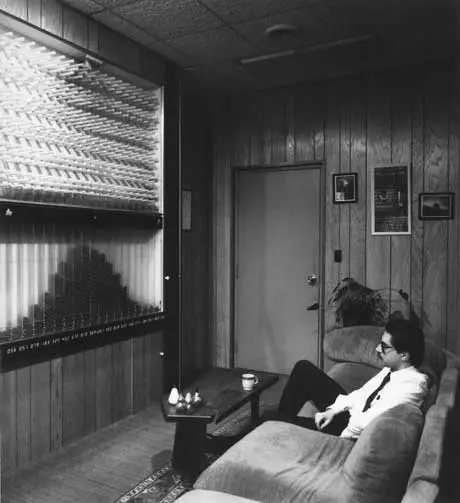
Mechanical cascades: a macroscopic “reality check”
PEAR did not confine itself to electronics. Princeton’s obituary notes ball bearings dropped through channels as one experimental approach. (Princeton University)
In the 1995 overview, Dunne and Jahn also claim that a “large-scale random mechanical cascade apparatus” showed “marginal but statistically significant operator-specific correlations,” comparable in character (if not convenience) to the microelectronic REG work.
This mattered rhetorically because it aimed to counter the criticism that “your randomness source is just quirky electronics.” But it also opened PEAR to a different criticism: macroscopic systems introduce more uncontrolled variables, and “random-looking” does not automatically mean “well-modeled and stable.” That debate remains part of why macroscopic work never became a mainstream pivot point.
Remote perception: the PRP database
PEAR’s remote perception program is often blurred with government remote viewing history.
The remote perception paper (archival form published as a Journal of Scientific Exploration article) summarizes decades of PRP trials and presents several large statistical summaries.
The authors’ own caution flags inside the dataset:
The paper explicitly worries about possible inflation from earlier “ex post facto” trials and re-runs analyses on the “formal ab initio” subset to argue the “bottom-line yield… cannot be discounted” as mere inflation. (ICRL)
Distance and time:
The same paper states there is “no evidence” for certain dependencies (often summarized as no significant correlation of effect size with distance or time), a point frequently used to argue for “nonlocality.” That is PEAR’s reported outcome, not a consensus conclusion. (ICRL)
FieldREG: group settings and “consciousness field” language
PEAR’s FieldREG work is where the lab’s claims became most socially legible: put REG devices into emotionally “resonant” environments (rituals, performances, ceremonies, etc.) and test whether deviations cluster differently than in mundane contexts.
In The PEAR Proposition, Jahn and Dunne report that FieldREG units in “resonant” venues displayed displacements at a collective chi-square level with chance probability 3.23×10⁻¹⁰, and they say they had “a substantial database of several hundred such applications.” (pear-lab.com)
Important tightening (per your fact-check): that FieldREG summary is a PEAR-authored retrospective, not an independent audit, and even within that text the authors acknowledge interpretive challenges (null criteria, calibration procedures, indicator choice) that were “yet to be pursued systematically.” (pear-lab.com)
The strongest criticism: not “they never had data,” but “the data do not settle the claim”
A fair investigative article has to treat criticism as more than a vibe. Here is the most load-bearing critical line of attack, represented cleanly by Stanley Jeffers’ Skeptical Inquirer piece.
Jeffers’ core critique in plain language
Jeffers does not claim PEAR “fabricated” its program. He treats PEAR as a serious claimant. But he argues that methodological and interpretive issues undermine the conclusion that mind caused the observed deviations.
Two points from Jeffers are especially relevant:
- Replication difficulty: Jeffers states that if the claim is credible, other groups should replicate it, and he describes a three-lab replication effort (“Mind/Machine Interaction Consortium”) that he says failed to reproduce the effects, even reporting that PEAR itself could not reproduce a “credible effect” in that context.
- Baseline behavior: Jeffers argues that PEAR’s published baseline behavior sometimes appears problematic under PEAR’s own criteria, and he frames this as a reason to question whether the device and/or analysis pipeline behaves as assumed.
Those criticisms do not erase PEAR’s reported anomalies. They undercut any claim that the case is closed.
PEAR’s own “small effects” amplify the dispute, not resolve it
A critical nuance your fact-check correctly flags: even PEAR describes effects as small. (pear-lab.com)
Small effects are not automatically meaningless. But they are especially vulnerable to subtle biases, device drift, selection effects, analytic flexibility, and what later fields (psychology, biomedicine) now routinely treat as replication stress tests. Jeffers’ criticism lands harder precisely because PEAR’s effects are not the kind you can see in a short demonstration.
Princeton itself documents the social controversy
Princeton’s obituary states PEAR set Jahn “at odds with many colleagues,” some objecting to any such research on campus, and that the “private funding/no graduate students” agreement followed. (Princeton University)
This is not proof PEAR was wrong. It is proof PEAR never achieved institutional consensus inside its host environment.
Government involvement: tighten the claim to what the evidence supports
This section is where many articles overreach. Here is the tightened version:
What we can say confidently
- PEAR operated under private funding constraints at Princeton and was not a normal, university-funded graduate research pipeline. (Princeton University)
- Government agencies have, at various times, shown interest in adjacent topics like remote viewing and parapsychological techniques. (That is historically documented in multiple public sources, including government-commissioned reviews.) (National Academies)
What we should not imply without stronger evidence
- That PEAR was a government program. The evidence you provided supports government-adjacent interest, not “government involvement” in the operational sense. (Princeton University)
The Star Gate clarification
A particularly important corrective: in a 2007 interview context discussing remote viewing history, Brenda Dunne is explicitly described as entirely unaffiliated with the Star Gate program. (Believer Magazine)
That does not mean PEAR had no overlap in ideas, methods, or personnel networks with the broader psi ecosystem. It means we should not collapse distinct programs into one narrative.
Cases and case studies: what an investigator would actually examine
If you were building a real “PEAR case file,” you would not just list p-values. You would ask what could generate the appearance of a persistent anomaly.
Case Study A: “Operator 10” and the long-run intention database
Evidence: PEAR reports 62 independent series over ~12 years, >120,000 trials per intention, with persistent directional trends and baseline near theoretical expectation.
Critical questions:
- How stable was the device calibration across years?
- How many analytic forks existed (intention assignment modes, run length, feedback modes), and how were they corrected for?
- What is the “file drawer” exposure (unreported sessions, abandoned runs)?
PEAR argues robustness across protocol variation. Critics argue robustness is exactly what long-run analytic flexibility can simulate if controls are imperfect.
Case Study B: “Baseline bind” as either psychological effect or device artifact
Evidence (PEAR’s own framing): The 1995 overview notes baselines “almost too well behaved” and references prior discussion.
Criticism: Jeffers reframes baseline behavior as potentially indicating nonrandomness in the device or analysis, which would contaminate intention comparisons.
Unresolved: Whether baseline anomalies are psychological, instrumental, analytic, or some mixture is not settled in the public record.
Case Study C: Binary PRP, ab initio vs. ex post facto
Evidence: PRP tables show strong composite z-scores and probabilities for “all trials” and a still-strong (though reduced) effect for “formal ab initio” subsets. (ICRL)
Built-in concern (from PEAR): The authors explicitly worry that ex post facto methods could inflate and attempt to demonstrate robustness without them. (ICRL)
Critical questions:
- Were target pools and judging protocols pre-registered? (In that era, generally not in the modern sense.)
- How many scoring methods were tried before the published one became “standard”?
- How did experimenter expectations influence judging?
Case Study D: FieldREG and the risk of narrative-driven analysis
Evidence: PEAR reports a strong chi-square significance for resonant vs mundane venues and says interpretive complexities remain. (pear-lab.com)
Risk profile: Field work increases degrees of freedom: event selection, time windows, venue classification, multiple outcomes. Those are exactly the conditions where “meaning” can leak into analysis unless protocols are ruthlessly locked down.
This is where the fact-check warning matters most: FieldREG is intriguing, but it is the easiest for both supporters and critics to over-interpret.
What PEAR changed, even if you doubt the thesis
It normalized “consciousness as a variable” inside a technical lab culture
Even critics often concede PEAR forced a conversation about what counts as admissible evidence, and what kinds of human factors belong inside physical experimentation. Princeton’s own obituary captures Jahn’s willingness to test unusual ideas pedagogically, even when skeptical. (Princeton University)
It seeded a continuing ecosystem
After Jahn’s retirement, the obituary states he and Dunne helped establish the nonprofit International Consciousness Research Laboratories (ICRL) to continue the work. (Princeton University)
Roger Nelson’s biography records his role at PEAR (1980–2002) and his direction of the Global Consciousness Project (GCP) since 1997, framing it as an extension of field REG ideas into a global network. (noosphere.princeton.edu)
It created a durable template for “small effect, big N” anomaly claims
Whether you see that template as visionary or as a cautionary tale, PEAR became a canonical example of the problem: tiny deviations can become statistically flamboyant when N becomes enormous. (pear-lab.com)
Claims taxonomy
Verified
- PEAR existed at Princeton from 1979 and was run by Jahn and Dunne; Princeton administrators allowed continuation under private funding and without graduate students. (Princeton University)
- PEAR published the reported REG, PRP, and FieldREG statistical summaries cited here (including large-N datasets and small effect sizes).
Probable
- PEAR’s work influenced later consciousness/REG field projects (for example, via Roger Nelson’s continuation into GCP). (noosphere.princeton.edu)
Disputed
- That PEAR’s anomalies demonstrate consciousness causally affecting physical randomness or nonlocal perception as a settled fact.
- That FieldREG findings are robust against statistical artifacts introduced by field-study flexibility and event selection. (pear-lab.com)
Misidentification
- Conflating PEAR with the Stargate remote viewing program (PEAR is described as unaffiliated). (Believer Magazine)
Hoax
- Not supported by the sourced record presented here.
Speculation Labels
PEAR is not a UAP case file. It is, however, directly relevant to UAP research in a specific way: UAP history repeatedly intersects with claims about consciousness, perception, intention, and nonlocal information acquisition. That is why UAPedia’s taxonomy places PEAR under mind-matter research.
Evidence
- PEAR conducted long-run intention/REG experiments and remote perception studies, and it published statistical summaries claiming above-chance effects.
- PEAR’s host institution constrained it to private funding and no graduate students, indicating sustained internal controversy. (Princeton University)
Hypothesis
If some UAP interactions involve informational effects on witnesses (precognitive impressions, telepathic-like “downloads,” time anomalies), then a rigorous framework for testing “information without ordinary channels” becomes strategically important, even if PEAR’s specific interpretations remain disputed.
Researcher Opinion
PEAR’s greatest utility for UAP studies may be methodological rather than ontological: it provides an example of how easily extraordinary interpretation can outrun the narrow, technical meaning of a p-value, and also how persistent anomalies can survive decades of criticism without collapsing into obvious fraud.
Witness Interpretation
Former participants described PEAR as “rigorous” and “serious” in method, while critics described it as an embarrassment to mainstream norms. Those are sociological data points about scientific stigma, not proofs of truth or falsity. (The Princetonian)
Publications and References
Dunne, B. J., & Jahn, R. G. (1995). Consciousness and anomalous physical phenomena. (Technical overview paper; includes REG database summaries and “operator signature” concept).
Dunne, B. J., & Jahn, R. G. (2003). Information and uncertainty in remote perception research. Journal of Scientific Exploration, 17(2), 207–241. (ICRL)
Jahn, R. G., Dunne, B. J., & Nelson, R. D. (1987). Engineering anomalies research. Journal of Scientific Exploration.
Jahn, R. G., & Dunne, B. J. (2005). The PEAR proposition. Journal of Scientific Exploration, 19(2), 195–246. (pear-lab.com)
Jeffers, S. (2006). The PEAR proposition: Fact or fallacy? Skeptical Inquirer, 30(3).
Princeton University. (2017, November 30). Robert Jahn, pioneer of deep space propulsion and mind-machine interactions, dies at 87. (Princeton University)
The Daily Princetonian. (2007, February). Weird science loses its home. (The Princetonian)
Nelson, R. (n.d.). Brief biography (PEAR / Global Consciousness Project). (noosphere.princeton.edu)
Pear Laboratories (n.d.). Publications. pear-lab.com
SEO keywords
PEAR Laboratory, Princeton Engineering Anomalies Research, Robert G. Jahn, Brenda Dunne, random event generator, REG experiments, psychokinesis research, mind-matter interaction, remote perception research, remote viewing science, FieldREG, Global Consciousness Project, operator signature, baseline bind, Journal of Scientific Exploration, Stanley Jeffers PEAR critique, consciousness studies, UAP consciousness hypothesis, anomalous cognition, nonlocal perception