The intersection of N,N-Dimethyltryptamine (DMT), Non-Human Intelligence (NHI) and Unidentified Anomalous Phenomena (UAP) is a subject of growing interest in consciousness research, with many users reporting encounters with intelligent, non-human entities that parallel “alien abduction” or UAP experiences. Researchers and observers are exploring whether DMT serves as a “gateway” to other dimensions or if it triggers a deeply embedded neurological mechanism that mimics contact with an external intelligence.
One number that keeps showing up in serious discussions about DMT, and it is not a “fun fact.” It is a structural fact, the kind you build investigations around. In a 2022 Scientific Reports analysis of 3,778 inhaled DMT experience reports drawn from 2009–2018 posts in Reddit’s r/DMT community, entity encounters appear in 45.5% of experiences. That is 1,719 accounts where the central event is not “visuals” or “colors,” but interaction with something perceived as autonomous. The paper even breaks down recurring “phenotypes,” including feminine entities (24.2% of entity encounters), deities (17.0%), “aliens” (16.3%), creature-based entities (9.2%, including “reptilian and insectoid beings”), mythological beings (8.4%, including “machine elves”), and jesters (6.5%). (Nature)
If your first reaction is to shrug and say, “People on the internet describe weird things,” that is healthy. It is also incomplete. The sheer volume forces a second question: why is the encounter motif so stable that it shows up at scale, in a dataset large enough to code and quantify?
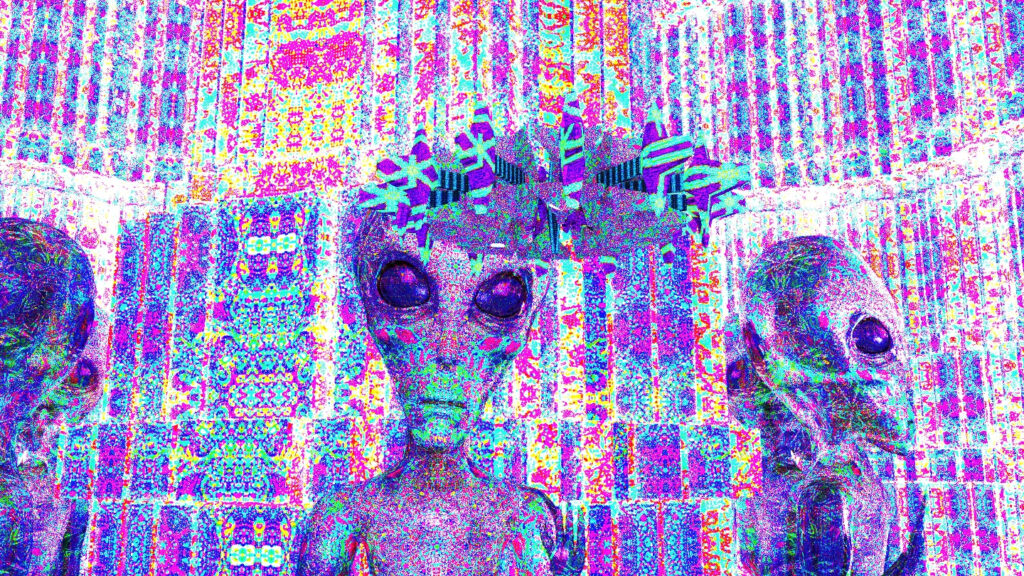
A second number tightens the lens. In a 2020 survey paper indexed by PubMed, 2,561 respondents described their single most memorable DMT-occasioned entity encounter, and they did not just describe it as vivid. Many endorsed the entity as “conscious, intelligent, and benevolent,” existing in “some real but different dimension of reality,” and continuing to exist after the encounter. Sixty-nine percent reported receiving a message; 19% reported a prediction about the future. The authors’ own conclusion is careful: these DMT entity encounters have “many similarities” to non-drug entity encounter reports, including those in religious contexts, alien abduction contexts, and near-death contexts. (PubMed)
That last sentence is where the UAP question usually tries to force its way in. So let’s set the ground rules up front, and keep them in place for the rest of this investigation.
The data support a strong claim and a weaker claim. The strong claim is that entity-encounter phenomenology is common, patterned, and repeatedly reported under inhaled DMT, across large datasets. The weaker claim is that these patterns resemble motifs in some UAP contact narratives.
What the data do not support, on their own, is the leap from resemblance to shared cause, shared mechanism, or shared ontological status. Similarity is not identity. Comparative phenomenology is not proof of an external intelligence. If we want to take the DMT–UAP overlap seriously, we have to keep that distinction clean and visible at all times.
What follows is an attempt to do exactly that: treat DMT datasets as a large, analyzable “contact phenomenology corpus,” then compare it, cautiously, to UAP contact narratives as they exist in archives, media, and testimony. Not to “solve” UAP. Not to declare that DMT is a portal. But to ask whether the DMT literature gives UAP research something it usually lacks: a time-bounded, repeatable, high-intensity encounter state that generates enough comparable reports to study at scale.
What DMT is, in the boring legal and pharmacological sense
DMT is also where myth and reality get tangled quickly, so it helps to anchor it in the plain language of agencies that do not trade in mysticism.
A 2025 DEA Drug & Chemical Evaluation document describes DMT as a Schedule I controlled substance in the United States, notes it has “no approved medical use” there, and highlights the common practical facts: it has long-standing ritual use in some contexts, is generally orally inactive unless combined with monoamine oxidase inhibitors (as in ayahuasca), has rapid onset when smoked or vaporized, and in clinical settings effects typically resolve within roughly 30–45 minutes. (deadiversion.usdoj.gov)
The DEA document also includes a useful trend marker: the National Forensic Laboratory Information System (NFLIS) counts thousands of DMT reports since 1999, with over a thousand in a recent year cited in the document, indicating the compound is not a rare curiosity in U.S. drug surveillance. (deadiversion.usdoj.gov)
None of that tells you what DMT “means.” It tells you why it is trackable, why it is short-acting, and why datasets exist in the first place.
The largest DMT corpus we have is naturalistic, messy, and still valuable
The 2022 Scientific Reports paper is widely cited because it did something UAP research constantly struggles to do: it turned thousands of narratives into coded variables, then published the counts.
The method is important. The authors did not run a controlled clinical trial. They performed qualitative analysis on public r/DMT posts over a 10-year span, screening and coding for phenomena and content. They report a median dose of 40.0 mg (IQR 27.5–50.0) and a median experience duration of 10 minutes (IQR 5–15). The common bodily effects include somaesthesias (37.5%) and an auditory ringing (15.4%), with visual themes dominated by fractals and patterns (32.6%) and vivid colors (25.2%). (Nature)

Then comes the “world” structure.
Beyond entities, the paper codes recurring environmental architecture: descriptions of alternate or higher dimensions (25.2%), “rooms” (15.4%) including a “waiting room” (2.8%), and “a tunnel” (10.3%). (Nature)
If you have read even a small amount of UAP close encounter and abduction literature, you can feel the comparison engine starting to spool up: rooms, tunnels, beings, messages. But here is the crucial part: the Scientific Reports authors actively warn readers not to overgeneralize. They discuss selection bias (who posts and what gets posted), lack of dose verification, and the influence of set and setting. They point out the need for controlled studies before treating patterns as robust outside this naturalistic dataset. (Nature)
This is where a disciplined UAP researcher should lean in, not lean away.
UAP archives are full of “signal versus noise” problems. DMT corpora have their own noise, but at least some of the noise is visible and nameable: online self-selection, cultural feedback loops, uncertain dosing. That means you can design around it.
The paper even codes motifs that sound like they belong in a UAP catalog, while remaining clearly “DMT-world” in context. For example, it reports that 8.8% of experiences describe novel or alien languages, and it includes small but non-zero frequencies for “spaceship” (1.0%) and “orbs/globes” (1.2%). (Nature)
Those low percentages matter because they are exactly where sloppy writing tends to overreach. One percent is not “DMT proves craft.” It is “craft imagery appears in a measurable minority of reports.”
That is a very different claim.
The second major DMT entity dataset
If the Scientific Reports corpus is a naturalistic field sample, the 2020 PubMed-indexed survey is a different kind of instrument: a retrospective questionnaire focused specifically on entity encounters.
The sample size is 2,561 people. The survey asks respondents about their single most memorable entity encounter after inhaled DMT. In the PubMed abstract, we get several key findings that are directly relevant to comparative work: respondents describe primary senses involved as visual and extrasensory (explicitly, telepathic), and common descriptive labels for the entity include “being,” “guide,” “spirit,” “alien,” and “helper.” (PubMed)
The emotional profile is also informative. Forty-one percent report fear during the encounter, but the most prominent emotions attributed both to the respondent and to the entity are love, kindness, and joy. (PubMed)
Then we hit the ontological shock: many respondents endorse the entity as conscious and real in some dimension, and a majority report receiving a message or prediction. (PubMed)
Notice what the authors do not say. They do not declare that entities are objectively external. They do not claim a nonhuman intelligence is established. They say similarities exist to other classes of entity encounter narratives, including alien abduction contexts. (PubMed)
That restraint is not a weakness. It is the line between data and metaphysics.
Controlled science does exist here, but it answers a different question
A common move in online discussions is to treat DMT entity reports as if they are floating free of biology. Meanwhile, another camp uses biology to dismiss the entire encounter motif as meaningless.
Neither approach is good enough.
Clinical and neuroimaging studies do not validate the “reality” of entities, but they do validate something extremely useful for investigators: DMT reliably drives rapid, transient, high-amplitude changes in perception and cognition on a predictable time course.
The University of New Mexico’s public account of its psychedelic research history notes that Rick Strassman’s DMT and psilocybin work from 1990–1995 was the first human psychedelic research there since research was halted in the early 1970s. (hsc.unm.edu)
More recently, a 2025 Communications Biology paper by Piccinini and colleagues modeled whole-brain dynamics using fMRI from 15 volunteers given 20 mg intravenous DMT, emphasizing the transition into the psychedelic state and its transient destabilization patterns, aligned with pharmacokinetics. (PubMed)
Here is the key point for UAP research: controlled neuroscience does not tell you what entities are, but it can help you map what “the contact state” looks like when a human brain is driven into a short-lived, high-entropy perceptual regime. It gives you timing, constraints, and a way to think about sensitivity to perturbation. (Nature)
That can be compared to UAP contact narratives without claiming they share a cause.
The “Oz Factor” and why UAP research keeps tripping over the same threshold language
UAP investigators have long struggled to name a liminal shift that witnesses describe before, during, or around close encounters: silence, stillness, a sense of separation from ordinary reality, an almost theatrical staging of attention.
In religious experience research literature, one journal article quotes Jenny Randles’ definition of the “Oz factor” as a “peculiar state of consciousness” often preceded by “a dreamy feeling,” followed by “stillness and silence,” during which witnesses become “more aware.” (RERC Journal)
Whether you take the Oz factor as evidence of an external manipulation, an endogenous dissociative response, a perceptual narrowing under stress, or something else entirely, it functions as a phenomenological marker. It is a way of saying: the witness reports crossing a threshold.
DMT experiences, particularly high-dose “breakthrough” experiences, are also threshold experiences. They have a rapid onset, a clear departure from baseline, and a distinct “somewhere else” quality that many users describe in architectural terms: rooms, tunnels, boundaries, and waiting zones. (Nature)
If you are trying to understand how human consciousness narrates “contact,” the Oz factor gives you a vocabulary on the UAP side, and the DMT datasets give you counts on the psychedelic side. That is the honest bridge.
It is not an ontological bridge. It is a descriptive one.
The overlap: motifs that rhyme, without pretending they share an author
So what actually overlaps, when you read the DMT datasets and the UAP contact archives like an investigator, not like a partisan?
The overlaps cluster in four places.
First, communication style. In the DMT entity survey, respondents report primary senses as visual and extrasensory, explicitly including telepathy, and label entities as guides, spirits, and aliens. (PubMed)
UAP contact narratives, especially abduction narratives, repeatedly emphasize telepathic communication, conveyed messages, and “knowing without words.” The DMT survey does not prove that UAP telepathy is real. But it does demonstrate that humans readily report telepathic-style communication in a high-intensity altered state, and that they interpret it as interaction with an agent. (PubMed)
Second, environment-as-structure. The Scientific Reports paper’s “rooms,” “waiting room,” and “tunnel” motifs are not rare edge cases. They are among the common coded features of the “DMT world.” (Nature)
UAP abduction narratives often describe interiors, corridors, examination rooms, and transitional spaces. Comparative work here can ask a concrete question: are there a limited number of “architectural archetypes” the mind uses to stage encounters with perceived others?
Third, entity typology. The DMT corpus contains a mix: benevolent feminized figures, gods, aliens, insectoid and reptilian creatures, jesters, and “machine elves.” (Nature)
UAP narratives contain a similar spread, though filtered through different cultural frames: humanoids, “small beings,” “tall beings,” animalistic or insect-like figures, and trickster motifs. The overlap here is meaningful as a taxonomy problem. It is not meaningful as a “therefore they are the same beings” claim.
Fourth, aftermath and belief change. The DMT survey reports that experiences are rated as among the most meaningful of respondents’ lives and that many report enduring changes in worldview, including shifts in religious identification. (PubMed)
UAP contact narratives often show similar life impacts: obsession, fear, spiritual reframing, mission narratives, and long-term identity change. The overlap suggests a shared psychological consequence profile of “encounter events,” regardless of cause.
That last phrase matters: regardless of cause.
Government involvement: what is documented, and what is merely implied by tone
Any article that mentions psychedelics and UAP will attract a gravitational pull toward government programs. The only way to handle that responsibly is to separate what is documented from what is insinuated.
It is documented that U.S. intelligence and defense institutions pursued behavioral modification research that involved drugs, and that this became a subject of Senate investigation.
A 1977 joint Senate hearing record is explicitly titled “Project MKULTRA, the CIA’s Program of Research in Behavioral Modification,” and early in the hearing Senator Inouye states the committee is reviewing “documents… on drug testing conducted by the Central Intelligence Agency,” emphasizing oversight to prevent recurrence of abuses. (intelligence.senate.gov)
Separately, a DoD FOIA Reading Room release concerning MKOFTEN and MKCHICKWIT describes MKOFTEN as having the objective to test “behavioral and toxicological effects of certain drugs on animals and humans,” and frames the projects in relation to CIA codeword programs and DoD contacts. (ESD)
This is the correct conclusion to draw from those records: government entities, including those associated with the CIA and the DoD, have historically shown interest in how drugs affect perception, behavior, and control. In DoW-era continuity terms, state interest in human factors and altered states predates the modern DoD, even if the specific documentation most people cite clusters in Cold War and postwar archives. (intelligence.senate.gov)
Here is what the documents do not establish: any specific DMT-UAP connection.
You can propose hypotheses. You can argue that institutional interest in perception intersects with UAP interest in witness testimony. But if we are doing a data-first investigation, we do not smuggle an implied program into the reader’s mind just because the historical atmosphere feels charged.
The clean stance is this: government records show drug and behavior research; DMT records show entity-contact phenomenology; UAP records show contact narratives; the connection between these streams remains unverified.
The controversy is not “is it real,” it is “what kind of real is being claimed”
The DMT–UAP conversation gets stuck because people argue past each other with different definitions of “real.”
One group means neurological real: the experience is real as an event in consciousness, with measurable brain correlates and predictable time course. The clinical and modeling literature supports this framing. (Nature)
Another group means external-agent real: the entities exist independently and are encountered, not generated. The surveys show many respondents endorse something like this, but endorsement is not verification. (PubMed)
Then there is the UAP camp where “real” is sometimes physical: craft, radar, flight characteristics, trace evidence. That is a different category than “entity contact.” Conflating them muddies both.
The most productive controversy, and the one investigators can actually work with, is methodological: how do you separate universal features of human encounter cognition from case-specific features that might point to something external?
The 2022 Scientific Reports authors themselves highlight why this is hard: selection bias, uncertain dosing, and contextual effects in naturalistic reports mean you cannot assume the dataset is a transparent window into the “true” frequency of motifs in all DMT experiences. (Nature)
In UAP research, we face parallel issues: media influence, investigator influence, the unreliability of hypnosis as a memory tool in some contexts, and the long time spans over which narratives evolve. The UNH archive guide itself notes the Hills pursued hypnosis about a year after the event, which is historically important context even before you debate its implications. (Library | University of New Hampshire)
So the controversy is not a single yes/no. It is a stack of questions about data quality, narrative evolution, and what constitutes corroboration across domains that rarely talk to each other.
Implications: what a disciplined comparison could actually do for UAP research
If we treat DMT corpora as a comparative dataset rather than a “portal,” the payoff becomes practical.
First, DMT data can help standardize encounter coding. UAP research often relies on bespoke typologies. DMT studies show what it looks like to code thousands of narratives into stable categories, then publish counts that others can critique and replicate. (Nature)
Second, DMT could function as a “stress test” for contact motifs. If a motif is extremely common under DMT, like rooms, tunnels, guides, telepathic communication, then its presence in a UAP contact narrative may tell you less about external cause and more about how the mind stages encounters under shock, awe, or altered attention. (Nature)
Third, and this is where UAPedia’s heterodox stance still has room to breathe, DMT data does not explain away physical UAP cases. It does not account for radar tracks, multi-witness sightings, or instrumented anomalies. What it can do is isolate the “contact” layer as a distinct phenomenon with its own rules, its own signatures, and its own susceptibility to interpretive drift.
And if the contact layer turns out to have consistent features across drug-induced and non-drug contexts, that does not prove external intelligence, but it does justify careful interdisciplinary study. The DMT survey authors already flag “many similarities” across religious, alien abduction, and near-death contexts, which is a scientific invitation to compare, not a license to conclude. (PubMed)
Claims taxonomy
Verified
Large datasets document recurring entity-encounter motifs under inhaled DMT, including the 45.5% entity-encounter rate in a 3,778-report corpus and a 2,561-respondent survey reporting high rates of “message” and “prediction” claims, alongside telepathic-style communication reports. (Nature)
Probable
DMT-occasioned entity encounters share meaningful phenomenological similarities with some non-drug entity encounter narratives, including those framed as religious encounters, near-death experiences, and alien abduction experiences, as explicitly stated in the 2020 survey’s conclusion. (PubMed)
Disputed
Whether entity encounters represent contact with external intelligences, purely endogenous cognition, or a mixed model remains unresolved. The available published datasets support pattern description and comparison, not ontological adjudication. (Nature)
Legend
The “portal” framing, and culturally specific metaphysical interpretations of DMT entities or UAP beings, can be discussed as modern myth-making or spiritual narrative architecture, but should be presented as worldview, not as established fact.
Speculation labels
Hypothesis
A mature UAP research program could use DMT datasets as a comparative baseline to distinguish “human encounter universals” from case-specific anomalies, without assuming any shared cause between DMT experiences and UAP encounters.
Witness Interpretation
Many DMT respondents interpret entities as autonomous, intelligent, and real in some other dimension, and many UAP contact witnesses interpret beings as nonhuman agents. These interpretations are part of the phenomenon’s lived reality, even when they are not independently verifiable. (PubMed)
Researcher Opinion
The most defensible bridge between DMT and UAP is methodological, not metaphysical. The overlap is best treated as a comparative phenomenology problem, because that is what the sources actually support at present. (Nature)
References
Davis, A. K., Clifton, J. M., Weaver, E. G., Hurwitz, E. S., Johnson, M. W., & Griffiths, R. R. (2020). Survey of entity encounter experiences occasioned by inhaled N,N-dimethyltryptamine: Phenomenology, interpretation, and enduring effects. Journal of Psychopharmacology, 34(9), 1008–1020. doi:10.1177/0269881120916143 (PubMed)
Drug Enforcement Administration. (2025, December). N,N-Dimethyltryptamine (DMT) (Drug & Chemical Evaluation Section). (deadiversion.usdoj.gov)
Lawrence, D. W., Carhart-Harris, R., Griffiths, R. R., et al. (2022). Phenomenology and content of the inhaled N, N-dimethyltryptamine (N, N-DMT) experience. Scientific Reports, 12, 8562. doi:10.1038/s41598-022-11999-8 (Nature)
Piccinini, J. I., Sanz Perl, Y., Pallavicini, C., et al. (2025). Transient destabilization of whole brain dynamics induced by N,N-Dimethyltryptamine (DMT). Communications Biology, 8, 409. doi:10.1038/s42003-025-07576-0 (PubMed)
Senate Select Committee on Intelligence. (1977, August 3). Project MKULTRA, the CIA’s program of research in behavioral modification (Joint Hearing Record). (intelligence.senate.gov)
U.S. Department of Defense. (1977). 02-A-0846_RELEASE (FOIA Reading Room document discussing MKOFTEN/MKCHICKWIT). (ESD)
University of New Hampshire Library. (n.d.). Guide to the Betty and Barney Hill Papers, 1961–2006. (Library | University of New Hampshire)
Library of Congress. (n.d.). [Image from LOOK – Job 66-2889 titled U.F.O.] (catalog record). (The Library of Congress)
SEO keywords
DMT and UAP, DMT entities, breakthrough DMT experience, UAP contact narratives, alien abduction phenomenology, Oz factor UAP, missing time UAP, Betty and Barney Hill archive, Pascagoula encounter, DMT telepathy reports, psychedelics and UAP research, MKULTRA behavioral modification hearing, MKOFTEN MKCHICKWIT DoD FOIA, consciousness anomalies UAP