Egypt never needed the word “portal” to build a worldview full of thresholds.
Long before modern UAP debates introduced phrases like “interdimensional transit” or “gateway events,” ancient Egyptians were already describing the afterlife as a place you do not simply drift into. You enter it. You pass checkpoints. You face guardians. You move through named gates in a sequence, sometimes hour by hour, as if the cosmos itself is structured like a corridor with controlled access.
That does not mean Egypt “proves” interdimensional portals in the modern sense. It means something more grounded, and arguably more useful: Egyptian mortuary religion gives us one of humanity’s most detailed, best-preserved ritual threshold systems. The dead do not vanish into abstraction. They navigate.
In this explainer, the evidence and the interpretation remain clearly separated. First, we’ll look at what the primary record supports: architectural threshold objects such as false doors, and textual systems like the Book of the Dead gate spells and the Book of Gates. Then we’ll explore why modern portal language keeps attaching itself to these materials, while staying honest about what the sources do and do not claim.
Gateways in Egypt: what the evidence supports
Egyptian “gateways” appear in three places at once: on tomb walls, in ritual objects, and in the words intended to accompany the dead.
The simplest, and least controversial, example is the false door. This is an architectural feature carved on the inner wall of a tomb chapel, designed to look like a doorway but not to function as one in a physical, human sense. Egyptologists understand it as a ritual interface: the focal point where the living bring offerings, and where the deceased, in Egyptian thought, can receive them.
The Met describes the false door in the tomb chapel of Raemkai as a symbolic doorway and focal point for prayers and offerings, associated with the west wall and the west as the realm of the dead. (The Metropolitan Museum of Art)
The Fitzwilliam Museum’s description is even more direct about function in Egyptian belief: such objects were carved or placed to allow the ka-spirit to pass through from the netherworld into this world in order to receive offerings. (The False Door of Hemi-Ra)
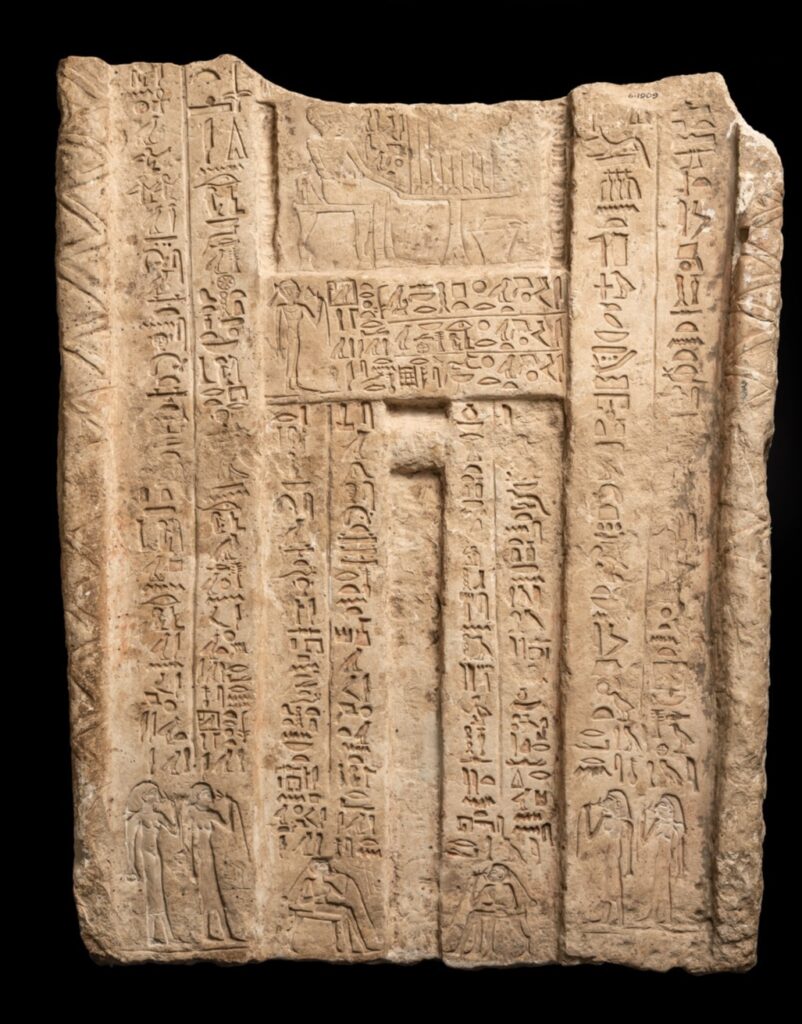
(Fitzwilliam Museum – University of Cambridge)
Those museum statements are describing ritual intent and belief, not a measurable physical mechanism. The false door is a threshold object, designed for contact across domains as the culture understood them.
Now expand from the object to the journey.
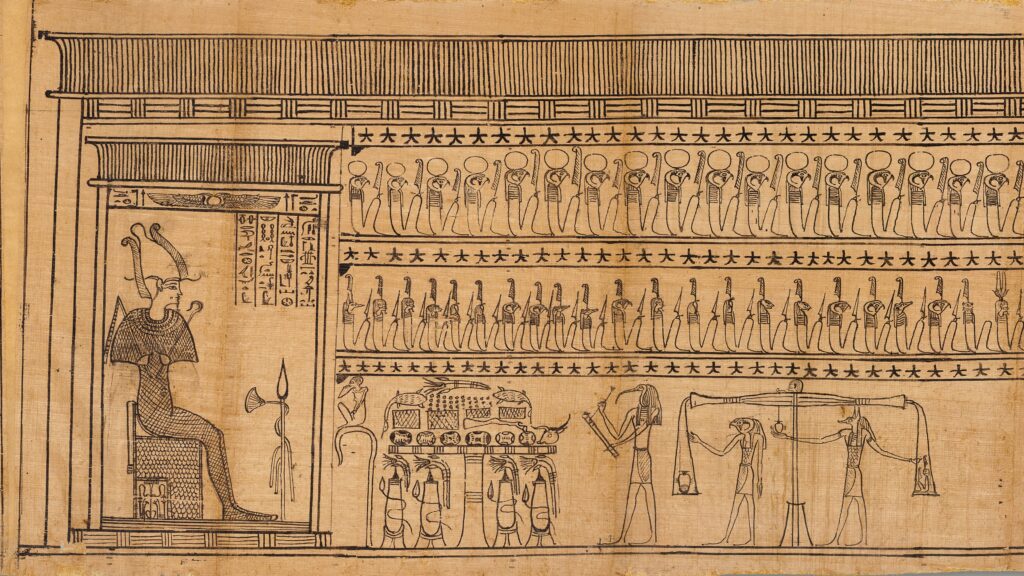
By the New Kingdom, Egyptians are not only marking a point of contact. They are mapping a route. The Book of the Dead is a modern term for a large body of compositions used to help the deceased reach and thrive in the afterlife. UCL’s Digital Egypt resource notes that the Book of the Dead is a modern name applied to about two hundred compositions, numbered by modern editors for reference. (Book of the Dead)
Within that corpus are texts that talk about gates in a way that is strikingly procedural. The British Museum explains that the deceased encountered gates in the Duat, protected by guardians wielding knives, and that to pass they had to know the name of the gate, the god associated with it, and the guardian defending it, identifying Book of the Dead Spells 144 and 146 as key to this scenario. (Journey to the afterlife | British Museum)
Finally, there is the royal-scale version of the same idea: netherworld books that divide the underworld into structured segments, each separated by a gate. Sir John Soane’s Museum’s collection record for Seti I’s sarcophagus states that the underworld is divided into twelve portions equated with the twelve hours of the night, each separated by a gate guarded by snakes and a warder, and that no one could pass through any of the gates without giving the password. (Sarcophagus of Pharaoh Sety)
This is the evidentiary baseline: boundaries exist, boundaries have guardians, and boundaries can be crossed through knowledge and proper preparation, within the Egyptian religious system.
Case study: False doors as contact points, not modern portals
If you want to understand Egyptian gateways without any modern gloss, sit with the false door and let it be what it is.
It sits on a tomb wall like a door that isn’t there. It’s carved with names. It’s placed where offerings are made. It is a site of exchange, and that exchange presumes two domains: the living domain where bread and beer are placed, and the dead domain from which the ka may “come forth” to receive.
This isn’t speculative. It’s standard interpretive framing reflected in museum collections, and it’s one of the reasons Egypt is so valuable for portal-hypothesis discussions even when you keep the language conservative. It offers a documented ritual threshold object for attempted contact with the dead as a repeatable act at a designed boundary. (False door of Hemi-Ra)
What it does not do, by itself, is establish any literal mechanism akin to a science-fiction doorway or a physics-based wormhole. When we later compare Egyptian thresholds to modern portal models, that comparison remains interpretive.
Case study: Book of the Dead gate spells as access protocol in a religious system
Spells 144 and 146 tend to surface again and again in gateway discussions because they describe gates and the requirements to pass them.
The British Museum’s explainer makes the essentials plain: gates, knife-wielding guardians, and the requirement that the deceased know names to pass. (Journey to the afterlife | British Museum)
The Oriental Institute’s publication tied to its Book of the Dead materials notes that spells 144-146 deal with “gates and portals of the netherworld,” facilitating passage. (Book of the Dead: Becoming God in Ancient Egypt)
The record supports a clear claim: Egyptians conceived the afterlife as an environment where movement was conditional. Passage depended on correctly performed knowledge. If you want a modern analogy, “credentialing” is closer than “teleportation.” In the Egyptian imagination, names are keys, words are tools, and ignorance is a kind of danger.
Case study: The Book of Gates and Seti I’s sarcophagus
If the Book of the Dead gives you a set of portable “tools,” the netherworld books give you the map.
The Seti I sarcophagus is often mentioned because it physically contains the logic of the Book of Gates. Soane’s Museum identifies the Book of Gates on the sarcophagus and explains that it comprises spells and rituals the deceased king needed to pass safely through the underworld and reach the afterlife. (Sarcophagus of Sety I | Sir John Soane’s Museum)
Soane’s collection record describes the structure: twelve divisions, twelve hours, gates guarded by warders and serpents, and the requirement to give passwords. (Sarcophagus of Pharaoh Sety)
The sources support a ritual-cosmological model in which the underworld is segmented and passage is restricted. They do not assert that these gates correspond to a literal, physically measurable portal mechanism.
Case study: Abydos, the Osireion, and descent architecture
Egyptian gateways are not only “doors” and “gates” in texts. They’re also experienced as a choreography in stone: descent, enclosure, darkness, and the sense of being brought under the world.
Behind Seti I’s temple at Abydos, the Osireion has long been associated with Osiris and underworld symbolism. Margaret Murray’s 1904 excavation report is a primary, first-hand document of what was found. (The Osireion At Abydos : Murray, Margaret Alice)
Later formal scholarship, such as Frankfort’s 1933 Egypt Exploration Society publication on what he frames as the cenotaph of Seti I, anchors how the site entered more systematic academic discourse. (The cenotaph of Sety at Abydos)
Modern studies also examine the Osireion’s environment as a technical question, including debate about paleochannels and groundwater in the Abydos area. (PDF paper on an Integrated Geophysics and Isotope Geochemistry Analysis)
Here the stance stays tight: the Osireion is unusual and continues to attract investigation. It is architecture that embodies liminality and descent. That makes it relevant to gateway discussions by design intent and cultural function, not because a portal mechanism has been demonstrated.
Witnesses and first-hand accounts: where they help and where they don’t
Modern testimony can illuminate how ancient threshold landscapes still affect people, but it should not be used to “prove” ancient claims.
Dorothy Eady, known as Omm Sety, is best treated as a modern comparative testimony, not as support for Egyptological conclusions. The Psi Encyclopedia describes her as a reincarnation case and notes serious problems of interpretation due to limited serious investigation. (Psi Encyclopedia)
So Omm Sety belongs here as a modern example of anomalous attachment to an Egyptian threshold site, not as corroboration that ancient gateways were literal portals. Egypt offers documented ritual threshold systems. Some modern witnesses report threshold experiences at Egyptian sites. Those categories must remain separate.
Where the portal comparison belongs: clearly marked interpretation
From a modern interpretive perspective, Egyptian afterlife gateways can be compared to portal models because they share a recognizable pattern: controlled thresholds, segmented transit, guardianship, and knowledge-based access.
But resemblance is not a mechanism. The sources do not establish a literal interdimensional portal. The portal comparison is an analogy used to explore how humans model boundary-crossing experiences, and it should remain explicitly interpretive.
This is also where Egypt contributes something unusually valuable to UAP studies: many modern portal narratives are vague. Egyptian gateway systems are not. They are named, enumerated, ritualized, and embedded in mortuary contexts.
Implications for interdimensional and portal hypotheses in UAP studies
If your interest in portals comes from UAP cases, Egypt offers grounded implications without requiring sensational leaps.
First, “gateway” experiences may be about structured transition rather than spatial travel. In Egypt, a gate is not a destination. It’s a checkpoint. This suggests that some modern “portal” narratives might be better analyzed as shifts in access or state.
Second, Egyptian texts foreground cognition and preparation as functional components. The British Museum’s summary of required names highlights that access is contingent. (Journey to the afterlife | British Museum)
Third, Egypt’s gateways are typically guarded. The Seti I sarcophagus record’s emphasis on passwords is an explicit example of that guardianship motif in a major artifact. (Sarcophagus of Pharaoh Seti)
The comparative value is structural: Egypt supplies an ancient, richly documented template for thinking about liminality, constraint, and conditional passage.
Claims taxonomy
Verified
- Ancient Egyptian funerary practice used false doors as symbolic and ritual thresholds tied to offerings and contact with the deceased, and museum sources describe them as enabling the ka-spirit’s passage in Egyptian belief. (False door of Hemi-Ra)
- Book of the Dead materials include gate passages where guardians block the way and passage requires knowing the names of the gate, associated deity, and guardian, with Spells 144 and 146 highlighted in museum explanation. (Journey to the afterlife | British Museum)
- The Book of Gates, as described in Soane’s collection record for Seti I’s sarcophagus, divides the underworld into twelve portions separated by guarded gates requiring passwords. (Sarcophagus of Pharaoh Sety)
Probable
- Egyptians intended these gateway systems to function as ritual frameworks for successful transition and safe passage, given their mortuary placement and procedural framing. (Book of the Dead: Becoming God in Ancient Egypt)
Disputed
- The interpretation that Egyptian gateways map onto literal interdimensional portals in a physical, mechanistic sense remains unestablished by the Egyptological record used here and should be treated as analogy or speculative framing rather than demonstrated fact.
Legend
- The Duat as an inhabited underworld with literal gate guardians belongs to religious narrative presented as such, even when it may reflect experiential or visionary traditions within the culture.
Misidentification
- Pop-cultural claims that specific Egyptian monuments are confirmed “stargates” or operational portal devices are not supported by the evidence base used here and often reflect modern projection onto ancient material.
Speculation labels
Hypothesis
The Egyptian gate model may preserve an altered-state cartography, where ritual texts encode repeatable experiences of transition, whether understood as visionary journeys, dream states, near-death phenomenology, or structured trance. In this view, “names” and “passwords” function as cognitive stabilizers rather than purely narrative props.
Witness Interpretation
Institutional summaries show that Egyptians framed gate passage as conditional and knowledge-based, with passage requiring correct names and guarded thresholds in the Duat. (Journey to the afterlife | British Museum)
Researcher Opinion
Comparing Egyptian threshold systems to modern “portal hypotheses” can be a useful heuristic for UAP studies because it foregrounds controlled access and boundary management. However, it should be treated as an analogy about models of transition, not as evidence of a demonstrated physical portal mechanism.
References
British Museum. (n.d.). Journey to the afterlife. (Journey to the afterlife | British Museum)
British Museum. (2010, September 22). What is a Book of the Dead? (What is a Book of the Dead? | British Museum)
Frankfort, H. (1933). The cenotaph of Sety I at Abydos. Egypt Exploration Society. (The cenotaph of Sety I at Abydos)
Metropolitan Museum of Art. (n.d.). Tomb Chapel of Raemkai: West Wall. (Tomb Chapel of Raemkai: West Wall – Old Kingdom)
Murray, M. A. (1904). The Osireion at Abydos. Egypt Exploration Fund. (The Osireion At Abydos)
Sir John Soane’s Museum. (n.d.). Sarcophagus of Sety I. (Sarcophagus of Sety I | Sir John Soane’s Museum)
Sir John Soane’s Museum. (n.d.). Sarcophagus of Pharaoh Seti I (collection record). (Sarcophagus of Pharaoh Seti)
Society for Psychical Research. (2018). Dorothy Eady/Omm Sety – reincarnation case. (Psi Encyclopedia)
University College London. (n.d.). Book of the Dead by number. (Book of the Dead)
University of Chicago, Oriental Institute. (2017). Book of the Dead: Becoming God in Ancient Egypt (OIMP 39). (Book of the Dead: Becoming God in Ancient Egypt)
Abudeif, A. M., Abdel Aal, A. K., Abdelbaky, M. A., Ali, K. M., & Mohammed, M. A. (2022). [Abydos paleochannel and groundwater study]. Minerals, 13(1), 64.
See also
Category – Interdimensional and Portal Hypotheses
Category – Ancient and Mythological Accounts
Article – UAP as an Entry Point into High Consciousness
SEO keywords
Egyptian afterlife gateways, Duat gates, Book of the Dead Spell 144, Book of the Dead Spell 146, Egyptian gate guardians, Book of Gates, Seti I sarcophagus Book of Gates, false door ka spirit, ancient Egyptian mortuary thresholds, Abydos Osireion, Egyptian netherworld books, interdimensional portal hypothesis, UAP portal models, liminality and gateways, ritual access afterlife, threshold intelligence model