
On a calm night at sea, a single point of light can feel bigger than a storm. It is not just something you see. For sailors in 1492, the Atlantic was still a psychological frontier: the horizon was not only distant, but doubtful.
That is the atmosphere behind one of the most famous “small” anomalies in exploration history. Late on October 11, 1492, at Guanahany, Bahamas, Christopher Columbus recorded seeing a light ahead, described as “like a small wax candle being raised and lowered.” He called for others to look. Pedro (Pero) Gutiérrez, a gentleman of the king’s household, “thought he saw it too.” Rodrigo Sánchez de Segovia, the crown’s representative aboard, did not see it because he was not in position. The light appeared again “a couple of times,” then vanished. About four hours later, land was sighted. (Early Modern Spain)
For UAPedia, the interest here is not in forcing a modern label onto a fifteenth-century maritime note. It is in treating the record as what it is: a historically significant witness claim preserved in a near-contemporary but mediated journal tradition, attached to a consequential decision point, and still debated because key contextual variables, especially distance from shore, remain contested. (Early Modern Spain)
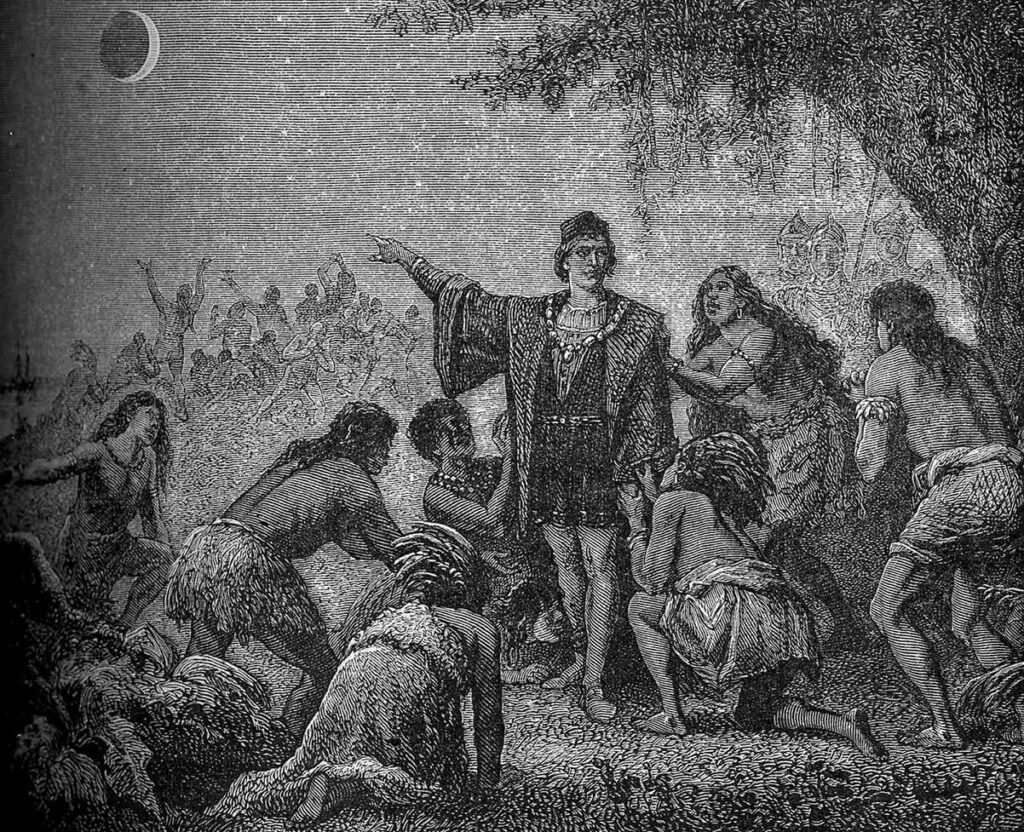
(Camille Flammarion – Astronomie Populaire 1879, p231 fig. 86,)
What evidence has survived
The “Journal of the First Voyage” does not survive in Columbus’s original handwriting. The known copy also disappeared. What we have is a later digest associated with Bartolomé de las Casas, and modern scholarly presentations emphasize that the journal survives in a truncated, partially summarized form. (Early Modern Spain)
The October 11 entry remains unusually vivid. Even as a mediated text, it preserves the kind of operational detail that makes it hard to dismiss as pure legend: who saw what, who did not, where people were standing, and the fact the light was brief and uncertain. (Early Modern Spain)
When UAP researchers point to the “wax candle,” the strongest responsible claim is simple: the journal tradition records a small light, seen briefly, with apparent up-down behavior, shortly before landfall.
Everything beyond that is interpretation.
The sighting, told as a human moment
It is late, the ships are running westward in darkness, you can’t see land, you can’t smell land. You can only feel the pressure of weeks at sea and the growing tension of men who signed up for an expedition that might never end.
Columbus is on the sterncastle, he is watching the horizon with the intensity of someone who has staked reputation, livelihood, and destiny on a wager.
Then he sees it: a small light in the distance. Not a blaze. Not a beacon. Something candle-like. He calls someone over. Another man “thinks” he sees it too. A third, positioned differently, cannot confirm. The light returns once or twice. Then it is gone. (Early Modern Spain)
If this were a modern UAP report, investigators would immediately ask about angle of view, eye height above sea level, the ship’s motion, the sea state, atmospheric clarity, and the presence of other lights or fires. In 1492, none of that was recorded with the precision we would want. But the journal does give us enough to understand why the case has never fully settled.
Why Vallée and Aubeck include it
Jacques Vallée and Chris Aubeck’s Wonders in the Sky is often described as a large compilation of historical aerial-anomaly reports.
A mainstream review in Library Journal says the book “lists 500 accounts” and emphasizes the amount of research that went into assembling them. (Library Journal)
Columbus’s “candle” belongs in that catalog for a specific reason: it looks like a type of report that keeps recurring in maritime contexts across centuries. It is not a baroque sky prodigy. It is a distant, ambiguous light with a reported motion characteristic and limited confirmation. Cases like that are frustrating precisely because they are common and because they sit at the edge of what perception can lock down. (UAPedia – The Alan Steinfeld Archives)
The usefulness of the Columbus case is methodological. It is a good demonstration of how careful historical UAP work can proceed despite textual mediation and contested reconstruction: you treat the witness claim respectfully, avoid false certainty, and stay disciplined about what is evidence versus what is inference. (Wonders in the Sky)
The argument that reshapes everything: distance
If the fleet was close enough to shore, the light could have been a torch, a small fire, a canoe lamp, or a moving flame on land.
If the fleet was far offshore, those options become less likely, and the interpretation shifts toward atmospheric effects, astronomical confusion, or a genuine unknown.
This is why historians keep circling the same hinge point: where exactly was Columbus at 10 p.m.?
Samuel Eliot Morison, writing as a sailor-historian, argued that because landfall came four hours later, the fleet was “at least 35 miles offshore” at the time of the light, and he framed the candle as a product of Columbus’s “imagination.” (Smithsonian Research Online) Morison’s treatment is not casual dismissal; it is an attempt to bind the sighting to a navigational reconstruction.
But there is an equally practical countercurrent in scholarly literature. Edwin and Marion Link, in a Smithsonian Miscellaneous Collections study built around a different track and landfall model, entertain near-shore possibilities.
They discuss the plausibility of a torch in the canoe of an Indigenous fisherman and use line-of-sight reasoning tied to eye height above water, suggesting that an observer at around nineteen feet could see a horizon object on the order of five miles away under favorable conditions. (Smithsonian Research Online)
The disagreement is real, but it is also easy to misread. It is not simply “one side thinks it’s a UAP, the other thinks it’s nothing.” It is “different reconstructions of the voyage produce different constraints on what the light could have been.”
And that is why the case stays alive.
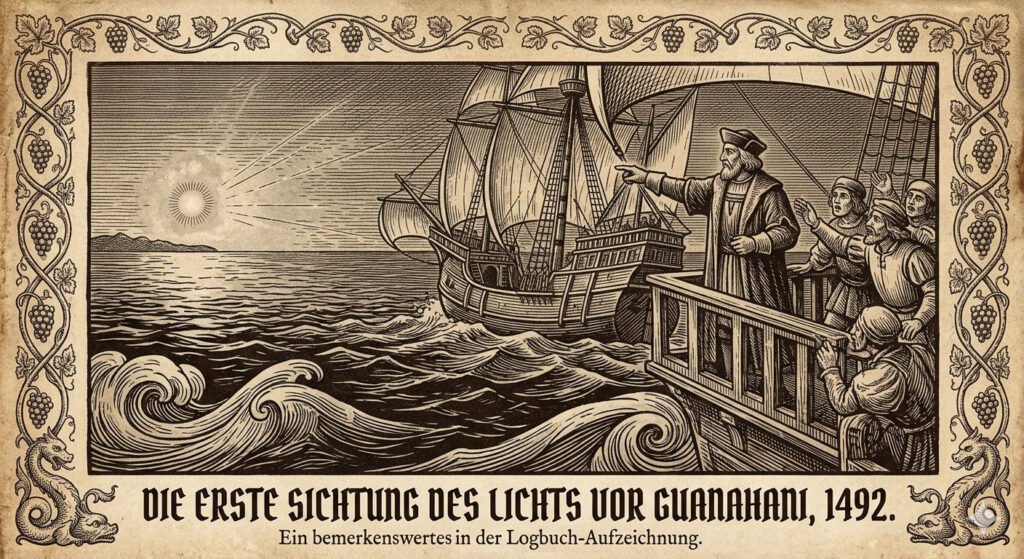
The light’s “motion”: object behavior or ocean optics?
The journal’s phrase that the light was like a candle being “raised and lowered” is the heartbeat of the case. (Early Modern Spain) It is also where interpretation can outrun the record if we are not careful.
There are at least two broad ways a witness can truthfully report “up and down” at sea.
One is literal motion: a light source moving vertically relative to the observer, perhaps held by someone in a canoe that rises and falls with swell, or carried along uneven ground.
A nineteenth-century narrative tradition, popularized by Washington Irving, imagined something like this: a fisherman’s torch rising and sinking with waves, or a light being carried from house to house on shore.
That kind of scenario is not independent confirmation of the event, but it shows how the “candle” description naturally invites a near-shore human explanation. (Irving’s framing is discussed and contextualized within Smithsonian landfall literature.) (Smithsonian Research Online)
The other is masking: a steady light that appears to rise and fall because the observer’s ship is moving and the ocean horizon is a living barrier. A small source near the horizon can blink in and out behind swells and the ship’s own roll, creating an illusion of deliberate movement. This does not require fraud or fantasy. It is how the sea edits what you think you are seeing.
The journal, as preserved, cannot adjudicate between these. It gives us the witness claim, not the physical diagram.
The money problem: reward and motive
There is a reason the Columbus candle became famous beyond navigation circles.
The Spanish Crown offered a reward to the first person to sight land. The 2 a.m. land sighting is traditionally credited to Rodrigo de Triana, but Columbus later claimed the annuity on the grounds that he had seen the earlier light. Morison treated this claim as ungracious and used it to sharpen his skepticism about the candle’s reality. (Smithsonian Research Online)
Here, the responsible stance is to keep two truths in the same frame.
First, incentives can distort narratives. Once a light becomes money, it becomes a magnet for suspicion.
Second, incentives can also reflect genuine belief. A person can be self-interested and still have observed something real. The presence of motive is not proof of invention; it is a caution sign for how we weigh emphasis and certainty.
In modern UAP cases, investigators routinely face the same dilemma in a different costume: publicity, attention, institutional stakes, and personal reputation can all warp testimony. The Columbus case shows that this dynamic is old.
Interpreting the candle without pretending to solve it
A near-shore human light source, such as a torch or small fire, fits the candle metaphor nicely, and it fits the timing, especially under reconstructions that bring the fleet closer to land by 10 p.m. (Smithsonian Research Online)
It also fits the fact that only a few observers confirmed it, because a marginal line-of-sight light can be highly dependent on position, attention, and timing. (Early Modern Spain)
Where the torch explanation strains is under reconstructions like Morison’s, which place the fleet too far offshore for such a light to be visible, and under the question of why the light was observed only briefly.
Morison’s answer is that this is exactly how expectation-driven misperception behaves at sea: you think you see something, you persuade someone else, and then it dissolves. (Smithsonian Research Online)
A purely perceptual explanation also has strain points. The journal’s presentation is not just “I imagined a light.” It includes a call for verification and a second observer who “thought” he saw it too. (Early Modern Spain) That is not strong corroboration in the modern sense, but it is something.
Atmospheric or optical phenomena are also possible candidates in the abstract, because the sea-horizon environment can produce odd glints, mirage-like effects, and intermittent visibility. The difficulty is that, in this specific case, the record does not give us enough meteorological detail to responsibly choose one physical mechanism over another.
Which leaves the most honest classification: an unresolved light anomaly with plausible conventional candidates that cannot be cleanly eliminated, paired with a historical context that makes the report culturally and methodologically significant.
The case’s quieter impact: how anomalies steer decisions
The strangest thing about the Columbus candle is not that it is mysterious. It is that it shows how small perceptions can lean on big outcomes.
If Columbus was right that land was near, the crew’s morale got a jolt, watchfulness sharpened, and risk decisions shifted. If he was wrong and it was a false alarm, the same psychological machinery still mattered: it reveals what the expedition was hungry to see.
In UAP studies, this is one of the most consistent secondary effects of anomalous reports. Even when the object remains unknown, the report influences behavior, memory, and narrative identity. A single light can become a symbol: for land, for providence, for leadership, for deception, for fate.
And it is worth noticing how the “candle” sits exactly on the seam between two worlds. Behind it is the medieval Atlantic of rumor and theological geography. Ahead of it is the early modern Atlantic where new peoples and new continents become a European storyline. The candle is a tiny artifact of that transition, glowing briefly in the textual darkness.
Claims taxonomy
Disputed
The report is grounded in a historically important, near-contemporary journal tradition that records specific observational details and names other observers, but the text is mediated and truncated, and plausible conventional explanations cannot be excluded because crucial parameters, especially distance from shore, depend on disputed reconstructions of the voyage. (Early Modern Spain)
Speculation labels
Witness Interpretation
Columbus interpreted the light as a meaningful indicator that land was near, and it later served as part of his justification for claiming the promised reward for first sighting. (Smithsonian Research Online)
Researcher Opinion
Morison framed the candle as an expectation-driven misperception, anchored to his estimate that the fleet was far offshore at the time of the sighting. (Smithsonian Research Online)
Link and Link treated near-shore explanations as plausible under their reconstruction, including a torch in a canoe visible at a limited range given eye height and horizon distance. (Smithsonian Research Online)
Hypothesis
If the “raised and lowered” description reflects an actual moving luminous source rather than wave masking or misperception, the observation could be treated as a genuine UAP-style light anomaly in the minimalist sense: a discrete light of uncertain origin over open water, reported with apparent motion and limited corroboration. The surviving record does not allow this hypothesis to be confirmed, and it does not exclude conventional sources under different route models. (Early Modern Spain)
References
Columbus, C. (1492). Journal of the first voyage (surviving in truncated, mediated form via later transmission). Early Modern Spain, King’s College London. https://ems.kcl.ac.uk/content/etext/e020.html (Early Modern Spain)
Early Modern Spain. (n.d.). Introduction to Christopher Columbus, Journal of the first voyage. King’s College London. https://ems.kcl.ac.uk/print/b001.html (Early Modern Spain)
Link, E. A., & Link, M. C. (1958). A New Theory on Columbus’s Voyage Through the Bahamas. Smithsonian Institution, Smithsonian Miscellaneous Collections, 135(4). https://repository.si.edu/bitstream/handle/10088/22943/SMC_135__Link_1958_4_1-45.pdf (Smithsonian Research Online)
Morison, S. E. (1941). Admiral of the Ocean Sea: I. The Discovery of America. The Atlantic. https://www.theatlantic.com/magazine/archive/1941/12/admiral-of-the-ocean-sea-i-the-discovery-of-america/654661/ (Smithsonian Research Online)
Jones, M. E. (2011). Review of Wonders in the Sky: Unexplained Aerial Objects from Antiquity to Modern Times. Library Journal. https://www.libraryjournal.com/review/wonders-in-the-sky-unexplained-aerial-objects-from-antiquity-to-modern-times (Library Journal)
Vallée, J., & Aubeck, C. (2010). Wonders in the Sky: Unexplained Aerial Objects from Antiquity to Modern Times. TarcherPerigee. https://books.google.com/books/about/Wonders_in_the_Sky.html?id=XINLC2ubHqwC (Google Books)
Suggested internal crosslinks
Jacques Vallee interview – Chariots of Fire (UAPedia – The Alan Steinfeld Archives)
SEO keywords
Christopher Columbus UAP, 1492 Atlantic light, wax candle raised and lowered, Columbus journal light sighting, pre-20th-century UAP accounts, Wonders in the Sky Vallée Aubeck, maritime UAP history, Columbus landfall anomaly, Smithsonian Columbus Bahamas reconstruction, historical UAP methodology