
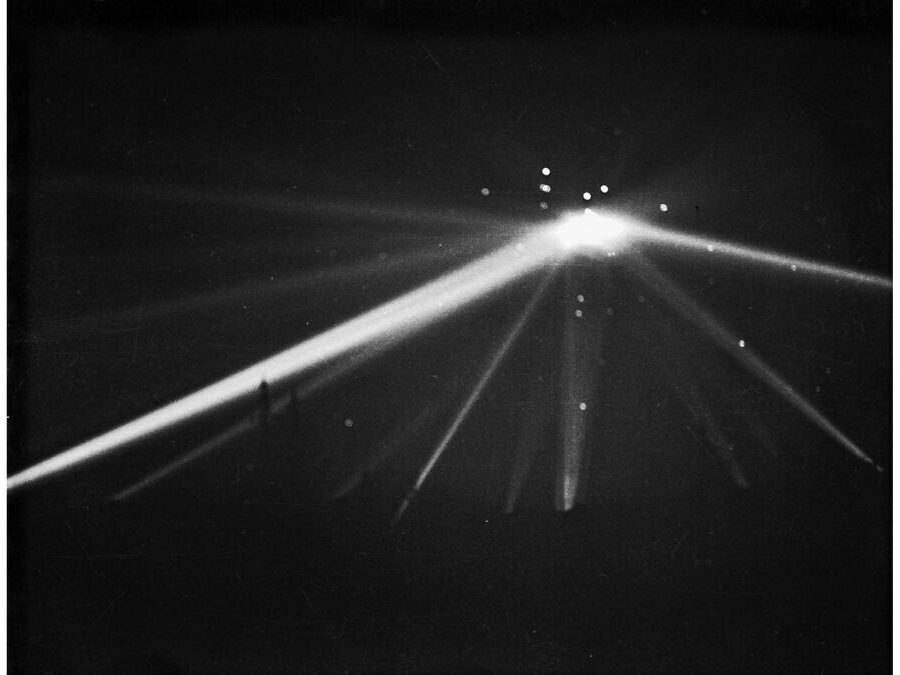
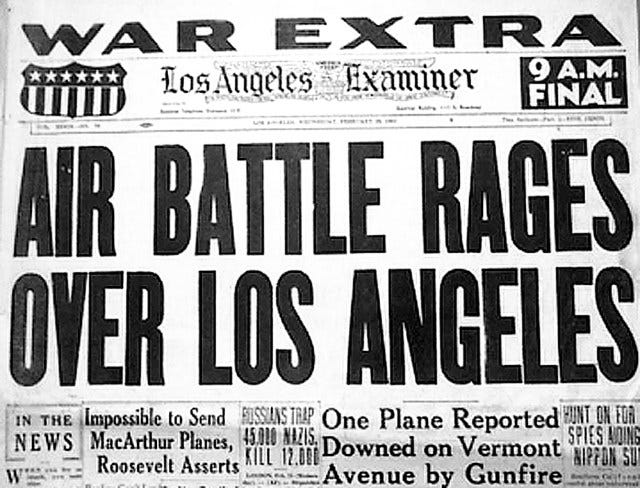
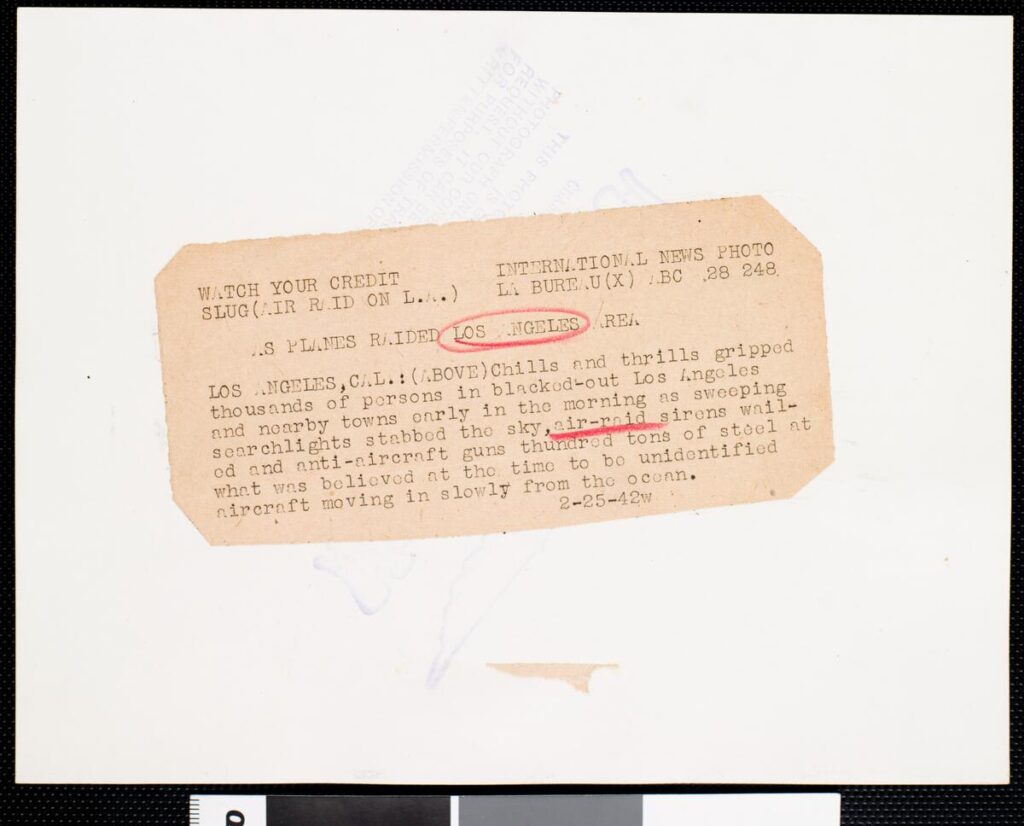
Los Angeles has always lived with the idea of spectacle, but the early hours of February 25, 1942 delivered a spectacle nobody wanted. A blackout dropped across the city. Sirens rose and fell. Searchlights swept the sky in disciplined arcs, then began to converge. Anti-aircraft guns followed with a rolling, metallic thunder that seemed to come from every direction at once. For hours, residents watched the night overhead behave as if it contained a target.
By morning, officials were split in public about what had happened. Some called it a false alarm driven by nerves. Others entertained the possibility of unidentified aircraft, even sketching out wartime scenarios involving reconnaissance. Meanwhile, people who had been awake for the barrage carried a simpler memory: something was up there, and the city tried to shoot it down.
The Battle of Los Angeles sits awkwardly at the intersection of documented military action and unresolved identification. As a UAP case file, it matters not because the public record proves a non-human craft, but because it demonstrates how quickly ambiguous signals can cascade into large-scale engagement, and how contradictory official messaging can harden uncertainty into decades of debate. It is also an early example of a recurring UAP pattern: the “event” is not only what is observed, but how institutions react, how witnesses interpret, and what survives in the record afterward.
A coastline braced for the next blow
To understand why Los Angeles fired so intensely into the night, you have to place yourself in early 1942. Pearl Harbor had happened only months before. The West Coast was not treating war as distant. It was preparing for it to arrive overhead.
This was not only the mood. It was reinforced by real hostile activity. On February 23, 1942, the Japanese submarine I-17 shelled the Ellwood area near Santa Barbara. The material damage was limited, but the symbolic damage was enormous. It demonstrated that the shoreline was reachable, and it poured fuel on fears of coastal raids and invasion. HistoryNet’s narrative of the Ellwood shelling and its effect on regional anxiety captures why a later radar plot or distant light would not be evaluated calmly. It would be evaluated as a possible opening move. (Ruhge, 2016; HistoryNet: https://historynet.com/the-battle-that-never-was/)
Smithsonian Magazine later framed the ensuing “Great Los Angeles Air Raid” as a lesson in what can happen when civilians and the military expect invasion at any moment, and that framing holds up. Fear can be rational, but fear also accelerates interpretation. When the mind is primed to see an enemy, the unknown becomes the enemy quickly. (Boissoneault, 2018: https://www.smithsonianmag.com/history/great-los-angeles-air-raid-terrified-citizenseven-though-no-bombs-were-dropped-180967890/)
So, when alerts began that night, Los Angeles was not starting from a blank page. The city was already leaning forward.
The timeline, and why it still feels slippery
One reason the Battle of Los Angeles is hard to “solve” in a satisfying way is that it unfolded through overlapping channels: radar cues, observer reports, blackout procedure, and public rumor, all operating at once. That produces timekeeping problems. People remember sequences, not always minutes.
What can be stated with confidence is that the escalation began in the early morning hours, with the alert and blackout occurring roughly around 2:20 to 2:30 a.m., followed by intensive anti-aircraft engagement that continued into the predawn period. Some sources offer precise minute marks, but the broad window is safer and matches the way contemporary crises actually feel from inside them.
The official U.S. Army Air Forces history in The Army Air Forces in World War II describes radar picking up an unidentified target well offshore, a rising state of readiness, and then a surge of reports. At 3:06 a.m., a balloon carrying a red flare was reported over Santa Monica. Soon after, anti-aircraft batteries opened fire, and reports of “enemy planes” multiplied. The same official narrative notes that shell bursts were mistaken for aircraft, an observation that becomes crucial to understanding how the event could grow even if the original stimulus was small. (Craven & Cate / Goss via SFMuseum: https://sfmuseum.org/hist9/aaf2.html)
That “balloon with a flare” detail is often treated like a plug pulled from a drain, as if the mystery vanishes the moment the balloon appears. In reality, it explains an ignition point, not necessarily the entire experience. A balloon can be the match, but the fire can still be fed by other factors once it is burning.
The incident begins wiot down for the 1440 AA shells fired, though no wreckage was found.
How a sky becomes a feedback loop
Air defense is not a gentle activity. Once firing begins, it changes what everyone sees.
The official history is explicit about this: as the barrage continued, shell bursts caught by searchlights were mistaken for aircraft. Smoke and glare become part of the visual field, and the mind begins to assemble “objects” from fragments of light and motion. (SFMuseum: https://sfmuseum.org/hist9/aaf2.html)
This is a key idea for UAP research more broadly. A phenomenon does not have to be a craft to be experienced as a craft. The perceptual system is constantly pattern-matching, and in high-stress contexts it can be aggressive in completing shapes.
HistoryNet’s account describes the same self-reinforcing effect in plain language. Once firing began, searchlights and exploding shells created the illusion of targets in the sky. That phrasing is valuable because it acknowledges the mechanics without mocking the people involved. A city under blackout and bombardment is not a laboratory. It is a pressure chamber. (HistoryNet: https://historynet.com/the-battle-that-never-was/)
That said, the Battle of Los Angeles cannot be reduced to perception alone, because the defensive response was materially real. Thousands of rounds were fired, and that firing had consequences.
The ammunition count, and what the discrepancy tells us
Two widely cited totals exist for how many anti-aircraft rounds were fired during the incident.
The Fort MacArthur compilation associated with Major David Gustafson records that gun crews fired 1,433 rounds. (Coast Defense Study Group / Fort MacArthur compilation PDF: https://cdsg.org/wp-content/uploads/2024/07/FtMacBookNew.pdf)
The official Army Air Forces history gives a slightly higher number: 1,440 rounds of antiaircraft ammunition. (SFMuseum: https://sfmuseum.org/hist9/aaf2.html)
In a courtroom, you would not treat this discrepancy as a reason to discard the entire event. You would treat it as a reminder that even official records can differ by small amounts, especially when compiled from after-action reports, logs, and summaries. The practical conclusion is the same: the engagement was sustained and large-scale.
The more important point is not whether the number begins with 1,433 or 1,440. It is that Los Angeles expended enough ordnance to make the sky itself a physical environment, full of shrapnel, smoke, and concussion. That kind of environment generates both fear and false certainty.
What witnesses agreed on, even when they disagreed on the “object”
If you step away from the arguments for a moment and simply ask what most people who were there would recognize as true, a clear core emerges.
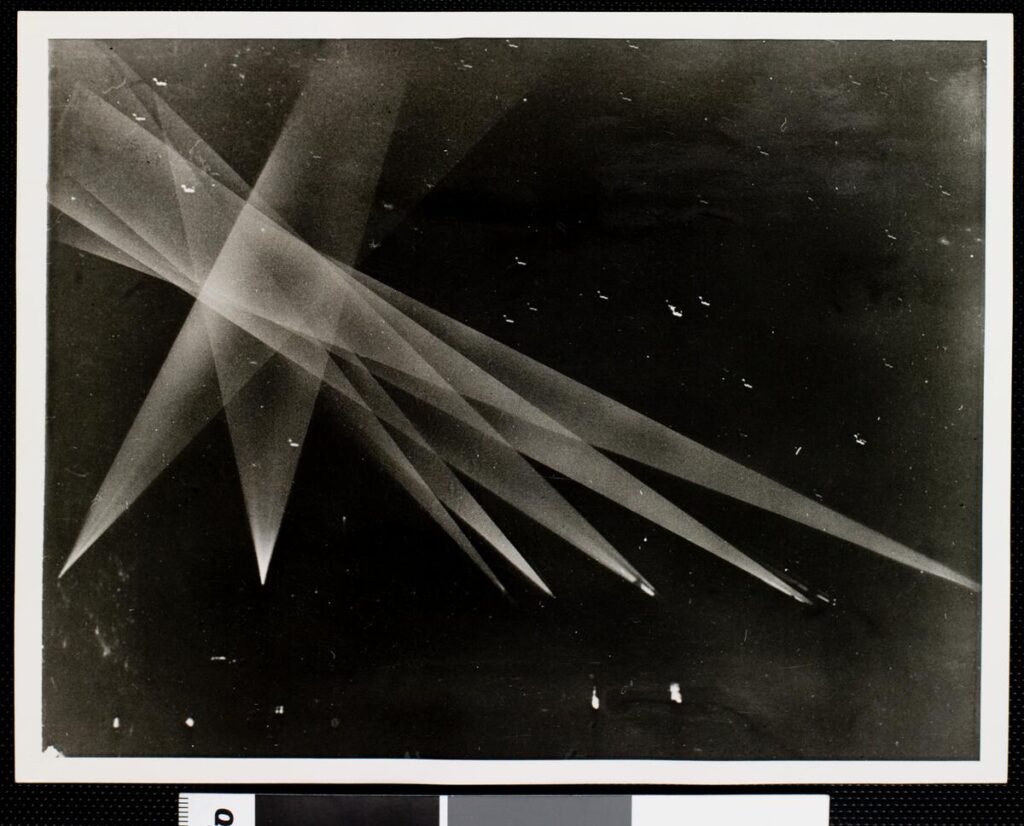
They would recognize the sirens. They would recognize the blackout. They would recognize the converging searchlights. They would recognize the long duration of firing, the sense that it was not a brief scare but a sustained ordeal. They would also recognize the morning after, when the city discovered that the night’s violence had left damage and casualties behind.
What they would not necessarily agree on is what the searchlights were converging on. Some described aircraft. Some described a single object. Some could not make out a solid form at all and remembered only light, smoke, and bursts.
This is not unusual in mass sightings. Multiple witnesses can be honest and still disagree, especially when the viewing conditions are chaotic and the stimuli are changing. In this case, the stimuli were not just whatever might have been in the sky. The stimuli included the defense response itself.
The famous photograph of searchlights converging on a bright patch reinforces the impression of a “target.” It is iconic, but iconography can mislead. Exposure, smoke density, and publication practices can reshape a scene. The photo is not definitive proof of a craft. It is evidence of coordinated illumination and intense engagement.
For UAPedia, that distinction matters. The Battle of Los Angeles is at minimum a verified targeting event. Whether the target was a balloon, an optical artifact of the barrage, a misinterpreted radar plot, or something else remains the disputed layer.
“False alarm” versus “unidentified aircraft”: the institutional split that kept the mystery alive
One reason this incident never settled neatly into a single story is that the official messaging fractured quickly.
Secretary of the Navy Frank Knox called the incident a “false alarm” driven by nerves. Smithsonian documents Knox’s stance and emphasizes that no evidence of enemy aircraft was ever found. That statement remains one of the strongest anchors against sensational overclaiming. (Boissoneault, 2018: https://www.smithsonianmag.com/history/great-los-angeles-air-raid-terrified-citizenseven-though-no-bombs-were-dropped-180967890/)
At the same time, the Army’s public posture did not stay perfectly aligned with the Navy’s. The Army Air Forces history preserves the messy evolution: initial conclusions leaning toward no planes, later adjustments after witness examination, and an openness to the idea that one to five unidentified airplanes might have been present. It also records Secretary of War Henry Stimson floating theories about reconnaissance and possible aircraft launched from submarines. (SFMuseum: https://sfmuseum.org/hist9/aaf2.html)
This divergence is not a trivial footnote. It is the structural seed of long-term controversy. When two high-authority voices tell different stories, the public does not hear “complexity.” It hears “someone is wrong,” and sometimes “someone is hiding something.” In wartime, where censorship and secrecy are expected, that second inference becomes even easier to adopt.
This is one of the reasons the Battle of Los Angeles persists as a UAP reference point. It demonstrates how uncertainty hardens when institutions disagree.
The human cost: casualties without a single enemy bomb
If the phrase “false alarm” makes the event sound harmless, the record contradicts it.
The Fort MacArthur compilation states that five fatalities and numerous injuries resulted, and it describes damage caused by shells and fragments, including shells that did not explode in the air. (CDSG / Fort MacArthur PDF: https://cdsg.org/wp-content/uploads/2024/07/FtMacBookNew.pdf)
The Army Air Forces history similarly notes that the morning revealed damage from shell fragments and the broader chaos of blackout conditions. (SFMuseum: https://sfmuseum.org/hist9/aaf2.html)
This matters for the way UAP cases are sometimes dismissed. Even if the initiating stimulus was a balloon and the “targets” were largely illusions created by flak and light, the consequences were real. This is an incident where identification failure and escalation produced injury and death. That is not entertainment. It is a warning.
The role of postwar commentary, and why it must be handled carefully
Over the years, the Battle of Los Angeles has attracted postwar reflections from people connected to air defense and military history. One often-cited item is a 1949 discussion in Antiaircraft Journal commonly associated with John G. Murphy, described as referencing an investigating board and witness interviews. The challenge for publication is accessibility. If a source cannot be reliably accessed, it should not be treated as a load-bearing pillar.
For that reason, it is better to treat such postwar commentary as contextual rather than foundational, and to note where a stable secondary source echoes the same points. HistoryNet, for example, repeats the balloon-trigger theme and describes how the barrage and searchlights created illusions of targets. That corroboration allows the reader to evaluate the claim without relying on a fragile PDF link. (HistoryNet: https://historynet.com/the-battle-that-never-was/)
The responsible approach is to let the strongest, most accessible record carry the narrative: the Army Air Forces historical account for the official timeline, Smithsonian for cultural framing and the “false alarm” stance, the CDSG / Fort MacArthur compilation for local defense context and casualty details, and HistoryNet for a widely readable synthesis that reinforces the perception loop concept.
What remains controversial, and what can be said without overreach
A reader drawn to UAP history often wants the clean answer first: was there a genuinely anomalous object over Los Angeles?
The public record does not allow a definitive yes. No confirmed enemy aircraft were found, and no material evidence of a non-human craft exists in the accessible documentation. Smithsonian is explicit that no evidence of enemy aircraft was ever found. (Boissoneault, 2018)
At the same time, the event remains contested because it contains irreconcilable layers.
One layer is procedural and technical: radar cues, blackouts, and the balloon with a flare, followed by a prolonged barrage that could easily manufacture false targets in smoke and light. The Army Air Forces history supports this layer strongly, including the detail that shell bursts were mistaken for aircraft. (SFMuseum)
Another layer is experiential: thousands of people lived through a night in which defenses behaved as though a target existed, and many believed they saw aircraft. A mass experience can be built from misinterpretation, yes, but the experience itself still has historical weight because it shaped public trust and became part of wartime folklore.
The most reasonable conclusion is that the Battle of Los Angeles is an unresolved identification event with a highly probable prosaic trigger, coupled with a powerful escalation mechanism that created a prolonged “targeting reality” in the minds of observers and defenders.
That conclusion is not as thrilling as a clean “craft over L.A.” headline, but it is more faithful to what the record supports.
Implications
The Battle of Los Angeles is sometimes treated as a wartime oddity, but its implications reach into modern UAP discussion in a surprisingly direct way.
First, it shows that “unknown” can be operationally real even when it is not physically resolved. Los Angeles fired more than a thousand rounds into the sky, and people died, without a confirmed enemy aircraft ever being found. That is a stark demonstration of how identification failure can produce real-world harm.
Second, it illustrates how public trust is shaped. When the Navy calls a false alarm and the Army entertains unidentified aircraft, the public is left to decide what to believe. That decision does not always favor institutions, especially during wartime secrecy.
Third, it demonstrates why disciplined reporting matters. A system that can be tipped into prolonged engagement by an ambiguous stimulus is a system that needs robust verification pathways, and that is a lesson that applies to modern multi-sensor UAP reporting as much as it did to early radar and searchlights.
Claims Taxonomy
Verified
A large-scale air raid alert and blackout occurred in Los Angeles in the early hours of February 25, 1942, involving extensive searchlight activity, sustained anti-aircraft firing, and documented civilian casualties and damage. (CDSG / Fort MacArthur PDF; SFMuseum)
Probable
A balloon carrying a red flare was present and acted as a major trigger, and perceptual confusion amplified by smoke, shell bursts, and searchlights likely accounts for many reports of “targets” and aircraft. (SFMuseum; HistoryNet)
Disputed
Whether any hostile aircraft or truly anomalous aerial object was present remains unresolved in accessible documentation, especially given the absence of confirmatory evidence and the divergence of official interpretations. (Smithsonian; SFMuseum)
Legend
Later claims that the incident definitively confirms a non-human craft over Los Angeles exceed what the surviving documentation can establish.
Misidentification
Some “objects” reported during the barrage were likely misinterpretations of shell bursts, smoke, and lighting effects in a chaotic sky. (SFMuseum; HistoryNet)
Speculation Labels
Hypothesis
A mixed-cause scenario best fits the surviving record: early radar plots and heightened readiness primed the system; a meteorological balloon carrying a red flare provided a concrete stimulus; then smoke, searchlight beams, and shell bursts created repeated false cues that were interpreted as aircraft, sustaining the engagement until dawn. This model is directly supported by the Army Air Forces history describing the balloon and the misidentification of shell bursts as aircraft. (SFMuseum: https://sfmuseum.org/hist9/aaf2.html)
Witness Interpretation
For many residents, the night was not experienced as “maybe.” It was experienced as intrusion. The convergence of searchlights and the scale of the barrage produced a durable impression that something tangible was overhead. Witness conviction alone cannot identify an object, but it remains important as a record of how the incident was perceived at street level, which in turn helps explain why the case became culturally permanent.
Researcher Opinion
The long-term importance of this case lies less in proving a particular craft and more in what it reveals about UAP dynamics: ambiguous cues can escalate rapidly; defensive action can create visual artifacts that resemble targets; institutional disagreement can transform a temporary crisis into lasting controversy. The Battle of Los Angeles is an early template for how UAP narratives form at the junction of perception, policy, and incomplete records.
References
Boissoneault, L. (2018, January 19). The Great Los Angeles Air Raid terrified citizens, even though no bombs were dropped. Smithsonian Magazine. https://www.smithsonianmag.com/history/great-los-angeles-air-raid-terrified-citizenseven-though-no-bombs-were-dropped-180967890/
Craven, W. F., & Cate, J. L. (Eds.). (1983). The Army Air Forces in World War II: Plans and early operations (January 1939 to August 1942). Office of Air Force History. (Hosted excerpt). https://sfmuseum.org/hist9/aaf2.html
Gustafson, D. (1980). The “Great Los Angeles Air Raid” (reprinted in Fort MacArthur compilation). Coast Defense Study Group. https://cdsg.org/wp-content/uploads/2024/07/FtMacBookNew.pdf
Ruhge, J. (2016, November 1). The battle that never was. HistoryNet. https://historynet.com/the-battle-that-never-was/
Additional links
https://sfmuseum.org/hist9/aaf2.html
https://cdsg.org/wp-content/uploads/2024/07/FtMacBookNew.pdf
SEO keywords
Battle of Los Angeles 1942, Great Los Angeles Air Raid, Los Angeles UAP 1942, February 25 1942 air raid, searchlights over Los Angeles, anti-aircraft barrage Los Angeles, Santa Monica red flare balloon, wartime air raid panic California, Frank Knox false alarm, Henry Stimson unidentified aircraft, radar plot Los Angeles 1942, Fort MacArthur air raid, Coast Defense Study Group Great Air Raid, World War II aerial anomaly, mass sighting perception loop UAP