
Belgium is compact, densely inhabited, and crisscrossed by roads that make it easy to imagine the whole country as one shared neighborhood. That scale is part of why the Belgian UAP wave still lands with force. When hundreds of people, across multiple provinces, describe oddly similar nocturnal sights within months of each other, it does not feel like “somewhere far away.” It feels like a national experience.
The Belgian wave also sits at a fascinating hinge point in UAP history. It arrives late enough to involve modern air-defense infrastructure and an official military report, yet early enough that nearly everything still depends on human eyes, handwritten notes, and the fragile social chemistry of rumor, headlines, and late-night phone calls. It offers the classic ingredients of a wave, including misidentifications and at least one famous hoax, but it also includes a peak night that forced the Belgian Air Force to treat the situation as operationally serious.
Most summaries frame the core wave as 1989–1990, because it begins with widely cited late-November 1989 reports and reaches its most documented military crescendo on March 30–31, 1990. (caelestia.be) At the same time, Belgian case catalogs and discussion within the Belgian research community clearly extend into 1991 and beyond, which is why “1989–1991” is a useful lens for understanding how the wave behaved, how it evolved, and how it kept echoing after the peak. (cobeps.org)
What follows is a magazine-style explainer rather than a verdict. Belgium’s wave is best understood as layered: some reports likely ordinary, some shaped by attention, some complicated by sensor interpretation, and a residue that remains hard to settle cleanly.
The first spark: Eupen and the authority-witness effect
Many wave narratives begin with ordinary citizens. Belgium’s, unusually, is often told as beginning with gendarmes, which matters because it changes how later testimony is perceived.
One of the most circulated early accounts, compiled and presented in English by CAELESTIA, places a key initiating episode on November 29, 1989 near Eupen. Two gendarmerie officers driving patrol reportedly observed a bright light over a field that seemed to move in relation to them, stop, turn, and depart in the opposite direction. (caelestia.be)
Treat that story as a reported narrative, not a laboratory measurement. Still, it captures a pattern that repeats throughout the Belgian wave: trained observers describing something they feel does not match their normal nighttime aerial vocabulary.
This “authority-witness effect” has consequences. Once local media and local networks absorb the idea that police have seen something, more people look up. More people call in. Some will be sincere and accurate. Some will be sincere and wrong. A few may decide to play games. In other words, the wave begins to behave like a social system as much as an atmospheric one.
That does not make it unreal. It means the Belgian wave needs to be read with both eyes open: one eye on the sky, one on society.
What the archives say about scale and duration
Belgium’s wave is often described as large, and that is not an exaggeration if we look at the numbers preserved by Belgian case cataloging.
A COBEPS retrospective document, grounded in Belgian report archiving, states that between 1989 and 1993 there were 1,282 notifications involving 2,531 witnesses, with hundreds of cases investigated in the sense that an investigation report was produced. (cobeps.org)
Those numbers are not a claim that 1,282 craft flew over Belgium. They are evidence that an unusual reporting environment existed for years, with a clear swell around the 1989–1990 period and a measurable tail afterward. That tail is crucial because it reminds us: the wave did not simply “end” when the headlines moved on.
If you want the wave as a published artifact rather than just a statistical one, Belgium also has that. The Belgian civilian research group SOBEPS produced substantial book-length documentation of the wave, including a 1991 volume titled Vague d’OVNI sur la Belgique: Un dossier exceptionnel (ISBN 978-2960000702) and a 1994 second volume Vague d’OVNI sur la Belgique, tome 2: Une énigme non résolue (ISBN 2960000714). (abebooks.co.uk, amazon.fr)
Those SOBEPS volumes matter for two reasons. First, they show that Belgium’s wave was documented close to real time by investigators who treated it as a serious archive. Second, the existence of those books helped shape the wave’s international afterlife: later writers, supporters and critics alike, had something concrete to argue with.
The “triangle language”: what witnesses kept describing
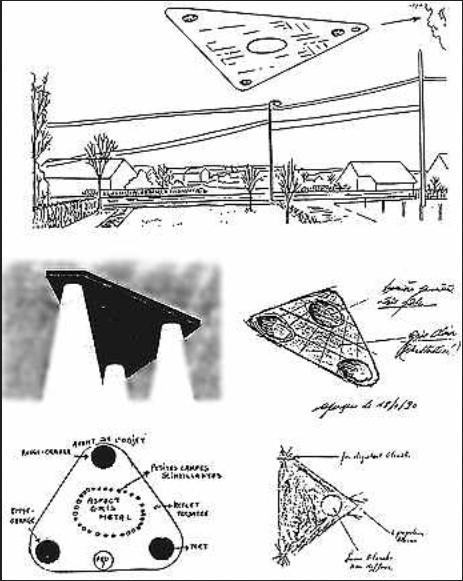
A striking feature of the Belgian wave is how often witnesses used similar geometry to describe what they saw. Many accounts describe three bright lights forming a triangle, sometimes with a distinct central light, sometimes with a dark “mass” implied between them. The object is frequently described as moving slowly, sometimes hovering, often with little or no sound.
This kind of repeated description is psychologically powerful. It makes the wave feel coherent. It encourages the sense that people are reporting “the same thing.”
But the same surface description can arise from very different stimuli. Aircraft navigation lights can create triangular impressions at night. Helicopters can behave in ways that look uncanny when their sound is masked by wind and atmospheric conditions. Bright astronomical bodies can look oddly structured when viewed through haze, branches, or human expectation. And, of course, sometimes a witness may genuinely be seeing an unusual structured object.
The Belgian wave’s triangle language is therefore best treated as a pattern in testimony, not automatic proof of a single underlying craft type. The pattern still matters, because it tells us how the phenomenon was experienced and communicated.
March 30–31, 1990: the night Belgium became a global UAP case
Belgium would still be notable if it were “just” a mass wave of triangle reports. What pushed it into modern-case status was the night when witness reports, command-and-control attention, and fighter operations converged.
The Belgian Air Force report written by Major P. Lambrechts (dated May 31, 1990) is the key primary source for this event. It describes a chain of reports and radar observations that led the Air Force to scramble two F-16s. (das-ufo-phaenomen.de)
The tone of the report is worth emphasizing. It is not mystical. It is procedural. It reads like a document written by someone who expects it might be scrutinized later.
According to the report’s timeline, the Control Reporting Center (CRC) at Glons received reports of unusual lights moving toward the Thorembais-Gembloux area around 23:00. Glons requested gendarmerie confirmation. Radar nodes, including Semmerzake, reported contact, and at 23:56 the scramble order was issued. Two F-16s took off shortly after midnight and conducted multiple interception attempts under CRC control. (das-ufo-phaenomen.de)
The report describes brief radar locks and dramatic apparent changes in speed and altitude associated with those locks. It includes the now-famous line about the target’s speed changing from roughly 150 to 970 knots. (das-ufo-phaenomen.de)
It also notes a detail that has become central to the controversy: the pilots did not obtain visual confirmation. (das-ufo-phaenomen.de)
This “radar story without visual confirmation” is exactly the kind of knot that makes a modern UAP case enduring. It is simultaneously compelling and frustrating.
What ground witnesses contributed
The Lambrechts report includes witness descriptions from gendarmerie and others that focus on light behavior, formation, and color changes. These descriptions read like attempts to be observational rather than interpretive. (das-ufo-phaenomen.de)
Even if we eventually decided the stimulus was conventional, the ground layer still matters. It shows why the event escalated. People believed they were watching something structured and unusual enough to justify calling authorities.
Why the night is not “case closed”
It is tempting to treat the March 1990 night as either definitive proof of something extraordinary or definitive proof of mass confusion. Both moves are too clean.
The Air Force report is a primary record that confirms an operational response and documents radar contacts and intercept attempts. (das-ufo-phaenomen.de) That alone is significant.
But interpretation of the radar data remains contested. A major skeptical line of analysis argues that some of the “locks” can be explained as the F-16s locking onto each other and that other reported contacts may be linked to atmospheric interference effects such as Bragg scattering. While not every skeptic agrees on every technical detail, this family of explanations exists precisely because radar is not a simple camera. (astronomyufo.com)
Tim Printy’s detailed work is frequently cited in skeptical circles because it attempts to unpack radar behavior and intercept geometry rather than relying on rhetorical dismissal. (astronomyufo.com)
COBEPS, in its retrospective, notes that the event provoked heated debate, capturing the key tension succinctly: the intercept was “invisible” to pilots while being described as visible from the ground and present on radar. (cobeps.org)
A scientifically-minded reader should take that tension seriously. It is the sort of mismatch that can emerge from either an unusual target with unusual signature behavior or from the complex interaction of perception, instrumentation, and environment during a live intercept.
Wave dynamics: why “a lot of reports” is never a simple claim
One of the most useful things Belgium teaches is how waves form and how they can persist.
When a society becomes sensitized to a particular pattern, the sky fills up with candidate explanations. That does not mean people are lying. It means perception is doing what perception does: it tries to match stimuli to available patterns. Media attention and conversation act as catalysts. Researchers on the skeptical side have long argued that social and media factors can amplify a wave by encouraging observers to watch, interpret, and report ambiguous stimuli as UAP. (afis.org)
This critique becomes sharper in Belgium because of timing. Some discussions emphasize that many public witness reports describing the March 1990 event were filed after the fact, raising questions about memory, reconstruction, and the influence of subsequent narratives. (Mainstream retrospectives still describe the Belgian wave as unresolved while acknowledging how social feedback loops shape such events.) (theweek.com)
A fair reading of Belgium therefore holds two ideas together:
The wave’s scale is real as a reporting phenomenon. (cobeps.org)
The wave’s scale does not automatically equate to a single extraordinary cause.
That is not cynicism. It is the discipline that keeps wave cases from collapsing into either credulity or contempt.
The photograph that became a trap: Petit-Rechain
Belgium also provides a cautionary tale about what happens when one artifact becomes the symbol of a whole period.
The so-called Petit-Rechain photograph became the iconic image of the Belgian wave. In 2011, Reuters reported that the photographer admitted it was a hoax made using a model and lights. (reuters.com)
The hoax is important, but not because it “debunks Belgium.” It is important because it demonstrates how wave environments attract fabrication, and how fabrication can distort public memory.
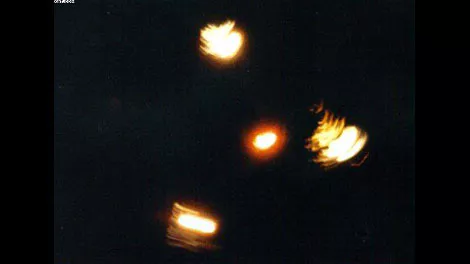
After the confession, skeptics could treat the hoax as representative; believers could treat the confession as suspicious; and the actual archival complexity of Belgium risked being reduced to a single image.
A more careful approach is simple: treat the Petit-Rechain photo as a hoax and move on, without allowing it to swallow the rest of the record.
Institutional attention beyond Belgium
Belgium’s wave was visible enough to be noticed outside Belgium’s borders. A UK Ministry of Defence file (DEFE 31/184/1) includes correspondence acknowledging the Belgian March 1990 sightings and reflecting an institutional posture that the events were taken seriously enough to discuss, even if not solved. (documents.theblackvault.com)
These kinds of documents help anchor the reality that Belgium was not a purely local rumor. It was an international point of interest.
At the same time, official attention does not automatically resolve identification. Government documents can be valuable and limited at once, which is why UAPedia treats government sources as inputs rather than verdicts. (uapedia.ai)
Where the debate currently lands, and why it stays alive
If you want a single sentence summary of why Belgium remains compelling, it might be this: the country produced a sustained pattern of structured-night-sky testimony, and one peak night generated an official report describing radar-intercept operations that still split technical opinion.
Supportive readings emphasize the seriousness of the scramble, the apparent radar correlations, and the consistency of triangle-style reports across months. The existence of substantial SOBEPS documentation reinforces the sense that Belgium is not a casual story but a deeply recorded one. (abebooks.co.uk)
Skeptical readings emphasize that waves are mixed environments and that radar interpretation is tricky. They argue that dramatic radar kinematics can emerge from misassociation, atmospheric effects, and intercept dynamics, and that the absence of pilot visual confirmation should push us away from literal readings of “extreme acceleration.” (astronomyufo.com)
Meanwhile, even within Belgian archival commentary, the fact that the March 1990 episode triggered “heated discussions” is treated as a defining feature rather than an embarrassment. (cobeps.org)
Belgium stays alive because neither side has managed to make the other side look irrational. That is surprisingly rare.
Implications for modern “sensor-verified” casework
Belgium also matters because it teaches specific methodological lessons that modern UAP research still struggles to implement.
First, “multi-sensor” is not the same as “identified.” A radar track is not an aircraft label. It is data requiring interpretation, and interpretation depends on context, calibration, and human decision-making.
Second, wave environments demand triage. If a wave produces hundreds of reports, investigators must separate the likely-prosaic from the high-information cases rather than treating everything as equally probative.
Third, iconic artifacts can harm a case as much as help it. The Petit-Rechain hoax did not just embarrass believers. It taught everyone how easily public memory can be hijacked by a single image. (reuters.com)
Finally, Belgium is an argument for better data culture. If a similar wave occurred today, the ideal response would involve time-synced sensor fusion, transparent metadata handling, and clear public communication that separates observation from interpretation.
Belgium did not have those tools. It still produced one of Europe’s most instructive modern case libraries.
Claims taxonomy
Verified
The Belgian Air Force produced an official report describing the March 30–31, 1990 event, including the decision to scramble two F-16s, multiple interception attempts, and the lack of pilot visual confirmation. (das-ufo-phaenomen.de)
Probable
Belgium experienced a sustained multi-witness reporting wave beginning in late 1989 with significant case cataloging and witness volume extending beyond the 1990 peak into the early 1990s. (cobeps.org)
Disputed
The interpretation of the March 1990 radar data, including whether reported extreme kinematics represent a target’s real performance or arise from radar artifacts, misassociation, or atmospheric interference. (astronomyufo.com)
Misidentification
Some portion of the broader wave likely consists of conventional explanations typical of wave environments, a view emphasized in skeptical analyses that foreground psychosocial amplification and ordinary aerial/astronomical stimuli. (afis.org)
Hoax
The Petit-Rechain photograph was admitted by its creator to have been fabricated using a model and lights. (reuters.com)
Speculation labels
Evidence
Belgium experienced a significant cluster of UAP reports beginning in late November 1989, with a widely documented peak on March 30–31, 1990 involving a Belgian Air Force scramble and an official report describing radar contacts and interception attempts, while Belgian report catalogs show the broader reporting environment extending into the early 1990s. (das-ufo-phaenomen.de)
Witness interpretation: Many witnesses interpreted what they saw as a large structured object, often triangular, with distinctive light patterns and flight behavior that felt unlike ordinary aircraft. (caelestia.be)
Researcher opinion
Interpretations diverge. Some researchers treat the March 1990 radar-intercept narrative as a strong indicator of an unresolved target, while others argue that much of the radar drama can be explained by known tracking issues and atmospheric effects, and that the broader wave was amplified by social and media feedback loops. (astronomyufo.com, afis.org)
Hypothesis
A conservative hypothesis is that Belgium’s wave was a composite: a small number of unusual stimuli embedded in a much larger reporting environment of misidentifications and a few hoaxes, with the pattern sharpened by media-driven attention. (cobeps.org) A more anomalous hypothesis is that at least one stimulus in Belgian airspace produced signatures and witness impressions that remain difficult to reduce to conventional aircraft behavior, though this depends heavily on contested radar interpretation. (das-ufo-phaenomen.de)
Active links
Belgian Air Force report (Major P. Lambrechts, 31 May 1990):
https://www.das-ufo-phaenomen.de/app/download/5789262574/Belgian_UFO_Report.pdf
COBEPS Belgian wave retrospective statistics:
https://www.cobeps.org/pdf/belgian_wave_130310.pdf
CAELESTIA “Triangles over Belgium”:
https://www.caelestia.be/article05.html
Tim Printy analysis hub:
https://www.astronomyufo.com/UFO/Belg.htm
Reuters (2011) on Petit-Rechain hoax confession:
References
Abrassart, J.-M., & Gauvrit, N. (2014, December 4). La vague belge d’OVNI : une panique engendrée par les médias ? Association Française pour l’Information Scientifique. (afis.org)
CAELESTIA. (n.d.). Triangles over Belgium. https://www.caelestia.be/article05.html (caelestia.be)
COBEPS. (2012). Belgian wave retrospective statistics and discussion (Catalogue des Observations Belges). https://www.cobeps.org/pdf/belgian_wave_130310.pdf (cobeps.org)
Lambrechts, P. (1990, May 31). Report concerning the observation of UAP in the night from March 30 to March 31, 1990 (Belgian Air Force report). https://www.das-ufo-phaenomen.de/app/download/5789262574/Belgian_UFO_Report.pdf (das-ufo-phaenomen.de)
Printy, T. (n.d.). Belgium 1990: A case for radar-visual UAPs? https://www.astronomyufo.com/UFO/Belg.htm (astronomyufo.com)
Reuters. (2011, July 27). Belgian hit UAP image was polystyrene, says forger. https://www.reuters.com/article/lifestyle/belgian-hit-ufo-image-was-polystyrene-says-forger-idUSTRE76Q2DE/ (reuters.com)
SOBEPS. (1991). Vague d’OVNI sur la Belgique: Un dossier exceptionnel. Bruxelles, Belgique: SOBEPS. (ISBN 978-2960000702). (abebooks.co.uk)
SOBEPS. (1994). Vague d’OVNI sur la Belgique, tome 2: Une énigme non résolue. Bruxelles, Belgique: SOBEPS. (ISBN 2960000714). (amazon.fr)
The Week. (2020, March 30). 30 years later, we still don’t know what really happened during the Belgian UAP wave. https://theweek.com/articles/905215/30-years-later-still-dont-know-what-really-happened-during-belgian-ufo-wave (theweek.com)
SEO keywords
Belgian UAP wave, Belgium triangle sightings, Eupen gendarmerie 1989 UAP, March 30 1990 Belgium F-16 intercept, Belgian Air Force UAP report Lambrechts, Glons CRC, Semmerzake radar, radar-visual UAP Europe, SOBEPS Vague d’OVNI sur la Belgique, COBEPS Belgian UAP statistics, Petit-Rechain photo hoax, Tim Printy Belgium radar analysis, Bragg scattering radar explanation, social amplification UAP wave, 1989–1991 Belgium UAP triangles