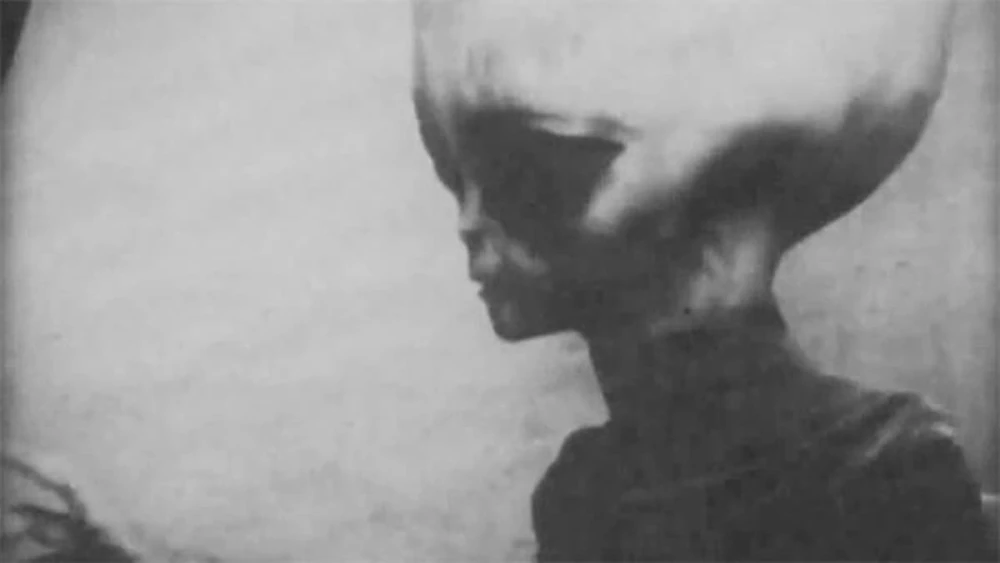
If you ask ten people what a “Grey” looks like, you will usually hear the same core description: a small, slight humanoid body; an oversized head; a reduced nose and mouth; and eyes that seem too large for the face. That shared mental image is now so widespread that it can feel inevitable, as if the Grey has always been the default non-human figure in UAP lore.
But the Grey did not begin as a meme. It became a meme because it was already a motif: a recurring pattern in first-person encounter reports where witnesses said they were not merely observing something at a distance, but being handled, examined, communicated with, and returned. Whether those reports represent external events, internal experiences, or some mixture is the central controversy, but the pattern itself is what keeps the Grey in the conversation.
This article treats “Grey” in the narrowest way the record can responsibly support: as a recurring reported morphology and a recurring narrative motif in abduction and entity-encounter literature, not as a verified biological species with a confirmed point of origin. That framing matters because it respects witness testimony without quietly smuggling in conclusions the evidence does not warrant.
So what do witnesses actually report? Where did the Grey template come from? Which cases shaped it, and which cases complicate it? What do official UAP studies constrain, and what are they simply not designed to address? And how do we discuss this subject in a way that is engaging, readable, and still transparent about what is evidence, what is interpretation, and what remains speculation?
What “Grey” means in practice
In encounter literature, “Grey” functions more like a field label than a species name. It groups together descriptions that cluster around a body plan: short stature; thin limbs; enlarged cranium; minimal facial features; and prominent, dark, almond-like eyes. Skin is commonly described as grey, pale, or matte. Clothing varies widely, ranging from tight dark suits to minimal uniforms to indistinct coverings that the witness struggles to describe.
The behavioral profile is where reports start to converge in a way that feels less like simple image-borrowing. Many experiencers describe a procedural manner: efficient movement, limited overt emotion, and an apparent focus on tasks rather than conversation. Communication, when reported, often feels internal, as if thoughts are being placed directly into the witness’s mind. The content of these messages is usually simple, sometimes calming, sometimes direct.
Those features matter because they appear in the kinds of accounts that claim high intimacy: missing time, paralysis, “onboard” environments, and clinical examination motifs. Even if you remain agnostic about what caused these experiences, this is the core reason the Grey became central to “Alien species related to UAP hypothesis” discussions.
How the Grey template stabilized
A useful anchor is folklorist Thomas E. Bullard, who examined abduction reports as a narrative tradition. In a peer-reviewed paper in The Journal of American Folklore, Bullard argued that abduction accounts form a notably structured story type that echoes older “supernatural kidnap” traditions, updated into technological form. He identified recurring sequences, with capture, examination, interaction, and return appearing as common elements across cases. (Bullard, 1989). (Semantic Scholar)
Bullard’s work is valuable here because it does not require you to decide in advance whether abductions are literal external events or internal psychological episodes. It asks a simpler question: what patterns recur across reports? That approach makes the Grey look less like a one-off monster and more like a recurring role inside a repeated narrative structure, especially in the “examination” segment.
Bullard also highlights the cultural feedback problem. Once a story structure becomes widely known, later witnesses can use it as a vocabulary for interpreting ambiguous experiences, and investigators can unintentionally guide testimony toward familiar motifs. (Bullard, 1989). (Semantic Scholar) This is not a dismissal of witnesses. It is a constraint on what we can safely conclude from recurring patterns alone.
The result is a paradox: the more consistent the Grey motif becomes, the easier it is to spot across cases, but the harder it becomes to prove the consistency is independent of culture.
The Hills: how the modern abduction conversation took shape
The Betty and Barney Hill case (New Hampshire, 1961) remains foundational because it is early, widely documented in a historical sense, and deeply influential. The Hills reported a close encounter with a structured craft, including the famous “occupants behind windows” theme and a period of missing time. Later, the case became intertwined with hypnosis and public debate over memory and suggestion.
UAPedia’s forensic overview lays out the encounter timeline, the missing time, and the later use of hypnosis with psychiatrist Dr. Benjamin Simon, while also treating hypnosis-derived specifics as contested rather than automatic fact. (UAPedia, n.d.). (UAPedia – Unlocking New Realities)
One of the strongest reasons the Hill case stays “real” as an event in history is the archival footprint. The University of New Hampshire’s public description of the Betty and Barney Hill Papers notes that the collection contains correspondence, personal journals and essays, manuscripts, newspaper clippings, photographs, slides, and DVDs relating to their experiences and interest in UAP. (University of New Hampshire Library, n.d.). (Library | University of New Hampshire) The UNH archives entry similarly summarizes the breadth of materials. (archives.unh.edu)
An archive does not verify an abduction. What it does verify is that there is a traceable record of who said what, when, and how the story evolved over time.
This is also where origin claims often slip in through the side door, especially the famous “star map” discussions that later became associated with Zeta Reticuli. A publication-ready approach keeps those claims separated: the Hills’ documented distress and the missing time are one category; later interpretive origin claims derived from hypnosis and subsequent argument chains are another.
Travis Walton: Greys in a “procedural” role, plus other entities
The Travis Walton incident (Arizona, 1975) is frequently cited because it includes a classic Grey-like description and a “Grey-plus-others” pattern. UAPedia’s case file summarizes Walton’s account of regaining consciousness in an interior room with three short beings with oversized heads and large eyes, followed by an encounter with human-appearing figures wearing helmets. (UAPedia, n.d.).
This pattern matters because it pushes against a simplistic belief that the Grey is always the only entity present. In many narratives, Greys appear during the segment witnesses interpret as clinical or procedural, while other figures appear as escorts, supervisors, or different “types” entirely. Some experiencers interpret this as hierarchy or division of labor. More cautious readers interpret it as the mind mapping an unfamiliar situation into human categories like “medical staff” and “guards.”
Either way, the key point is that Grey reports often exist inside more complex “cast lists,” which complicates any attempt to treat “the Greys” as a single, uniform species with a single role.
Allagash: why later testimony changes evidential weight
The Allagash case (Maine, 1976) has long been used as a multi-witness abduction narrative involving missing time and Grey-like beings. It also illustrates why evidential weighting can change over time and why case components sometimes need to be separated.
A crucial caveat comes from later reporting in The County (Maine), where Chuck Rak is quoted expressing skepticism about the abduction component, saying he did not call it a hoax but described it as “brilliant storytelling,” and noting how parts of the story were framed and circulated. (Potila, 2016). (The County)
That does not erase the original wilderness light encounter from the record. It does mean the case is no longer cleanly usable as a “four consistent witnesses” foundation for the abduction narrative. A careful treatment separates the components: the night-time light encounter and missing time claims remain one layer; the later detailed abduction narrative, especially where hypnosis, media retellings, and later disagreement enter, becomes a disputed layer.
For the Grey motif, Allagash still matters as part of the broader pattern of reported features. It just cannot responsibly carry the same evidential load it once did in popular retellings.
Ariel School: Grey-like features outside the classic abduction pathway
The Ariel School encounter (Zimbabwe, 1994) is one of the most discussed multi-witness entity reports involving children. It matters to the Grey discussion because many children described small figures with unusually large eyes and a striking presence, while also differing on details and interpretation.
This case sits outside the classic “adult abductee under hypnosis” pathway, which makes it valuable, but it also demands care. Children can be credible, children can be influenced by group dynamics, and post-event discussion can shape memory in either direction. A sober approach treats Ariel as a significant multi-witness entity report that includes Grey-adjacent features, while remaining contested and methodologically complex.
What official UAP reports do, and do not, constrain
Official UAP studies are often invoked in debates about Greys, but their mandates typically focus on UAP as objects and hazards, not intimate entity encounters.
NASA’s 2023 UAP Independent Study Team report states that the lack of “consistent, detailed, and curated observations” prevents definitive scientific conclusions and calls for improved data collection and stigma reduction so higher-quality data can be gathered. (NASA UAP Independent Study Team, 2023). (NASA Science)
ODNI’s 2022 Annual Report on UAP is oriented toward reporting and assessment in a national-security context, with scope and assumptions centered on observer reports and available sensor data rather than experiential narratives. (Office of the Director of National Intelligence, 2022). (DNI)
AARO’s 2024 Historical Record Report, issued under the U.S. Department of Defense, reviews the historical record of U.S. government involvement with UAP and states that investigations have not found even one case of UAP representing off-world technology. (All-domain Anomaly Resolution Office, 2024). (U.S. Department of War)
These reports matter as constraints on certain categories of claims, especially claims that “official investigations” have verified off-world technology. They do not directly adjudicate abduction narratives, and they are not structured to confirm or falsify Grey encounters as experiencers describe them. Most abduction-type reports do not produce the instrumented metadata NASA is asking for, and they rarely appear in the kind of reconstructable historical government record AARO is tasked to evaluate.
This mismatch is part of why Grey debates continue: the official data pipeline and the experiencer testimony pipeline are not the same stream.
The big controversies, stated plainly
The Grey question remains unsettled because the controversies are methodological.
One is hypnosis. Many classic abduction cases rely on regression hypnosis for detailed recall. Even when hypnosis helps someone articulate distressing experiences, it can also increase confidence in reconstructed narratives. A careful approach treats hypnosis-elicited specifics as disputed unless supported by contemporaneous documentation or independent corroboration.
Another is sleep paralysis and false-memory formation. Harvard Gazette coverage of research into abduction claims describes how some experiences can map onto sleep paralysis and memory processes, especially when combined with cultural expectations. (Cromie, 2005). (Harvard Gazette)
A third is cultural standardization. Once a particular Grey face becomes “the” Grey face, it becomes easier for witnesses to describe ambiguous experiences through that vocabulary, and easier for audiences to recognize and accept the story form.
A stronger source than Wikipedia for this standardization point is the interview with artist Ted Seth Jacobs hosted at Beyond Communion, where Jacobs discusses creating the Communion cover art and Strieber’s involvement. (Jacobs, n.d.). (beyondcommunion.com)
This does not prove the Grey is fictional. It proves the Grey image became culturally stabilized, which affects how testimony is narrated and received.
Publications and studies that shaped Grey discourse
Bullard’s 1989 paper remains a key scholarly reference because it supports a restrained claim: abduction reports commonly exhibit patterned narrative structure, and entity motifs recur across cases in ways that resemble a legend type. (Bullard, 1989). (Semantic Scholar)
A second influential document is the 1992 Roper Organization survey analysis published as Unusual Personal Experiences, associated with Budd Hopkins, David M. Jacobs, and Ron Westrum. The report analyzes survey responses for “indicator” experiences that the authors argue correlate with patterns in abduction narratives. (Hopkins, Jacobs, & Westrum, 1992). (iPhemeris)
This source is often misused, so the safest way to read it is as sociological data about self-reported experiences, not as confirmation of Greys or abductions. It can suggest that certain clusters of unusual experiences are not extremely rare in the general population. It cannot, by itself, determine whether those experiences represent external events, internal events, or mixtures.
Implications, carefully stated
If Greys are external non-human intelligences interacting with humans as described in abduction narratives, the implications are ethically severe: consent, bodily autonomy, and human vulnerability become central concerns.
If Greys are partly an “interface” phenomenon, where experience is shaped by cognition and culture alongside any external trigger, the implications shift toward consciousness studies and the mechanics of perception, memory, and meaning. That approach can account for variability and symbolic content without pretending it settles the external-versus-internal question.
If the dataset is mixed, which is a plausible research stance given the range of cases and methods, the implication is methodological: better standards for documentation and witness care are needed, along with stigma reduction so experiences are recorded closer to the time they occur. NASA explicitly emphasizes that stigma reduction and improved data practices are necessary to improve the quality and usefulness of UAP reporting. (NASA UAP Independent Study Team, 2023). (NASA Science)
Claims taxonomy
Verified
“Grey” is a recurring reported morphology and narrative motif in modern abduction and entity-encounter literature, documented as a patterned element in comparative scholarship. This verifies recurrence of the motif in reports, not Greys as a biological species, and it does not confirm the external reality of any specific encounter. (Bullard, 1989). (Semantic Scholar)
Probable
Some classic cases credibly document close-range claims involving structured objects and missing time with substantial contemporaneous documentation and later archival preservation, even when detailed abduction narratives remain contested. The Hill case’s archival footprint at the University of New Hampshire supports this narrower “documented case history” claim. (Library | University of New Hampshire)
Disputed
Detailed onboard narratives that rely primarily on regression hypnosis, especially where later participant accounts diverge or where public retellings appear to shape the storyline. The Allagash case is appropriately treated as disputed for its abduction component given later participant skepticism reported in local coverage. (The County)
Misidentification
Specific star-system origin certainty derived from the Hill “star map” as settled proof of provenance. Origin claims of this kind remain contested and should not be presented as established fact.
Hoax
The 1995 “Alien Autopsy” film as authentic documentation of a non-human body; reporting and later accounts support its status as fabricated media rather than verified evidence.
Speculation labels
Hypothesis
Greys represent a recurring non-human actor-type associated with certain close UAP encounters, characterized by controlled procedures, minimal overt emotion, and non-verbal communication.
Witness Interpretation
Many experiencers interpret paralysis, missing time, and examination motifs as deliberate control and medical sampling by Grey entities, often describing communication as telepathic or “in the head.”
Researcher Opinion
“Grey” is best treated as a recurring reported morphology and narrative motif. This preserves the cross-case pattern without claiming biological verification, and it avoids treating origin claims as established fact unless supported by evidence beyond hypnosis, later retellings, and cultural circulation.
References
All-domain Anomaly Resolution Office. (2024). Report on the Historical Record of U.S. Government Involvement with Unidentified Anomalous Phenomena (UAP), Volume I. U.S. Department of Defense. (U.S. Department of War)
Bullard, T. E. (1989). UFO abduction reports: The supernatural kidnap narrative returns in technological guise. The Journal of American Folklore, 102(404), 147–170. (Semantic Scholar)
Cromie, W. J. (2005, September 22). Alien abduction claims explained. Harvard Gazette. (Harvard Gazette)
Hopkins, B., Jacobs, D. M., & Westrum, R. (1992). Unusual Personal Experiences: An Analysis of the Data from Three National Surveys Conducted by the Roper Organization. Bigelow Holding Corporation. (iPhemeris)
Jacobs, T. S. (n.d.). Ted Seth Jacobs: An interview with the artist. Beyond Communion. (beyondcommunion.com)
NASA Unidentified Anomalous Phenomena Independent Study Team. (2023). UAP Independent Study Team Final Report. NASA. (NASA Science)
Office of the Director of National Intelligence. (2022). Annual Report on Unidentified Aerial Phenomena. ODNI. (DNI)
Potila, J. (2016, September 21). How much of a famed 1976 UFO abduction is true? The County (Maine). (The County)
UAPedia. (n.d.). The Betty and Barney Hill Abduction: A Forensic Overview. (UAPedia – Unlocking New Realities)
UAPedia. (n.d.). Travis Walton, Abduction Incident (USA, 1975). (UAPedia – Unlocking New Realities)
UAPedia. (n.d.). Allagash Abductions (1976): Maine’s Wilderness Encounter. (UAPedia – Unlocking New Realities)
UAPedia. (n.d.). Ariel School Encounter, Zimbabwe 1994: A Dossier. (UAPedia – Unlocking New Realities)
University of New Hampshire Library. (n.d.). Betty and Barney Hill Papers, 1961–2006. (Library | University of New Hampshire)
SEO keywords
Greys, The Greys, Grey aliens, reported alien species, UAP hypothesis, non-human intelligences, entity encounters, abduction narratives, missing time, telepathic communication, Betty and Barney Hill, Travis Walton, Allagash abductions, Ariel School encounter, regression hypnosis controversy, sleep paralysis and abduction claims, NASA UAP Independent Study Team report, ODNI UAP annual report, AARO historical record report