
On a cold January night in North Texas, the sky can feel like an open plain all its own. The air is dry, the horizon is low, and the darkness has that rare rural depth where even familiar stars look sharpened. It is the kind of night when, if something bright appears and behaves strangely, you notice. Then you keep noticing. Then you call someone. And if your neighbor says, “I saw it too,” the story becomes something else entirely.
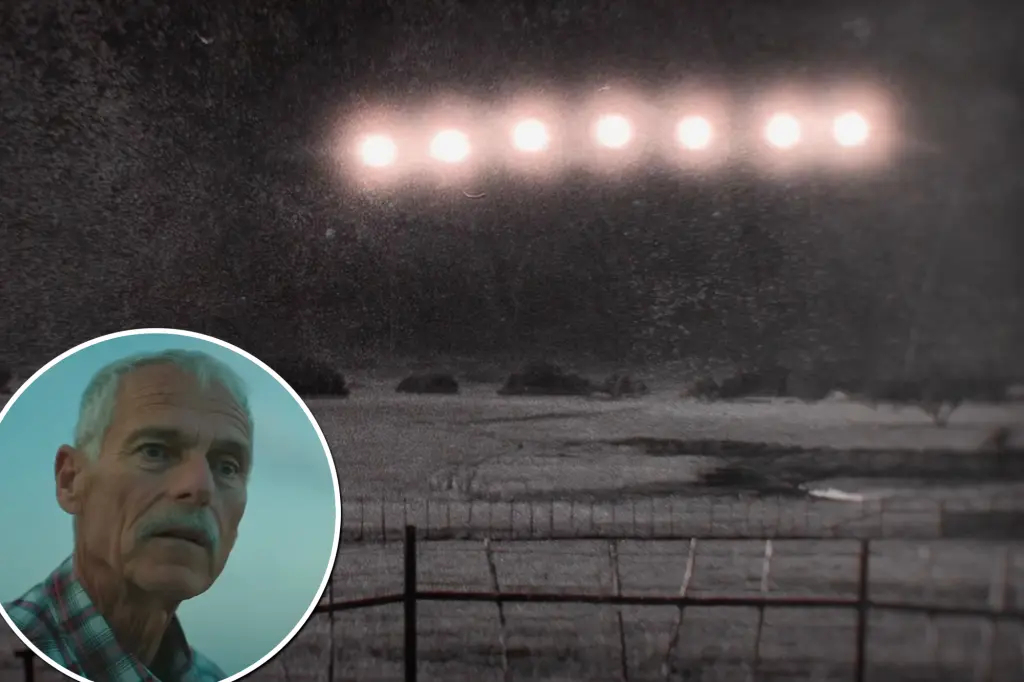
That is the emotional weather around the Stephenville, Texas UAP wave of January 8, 2008. It began as a local puzzle and turned into one of the most argued modern UAP cases in the United States, largely because it sits at a collision point: credible first-hand accounts, a region known for military training activity, and FAA radar data that exists, was released, and was analyzed, but remains disputed in what it ultimately implies.
That last line matters, so let’s be plain about it upfront. When UAP researchers call Stephenville “sensor-supported” or “sensor-anchored,” they mean there was FAA radar data relevant to the time window, that data was obtained and analyzed, and it became part of the public evidentiary record. They do not mean the anomalous interpretation is settled. Stephenville is still a case where the data and the testimony push hard against easy answers, but do not force a single conclusion.
A wave, not a single sighting
If you only know the headline version, it can sound like “people saw a giant craft near Stephenville.” The more accurate framing is: multiple groups across multiple towns reported unusual aerial lights over a multi-hour window, with descriptions that rhyme but do not perfectly match. That’s what “wave” means here. The evening generated a cluster of reports in and around Stephenville, Dublin, Gorman, and Comanche, plus surrounding rural roads where people were driving home, checking on livestock, or simply outside when the sky changed.
The best known investigative synthesis from the period is the “Stephenville Lights: A Comprehensive Radar and Witness Report Study” by Glen Schulze and Robert Powell. Built from interviews and FOIA-obtained FAA radar returns, it treats January 8 as a multi-episode event and attempts to identify which reports plausibly share a single causal source. It documents a set of sightings spanning roughly 6:00 p.m. to after 9:00 p.m., and it uses a radar window covering 4:00 p.m. to 8:00 p.m. local time as the key overlap for correlating testimony with air activity. (Schulze & Powell, 2008, PDF: https://www.ufocasebook.com/pdf/mufonstephenvilleradarreport.pdf)
Waves also create a human complication that can be uncomfortable to admit: once the first story hits radio or television, attention changes what people report. Some witnesses look up more than they otherwise would. Others compare notes, and even honest people can unintentionally absorb details from each other. At the same time, people who would normally shrug and stay quiet decide to come forward because they realize they are not alone. Stephenville had all of that, almost immediately, and the social ripple became part of the case’s identity. (Gellene, 2008: https://www.latimes.com/archives/la-xpm-2008-jun-14-sci-ufo14-story.html)
The disciplined approach is to treat Stephenville like a case file with chapters rather than a single snapshot. You can have conventional activity in the same sky as anomalous reports. You can have misinterpretations inside a larger event that also contains something harder to attribute. And you can have a radar dataset that is real while still leaving space for interpretive disagreement.
Selden hill and the pilot who said “not that”
One of the most visible witnesses early on was Steve Allen, a private pilot, who described bright lights approaching quickly, appearing to maneuver, and then disappearing. In a nationally broadcast interview, he also described later seeing military jets he believed were connected to what he had just watched. (CNN, 2008-01-18 transcript: https://transcripts.cnn.com/show/lkl/date/2008-01-18/segment/01)
Pilot testimony is not a magic wand, and pilots can be fooled like anyone else. The value is more modest and more practical: pilots accumulate significant flight experience, and many develop a strong baseline for what typical aircraft lighting and movement look like in real skies, not just in diagrams. That doesn’t make any one witness infallible, but it can reduce the odds that a striking observation is dismissed too quickly as ordinary air traffic.
Allen’s certainty that “this wasn’t normal traffic” helped propel the case into national attention, and it also created a pressure point for critics: if the lights were conventional, how did experienced observers become so confident they were not?
The Gorman police chief and the flare that didn’t behave
One of the strongest vignettes in Schulze and Powell’s report comes from a police chief driving east on State Highway 6 near Gorman at about 6:20 p.m. What makes it compelling is how the witness begins. He assumes what he sees is a flare in the Brownwood Military Operating Area, because flares are not unusual there. Then he describes why that explanation stopped fitting: the light did not descend and fade the way he expects a flare to behave, it extinguished, and then multiple lights appeared in a way he found inconsistent with a single descending illumination source. (Schulze & Powell, 2008, pp. 7–11, PDF: https://www.ufocasebook.com/pdf/mufonstephenvilleradarreport.pdf)
That pattern, “I assumed X because X is common here, but this diverged from X,” is exactly what investigators hope for. It is not proof, but it is a sign of an observer actively trying to normalize the stimulus before labeling it unusual.
The flare hypothesis is powerful in this region, and we will return to it, but the Gorman account illustrates why some witnesses did not find “flares” satisfying as a complete answer. Not because flares cannot be bright or strange at a distance, but because some observers felt the behavior broke their baseline.
The Dublin-area constable and the problem of silence
Another anchor report is from a local constable around 7:15 p.m. He and his young son reportedly observed reddish-orange lights just above the tree line, with no obvious sound and lights that disappeared abruptly. (Schulze & Powell, 2008, pp. 12–14, PDF: https://www.ufocasebook.com/pdf/mufonstephenvilleradarreport.pdf)
Silence is tricky. People often assume silence means “not a jet,” but sound propagation is inconsistent, especially in layered wind conditions. You can see aircraft before you hear them, and sometimes you may not hear them clearly at all. Still, silence becomes more interesting when paired with other claims: apparent low altitude, hovering behavior, abrupt “lights out” transitions, and rapid repositioning.
That combination is one reason Stephenville refuses to collapse into a single easy category. Each element alone can be explained away. Together, across multiple witnesses, they become harder to dismiss without leaning heavily on coincidence and perception error.
Comanche later that evening, and a controller’s “no”
A later report around 9:30 p.m. near Comanche is memorable because it involves a former air traffic controller and his spouse. The witness described several strange lights near the horizon and compared them to “white fireworks,” rising without trailing flame, moving quickly and irregularly, and then disappearing abruptly. He explicitly stated these were not aircraft as he understood them, and he contrasted the earlier lights with small jets seen later as a separate, familiar stimulus. (Schulze & Powell, 2008, pp. 19–21, PDF: https://www.ufocasebook.com/pdf/mufonstephenvilleradarreport.pdf)
As with pilot testimony, a controller’s background does not guarantee accuracy, but it does make the “I can’t fit this into normal air traffic” claim more evidentially meaningful. It’s evidence of anomaly perception by a trained observer, not evidence of origin.
The radar backbone: what was actually obtained
Stephenville’s “sensor” backbone is FAA radar data, obtained by FOIA and analyzed as part of the Schulze–Powell investigation. The FAA response included a very large dataset, described publicly as millions of lines of radar returns, which the investigators treated as unusually useful because it included detailed return information rather than a simplified, curated track display. (Schulze & Powell, 2008, PDF: https://www.ufocasebook.com/pdf/mufonstephenvilleradarreport.pdf)
This dataset included returns from multiple radar sites, and the investigators attempt to validate accuracy by comparing known aircraft tracks and speeds across sites. They distinguish between secondary radar returns (transponder-based) and primary radar returns (sometimes called “skin paint”), which can reflect physical targets without a transponder but can also include clutter and artifacts.
This is where Stephenville becomes both stronger and more complicated.
Primary radar is the kind of data people dream about in UAP research because it can, in principle, register something that is not cooperating. But primary radar is also where nature and physics play tricks. Weather, birds, anomalous propagation, ground clutter, and instrument idiosyncrasies can all produce returns that look suggestive. The evidentiary task is to isolate coherent tracks without simply drawing your expectations onto noise.
Here the phrasing matters: Schulze and Powell argue that certain returns align too well with witness timing and directions to dismiss as random clutter, and they treat those alignments as part of the case’s core support. Skeptical analysts argue that extracting an “unknown track” from a huge field of returns risks selection bias, and that many of the returns can be explained through known traffic and radar effects. You do not have to pick a side to appreciate the crucial point: Stephenville’s radar evidence exists, it was analyzed, and it remains interpretively contested.
This is precisely what “sensor-supported” means in the UAPedia sense for this case. The sensor data is real and part of the record. The interpretation is not settled.
A thin but intriguing radar moment
A detail often lost in casual retellings is that some of the most-discussed “unknown” radar in the Selden timeframe is not a continuous, cinematic track. In parts, it can be as thin as a small number of detections close in time that, when plotted, resemble the movement witnesses described. This does not constitute continuous tracking of a single object. It is one reason the case remains disputed even among analysts who agree the underlying dataset is valuable. (Schulze & Powell, 2008, see sections on radar correlation and plotting methodology, PDF: https://www.ufocasebook.com/pdf/mufonstephenvilleradarreport.pdf)
This cuts both ways.
If you are skeptical, you can say: a handful of primary returns do not prove a craft. They can be clutter, artifacts, or coincidence.
If you are persuaded by anomaly, you can say: when returns occur close in time and space to credible witness windows, the probability of coincidence may shrink, and the broader dataset might contain more structure than critics allow.
The honest position is to admit what the data does and does not do. It does not hand you a single unambiguous object with a continuous track and known performance metrics. It does give you a shared reference frame between witness time windows and recorded airspace activity, and that is enough to keep Stephenville in the modern evidentiary tier.
Military aircraft in the same sky, and why that did not end the story
From the beginning, the region’s training activity was central to explanations. The Brownwood Military Operating Area is a known context, and jets were flying. Schulze and Powell’s analysis includes multiple military aircraft tracks, including scenarios where one aircraft in a formation carried an active transponder and others did not, which complicates straightforward public interpretations of radar displays. (Schulze & Powell, 2008, PDF: https://www.ufocasebook.com/pdf/mufonstephenvilleradarreport.pdf)
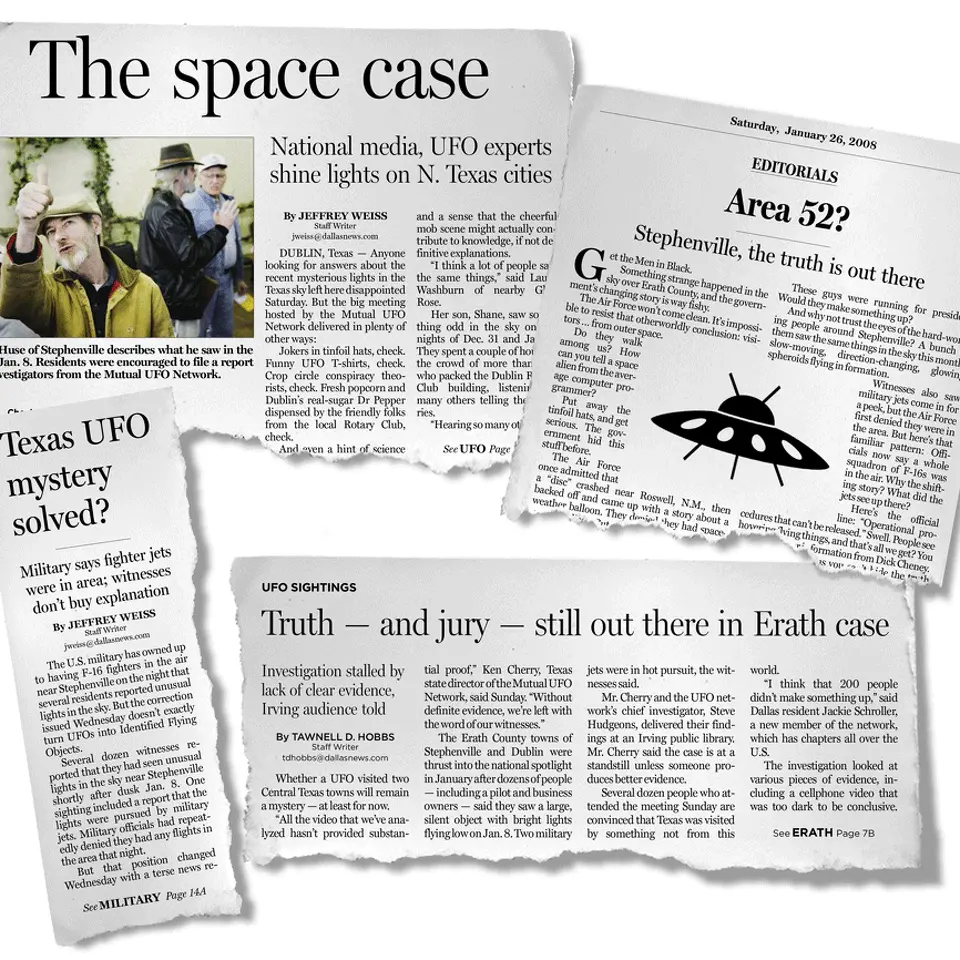
Mainstream reporting later captured a key public twist: initial official messaging suggested no jets were operating in the immediate area, and then subsequent reporting indicated that ten F-16s had been on a training mission that night, reinforcing the view that “it was just jets and training.” (Gellene, 2008: https://www.latimes.com/archives/la-xpm-2008-jun-14-sci-ufo14-story.html)
This is exactly where Stephenville becomes a case about institutional communication as much as aerial lights. When official messaging changes, people interpret the change in different ways. Some see honest error and correction. Others see minimization. Either way, the shift adds fuel.
For balance, it also helps to include early mainstream reporting that reflects the core witness claims without the later analytical layers. CBS News, citing Associated Press reporting, described “several dozen” reports and emphasized repeated descriptions of a large, silent object. (CBS News, 2008-01-16: https://www.cbsnews.com/news/dozens-report-ufo-over-texas-town/)
The flare argument: plausible, powerful, and still incomplete
If you want a conventional explanation that can reproduce a lot of “wow,” military illumination flares are near the top. They can be extraordinarily bright, visible for long distances, and they can appear to hover or drift. Multiple flares deployed sequentially can look like lights turning on and off across a section of sky. A viewing angle that hides the parachute descent can make them appear to “hang.”
A skeptical critique in Skeptical Inquirer, discussing Stephenville, leans strongly on this kind of explanation and argues that aircraft and flares, combined with misperception and selective radar interpretation, account for the event. (McGaha, 2009: https://centerforinquiry.s3.amazonaws.com/wp-content/uploads/sites/29/2009/01/22164446/p56.pdf)
It is important not to dismiss this critique out of hand. It addresses real features of the case: the presence of training aircraft, the plausibility of flare misinterpretation, and the interpretive complexity of primary radar.
The counterweight, and it is a serious one, is that several key witnesses in the Schulze–Powell compilation appear to have considered flares first and still found what they saw inconsistent with typical flare behavior in that area. The Gorman police chief’s account is again the cleanest example because it begins with normalization and then diverges. (Schulze & Powell, 2008: https://www.ufocasebook.com/pdf/mufonstephenvilleradarreport.pdf)
Also, the flare explanation does not automatically map onto the subset of testimony that includes apparent structured motion and reconfiguration rather than drift, unless you assume those perceptions were artifacts of distance, sequential deployment, and perspective. That is possible. But Stephenville’s evidentiary weight is not in any one claim. It is in the number of credible people who felt they were watching behavior, not just brightness.
“Two-and-a-half million lines”: the public radar debate
Stephenville’s radar debate moved into mainstream visibility through interviews where the investigators described the dataset’s scale and their interpretation, alongside skeptical countervoices.
In a CNN Larry King Live transcript dated July 11, 2008, Schulze is quoted describing “two-and-a-half million lines” of unabridged, unedited data and characterizing it as excellent for analysis, while skeptical commentary appears in the same program context. (CNN, 2008-07-11 transcript: https://transcripts.cnn.com/show/lkl/date/2008-07-11/segment/01)
What Schulze and Powell concluded, and what they did not claim
Schulze and Powell’s report takes a strong stance. They argue their primary conclusion is that there was a real, physical object witnessed in the Dublin–Stephenville area on January 8, 2008, and they treat radar-witness correlation as central support. They also state they cannot identify the object’s origin. (Schulze & Powell, 2008: https://www.ufocasebook.com/pdf/mufonstephenvilleradarreport.pdf)
That combination, strong assertion about physical reality paired with restraint about origin, is important. It is possible to argue “there was an object” without leaping to “it was non-human.” That separation is one of the more mature habits modern UAP work has developed.
It is also where critics push hardest. Skeptical analysts argue that “object” is an interpretive leap from the radar, and that the same airspace context supports a conventional explanation. (McGaha, 2009: https://centerforinquiry.s3.amazonaws.com/wp-content/uploads/sites/29/2009/01/22164446/p56.pdf)
Both positions should be treated as what they are: interpretive frameworks built on shared facts.
The impact: a town becomes a case study in stigma and attention
Beyond the sky, Stephenville became a case about community. The Los Angeles Times captured the media surge, the way a rural town found itself recast as a UAP destination, and the social split between those who felt embarrassed and those who felt vindicated. It also documents the “correction” narrative about jets, which shaped local attitudes toward official statements. (Gellene, 2008: https://www.latimes.com/archives/la-xpm-2008-jun-14-sci-ufo14-story.html)
That community impact is not a side note. Stigma changes reporting. People who fear ridicule hold back, which means the public record is always incomplete. When an event becomes nationally visible, it can temporarily lower that barrier, producing a more data-rich wave. Stephenville is an example of how a social environment can shape a dataset.
It also influenced the broader UAP research ecosystem by demonstrating a model: obtain data through FOIA, publish methodology, invite critique, and preserve the record. Whatever you think of the conclusions, that approach is part of why the case remains useful.
Implications: what Stephenville suggests, even without certainty
Stephenville pushes three implications into view.
First, flight safety and awareness. Even if every light was ultimately conventional, the event shows how quickly civilian observers can become aware of unusual training activity, and how rapidly confusion can spread when messaging changes or lags. (Gellene, 2008: https://www.latimes.com/archives/la-xpm-2008-jun-14-sci-ufo14-story.html)
Second, the meaning of “sensor data” in UAP cases. Radar data can exist and still be disputable. The presence of a sensor record raises the case above pure anecdote, but it does not guarantee interpretive clarity. Stephenville is a reminder that “multi-sensor” is a spectrum, and radar is not automatically a verdict. (Schulze & Powell, 2008: https://www.ufocasebook.com/pdf/mufonstephenvilleradarreport.pdf)
Third, institutional credibility. When official statements shift, trust becomes part of the case. That does not mean every correction implies wrongdoing, but it does mean the public reacts to uncertainty in predictable ways, especially in a topic already burdened by decades of ridicule. (Gellene, 2008: https://www.latimes.com/archives/la-xpm-2008-jun-14-sci-ufo14-story.html)
Claims taxonomy
Verified
On January 8, 2008, multiple witnesses across the Stephenville–Dublin region reported unusual aerial lights over a multi-hour window, and mainstream outlets documented those reports as they unfolded. (CBS News, 2008-01-16: https://www.cbsnews.com/news/dozens-report-ufo-over-texas-town/)
FAA radar data for the relevant evening window was obtained via FOIA and became the basis for published analysis and sustained public debate. (Schulze & Powell, 2008: https://www.ufocasebook.com/pdf/mufonstephenvilleradarreport.pdf)
Military training aircraft activity in the region that evening was reported and became central to conventional explanations, contributing to public controversy and local division. (Gellene, 2008: https://www.latimes.com/archives/la-xpm-2008-jun-14-sci-ufo14-story.html)
Probable
Some witness accounts, including those from individuals with professional exposure to aircraft and airspace norms, describe features they found difficult to reconcile with routine air traffic or typical flare behavior, particularly when considering their stated familiarity with local training patterns. (Schulze & Powell, 2008: https://www.ufocasebook.com/pdf/mufonstephenvilleradarreport.pdf)
Disputed
Whether the most salient lights and perceived maneuvers were primarily aircraft and illumination flares viewed under deceptive geometry, or whether at least one anomalous object produced meaningful primary radar returns correlated with credible witness windows. (Schulze & Powell, 2008: https://www.ufocasebook.com/pdf/mufonstephenvilleradarreport.pdf; McGaha, 2009: https://centerforinquiry.s3.amazonaws.com/wp-content/uploads/sites/29/2009/01/22164446/p56.pdf)
Misidentification
A subset of reports in the broader wave plausibly reflect conventional stimuli, including aircraft navigation lights and training-related illumination, that became absorbed into a larger narrative as attention increased. (McGaha, 2009: https://centerforinquiry.s3.amazonaws.com/wp-content/uploads/sites/29/2009/01/22164446/p56.pdf)
Speculation labels
Hypothesis
The Stephenville wave included at least one structured object operating in the region’s airspace without an active transponder, producing intermittent primary radar returns and being perceived by multiple credible witnesses as maneuvering in ways inconsistent with ordinary aircraft lighting and flare behavior. This hypothesis is motivated by the investigators’ correlation claims and the clustering of testimony, but it is not proven and remains disputed. (Schulze & Powell, 2008: https://www.ufocasebook.com/pdf/mufonstephenvilleradarreport.pdf)
Witness Interpretation
Several witnesses interpreted the lights as being attached to a single very large craft and interpreted later jets as “in pursuit.” These interpretations are understandable given brightness, timing, and context, but night-sky distance and size judgments can be unreliable without reference points. (CNN, 2008-01-18: https://transcripts.cnn.com/show/lkl/date/2008-01-18/segment/01)
Researcher Opinion
Schulze and Powell characterize the event as involving a real, physical object and treat radar-witness correlation as decisive. Skeptical interpretations argue the radar analysis risks overfitting, and that aircraft and flares plausibly account for most or all observations. Both views rest on shared facts, but diverge in methodology and weighting. (Schulze & Powell, 2008: https://www.ufocasebook.com/pdf/mufonstephenvilleradarreport.pdf; McGaha, 2009: https://centerforinquiry.s3.amazonaws.com/wp-content/uploads/sites/29/2009/01/22164446/p56.pdf)
References
CBS News. (2008, January 16). Dozens report UAP over Texas town (Associated Press coverage). https://www.cbsnews.com/news/dozens-report-ufo-over-texas-town/
CNN Transcripts. (2008, January 18). Larry King Live: Stephenville, Texas eyewitness segment. https://transcripts.cnn.com/show/lkl/date/2008-01-18/segment/01
CNN Transcripts. (2008, July 11). Larry King Live: FAA radar data discussion involving Schulze and Powell. https://transcripts.cnn.com/show/lkl/date/2008-07-11/segment/01
Gellene, D. (2008, June 14). How UAPs took over a town. Los Angeles Times. https://www.latimes.com/archives/la-xpm-2008-jun-14-sci-ufo14-story.html
McGaha, J. (2009, January/February). The Stephenville lights. Skeptical Inquirer. https://centerforinquiry.s3.amazonaws.com/wp-content/uploads/sites/29/2009/01/22164446/p56.pdf
Schulze, G., & Powell, R. (2008, July 4). Stephenville Lights: A Comprehensive Radar and Witness Report Study Regarding the Events of January 8, 2008 (Special Research Report, MUFON). https://www.ufocasebook.com/pdf/mufonstephenvilleradarreport.pdf
Scientific Coalition for UAP Studies. (n.d.). Stephenville Lights: A Comprehensive Radar and Witness Report Study (publication page). https://www.explorescu.org/post/stephenville-lights-a-comprehensive-radar-and-witness-report-study
Zenodo (SCU community). (2010; record updated later). Stephenville Lights: A Comprehensive Radar and Witness Report Study (report archive and radar files). https://zenodo.org/records/10530422
SEO keywords
Stephenville Texas UAP wave 2008, Stephenville lights, Dublin Stephenville UAP, Selden Texas UAP, Brownwood MOA lights, FAA radar FOIA UAP, primary radar skin paint, MUFON Stephenville radar report, Schulze Powell Stephenville, Comanche Texas UAP sighting, Gorman police chief UAP, military flares UAP debate, Larry King Stephenville UAP, SCU Stephenville report, modern sensor supported UAP cases