
If there is a single detail that repeats across mantid or “insectoid” encounter testimony, it is not a spacecraft shape or a spectacular beam. It is the feeling of being assessed.
Witnesses who describe mantid-like entities tend to reach for the same handful of phrases, even when their backgrounds and belief systems differ: tall, angular, “praying mantis” head, unusually large eyes, a posture that communicates authority without obvious aggression, and a style of communication that seems to bypass ordinary speech. The core claim is not simply “I saw something strange.” It is “something engaged me.”
In UAP circles, mantids occupy a strange position. They are not the default pop-culture “alien,” yet they recur often enough in modern testimony that experiencer communities treat them as a recognizable type. At the same time, the public official UAP record largely avoids the entire question of occupants or entities. That gap is important, because it changes what we can responsibly say.
The aim here is to map what is actually on record, mark where the evidence is strongest, and keep interpretation in its proper lane. Mantid reports are a real part of the contact and abduction discourse, but the public evidence base is lopsided: we have abundant narrative detail from witnesses, and comparatively little instrumented data that would let anyone claim forensic certainty.
What “mantid” means in UAP testimony
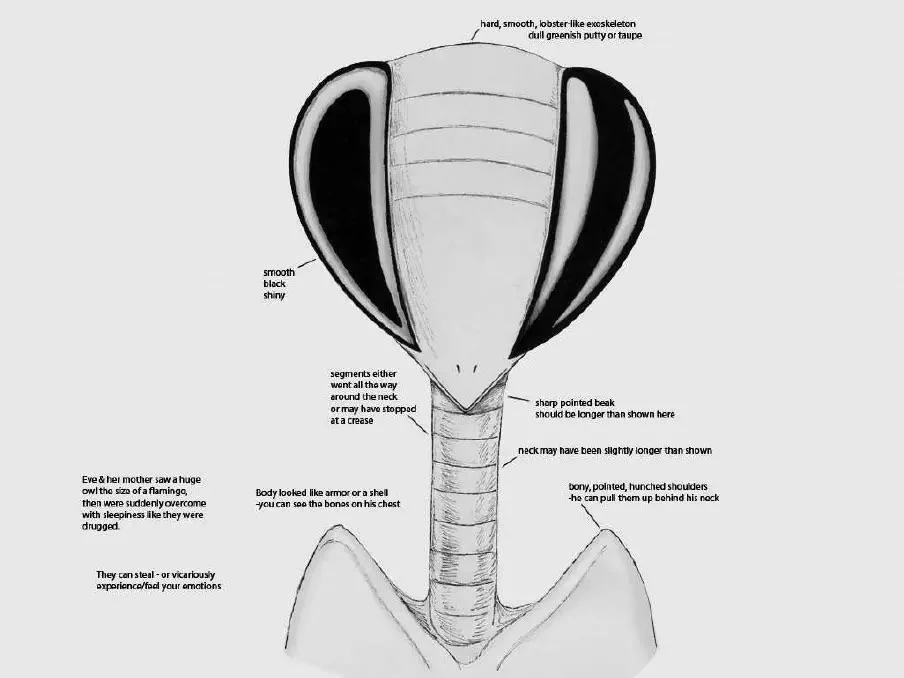
“Mantid” in UAP reporting is shorthand for a cluster of visual and behavioral traits that witnesses interpret as insect-like: a triangular head, forward-facing eyes that dominate the face, a thin torso, long limbs, and an almost clinical stillness. “Insectoid” is sometimes used as a broader term that can include mantis-like, grasshopper-like, or other arthropod-inspired features.
These descriptions most often appear in close-range contact narratives rather than distant sky sightings. That matters because official UAP programs focus primarily on aerial objects, sensor captures, and airspace safety, not on entity encounters.
Mantid descriptions most commonly appear in the experiential zone sometimes described as close encounters with entities, missing time, procedures, or intrusive contact. That is also where memory, trauma, sleep-state ambiguity, and cultural influence become difficult to separate cleanly. None of that automatically debunks the claims. It simply tells us to label testimony as testimony, and to avoid presenting narrative frequency as if we have a comprehensive dataset.
Some researchers, especially in folklore and sociology, have approached abduction narratives as a modern form of “supernatural kidnap” tradition updated with technological imagery. That does not settle whether the events are literal, symbolic, or something in between, but it does help explain why motif patterns can persist even when sources are messy. Academic discussion of Thomas E. Bullard’s work, for example, treats abduction narratives as having recognizable sequences and recurring elements without claiming that those elements are proven as physical events. (ocf.berkeley.edu)
That same approach is useful for mantid material. We can document that witnesses describe mantid-like beings, and we can document how those beings are described, without pretending we can quantify “how often” they appear across all cases.
Case study: Whitley Strieber and the “mantid-like” presence
Whitley Strieber remains one of the most influential modern voices in contact literature because his story did not stay private. His 1985 incident and subsequent accounts shaped how large numbers of people framed their own experiences, for better and for worse.
UAPedia’s profile of Strieber notes that his “Visitors” are not described as one uniform type. It explicitly includes reports of “tall, insectoid or mantid-like presences” among the forms he describes. (UAPedia: https://uapedia.ai/wiki/whitley-strieber-experiences-and-biography/)
That matters because Strieber’s significance is less about any single detail and more about cultural reach. When an account becomes widely read, it can serve as a template that later witnesses may consciously or unconsciously draw from. That possibility does not negate Strieber’s testimony, but it does complicate how we interpret motif spread. In a field where personal narratives drive much of the record, influence itself becomes a variable.
The responsible stance is to keep two realities in view at once: Strieber’s narrative is a primary testimony in the modern era, and it is also a cultural amplifier.

Case study: Karla Turner’s “praying mantis” drawing
Karla Turner’s Into the Fringe (1992) contains one of the clearest, plain-language mantid descriptions in widely circulated abduction literature. Turner recounts a regression-related session in which a witness later draws an entity that “looked like a tall, pale-white praying mantis.” (archive.org) Turner then describes her own visceral response, including a childhood memory of seeing what seemed like “a giant grasshopper” and reacting with the child’s blunt insistence: “You’re not my mother.” (archive.org)
This is vivid testimony, and it is also methodologically sensitive. Hypnosis and regression are controversial in memory work because they can increase confidence without increasing accuracy, and they can increase susceptibility to suggestion. (pmc.ncbi.nlm.nih.gov)
Because Turner’s mantid passage emerges in a regression-related context, it should be treated as testimony rather than a forensic reconstruction. The drawing and the emotional impact may still be meaningful data points, but they do not automatically function like an audio recording or a calibrated sensor readout.
The deeper value of Turner’s passage is that it shows mantids being described as distinct from both the “classic Gray” image and from reptilian imagery, at least in the witness’s framing. (archive.org) In other words, the mantid is not merely a different costume for the same archetype. It is experienced as a different category.
Case study: a modern mainstream-adjacent testimony record
Ralph Blumenthal’s long-form article in The Debrief includes a line that often gets quoted in experiencer circles because it places “mantis-like beings” in a modern, named witness account. Jay Christopher King, a co-host of an experiencer support group, says he has encountered “spindly mantis-like beings that communicate telepathically.” (thedebrief.org)
The crucial thing here is not just the claim, but how the publication frames it. The Debrief includes an editorial note stating that the phenomena are not a proven objective event “according to contemporary scientific understanding,” and that due to the nature of the accounts, they “can not be verified” by the editorial team. (thedebrief.org)
That caveat belongs inside any responsible presentation of the case. The testimony is still useful as testimony, but it must not be presented as independently verified fact.
It is also worth noticing a subtler point: in King’s description, the mantis beings are differentiated from “tall grays” by body structure and by what he calls the “content” and style of telepathy. (thedebrief.org) Whether telepathy is interpreted as literal, symbolic, psychological, or technological, the witness is making a comparative claim: mantids are not just visually different, they feel communicatively different.
A scientific bridge that needs careful handling: insectoid entities across “entity encounter” contexts
One of the more intriguing research touchpoints comes from a peer-reviewed survey of entity encounter experiences occasioned by inhaled DMT, published in Journal of Psychopharmacology (Davis et al., 2020). The authors compare DMT entity encounters to “non-drug” entity encounter reports, including alien encounter and abduction literature, and they note that the non-drug literature most commonly describes humanoids but also includes insectoid and reptilian types. (journals.sagepub.com)
This supports a narrow but useful point: “insectoid” functions as a recurring descriptive category across several extraordinary-experience contexts. It does not validate mantid beings as external entities, and it does not “explain” UAP contact cases as drug experiences. It does, however, document that “insectoid entity” is a recognizable descriptive option across different bodies of literature, and that nonverbal or telepathic-style communication is commonly reported in those contexts. (journals.sagepub.com)
That convergence creates interpretive possibilities, but those belong in hypothesis and researcher-opinion lanes, not in the evidence lane. The evidence lane ends at: multiple contexts include insectoid entity descriptions.
Why the mantis form is psychologically powerful
Even before you touch questions of origin, the mantis form is a perfect generator of human unease.
Humans are mammals. Our social intuition is tuned to faces that broadcast mammalian emotion through eyebrows, cheeks, and mouth. Insects do not do that. A mantis face, especially scaled up in imagination or encounter, can feel like a mask with intent behind it. That can be experienced as predatory, divine, mechanical, or simply alien.
This psychological impact matters because the emotional intensity of a testimony can be real even when the underlying cause is unresolved. Many witnesses are not reporting a whimsical hallucination. They are reporting an experience that reorganized their sense of safety, privacy, and the boundaries of the self.
That is one reason stigma is such a persistent theme. NASA explicitly calls for reducing reporting stigma as part of improving data collection. (science.nasa.gov) Even within purely official frameworks, the human side affects the data, because people do not report what they fear will destroy their credibility.
Mythic echoes, handled with care
In southern African San traditions, ǀKaggen is commonly translated as “Mantis” and appears as a creator and trickster figure in recorded narratives. (sahistory.org.za) The Bleek and Lloyd archive preserves stories in which |kaggen (“the Mantis”) acts through transformation and deception motifs. (digitalbleeklloyd.uct.ac.za)
It is tempting to connect this directly to modern mantid encounter testimony, but that temptation needs restraint. Similar imagery across cultures does not prove continuity or identity. At most, it suggests that mantis symbolism has long carried a particular charge in human meaning-making: creation, trickery, boundary-crossing, and the unsettling intimacy of a non-human intelligence.
In UAP terms, the most defensible claim is modest: mythic mantis figures demonstrate that mantis imagery has been meaningful in human cultures for a long time, and modern witnesses sometimes reach for similar imagery when describing anomalous encounters. Anything beyond that becomes interpretive.
The controversy: “overseer” language and what we can responsibly claim
Many experiencer communities describe mantids as supervisors or “overseers” in multi-entity encounters. The challenge is evidentiary: public sources support that mantid-like entities are described in testimony, but they do not allow us to quantify role frequency across a comprehensive corpus.
So the best practice is to present “overseer” as a recurrent witness and community interpretation rather than as a settled pattern. You can still discuss it, because it is part of the narrative landscape, but the language must remain precise.
When witnesses use “overseer” framing, they are typically describing a felt hierarchy: smaller beings performing tasks while a taller mantid-like presence stands apart, watches, and seems to direct. That is a claim about perceived roles, not a measurable organizational chart. In the Debrief account, for example, the witness offers a detailed comparison of how “telepathic content” differs between entity types, which implies role differentiation, but it remains unverified testimony. (thedebrief.org)
This is the point where UAPedia’s stance tends to matter most: accept credible testimony as testimony, label it cleanly, and do not inflate it into statistical certainty unless a dataset supports it.
Implications for the NHI and advanced technology hypothesis
The public official record does not validate non-human entities. AARO’s report is explicit about not finding evidence of extraterrestrial beings, activity, or technology. (media.defense.gov) NASA’s report focuses on how to improve the quality of UAP data, not on endorsing any particular origin. (science.nasa.gov)
And yet, mantid testimony persists, and it comes with a specific implication: if even a subset of these encounters involve an external intelligence, the central “technology” may not be a craft at all. It may be the interface.
Witnesses frequently describe communication that bypasses speech, and experiences that include altered perception, paralysis, missing time, or memory fragmentation. Whether those features reflect advanced technology, altered states, sleep phenomena, or something we do not yet understand, they point to cognition as the battleground.
That has practical implications even if you remain agnostic about NHI. It suggests that UAP research cannot remain purely aerospace-focused if it hopes to address the full scope of reported human encounters. You would need collaboration across aviation safety, psychology, neurology, trauma studies, and data standards, and you would need ethical protocols that protect witnesses who risk stigma by reporting.
NASA’s emphasis on structured reporting, metadata, and standardized civilian reporting systems is, indirectly, a blueprint for reducing the chaos in which entity narratives currently live. (science.nasa.gov) Even if entity reports remain outside official scope, better infrastructure would clarify what is happening at the edges.
Claims taxonomy
Claim
Mantid or insectoid entities appear as a distinct descriptive category in modern UAP-related testimony and literature, separate from Gray and reptilian descriptions.
Assessment: Probable. The category is documented in widely circulated experiencer sources (for example, Turner’s published account and The Debrief’s named witness testimony) and in comparative discussions of non-drug encounter literature, but it remains primarily testimonial rather than instrumented. (archive.org)
Claim
Public-facing official UAP reports currently substantiate non-human entities or “occupants.”
Assessment: Verified as not supported in the public record. AARO’s FY2024 report explicitly states it has discovered no evidence of extraterrestrial beings, activity, or technology. (media.defense.gov)
Claim
The “overseer” framing is a well-quantified role pattern across abduction cases.
Assessment: Disputed. “Overseer” framing appears in witness and community interpretation, but open, citable sources do not support role-frequency quantification across a comprehensive corpus. (thedebrief.org)
Claim
Insectoid entity imagery appears across multiple extraordinary-experience literatures, including comparisons to non-drug alien encounter and abduction literature.
Assessment: Probable. Davis et al. (2020) explicitly notes insectoid entities as part of the non-drug alien encounter and abduction literature referenced in their comparison. (journals.sagepub.com)
Claim
Mantis imagery in San traditions demonstrates continuity or identity with modern mantid encounter testimony.
Assessment: Legend. The cultural material is real, but mapping it onto modern UAP testimony is interpretive rather than evidentiary. (sahistory.org.za)
Speculation labels
Hypothesis
Some mantid reports reflect a perceived “management layer” within a multi-entity encounter ecology, where the mantid presence is experienced as supervisory rather than task-focused. This hypothesis is about reported roles and witness perception, not a proven organizational structure.
Witness interpretation
Witnesses who describe telepathic communication sometimes interpret it as evidence of a higher-order intelligence, and they sometimes interpret differences in “telepathic style” as differences in entity function or status. In The Debrief account, the witness explicitly claims that mantis beings communicate in a more “elegant” way than grays and describes a portal-like entry, but the publication notes the accounts cannot be verified by its editorial team. (thedebrief.org)
Researcher opinion
Comparative researchers have argued that abduction narratives show structural regularities over time and that they resemble older supernatural-kidnap traditions in “technological guise.” This framing can explain why entity types, including insectoid forms, can persist as motifs without proving what the motifs ultimately correspond to in physical reality. (ocf.berkeley.edu)
Relevant links
UAPedia: Whitley Strieber profile
https://uapedia.ai/wiki/whitley-strieber-experiences-and-biography/
The Debrief: “The Experience” (includes editorial note on unverifiability)
https://thedebrief.org/the-experience-the-cultural-rise-of-alien-abductions-and-those-who-encounter-them/
Turner, Into the Fringe (public text copy)
https://archive.org/stream/IntoTheFringeByDrKarlaTurner/Into%20The%20Fringe%20by%20Dr%20Karla%20Turner_djvu.txt
Davis et al. (2020), Journal of Psychopharmacology (publisher page)
https://journals.sagepub.com/doi/10.1177/0269881120916143
San /Kaggen background (South African History Online)
https://sahistory.org.za/article/san-hunter-gatherer-society-later-stone-age
Bleek and Lloyd Digital Archive (UCT) story page
https://digitalbleeklloyd.uct.ac.za/metadata/stories/Wilhelm_Bleek_notebooks/story_101/index.html
References
All-domain Anomaly Resolution Office. (2024). Fiscal Year 2024 consolidated annual report on unidentified anomalous phenomena. Department of Defense; Office of the Director of National Intelligence. https://media.defense.gov/2024/Nov/14/2003583603/-1/-1/0/FY24-CONSOLIDATED-ANNUAL-REPORT-ON-UAP-508.PDF (media.defense.gov)
Blumenthal, R. (2021, September 24). The experience: The cultural rise of alien abductions and those who encounter them. The Debrief. https://thedebrief.org/the-experience-the-cultural-rise-of-alien-abductions-and-those-who-encounter-them/ (thedebrief.org)
Davis, A. K., Clifton, J. M., Weaver, E. G., Hurwitz, E. S., Johnson, M. W., & Griffiths, R. R. (2020). Survey of entity encounter experiences occasioned by inhaled N,N-dimethyltryptamine: Phenomenology, interpretation, and enduring effects. Journal of Psychopharmacology, 34(9), 1008–1024. https://doi.org/10.1177/0269881120916143 (journals.sagepub.com)
National Aeronautics and Space Administration. (2023). Unidentified anomalous phenomena: Independent study team report. https://science.nasa.gov/wp-content/uploads/2023/09/uap-independent-study-team-final-report.pdf (science.nasa.gov)
South African History Online. (n.d.). San hunter-gatherer society in the Later Stone Age. https://sahistory.org.za/article/san-hunter-gatherer-society-later-stone-age (sahistory.org.za)
Turner, K. (1992). Into the fringe: A true story of alien abduction. Berkley Books. (Public text copy via Internet Archive.) https://archive.org/stream/IntoTheFringeByDrKarlaTurner/Into%20The%20Fringe%20by%20Dr%20Karla%20Turner_djvu.txt (archive.org)
University of Cape Town. (n.d.). Bleek and Lloyd Digital Archive: Story 101 (“The Mantis turned into a hartebeest”). https://digitalbleeklloyd.uct.ac.za/metadata/stories/Wilhelm_Bleek_notebooks/story_101/index.html (digitalbleeklloyd.uct.ac.za)
SEO keywords
mantid entities, insectoid beings, praying mantis alien, mantis being UAP, insectoid NHI, alien species UAP hypothesis, abduction mantis report, mantis-like beings telepathy, Karla Turner Into the Fringe mantis, Whitley Strieber mantid, The Debrief mantis beings, DMT entity encounters insectoid, non-human intelligence advanced technology, UAP experiencer testimony