There’s a quiet hinge-point in almost every serious UAP or NHI conversation. It starts with objects, lights, sensor tracks, flight safety, “things in the sky.” Then someone said: there were figures near it. Or: something was standing there. Or, in the hardest versions to hear, the witness adds a detail that doesn’t behave like a balloon or a misread aircraft. It looked like someone.
That hinge-point is where the topic stops being only physics and becomes anthropology, psychology, ethics, and governance all at once. It’s also where sloppy language can sabotage the entire discussion. “Alien” smuggles in an origin story. “Extraterrestrial” narrows the range of possibilities before you’ve earned the right to narrow it. “Visitor” implies motives you don’t actually know.
That’s one reason the term Non-Human Intelligence (NHI) has gained traction: it’s meant to be a neutral placeholder for agency without asserting origin. A widely quoted definition appears in proposed UAP Disclosure Act (UAPDA) amendment language introduced during FY2024 NDAA negotiations, defining “non-human intelligence” as “any sentient intelligent non-human lifeform regardless of nature or ultimate origin.” (Senate Democrats, proposed UAPDA language). (Senate Democrats PDF)
Policy precision matters here. That definition was part of a proposed legislative framework that influenced public debate, but many of the broader UAPDA-style mechanisms discussed publicly did not survive unchanged into the final FY2024 NDAA. A legal analysis of the enacted amendment and its implications is a cleaner anchor for that point than any records-management memo. (Inside Government Contracts)
At the same time, some very concrete, non-theoretical things did happen in the records world. The U.S. National Archives issued guidance implementing the statutory requirement to establish a UAP Records Collection and directing agencies to identify and organize relevant records, with an agency deadline of October 20, 2024. (National Archives and Records Administration, UAP Records Collection guidance). (NARA Guidance)
None of this proves NHI. It does something more modest and more real: it gives the conversation a vocabulary and a bureaucracy, and those two things change what gets recorded, what gets preserved, and what can be evaluated later.
This article is a field guide to the major hypothesized categories of non-human entities that recur across testimony-rich UAP cases and close encounters. It does not claim “entities” are confirmed. It keeps evidence and interpretation separate, and it labels speculation explicitly.
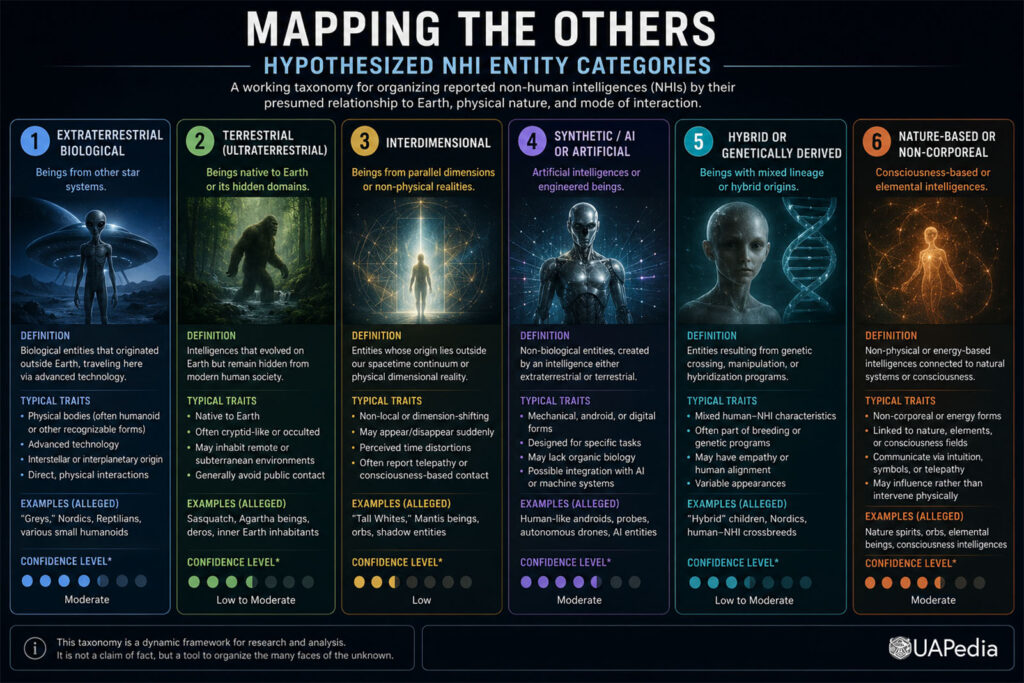
Two taxonomies hiding inside one argument
One taxonomy is descriptive: what witnesses report perceiving. Height, movement, apparent skin texture, eyes, clothing, tools, communication style, and the emotional texture of the encounter.
The other is ontological: what the entities actually are, if they exist. Biological beings. Autonomous machines. Something long-established on Earth. Something operating through unusual interfaces with human consciousness.
A responsible article can map descriptive clusters without pretending that mapping equals solving. Where this article moves into ontological possibilities, it labels them as Hypothesis or Researcher Opinion, not as settled fact.
Near-craft humanoids
Socorro, New Mexico (1964)
The Project Blue Book case file preserves the reporting and investigative context, including the “two figures” detail associated with Zamora’s account, and it remains a key document in the case’s long afterlife. (Project Blue Book case file). (Project Blue Book Socorro PDF)
Socorro is also a reminder that “documented” does not mean “settled.” Skeptical critiques have argued for prank or misinterpretation scenarios, and those critiques are part of the public record of debate around the case. (Skeptical Inquirer analysis). (Skeptical Inquirer PDF)
Ariel School, Zimbabwe (1994)
Ariel School remains one of the most discussed “near-craft humanoid” cases because many children reported an anomalous event. It is also one of the most contested, because high witness numbers create both narrative power and methodological risk.
A widely cited retrospective in Mail & Guardian anchors that the case persists in public record and witness discourse while remaining unresolved and debated. (Mail & Guardian, retrospective). (Mail & Guardian)
Mechanical or device-like entities
Pascagoula, Mississippi (1973)
The Pascagoula incident is methodologically notable for a rare contemporaneous artifact: police recorded the witnesses without their awareness while they spoke privately. The University of Southern Mississippi’s Special Collections describes the “tape recorder still running” context that later became central to how the case is discussed. (USM Libraries, Special Collections). (USM Special Collections)
That does not prove the abduction claim. It does strengthen the documentation compared to narratives that exist only as later retellings. In descriptive terms, Pascagoula matters because witnesses described entities in a way that reads less like humanoid strangers and more like engineered instruments.
Community-based “biological-looking” entity claims
Varginha, Brazil (1996)
Varginha can no longer be framed only as a culturally persistent story. In 2025–2026, neurosurgeon Ítalo Venturelli publicly testified that he directly observed a small, living being at Varginha Regional Hospital which, based on decades of medical practice, he judged non-human. He said another physician had already treated a cranial wound. Forensic physician Armando Fortunato separately presented evidence concerning the unusual infection that killed military police officer Marco Chereze. These accounts add medical testimony, although no biological specimen or contemporaneous medical record has been released publicly. (The Debrief)
Retired Brazilian air-traffic controller Marcos Feres also stated that an irregular USAF transport landed at Viracopos, followed by Brazilian Air Force helicopter flights to Varginha. His account supports, but does not independently prove, a U.S.-linked retrieval operation. (Portal Vigília)
For taxonomy purposes, Varginha is a disputed, evidence-bearing community entity case involving convergent civilian, medical, military, and aviation testimony, rather than merely a durable cultural narrative. (The Debrief)
Cryptoterrestrial framing and “local but hidden” intelligences
Cryptoterrestrial framing imagines an intelligence local to Earth, long-established, concealed by geography, environment, or deliberate behavior.
Mac Tonnies’ The Cryptoterrestrials is often referenced in UAP discussions as a compact articulation of this possibility. (Anomalist Books, publisher page). (Anomalist Books)
Archives and government record collections do not strengthen cryptoterrestrial framing by validating it. What they validate is narrower: that reports were made, collected, and preserved.
Brazil’s National Archives describes its OVNI collection as consisting of 743 records, including reports, questionnaires, correspondence, photographs, drawings, audio, video, and press clippings. (Arquivo Nacional / Governo Federal do Brasil; and the DIBRARQ catalogue entry). (Arquivo Nacional news page) (DIBRARQ catalogue entry)
Ultraterrestrial patterns and the “interface” problem
Some researchers argue that a subset of UAP and entity encounters behaves less like straightforward physical visitation and more like an interaction that shapes perception, belief, and culture.
Jacques Vallée’s Passport to Magonia is foundational to that approach. A library/archive bibliographic source is preferable to retail listings when citing the work’s identity and availability. (Internet Archive bibliographic record). (Internet Archive record)
This category is treated here as a pattern-recognition framework, not a claim about the structure of reality.
Synthetic intermediaries and “probe logic”
If an NHI exists, there is no reason to assume its primary interface with humans would be biological individuals. Humanity sends machines ahead of bodies for safety, cost, and scalability. “Robotic” entity descriptions are conceptually compatible with that logic. They don’t confirm it, but they keep the hypothesis space honest.
This also aligns with what NASA emphasizes: the bottleneck is data, and progress requires standardized reporting, calibrated sensors, and careful distinctions between unknown and unknowable. (NASA, UAP Independent Study Team report). (NASA Report PDF)
Nature-based or non-corporeal entities
This category covers reported intelligences that do not appear to possess a stable biological body or mechanical form. Witnesses may describe luminous spheres, humanlike figures composed of light, disembodied presences, voices without visible sources, or responsive phenomena associated with forests, mountains, bodies of water, weather systems, and particular locations. The defining feature is not luminosity alone. It is the witness’s perception that the phenomenon behaves purposefully, responds to attention, communicates, or demonstrates awareness of its surroundings.
Nature-based and non-corporeal should not be treated as synonymous. “Nature-based” concerns a reported relationship with an ecosystem, landscape, or natural process. “Non-corporeal” concerns the apparent absence of a fixed physical body. The two overlap when witnesses perceive an intelligence operating through light, atmosphere, animals, vegetation, or the environment itself.
Anthropology provides a useful framework for documenting such reports without deciding their ultimate reality. Bird-David described animism as a form of “relational epistemology” in which personhood and agency can emerge through relationships between humans and non-human aspects of the environment. This differs from the modern Western tendency to classify nature as passive matter and intelligence as something confined to individual biological organisms. Cross-cultural research by Luhrmann and colleagues similarly found that reports of gods and spirits are influenced by cultural understandings of whether the mind is bounded or permeable to external presence. These studies demonstrate that experiences of non-corporeal agency are culturally widespread and patterned. They do not establish that the perceived entities have been independently verified. (Chicago Journals)
Orb and light-being reports form an important subset of this category. Research in religious-experience archives has identified accounts of luminous spheres encountered visually, spiritually, and photographically, sometimes accompanied by feelings of presence, communication, or meaning. A circular light in a photograph, however, does not by itself demonstrate intelligence. Dust, moisture, insects, optical reflections, sensor behavior, and atmospheric effects must be excluded before anomalous agency is considered. (RERC Journal)
Hessdalen, Norway, illustrates the necessary evidentiary boundary. Recurring luminous phenomena in the valley have been observed and recorded through cameras, radar, magnetometers, infrared equipment, and other instruments. Scientific studies describe free-floating lights with recurring physical characteristics, while several atmospheric and geophysical explanations remain under investigation. Project Hessdalen deliberately collects data without assigning intelligence, consciousness, or NHI identity to the phenomena. Hessdalen therefore verifies that unusual luminous phenomena can exist as instrumented events, but it does not verify that such lights are living, aware, or nature-based entities. (Project Hessdalen)
For taxonomy purposes, this category preserves a possibility that would otherwise disappear between “biological entity,” “machine,” and “psychological experience.” It allows researchers to compare reports of responsive lights, place-linked presences, environmental intelligences, and apparently disembodied beings without prematurely deciding whether they represent unknown organisms, atmospheric structures, consciousness-mediated interfaces, religious experiences, or culturally interpreted natural phenomena.
The contactee era and why it still belongs in an entity taxonomy
The 1950s contactee era shaped a cultural template for “who the Others are,” with George Adamski as a particularly influential figure in the early movement. Sociological scholarship on the contact movement discusses Adamski’s prominence and the role contactees played in shaping public expectations about non-human visitors. (Chapman University Digital Commons). (Chapman Digital Commons PDF)
That matters here because cultural templates can influence how later experiencers interpret and narrate anomalous events.
Claims taxonomy
These ratings evaluate the public evidentiary record for the occurrence of the reported event and its documentation, not the NHI interpretation.
| Case / claim cluster | Claims taxonomy | What is being rated |
|---|---|---|
| Socorro (1964): documented close-encounter report including “two figures” | Probable | Probable occurrence of a reported incident with extensive documentation and unresolved elements, not “probable NHI.” (Project Blue Book Socorro PDF) |
| Ariel School (1994): many children report an anomalous event with beings | Disputed | Strong record that many children reported an experience; contested interpretations and limited instrumented data prevent a higher rating for objective occurrence of craft/beings. (Mail & Guardian) |
| Pascagoula (1973): abduction claim with device-like entity descriptions | Disputed | Archival support for contemporaneous recording context and immediacy; extraordinary elements remain primarily testimony-based. (USM Special Collections) |
| Brazil OVNI (UFO) archival holdings: existence of a large official collection | Verified | Verified existence and scope of the Arquivo Nacional OVNI collection and its content categories; no claim is made that it verifies NHI causation. (DIBRARQ catalogue entry) |
| Varginha (1996): ship and entity sightings narratives remain active and controversial | Disputed with several component claims reaching Probable status | The convergence of civilian, medical, military, and aviation accounts makes Varginha substantially more evidentially developed than a case sustained only by media repetition or civic folklore. (The Debrief) |
| Vallée’s ultraterrestrial framework: bibliographic existence and influence | Verified | Verified bibliographic existence and influence within UAP literature, not verified NHI reality. (Internet Archive record) |
| Cultural and religious tradition of NHI beliefs | Verified | Human cultures and religious traditions contain extensive, independently documented reports of perceived non-corporeal and nature-associated agency. Instrumented luminous phenomena have also been recorded at locations including Hessdalen. |
Speculation labels
Hypothesis
Some entity descriptions may reflect a single operational system expressed through multiple interfaces, including craft, autonomous intermediaries, and occasional humanoid-like avatars, producing diverse descriptive clusters without requiring that every “being” is a biological organism. (NASA’s emphasis on data limits supports the need for this hypothesis to remain tentative, not confirmed). (NASA Report PDF)
Witness Interpretation
In the Ariel School narratives, some witnesses described meaning or communication they perceived as attached to the encounter, regardless of origin. (Mail & Guardian, retrospective). (Mail & Guardian)
Researcher Opinion
Record-collection mandates and standardized reporting pipelines can make UAP administratively actionable even when ultimate explanations remain unknown. (NARA guidance reflects the practical mechanics of this shift). (NARA Guidance)
References
Anomalist Books. (n.d.). The Cryptoterrestrials: A meditation on indigenous humanoids and the aliens among us (publisher page). https://www.anomalistbooks.com/book.cfm?id=46
Barna, S., McCarthy, C., & Pope, E. (2024, January 9). Implications of the Unidentified Anomalous Phenomena (UAP) Amendment in the 2024 National Defense Authorization Act (NDAA). Inside Government Contracts. https://www.insidegovernmentcontracts.com/2024/01/implications-of-the-unidentified-anomalous-phenomena-uap-amendment-in-the-2024-national-defense-authorization-act-ndaa/
Bader, C. (1995). The UFO contact movement from the 1950’s to the present. Chapman University Digital Commons. https://digitalcommons.chapman.edu/cgi/viewcontent.cgi?article=1002&context=sociology_articles
Internet Archive. (n.d.). Passport to Magonia: On UAP, folklore, and parallel worlds (bibliographic record). https://archive.org/details/passporttomagoni0000vall
Mail & Guardian. (2014, September 4). Remembering Zimbabwe’s great alien invasion. https://mg.co.za/article/2014-09-04-remembering-zimbabwes-great-alien-invasion/
National Archives and Records Administration. (2024, May 8). Guidance to Federal agencies on Unidentified Anomalous Phenomena (UAP) Records Collection. https://www.archives.gov/records-mgmt/uap-guidance
Project Blue Book. (1964). Socorro, New Mexico case file (April 24, 1964) [PDF]. https://documents2.theblackvault.com/documents/projectbluebook/ProjectBlueBook-Socorro-NewMexico-04-24-1964.pdf
Senate Democrats. (2023). UAP amendment (proposed UAP Disclosure Act language) [PDF]. https://www.democrats.senate.gov/imo/media/doc/uap_amendment.pdf
University of Southern Mississippi Libraries, Special Collections. (2014, March). Sermon about Pascagoula alien abduction (Item of the Month). https://www.lib.usm.edu/spcol/exhibitions/item_of_the_month/march_2014.html
Kean, L., & Blumenthal, R. (2026, January 30). Landmark Brazilian UAP case reaches Capitol Hill as Varginha incident turns 30. The Debrief. (The Debrief)
McCue, D. (2026, January 21). Varginha UAP incident takes center stage at Press Club press conference. The Well News. (The Well News)
Portal Vigília. (2021, September 15). Avião dos EUA entrou sem autorização no Brasil e americanos estiveram em Varginha no dia da captura do ET. (Portal Vigília)
Phillips, T. (2026, March 21). “I’ve seen the devil”: Brazil’s UAP capital marks 30 years since alleged entity encounter. The Guardian. (The Guardian)
Bird-David, N. (1999). “Animism” revisited: Personhood, environment, and relational epistemology. Current Anthropology, 40(S1), S67–S91. (Chicago Journals)
Caron, E., & Faridi, P. (2016). To investigate or not to investigate? Researchers’ views on unexplored atmospheric light phenomena. Frontiers in Earth Science, 4, Article 17. (Frontiers)
Luhrmann, T. M., Weisman, K., Aulino, F., Brahinsky, J. D., Dulin, J. C., Dzokoto, V. A., Legare, C. H., Lifshitz, M., Ng, E., Ross-Zehnder, N., & Smith, R. E. (2021). Sensing the presence of gods and spirits across cultures and faiths. Proceedings of the National Academy of Sciences, 118(5), e2016649118. (PNAS)
Project Hessdalen. (2026). Project Hessdalen: Collecting objective data on unexplained luminous phenomena. (Project Hessdalen)
Steenhuisen, M. (2020). Orbs: A preliminary search in the RERC archives. Journal for the Study of Religious Experience, 6, 24–38. (RERC Journal)
SEO keywords
NHI categories, non-human intelligence definitions, hypothesized non-human entities, UAP entity typologies, near-craft humanoids, Socorro Zamora two figures, Ariel School Ruwa Zimbabwe encounter, Pascagoula police recording tape, Varginha Brazil entity claims, cryptoterrestrial hypothesis UAP, Mac Tonnies Cryptoterrestrials, ultraterrestrial Vallée Passport to Magonia, synthetic intermediaries UAP, UAPDA non-human intelligence definition, NARA UAP Records Collection guidance, Arquivo Nacional OVNI archive, DIBRARQ OVNI catalogue, Varginha Brazil (1996), Varginha incident, Varginha NHI testimony, Ítalo Venturelli, Marcos Feres, USAF Viracopos flight, Varginha biological entity, Brazil UAP case, non-human entity testimony, Varginha hospital testimony, UAP retrieval operation, nature-based NHI, non-corporeal entities, luminous entities, intelligent orbs, light beings, environmental intelligence, consciousness-based entities, nature spirits and UAP, Hessdalen lights, anomalous luminous phenomena, non-human consciousness, responsive light phenomena, animism and NHI, UAP entity categories