
In the mid-1950s, the U.S. Air Force’s Project Blue Book tried to do something that still feels oddly modern: take thousands of messy, human, inconsistent UAP reports and turn them into something that could be analyzed like a dataset.
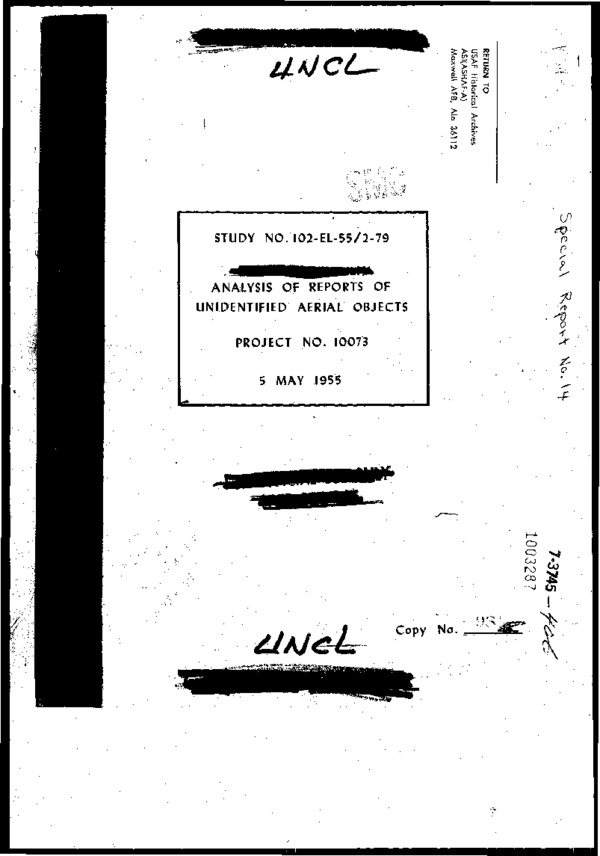
Project Blue Book Special Report No. 14, formally titled Analysis of Reports of Unidentified Aerial Objects (Project No. 10073), dated 5 May 1955, is the most famous attempt. (Academia) It is routinely summarized with a single phrase, “highly improbable,” as if that ends the discussion. (Academia) But Special Report 14 is more interesting and more consequential than its most quoted sentence. It is a methodological artifact shaped by the Cold War, by institutional incentives, by the limits of witness reporting, and by the early computer era’s belief that if you can code something, you can understand it.
It also contains a tension that never really went away: the Air Force wanted closure, while the data pipeline kept producing a residue of cases that would not be neatly explained. Whether that residue points to genuinely anomalous stimuli, systematic perceptual effects, gaps in investigative capability, or some blend of all three is still contested. What matters historically is that the Air Force could not make the residue disappear simply by declaring it small.
Special Report 14 sits right at the seam where “UAP as folklore” becomes “UAP as systems problem.” It is where the phenomenon is treated less like a campfire story and more like an air defense triage challenge: too many reports, too many variables, too much reputational heat, and not enough time.
Why Special Report 14 happened at all
You can’t understand Special Report 14 without the churn that came before it.
Project Sign (1948) and Project Grudge (1949–1951) were early attempts to handle the surge of post-1947 sightings, but they were staffed and positioned unevenly, and the public environment was already polarized. When Project Blue Book was established in 1952, it inherited two simultaneous mandates that pull against each other: investigate sightings for national security relevance, and prevent the subject from spiraling into distraction or panic.
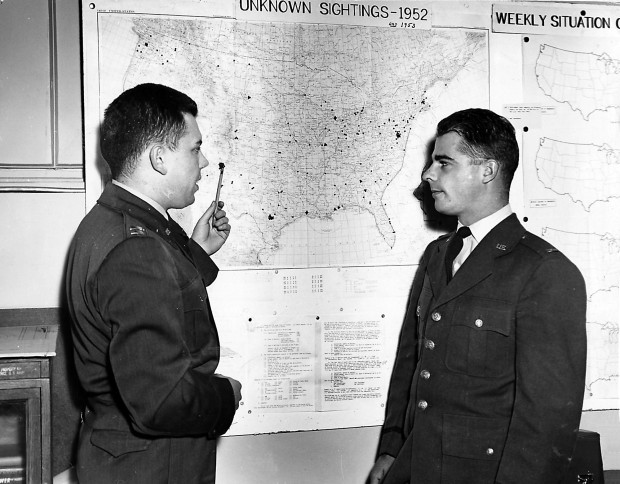
Then came the 1952 surge. Special Report 14’s own introduction notes that the Air Force initially had roughly 1,300 reports through the end of March 1952, and that during the work the number of reports submitted for analysis more than tripled due to the “unprecedented increase in observations during 1952,” producing a study base of approximately 4,000 reports. (Academia) That’s the key operational problem in one paragraph: volume was exploding, and the system needed a way to process it.
This is where Battelle Memorial Institute enters the story, not as a dramatic villain or savior, but as the kind of research organization you hire when you want a process. Modern official history from the All-domain Anomaly Resolution Office (AARO), within the U.S. Department of Defense, explicitly describes Battelle’s role: it developed a questionnaire for observers and a computer punch-card system to automate statistical study, and it released the report under the cover of the Air Technical Intelligence Center (ATIC) to maintain anonymity. (U.S. Department of War)
That anonymity detail matters. It tells you the stigma was real even then. If the work was purely routine and reputationally safe, there would be no need to hide the contractor.
So Special Report 14 wasn’t just born from curiosity. It was born from institutional stress: too much data, too much attention, too much uncertainty, and a strong desire to show that the situation was being handled with “seriousness accorded to a straightforward scientific investigation,” as the report itself puts it. (Academia)
(Internet Archive)
What the report actually did, in plain language
Special Report 14 begins with a confession that is also a boundary-setting move. The “original data” are described as “impressions and interpretations” of apparently unexplainable events, and the reports “seldom contained reliable measurements of physical attributes.” (Academia) That is not the report throwing up its hands. It is the report drawing a box around what it can legitimately claim.
Then it does something that, for 1955, was ambitious: it reduces the Air Force’s UAP sighting reports to “IBM punched-card abstracts” using logically developed forms and standardized evaluation procedures. (Academia) In modern terms, it created a schema, performed data entry, and ran statistical comparisons.
The report describes the purpose of this pipeline in a way that is revealing: it wasn’t only trying to catalog. It was trying to determine “the probability that any of the UNKNOWNS represent observations of a class, or classes, of ‘flying saucers’.” (Academia)
That phrase is often overlooked. The report wasn’t merely asking, “Are people mistaken?” It was asking whether the unresolved cases could represent recurring, structured phenomena that cannot be fitted to known categories.
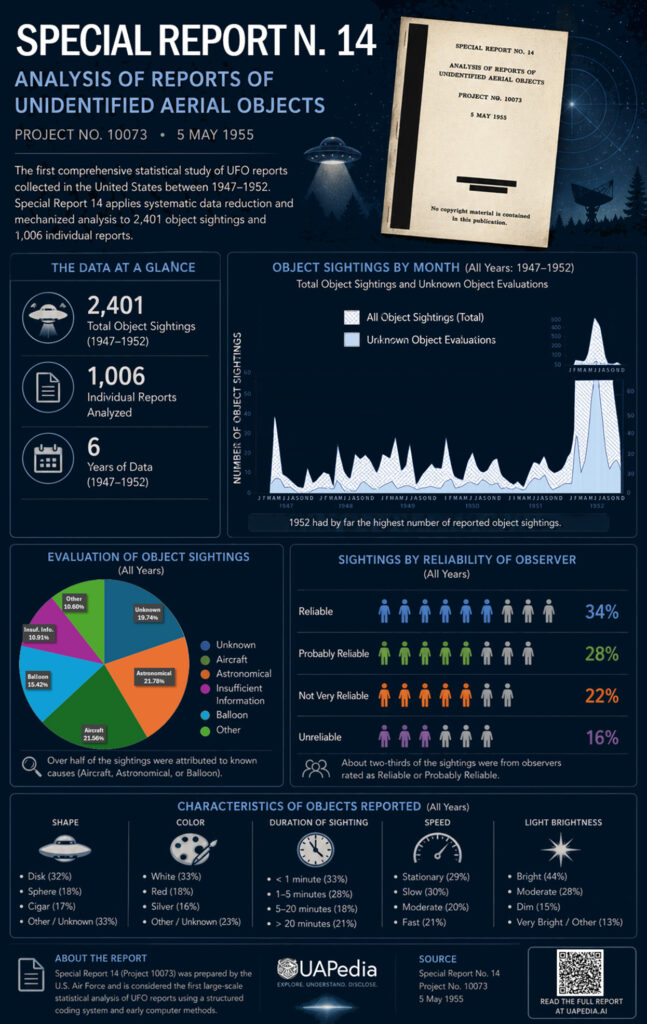
From there, it applies statistical testing to compare distributions between identified cases (“knowns”) and unidentified cases (“unknowns”). Tables listed in the document include multiple chi-square tests comparing knowns versus unknowns across variables such as color, number, shape, duration, speed, and brightness. (Academia)
This is the diagnostic heart of Special Report 14: if unknowns are just random leftovers, their characteristics should look like a noisy subset of the knowns. If unknowns differ, it suggests there may be systematic differences in the underlying reports or stimuli.
The important nuance, and one that should be carried carefully, is that the report’s statistical comparisons can indicate potential differences, but they do not automatically establish a single cause, much less confirm a non-human origin. A statistical difference could result from a genuinely different class of objects, or from differences in witness interpretation under certain conditions, or from investigative bias, or from limitations in the identification toolkit. Special Report 14 treats the data conservatively, and its final language reflects that conservatism. (Academia)
The famous conclusion, and what it does and doesn’t mean
The report’s summary contains the sentence that became its public identity:
It is “considered to be highly improbable” that the reports examined “represent observations of technological developments outside of the range of present-day scientific knowledge,” and it emphasizes “a complete lack of any valid evidence consisting of physical matter” in any case. (Academia)
Those words were perfectly designed for a Cold War institution seeking to reduce alarm. But they are not as absolute as they can sound in casual retelling.
“Highly improbable” is a judgment, not a measurement. It is the report’s concluding interpretation of what the data can support, given the limitations it already admitted. And “no valid physical matter” is a statement about the content of case files and what was judged “valid,” not necessarily a statement about what occurred in the external world.
If you work in any field that depends on incident reporting, you know the difference. “No evidence collected” can reflect reality, but it can also reflect collection failure, time delay, institutional barriers, or inconsistent standards.
Special Report 14 itself underscores that the subjectivity of the data “presented a major limitation to the drawing of significant conclusions, but did not invalidate the application of scientific methods of study.” (Academia) That sentence is almost a mission statement: cautious about claims, but unwilling to dismiss the problem as unscientific.
The “3% unknown” figure, clarified without distortion
One of the most persistent confusions around Special Report 14 is the famous “3% unknown” statistic.
Handled sloppily, it becomes: “SR14 proved only 3% were unknown.” That is not the accurate way to describe it.
The cleaner description is that the 3% unknown figure appears in later Air Force-oriented messaging about a narrower reporting window and improved procedures, rather than as a blanket summary of the entire dataset associated with Special Report 14’s broader analysis.
A CIA-hosted Air Force-oriented summary notes that “since 1 January 1955,” the cooperative program reduced “insufficient information” cases to 7% and “unknown” cases to 3% of totals, explicitly linking that claim to the 1955 period. (documents2.theblackvault.com)
This matters because it shifts what the number is doing. It is not describing the entire multi-year body of cases that made the report famous. It is describing an improvement narrative for a later period: better coordination, better forms, faster follow-up, fewer unresolved cases.
That improvement narrative could be genuine. Better intake can reduce unknowns. But even if it is genuine, it should not be used to retroactively reframe the unresolved fraction in the earlier, larger study base as if it never existed. The “3%” figure belongs to a specific window and a specific messaging context. (documents2.theblackvault.com)
What counts as a “case study” in SR14’s world
Special Report 14 is often discussed as pure statistics, but it is built from real reports. In the report’s own words, the data originated in impressions and interpretations, and then were reduced into coded abstracts. (Academia)
That creates a practical editorial problem for anyone writing about it: readers want vivid case texture, while the report itself is primarily methodological. The case descriptions often circulate through compiled documents and reprints, where individual report narratives appear as examples of the kinds of sightings being handled.
Two representative descriptions that frequently appear in compiled SR14 materials include an airliner-related sighting described as lasting tens of seconds with a disc-like object and a light, and another description involving unusual edge details and follow-up sampling of vegetation, with the examination finding nothing unusual. These should be treated as representative narratives drawn from compiled report materials associated with the SR14 ecosystem, rather than as a complete, uniquely identified “case file” in the modern sense unless a specific case number, date, and report source are provided. (Academia)
In other words, the value of such narratives is to illustrate the kinds of reports that were being coded, not to claim that any single example conclusively validates a particular interpretation.
For a first-hand feel of how Blue Book-era cases were handled in practice, Edward J. Ruppelt’s 1956 book The Report on Unidentified Flying Objects remains one of the clearest near-contemporary accounts. Ruppelt describes the seriousness with which some reports were treated, including air defense reactions and intercept-driven incidents. (Project Gutenberg) His book is not Special Report 14, but it is a useful window into the operational environment that made SR14’s statistical pipeline seem necessary.
Jennie Zeidman’s “I Remember Blue Book,” written from the perspective of someone who worked around Hynek’s Blue Book-era workflow, also provides first-hand recollection of the intake reality: teletype summaries, uneven follow-up, and the day-to-day grind that can easily turn “insufficient information” into a dominant category. (Active link: https://cufos.org/PDFs/pdfs/I_remember_blue-book.pdf)
These sources should be held in their proper lanes: SR14 is the primary methodological document; Zeidman is witness recollection about process; Ruppelt is a contemporary insider narrative about operations.
The geopolitics of anonymity and the politics of summary
AARO’s historical report is blunt: Battelle released SR14 under ATIC cover to maintain anonymity. (U.S. Department of War) If you’re wondering what “geopolitics” has to do with a statistical study, that single sentence gets you most of the way there.
During the Cold War, unidentified objects in the sky were not merely curiosities. They were potential intruders, possible misreadings of secret technology, and potential sources of public anxiety. At the same time, “flying saucers” were becoming a cultural phenomenon that could embarrass institutions that prized authority.
That creates a familiar communications dilemma: an institution may genuinely want better data and better analysis while also wanting the public story to be calming, compressible, and reputationally safe.
When writers describe phrases like “narrative control” or “policy instruments,” those should be treated as analysis of institutional behavior rather than as proven intent in any specific instance. The historical record shows the existence of public-facing summaries and framing, and it shows the institutional incentive landscape. (documents2.theblackvault.com) Whether any given line was crafted cynically or simply pragmatically is harder to prove without internal deliberation records.
So it’s fair to say this: Special Report 14 became a communications object as well as a scientific object. Its conclusions were easy to quote, and its methodological nuance was harder to explain on a newspaper deadline.
What SR14’s statistical comparisons actually imply, stated carefully
Special Report 14’s statistical approach is often invoked to argue that “unknowns” are distinct from “knowns.” The disciplined way to describe this is:
SR14 applied statistical comparisons between known and unknown categories across multiple variables and reported low probability that apparent similarities were significant, which suggests the distributions may differ in ways that merit attention. (Academia)
That is a meaningful statement, but it is not the same as saying SR14 “proved anomalous clustering” in the sense of establishing a separate origin for unknowns. SR14’s own language is cautious and its final interpretation is conservative. (Academia)
What SR14 does credibly establish is that there was enough structure in the data to justify formal statistical testing, and enough unresolved residue to warrant asking whether unknowns might represent recurring patterns that the identification toolbox was failing to capture.
That is a very different kind of significance than “disclosure,” but it is significant nonetheless.
Impact: the template that never really died
Even if you disagree with SR14’s concluding posture, it left a methodological legacy that keeps resurfacing.
It normalized the idea that UAP reporting needs standard forms, not just anecdotes. It normalized the idea that case evaluation needs categories and quality ratings. It normalized the idea that you can use statistical comparisons to ask whether unresolved cases behave like random noise or like something structured. (Academia)
Modern official history explicitly links Battelle’s punch-card system and questionnaire to the automation of statistical study within Grudge and Blue Book holdings, describing it as part of the lineage that led to SR14. (U.S. Department of War)
And the National Archives’ public page on Blue Book reminds us that much of this history is now a matter of records stewardship: the files were retired to the Archives, declassified, and made available for examination, with Blue Book closing in 1969. (archives.gov)
So SR14’s impact is not only what it concluded. Its impact is that it created a model for how a government office could claim, “We are being scientific,” even when the input data are messy.
That model can be used for genuine inquiry, for risk management, for public reassurance, or for some mixture depending on the moment.
Implications for today’s UAP conversation
The UAP field tends to collapse into extremes: “it’s all misidentification” versus “it’s all non-human.” SR14 is a useful antidote because it forces you to live in the uncomfortable middle.
It admits that many cases can be resolved. It admits that the data are subjective. It also admits that a portion remains unresolved and that the unresolved portion is worth formal analysis rather than casual dismissal. (Academia)
A modern, policy-relevant lesson from SR14 is not “believe everything” or “believe nothing.” It is this: if you want answers, you need a pipeline that can collect better measurements, preserve chain-of-custody, and support rapid investigation when events are fresh. Otherwise, you’ll still be arguing about impressions decades later.
And if a modern office wants to avoid repeating the Blue Book era’s failures, the most important thing it can do is publish methods transparently, clarify what statistics do and do not mean, and avoid letting narrow-window metrics become the whole story.
Claims taxonomy
Verified
Project Blue Book Special Report No. 14: Analysis of Reports of Unidentified Aerial Objects (Project No. 10073) is dated 5 May 1955, describes reducing reports to IBM punched-card abstracts via standardized procedures, and concludes it is “highly improbable” the examined unidentified reports represent technological developments outside present-day scientific knowledge, while emphasizing a lack of valid physical matter evidence in any case. (Academia)
SR14 lists multiple chi-square comparisons between knowns and unknowns across several variables, reflecting a comparative statistical approach rather than simple descriptive cataloging. (Academia)
AARO’s Historical Record Report, Volume 1 (U.S. Department of Defense, 2024) states Battelle developed a questionnaire and a computer punch-card system to automate statistical study and released SR14 under ATIC cover to maintain anonymity. (U.S. Department of War)
Probable
The commonly cited “3% unknown” figure is best understood as applying to a narrower reporting window described in Air Force-oriented summary messaging since 1 January 1955, rather than serving as a blanket statistic for the broader SR14 dataset. (documents2.theblackvault.com)
Disputed
The extent to which public-facing summaries were designed to steer perception versus simply compressing complex findings remains contested; available sources support the existence of simplified messaging and strong incentive pressures, but do not conclusively establish intent in every instance. (documents2.theblackvault.com)
Speculation labels
Hypothesis
SR14’s most durable contribution is methodological. By showing that large-scale coding and statistical comparison are possible even with imperfect witness reports, it implicitly argues that better instrumentation and standardized intake should reduce uncertainty, whether the source of that uncertainty is anomalous objects, perceptual effects, or investigative limitations. (Academia)
Witness Interpretation
Zeidman’s recollection emphasizes the practical limits of the Blue Book-era reporting pipeline, suggesting that unresolved outcomes can reflect poor intake and follow-up rather than the intrinsic “strangeness” of the stimulus. (Active link: https://cufos.org/PDFs/pdfs/I_remember_blue-book.pdf)
Researcher Opinion
Researchers who focus on the public messaging environment argue that selected statistics and compressed phrasing can shape public perception more strongly than the underlying methodological nuance. This should be treated as analysis of institutional communication dynamics, not as proven intent in every instance. (documents2.theblackvault.com)
Relevant links
Primary report text (hosted scan): https://www.academia.edu/49680297/Project_Blue_Book_Special_Report_14 (Academia)
AARO Historical Record Report, Volume 1 (DoD, 2024): https://media.defense.gov/2024/Mar/08/2003409233/-1/-1/0/DOPSR-2024-0263-AARO-HISTORICAL-RECORD-REPORT-VOLUME-1-2024.PDF (U.S. Department of War)
Ruppelt (1956) public-domain eBook: https://www.gutenberg.org/cache/epub/17346/pg17346-images.html (Project Gutenberg)
CUFOS SR14 reprint link (may require direct access): https://cufos.org/PDFs/books/Air_Force_Project_Blue_Book_Special_Report_14R.pdf
References
Air Technical Intelligence Center. (1955). Project Blue Book Special Report No. 14: Analysis of Reports of Unidentified Aerial Objects (Project No. 10073, 5 May 1955). Hosted scan. https://www.academia.edu/49680297/Project_Blue_Book_Special_Report_14 (Academia)
All-domain Anomaly Resolution Office. (2024). Report on the Historical Record of U.S. Government Involvement with Unidentified Anomalous Phenomena (UAP), Volume 1. U.S. Department of Defense. https://media.defense.gov/2024/Mar/08/2003409233/-1/-1/0/DOPSR-2024-0263-AARO-HISTORICAL-RECORD-REPORT-VOLUME-1-2024.PDF (U.S. Department of War)
Central Intelligence Agency (hosted document). (n.d.). Analysis of Reports of Unidentified Aerial Objects (Air Force-oriented summary PDF including “since 1 January 1955” unknown rate discussion). https://documents2.theblackvault.com/documents/ufos/CIA-RDP81R00560R000100060001-5.pdf (documents2.theblackvault.com)
U.S. National Archives and Records Administration. (n.d.). Project BLUE BOOK – Unidentified Flying Objects. https://www.archives.gov/research/military/air-force/ufos (archives.gov)
Ruppelt, E. J. (1956). The Report on Unidentified Flying Objects. Doubleday. Public-domain eBook. https://www.gutenberg.org/cache/epub/17346/pg17346-images.html (Project Gutenberg)
SEO keywords
Project Blue Book Special Report No. 14; Analysis of Reports of Unidentified Aerial Objects; Project 10073; ATIC; Battelle Memorial Institute UAP; IBM punch cards UAP; UAP statistical study 1955; Blue Book unknown cases; 3 percent unknown 1955; Cold War UAP investigations; UAP government reports methodology; AARO historical record report; UAP reporting standards history; Hynek Blue Book era; Ruppelt Report on Unidentified Flying Objects; National Archives Blue Book files