
Denmark is not a country that panics easily. It is a country that schedules. It is a country that plans. It is a country where critical infrastructure tends to hum quietly in the background while life carries on in the foreground. That’s why the week of 22–28 September 2025 landed with such force. Denmark did not merely notice unusual activity in its skies. It reacted to it, publicly and at scale, in ways that revealed something uncomfortable: the airspace above a modern European state can still be manipulated by an unknown actor, and the gap between “we saw something” and “we can prove what it was” can be wide enough to close airports.
In headlines, the story was told as a drone crisis. That was not wrong. Danish police and officials repeatedly used “drones,” and the operational decisions, airport closures, and national readiness posture all fit the profile of drone incursions. (Reuters) But in UAP terms, the Danish episode is a clean example of a modern flap that sits in the overlap between two realities.
In the first reality, authorities are dealing with what they assess to be unmanned aerial vehicles violating controlled airspace. In the second, the public is living through an “unidentified” wave, where the exact identity, origin, operator, and intent are not settled in the open record. Denmark’s 2025 flap matters because it shows how quickly “drone” becomes a label of convenience when the deeper question is still unresolved: who was behind it, how did they do it repeatedly, and why Denmark that week?
This article takes an explanation-first approach. It separates what was institutionally corroborated from what remains ambiguous. It also treats the “sensor” angle with care. Authorities referenced evidence streams that strongly suggest technical corroboration existed, but no consolidated public multi-sensor package was released that would allow independent reconstruction of tracks and signatures. (euronews)
And one more line needs to be said plainly, because it shapes everything that follows: no operator, launch site, or state sponsor was publicly proven in released evidence during the flap period. Associated Press reporting also emphasized that Danish officials did not have information to name a specific actor. (AP News)
A flap in the modern sense
UAP history has taught researchers to look for certain patterns. A flap is not just many reports. It is a concentrated burst of reports that interacts with institutions, and produces a feedback loop between attention, anxiety, and additional sightings. Denmark’s 2025 week had the full set.
First came a high-impact anchor event: Copenhagen Airport (Kastrup) halted traffic after reports of multiple large drones in the airspace, with police describing the pattern as indicating a capable operator. (Reuters)
Then came geographic spread: within days, reports and disruptions expanded to western Denmark, involving Aalborg and Billund airports, plus sightings near Esbjerg, Sønderborg, and military-related locations including Skrydstrup and Holstebro. Danish officials described the pattern as “systematic,” and senior figures used “hybrid attack” framing. (Reuters)
Finally came the signature of every true flap: false positives and mass reporting pressure. Reuters described Billund’s “shining star” incident and the sheer volume of sightings logged in a short time window. (Reuters)
The result was a situation where Denmark’s skies became both a security problem and a perception problem. The first is solved with detection, attribution, and deterrence. The second is solved with careful communication, disciplined evidence collection, and the ability to admit uncertainty without losing public trust. Denmark had to attempt both at once.
The Copenhagen anchor: a controlled-airspace shock
If you want the moment the flap became “real” to the broader public, it is the Copenhagen Airport shutdown on the night of 22–23 September 2025.
Public reporting established that traffic was halted and that authorities treated the reports as credible. (euronews) But what makes this incident especially valuable to UAP analysis is what Copenhagen Police later said about their investigative posture.
In a public statement, Copenhagen Police described “flere uidentificerede droner” (several unidentified drones) over Copenhagen Airport and noted coordination with PET, the armed forces, and other national and international authorities. They also outlined categories of evidence they were collecting: witness interviews, physical and electronic traces, video material (including surveillance), air-traffic-related data, and contextual checks such as ship-presence/location assessments. (euronews)
That list does not confirm what the objects were. It confirms something else: Denmark treated the incident as one that might have a measurable footprint beyond human observation. Even without the release of raw sensor outputs, a case where law enforcement explicitly references electronic traces and aviation-related data sits closer to the modern, instrumented end of UAP history than the classic single-witness sighting ever could. (euronews)
At the same time, we should keep the language honest. The public record does not include a synchronized package of radar data, electro-optical imagery, RF interception, or flight-path reconstructions that outside analysts can test. So the best description is sensor-era and institutionally corroborated, rather than publicly “sensor-verified.” (euronews)
Copenhagen becomes, in UAP terms, an anchor incident with high institutional credibility but limited public technical transparency.
The western Denmark cluster: why “systematic” changed the story
The second act of the flap is where Denmark’s episode becomes more than “airport disruption.” It becomes a pattern that looks deliberate.
Reuters described how airports in western Denmark reopened after temporary shutdowns due to unauthorized drone activity, and also reported sightings near Esbjerg and Sønderborg as well as Skrydstrup airbase and Holstebro. (Reuters) AP likewise described systematic flyovers affecting multiple airports and emphasized that officials framed it as intended to sow fear and division, while still not naming a specific perpetrator. (AP News)
The word “systematic” matters because it pushes interpretation away from accidental intrusion and toward intent. Even if each object were a commercially available drone, the coordination implied by multi-site activity can represent something more sophisticated than the airframes themselves. In other words, Denmark’s flap isn’t necessarily about exotic technology. It may be about an operational method that exploited gaps in detection, response authority, or the ability to act safely in civilian environments. (Reuters)
This is where public debate often misfires. People argue about whether the objects were “just drones” as if that ends the story. It doesn’t. A drone can be a simple tool and still be used in a way that overwhelms a state’s real-time response capacity. Denmark’s flap made that vulnerability visible.
Here, the UAP framing becomes useful, not as a claim of non-human origin, but as a disciplined way of saying: “We cannot yet responsibly name what we are dealing with beyond a broad category, and we should not pretend we can.”
NOST readiness: the state acknowledges disruption as a goal
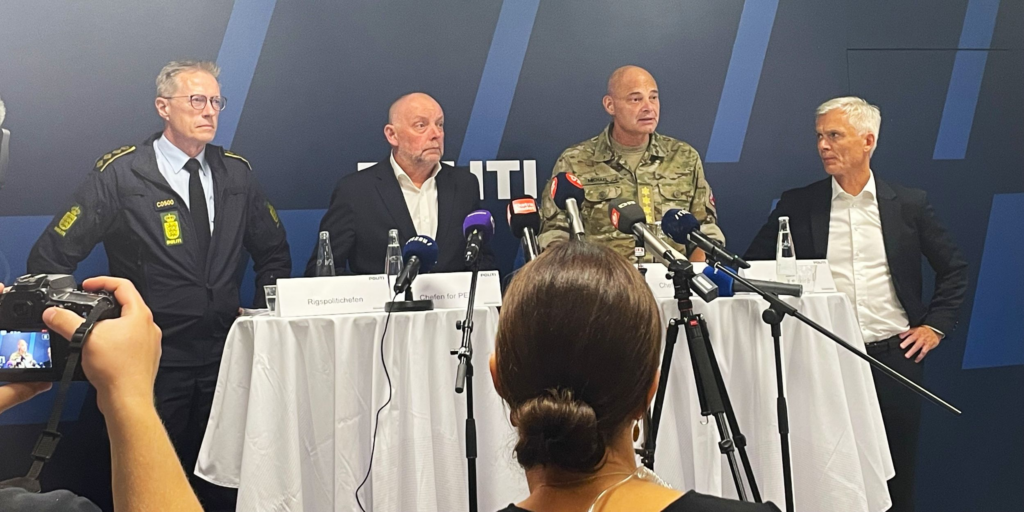
When Denmark’s National Operative Staff (NOST) moved into operations readiness, it effectively told the public that the state was treating the situation as a coordinated national issue, not a set of local police calls.
In its 25 September 2025 statement, Rigspolitiet assessed the drone activity as intended to “skabe utryghed og forstyrre vores infrastruktur” (create insecurity and disrupt our infrastructure), and it urged the public to document sightings carefully. (Politi)
That sentence is not just rhetoric. It tells you the state’s working model: this activity was, at minimum, psychological and disruptive. The practical implication is that the “target” may have been Denmark’s sense of control as much as any specific site.
From an investigative standpoint, NOST readiness also reflects a familiar UAP problem. In a reporting surge, signal and noise mix together. Officials need the public to report, but they also need the public to report in a way that does not drown the system in misidentifications.
The “shining star” moment: how flaps make ordinary skies suspicious
The Reuters “shining star” report is one of the most revealing pieces of the whole week, because it captures the flap’s emotional physics.
Reuters reported that Billund Airport was briefly shut after an alleged drone sighting that turned out to be a bright star, amid a sudden torrent of public reports during the flap. (Reuters)
It is tempting to treat this as embarrassing, or as evidence the entire flap was misperception. That is the wrong lesson. In a true flap, misidentifications do not cancel real incidents. They accumulate around them. The human mind becomes primed. The sky becomes “hot.” Institutions become cautious because the cost of being wrong can be catastrophic.
This is why UAP research benefits from a two-lane approach. One lane focuses on a narrower set of high-quality incidents with institutional action and corroboration. The other studies the social dynamics of reporting waves, because those dynamics shape what gets recorded, what gets ignored, and what becomes legend.
Official language versus UAP language: a clean separation
To keep Denmark’s flap clear, we need a bright line.
Officially, Denmark described “drones,” “unidentified drones,” “drone activity,” and “drone incursions.” Police and national institutions treated them as real aerial objects causing disruption. (euronews)
UAPedia uses “UAP” in a broader, method-based sense. It covers aerial phenomena that are not confidently attributed at the time of reporting, especially when there is institutional uncertainty or ongoing investigation. Denmark’s case qualifies under that definition because, despite the “drone” label, the open record did not conclusively identify operators, launch points, or command-and-control methods, and the incidents prompted sustained investigative coordination. (euronews)
So this case is not presented as “mystery craft beyond human capability.” It is presented as “a sustained unidentified aerial problem that created real-world consequences, and remained only partly resolved publicly.”
The attribution controversy: “state actor” talk and the limits of public proof
Denmark’s flap unfolded in a European environment already shaped by sabotage concerns and drone disruptions elsewhere. In that context, Reuters reported discussion of state-actor risk and hybrid tactics, alongside denials and the lack of publicly demonstrated attribution. (Reuters) AP was especially clear that Danish officials did not have information to name a specific actor. (AP News)
This is where disciplined uncertainty matters. There is a difference between a state’s internal assessment and a publicly provable claim. In the public record, the operator was described as capable and the pattern as systematic. But naming a specific sponsor remains contested in public discourse, and any confident attribution goes beyond what has been released in a way that independent researchers can test.
So the most accurate public-facing conclusion is simple: Denmark experienced a serious, apparently coordinated series of incursions that officials framed as consistent with hybrid pressure tactics, but publicly released evidence did not prove the identity of the operator or sponsor. (Reuters)
Policy aftermath: Denmark as a vivid example in a wider shift
If Denmark’s 2025 flap was a shock for Danish society, the wider European policy response reflected an accelerating recognition that malicious drones can become a cross-border security issue.
On 11 February 2026, the European Commission published its Action Plan on Drone and Counter-Drone Security, emphasizing preparedness, detection, coordinated response, and defense readiness against malicious drone threats. (Politi)
It is important not to oversimplify this as “Denmark caused the action plan.” Europe’s shift was broader than any single week in any single country, shaped by multiple incidents and evolving threat assessments across the region. Denmark’s flap is best understood as a particularly clear illustration of the kind of disruptive scenario European institutions were increasingly designing against. (Politi)
Implications for UAP research: what Denmark teaches
Denmark’s 2025 flap offers lessons that are easy to miss if you only skim headlines.
Modern UAP flaps often happen at the boundary between civilian and military domains. Airports are civilian infrastructure, but they sit inside an airspace governance regime that quickly touches national defense. That is why PET and the armed forces were drawn into coordination. (euronews)
“Sensor-era” also does not automatically mean “publicly measurable.” States may have radar, video, and electronic traces, yet release almost none of it. Researchers must learn to work with institutional footprints while continuing to advocate for responsible transparency.
Flaps also produce their own shadows. The “shining star” moment is not a side joke. It is evidence of how uncertainty spreads into the interpretation of the sky itself. (Reuters)
Finally, Denmark’s episode reminds us that UAP is a category defined by uncertainty, not by origin. Even if later investigations ultimately attribute these events to a specific operator and method, the 2025 episode still belongs in UAPedia’s historical taxonomy as a UAP flap because it unfolded, publicly, as an unidentified and consequential aerial problem in real time. (euronews)
Claims taxonomy
Verified
Copenhagen Police described several unidentified drones over Copenhagen Airport and stated they were collecting evidence including witness interviews, physical/electronic traces, video (including surveillance), air-traffic-related data, and ship-presence/location checks, in coordination with PET and the armed forces. (euronews)
NOST moved into operations readiness and assessed the activity as intended to create insecurity and disrupt infrastructure, while issuing public documentation guidance. (Politi)
Reuters and AP reporting support a multi-site cluster across Denmark in the same week, including Aalborg and Billund and other locations, with officials describing the activity as systematic and hybrid in character. (Reuters)
A high-profile alert during the flap period involved a confirmed misidentification at Billund (“a shining star in the sky”), amid a surge of public reports. (Reuters)
Probable
The core airport and military-adjacent incidents involved a professional or highly capable operator rather than casual recreational use, based on repeated incursions and official framing. (Reuters)
Disputed
Public attribution to any named state or sponsor. Officials discussed hybrid tactics and state-actor risk; publicly released evidence did not establish a specific culprit, and AP reports officials did not have information to name one. (Reuters)
Misidentification
A meaningful portion of the broader reporting wave likely included ordinary sky phenomena, as evidenced by the Billund “shining star” incident and the documented reporting volume under heightened alertness. (Reuters)
Speculation labels
Hypothesis: The 2025 Denmark incidents represent deliberate probing of response gaps using unmanned systems, with the “payload” being disruption and psychological pressure rather than physical damage. This aligns with NOST’s assessment about creating insecurity and disrupting infrastructure, and with officials’ description of systematic activity. (Politi)
Hypothesis: A maritime element, such as launch, recovery, relay, or control, played a role in at least some incidents. This is suggested by Copenhagen Police’s explicit interest in ship-presence/location checks as part of their investigative work. It remains unproven publicly. (euronews)
Witness Interpretation: During the peak of the flap, some observers likely interpreted ambiguous lights as drones or anomalous craft because the social context made that interpretation feel urgent and reasonable. The Billund “shining star” episode demonstrates how readily a celestial object can be misclassified under flap conditions. (Reuters)
Researcher Opinion: Denmark’s flap should be treated as a layered dataset. The most valuable research subset is the set of incidents that triggered institutional action and involved described evidence streams (air-traffic data, video, electronic traces). The broader reporting wave should be studied as a secondary phenomenon because it shapes the narrative environment in which genuine incursions occur. (euronews)
Relevant links
https://www.reuters.com/world/europe/shining-star-sky-highlights-denmarks-drone-anxiety-2025-09-26
References
Associated Press. (2025, September 25). Danish officials believe drone flyovers at 4 airports are meant to sow fear and division. (AP News)
Copenhagen Police. (2025, September 24). Orientering om efterforskning af hændelse med uidentificerede droner over Københavns Lufthavn. Politi.dk. (euronews)
European Commission, Directorate-General for Defence Industry and Space. (2026, February 11). Commission publishes the Action Plan on Drone and Counter-Drone Security. (Politi)
Reuters. (2025, September 25). Denmark reopens airports after drone disruption. (Reuters)
Rigspolitiet (National Police). (2025, September 25). NOST’en er i operationsberedskab grundet de seneste dages droneaktivitet. Politi.dk. (Politi)
SEO keywords
Denmark UAP flap 2025, Copenhagen Airport unidentified drones, Kastrup drone incident September 2025, Aalborg Airport drone airspace closure, Billund shining star misidentification, NOST operations readiness Denmark, Skrydstrup drone sightings, Holstebro military site drone reports, systematic hybrid drone incursions Denmark, Danish critical infrastructure aerial incursions, European Commission Action Plan on Drone and Counter-Drone Security 11 February 2026, modern UAP flap Europe, institutionally corroborated UAP cases Denmark