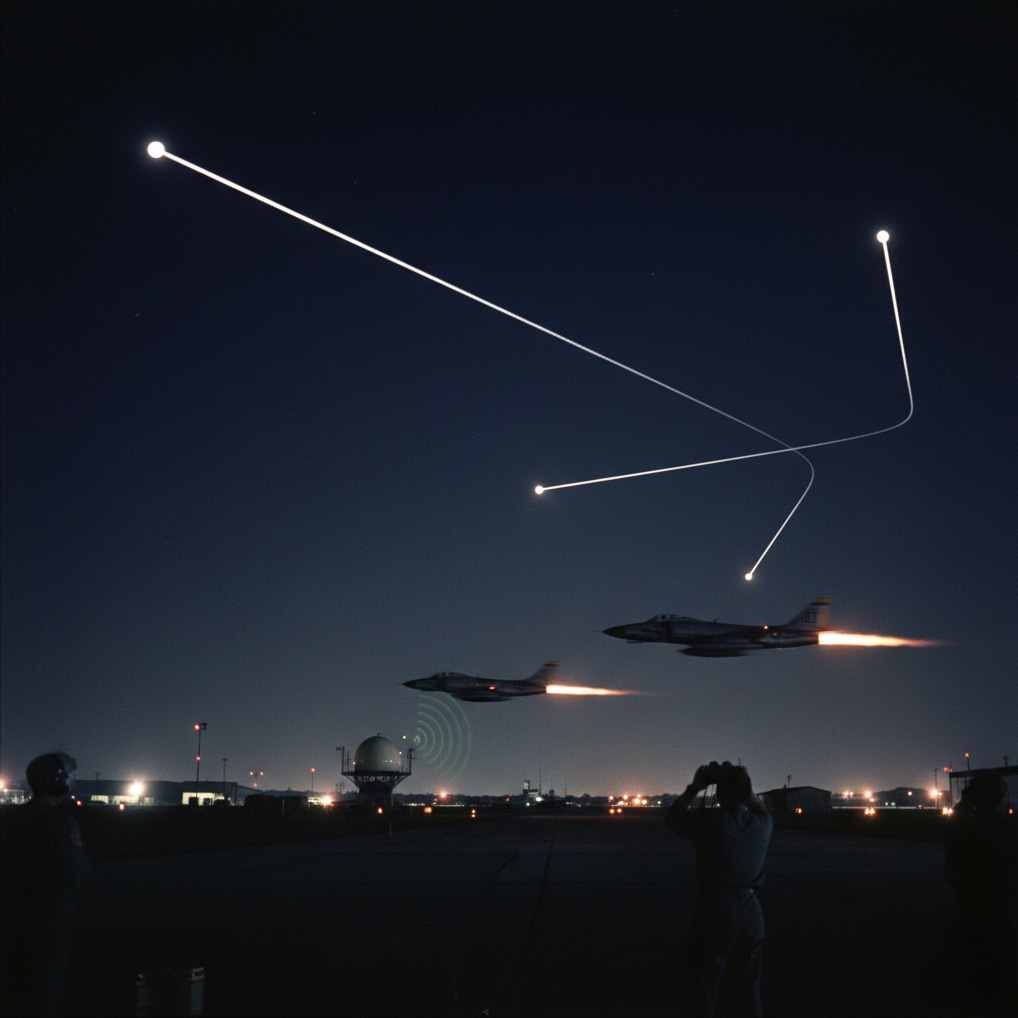
A 1990s apocalyptic script about staged revelation, synthetic “sky shows,” and manufactured UAP crises
Project Blue Beam is best understood as a modern apocalyptic narrative about how a future global “revelation” could be staged using advanced communications, optics, and psychological influence. Its core allegation is that a coalition of powerful institutions (often named as NASA and the United Nations in early tellings) could simulate religious and “off-world” events, then leverage mass shock to consolidate political authority and establish a new global belief system. (Internet Archive)
In UAP culture, “Blue Beam” has become a flexible explanatory frame that people reach for when they suspect that public attention toward anomalous objects is being steered, or when they fear that dramatic “disclosure” headlines might be theater. In recent years it has repeatedly resurfaced in response to viral aerial videos, drone waves, and periods of low institutional trust. (Reuters)
The four steps of the Project Blue Beam narrative (UAPedia)
What Project Blue Beam claims
The most circulated versions of Project Blue Beam trace to Serge Monast, a Canadian author and lecturer whose name is closely associated with the concept in the 1990s. (Internet Archive)
A widely shared text attributed to Monast describes “four steps”:
Step 1: “Engineered earthquakes” and hoaxed archaeological “discoveries” intended to discredit foundational religious doctrines. (Internet Archive)
Step 2: A global “space show” using three-dimensional optical projections and sound, tailored to regional religious expectations. (Internet Archive)
Step 3: “Telepathic” or mind-internal messaging using ELF/VLF-style framing and satellite delivery, making individuals believe their deity is speaking from within. (Internet Archive)
Step 4: “Universal supernatural manifestations,” including (in some variants) a simulated “alien invasion,” a synthetic “rapture,” and mass panic to eliminate opposition and justify a new political order. (Internet Archive)
Even at face value, Blue Beam is not one single claim. It is a bundle of claims about:
Institutions (who is doing it, and how coordinated they are)
Timelines (often shifting, sometimes tied to round-number years)
Those components can be assessed separately.
Origins and cultural seedbed
Serge Monast and the “script” format
Monast’s biographical details are frequently repeated online with inconsistencies, but an authoritative library authority record places his death in December 1996. (Data BnF)
The widely circulated “Blue Beam” text itself is important because it shows the structure of the story: not a single incident report, but a scenario plan. It reads like a staged sequence, complete with psychological preparation via popular media and escalating phases of spectacle. (Internet Archive)
Why the Reagan “alien threat” quote matters in Blue Beam lore
Some tellings connect Blue Beam’s conceptual spark to Ronald Reagan’s 1987 United Nations speech, where he mused that a shared “alien threat from outside this world” could dissolve geopolitical differences. (Reagan Library)
In Blue Beam culture, this line is treated less as rhetorical flourish and more as an inadvertent “tell” that global unity might be catalyzed by an externalized nonhuman threat. Whether or not that interpretation is warranted, it helps explain why the Blue Beam narrative binds itself so tightly to UAP imagery as a unifying fear object.
A persistent confusion point is the name itself. “Blue Beam” is often assumed to be connected to (or a successor of) the U.S. Air Force’s UAP investigation program historically called Project Blue Book. The Guardian has noted that the name is likely derived from Blue Book. (The Guardian)
That naming proximity matters because it gives the narrative an “official echo” even where no documentary connection exists.
The Four Steps in detail
Below is the most common “four steps” outline, following the widely circulated text attributed to Monast. These are not verified stages of a real program. They are the narrative’s internal architecture.
Step 1: Engineered quakes and curated “discoveries”
The text describes artificially created earthquakes at precise locations, paired with “discoveries” meant to demonstrate that religious doctrines were “misinterpreted.” (Internet Archive)
This step is less about geology than about epistemic demolition: remove confidence in inherited stories, then supply a replacement narrative.
Step 2: The “space show” tailored to belief
The second step describes three-dimensional projections and audio, distributed globally with different imagery by region, matching predominant faith expectations. (Internet Archive)
This is the most famous piece of Blue Beam because it maps cleanly onto a pop-culture idea: “holograms in the sky.”
Step 3: “Artificial talk” and inner-voice messaging
The third step, as circulated, frames satellite-delivered ELF/VLF signals as a way to produce mind-internal experiences, persuading each person that their own deity is communicating. (Internet Archive)
This is where Blue Beam crosses from spectacle into claims about neuro-influence at scale.
Step 4: The capstone crisis
The fourth step is described as “universal supernatural manifestations,” with three orientations that include:
A simulated “alien invasion” to provoke nuclear response and subsequent disarmament
A simulated “rapture” narrative
A composite of “electronic and supernatural forces” channeled through networks and devices (Internet Archive)
This is the part of Blue Beam that most strongly fuses UAP imagery with apocalyptic religion and political consolidation.
Key evidence
When people ask for “key evidence” for Project Blue Beam, they often mean “evidence that it exists as a real operational program.” The available record looks different:
1) Primary-source “evidence” is mainly the Monast-attributed text and derivative retellings
The most concrete artifact is the text itself, which lays out the four steps and the intended psychological effects. (Internet Archive)
But a text describing an alleged program is not the same as:
budgets or contracts,
named facilities,
technical demonstrations,
whistleblowers with checkable credentials and documentation, or
a paper trail consistent with large-scale multinational coordination.
2) No publicly verified NASA or UN documentation supports an actual “Project Blue Beam”
Despite the narrative’s frequent naming of NASA and the UN, credible public documentation of such a program has not been produced in the way real aerospace or defense programs typically leak into public visibility over time (contracts, procurement traces, audits, subcontractor footprints).
A rigorous evaluation therefore classifies the “NASA program exists” component as uncorroborated.
3) Blue Beam is frequently used as a lens for miscaptioned or simulated UAP media
A Reuters fact-check is illustrative: a clip misrepresented online as UAP footage was actually generated in a flight simulation game, and online discussion invoked “Project Blue Beam” as an explanation for why “the government” would push fake UAP imagery. (Reuters)
This shows something important: in contemporary usage, “Blue Beam” often functions as a default explanation for perceived media manipulation, even when a simpler explanation exists (mislabeling, edits, simulations).
4) The narrative borrows plausibility from real historical precedents of information management and staged-incident planning, but those precedents do not substantiate Blue Beam itself
Two examples often cited in adjacent discussions:
Operation Northwoods (1962) is a declassified Pentagon/JCS planning document proposing provocations to justify intervention in Cuba. (National Security Archive)
The CIA’s Robertson Panel-era documentation reflects concern that public interest in “flying saucers” could be exploited, and it discusses education or “debunking” efforts to reduce public reaction and vulnerability to propaganda. (CIA)
These show that states can plan deception and perception-management. They do not show that a sky-hologram messiah project exists. They explain why some audiences treat a staged UAP spectacle as psychologically plausible.
5) The technical building blocks exist in limited forms, but Blue Beam’s implied scale is the gap
Blue Beam’s “hologram sky show” is often described as if it were already solved engineering. The real world shows partial components:
Research demonstrates aerial/volumetric graphics using focused femtosecond lasers that create luminous points in air, with reported workspaces on the order of cubic centimeters in at least one experimental system. (displaydaily.com)
Related research discusses voxel generation and re-projection methods for aerial imagery, but these are still constrained systems, not city-scale sky theater. (Nature)
Atmospheric scattering and attenuation degrade crisp long-range optical projection through real air, which is a basic physical constraint on “clean holograms across a skyline.” (sciencedirect.com)
So, the “key evidence” on technology is not proof of Blue Beam. It is evidence that some optical and perceptual effects exist, while the narrative’s implied global scale is not demonstrated in public technical literature.
Technical reality check: what is plausible, what is not
This section does not argue that institutions cannot stage aerial spectacles. They can. The question is whether Blue Beam’s specific package is realistic as commonly described.
“Holograms in the sky”
A true free space “hologram” visible from many angles in open air is not the same as:
projecting onto clouds or haze,
using drones as light sources,
using lasers to create small plasma voxels, or
using augmented reality via personal devices.
The optical environment matters. Light moving through the atmosphere is deflected and attenuated by particulates, degrading image clarity and contrast. (sciencedirect.com)
The most feasible “mass sky display” methods in practice tend to be:
drones carrying lights in coordinated formations,
projection onto surfaces (clouds, haze, screens, building facades),
broadcast media (the “sky show” happens on screens, not in the sky).
Blue Beam’s cultural image of omnidirectional, city-scale 3D apparitions remains unproven in open scientific or engineering literature.
“Voice in your head” broadcasting
With our current scientific understanding there is a real, well-documented phenomenon commonly called the microwave auditory effect: pulsed microwave energy can produce perceived sounds described as buzzing or clicking, as reported in classic work by Frey and in later reviews. (ヒロコ財団)
However, moving from “auditory clicks/buzzes are possible under certain exposure conditions” to “satellites can deliver individualized deity-voices into billions of minds” is a major leap. The biological effect is real; the Blue Beam scale and personalization claim is not established by the medical and biophysics literature cited in public sources. (ヒロコ財団)
Psychological operations without sci-fi hardware
Ironically, Blue Beam’s social impact can be achieved without its most extravagant claims. A modern “manufactured revelation” could be attempted using:
coordinated drone waves,
selective release of ambiguous videos,
synthetic audio/video (deepfakes),
algorithmic amplification, and
crisis framing.
That pathway requires far less exotic physics than a planetary hologram theater. This helps explain why Blue Beam persists even when its technical claims are challenged: its psychological plot can be re-implemented with new tools each decade.
Blue Beam and UAP discourse: the collision of two explanatory instincts
UAP history contains two competing instincts:
The anomaly instinct: enduring, credible UAP reports across eras and cultures indicate a genuine phenomenon that is not reducible to prosaic causes. (This is where UAPedia’s broader editorial gravity tends to sit.)
The stagecraft instinct: states and institutions can manage narratives, seed confusion, and sometimes stage events, so apparent “revelations” may be choreographed.
Blue Beam is the most theatrical expression of the second instinct. It becomes problematic when it is used as a universal solvent that dissolves every UAP case into “they faked it,” including cases with serious multi-witness, multi-sensor, or historically deep patterns.
A careful UAP research posture can hold two ideas at once:
staged aerial events and disinformation exist in history,
but they do not automatically explain the full UAP record.
Timeline
The timeline below distinguishes between: (a) cultural/ideational roots, (b) publication milestones, and (c) modern resurgences.
Date
Event
Relevance to Project Blue Beam
1953 (declassified later)
CIA Robertson Panel-era documentation discusses “debunking”/education to reduce public reaction to “flying saucers”
Shows institutional interest in managing public perception around UAP reports, feeding the plausibility of later narrative frameworks. (CIA)
1962-03-13
Operation Northwoods planning memo produced by U.S. Joint Chiefs of Staff
Demonstrates that staged-incident proposals have existed in declassified history, often cited as “proof that planners can imagine provocations,” though unrelated to Blue Beam’s specific claims. (National Security Archive)
1987-09-21
Reagan UN speech referencing an “alien threat from outside this world” as unifying
A rhetorical seed frequently interpreted in Blue Beam lore as foreshadowing a unifying external threat narrative. (Reagan Library)
1994
Monast-associated “Project Blue Beam” text circulates, describing four steps including quakes, a global “space show,” and mind-internal messaging
The canonical “script” formulation and source for the commonly repeated four-step structure. (Internet Archive)
1996-12
Death of Serge Monast (date varies across secondary sources; library authority record lists 05-12-1996)
Becomes part of the surrounding legend ecology; later retellings often treat his death as suspicious, without public verification of that claim. (Data BnF)
2023-08
Reuters fact-check notes Blue Beam invoked online as a reason “government falsifies UAP footage,” in a case where a clip was from a simulation game
Illustrates how “Blue Beam” functions today as a meme for media distrust, often triggered by viral UAP clips. (Reuters)
2024-12
Drone wave discourse in the U.S. Northeast includes renewed “Project Blue Beam” chatter
Demonstrates the narrative’s periodic resurgence during ambiguous aerial events. (The Guardian)
What would count as strong evidence if Project Blue Beam were real?
Because Blue Beam claims planetary scale and high complexity, the evidentiary bar is correspondingly high. Strong evidence would look like:
procurement records (contracts, subcontractors, deliverables) consistent with long-range aerial display R&D at scale
insider testimony with verifiable employment history plus corroborating documents
multi-source leaks that converge on the same program structure and timeline
To date, public Blue Beam discourse relies primarily on scenario-text circulation and inference rather than that kind of convergent evidentiary stack.
Claims Taxonomy
Below are the major Blue Beam claims treated as discrete claims, with UAPedia’s taxonomy applied.
Claim: “Project Blue Beam is a real NASA program with four Classification:Legend (widely circulated narrative with no publicly verifiable program documentation). (Internet Archive)
Claim: “A global ‘sky show’ of religious/UAP imagery can be projected worldwide as 3D holograms visible to the public.” Classification:Disputed (limited related technologies exist in laboratories, but global scale as described is not established in open literature). (displaydaily.com)
Claim: “Satellite-delivered signals can generate individualized inner-voice messages for entire populations.” Classification:Disputed (microwave auditory effects are documented, but the individualized, global ‘deity voice’ scenario is not supported by the cited biomedical literature). (ヒロコ財団)
Claim: “Modern viral UAP clips are often ‘Blue Beam’ productions.” Classification:Misidentification (many such attributions are post hoc and sometimes attach to miscaptioned or simulated footage). (Reuters)
Speculation labels
Hypothesis
Blue Beam persists because it is a portable myth-template: it explains institutional secrecy, religious anxiety, and media unreliability in one story, and it can update its “tech props” each decade (from satellites and lasers to drones and synthetic media). (University of California Press)
Witness Interpretation
During ambiguous drone waves or unclear official messaging, some observers interpret uncertainty itself as evidence of orchestration. The Guardian’s reporting on drone-related anxiety shows how quickly such interpretive frames spread in moments of collective attention. (The Guardian)
Researcher Opinion
Blue Beam should be treated as a cultural artifact inside UAP discourse, not as an established explanatory solution for UAP. It is more useful for studying belief, information trust, and narrative contagion than for explaining high-quality anomalous cases. Having said that, there is evidence in the studies of consciousness that could produce some of the effects purported by the Blue Beam narrative in our article here.
References
Barkun, M. (2013). A culture of conspiracy: Apocalyptic visions in contemporary America (2nd ed.). University of California Press. (University of California Press)
Central Intelligence Agency. (1953). Report of meeting of scientific advisory panel on unidentified flying objects (declassified document). (CIA)
Frey, A. H. (1961). Auditory system response to radio frequency energy. Aerospace Medicine, 32, 1140–1142. (As cited in Lin’s review). (ヒロコ財団)
Frey, A. H. (1962). Human auditory system response to modulated electromagnetic energy. Journal of Applied Physiology, 17, 689–692. (As cited in Lin’s review). (ヒロコ財団)
Lin, J. C. (1978). Microwave auditory effects and applications (review). (ヒロコ財団)
Monast, S. (1994). Project Blue Beam; Revival of the fake alien invasion technology (widely circulated text). Internet Archive. (Internet Archive)
National Security Archive. (1962). Justification for U.S. military intervention in Cuba (Operation Northwoods memorandum) (declassified PDF). George Washington University. (National Security Archive)
Ochiai, Y., Kumagai, K., Hoshi, T., Rekimoto, J., Hasegawa, S., & Hayasaki, Y. (2015). Fairy lights in femtoseconds: Aerial and volumetric graphics rendered by focused femtosecond laser combined with computational holographic fields (PDF). (displaydaily.com)
Reuters Fact Check. (2023, August 2). Fact check: Clip of UAP over Nevada created with simulation game. (Reuters)
Science. Atmospheric scattering (definition and overview). (sciencedirect.com)
Bibliothèque nationale de France. (n.d.). Serge Monast (1945–1996) authority record (PDF). (Data BnF)
The Guardian. (2024, December 17). New Jersey governor urges state to calm down as FBI looks into drone mystery. (The Guardian)
The Ronald Reagan Presidential Library. (1987, September 21). Address to the 42d session of the United Nations General Assembly. (Reagan Library)
SEO keywords
Project Blue Beam, Project Blue Beam timeline, Serge Monast, staged UAP event, fake alien invasion narrative, holograms in the sky, volumetric display lasers, microwave auditory effect, Frey effect, UAP disinformation narratives, UAP media miscaptioning, Operation Northwoods and UAP culture, Robertson Panel perception management
Before Bob Lazar, before viral videos of Navy pilots, there was John Lear, a silver-haired Nevada aviator who walked onto radio shows and bulletin boards and calmly announced that the United States government had cut a deal with hostile non-human intelligences.
To many in mainstream culture his stories sounded outrageous. To a generation of UAP-obsessed night owls listening to Coast to Coast AM with Art Bell, they were electrifying. Lear wrapped his claims in something unusual for this space: real aviation pedigree, a famous last name and decades of high-risk flying that made him sound less like a guy with a website and more like someone who might actually have seen the classified world up close. (Coast to Coast AM)
Lear died in March 2022 at 79, but the “John Lear file” is still pulsing through UAP culture. His tales of MJ-12, underground bases, cattle mutilations and “grand deception” feed directly into what scholars now call the “dark side” strand of modern UAP lore, where the real danger is not just the craft in the sky, but the governments that allegedly collaborate with whoever is flying them. (HowStuffWorks)
He is important not because his claims are verified, but because he shows how a single well-connected insider figure can reshape the mythos around UAP almost overnight.
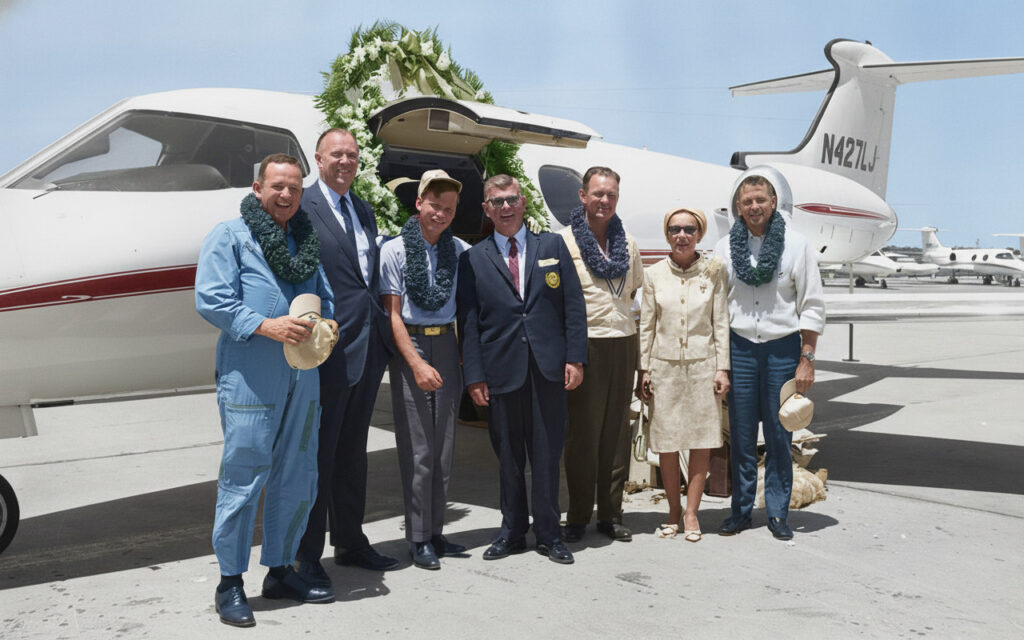
John Lear was only 24 when he (3rd left to right), Henry Beaird, Rick King, and John Zimmerman completed their record-breaking Round the World Flight, covering 23,000 miles in under 65 hours. (Wichita State Univ. Library)
Aviation royalty: the Learjet heir
John Olsen Lear was born on 3 December 1942, son of inventor and entrepreneur Bill Lear, whose name became synonymous with sleek business jets, and actress Moya Olsen Lear. He was named after his maternal grandfather, vaudeville comedian John Olsen. (Encyclopedia Pub)
Lear grew up in a world of hangars, test flights and celebrity passengers. He attended Switzerland’s elite Institut Le Rosey boarding school, then Wichita State University, and was flying as a teenager. By his own and archival accounts he climbed the Matterhorn at 17, flew solo at 16 and was working as a pilot and PR representative for his father’s company by 1960. (Encyclopedia Pub)
The paper trail from that period is robust:
In 1965 he testified before the Civil Aeronautics Board after a fatal Learjet crash while working for Paul Kelly Flying Service. (Encyclopedia Pub)
In May 1966 he co-piloted a Learjet 24 on a record-setting round-the-world trip: about 22,000 miles in just over 50 hours, logging 18 international aviation records. (Encyclopedia Pub)
That same year he flew rock band The Byrds in a Learjet, inspiring their track “2-4-2 Foxtrot (The Lear Jet Song),” which samples his cockpit chatter. (Encyclopedia Pub)
In 1968, heavy fog forced a near-emergency over San Francisco. Air Force personnel cleared traffic off the Golden Gate Bridge in case he had to set down there, then guided him safely into Hamilton AFB, a story that still circulates in aviation circles. (Encyclopedia Pub)
Later, according to his own talks and an oral-history finding aid at the University of Nevada Las Vegas, Lear flew a wide variety of aircraft on contract work in conflict zones, including missions linked to the CIA and State Department. He described flying for Air America and other fronts in Southeast Asia and the Middle East from the late 1960s into the early 1980s.
By the time he drifted into the UAP world, John Lear was not just “a guy with a story.” He was a decorated, if unconventional, pilot with thousands of hours in everything from Learjets and Boeing widebodies to warbirds.
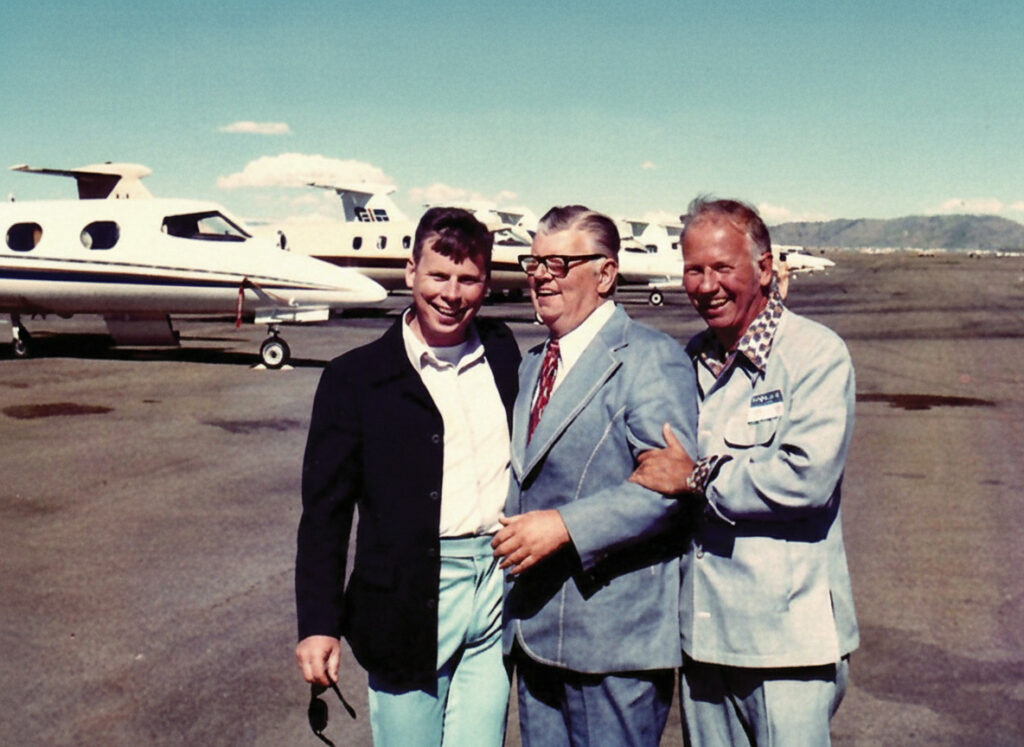
John Lear, Bill Lear Sr. and Bill Lear Jr. at the Reno Airport in 1977. (Unknown)
From pilot to “dark side” UAP narrator
Lear’s own accounts say the switch flipped in the mid-1980s after a conversation with an Air Force friend who had been at Bentwaters during the famous Rendlesham Forest incident and described a landed craft and small beings.
That story, paired with growing contact with New Mexico electronics businessman and experiencer Paul Bennewitz, pushed Lear from casual interest into full-tilt UAP activism. (Hangar1publishing)
His key move came in late 1987. Using the ParaNet bulletin board system, Lear posted a long document usually called “The John Lear Statement,” revised several times into 1988. In it he claimed:
The US government had been in business with “little grey” extraterrestrials for roughly 20 years.
A clandestine committee, MJ-12, made a secret treaty after crash recoveries in the late 1940s.
In exchange for technology, the government tolerated abductions and agreed to suppress information about cattle mutilations and other events.
A “grand deception” later emerged, involving missing children, genetic experiments and underground bases where humans and animals were allegedly disassembled in vats of liquid. (Hangar1publishing)
The tone was calm and oddly bureaucratic, which only made it more disturbing. This was not a channeled message from friendly space brothers. It was a horror briefing that blended Bennewitz’s tales of Dulce, earlier MJ-12 lore, and abduction narratives from researchers like Budd Hopkins into one big, frightening arc. (Internet Archive)
Later writers like Greg Bishop (Project Beta), Mark Pilkington (Mirage Men) and MDPI’s Encyclopedia entry on Lear argue that this statement became a pivot point for what they call the “dark side” of UAP culture, in which secret government collusion and apocalyptic scenarios move to the center of the story. (Internet Archive)
Art Bell interviews John Lear
Coast to Coast, Art Bell and the birth of a late-night legend
If ParaNet was the spark, late-night radio was the accelerant.
Beginning in the early 1990s, Lear became a recurring guest on Coast to Coast AM with Art Bell. He spent multiple four-hour blocks walking listeners through the “horrible truth” as he saw it: hostile greys, secret treaties, Dulce Base, and a government that feared its own citizens more than the visitors. (Listen Notes)
The official Coast to Coast guest bio describes him as a retired airline captain, former CIA pilot, former Lockheed L-1011 captain and holder of almost every certificate the FAA can issue, with 18 world speed records, who began revealing “startling” information about aerial phenomena and UAP in the late 1980s. (Coast to Coast AM)
An obituary from the same ecosystem underscores that by the time of his death, he was known above all as a “legendary aviator, UAP researcher, and longtime guest” whose early shows helped steer Art Bell’s career into anomaly territory. (iHeart)
His broadcast footprint stretched beyond Bell:
Regular guest spots with George Noory and George Knapp on topics like Area 51, lunar anomalies, “secret wars,” and alleged underground civilizations. (Coast to Coast AM)
Appearances in cable and streaming shows like Ancient Aliens, America’s Book of Secrets, Brad Meltzer’s Decoded and The Unexplained Files. (Encyclopedia Pub)
Lear’s confident delivery and aviation credentials made his claims feel like “inside information” to millions of listeners and helped cement Area 51, Dulce and MJ-12 in the popular UAP imagination.
Websites, forums and “The Real John Lear”
For an internet-native generation, Lear was less a late-night voice and more a long scrolling page.
The main living hub for his material is TheLivingMoon.com, a sprawling archive subtitled “A Collection of Theories and Facts” that organizes his topics of interest into dozens of sections: atmosphere on the Moon, secret astronaut programs, underground transit systems, 9/11 anomalies, remote viewing, and more. (The Living Moon)
The site also preserves content from TheRealJohnLear.com, which it describes as John’s former personal site, now folded into the archive. That includes:
A “Career Summary”
“John’s Own Words”
A copy of his 9/11 affidavit
Photos “with Bob Lazar at Groom Lake”
Links to classic interviews: Project Camelot, Coast to Coast, and others (The Living Moon)
The Coast to Coast AM guest page lists four key web presences associated with him:
MUFON, Bennewitz, Bill Cooper and the disinformation tangle
Lear was not working in a vacuum. He arrived in the UAP scene just as the Paul Bennewitz story was turning from a local concern into a national cautionary tale.
Bennewitz, an Albuquerque businessman, had convinced himself that he was intercepting alien communications near Kirtland AFB and Dulce. Greg Bishop’s Project Beta and Mark Pilkington’s Mirage Men document how Air Force Office of Special Investigations officer Richard Doty and others fed him false information as part of a disinformation campaign that ultimately contributed to Bennewitz’s psychological collapse. (Internet Archive)
Lear took pieces of that material and built them into his statement. He then carried them onto a bigger stage through the 1989 MUFON symposium in Las Vegas, where he served as Nevada State Director and host. According to the MDPI Encyclopedia entry and later historical analyses, he pushed for a lineup that would validate the Bennewitz-style underground base narrative. The conference climaxed with researcher Bill Moore admitting that he had cooperated with intelligence personnel in planting false material with Bennewitz. (Encyclopedia Pub)
Around the same time, Lear formed a brief alliance with former Navy man William “Bill” Cooper. In the late 1980s, the two issued a kind of “indictment” of the US government for collaborating with an alien “nation.” Their relationship later fractured, but historians of fringe politics note that Cooper absorbed and amplified many of Lear’s themes in his own writings and broadcasts, which then flowed into wider political subcultures. (Encyclopedia Pub)
Lear also played a catalytic role in the Bob Lazar saga. When George Knapp’s television segments about Lazar’s claimed work at S-4 near Area 51 aired in 1989, Lear was present as a kind of on-air validator, contextualizing Lazar’s accounts within his broader narrative of underground bases and reverse-engineered craft. (Encyclopedia Pub)
Claims taxonomy here is especially delicate:
Verified: MUFON role and 1989 Las Vegas symposium; Moore’s confession about disinformation; Lear’s visible participation in early Lazar media. (Encyclopedia Pub)
Disputed: The underlying Dulce base, MJ-12 documents and treaty narratives, which later work suggests were heavily salted with deliberate falsehoods and psychological operations. (Internet Archive)
The CIA’s own retrospective on its role in “UFOs, 1947–90” shows how psychological warfare and secrecy around U-2 and OXCART flights seeded public mistrust, even as the agency insists there was no confirmed ET presence. (FAS Project on Government Secrecy)
In other words, the record supports both the existence of real deception and the likelihood that some of Lear’s scariest stories were built on sand.
John Lear circa 2000. (Unknown)
The claims themselves: bases, bodies and bleak cosmology
Across interviews, website essays and radio shows, several recurring themes define “Lear cosmology”:
Secret treaties and MJ-12 Lear insisted that MJ-12, an elite committee allegedly created by Truman in 1947, cut a deal with hostile greys: technology in exchange for permission to abduct and experiment on humans and animals. He claimed that sometime around 1979 the committee realized the scale of the deception, including missing children and human body parts found in vats in underground bases. (Hangar1publishing)
Dulce Base and underground facilities Building on Bennewitz material, Lear described a massive joint facility near Dulce, New Mexico, and other sites in Nevada, housing vats of dismembered bodies, genetic experiments and a failed 1979 rescue mission that allegedly killed dozens of US personnel. (Hangar1publishing)
Cattle mutilations and alien “food” Lear leaned on Linda Moulton Howe’s work and abductee accounts to argue that classic mutilation cases showed surgical precision beyond human tech and supported his view that greys absorbed a slurry of animal and human tissues through their skin. (HowStuffWorks)
The Moon and Mars as occupied territory Through image analysis, hearsay and remote viewing, Lear claimed an atmosphere and surface activity on the Moon, long-standing non-human bases and even a “soul catcher” technology that recycles human consciousness. He also spoke of artificial structures and ancient ruins on Mars. Much of this is cataloged at TheLivingMoon. (The Living Moon)
A bleak census of non human intelligences Unlike many contactees who talk about benevolent “space brothers,” Lear painted a near-totalized hostile cosmos. He spoke of dozens of visiting species and estimated that the overwhelming majority were dangerous or indifferent to human wellbeing. (Hangar1publishing)
HowStuffWorks, in a critical overview of Lear and related “dark side” narratives, points out that there is no independently verifiable evidence for these extreme claims and that they appear to be constructed from a patchwork of older saucer folklore, fringe politics and even a spoof British TV program (Alternative 3). (HowStuffWorks)
Other controversies: 9/11, NASA and reality itself
Lear did not confine his distrust to UAP.
He signed an affidavit questioning the official account of the 9/11 attacks, hosted at TheLivingMoon, and associated himself with pilots’ groups that argued for alternative explanations of building collapses. (The Living Moon)
He became a prominent “NASA hoax” voice, arguing that many Apollo images were faked or heavily censored and that the real lunar environment was being hidden. (The Living Moon)
At times he questioned the reality of widely accepted physics, endorsing fringe criticisms of Einstein’s relativity hosted as papers on his site. (The Living Moon)
From an editorial perspective, these controversies matter because they shape how we weigh his testimony. When a witness confidently advances demonstrably false ideas in one domain, it affects how strongly we can lean on them in another.
Late life, Gold Butte and local activism
One of the more grounded chapters of Lear’s later life has nothing to do with aliens.
A 2018 UNLV oral-history finding aid describes an interview in which he spends substantial time on his interest in Gold Butte National Monument, a 300,000-acre desert area in Nevada. He talks about prospecting for gold and silver, exploring the landscape and advocating for public awareness and protection of the monument’s resources, alongside conservationist Jaina Moan.
In this setting he appears less as the “dark side” prophet and more as a seasoned pilot and local character who has simply seen a lot of terrain, both literal and political.
On 29 March 2022, John Lear died in Las Vegas. Local TV segments and MysteryWire tributes framed him as a daring aviator whose death sent “ripples through the worlds of aviation and UFOlogy,” echoing a Coast-linked obituary that honored both his flying exploits and his status as a legend in UAP talk radio. (iHeart)
Implications for UAP research
Whether one finds Lear compelling or infuriating, his footprint on the field is hard to ignore.
He helped fuse UAP narratives with deep distrust of the government. Scholars like Michael Barkun and Mark Jacobson argue that Lear and Bill Cooper were early, influential figures in shifting UAP talk from “what are these craft” toward “what is the state hiding and why,” with lasting effects on political culture. (Encyclopedia Pub)
He stands at the crossroads of disinformation and belief. Project Beta and Mirage Men show how intelligence operations deliberately injected false material into the UAP community. Lear propagated some of that material widely, making him a case study in how sincere actors can still amplify crafted stories and distort the evidentiary landscape. (Internet Archive)
He illustrates the power and danger of charismatic expertise. Lear’s genuine aviation record gave his wildest claims a patina of plausibility. For investigators, this is a reminder to separate domain expertise (flying airplanes) from entirely different domains (evaluating alleged underground bases) and to resist credential “spillover.” (Coast to Coast AM)
He shows how UAP lore can bleed into other contested topics. His embrace of 9/11 anomalies, NASA hoax narratives and radical cosmologies illustrates how UAP belief often coexists with a broader “nothing is as it seems” worldview. Understanding that broader ecosystem is important when evaluating testimony, community dynamics and public impact. (The Living Moon)
Our editorial stance is to neither dismiss nor canonize such figures. Instead we log the claims, map their sources, mark the speculation level and track how they reshape the conversation.
Claims taxonomy
Verified
John Lear’s aviation career, record-setting flights and broad type ratings, as reflected in press archives, museum records and Coast to Coast biography. (Encyclopedia Pub)
His multiple appearances on Coast to Coast AM and other shows discussing UAP, Area 51 and lunar anomalies. (Coast to Coast AM)
His role in hosting MUFON’s 1989 Las Vegas symposium and his longstanding involvement with that organization in Nevada. (Encyclopedia Pub)
The existence of his websites and archive pages, including TheLivingMoon and TheRealJohnLear content preserved there. (The Living Moon)
Probable
Long-term contract flying for CIA-linked fronts like Air America during the Vietnam era, supported by his own statements, UNLV oral-history notes and obituaries, though not fully declassified.
That his 1987–88 ParaNet statement strongly shaped later “dark side” UAP narratives, as argued by historians and summarized in Hangar1Publishing’s “Decoding the John Lear Files.” (Hangar1publishing)
Disputed
Specific content of the alleged MJ-12 treaty, Dulce Base details, body vats, missing children and vast underground battles. Later investigations suggest that key components came from deliberate disinformation fed to Paul Bennewitz and amplified by others. (Internet Archive)
His lunar atmosphere, lunar city and “soul catcher” claims, which contradict mainstream planetary science and NASA data and rely on his interpretations of imagery and testimony hosted at his own site. (The Living Moon)
Bishop, G. (2005). Project Beta: The story of Paul Bennewitz, national security, and the creation of a modern UFO myth. Simon & Schuster. Retrieved from (Internet Archive)
Dickey, C. (2018, August 28). A pioneer of paranoia. The New Republic. Retrieved from (Bunk History)
Encyclopedia MDPI. (2022). John Olsen Lear. Retrieved from (Encyclopedia Pub)
Hangar1Publishing. (2024). Decoding the John Lear Files. Retrieved from (Hangar1publishing)
HowStuffWorks Editors. (2024, April 16). John Lear and the dark side. HowStuffWorks. Retrieved from (HowStuffWorks)
IHeart / Coast to Coast AM. (2022, March 31). RIP John Lear. Retrieved from (iHeart)
Lear, J. (n.d.). John Lear – A collection of theories and facts. The Living Moon. Retrieved from (The Living Moon)
Premiere Networks. (n.d.). John Lear – Guest biography. Coast to Coast AM. Retrieved from (Coast to Coast AM)
CIA. (1997). CIA’s role in the study of UFOs, 1947–90. Reproduced by Federation of American Scientists. Retrieved from (FAS Project on Government Secrecy)
SEO keywords
John Lear biography, John Lear UAP researcher, The Living Moon John Lear, dark side UFO lore, MJ-12 treaty claims, Dulce Base narrative, Lear and Bob Lazar, MUFON 1989 Las Vegas symposium, Coast to Coast AM John Lear, CIA pilot UFO stories, John Lear moon cities claims, UAP government collusion allegations, Paul Bennewitz disinformation Project Beta, Mirage Men John Lear, UAP whistle-blowers and insiders
On a summer day in 1995, in a small surgical suite in Thousand Oaks, California, a podiatric surgeon did what surgeons do. He numbed a patient’s foot, opened the skin, and went looking for a foreign body that showed up on X-ray.
What Dr. Roger Leir says he found there, a small metallic object wrapped in a tough biological membrane with no obvious entry wound or inflammation – would drag him out of conventional medicine and into the deep end of the UAP world. (Soul:Ask | Unlock your mind and soul)
By the time he died in 2014, Leir had become one of the most polarizing figures in abduction research. To supporters he was the calm, credentialed surgeon who finally brought “hard evidence” to a field dominated by testimony. To critics he was a true believer who over-interpreted mundane fragments as artifacts of a non-human program.
Either way, you cannot tell the story of “alien implants” without telling the story of Dr. Roger K. Leir.
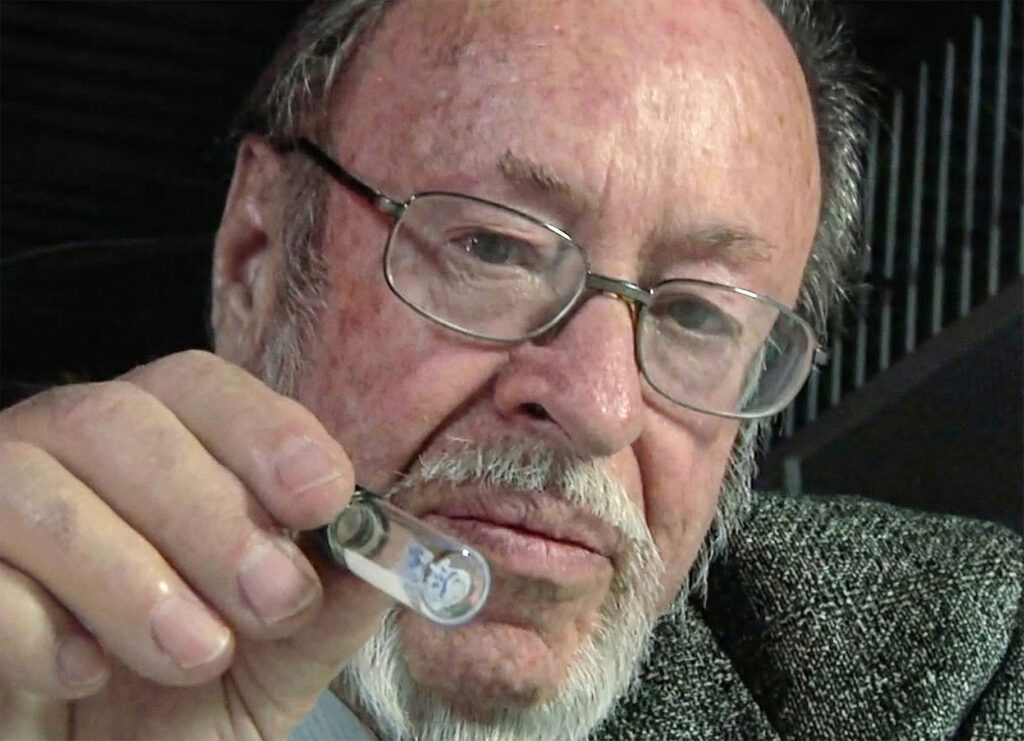
Dr. Roger Leir circa 1999 (OpenMinds)
Early life and medical career
Roger Krevin Leir was born in the San Francisco Bay Area on 20 March 1935 and moved to southern California in his early teens. He described a childhood imagination filled with flight and space travel, a theme that would later make his pivot into UAP investigation feel almost inevitable. (Scribd)
He took a very terrestrial path first. Leir earned a Bachelor of Science from the University of Southern California in 1961 and qualified as a Doctor of Podiatric Medicine in 1964. (ijsred.com) He spent more than four decades in Ventura County as a practicing podiatric surgeon, eventually serving as chief of podiatry at multiple Southern California hospitals and running a private clinic in Thousand Oaks. (Openminds.tv)
In colleagues’ accounts, this part of his life looked entirely conventional. He did reconstructive foot surgery, treated diabetic complications, and built a reputation as a careful, hands-on clinician. Nothing about his résumé predicted that he would wind up presenting at UFO conferences or arguing about isotopic ratios on late-night radio.
From MUFON volunteer to implant pioneer
Leir’s on-ramp into the UAP community came in the late 1980s, when he joined the local chapter of MUFON, the Mutual UFO Network. He wrote for the Ventura, Santa Barbara chapter’s publication The Vortex, covering sightings and abduction claims that crossed his desk. (ijsred.com)
The turning point arrived in 1995. At a MUFON event he was shown X-rays of two Texas experiencers who reported abduction narratives and had odd metallic densities in their extremities. As he later told interviewer L. A. Marzulli, his first reaction was ridicule; he assumed the images showed ordinary surgical hardware. (Scribd)
Instead of walking away, he agreed to help. Working with Houston-based investigator Derrel Sims and a volunteer surgical team, Leir performed the first two “implant” removals on 19 August 1995 at his Thousand Oaks clinic. (Medium)
According to their joint account:
One patient, a Texas woman, had two small objects in her left great toe.
A second patient had a similar object in his hand, removed by a general surgeon colleague. (Scribd)
The pathology reports were already odd enough for Leir to take notice. Lab analysis reported a lack of typical inflammatory response around the objects and the presence of nerve fibers where they would not normally be expected around a foreign body. (Scribd)
The objects themselves looked entirely unremarkable to many observers: tiny metallic fragments and rodlike pieces that might fit any emergency department’s catalog of “stuff people step on.” But for Leir the combination of patient narratives, imaging and tissue response suggested something more deliberate.
A&S Research, FIRST and the “implant surgeries”
To formalize the work, Leir helped found FIRST, the Fund for Interactive Research and Space Technology, with Sims as co-founder and lead investigator. (Medium) FIRST coordinated screening of possible abductees, imaging, and pre-surgical work-ups, while Leir headed the operating room.
He also created a separate non-profit, A & S Research Inc., specifically to coordinate scientific analysis of the removed objects. (Openminds.tv)
Across roughly two decades, different summaries give slightly different totals, but all agree this became an extended program rather than a one-off curiosity:
Open Minds and A & S Research materials state that Leir’s team conducted fifteen surgeries on alleged abductees, removing sixteen objects that they interpreted as implants. (Openminds.tv)
Other retrospective write-ups count seventeen objects from sixteen surgeries over about nineteen years. (UFO Insight)
What they claimed to find:
Metallic objects typically 6–10 mm long, often near bone and close to the skin rather than deep organs. (UFO Insight)
Some were covered in a tough, greyish biological membrane that resisted cutting with a surgical scalpel. (Scribd)
In several cases, pathology reports allegedly showed little to no inflammatory response and unexpected nerve tissue integration. (Scribd)
According to A & S Research, multiple mainstream laboratories examined the samples, including Los Alamos National Laboratory, New Mexico Tech, Seal Laboratories, Southwest Labs, the University of Toronto, York University, and the University of California San Diego. (Openminds.tv)
Reported anomalies included:
Metallic compositions similar to meteoritic iron, sometimes with unusual crystalline inclusions.
Isotopic ratios that the group described as “not of this world.”
Alleged radio-frequency emissions in the “deep space” band from certain objects pre-removal. (Scribd)
Independent corroboration of these specific claims is limited. The New Mexico Institute of Mining and Technology, for example, analyzed early samples and reported that they were composed of common elements such as iron or aluminum, noting only that some elements resembled those found in meteorites. Leir took that meteorite comparison as support for an extraterrestrial origin; the lab itself did not endorse that conclusion.
Books, case studies and a growing platform
By the late 1990s, Leir had become a fixture in abduction circles and began publishing his findings.
The Aliens and the Scalpel
His first major book, The Aliens and the Scalpel: Scientific Proof of Extraterrestrial Implants in Humans (Granite Publishing, 1998; reissued by Book Tree in 2005), lays out early surgeries, lab reports and speculation that the implants function as some kind of nano-transmitter. (Google Books)
In interviews he argued that about 15 percent of abductees might carry such devices and compared his work to wildlife biologists tagging animals for study. (Scribd)
Casebook: Alien Implants
Casebook: Alien Implants (Dell, 2000) expanded the narrative with eight detailed patient histories and X-ray imagery, published under Whitley Strieber’s “Hidden Agendas” imprint. (Bookshop.org)
The marketing copy is blunt: it calls the objects “hard evidence” that “did not come from Earth,” a framing that solidified Leir’s reputation as the surgeon who dared to say the quiet part out loud.
UFO Crash in Brazil
In 2003 Leir traveled to Varginha, Brazil, to investigate eyewitness claims that a non-human craft had crashed there in 1996 and that entities were recovered by the Brazilian military. (Openminds.tv) He published his reconstruction in UFO Crash in Brazil: A Genuine UFO Crash with Surviving ETs (Book Tree, 2005). (Google Books)
The book assembles testimony from local witnesses, police and military sources and argues that at least one non-human entity survived for a time under Brazilian custody. These claims remain hotly debated and contrast with official denials and more prosaic explanations from Brazilian authorities. (Openminds.tv)
UFOs Do Not Exist: The Greatest Lie That Enveloped the World
Published in 2014, UFOs Do Not Exist: The Greatest Lie That Enveloped the World pushes beyond case reports to a thesis: that governmental and institutional actors have systematically denied a demonstrable UAP reality. The book includes a foreword by Apollo 14 astronaut Edgar Mitchell, who had spoken publicly about his belief that some UAP cases involve non-human intelligence. (Amazon)
The title is deliberately ironic. “UFOs do not exist” are the words of official denials; Leir’s counterclaim is that the implants, crash cases and enduring witness testimony collectively undermine that line.
Media presence and public appearances
Once his implant work became known, Leir was frequently in demand as a guest and speaker.
He appeared repeatedly on Coast to Coast AM with Art Bell and later George Knapp, often alongside Whitley Strieber, to discuss abduction narratives and implant surgeries. (Coast to Coast AM)
He was a regular speaker at conferences, including the International UFO Congress in 2013, where he was photographed presenting the latest implant data. (Openminds.tv)
New Zealand media covered his 2007 appearance at a UFOCUS conference, noting that even some believers in the audience struggled with aspects of his presentation. (NZ Herald)
In 2013 he testified at the “Citizen Hearing on Disclosure” at the National Press Club in Washington, D.C., offering implant cases and the Varginha investigation as part of a broader argument for serious official inquiry into UAP. (Openminds.tv)
Even after his death, his presence continued in reruns and archive shows. Coast to Coast regularly rebroadcasts his late-1990s and early-2000s programs as “Somewhere in Time” specials, preserving his style and arguments for new audiences. (Coast to Coast AM)
The Turkey case: up close with an anomalous craft
Beyond implants, the other major pillar of Leir’s UAP legacy is the Kumburgaz, Turkey case.
Between 2007 and 2009, a night watchman named Yalçın Yalman filmed a series of anomalous objects over the Sea of Marmara near Kumburgaz, producing hours of zoomed-in footage. The videos appear to show a structured, dark object with a bright rim, sometimes with a “port” through which humanoid shapes seem visible.
Leir traveled to Turkey and was present during some of the 2009 filming sessions. He later stated publicly that he watched the object through binoculars as Yalman recorded, and that in his view the footage is “100 percent real” and shows non-human occupants. (youtube.com)
The footage was analyzed by TÜBİTAK, the Turkish state Scientific and Technology Research Board, which concluded that the images were not computer animation, models or studio effects and that the objects qualified as “unidentified flying objects” in the strict descriptive sense. (turkeyufocase.blogspot.com)
Subsequent analyses by independent researchers and skeptics have proposed cruise ships, mirages and model work as alternatives, while others, including Jacques Vallée, have argued that the footage deserves to be treated as “genuine” in the sense that the object captured remains unexplained. (Reddit)
Leir’s firm advocacy for the Turkey case as visual proof of non-human craft reinforced his role as a physical-evidence maximalist within the UAP community.
Known connections and collaborative ecosystem
Although Leir’s name is most tightly linked to implants, he operated within a dense network of researchers, experiencers and media figures:
Derrel Sims – Abduction investigator and co-founder of FIRST, Sims provided many of the early patients and served as chief investigator on multiple cases. (Medium)
Whitley Strieber – The Communion author partnered with Leir on Casebook: Alien Implants and hosted him on radio and conference stages, helping mainstream the implant narrative among abduction readers. (Bookshop.org)
Edgar Mitchell – The Apollo 14 astronaut wrote the foreword to UFOs Do Not Exist, lending his name to Leir’s broader argument about institutional denial. (Amazon)
George Knapp and Art Bell – As hosts of Coast to Coast AM, they re-framed Leir’s surgical stories for mass late-night audiences and later worked with him on coverage of the Turkey case. (Coast to Coast AM)
Jeremy Kenyon Lockyer Corbell – The filmmaker behind Patient Seventeen centered his 2017 documentary on one of Leir’s later surgeries and the mystery of a single object removed from “Patient 17.” (IMDb)
This web of relationships situates Leir inside a broader UAP research ecosystem: physical-evidence advocates, abduction chroniclers, sympathetic scientists and documentary storytellers.
Patient Seventeen and the posthumous mystery
Patient Seventeen documents what became Leir’s final implant surgery, on an anonymously identified man who believed he had been subject to repeated contact. The film follows the surgical removal of a small object from the patient’s leg and the subsequent lab analyses. (Apple TV)
Corbell’s documentary highlights some intriguing results: unusual isotopic ratios, traces of elements associated with meteorites, and complex internal structure. At the same time, outside experts consulted in the film, including a UCLA meteorite specialist, are cautious and stress that more testing is needed before any claim of non-terrestrial origin could be made. (VICE)
The plot twist worthy of a UAP case file comes after Leir’s death, when his close collaborator Steve Colbern temporarily disappears from contact with both Corbell and the patient while in possession of the object. Corbell later recovered it and has discussed plans for renewed testing.
Controversies and skeptical responses
From early on, Leir’s work drew sharp criticism.
Skeptical investigator Joe Nickell reviewed implant claims in his book Real-Life X-Files and subsequent articles. He argued that all alleged “alien implants,” not just Leir’s, are consistent with ordinary foreign bodies: shards of glass, bits of metal, carbon fibers and other debris that become embedded through accidents or barefoot walking, then encapsulated in scar tissue.
Nickell and others also faulted what they saw as poor scientific process, noting that:
Requests from independent forensic institutions for direct access to specimens or high-quality imagery were sometimes refused by investigators associated with Leir’s circle, particularly in earlier cases.
Lab reports cited as evidence of non-terrestrial isotopic ratios or exotic structure were rarely published in peer-reviewed venues or released in full for scrutiny. (Creation.com)
Even within the UAP community, not everyone was persuaded. A report from a New Zealand conference in 2007 described audience members as unconvinced by aspects of Leir’s presentation about implants. (NZ Herald)
Leir, for his part, became increasingly combative about critics. In interviews he dismissed “so-called skeptics” as non-investigators who offered proclamations instead of engagement with data, and he believed some were effectively paid debunkers. (Scribd)
This hardened stance contributed to a polarization that still surrounds his name. For some, he was an early martyr of scientific gatekeeping. For others, he was a case study in how enthusiasm can outrun methodology.
Claims taxonomy: how we classify Roger Leir’s key assertions
Claim 1: Some surgically removed metallic objects are manufactured non-human devices placed by a technologically advanced intelligence.
Type: Physical artifact claim.
Evidence cited: Surgeries on 15–16 patients; objects lacking inflammatory response; alleged neural integration; lab reports suggesting unusual isotopic ratios and meteoritic or exotic features. (Openminds.tv)
Counter-evidence / alternative views: At least one lab (New Mexico Tech) reported ordinary terrestrial composition; skeptical investigators argue all such objects are consistent with accidental foreign bodies but with minimal peer-reviewed analyses.
Status: Disputed – physical evidence claim.
Claim 2: These implants function as radio-frequency transmitters or monitoring devices.
Type: Functional hypothesis.
Evidence cited: Reports of RF emissions in deep-space bands from some objects; descriptions of nano-scale structure; analogies to wildlife tagging. (Scribd)
Counter-evidence / alternative views: RF measurements are not fully documented; other explanations (instrument noise, environmental signals) are proposed; no widely replicated demonstration of data transmission.
Status: Hypothesis – requires replication and open data.
Claim 3: The 1996 Varginha case represents a genuine crash of a non-human craft with surviving entities captured by Brazilian authorities.
Type: Historical incident reconstruction.
Evidence cited: Multi-witness testimony gathered in UFO Crash in Brazil; local press reports; later ufological investigations. (Google Books)
Counter-evidence / alternative views: Official denials; explanations involving misidentified humans and routine military activity; lack of publicly released physical evidence. (Openminds.tv)
Status: Controversial case – non-prosaic possibility not excluded, but evidence remains contested.
Claim 4: The Kumburgaz, Turkey videos show a non-human craft with visible occupants and are “100 percent real” in that sense.
Type: Instrumental (video) evidence claim.
Evidence cited: Hours of footage filmed over three years; simultaneous visual observation by multiple witnesses including Leir; TÜBİTAK determination that footage is not a studio hoax; analyses rejecting some prosaic explanations. (turkeyufocase.blogspot.com)
Counter-evidence / alternative views: Competing analyses propose distant ships or mirage effects; limited resolution and lack of corroborating sensor data; some video artifacts consistent with digital zoom limits. (Reddit)
Status: Persistent anomaly – prosaic explanations remain plausible, but UAP classification is not excluded.
Claim 5: “UFOs do not exist” is a false narrative maintained by authorities despite decisive evidence to the contrary.
Type: Institutional behavior / secrecy claim.
Evidence cited: Long-term patterns of denial; implant claims; crash narratives like Varginha; insider statements highlighted by Leir and contemporaries such as Edgar Mitchell. (Amazon)
Counter-evidence / alternative views: Governments and militaries exhibit mixed behavior ranging from denial to partial acknowledgement of UAP; “decisive evidence” is still debated within science; some secrecy is plausibly tied to defense classification rather than a single global lie.
Status: Partially supported systemic secrecy claim – documented under-reporting and stigma exist, but the strength of evidence for a unified “greatest lie” remains unproven.
Implications and impact
If even one implant is truly non-terrestrial, biomedical contact has already occurred. Speculation label (Hypothesis): A single confirmed non-human device integrated into human tissue would imply an ongoing, technology-mediated study or management of human populations by some form of non-human intelligence.
Implant narratives may be an under-explored subset of contact phenomena. The broader UAPedia taxonomy already tracks physical injuries, physiological effects and “implant detection” as recurring motifs in contact reports. Leir’s work, whether ultimately vindicated or not, helped move “objects under the skin” from the fringes into the main analytical frame.
Experimental design in UAP research must harden. Whatever one thinks of his conclusions, Leir’s projects show the stakes of methodology. Chain of custody, open publication of lab data, and pre-registered analyses are the minimum standard if future implant cases are to be decisive rather than endlessly argued. Speculation label (Researcher opinion).
Public imagination and stigma. Leir’s surgeries, conference talks and the Patient Seventeen documentary helped crystalize the “alien microchip” image in popular culture. That likely has a feedback effect on abduction narratives and may influence how experiencers interpret ordinary medical conditions.
Selected publications and media
Leir, R. K. (1998/2005). The Aliens and the Scalpel: Scientific Proof of Extraterrestrial Implants in Humans. Granite Publishing / Book Tree. (Google Books)
Documentary – Patient Seventeen (2017), dir. Jeremy Kenyon Lockyer Corbell. (Apple TV)
Turkey case hub – “National Observatory report” on the Kumburgaz case (unofficial English translation of TÜBİTAK report). (turkeyufocase.blogspot.com)
References
Bates, G. (2021). Are alleged alien implants really extraterrestrial in nature? Creation.com. (Creation.com)
Book Tree. (2005). UFO Crash in Brazil: A genuine UFO crash with surviving ETs: A thorough investigation (R. K. Leir). San Diego, CA: Book Tree. (Google Books)
Corbell, J. K. L. (Director). (2017). Patient Seventeen [Documentary film]. (Apple TV)
Leir, R. K. (2005). The Aliens and the Scalpel: Scientific proof of extraterrestrial implants in humans. San Diego, CA: Book Tree. (Google Books)
Leir, R. (2000). Casebook: Alien Implants. New York, NY: Dell. (Bookshop.org)
Leir, R. (2014). UFOs Do Not Exist: The greatest lie that enveloped the world. San Diego, CA: Book Tree. (Amazon)
McClellan, J. (2014, March 17). A leader in the field of alleged alien implant research passes. Open Minds TV. (Openminds.tv)
Nickell, J. (2001). Real-life X-Files: Investigating the paranormal. Lexington, KY: University Press of Kentucky. (Deadnet)
Turkey UFO Incident: The Kumburgaz case 2007–2009. (n.d.). Turkey UFO Case. (turkeyufocase.blogspot.com)
SEO keywords
Dr Roger Leir biography, Roger Leir alien implants, UAP abduction implants, A&S Research alien implant surgery, FIRST Fund for Interactive Research and Space Technology, Kumburgaz Turkey UFO case occupants, Varginha Brazil crash Roger Leir, Patient Seventeen documentary implant, UFOs Do Not Exist Greatest Lie That Enveloped the World, The Aliens and the Scalpel scientific proof of extraterrestrial implants, Casebook Alien Implants Whitley Strieber Hidden Agendas, UAP physical evidence researcher, alien implant radio frequency emissions, Turkey TÜBİTAK UFO report, UAPedia experiencer research investigators
On a cold Nevada night in the mid 1990s, a small group of visitors steps out of a van onto Highway 375. The desert is silent, the only light a razor-sharp moon. At the roadside, a man in a hat with earflaps waits beside a telescope aimed at the sky. He introduces himself as Chuck Clark, an amateur astronomer who has more or less given his life over to two questions:
What is flying around the perimeter of Area 51, and why is the United States government so nervous about anyone watching it? (Los Angeles Times)
For several decades Clark has been one of Rachel, Nevada’s most persistent skywatchers and perhaps the best-known civilian cartographer of the strange boundary zone around the Groom Lake test facility. His story threads through tourist buses, late-night stargazing sessions, a homemade field guide, a buried ring of motion sensors, a federal criminal case, and an elusive UAP video that some have called a “holy grail” while others dismiss it as a hoax. (Internet Archive)
This biography follows Clark’s trajectory as a desert watcher, local guide, reluctant protagonist in a government overreach case, and long-term custodian of one of the most debated pieces of UAP footage never properly released.
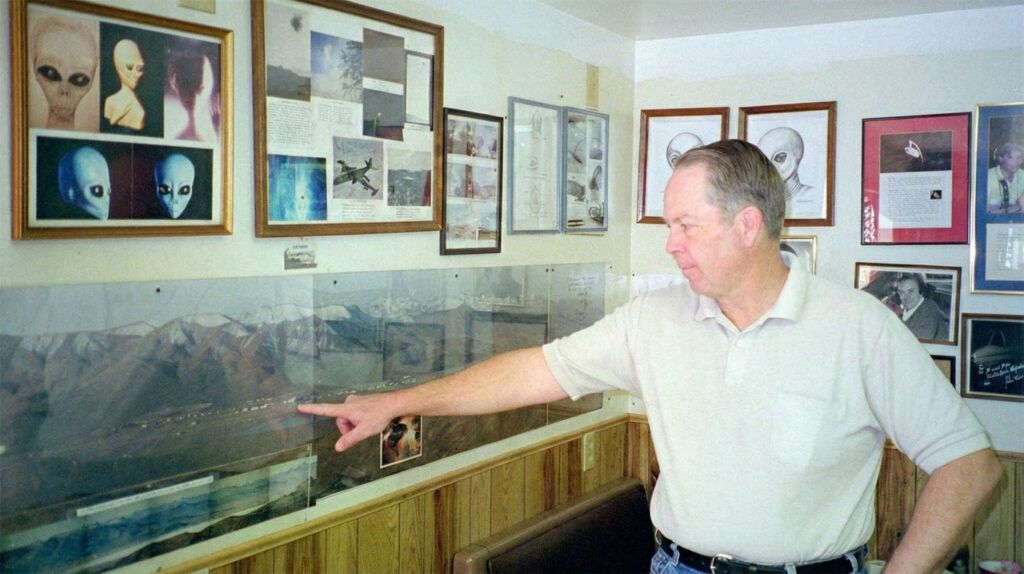
Chuck Clark explaining his sightings in 1996 (AP)
Early life and the 1957 sighting that never left him
Biographical data on Chuck Clark is sparse, which is itself very Rachel. What we can say with reasonable confidence is that he was born in the late 1940s in the United States, that he developed a passion for aviation and astronomy early, and that a single afternoon in 1957 lodged UAP permanently in his mental sky.
In an interview reproduced in the British newspaper The Independent, Clark recalls being 11 years old when he and others watched small, silent disc-like objects in broad daylight. At first they assumed they were conventional jets. The illusion broke only when two F-84 fighters attempted to intercept them and the group realised the discs were much smaller than airplanes yet completely silent. (The Independent)
Psychology Today later describes Clark mentioning another cluster of nine anomalous objects he saw in California in 1957. (Psychology Today) Those early encounters gave him what many life-long UAP investigators share: not a vague interest in mysteries, but a precise, unshakable memory of something that should not have been there and yet was.
Throughout adulthood he cultivated skills that intersect naturally with UAP watching. He became an “aviation enthusiast and amateur astronomer,” comfortable with the night sky, familiar with aircraft behaviour, and at ease operating telescopes and cameras. (Quod Lib.)
By the early 1990s, with Bob Lazar’s Area 51 claims ricocheting through American media, Clark was exactly the sort of person who would feel magnetised toward the most secret airspace in the country.
Moving to Rachel: choosing the edge of the map
Clark relocated to Rachel, Nevada around 1994. Multiple accounts describe him explicitly as an “amateur astronomer” who moved there for the dark skies, only to find himself pulled into the gravitational field of Area 51. (Psychology Today)
Rachel, population roughly 50 to 100 depending on the year, sits on the northern edge of the Nellis Test and Training Range. This is the civilian outpost closest to the Groom Lake complex that the public calls Area 51. (Quod Lib.)
Once there, Clark slid almost naturally into the role of local skywatch guide. Articles in the Los Angeles Times and Washington Post describe him waiting on the roadside with a telescope for tour groups, pointing out Venus, the direction of the base, and recounting his latest sightings. (Los Angeles Times)
He also became a fixture at the Little A’Le’Inn, Rachel’s famous alien-themed bar and motel. Glenn Campbell, founder of the Area 51 Research Center and one of Clark’s most vocal critics, wrote in his zine The Groom Lake Desert Rat that Clark “hangs out at the Inn” and is presented as the in-house Area 51 expert. (Internet Archive)
From the perspective of UAP history, Clark’s relocation to Rachel marks the shift from “interested witness” to “embedded observer.” He was no longer just watching the sky; he was part of the ecosystem that grew up around Area 51 in the 1990s, where locals, tourists, media, and black-budget aviation collided.
The Area 51 & S-4 Handbook: field notes for the curious
Clark’s most tangible contribution to UAP culture is a spiral-bound guide titled The Area 51 & S-4 Handbook. The booklet is self-published, first appearing around 1995–1996 and running to about 58 pages. (Internet Archive)
The handbook offers maps, directions to viewing spots like “Mailbox Road,” safety guidance for staying on the legal side of the border, and commentary on what visitors might see. Copies were sold at the Little A’Le’Inn and occasionally change hands online today, including a 2009 updated edition with black-and-white photos and maps. (eBay)
In tone, Clark’s handbook fits into UAPedia’s “field manual” tradition. It does not try to prove a grand unified theory of UAP. Instead it teaches people how to be present on the ground in a liminal place. Where to park. Which ridge actually gives you a line of sight. Why you should treat the border signs like a tripwire.
A feud in the desert
The handbook also lands Clark in one of his earliest public controversies. Glenn Campbell, whose own Area 51 Viewer’s Guide preceded Clark’s work, accused the Little A’Le’Inn and Clark of producing a derivative “rip-off” guide and pirated souvenir patches without permission. In a 1995 issue of The Groom Lake Desert Rat, Campbell mockingly lists Clark as one of his “Top Ten Declared Enemies” and refers to him as a “daffy astronomer” who tells visitors that aliens are time travellers from our future. (Internet Archive)
It is important to note that these are Campbell’s characterisations, written in a deliberately satirical house style. They illustrate how the tiny ecosystem around Rachel could turn fractious, but they do not serve as neutral biographies. UAPedia treats such personal disputes as context rather than fact about the underlying phenomena.
For readers today, the more enduring point is that two competing, self-published field guides emerged from Rachel at the height of Area 51’s media moment. Clark’s Area 51 & S-4 Handbook has since been cited in academic and journalistic works on Dreamland and is remembered fondly by many visitors as part of the era’s material culture. (Internet Archive)
Watching the watchers: motion sensors and the federal case
If Clark’s handbook made him part of the tourist infrastructure, his next chapter collided directly with the security infrastructure.
Mapping the hidden surveillance ring
An essay in The Michigan Quarterly Review recounts what it calls “the cautionary tale of Chuck Clark.” It describes Clark as an aviation enthusiast and amateur astronomer who moved to Rachel for its dark skies, then became interested in the buried motion sensors that ring the public land around Area 51. (Quod Lib.)
Believing that such devices, when placed far out on public land, amounted to unlawful surveillance of citizens traveling legally, he began systematically finding and mapping them. He eventually estimated there were 75 to 100 sensors, some miles from the official boundary. (Quod Lib.)
To publicise what he had found, Clark brought a Las Vegas television crew to the desert and showed them several of the devices. Within a week, according to that same account, Air Force security personnel visited his trailer, seized his laptop and photographs, and the FBI interviewed him. (Quod Lib.)
The 2003–2005 prosecution
The legal consequences surfaced later. In 2003 federal prosecutors charged Clark, then 58, with “malicious interference with a communications system used for the national defense” after holding him responsible for the disappearance of one of the wireless motion sensors. (The Register)
According to reporting in The Register, Clark entered a one-year pretrial diversion agreement in early 2004. He agreed either to return the missing sensor or pay for it, and to meet other conditions. After he complied, prosecutors formally dismissed the case in January 2005. (The Register)
Friends quoted in later pieces find it hard to believe he would have deliberately stolen a sensor, interpreting the prosecution instead as punishment for exposing the surveillance network on national television. (Quod Lib.) In public, Clark has mostly declined to revisit the episode.
From a research analyst perspective, this episode is less about proving who removed a piece of hardware and more about documenting how aggressively the state can respond when civilians start instrumenting the environment around secret test sites. In line with our approach to government sources, we treat the indictment, press statements and dismissal as one stream of evidence, weighed against well-reported accounts from journalists and observers who were close to the case. (UAPedia)
The “1995 video”: holy grail or mirage?
Clark’s most debated UAP-related legacy is not something he filmed himself, but a VHS tape that passed through his hands in the mid 1990s and has remained stubbornly elusive ever since. In contemporary discourse it is often called “the 1995 video” or simply “the Chuck Clark tape.”
How the tape reached Clark
In a 2023 interview published on Medium, Clark explains that he received the video around 1995 from a cameraman at a major Hollywood-area network news bureau who had done a piece with him on Area 51 the year before. The cameraman had, in turn, obtained a copy from two acquaintances who went out to the base as tourists and captured something extraordinary near the famous “black mailbox” viewpoint. (Medium)
Clark agreed to evaluate the footage but promised not to copy or disseminate it. He says he kept that promise, allowing selected individuals to view the tape in person while refusing to release it publicly. (Medium)
What the footage allegedly shows
The tape, according to Clark’s description, is a typical mid-90s tourist video that hits all the usual spots: the original Extraterrestrial Highway sign at Crystal Springs, the junction near Rachel, the Groom Lake Road boundary with security guards on the hill, and exterior shots of the Little A’Le’Inn. The anomalous segment appears later that night as the tourists leave the inn and stop near the black mailbox. (Medium)
Clark estimates that about 45 seconds of the three-minute clip are truly compelling. He describes a luminous object nearly overhead, close enough that its light casts moving shadows inside the car as the occupants panic, whispering that they think they are going to die. (Medium)
He showed the tape to at least two friends who were NASA-connected engineers, including an engineer who had worked on the Saturn V program. Both reportedly felt the footage was probably genuine. (Medium)
Crucially, Clark argues that the state of computer graphics in the mid 1990s makes a sophisticated hoax unlikely outside a major studio environment. He notes the awkward, inconsistent camerawork and lack of clean edits as signs of genuine amateurs. (Medium)
Enter James Fox and Logan Paul
Documentary filmmaker James Fox has spoken publicly about seeing the tape in Clark’s presence and has described it as one of the most compelling pieces of UAP footage he has encountered, sometimes even calling it a potential “holy grail” of evidence. (BroBible)
In 2023 articles and social media debates, Fox recounts that YouTuber and boxer Logan Paul also visited Clark with UAP watchdog Royce Meyers, viewed the tape, and allegedly made a covert recording of it using hidden equipment. (Medium) Paul has since acknowledged seeing the tape and flirted with releasing his recording, though as of this writing no full, high-quality version has entered the public record.
The result is a kind of modern myth: a VHS tape locked in the possession of a desert astronomer, a documentary filmmaker who swears by it, an internet celebrity who may have smuggled out a copy, and a UAP community divided between anticipation and exasperation.
Skepticism and the problem of inaccessible evidence
Not everyone is impressed. Some commentators who have seen still frames or low-quality leaked snippets online consider the footage underwhelming and have accused those invoking it of hype or opportunism. (Reddit)
From an evidential standpoint, the tape occupies an awkward place in the UAP landscape. It is:
Potentially instrumented, multi-minute footage of a luminous object displaying anomalous motion and close-range interaction effects.
Vouched for by at least one seasoned UAP documentarian and two NASA-linked engineers, if Clark’s account is accurate. (Medium)
Yet effectively non-existent to the research community because it has never been released in a form that allows independent analysis.
Claims taxonomy: the 1995 video
Claim type: Instrumental UAP evidence (video) held in private custody
Primary claimant: Chuck Clark (custodian and evaluator)
Supporting witnesses: James Fox; two unnamed NASA-linked engineers; various individuals who viewed the tape in Rachel; possibly Logan Paul via covert recording. (Medium)
Evidence status: High potential evidential value but inaccessible for independent verification. No known chain-of-custody documentation.
Assessment: “Unreleased instrumental dataset”. Not suitable as foundational proof, but highly relevant as a case study in how potentially important data can be trapped in private hands and transformed into story rather than analysis.
Sightings, philosophy, and a cautious take on abductions
Separate from the tape, Clark has his own observational record.
The Independent and Los Angeles Times both document a dramatic event he describes from early 1990s Rachel. He was watching near Highway 375 when he saw what looked at first like a descending flare over a ridge. The object then moved laterally approximately 4.8 miles in under two seconds, came to an instant stop, hovered about 20 feet above the ground, and then vanished without any audible sonic boom. (The Independent)
Clark interprets such craft as potentially “inter-dimensional” or “other dimensional,” possibly involving time travellers or beings operating from adjacent realities rather than classic extraterrestrials from a distant planet. (CBS News) This places him inside the broader UAP discourse that sees non-human intelligence as something more complex than a straightforward alien civilisation.
He also points out a geopolitical oddity that many Rachel observers echo. The airspace around Area 51 is among the most restricted on Earth. Yet these luminous craft seem to move freely through it with no visible interception. He infers that their presence is at least tolerated, perhaps coordinated, by whoever runs the range. (The Independent)
On abduction narratives, Clark is notably conservative. He has expressed skepticism toward people who claim elaborate contact experiences that include grandiose messages for humanity, saying that his “wacko flag” goes up when abductees present prophetic teachings. (The Independent) That places him closer to a physical-phenomena focus than to the “contactee” tradition.
Claims taxonomy: personal observations
Claim type: Close-range visual UAP encounters, single-witness and small-group, with unusual kinematics
Events: 1957 daylight discs in California; later multi-object sightings; 1990s high-speed, silent object near Rachel. (The Independent)
Observables: Hovering at low altitude, extreme acceleration, right-angle turns without inertia effects, absence of sonic boom.
Evidence status: Testimonial only. No known photographs or instrument data from these specific events.
Assessment: “High-interest anecdotal cases” that match kinematic patterns seen in better-instrumented incidents, but limited by lack of physical data.
Media appearances and public profile
Clark’s style is low-key and somewhat camera shy, yet he has appeared repeatedly in media narratives about Area 51 and UAP.
Print and magazine features: He is quoted or profiled in the Los Angeles Times, the Independent, the Washington Post, CBS News online, Psychology Today, and regional papers covering Nevada’s rebranding of Highway 375 as the “Extraterrestrial Highway.” (The Independent)
Documentary work: An IMDb entry lists a Chuck Clark credited in productions such as Where Are All the UFO’s? (1996) and UFOs: 50 Years of Denial? (1997). (IMDb) These align with the timeline when he was most active as a local expert.
TV news segments: Clark mentions that the cameraman who gave him the 1995 tape had previously shot a network news piece with him about Area 51, focused on the base rather than explicitly on aliens. (Medium)
Podcast and modern retellings: The Weaponized podcast with Jeremy Corbell and George Knapp has revisited his motion-sensor saga as a key example in the modern Storm Area 51 era, framing him as the man who mapped the invisible surveillance fence and paid the price. (Snipd)
Together these appearances form a consistent portrait: Clark as the quiet, technically minded local who knows every ridge and wash, provides context for visiting crews, and occasionally reveals that his personal experiences are wilder than the B-roll.
Work history and “ex-military” labels
The public record does not offer a detailed CV for Clark before Rachel. Most mainstream coverage simply calls him an aviation enthusiast and amateur astronomer. (Quod Lib.)
Some secondary sources describe him as former military personnel or even a former Air Force captain, and a Nevada tourism write-up for an Area 51 tour mentions an “ex-Air Force Captain Chuck Clark” as guide. (Travel Nevada) However, these claims have not yet been corroborated through independent documentation.
We therefore treats “ex-military” as a plausible but not fully verified element in his background. If accurate, it would add another layer of irony: a former insider turned civilian gadfly at the edges of a different secret program.
Controversies and points of contention
The guidebook rivalry
As noted earlier, Clark’s Area 51 & S-4 Handbook provoked strong resentment from Glenn Campbell, who saw it as derivative of his Area 51 Viewer’s Guide and accused Clark of helping the Little A’Le’Inn profit from pirated patches and replicated concepts. (Internet Archive)
Impact: The spat illustrates the competitive, sometimes ego-driven nature of early civilian Area 51 research culture. It also underlines that Clark was influential enough in Rachel that rival researchers considered him a threat to their own brands.
Our label: “Community-level controversy”, with minimal bearing on the objective reality of UAP but useful for understanding the social context of data collection.
The motion sensor case
Clark’s discovery and mapping of buried motion sensors led directly to a federal prosecution that could have ended with a felony conviction. (The Register)
Government narrative: A sensitive communications device used to protect a national defence installation was stolen, and Clark was responsible, warranting serious charges. (The Register)
Civilian narrative: Clark exposed a sprawling, arguably unlawful surveillance network on public land. The subsequent raid, seizure of equipment and prosecution look like an attempt to intimidate a high-profile critic rather than a measured reaction to an actual theft. (Quod Lib.)
Per our editorial approach, both narratives are recorded. The dismissal of the case after pretrial diversion is an uncontested fact. Whether the original allegation was proportionate or retaliatory remains in the interpretive zone. (The Register)
The ethics of withholding the 1995 tape
Clark’s decision not to release the 1995 video, despite its potential evidential value, has drawn criticism from within the UAP community. Some argue that his promise to the now-deceased intermediary should yield to the public interest. Others suggest that decades of teasing an unseen tape invites skepticism by default. (Medium)
Clark’s own position is clear: he sees his word of honour as binding and uses the unreleased details of the footage as a kind of shibboleth to filter out hoaxes. (Medium)
Our label: “Custodial ethics controversy” rather than evidence fraud. There is no direct indication that Clark has fabricated the tape’s existence; plenty of corroborating witnesses say they have viewed something. The problem is that his custodial choice converts potential data into folklore.
Broader implications
Even without definitive proof attached to his name, Clark’s life in Rachel radiates out into several important themes in UAP studies:
Civilian instrumented observation: His work demonstrates how much can be learned about a classified test range using consumer-grade optics, scanners and methodical fieldwork, long before drones and cheap high-resolution satellites. (Los Angeles Times)
State-civilian friction: The motion-sensor case shows that when citizen sensing brushes against sensitive programs, the state can respond through criminal law rather than public dialogue. That tension is central to any honest conversation about UAP transparency and national security. (The Register)
Custody of evidence: Clark’s stewardship of the 1995 tape illustrates how UAP evidence can be bottlenecked by trust, promises and personal ethics. In the age of smartphones and instant uploads, his story is a reminder of how much pre-internet data may still sit in boxes, attics and private vaults. (Medium)
In the larger UAP narrative, Chuck Clark is not a mass-sighting witness or a whistleblower for a crash retrieval program. He is something quieter and arguably just as important: a desert astronomer who refused to stop paying close attention, who mapped the invisible systems watching the watchers, and who still holds a piece of the puzzle that the rest of the community has yet to see in full.
Later printings and sales records indicate at least one updated spiral-bound edition in 2009 with photos and maps. (eBay)
Claims taxonomy
Below is a structured view of Clark’s main UAP-relevant claims and actions.
Domain
Specific claim or action
Evidence type
Current evidential weight
UAPedia classification
Childhood sighting (1957)
Observed multiple small, silent discs intercepted by F-84 jets in California
First-person testimony reported decades later (The Independent)
Moderate (lifetime consistency but no contemporaneous record)
Anecdotal visual case with aviation corroboration (jets scrambled)
Rachel flare-turned-flyer
Object descended like a flare, then moved ~4.8 miles in under 2 seconds without sound, stopped instantly, later vanished
First-person testimony; echoed in multiple journalistic sources (The Independent)
Moderate
High-strangeness kinematics consistent with “six observables” profile
Inter-dimensional hypothesis
UAP near Area 51 may be inter-dimensional or time-shifted rather than purely extraterrestrial
Philosophical inference from observed performance and placement in restricted airspace (CBS News)
Low to speculative
NHI framework hypothesis, compatible with broader inter-dimensional models
Cooperation with military
Craft operating freely in restricted Groom Lake airspace imply at least tacit permission from U.S. authorities
Geopolitical inference based on restricted airspace norms (The Independent)
Low to moderate
“Cooperative UAP-military coexistence” hypothesis
Motion-sensor mapping
Extensive hidden sensor network (75–100 units) deployed on public land around Area 51
Direct physical detection, mapping and on-camera demonstrations; indirectly corroborated by government prosecution that presupposes existence of such sensors (Quod Lib.)
High
Established example of large-scale surveillance of public access routes to UAP-linked facility
1995 UAP tape
VHS recording of close-range UAP near Area 51; 45 seconds particularly compelling; likely authentic, not CGI for era
Private video seen by Clark, James Fox, NASA-linked engineers, Logan Paul and others; detailed verbal description; partial stills online (Medium)
Medium potential, low practical value until released
“Unreleased instrumental dataset” with unresolved authenticity; key lore node in modern UAP culture
Speculation labels
Because UAPedia does not shy away from informed speculation, we can ask: if Clark’s experiences and actions are taken at face value, what are the possible long-term implications?
Speculation label: “Unreleased keystone dataset” If the 1995 tape is as good as some witnesses claim and is eventually released, it could become a keystone visual case from the pre-digital era, showing close-range UAP performance over a highly restricted military test range. Until then, it is a Schrödinger object: simultaneously legendary and unusable.
Speculation label: “Boundary walker between black-budget tech and non-human craft” Clark spent years differentiating flares, stealth aircraft and experimental jets from genuinely anomalous objects above one of the world’s prime black-budget testing grounds. His testimony contributes to the argument that not all high-performance UAP near Area 51 can be written off as classified human technology, especially when they show silent, instantaneous accelerations that exceed performance envelopes of known aircraft of the era. (The Independent)
Speculation label: “Case study in state reaction to civilian sensing” His motion sensor saga offers a vivid example of what can happen when a technically minded citizen begins to instrument and map a sensitive region on public land. From a future UAP transparency perspective, Clark’s experience might be seen as early evidence of the frictions that arise when grassroots sensing meets national security infrastructure. (Quod Lib.)
References
Graham, P. (1995, June 4). On the road to nowhere: “Extraterrestrial Alien Highway”. Los Angeles Times. (Los Angeles Times)
“For UFO buffs, the truth is out there on Highway 375.” (1995, December 25). Los Angeles Times. (Los Angeles Times)
“Nevada’s UFO heaven: Prying eyes look in on secret air base.” (1995, May 29). The Washington Post. (The Washington Post)
A town like Rachel. (1996, June 2). The Independent. (The Independent)
A night at the Little A’Le’Inn. (2000, May 3). CBS News. (CBS News)
Poulsen, K. (2005, January 28). Area 51 “hacker” charges dropped. The Register. (The Register)
“The passion of sheepdogs.” Michigan Quarterly Review. (Quod Lib.)
SignalsIntelligence. (2023, May 9). A conversation with Chuck Clark regarding the ‘1995’ video. Medium. (Medium)
Charles, D. (2023, May 3). Filmmaker says he has seen the “most compelling” UFO video ever, and Logan Paul has copy of it. BroBible. (BroBible)
Clark, C. (1996). The Area 51 & S-4 Handbook (1st ed., approx. 58 pp.). Rachel, NV: Chuck Clark. (Google Books)
SEO keywords
Chuck Clark, Chuck Clark Area 51, Chuck Clark biography, Area 51 & S-4 Handbook, Rachel Nevada UFO, Rachel Nevada UAP, Little A’Le’Inn, Extraterrestrial Highway UAP, 1995 Chuck Clark UFO video, holy grail UFO footage, James Fox Chuck Clark tape, Logan Paul UFO video, Area 51 motion sensors, Area 51 surveillance network, amateur astronomer Rachel Nevada, UAP near military bases, UAP video VHS, UAPedia Chuck Clark profile
On a quiet August night in 1956, Eastern England’s air defenses did something they almost never do in peacetime: they behaved like it was wartime.
Radar rooms at U.S. and British installations began calling each other with a question that still reads like science fiction, even in a decade saturated with UAP headlines: are you seeing targets moving at extraordinary speed, stopping dead, and then moving again?
The event that followed is now commonly labeled the “Lakenheath-Bentwaters” case, but the investigative heart of the story lives in the Lakenheath radar room and the scramble that followed. It is one of the rare Cold War UAP incidents that combines a paper trail, multiple military witnesses, and the kind of sensor-witness interplay that makes analysts sweat: radar guidance, pilot reactions, and visual reports that do not line up neatly with conventional expectations.
Below is a data-first reconstruction: what is documented, what is claimed, what is disputed, and why Lakenheath remains a benchmark case for modern “multi-sensor” standards.
Rendering of the Incident at RAF Bentwaters, UK, in the summer of 1956. (UAPedia)
Incident brief
The Lakenheath-Bentwaters incident of August 13–14, 1956, is one of the most well-documented military UFO encounters, involving both radar tracking and visual sightings from ground personnel and pilots. (CIA)
Aircraft Involved
Several military aircraft were involved in the attempt to identify the objects:
de Havilland Venom: Two RAF Venom night fighters were scrambled from RAF Waterbeach to intercept the objects. One pilot famously reported that the UFO performed a maneuver to get directly behind his aircraft, “tailing” him despite his attempts at evasive action.
T-33 Shooting Star: Two USAF lieutenants, Charles Metz and Andrew Rowe, took off in a T-33 jet trainer to inspect the initial targets, though they were unable to make contact.
C-47 Skytrain: A C-47 flying at 4,000 feet over Bentwaters reportedly sighted a fast-moving white light at the same time radar detected a target.
Key Events
Initial Radar Contact: At approximately 9:30 PM, radar at RAF Bentwaters tracked an object traveling at speeds exceeding 1,000 mph – far faster than any aircraft of that era.
The “Mother Ship” Maneuver: A group of 12 to 15 objects was tracked moving toward the northeast; they eventually appeared to converge into a single large radar echo described as several times larger than a B-36 Peacemaker bomber.
Extreme Performance: Targets were tracked at speeds ranging from 2,000 to 12,000 mph, performing sudden stops and rapid accelerations.
Date and location: Night of 13–14 August 1956, over/near RAF Lakenheath and RAF Bentwaters in East Anglia, England.
Witness profile: Military radar operators, ground observers, and aircrew involved in an attempted intercept, with later retrospective accounts adding complexity.
Core documented features:
radar targets described as showing very high speed, abrupt stopping, and course changes
visual reports of luminous objects (including reports of two objects “joining”)
a fighter intercept guided toward a radar target, with a “chase” narrative in at least one major account
Why it matters: The U.S. Air Force–commissioned Condon Committee (whose overall report leaned strongly toward conventional explanations in most cases) treated this case as unusually difficult and, in its case narrative, indicated that ordinary explanations could not be confidently preferred.
The setting
In 1956, East Anglia was a tightly watched slice of NATO geography: coastal approaches, strategic air bases, and overlapping radar coverage. That matters because this isn’t a single witness on a country road. It’s a defense ecosystem: operators trained to distinguish aircraft tracks from weather, clutter, and noise, making real decisions under real constraints.
Two locations anchor the story:
RAF Lakenheath (Suffolk), the site of the radar room whose watch supervisor later wrote a detailed letter that helped trigger renewed scientific attention.
RAF Bentwaters (Suffolk), a U.S.-tenanted base roughly 67 km (about 42 miles) from Lakenheath, frequently cited in the early-phase radar narrative.
Schematic distances (approximate, based on published coordinates):
Lakenheath ↔ Bentwaters: ~67 km
Lakenheath ↔ Waterbeach: ~29 km
Bentwaters ↔ Neatishead: ~65 km
What counts as “documentation” in this case
A major strength of the Lakenheath incident is that it is not built from a single narrative source. The modern researcher typically works from four “document pillars”:
Condon Report Case 2 (USAF/RAF Radar Sighting, 1956)
includes a detailed narrative and reproduces key materials (including a pivotal witness letter)
Project Blue Book-era reporting
referenced across summaries and later technical discussions as a primary case file backbone
Later UK archival discussion and witness resurfacing
including references to additional radar-controller testimony (notably Freddie Wimbledon) in National Archives-related material
Critical and skeptical technical commentary
especially discussions that argue the case can be “cracked” via radar effects plus misidentified astronomical/meteor phenomena
A UAPedia rule of thumb: treat government paperwork as valuable, not sacred. Here, the best practice is to triangulate official documents with independent technical critique and later witness retrieval efforts.
A very detailed timeline for a UAP incident
Most operational reporting for this case uses Z time (Zulu), effectively UTC/GMT. UK civilian local time in East Anglia on these dates was British Summer Time (BST), UTC+1. In practical terms: BST = Z + 1 hour for 13–14 August 1956. Where a source labels a time “local” or mixes conventions, this timeline keeps the original intent but flags the ambiguity.
Sensors and assets referenced in the primary record
From the redundancy table compiled in later technical review, the incident’s core sensor stack includes:
RAF Bentwaters GCA radar (AN/MPN-11A)
RAF Lakenheath RATCC radar (CPS-5)
RAF Lakenheath GCA radar (CPN-4)
Airborne interceptor (RAF de Havilland Venom night fighter, with airborne radar referenced as “A-1” in later summaries)
The Blue Book case file also explicitly frames the sources as ground radar observers, ground observers, and pilots, and logs the overall observation windows used by investigators.
Timeline
Monday, 13 August 1956 (evening phase: Bentwaters radar contacts)
~2120–2220Z (reported “local” window in Blue Book summary):
Project Blue Book’s record-card summary groups Bentwaters activity into a roughly one-hour evening window, stating Bentwaters radar reported multiple separate targets that appeared and disappeared.
2130Z (2230 BST): Bentwaters URE contact No. 1
Radar: Bentwaters GCA (AN/MPN-11A) logs a first unusual radar echo (“URE”).
Visual: Not confirmed in the technical redundancy table.
Radar: Bentwaters GCA continues with a second episode lasting about 20 minutes.
Remarks in later analysis: flagged as the most plausible candidate for anomalous propagation among the Bentwaters episodes, but not treated as definitively explained.
2200Z (2300 BST): Bentwaters URE contact No. 3
Radar: Bentwaters GCA logs a third URE event.
Remarks: later summaries note it may be related to, or confused with, the next event (No. 4).
Bentwaters control tower reports a bright light traversing the field rapidly.
A C-47 aircraft in the area reports a bright light “streaking” beneath it at roughly the same time.
Interpretive note in the technical table: URE No. 4 is treated as not anomalous propagation, and later reviewers suggest it could have been the same object as the later Lakenheath track (No. 5), though that remains a linkage hypothesis rather than a proven identity.
The University of Colorado “Condon Report” text indicates intercept attempts by an American T-33 in this evening window were unsuccessful.
A separate Blue Book analytical section also mentions two pilots vectored to the area for a ~45-minute search with no result, and notes a bright astronomical object could have influenced visual impressions in at least one sub-episode.
Context during the evening phase: heightened meteor activity reported
The Blue Book file explicitly notes that ground observers reported many “shooting stars” during the period.
Later analysts treated meteor activity as a relevant confound for some visual reports, but it does not directly account for the radar track continuity at Lakenheath later in the night.
Tuesday, 14 August 1956 (after midnight phase: Lakenheath multi-radar track and fighter intercept)
Later technical reviews and Blue Book summarization converge on this as the core tracking period for the Lakenheath phase, with multiple radar channels involved and an airborne intercept occurring during the track.
Shortly after alerting call: Lakenheath initiates full-scope search using MTI filtering
In a detailed “sighting letter” preserved in the Blue Book file, the Lakenheath watch supervisor describes receiving an alert call from a regional radar unit reporting an extremely fast target and a coincident visual light report, prompting an immediate sweep with full MTI (moving target indicator).
The same account emphasizes that MTI should suppress stationary returns, which becomes important because the first Lakenheath contact appears stationary.
Initial Lakenheath contact: stationary radar target ~20–25 miles southwest of Lakenheath
The watch supervisor reports a stationary echo at about 20–25 miles SW, seen on multiple scopes and confirmed by the Lakenheath GCA unit on a separate radar chain.
This “stationary then move” structure is also referenced in technical summaries as central to why simple anomalous propagation arguments struggle, since discrete start-stop maneuvers and consistent multi-radar concurrence are atypical for classic AP artifacts.
Abrupt acceleration without “build-up”: ~400–600 mph toward the NNE, then stop
The Blue Book-preserved Lakenheath account states the target transitions from stationary to ~400–600 mph immediately, without gradual acceleration, traveling toward a point roughly north-northwest of Lakenheath before stopping again.
Repeated maneuver pattern: straight-line runs at ~600 mph, then stationary pauses Across the next phase, the watch supervisor describes:
Multiple position changes, always in straight lines
Typical run speed around ~600 mph
Run lengths varying roughly 8–20 miles
Stationary pauses typically 3–6 minutes (reported as variable)
No consistent “pattern” that would suggest standard aircraft holding procedures
Command escalation: conference line established with higher headquarters
The same account describes notification up the chain (including 7th Air Division and 3rd Air Force command structures) and the creation of a monitored conference line to coordinate the situation.
Decision to scramble interceptors: approximately 30–45 minutes into the Lakenheath tracking sequence
The watch supervisor estimates that after roughly 30–45 minutes, it was decided to scramble RAF interceptors.
Later technical review notes a discrepancy in which base launched the interceptor (one account places it at Waterbeach, another suggests a station “near London”), but both agree on the intercept attempt itself.
Vectoring the first interceptor onto a stationary target
During vectoring, the target is described as stationary, allowing controllers to issue frequent range/bearing corrections.
The watch supervisor reports they could not confidently fix altitude but inferred a band roughly above ~1,500 ft and below ~20,000 ft, tied to radar operational characteristics and coverage assumptions.
Close approach and “gun lock”: interceptor reports a lock at ~0.5 mile
The interceptor is guided to within about half a mile, at which point the pilot reports he has his gunsight or fire-control radar locked.
Seconds later, he reports the target “went” somewhere, asking ground control if it is still present.
Key maneuver: unknown shifts behind the interceptor; ground radar resolves two distinct targets in close trail
Ground controllers report that the unknown performs a fast maneuver into a tailing position.
Critically, they maintain that they could see two distinct targets, with separation at least on the order of radar resolution in that sector and range.
~10-minute tail-chase: interceptor cannot shake the trailing target
The watch supervisor describes an approximate 10-minute period where the pilot climbs, dives, and circles unsuccessfully while the unknown remains close behind.
He characterizes the pilot’s radio tone as increasingly stressed.
Fuel constraint: interceptor returns; unknown follows briefly, then stops and resumes a stationary posture
The first interceptor breaks off due to fuel state.
Controllers report the unknown follows for a short distance, then stops and becomes stationary again at a position roughly south of Lakenheath.
Second interceptor attempt: aborted due to aircraft malfunction
The second interceptor is brought toward the last known position, but the watch supervisor reports the pilot experiences engine trouble and returns to base.
Post-intercept tracking: additional short moves; departure to the north; loss of contact at ~50–60 miles
After intercept attempts, the target reportedly makes a few additional short moves and then departs northbound at about ~600 mph.
The watch supervisor reports loss at about 50–60 miles, consistent with radar geometry if the target is below about 5,000 ft.
0330Z (0430 BST): end of radar episode
The Blue Book case materials and later technical summaries cite around 0330Z as the time targets disappear from scopes.
The Condon Report analysis notes an apparent coincidence between changing cloud conditions and the timing of radar loss, while still emphasizing that reported track behavior is not typical of classic AP false targets.
Thursday, 16 August 1956 (documentation phase)
Teleprinter message “BOL-485” summarizing the case
The Blue Book record card references a TT message BOL-485 (16 Aug 1956) as an early formal summary artifact.
Tuesday, 21 August 1956 (documentation phase)
TD-1313 and detailed report AIR-1-56 (dated 21 Aug 1956)
The Blue Book record card references TD-1313 and a detailed report AIR-1-56 dated 21 Aug 1956, noting that early messaging could give a misleading impression that all observations were concurrent, whereas the detailed report implies otherwise.
A companion analysis memo in the file frames the then-current working explanation as anomalous propagation with meteor activity as a contributing factor, while also emphasizing the need for further review based on original data.
Confidence notes on timing and sequencing
The Bentwaters micro-sequence (2130Z, 2135–2155Z, 2200Z, 2255Z) is strongly anchored by the later AIAA technical table.
The Lakenheath window (0010–0330Z) is independently anchored by both the AIAA table and the Blue Book record card.
Exact minute-by-minute timestamps inside the Lakenheath window are not consistently provided in the surviving narrative letters, so this timeline preserves the best-supported “hard” time brackets and uses relative ordering within those brackets for the intercept and tail-chase sequence.
Witness testimony that shaped the case
The watch supervisor letter
A core piece of testimony comes from Technical Sergeant Forrest Perkins, identified as watch supervisor in the Lakenheath Radar Air Traffic Control (RATCC) center. His letter (reproduced in the Condon case narrative) describes a fighter being vectored toward a radar target and the pilot’s rising anxiety as the target maneuvered relative to the aircraft.
One detail that matters, journalistically and psychologically: the account is not written like mythology. It reads like a duty log that got personal because something in the scope-room logic stopped matching the sky’s behavior.
In the commonly cited recounting, the pilot is described as “worried… excited… pretty scared,” which is operationally significant: military pilots do not normally emote to ground controllers unless they believe they are dealing with an aircraft safety situation or an adversary-like unknown.
Ground visual observations
Also reproduced in the Condon narrative is an “Unidentified Flying Object” report-style summary describing luminous objects observed from the ground, including a striking claim that two objects appeared to join and then move off.
That “join” detail is one of the case’s signature features because it is difficult to map cleanly onto meteors. Meteors do not merge. Observers can misperceive depth and motion, but a “merge then move away” report invites a different class of questions than a single streaking fireball.
The radar-controller layer
Later public discussion points to radar-controller testimony beyond the initial U.S. Air Force reporting chain. In National Archives-associated material, a retired RAF fighter controller, Freddie Wimbledon, is referenced as describing an anomalous target “clearly seen on RAF radar,” adding a UK radar perspective to the better-known U.S.-tenanted base narrative.
This matters because one common “escape hatch” in radar cases is blaming a single radar set, a single operator, or a single bad night of propagation. When multiple radars and multiple teams are discussed, the explanation burden rises.
Data points that make analysts care
This case is not famous because it is dramatic. It’s famous because it is hard to reduce.
Here are the “data-shaped” claims most often cited as central:
Extraordinary apparent speed, at least as estimated from radar behavior and reporting language
Abrupt stopping or hovering in radar narrative
Sharp course changes inconsistent with typical aircraft turn radii at speed
Luminous visual objects with behavior described as more structured than a single transient meteor
Intercept dynamics in which a target appears to maneuver relative to a pursuing aircraft
A crucial nuance: “apparent” is not a hedge word to weaken the case. It is the correct technical word. Radar is an instrument, not a god. It can lie through physics, geometry, and edge-case propagation. But when radar “lies,” it typically does so in recognizable ways, and those ways become the real investigative battleground.
Map and geography
A UAP event is always also a terrain event.
For context, here are map links to the key sites. These are helpful because so much of the interpretive fight involves line-of-sight assumptions, distances, and what “from the sea” means in practical geometry.
These coordinates are widely published for the bases/sites (and are adequate for a schematic).
Testimony for the Lakenheath-Bentwaters Incident surfaced in 2025. (YouTube)
Competing explanations
A serious investigative article does not pretend only one interpretation exists. Lakenheath endures because multiple interpretations each solve part of the puzzle and fail on another part.
Below are the main explanatory families, clearly labeled.
Hypothesis: meteor activity plus perceptual confusion
The night coincided with the mid-August period popularly associated with Perseid meteor activity, and multiple summaries mention an “unusually large number of shooting stars.” That creates a real possibility of bright meteors producing compelling visual stimuli, especially for observers already primed by radar alerts.
Problem: Meteors explain streaking lights well, but they strain to explain repeated structured behaviors reported as “joining,” extended pacing, or a multi-minute intercept narrative.
Hypothesis: anomalous propagation and radar “angels”
A classic radar answer is anomalous propagation: atmospheric layers bending radar energy so that distant ground returns, sea clutter, or thermal inversions appear as moving targets. This is technically real, and many Cold War radar anomalies were exactly this kind of physics.
Problem: In the core Lakenheath phase, the narrative emphasis is that the target behavior looked discrete and track-like, and the case became notable partly because analysts felt ordinary propagation did not neatly fit all observations.
Hypothesis: mixed causes in a high-stress operational environment
Many modern historians of UAP lean toward a “multiple-cause” model: radar returns from one source, visual stimuli from another, then narrative fusion under stress. It’s a psychologically plausible model for some cases.
Problem: Lakenheath’s enduring weight comes from the sense that the radar-visual interplay and the intercept-guidance structure are unusually coherent for a “just confusion” explanation. The Condon case narrative is often cited precisely because it treats the case as unusually puzzling.
Hypothesis: conventional aircraft, classified tests, or mis-tracked friendlies
Because this is Cold War airspace, researchers have periodically raised the idea of mis-tracked conventional aircraft or secret testing.
Problem: This tends to run into documentation constraints. Without released flight plans, full radar logs, or corroborating records, the “secret aircraft” hypothesis often becomes unfalsifiable. A data-first approach flags it as possible, but not evidentially anchored for this specific case.
Hypothesis: non-human technology operating with “apparent intent”
This is the hypothesis that keeps Lakenheath alive in serious UAP circles: that at least one track and at least one luminous object behaved in a way that implied control, not drift; interaction, not coincidence.
This is the interpretive spirit captured in the well-known Condon-case conclusion language that ordinary explanations could not be favored with confidence, and that the probability of at least one genuine UAP was regarded as significant within that case narrative.
If there is a “data-first” point here, it is simple: a case doesn’t need a landed craft to be strategically important. If a target can enter defended airspace, generate multi-channel concern, and depart without resolution, that alone is an operational and scientific problem.
The skeptical challenge
Some skeptical authors have argued the case is explainable and have criticized pro-UAP presentations for not engaging deeply enough with proposed conventional solutions, notably those associated with Philip J. Klass.
A fair investigative stance is this:
Skeptical radar explanations deserve attention because radar absolutely can produce false structured targets under specific conditions.
The burden is not to “prove it was extraordinary.” The burden is “to show that a mundane explanation fits the full pattern better than the UAP hypothesis.”
Lakenheath remains contested because neither side has produced a publicly accessible dataset rich enough to crush the other. The missing ingredient is not belief. It’s raw data: full radar recordings, complete intercept logs, and unredacted operational messaging.
Later research and the “time-shift” problem
One of the most important complicating factors in modern discussion is that later witness retrieval and interviews have reportedly suggested that certain intercept details may not match the most famous “chase” version, including differences in timing and the claimed absence of a tail-chase episode in pilot recollections.
This is not a death blow to the case. It is a normal feature of historical UAP research: narratives evolve, memory shifts, and the most widely repeated account is not always the most accurate in every detail.
Data-first implication: treat the case as a bundle of sub-claims, not a single monolith.
Implications
1) Air defense realism
Lakenheath is a reminder that “unknown tracks” are not a modern invention. Cold War defenses were already encountering targets and signals they could not cleanly categorize.
2) The modern multi-sensor standard
Today, the gold standard is “multi-sensor, correlated, time-synchronized.” Lakenheath is an early ancestor of that standard, even if the surviving public record is incomplete. It demonstrates why UAP investigation cannot be reduced to single-witness storytelling.
3) The scientific problem
If anomalous propagation explains the case, that is still scientifically interesting because it implies a failure mode in radar interpretation under operational conditions. If anomalous propagation does not explain the case, the implication space expands dramatically.
4) The NHI question
Lakenheath does not prove non-human intelligence. What it does is create an evidentiary corridor where the NHI hypothesis is not ridiculous on its face, because the reported behavior is repeatedly described as structured and reactive.
Claims taxonomy
UAPedia’s adjudication works best when we break the incident into claim units.
Claim 1: Multiple military personnel reported anomalous radar targets near Lakenheath and/or Bentwaters that night
Assessment: Verified Rationale: Converging documentation and repeated citation in formal case narrative.
Claim 2: Ground observers at/near Lakenheath reported luminous UAP, including two objects that appeared to join
Assessment: Probable Rationale: Present in formal-style reporting reproduced in the Condon case narrative; still subject to perceptual uncertainty at night.
Claim 3: A Venom interceptor experienced a sustained “tail-chase” dynamic with a UAP for roughly 10 minutes
Assessment: Disputed Rationale: Strongly represented in the famous account chain, but later witness retrieval has been reported to complicate timing and details.
Claim 4: The simplest conventional explanation fully accounts for radar behavior, visuals, and intercept narrative
Assessment: Disputed Rationale: Serious conventional proposals exist, but the case remains widely treated as unresolved in the same literature that documents those proposals.
Claim 5: At least one genuine UAP of unknown origin was present
Assessment: Probable Rationale: This is consistent with the unusual posture taken in the published case narrative relative to many other cases, while acknowledging incomplete public data.
Speculation labels
This section separates evidence-linked statements from interpretive claims.
Witness Interpretation
“Locked on” and “tailed”: the interceptor pilot’s experience, as relayed through controller monitoring and post-event letters, is consistent with an intelligently reactive unknown, but the exact mechanism (sensor lock conditions, geometry, and what the pilot saw visually) cannot be fully reconstructed from surviving summaries alone.
Researcher Opinion
Some analysts argue the case is best understood as a rare but solvable mix of radar effects and meteor/astronomical misidentification.
Later reviewers in the Condon-era technical analysis characterize the case as among the most puzzling radar-visual files, stressing that the movements reported are not typical of false targets, even while acknowledging a few AP-suggestive details.
Hypothesis
At least one genuine UAP craft, possibly NHI-associated, operated in a manner suggesting control and interaction with interceptors.
The case represents a multi-event night in which some tracks were mundane and one was not.
A classified conventional platform or electronic warfare artifact contributed to the radar picture.
These hypotheses are plausible to discuss, but none can be finalized from the public record alone.
Relevant and active links
Primary and major-reference reading list (links include UAPedia tracking parameter):
Condon, E. U. (Project Director), & Gillmor, D. S. (Ed.). (1969). Scientific study of unidentified flying objects (Condon Report). Bantam Books. files.ncas.org/condon/?utm_source=uapedia.ai