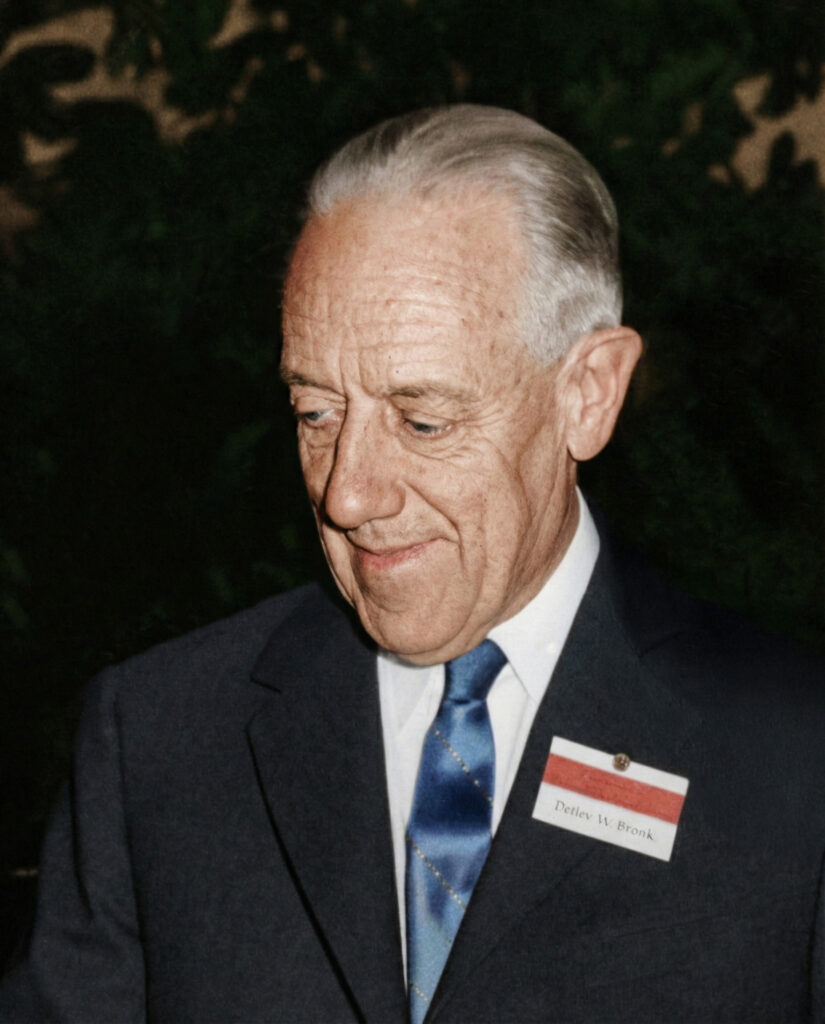
Detlev Wulf Bronk (1897–1975) occupies a singular place in twentieth-century science.
He is widely credited with helping establish biophysics as a distinct discipline, then parlayed that scientific authority into institutional leadership at the highest level of American research and education.
He served as president of Johns Hopkins University, president of the National Academy of Sciences, and president of The Rockefeller University.
The same résumé that made him a steward of American science also made him an irresistible name for later claims about a hidden United States program to retrieve and study non-human technology.
In the lore of Majestic 12, the so-called Eisenhower Briefing Document placed “Dr. Detlev Bronk” on a list of twelve officials charged with managing crash recoveries and the biological study of recovered entities.
The document’s authenticity has been rejected by federal agencies and archivists, yet the story persists, partly because Bronk’s real career was exactly the sort of career that a clandestine UAP committee would have needed if it existed. That tension between public record and enduring claims is the core of Bronk’s UAP biography. (National Academies)
Dr. Detlev Wulf Bronk in in 1963 (Smithsonian Institution | UAPedia)
Early life, education, and the making of a scientific organizer
Detlev Wulf Bronk was born in New York City on August 13, 1897, to a family whose surname echoes in the history of the Bronx.
He studied at Swarthmore College and then at the University of Michigan, where he earned a Ph.D. in 1926 under physiologist Robert Gesell. From the start he set out to fuse physics, mathematics, and physiology, which positioned him to become one of the architects of modern biophysics.
He taught at Swarthmore, the University of Pennsylvania, and Cornell before his high-profile move into academic leadership. The National Academy of Sciences’ biographical memoir and institutional histories give a textured account of this period, showing his rapid ascent as both investigator and organizer. (National Academies)
By the late 1920s and 1930s Bronk was already a network-builder. At the University of Pennsylvania he directed the Johnson Research Foundation and advanced new instrumentation for physiology.
His research and administrative work merged during World War II, when the scientific establishment was mobilized to meet urgent military and aeromedical problems. According to Academy histories, Bronk became Coordinator of Research in the Office of the Army Air Surgeon, chief of the Division of Aviation Medicine in the Office of Scientific Research and Development’s Committee on Medical Research, special consultant to the Secretary of War, and chairman of the National Research Council’s Committee on Aviation Medicine and its Subcommittee on Oxygen and Visual Problems.
These assignments tied him to aviators, flight surgeons, and the technical staff that would later become central to air defense and sensor-driven identification problems. (NCBI)
This wartime experience made Bronk a natural choice for national advisory roles.
In 1946 he was appointed chairman of the National Research Council, and by 1950 he was elected president of the National Academy of Sciences, a position he held for twelve years. He also served on the National Science Board and was appointed to the National Aeronautics and Space Council as the United States entered the space age.
In short, he stood at the confluence of biology, physics, aviation medicine, national security, and science policy. (nsf.gov)
University leadership and a public philosophy of science
Bronk accepted the presidency of Johns Hopkins University in 1949, anchoring his tenure to research excellence and academic freedom during a politically heated era.
He defended Professor Owen Lattimore when outside pressure sought punitive action, a stance that underscored his view that universities must protect the conditions under which inquiry thrives.
In 1953 he moved to lead The Rockefeller Institute for Medical Research, which became The Rockefeller University in 1965, where Bronk presided over a period of growth in graduate education and basic science.
These roles were not peripheral to his later UAP reputation.
They explain why his name lent credibility when it appeared in alleged high-level briefings about non-human technology. He was the sort of figure who could convene the right scientists and set the right protocols if such a program existed. (NSTMF)
He also became a symbol of the institutionalization of American science. National Academy and NIH-hosted histories describe how, as Academy president, he helped define the charter of the Space Science Board and steered early space-biomedicine conversations.
The same histories place him on the Defense Science Board and in close orbit around the newly created NASA. That proximity to aeronautics and space programs would later fuel speculation among UAP researchers that Bronk was closer to the anomalous than his public record acknowledges. (National Academies)
Bronk’s real-world proximity to the UAP problem
The official landscape during Bronk’s prime
Understanding Bronk’s UAP relevance requires a map of what the U.S. government actually did between 1947 and the early 1960s.
A 2024 historical report by the Department of Defense’s All-domain Anomaly Resolution Office (AARO) synthesizes that early history. It recounts a sequence familiar to specialists: initial ad hoc efforts known as Project SAUCER, the formalization of analysis under Project SIGN in 1948, a rebranding to GRUDGE in 1949, and the long-running Project BLUE BOOK from 1952 to 1969. AARO’s review also summarizes the Air Force’s end-of-program conclusions.
Across 12,618 cases, the Air Force said it found no evidence of a national security threat in the unidentified remainder, no verified technologies beyond contemporary scientific knowledge, and no proof of extraterrestrial vehicles, while 701 cases remained listed as unidentified.
These numbers are not the final word for UAP researchers, yet they frame what the government has openly conceded. (U.S. Department of War)
The 1952 Washington, D.C. radar-visual incidents intensified the policy pressure and led the CIA to convene the Robertson Panel in January 1953.
The Panel’s report, preserved in the CIA reading room, concluded that UAP did not constitute a direct threat, recommended better data vetting, and urged public education to reduce spurious reporting that could swamp defense systems.
Although Bronk was not a member of that panel, he was president of the National Academy of Sciences when the Academy later reviewed the University of Colorado’s Condon Study in 1968.
The AARO history notes that the Academy’s review endorsed the Condon panel’s conclusion that UAP did not warrant a new government program at that time. This is the institutional environment in which Bronk’s public leadership occurred. (CIA)
Why Bronk looked like the right person to brief presidents
Bronk’s portfolio had unusual overlap with the hypothetical needs of a crash-retrieval program.
He ran the National Research Council and its Division of Medical Sciences, where aviation physiology, human performance at altitude, and instrumented observation converged.
He served on the National Science Board and advised the federal science apparatus that mediated between defense and research universities.
He also had the credibility to coordinate multi-agency work that demanded secrecy and specialized expertise. Those facts are documented in institutional sources and help explain why later claims slated him into an inner circle. (NCBI)
UAPedia’s analytic stance is heterodox on a crucial point. We reject the notion that most UAP reports are solved by simple misidentifications. Official summaries repeatedly argue that the majority are mundane.
Our reading of the historical record is that poor data collection, inconsistent reporting channels, classification barriers inside government, and the cultural cost of saying “we do not know” distorted the dataset, which means any claim about what “most” cases are must be treated with caution.
AARO’s own historical synthesis acknowledges data gaps and acknowledges a persistent unidentified residue. That is where Bronk’s imagined role finds a foothold in the community’s memory. (U.S. Department of War)
Majestic 12 and the alleged role of “Dr. Detlev Bronk”
What the Eisenhower Briefing Document says
In the mid-1980s, a set of anonymously sourced documents surfaced that purported to brief President-elect Dwight D. Eisenhower on a program called “Majestic-12.”
The Eisenhower Briefing Document lists twelve members and includes “Dr. Detlev Bronk.” Its narrative claims that a scientific team under Bronk analyzed biological remains recovered after a 1947 crash and that the team suggested standardizing the term “Extraterrestrial Biological Entities,” often shortened to EBEs. It further suggests liaison arrangements between MJ-12 and the Air Force’s UAP projects from SIGN through BLUE BOOK.
Taken at face value, those claims place Bronk at the center of the government’s biological and scientific response to UAP events in the late 1940s. (Archive.org)
What the archives and agencies say about MJ-12
The National Archives created a reference page that documents efforts to verify or contextualize MJ-12 materials.
That page identifies multiple anomalies with the so-called “Cutler/Twining memo,” which is one of the few MJ-12 references ever found in federal holdings. Archivists note the absence of the proper Top Secret control number, inconsistencies in paper and letterhead, and scheduling conflicts that place Robert Cutler overseas when the memo was supposedly written.
The page also recounts negative searches for corroborating records across the Truman and Eisenhower libraries and the National Security Council files. (National Archives)
The FBI’s publicly posted case file on Majestic 12 summarizes a 1988 Air Force determination that the documents sent to the Bureau were fake, and the Government Accountability Office, in a 1995 letter to Rep. Steven Schiff, reported that agencies found no evidence that the MJ-12 materials were ever executive-branch documents and advised they should not be treated as properly classified records. These agency positions form the official baseline. (FBI)
Why the controversy endures
For many in ufology, MJ-12 persists because the cast list is plausible.
A secret committee would likely have included the Director of Central Intelligence, the Secretary of Defense, senior Air Force leadership, and a handful of scientific coordinators at the top of the Academy and research universities. Bronk fits that casting perfectly.
As NAS president and NRC chair, he had both the scientific gravitas and the organizational reach to lead a cross-agency biomedical and technical investigation. Whether or not the MJ-12 papers are authentic, their depiction of Bronk as the scientific lead for biological analysis leverages his real résumé as an authority in human physiology and aeromedical science.
That is the core reason his name still lights up the field. (National Academies)
UAPedia treats the Eisenhower Briefing Document as an artifact of the debate rather than as a verified historical record.
We cite it to describe what it claims about Bronk and because those claims have shaped the narrative arc of ufology for four decades. We balance that with the FBI, GAO, and National Archives material, which is the proper evidentiary standard for governmental records. (Archive.org)
Influence on UAP thinking and practice
The Bronk model of scientific management
Separate from MJ-12, Bronk changed how American science organizes itself.
As Academy president, he helped define the Space Science Board’s charter and pushed for systematic advisory structures that could share sensitive information while maintaining scientific rigor.
That legacy matters for UAP because it sets the template for how the government convenes outside experts when it faces ambiguous technical evidence. When later Air Force and CIA panels met to study UAP reports, they were operating within a governance framework Bronk helped normalize. (National Academies)
His wartime and postwar work in aviation medicine also has an indirect UAP link. The problem of how observers perceive objects, how physiology and environmental conditions affect observation at altitude, and how to instrument those observations sits at the heart of UAP case quality.
The NRC committees he chaired addressed oxygen, vision, and human performance in flight. That technical perspective fostered a data-first approach that modern investigators continue to advocate. (NCBI)
The gravitational pull of a name
Bronk’s appearance on MJ-12 lists did more than add a credential.
It gave proponents a rhetorical anchor. If a revered NAS president and Rockefeller University leader had chaired biological analysis of recovered entities, then the story could not be dismissed as a mere rumor. Even serious skeptics admit that the personnel choices in the MJ-12 materials feel realistic.
This peculiar realism has made Bronk a permanent fixture in crash-retrieval narratives, whether cited in support or used to illustrate how forgers select the most credible names. The AARO historical review actually calls out the broader cultural dynamic in which popular narratives about hidden recoveries and reverse-engineering programs have hardened over time in the absence of documentary proof. Bronk sits right at that fault line. (U.S. Department of War)
Claims attributed to Bronk, and what can actually be verified
The “EBE” attribution and alleged autopsy supervision
Within the Eisenhower Briefing Document, the most detailed Bronk-specific claim is that his team proposed the standardized term Extraterrestrial Biological Entities for the recovered beings and that he arranged the analysis of four bodies allegedly recovered in New Mexico in 1947.
The document reads as an internal summary rather than a transcript of a meeting, and it positions Bronk as the scientific lead for biological study.
That description fits his public qualifications, but its provenance remains unverified, and federal agencies advise against treating it as authentic. The claim therefore belongs to the category of influential but unproven assertions about his role. (Archive.org)
What Bronk himself said about UAP
There is no known, on-the-record public statement by Detlev Bronk endorsing extraordinary UAP hypotheses. Official biographies and Academy histories do not include comments by him on UAP, and contemporary news accounts that celebrate his medals and leadership emphasize science policy rather than anomalous phenomena.
This absence does not prove he never commented in private settings. It does establish that his public legacy in print and film centers on science administration, biophysics, and national advisory roles, rather than on the anomalous. (National Academies)
Controversies
Majestic 12 authenticity. The leading controversy is whether the MJ-12 materials are genuine. The National Archives has documented multiple inconsistencies around the “Cutler/Twining” memo, and the FBI reports an Air Force assessment that key MJ-12 documents were fake.
The GAO advised Congress that agencies found no evidence the MJ-12 papers were executive-branch records. Those findings have led major historians and most government offices to treat MJ-12 as inauthentic. Yet the narrative’s persistence has elevated Bronk’s name in ufology. (National Archives)
The scientist’s paradox. Bronk personified a paradox that vexes UAP research. He was exactly the sort of scientifically literate administrator who could lead an ethical and rigorous program if the United States had recovered non-human technology. The government’s official record does not corroborate that such a program existed within his portfolio.
The gap between plausibility and record fuels continuing debate.
University governance battles. Beyond UAP, Bronk sparked controversy through proposals at Johns Hopkins to reshape undergraduate education, sometimes called the “Bronk Plan,” that would have deemphasized lower-division undergraduate instruction in favor of an accelerated research-centered pathway.
The plan did not survive student and faculty pushback, but it illustrates his appetite for structural reform. That reformer’s mindset is one reason some researchers find it easy to imagine him redesigning how the government would manage a UAP scientific program. (Wikipedia)
Legacy and impact on ufology
What remains after the document battles
Even if one sets the MJ-12 debate aside, Bronk’s biography remains relevant to the UAP story.
He helped build the advisory infrastructure that decides how complex, ambiguous scientific issues are handled inside government. He put biophysics and human performance at the center of aviation and space medicine.
He defended academic freedom during years when pressure to conform was at its peak. Those commitments helped define how American institutions react when confronted with phenomena at the edge of explanation. (National Academies)
Why UAP researchers still talk about Bronk
UAP researchers, including those who are skeptical of MJ-12, continue to discuss Bronk because he is a model for what scientific leadership should look like when confronting unknowns.
Had a real committee existed to study recovered materials and physiology, it would have required exactly his blend of biomedical insight, organizational neutrality, and interagency trust.
That counterfactual makes the historical Bronk a guidepost, even if the archival record does not place him in the clandestine role that the Eisenhower Briefing Document assigns him.
UAPedia’s position is that the early U.S. handling of aerial anomalies was shaped less by deliberate suppression and more by structural problems that Bronk himself would have recognized.
A timeline with UAP relevance
1897–1926. Born in New York City, educated at Swarthmore and the University of Michigan, Ph.D. in 1926. Foundations laid for a career at the interface of physics and physiology. (NCBI)
1929–1946. Director, Johnson Research Foundation, University of Pennsylvania. War service as Coordinator of Research in the Office of the Army Air Surgeon, chief of the Division of Aviation Medicine in OSRD’s Committee on Medical Research, and chair of NRC’s Committee on Aviation Medicine. These roles fuse human performance, instrumentation, and flight environments. (NCBI)
1946–1950. Chairman, National Research Council. Close work with military and civilian science agencies. (NCBI)
1949–1953. President, Johns Hopkins University. Defends academic freedom and advocates for research-centric education. (NSTMF)
1950–1962. President, National Academy of Sciences. Builds the Academy’s modern advisory architecture, including the Space Science Board. Serves on the National Science Board and later on the National Aeronautics and Space Council. (nsf.gov)
1953–1968. President, The Rockefeller Institute for Medical Research and later The Rockefeller University. Oversees expansion of graduate programs and emerging fields. (Digital Commons Rockefeller University)
Mid-1980s onward. Posthumous entanglement with Majestic 12. The Eisenhower Briefing Document lists “Dr. Detlev Bronk” among twelve members and credits his team with biological analysis and the EBE terminology. Federal agencies and the National Archives reject MJ-12 authenticity. The debate repositions Bronk as a symbol of scientific plausibility in UAP legends. (Archive.org)
Concluding assessment
Detlev W. Bronk’s documented life tells the story of a scientist who built new disciplines, defended academic freedom, and professionalized the advisory machinery that navigates between science and state.
None of that requires invoking secret committees. Yet his résumé also explains why his name sits permanently at the center of the Majestic 12 storm. If one were to assemble a team to manage recovered craft and entities, one would have reached for exactly the sort of person Bronk was in the late 1940s and 1950s, a scientist-administrator with credibility across agencies and across the academy.
The archival record provides no verified documentary evidence that Bronk actually led crash-retrieval biology. The National Archives and FBI say the most famous documents claiming that role are not authentic, and the GAO concurs that agencies treat them as non-records.
At the same time, the official U.S. investigative history acknowledges a persistent unidentified residue and decades of public confusion that grew from data gaps, reporting inconsistencies, and policy choices about communication.
UAPedia’s view is that these ingredients invited a parallel narrative to flourish, one that rallies around figures like Bronk because they embody competence and discretion at a moment when the unknown demanded both.
Detlev Bronk, in other words, is both a matter of record and a matter of imagination.
The record is that he helped design the way the United States thinks about science at scale. The imagination is that he also designed the way the United States confronts the truly anomalous.
The more carefully we read the record, the more clearly we see why the imagination chose him.
References
All-domain Anomaly Resolution Office. (2024, March 8). Report on the Historical Record of U.S. Government Involvement with Unidentified Anomalous Phenomena (UAP), Volume I. U.S. Department of Defense. https://www.aaro.mil/Congressional-Press-Products/ (PDF direct) (U.S. Department of War)
Rockefeller University Digital Commons. (1959). Detlev Bronk and David Rockefeller at the Abby Aldrich Hall dedication ceremony. https://digitalcommons.rockefeller.edu/
Note on contested sources. The Eisenhower Briefing Document is cited to portray what the MJ-12 corpus claims about Bronk. Official U.S. sources from the National Archives, the FBI, and the GAO are cited to document the government’s finding that the MJ-12 materials are not authentic government records. Readers should weigh these together.
SEO keywords
Detlev Wulf Bronk biography, Bronk Majestic 12, Bronk UAP history, Extraterrestrial Biological Entities EBE, Eisenhower Briefing Document analysis, National Academy of Sciences UAP context, Project BLUE BOOK statistics, Robertson Panel Durant Report, Rockefeller University history, aviation medicine and UAP, National Science Board Detlev Bronk.
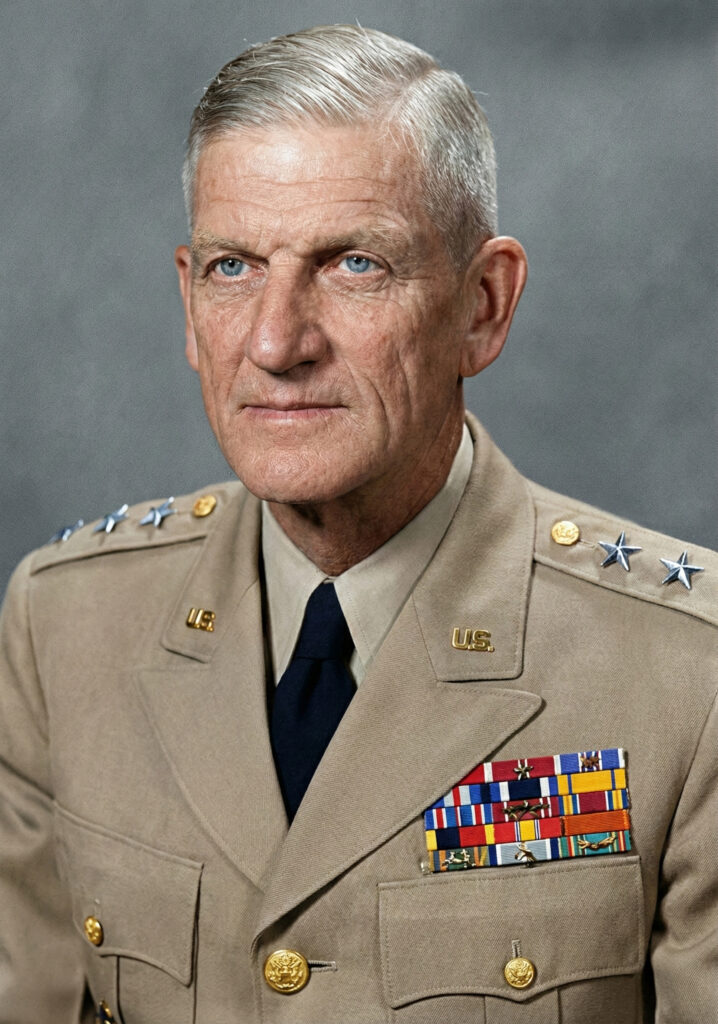
Lieutenant General Robert Miller Montague (1899–1958) is a pivotal figure at the intersection of America’s nuclear weapons enterprise and the postwar story of Unidentified Anomalous Phenomena (UAP).
As commanding general of Sandia Base starting in July 1947, in the same summer that the Roswell events entered public memory, Montague sat at the hub of atomic stockpile training, assembly, and logistics.
Four decades later his name appeared on the roster of the “Majestic 12” committee, instantly placing him in the center of a long running debate about secrecy, nuclear stewardship, and the earliest government responses to UAP.
The authentic historical record confirms his senior role at Sandia and later at U.S. Caribbean Command, along with the stature and clearances that made him a plausible insider to any compartment dealing with extraordinary aerospace questions.
The record also shows that the specific Majestic 12 documents that name him have not been validated by official repositories. Understanding Montague therefore requires careful separation of documentary fact from contested paper trails, and an appreciation of why nuclear leadership and UAP have remained intertwined in public imagination. (Defense Threat Reduction Agency)
Lieutenant General Robert M. Montague circa 1947 Montague as commander of the Sandia Missile Base (U.S. Army | UAPedia)
Early life and professional formation
Robert M. Montague was born in Portland, Oregon, on 7 August 1899. He attended the University of Oregon, then transferred to the United States Military Academy at West Point, graduating in 1918 as a second lieutenant in artillery.
His early career followed a classic interwar pattern of schools and staff assignments, including the Field Artillery Advanced Course and the Command and General Staff College in the 1930s, along with a stint as an instructor at West Point.
These foundational years established Montague as a technically competent officer in the Army’s rapidly professionalizing artillery branch.
During World War II he served with distinction. From 1944 to 1945 he commanded the 83rd Infantry Division Artillery in the European Theater and acted as division commander on several occasions.
The Army’s Center of Military History and period divisional records place Montague in the thick of late war operations where coordination of fires, logistics, and maneuver rewarded the kind of disciplined staff training he had received before the war.
From Fort Bliss to Sandia Base in the atomic age
With the war over and the atomic era underway, Montague was posted to Fort Bliss as deputy commander of the Army’s air defense artillery center, then moved to Albuquerque in mid 1947.
The chronology preserved in the Defense Threat Reduction Agency’s official history marks the moment clearly. In July 1947 Brigadier General R. W. Montague became commanding general of Sandia Base, an installation that by then housed the military side of America’s nuclear mission.
Two weeks later Washington publicly acknowledged Sandia’s formal connection to the Armed Forces Special Weapons Project, the joint agency that succeeded the Manhattan Engineer District for training, assembly, and weapons stockpile functions. (Defense Threat Reduction Agency)
Sandia was the operational complement to Los Alamos and, later, to Livermore. Z Division, the ordnance engineering unit spun out of Los Alamos to harden laboratory designs into fieldable weapons, had been relocated to Sandia’s complex of test and assembly facilities.
In this environment the Field Command of AFSWP grew into a large operational organization that trained bomb assembly teams, coordinated storage sites, managed base construction and logistics, and worked alongside Sandia Corporation to integrate new warheads with aircraft and delivery systems. Montague’s base provided the ground truth for a weapons enterprise that was scaling from a handful of components toward a real stockpile. (Defense Threat Reduction Agency)
The official history of the nuclear agency captures the spirit of the period. It describes Field Command’s close interaction with laboratory scientists, the training of assembly teams, and the management of schedules for drop tests and component verification as the stockpile expanded in the early 1950s.
This was the work of building a reliable nuclear force, and Sandia Base under Montague was one of its command centers. (Defense Threat Reduction Agency)
Incidents and pressures during the Sandia years
Atomic work was hazardous in ways both obvious and hidden.
Contemporary press accounts and later summaries recall a tragic fire at Sandia’s stockade in March 1950 that killed fourteen prisoners and injured responders. The context underscores the strain of rapid growth and stringent security inside a base that sat at the edge of America’s most sensitive technical enterprise.
While Montague’s command signature was on Sandia’s daily life during such events, the record emphasizes the broader state of the base rather than personal culpability. (Trove)
The period also saw intense debate in Washington over custody of the nuclear stockpile, the division of responsibilities between the Atomic Energy Commission and the Department of Defense, and how much authority AFSWP should exercise.
Archival entries from 1947 and 1948 show Montague’s Sandia command mentioned in Joint Chiefs discussions about roles, responsibilities, and security exercises.
The Sandia commandant’s perspective was inevitably shaped by the requirement to train forces, protect sites, and prepare for field operations under tight timelines and evolving policy. (Defense Threat Reduction Agency)
After Sandia: European Command, I Corps, and Caribbean Command
Montague left Sandia in 1951 for a tour as head of plans, operations, and training for United States European Command, then served as deputy commander of Army Field Forces. In 1955 he took command of I Corps in Korea in the tense post armistice period when U.S. forces maintained a forward deterrent along the Demilitarized Zone.
By 1957 he had been selected to command the U.S. Caribbean Command, the predecessor to today’s U.S. Southern Command, based in the Panama Canal Zone. The appointment capped a trajectory that moved from artillery and wartime leadership to the nuclear enterprise and onward to a geographic unified command. (generals.dk)
A surviving U.S. Southern Command photo caption preserves a telling detail. The headquarters building at Quarry Heights would come to be known as Robert M. Montague Hall.
The official description notes that Montague oversaw construction of the facility and that he died in Panama in February 1958, approximately four weeks before the dedication. The naming honored a commander who had only just begun to put his stamp on the theater. (U.S. Southern Command)
Montague’s death at Gorgas Hospital in the Canal Zone on 20 February 1958 was attributed to a cerebral hemorrhage following an intestinal illness. Veterans Affairs records and grave listings confirm his burial at Arlington National Cemetery. The arc of his career, from West Point to the European campaign, to Sandia Base and then to senior joint command, ended while he was still on active duty.
The UAP connection: what the record shows
1) Sandia in July 1947
Because Sandia Base was the military center of the nuclear weapons program, Montague’s arrival there in July 1947 has long attracted attention from UAP historians.
The Roswell events occurred earlier that month, and whether or not one accepts any crash narrative, it is beyond dispute that Sandia’s mission, location, and clearances made it a natural focal point for any highly compartmented response to anomalies touching national security.
The official chronology marks his assumption of command and places Sandia squarely within AFSWP’s remit at precisely this critical time. (Defense Threat Reduction Agency)
2) Montague’s inclusion in the Majestic 12 story
In the mid 1980s a set of documents began circulating that purported to describe a secret interagency group known as “Majestic 12,” allegedly formed in 1947 to manage crash retrievals, exploitation, and policy. The so called Eisenhower Briefing Document lists twelve “designated members,” and among the military and scientific leaders named is General Robert M. Montague. Copies of these materials are widely available in archival reproductions. (Archive.org)
Official repositories have not validated these documents. The FBI’s public Vault summarizes the Air Force determination that the circulated Majestic 12 briefing was a fake.
The National Archives maintains a detailed reference note that highlights anomalies in the associated “Cutler to Twining” memo, including the absence of required Top Secret register numbers and timing problems that place the purported author out of the country on the date in question.
The U.S. Government Accountability Office, responding to congressional inquiry, reported that agencies’ knowledge of “Majestic 12” was limited to the disputed papers themselves.
That said, Montague was exactly the kind of officer who would have been consulted if any small interagency group had existed to manage sensitive aerospace events.
He commanded Sandia Base at the dawn of the stockpile, worked at the center of AFSWP’s Field Command operations, and later held a unified command billet.
These are the bona fides that make his name a plausible inclusion in any real or fabricated roster. This is a key reason why the MJ 12 story has remained attached to him in public discourse despite the documentary provenance problems. (Defense Threat Reduction Agency)
3) What Montague himself claimed about UAP
There is no public record of Montague making personal claims about UAP in speeches, interviews, or sworn testimony.
Contemporary Army sources and later biographies do not show him as a public participant in the debate. The linkage is therefore documentary rather than testimonial.
Where claims exist, they appear inside the Majestic 12 materials rather than in verifiable statements by Montague. That distinction matters for any serious history of the subject.
Influence and impact on ufology
Montague’s importance for UAP history flows from two converging currents.
First, he embodied the nuclear nexus. Sandia Base was the bridge between laboratory design and fielded capability. Within months of his arrival Field Command was training assembly teams, developing procedures, and coordinating with laboratories on the engineering of deliverable systems. UAP narratives that foreground the nuclear weapons complex often return to Sandia, Manzano, Kirtland, and Los Alamos. Montague’s tenure gave those narratives a real historical anchor in the person of the base commander who managed the military side of the enterprise in 1947. (Defense Threat Reduction Agency)
Second, his appearance on the Majestic 12 roster, shaped public expectation about who would sit at a secret table if one existed. The list is stacked with people whose portfolios touched atomic weapons, air defense, and scientific leadership. Including the Sandia commander offered a tidy organizational logic that helped MJ 12 feel plausible to many readers.
Media and publishing in the late twentieth century amplified that effect, and Montague’s name has continued to circulate in both critical and supportive accounts as a result. (Archive.or
Controversies linked to Montague
The MJ 12 authenticity dispute. The most sustained controversy is the contested status of the documents that name him.
As noted, the FBI summarized an Air Force determination that the materials are bogus, and the National Archives has documented specific anomalies in related memoranda. Supporters argue that forgeries can coexist with authentic secrets and that the profiles of the named individuals are too apt to be accidental.
Skeptics counter that the documentary flaws are decisive.
Montague’s case is emblematic of this stalemate. His real career makes him plausible, and the paper trail that would validate the claim is flawed. (FBI)
Sandia Base safety and security incidents. The 1950 stockade fire, along with separate aviation and weapons handling mishaps in the wider Albuquerque complex during the decade, highlights the operational risks of the nuclear infrastructure that Sandia supported.
Contemporary and retrospective accounts discuss these incidents in institutional terms and rarely ascribe individual blame to base commanders, yet they form part of the environment in which Montague led.
The shadow of such events explains why public discussion of Sandia often blends real operational hazards with speculation about extraordinary programs. (Trove)
Death in command and the timing of honors. Montague’s sudden death in Panama in early 1958, on the eve of the dedication of the headquarters building that would bear his name, has occasionally been folded into speculative narratives about intrigue.
Official sources are straightforward. The cause was a cerebral hemorrhage after illness, and the building naming is explained in ordinary terms of honoring a commander who oversaw its construction. The episode is best understood as an example of how ordinary events become raw material for later storytelling once a figure is attached to UAP lore.
Assessing Montague’s legacy for UAP studies
From the perspective of UAP history, Montague is significant for what his verified positions reveal about the structure of U.S. secrecy in the early atomic age.
He occupied a ring of trust nearest to the stockpile. Sandia Base was not a public laboratory. It was the joint military arena for training, assembly, and storage operations that linked scientific invention to operational readiness.
The base commander had to coordinate with the Atomic Energy Commission and with top Air Force and Navy commands while managing the security culture that nuclear work demands. That level of trust is rare and explains why his name carries weight in any discussion of compartmented programs. (Defense Threat Reduction Agency)
He exemplified the blend of technical and joint command experience that UAP researchers often seek in historical witnesses. After Sandia, Montague served in European Command, commanded I Corps in Korea, and led a unified command in the Caribbean.
These billets indicate that he would have been exposed to the full range of Cold War concerns, including air defense, intelligence, and the integration of new technologies with strategy. This is precisely the profile people imagine for a high level participant in any hidden effort to understand anomalous aerospace events. (generals.dk)
He left no public claims about UAP, which in itself is instructive. Despite his proximity to the nuclear heart of the national defense enterprise and the later emergence of his name in MJ 12 documents, Montague did not publicly take a position on UAP.
For historians, that silence narrows the evidentiary base. What remains are official organizational histories, personnel chronologies, and the contested documents that invoked him posthumously.
Chronological snapshot
1899–1918 Born in Portland, Oregon, educated at the University of Oregon and West Point, commissioned into artillery.
1930s Professional schooling and teaching assignments, including the Command and General Staff College and a tour as an instructor at West Point.
1944–1945 Command of 83rd Infantry Division Artillery in Europe, with periods as acting division commander.
1945–1947 Deputy commander, Fort Bliss air defense artillery center.
July 1947–1951 Commanding general, Sandia Base. The DTRA chronology records his assumption of command in July 1947 and outlines Field Command’s expanding responsibilities for training, assembly, testing support, and logistics.
1951–1952 Head of plans, operations, and training, U.S. European Command.
1952–1955 Deputy commander, Army Field Forces.
1955–1956 Commanding general, I Corps, Korea.
1957–1958 Commander, U.S. Caribbean Command. Montague Hall at Quarry Heights was named in his honor.
1958 Dies in Panama while in command, buried at Arlington National Cemetery.
Notes: Where a government or institutional source provides the core fact pattern, non governmental summaries are used only to supplement dates or context. The “Majestic 12” materials are cited as archival reproductions for reference while acknowledging the official assessments listed above.
SEO keywords
Robert M. Montague biography, Sandia Base commander 1947, Montague Majestic 12 roster, AFSWP Field Command history, Sandia and UAP, Roswell 1947 Sandia connection, Montague Caribbean Command Panama, MJ 12 authenticity National Archives FBI, Project Blue Book 701 unidentified, AARO 2024 UAP report, nuclear weapons and UAP, UAPedia profile
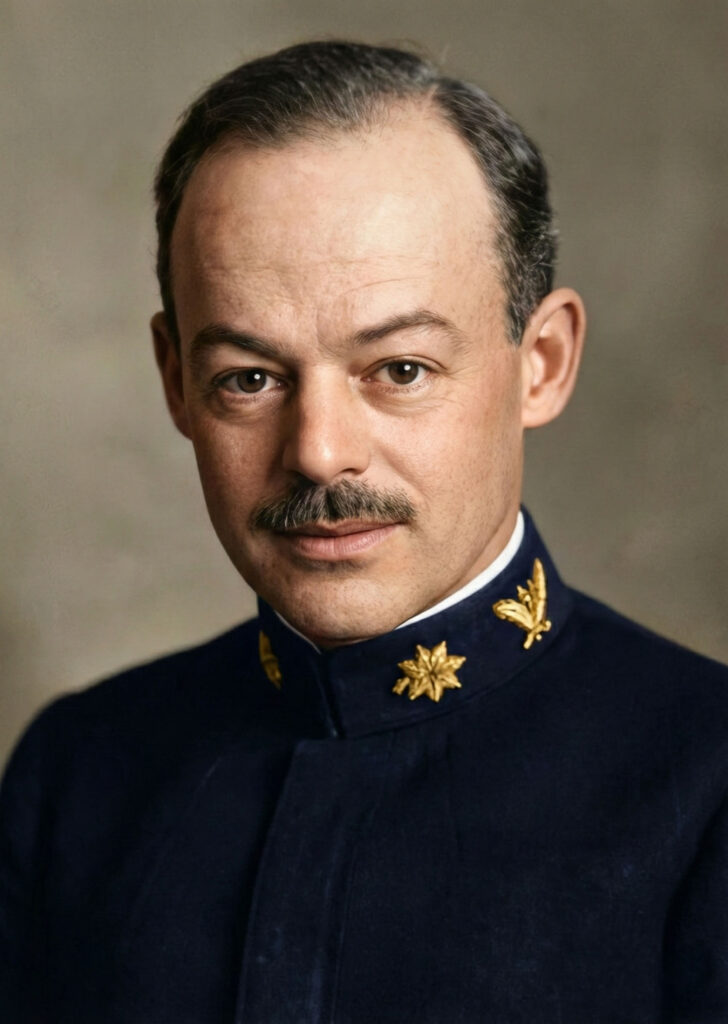
James Vincent Forrestal is a pivotal figure in twentieth-century U.S. national security history, and an enduring presence in UAP discourse.
He rose from Wall Street to become Secretary of the Navy during World War II and then the first U.S. Secretary of Defense after the National Security Act of 1947.
His sudden death in 1949, and later-emerging documents alleging his membership in a secret panel known as Majestic 12, placed him at the center of the most persistent debates in ufology.
Separating the documented record from later claims is essential for understanding his true impact on the UAP story. (History Defense)
James V. Forrestal as Secretary of Defense during the Truman Administration – 1947 (US Dept. of War / UAPedia)
Early life and ascent to power
Forrestal was born in 1892 in Matteawan, New York, and came of age amid the pressrooms and trading floors of the Northeast.
After studies at Dartmouth and Princeton, he built a formidable career at the investment bank Dillon, Read & Co., becoming its president in 1938.
His shift from finance to government came in 1940 when Franklin D. Roosevelt tapped him for the newly created post of Under Secretary of the Navy, a role in which he orchestrated wartime industrial mobilization.
In May 1944 he became Secretary of the Navy, presiding over the climactic final year of the Pacific war. These appointments positioned Forrestal as one of the most influential administrators of the U.S. military establishment in the mid-1940s. Authoritative institutional profiles and scholarly treatments, including the U.S. Navy’s historical materials and a Department of Defense special study, document this trajectory in detail. (Naval History and Heritage Command)
Following the war, Forrestal advocated a strong, globally engaged posture to contain Soviet power.
He also pressed for an integrated but balanced postwar military structure that preserved the Navy’s strategic role while consolidating overarching authority in a civilian Secretary of Defense.
The National Security Act of 1947 created that office, and President Harry S. Truman named Forrestal its first incumbent on September 17, 1947. The same period saw Forrestal quietly support a more coherent U.S. intelligence system, participating in early high-level deliberations regarding the scope of the Central Intelligence Agency and related covert capabilities.
State Department archival records preserve his contributions to those debates. (History Defense)
Forrestal and the birth of official UAP inquiry
The public term “flying saucer” exploded into the American lexicon in mid-1947, and the armed services confronted an operational question that could not be ignored.
Within the U.S. Air Force, the effort to organize the phenomenon began as Project Sign in early 1948, with antecedents often referred to as Project “Saucer.” Project Sign’s mission was to collect and evaluate the new class of sightings and to assess whether they represented a threat or an exotic technology.
In early 1949 the project reported that most sightings had conventional explanations, yet it left a small residual category unresolved, and it recommended the military continue exercising intelligence control over investigations.
These facts are documented in painstaking recent government histories that have systematized the archival record. (U.S. Department of War)
Institutionally, Forrestal sat at the top of the newly minted National Military Establishment during the months when the U.S. Air Force formalized this work.
The National Archives’ Project Blue Book collection, along with official Air Force fact sheets, make clear that the government’s three successive programs for UAP analysis ran from 1947 to 1969 and generated 12,618 case files, 701 of which remained unidentified after contemporary review.
These programs were subordinate to the broader defense framework Forrestal helped shape during unification. That places him squarely within the chain of responsibility at the birth of official UAP study, even though the Air Force led day-to-day investigations. (National Archives)
A frequently cited historical anchor in this era is a September 23, 1947 memorandum by Air Materiel Command chief Gen. Nathan Twining that assessed the “flying discs” phenomenon as real and recommended a formal investigative program.
Contemporary government syntheses refer to Twining’s role and the evolving 1947–49 structure that emerged from those recommendations, while British archival guides also summarize the memo’s thrust.
The point is not that Forrestal authored any policy on this specific memo, rather that in autumn 1947 he presided over the new defense apparatus precisely as UAP questions were professionalized inside the Air Force. (U.S. Department of War)
The Majestic 12 narrative and Forrestal’s alleged role
What the MJ-12 documents claim
In late 1984 and 1987, a set of documents surfaced that became known collectively as “Majestic 12” or “MJ-12.”
The centerpiece was a “Briefing Document: Operation Majestic 12,” dated November 18, 1952, purporting to brief President-elect Dwight D. Eisenhower on a secret committee of twelve senior figures created after an alleged crash recovery. This list includes “James V. Forrestal,” implying his membership from 1947 until his death.
A companion memorandum attributed to President Truman and addressed to Forrestal, dated September 24, 1947, authorizes him and Dr. Vannevar Bush to proceed with MJ-12. Copies of these purported documents are readily available and have circulated widely since the 1980s. (Archive.org)
How U.S. archives and agencies judge those documents
From the standpoint of the primary record, the MJ-12 papers have fared poorly. The FBI’s publicly released “Vault” file on Majestic 12 concludes, following an Air Force investigation, that the documents provided to the Bureau were “completely bogus.”
The National Archives has a dedicated reference page summarizing its searches for any MJ-12 records, noting that extensive checks of Air Force, Joint Chiefs of Staff, National Security Council, and presidential library holdings failed to produce corroboration.
The Archives further details inconsistencies in one often-cited Cutler-to-Twining memo, including dating, markings, and paper stock anomalies that are not consistent with Eisenhower-era practices.
A 1995 Government Accountability Office note, arising from its Roswell audit, reports that relevant government entities could find no evidence MJ-12 originated in the executive branch and that an “MJ Twelve” message was determined by OSI to be a forgery.
Taken together, these official assessments establish the current public record: no authenticated government source has verified MJ-12 as a real body, and the specific documents circulated publicly are regarded by agencies as fakes. (FBI)
Where that leaves Forrestal in relation to MJ-12
Because Forrestal’s name is prominent in the MJ-12 lists, the narrative inevitably wrapped around his legacy. Yet the evidentiary center of gravity remains with the FBI, NARA, and GAO determinations. Forrestal left voluminous diaries and official papers that have been published and microfilmed; researchers have not identified a contemporaneous, authenticated reference to MJ-12 in those collections.
The 1951 edited print edition of The Forrestal Diaries and later releases of the complete, unexpurgated diaries via the Princeton repository and microfilm projects enable direct inspection of his wartime and postwar concerns.
Those sources illuminate a statesman preoccupied with unification, budgets, strategy, and high-level diplomacy, not a clandestine crash-retrieval committee. (Internet Archive)
This does not settle the broader question of whether highly compartmented crash retrieval programs might ever have existed. It does, however, fix the narrow point that the publicly circulated MJ-12 papers citing Forrestal have failed institutional authentication tests.
Within ufology, opinions vary on whether the documents were hoaxed by private actors or seeded as disinformation, but the official paper trail weighs heavily against their genuineness. (FBI)
Forrestal’s public record on UAP
An essential part of the biography is what Forrestal himself said. The answer is stark. There is no verified public statement by Forrestal on UAP that has been documented in his speeches, his published diaries, or in official Defense Department communications now publicly available.
The 1951 edited diary volume and later releases of the complete diaries provide hundreds of pages of candid reflections across 1944–49 without an authenticated UAP passage. Institutional biographies and official studies of Forrestal’s tenure likewise do not record UAP claims in his voice.
That silence does not disprove personal interest or briefings, it simply defines the public record we have. (Internet Archive)
Crisis, hospitalization, and death at Bethesda
Forrestal’s break with President Truman over defense budgets and other policy rifts culminated in his resignation in March 1949. Truman accepted the resignation and soon after issued an official proclamation upon Forrestal’s death.
Within weeks of leaving office, Forrestal entered treatment for severe depression and exhaustion. He was admitted to the National Naval Medical Center at Bethesda, where he received intensive care under Navy psychiatrists, including Capt. George N. Raines.
In the early hours of May 22, 1949, Forrestal fell from a sixteenth-floor window. President Truman formally announced his death that same day. The Truman Library preserves both the acceptance of his resignation and the proclamation marking his death. (Truman Library)
A Naval Board of Review, convened by Admiral M. D. Willcutts investigated Forrestal’s death. The board’s finding stated that Forrestal died from injuries sustained in a fall from a high point of the hospital tower and that his behavior in the period leading up to the fall was indicative of mental depression.
Decades later, details from the board materials and related hospital documentation became available to researchers, while reputable press retrospectives summarized key elements. One such element, widely reported, was that Forrestal had begun copying lines from Sophocles’ Ajax shortly before his death, stopping mid-word. Discussions continue about the sash cord that was found and whether the fall followed a hanging attempt or not, but the official framing remains death due to the fall, with the associated medical history of depression. (The Washington Post)
The release of Forrestal’s diaries and the eventual accessibility of documentation related to his hospitalization have encouraged renewed scrutiny, sometimes from investigators who argue for alternative scenarios.
The fact pattern contained in the official proclamation and Naval Board review provides the government’s contemporaneous position, while press syntheses help contextualize the dramatic final night. Because later accounts often amplify singular details, the primary record is the most reliable baseline for biographical purposes. (Truman Library)
How Forrestal’s death shaped UAP discourse
Within ufology, Forrestal’s death is often interlaced with claims that he “knew too much” about crash retrievals.
The timing is suggestive to many researchers. He died less than two years after the 1947 wave, less than two years after he became Secretary of Defense, and two years before the Eisenhower Briefing Document’s alleged date.
Those narrative coincidences proved potent in later decades. Yet the dossier of authenticated government evidence, as summarized by the FBI, National Archives, and GAO, does not support the specific MJ-12 documents that carry his name. In this sense, Forrestal’s death operates more as a magnet for speculation than as proof of the alleged secret program. (FBI)
That said, his institutional vantage point in 1947–49 matters. The Air Force’s UAP machinery began its work while Forrestal led a still-consolidating defense structure. The recent All-domain Anomaly Resolution Office (AARO) historical report confirms the early timeline of UAP programs and offers a government-level synthesis of how Sign, Grudge, and Blue Book unfolded.
The broader historical record therefore places Forrestal adjacent to the origins of formal UAP inquiry, even if no Forrestal-authored policy on UAP survives in the declassified corpus. (U.S. Department of War)
Influence on national security architecture
Regardless of UAP questions, Forrestal’s enduring impact came through the institutional architecture he helped shape.
As Secretary of the Navy and then Secretary of Defense, he dealt with inter-service rivalry, budgetary discipline, and the new civil-military compact created by the National Security Act.
He advocated a robust foreign policy to counter Soviet power, sought to integrate service cultures without erasing them, and supported the maturation of a strategic intelligence capability aligned with national direction.
The Defense Department’s historical study of his tenure highlights how much of the Secretary of Defense’s role he had to invent in real time. His achievements and errors became precedents for every successor. (History Defense)
Claims attributed to Forrestal in UAP literature
Because Forrestal left no verified public UAP statements, most of what is attributed to him comes indirectly from later works. These fall into three categories:
Attribution via MJ-12. The alleged Truman-to-Forrestal authorization memo and the 1952 “Eisenhower Briefing Document” impute both knowledge and direct responsibility to Forrestal for crash retrieval and exploitation.
As noted above, federal agencies have rejected the documents’ authenticity, which weakens any claim built exclusively on those texts. (FBI)
Attribution by proximity. Some writers argue that Forrestal “must have known” about UAP because Projects Sign and Grudge began under his watch, and because senior defense leaders were briefed on air incidents. That inference may be plausible, but the evidentiary bar remains high.
Without a Forrestal-authored memo, a diary entry, or a contemporaneous briefing note, the claim remains an inference rather than a documented fact. The government’s own UAP histories place the operational center of gravity within the Air Force’s intelligence structure rather than the Office of the Secretary of Defense. (U.S. Department of War)
Attribution through cultural artifacts. Films, novels, and later oral histories often portray Forrestal as privy to UAP secrets. These depictions can have heuristic value but are not historical evidence.
The consensus of primary repositories, including Princeton’s Forrestal Papers and the edited diaries, does not include a verified Forrestal claim about UAP. (Internet Archive)
Controversies beyond UAP
Forrestal’s battles were not confined to budgets and organization charts. He opposed partition in Palestine on strategic grounds and clashed with journalists and political rivals who regarded him as too hawkish.
His mental health collapse in 1949 fueled fierce arguments about whether the pressures of unification and Cold War statecraft had burned him out or whether factional politics contributed to his undoing.
The Truman Library’s materials anchor the official timeline of his resignation and death, while mainstream encyclopedic profiles summarize the policy disputes that made Forrestal a polarizing figure.
The fiercest claims, from any side, need to be tested against these primary anchors. (Truman Library)
Forrestal’s legacy in UAP history
Even where the evidence is silent or ambiguous, Forrestal’s legacy is formative for the UAP field in at least four ways:
He sat at the creation. The government’s initial UAP investigative structure emerged during Forrestal’s brief tenure as Secretary of Defense. Understanding that administrative environment is indispensable to the historiography of UAP inquiry. (U.S. Department of War)
He became a touchstone for secrecy narratives. The stark end of his life, the editorial handling of his diaries, and his proximity to the 1947 wave created a narrative pull that later authors could not resist.
The MJ-12 papers capitalized on that gravity, naming Forrestal as a founding insider. The FBI’s and National Archives’ positions against MJ-12 are therefore more than procedural points. They bear directly on how researchers should weigh claims about Forrestal’s secret role. (FBI)
He embodied the Cold War’s new security ethos. Forrestal championed a robust, global approach to national defense and a disciplined intelligence posture. Whether or not one connects that to UAP secrecy, it shaped the very bureaucracies within which UAP reporting lived for the next two decades. (History Defense)
He is a cautionary case about sources. Forrestal’s story reminds researchers to privilege authenticated primary materials. In a domain where rumors multiply, the defense historian’s toolkit provides guardrails. Forrestal’s diaries and official papers, the AARO historical summary, and the institutional judgments on MJ-12 are more probative than any single anecdote. (Webdoc)
A balanced assessment
It is entirely plausible that a secretary of defense in 1947–49 would have been at least peripherally aware of the Air Force’s UAP work. It is likewise true that Forrestal’s vantage point gave him access to compartmented matters.
The leap from that plausibility to specific MJ-12 claims, however, is not warranted by the authenticated evidence.
The FBI, the National Archives, and the GAO collectively weigh against the MJ-12 documents. The diaries and government files available today do not yield a verified Forrestal statement on UAP. And yet Forrestal occupies a meaningful place in UAP history because of when and where he served, and because his life became enmeshed with later narratives that sought a human face for an era of secrecy.
In that sense, Forrestal’s UAP legacy rests on three pillars.
First, he presided while the Air Force professionalized UAP reporting and analysis.
Second, his name became a symbol within claims of crash retrieval and extreme secrecy, amplified by the MJ-12 papers that officials deem inauthentic.
Third, his tragic end catalyzed decades of re-interpretation that continue to shape the cultural imagination of UAP.
A rigorous historiography keeps these pillars in proportion. The task for researchers is to maintain fidelity to the documentable record while remaining open to new, authenticated disclosures that may further illuminate the period. (U.S. Department of War)
Key dates and timeline
1892: Born in Matteawan, New York.
1940: Appointed Under Secretary of the Navy; leads industrial mobilization.
1947: National Security Act takes effect; Forrestal sworn in as first Secretary of Defense on September 17. (National Security Archive)
1948–1949: U.S. Air Force Project Sign established and concluded; the era of formal UAP inquiries begins under Air Force lead. (U.S. Department of War)
March 1949: Resignation accepted by President Truman. (Truman Library)
May 22, 1949: Death at National Naval Medical Center, Bethesda; presidential proclamation issued. (Truman Library)
1951: Edited Forrestal Diaries published.
1984–1987: Circulation of MJ-12 papers implicating Forrestal; later judged “completely bogus” by FBI and found uncorroborated by NARA and GAO reviews. (FBI)
Conclusion
James V. Forrestal belongs in any serious account of early Cold War national security, and by extension in any rigorous history of government attention to anomalous aerial phenomena.
He neither authored a publicly verifiable statement on UAP nor left a declassified directive that would tie him to crash retrievals. The much-discussed MJ-12 documents that invoke his name have been rejected by the very institutions charged with preserving and authenticating such records.
Even so, Forrestal’s brief tenure coincided with the institutional birth of UAP investigation, and his tragic death helped propel a powerful narrative that continues to shape the field.
For UAP researchers, Forrestal’s biography is a reminder to hold two ideas at once.
The first is humility before the archival record.
The second is curiosity in the face of enduring gaps.
As more historical materials migrate online and as official syntheses, like AARO’s historical report, consolidate scattered files, our picture of 1947–49 will continue to sharpen. Forrestal’s shadow will remain there, close to the center, not because of what he is proven to have said about UAP, but because of the office he held when the modern UAP story began. (U.S. Department of War)
Note: The last two links reproduce the contested MJ-12 documents for reference. They are cited here only as artifacts within the historical debate. Institutional assessments from the FBI, National Archives, and GAO, cited above, conclude that these documents are not authentic government records. (FBI)
SEO keywords
James Forrestal biography, James V. Forrestal UAP, Majestic 12 Forrestal, MJ-12 authenticity, Forrestal death Bethesda, Forrestal diaries, Project Sign 1948, UAP history 1947, National Security Act 1947, first Secretary of Defense, Forrestal and CIA, Willcutts Report Forrestal, UAP crash retrieval claims
On the evening of July 15, 2019, crew aboard the Independence-variant littoral combat ship USS Omaha (LCS-12) operating off Southern California recorded a short infrared video of a spherical object and, separately, combat-information center displays that appeared to show multiple unknown tracks around the ship.
The Pentagon later confirmed that imagery from this 2019 series was taken by the U.S. Navy personnel and that the incidents were included in the UAP Task Force’s examinations, though it did not identify the objects. Independent FOIA releases and a 2022 congressional hearing fueled a counter-narrative that at least some of the 2019 Southern California events involved drones launched from nearby commercial vessels.
The Omaha sequence sits in the overlap of these two realities: authenticated Navy-captured imagery and unresolved target attribution.
This article reconstructs what happened, audits the data and the known government record, catalogs the witnesses, surfaces the controversy, and outlines the most defensible implications.
George Knapp reporting on KLAS the USS Omaha 2019 UAP incident (KLAS)
The night in question
Shortly after 9 p.m. Pacific on July 15, 2019, a spherical object is seen on a Navy infrared system as it moves above the ocean near a U.S. warship operating in a Southern California warning area.
The brief clip, later leaked to a filmmaker and televised by major outlets, ends with operators uttering “splash” and directing a bearing and range call.
The Pentagon’s spokesperson confirmed that the imagery in question was recorded by Navy personnel and was part of the UAP Task Force’s work, although the Department did not identify the object or endorse any extraordinary interpretation. (CBS News)
Separate leaked segments purport to show the USS Omaha’s radar display that night with multiple tracks around own-ship, coupled with crew voice loops using standard watch floor roles like OOD, CSM, and TAO.
The captions provided with the leak place the ship near 32°29′21.9″N, 119°21′53.0″W, with as many as 14 unknown tracks at one time between roughly 9 and 11 p.m. Pacific.
These clips, disseminated by the same filmmaker, are not part of an official public release, but they have become central to how the “Omaha case” is commonly described. (EXTRAORDINARY BELIEFS)
Two things can be said with confidence from the open record.
First, Navy-captured imagery from 2019 involving a spherical object is authentic, in the sense that it was recorded by Navy personnel and examined by the UAP Task Force.
Second, the Navy’s wider operating picture in summer 2019 off Southern California featured multiple nights where warships were concerned about small unmanned aircraft in their vicinity, a fact now documented in FOIA releases and discussed in Congress. The Omaha sequence lives at that intersection. (CBS News)
Who saw what: witnesses and source materials
There are no named, on-the-record USS Omaha eyewitnesses publicly describing the July 15 event in detail. What the public does have is:
Navy-captured imagery, acknowledged as such The Pentagon confirmed that photos and videos from 2019, including a spherical object and night-vision footage from other ships, were taken by Navy personnel and examined by the UAP Task Force. That confirmation is foundational. It authenticates provenance, not content or interpretation. (CBS News)
Leaked Omaha-labeled clips with crew audio The radar and infrared snippets attributed to Omaha include watchstander dialogue and interface symbology. The published captions also give approximate position and timeframe; they claim as many as 14 unknowns and describe a crescendo with one object entering the water, after which a search reportedly found no debris. These claims originate with the leak source rather than an official Navy release. (EXTRAORDINARY BELIEFS)
Media documentation and contemporaneous reporting A widely circulated broadcast segment presented the Omaha infrared clip alongside commentary and Pentagon confirmation that the imagery was Navy-captured. Those reports did not identify the object. (Yahoo)
Navy FOIA documents from adjacent ships and dates Deck logs, briefings, and imagery released via FOIA show that multiple destroyers encountered suspected small unmanned aircraft in the Southern California operations area in 2019. These records establish the drone context for the same operating area and season, though they do not directly adjudicate the Omaha clip itself. (The War Zone)
House UAP hearing testimony At the May 17, 2022 hearing, the Deputy Director of Naval Intelligence used 2019 night-vision footage as an example of a solved case, explaining that the triangular appearance was due to a known optical effect and that the objects in that instance were identified as aircraft or UAS. That testimony speaks to the 2019 Southern California environment and the Navy’s analytic posture, not to the Omaha sphere specifically. (Congress.gov)
FOIA effort focused on USS Omaha The Black Vault documented a FOIA trail related to Omaha deck logs and audio, noting that logs for the core dates were unavailable while logs just after the period were provided. The absence of those specific logs does not by itself resolve anything about the objects but has fueled debate. (The Black Vault)
The data, line by line
Infrared clip The leaked infrared sequence shows a small, high-contrast, roughly spherical target translating above a dark ocean background. Near the end, the target’s intensity fades at the horizon line and operators call “splash.” Without range, altitude, or sensor geometry, several interpretations remain possible. The Pentagon’s statement confirms the clip’s provenance, not its kinematics. (CBS News)
Radar segments The radar snippets show tracks with associated speeds and bearings discussed on voice. Captions assert speeds up to “138 knots,” though skeptics have noted the risk of mishearing voice callouts and the need to calibrate against own-ship motion, sensor mode, and track quality.
The leaked pages also reference X-band radar and the use of cross-checks. Absent raw radar files or a full console data export, we cannot independently validate the track designations or the track-to-target correlation with the infrared clip. (EXTRAORDINARY BELIEFS)
Approximate position and time The published captions put Omaha at approximately 32°29′N, 119°21′W between 9 and 11 p.m. Pacific on July 15, 2019.
That locale matches a well-used Southern California warning area with heavy Navy traffic, instrumented ranges, and frequent air-sea test activity. The night, area, and operational context align with FOIA-documented UAS concerns from nearby ships in the same period. (EXTRAORDINARY BELIEFS)
Voice loop roles Operators reference OOD, CSM, TAO, and call for bearing and range. That is consistent with a Navy watch team managing multiple contacts in a restricted area at night.
Some commentary online has quibbled over whether an Independence-variant LCS has a literal “CIC” in the destroyer sense.
A ship tour video and discussions among Navy-watchers suggest that the functional space exists, though the ship’s open-architecture layout differs from an Arleigh Burke’s hardened CIC. The terminology debate does not meaningfully change the technical questions at issue. (Metabunk)
The US Navy photographed & filmed “spherical” shaped UFOs & advanced transmedium vehicles; here is some of that footage. Filmed in the Combat Information Center of the USS Omaha / July 15th 2019 / warning area off San Diego @ 11pm PST. No wreckage found. No craft were recovered. pic.twitter.com/tK1YTG8sJ7
— Jeremy Kenyon Lockyer Corbell (@JeremyCorbell) May 14, 2021
What the government has said, formally
The most important formal statements are narrow but consequential.
Provenance and inclusion DoD spokesperson Susan Gough stated that the referenced 2019 photos and videos were taken by Navy personnel and that the UAP Task Force had included the incidents in its examinations. This affirms that the government treats the underlying data as real operational captures, not hoaxes. It makes no claim about origin or capability. (CBS News)
Context of drones in 2019 SOCAL operations FOIA releases, briefings, and a House hearing indicate that Navy destroyers encountered UAS swarms off Southern California in 2019. One Navy briefing slide singled out a Hong Kong-flagged bulk carrier, MV Bass Strait, as likely conducting surveillance with UAVs during one encounter, and the Navy released videos of suspected drones near ships on other nights. The hearing also addressed a separate 2019 “pyramid” night-vision clip, attributing the shape to lens bokeh and ultimately to aircraft or UAS. This establishes that 2019 SOCAL events were not a monolith. Some were definitely drones or aircraft seen under odd optics. That still leaves the Omaha sphere clip unresolved on its own merits. (The War Zone)
Status of the broader UAP portfolio The June 2021 ODNI Preliminary Assessment described 144 military UAP events and emphasized limited high-quality data as a primary barrier to resolution. Subsequent ODNI and AARO reports adopted a more formal taxonomy and noted that many new cases trend toward balloons, drones, and clutter, yet a subset remains uncharacterized without better data. That posture neither validates nor debunks the Omaha clip, and it underscores the importance of comprehensive sensor fusion that the public does not currently have. (Director of National Intelligence)
Transparency limits The Navy has explicitly declined to release additional UAP videos in at least one FOIA case, citing national security and the sensitivity of revealing operations, vulnerabilities, or capabilities. That policy choice constrains the public evidentiary record for cases like Omaha. (Task & Purpose)
The controversy: drones, illusions, or transmedium?
The drone hypothesis Multiple Navy ships documented suspected UAS activity during the same summer around the same ranges.
The War Zone’s FOIA-driven reconstructions are the most granular public record of those nights and include official slides labeling at least one case “swarm,” with a commercial vessel assessed as likely launching drones for surveillance. This is a coherent, conventional explanation for many 2019 SOCAL contacts.
The question is whether it explains the specific Omaha infrared clip that ends with “splash.” It could, but the clip alone does not supply enough geometric data to prove that a small quad or hex-rotor was the recorded target or that the apparent descent was not a horizon-line effect. (The War Zone)
The sensor/optics hypothesis Analysts who tackled the 2019 “pyramid” night-vision clip showed how bokeh from an out-of-focus lens can create triangular artifacts.
Some skeptics apply similar caution to the Omaha infrared clip, arguing that the apparent water entry could be a distant target dropping behind the horizon or a contrast change at the sea-sky boundary. Without range or multi-sensor cross-fixes publicly available, this cannot be excluded.
The Pentagon’s provenance confirmation alone does not certify kinematics. (Congress.gov)
The transmedium hypothesis The leak source characterizes the sphere as “transmedium,” asserting that it entered the water and that a follow-on search, including a submarine, recovered nothing.
In the absence of released sonar, MAD, or subsea sensor returns tied to that timestamp and location, the “transmedium” descriptor remains a hypothesis offered by the leak source and some former officials who have spoken publicly about such capabilities in general terms.
The claim is testable if more data is released, but it is not established by the short IR clip itself. (EXTRAORDINARY BELIEFS)
What counts as evidence in this case
A data-first approach separates four layers:
Provenance evidence Confirmed. The imagery was captured by Navy personnel and examined by the UAP Task Force. This puts the case inside the legitimate national-security pipeline. (CBS News)
Sensor evidence Partial. We have short-form IR and radar snippets without raw data, metadata, or synchronized multi-sensor exports. That is insufficient for rigorous kinematics. It is still meaningful as a prompt for targeted release review. (EXTRAORDINARY BELIEFS)
Operational context evidence Strong. Multiple nights of UAS concerns off Southern California in 2019 are documented and were briefed to Congress. This weighs toward drones as an explanation for at least some events. Whether it explains this one cannot be settled from the public file. (The War Zone)
Attribution evidence Indeterminate. The public record neither proves a drone nor a transmedium craft for the Omaha clip. AARO’s broader reporting trends toward many UAP being mundane once data improves. The Omaha clip has not been re-released with that level of data. (AARO)
Government involvement beyond confirmation
The Omaha clip entered the system through the Navy’s UAP Task Force, which fed the ODNI preliminary report delivered to Congress in June 2021.
After Congress mandated a permanent office, AARO assumed the mission, published annual assessments, and briefed lawmakers on case resolution methods that include signal processing, cross-domain sensor fusion, and environmental correlation.
This top-down architecture exists precisely for events like Omaha where sensors at sea capture something the operators cannot immediately classify.
The Pentagon has said it will not publicly detail many operational observations to protect capabilities, a stance at tension with public interest but consistent with long-standing classification norms. (Director of National Intelligence)
Implications
Maritime domain awareness needs to evolve The 2019 SOCAL cluster underscored that small UAS pose persistent challenges for surface forces. Even if Omaha’s sphere were ultimately a small drone or aircraft, the episode highlights the need for better automated correlation across IR, radar, EW, and optical channels at sea.
The Navy’s subsequent counter-UAS deployments and exercises reflect this trajectory. (The War Zone)
Policy and public trust depend on releasable synchronization The single biggest barrier to resolving Omaha in the public sphere is the absence of synchronized, metadata-rich exports across sensors with time stamps and platform states.
AARO keeps pushing toward standardized ingest and analytic pipelines. The policy dilemma is familiar: how to release enough to educate without exposing tactics, techniques, and procedures. (AARO)
The “transmedium” label is a testable claim If an object truly entered the ocean, correlating that timestamp and location with acoustic arrays, sonobuoys if deployed, or submarine logs would be decisive.
The Navy has not released such data. Until then, “transmedium” remains a hypothesis, not a conclusion. (EXTRAORDINARY BELIEFS)
The burden of proof is not evenly distributed The drone hypothesis gains leverage from the documented 2019 SOCAL swarm context. The non-prosaic hypothesis would require either multi-sensor correlation that rules out small UAS or a recovery. Neither has been presented publicly.
That does not mean it did not happen. It means the current public evidence does not settle it. (The War Zone)
Contested details, point-by-point
“Up to 14 unknowns” This figure appears in captions to the leaked radar segments and in broadcast narration drawn from those captions. Without the raw radar data and track files, the exact number and identity of tracks remain unverified in the public record. (EXTRAORDINARY BELIEFS)
“138 knots” Speed callouts in the audio are debated. Analysts have warned against over-reliance on a single shouted figure absent context on own-ship motion, sensor mode, and track covariance. (Metabunk)
“Entered the water” The IR clip ends near the horizon. “Splash” can be a call as much as a fact. Without range and altitude, a behind-the-horizon fade remains a live possibility. That does not disprove water entry. It makes the clip insufficient by itself to prove it. (Yahoo)
“VIPER team in the CIC” The term “VIPER team” appears in leak captions. Discussions among naval observers note that the LCS has a functionally equivalent combat information space, even if its architecture differs from larger combatants. The precise labeling does not change the evidentiary weight of the sensor data. (Metabunk)
Why this still matters in 2025
The Omaha sequence is an ideal stress test for the new U.S. UAP enterprise. It was a legitimate Navy capture that drew attention from Congress and the public, yet it sits adjacent to a well-documented series of drone incursions in the same waters and season.
The case demands transparent, synchronized, releasable data if public adjudication is the goal. In the absence of that, it becomes a narrative mirror where one side sees transmedium craft and the other sees hard-to-see drones flying at night among bright portholes and stars. AARO’s own reports emphasize that better data often moves cases into mundane bins.
It is precisely because the Omaha clip is data-poor in public that it has not moved definitively into any bin. (AARO)
Claims taxonomy
Verified • The video and photos from 2019 used in UAP Task Force examinations were recorded by U.S. Navy personnel. This includes a spherical object video captured in July 2019 off California. The Department of Defense confirmed provenance and inclusion. (CBS News) • Multiple Navy ships operating off Southern California in 2019 encountered suspected drone activity on several nights, documented in FOIA materials and acknowledged in public hearings. (The War Zone)
Probable • Several of the 2019 Southern California incidents involved unmanned aerial systems launched from or associated with nearby commercial vessels, including MV Bass Strait, as assessed in Navy briefings. (The War Zone)
Disputed • The Omaha radar segments showing “up to 14” unknowns, with speed callouts as high as “138 knots,” have not been publicly corroborated with raw data. Numbers in leaked captions and audio remain disputed by independent analysts. (EXTRAORDINARY BELIEFS) • The interpretation that the IR target “entered the water” is unconfirmed. The clip is too short and lacks range/altitude data to exclude a horizon fade. (Yahoo)
Legend • None. There is no cultural or religious narrative attached to Omaha that needs to be separated from the evidentiary record.
Misidentification • The 2019 “pyramid” night-vision video from USS Russell, often lumped into the Omaha conversation, was explained as an optical bokeh effect of out-of-focus cameras viewing aircraft lights. It was not part of Omaha’s infrared clip and should not be conflated with it. (Congress.gov)
Speculation labels
Hypothesis: The recorded sphere was a small UAS or conventional aircraft seen near the horizon, with a contrast fade misinterpreted as water entry.
Hypothesis: The recorded sphere was a transmedium vehicle entering the ocean, with no debris because it was intact and operating.
Witness interpretation: Operators honestly reported what they perceived in real time under stress, including a “splash,” without full geometric context.
Researcher opinion: FOIA records showing 2019 drone swarms nearby make a drone explanation more probable for many contacts, but they do not conclusively attribute the Omaha IR target. (The War Zone)
Bottom line
The USS Omaha sequence remains a narrow, provocative sliver of a larger 2019 Southern California operational picture.
The Department of Defense established the image provenance and the case’s inclusion in official study. FOIA releases and congressional testimony show that drones were definitively part of the story that year.
What we do not have is the synchronized, multi-sensor, metadata-rich archive that would settle the specific Omaha infrared clip one way or the other. Until that delta is closed, serious analysis must keep two propositions in tension: the 2019 SOCAL area had drones, and the Omaha clip itself is still unresolved.
References
All-domain Anomaly Resolution Office. (2023). Fiscal Year 2023 Consolidated Annual Report on Unidentified Anomalous Phenomena. AARO/DoD. https://www.aaro.mil/ (PDF direct) (AARO)
Kehoe, A., & Cecotti, M. (2022, June 10). Drone swarms that harassed Navy ships off California demystified in new documents. The War Zone. https://www.twz.com/ (The War Zone)
Kehoe, A., & Cecotti, M. (2022, June 15). Navy releases videos from mysterious drone swarms around warships off California. The War Zone. https://www.twz.com/ (The War Zone)
Kehoe, A., & Cecotti, M. (2022, February 10). Navy releases timeline for mysterious 2019 “UAS swarm” involving warships off California. The War Zone. https://www.twz.com/ (The War Zone)
Schwartz, G., & Stelloh, T. (2021, May 17). Leaked Navy video appears to show U.F.O. off California coast. NBC News [syndicated at Yahoo News]. https://news.yahoo.com/ (Yahoo)
U.S. House of Representatives, Permanent Select Committee on Intelligence. (2022, May 17). Unidentified Aerial Phenomena hearing transcript. Congress.gov. https://www.congress.gov/ (Congress.gov)
The Black Vault. (2022, February 3). USS Omaha deck logs, voice recordings missing during alleged UAP encounter timeframe. TheBlackVault.com. https://www.theblackvault.com/ (The Black Vault)
Jerome Clarke Hunsaker was one of the most consequential American aeronautical engineers of the twentieth century.
He helped bring modern aerodynamics into U.S. engineering education, guided naval aircraft design during World War I, chaired the National Advisory Committee for Aeronautics (NACA) during World War II and the early Cold War, and helped found the professional institutions that shaped aerospace research for generations.
His résumé alone would secure his place in aviation history, yet within UAP studies his name carries a different kind of gravity. In the mid-1980s, copies of the “Eisenhower Briefing Document” listed “Dr. Jerome Hunsaker” among twelve figures purported to form “Majestic 12,” an alleged high-level group created in 1947 to manage crashed craft and biology.
Federal agencies later judged the MJ-12 documents non-authentic, but the pairing of Hunsaker’s real authority with the alleged committee helped the story endure.
For UAP investigators, that pairing is the starting point for a biography that must braid two threads: what the archival record shows about Hunsaker’s life and what later MJ-12 claims say about him, set against what authoritative custodians say about those claims. (nasa.gov)
Early life, education, and the making of an aeronautical organizer
Hunsaker was born in Creston, Iowa, on August 26, 1886. He entered the U.S. Naval Academy and graduated in 1908, then the Navy sent him to the Massachusetts Institute of Technology for advanced work in naval construction and engineering.
At MIT he translated European aerodynamic work, helped inaugurate the nation’s first sustained academic program in aeronautical engineering, and built a wind tunnel in 1914 that became a laboratory anchor for a new curriculum. These steps positioned him as a transatlantic conduit for the young science of flight. (nasa.gov)
By 1916 Hunsaker had completed advanced study at MIT, and his Navy career swung decisively toward aviation. During World War I he served in Washington in the Aircraft Division of the Bureau of Construction and Repair, where he was involved in aircraft design and procurement.
US Navy 1917 picture of Lieutenant Jerome Hunsaker, as he took office in the then newly formed Naval Aircraft Factory in Philadelphia (US Navy / UAPedia)
After the Armistice he traveled in Europe for lessons learned and advocated institutional reforms that helped shape U.S. naval aviation in the 1920s. His work intersected naturally with the newly created NACA, which Congress had established in 1915 to guide aeronautical research across government, industry, and academia. (nasa.gov)
One of the achievements associated with Hunsaker’s early period is the Navy-Curtiss NC flying boat program. NASA’s official history notes that Hunsaker, together with Capt. George C. Westervelt and Capt. Holden C. Richardson, was among the key designers of the NC-4 flying boat that completed the first transatlantic flight in May 1919, a feat that signaled the practical reach of American maritime aviation. (nasa.gov)
Hunsaker also championed lighter-than-air craft and oversaw elements of the Navy’s airship program in the early 1920s. The trajectory was not without tragedy, and his career would later pivot back to heavier-than-air research and education.
In the private sector he briefly served as a vice president at Bell Telephone Laboratories, where he helped incubate weather reporting and airway navigation systems, then moved to Goodyear-Zeppelin before returning to academia.
MIT builder and NACA chair
In 1933 MIT recruited Hunsaker back to Cambridge to head mechanical engineering.
He revitalized the curriculum and faculty, secured funding for the Wright Brothers Memorial Wind Tunnel, and founded MIT’s Department of Aeronautical Engineering in 1939.
Parallel to this, the NACA brought him onto its Committee on Aerodynamics, and in August 1941 he succeeded Vannevar Bush as NACA chairman. He held that position until 1956, the longest tenure of any NACA chair. (MIT AeroAstro)
The NACA of Hunsaker’s chairmanship presided over a sprawling network of laboratories at Langley, Ames, and what became the Lewis Flight Propulsion Laboratory in Cleveland.
It was an era of wind tunnels, propeller research, boundary layer studies, icing research, and then an accelerating focus on transonic and supersonic regimes. The agency’s official histories, and Hunsaker’s own public remarks, record the challenge of balancing long-range science with wartime urgencies. (nasa.gov)
Hunsaker helped secure what is often called the “unitary” wind-tunnel program, a military-civilian investment in large transonic and supersonic tunnels, approved by Congress in 1949.
He also navigated budget fights that threatened to limit NACA’s research scope. NASA chronicles emphasize both the technical payoffs and the political stewardship demanded of the chair. (nasa.gov)
The historical record also preserves a friendly indictment. Several NASA histories acknowledge criticism that prewar NACA had lagged in turbojet and missile work and that the agency had to repair that gap through a visible commitment to high-speed research aircraft programs and propulsion studies in the late 1940s and 1950s. That criticism forms part of the context for Hunsaker’s leadership after 1945. (nasa.gov)
Hunsaker’s institutional legacy extends beyond NACA. With Lester D. Gardner he helped found the Institute of the Aeronautical Sciences in 1932 and served as its first president, a lineage that later merged into today’s American Institute of Aeronautics and Astronautics.
The National Academy of Engineering eventually named the J. C. Hunsaker Award in Aeronautical Engineering for him, awarded every five years for outstanding achievements in the field. (AIAA – Shaping the future of aerospace)
Dr. Jerome C. Hunsaker in 1967, the year he completed his final achievement: the construction of the Navy Supersonic Laboratory at MIT to study aircraft and missile designs involving speeds as high as two thousand miles per hour – (NACA / UAPedia)
Honors, service, and public profile
Hunsaker was elected to the National Academy of Sciences in 1935 and later to the National Academy of Engineering. He received the Daniel Guggenheim Medal, the Franklin Medal, the Wright Brothers Memorial Trophy, the Langley Gold Medal, and the U.S. Navy Award for Distinguished Public Service, among other honors.
MIT created the Jerome C. Hunsaker Professorship, and the department’s history still highlights his foundational role in bringing formal aeronautical education to the Institute. (National Academies)
NACA’s Cold War posture required quiet dealings that rarely entered the public eye at the time. One well documented episode is the use of NACA markings and a “research aircraft” cover story associated with the U-2 program in the 1950s, a sign of how the agency’s reputation for pure research could also serve the national security state.
The histories do not assign the arrangement to Hunsaker personally, yet as chair he inhabited the very center of the relationship between research institutions and secret reconnaissance. (nasa.gov)
The official UAP landscape in Hunsaker’s era
To situate Hunsaker in UAP history, we have to understand what the U.S. government actually did in the years he chaired NACA. The CIA-sponsored Scientific Advisory Panel convened in January 1953, known as the Robertson Panel. Its declassified record emphasizes the risk of communications overload if public fascination swamped air defense channels.
It recommended better screening, improved public education, and closer monitoring of civilian UAP groups. Though Hunsaker was not on that panel, the advisory system it represented overlapped with the world he helped build, where scientific and technical boards mediated between government, laboratories, and public understanding. (CIA)
From a heterodox UAPedia perspective, two points matter here.
First, the official lineage confirms that the government took reports seriously enough to create formal programs, even if its public messaging later minimized the topic’s significance.
Second, the presence of a persistent unidentified residue across decades suggests that the phenomena are not trivially reducible to misidentifications. The deeper problem has always been data quality, sensor coverage, and institutional incentives.
Those are precisely the kinds of structural questions that a figure like Hunsaker, trained to build systems, would recognize. (U.S. Department of War)
Majestic 12 and Hunsaker: what the documents say, and what the archivists say
What the Eisenhower Briefing Document claims
In 1984, copies of a “Top Secret” briefing surfaced, dated November 1952, titled “Operation Majestic-12.” The briefing’s membership roster includes “Dr. Jerome Hunsaker,” alongside figures such as Vannevar Bush, James Forrestal, Nathan Twining, and Detlev Bronk.
The text claims that after a 1947 crash in New Mexico a scientific team under Detlev Bronk examined biological remains and recommended the standardized term Extraterrestrial Biological Entities.
It also asserts that liaison between MJ-12 and Air Force UAP study was deliberately limited and that another crash occurred along the Texas–Mexico border in 1950.
If authentic, this would place Hunsaker on a committee responsible for scientific and policy oversight of recovered materials and biology. (Archive.org)
What the federal record custodians concluded
The National Archives’ dedicated portal on Project Blue Book and MJ-12 lists extensive negative searches for corroboration, and it enumerates anomalies with one oft-cited “Cutler/Twining” memorandum, including incorrect markings, missing control numbers, and the fact that the alleged author was out of the country on the date shown.
A 1995 letter from the Government Accountability Office to Congress similarly reported that agencies found no evidence the MJ-12 papers were legitimate executive-branch records. (FBI)
Why Hunsaker’s inclusion proved sticky in ufology
Hunsaker’s presence on the alleged roster made immediate narrative sense.
A real crash-retrieval program would need scientists who could convene elite experts, run secure laboratories, and navigate interagency politics. As NACA chair, a National Academy member, and a founder of the leading aeronautics society, he fit that template perfectly. (AIAA – Shaping the future of aerospace)
Did Hunsaker ever make public UAP claims?
The documentary record shows no public, on-the-record statement by Hunsaker endorsing extraordinary hypotheses about UAP. His biographies, NASA histories, and Academy memoirs focus on his engineering, institutional leadership, and public science service.
There is no speech or prepared paper in the open record where he took a position on anomalous aerial phenomena.
That absence does not prove he never discussed the topic privately, but it does set a baseline. Within the authenticated public corpus, Hunsaker’s UAP footprint is indirect and institutional rather than declarative. (National Academies)
Influence on UAP history, directly and indirectly
He embodied the kind of scientific leadership UAP investigation requires
Hunsaker’s career defined what competent scientific governance of a difficult, ambiguous problem looks like.
He built wind tunnels and curricula at MIT, chaired a national research system at NACA, and helped create advisory architectures that spanned government and academia.
Hunsaker teaches a lesson, if a government were managing potentially exotic material or biology, it would need precisely the independent stature, technical literacy, and convening power that Hunsaker actually had. That is partly why his name resonates in serious UAP circles. (MIT AeroAstro)
He helped shape the institutions that framed official UAP work
The formal UAP projects were Air Force programs, not NACA programs. Yet the NACA laboratory culture and advisory networks that Hunsaker oversaw influenced how the United States handled high-technology unknowns.
By standardizing rigorous testing and by insisting on methodical, shared infrastructure like the unitary wind tunnels, NACA made it easier to talk across agencies with a common technical language.
That culture informed the scientific panels that later touched UAP policy, including the CIA’s 1953 panel. (nasa.gov)
He influenced the environment for Cold War secrecy
NACA’s involvement as an innocuous cover for a sensitive reconnaissance program shows how the public sheen of neutral science could be combined with hidden national security requirements.
The U-2 story is a cautionary example for UAP history. It demonstrates that seemingly benign research markings can coexist with entirely different underlying realities. That does not prove a hidden UAP program existed. It does show how a figure like Hunsaker could be seen as a natural bridge between open science and protected compartments. (nasa.gov)
Controversies
The MJ-12 corpus and the Hunsaker roster entry. The “Eisenhower Briefing Document” lists “Dr. Jerome Hunsaker” among twelve members of a secret committee established in 1947, and it attributes specific organizational roles to the group regarding crash recovery and biology.
The FBI, National Archives, and GAO do not accept those documents as authentic government records. That divergence, between plausible casting and archival rejection, is the center of the controversy linking Hunsaker to MJ-12. (Archive.org)
NACA’s pace on jets and missiles under Hunsaker. NASA histories record that the agency faced criticism for lagging on turbojets and missiles before and during the early part of Hunsaker’s chairmanship. The response involved an elevated emphasis on high-speed research aircraft, propulsion work, and cross-laboratory coordination.
The record shows that by the early 1950s that course correction was well underway. The debate remains a cautionary tale about how institutional momentum can shape research priorities. (nasa.gov)
The line between public science and secret policy. NACA’s role in the U-2 cover story placed the committee at the edge of Cold War secrecy. While the histories do not assign the arrangement to Hunsaker personally, it occurred on his watch.
For UAP researchers this is neither proof of hidden UAP work nor irrelevant. It illustrates how elite scientific institutions can be drawn into classified undertakings when the state perceives a strategic need. (nasa.gov)
1908. Graduates from the U.S. Naval Academy. (nasa.gov)
1914. Builds an MIT wind tunnel and launches formal aeronautical instruction at the Institute. (MIT AeroAstro)
1917–1919. Key role in U.S. Navy aircraft design and procurement; co-designs the Navy-Curtiss NC flying boats that culminate in the NC-4 transatlantic flight. (nasa.gov)
1928–1933. Industry leadership at Bell Labs and Goodyear-Zeppelin, then returns to MIT to lead engineering and reshape aeronautical education. (Wikipedia)
1939. MIT establishes the Department of Aeronautical Engineering with Hunsaker as founder. (MIT AeroAstro)
1941–1956. Chairs the NACA through World War II and the early Cold War, overseeing expansion of laboratories and the unitary wind-tunnel program. (nasa.gov)
1952. Alleged date of the MJ-12 “Eisenhower Briefing Document” that lists Hunsaker as a member. (Archive.org)
1953. CIA convenes the Robertson Panel on UAP. (CIA)
1955. Receives the Langley Gold Medal; NACA celebrates forty years and publishes retrospective materials reflecting his leadership period. (nasa.gov)
1987–1995. Federal agencies publicly question and then reject MJ-12 document authenticity, establishing the archival baseline for evaluating claims that include Hunsaker. (FBI)
Balanced conclusions
Jerome C. Hunsaker’s authenticated biography is formidable. He founded educational programs, built laboratories, chaired the nation’s premier aeronautics research body for a decade and a half, and helped organize the professional society that still sets standards in the field.
In the language of UAPedia, that makes him an archetypal “builder,” the kind of person who creates the conditions in which difficult truths can be investigated.
The MJ-12 papers complicate the picture. The “Eisenhower Briefing Document” that lists Hunsaker is not validated by custodians of the historical record.
The FBI and the National Archives have placed those materials in the category of forgeries or non-records. That determination should guide responsible scholarship.
At the same time, it is easy to see why forgers chose Hunsaker.
If a clandestine program had existed, he is the caricature of whom it would have included. That is precisely why his biography remains relevant to ufology even if the MJ-12 roster is set aside. He shows what serious, disciplined, and institutionally savvy science leadership looks like when the stakes are high and the data are ambiguous.
Note on contested sources: This dossier cites the MJ-12 “Eisenhower Briefing Document” to document what it claims about Hunsaker, and it pairs that with official FBI and National Archives positions that reject the documents’ authenticity. Readers should weigh these together.
SEO keywords
Jerome C. Hunsaker biography; Hunsaker NACA chairman; Hunsaker MIT aeronautics; Majestic 12 Hunsaker; Eisenhower Briefing Document MJ-12; UAP historical programs Project Sign Grudge Blue Book; AARO historical record; NC-4 transatlantic flying boat; unitary wind tunnel program; NACA U-2 cover story context; Hunsaker AIAA founder; Hunsaker impact on UAP history.