Government sources are essential for documenting UAP history, policy, and events. However, due to the unique secrecy architecture surrounding UAP programs – including the existence of Unacknowledged, Waived, and Bigoted Special Access Programs in the US Government environment – government records cannot be treated as inherently authoritative or complete.
This standard sets the methodology UAPedia uses to classify, weigh, and contextualize government-derived information.
Core Principle
Government sources are indispensable, but not authoritative. They are inputs, not verdicts.
UAPedia treats government-supplied information as one evidentiary stream among several, acknowledging both its strengths and its structural limitations.
Why Government Sources Require Special Handling
Unlike typical scientific fields, the UAP subject intersects with:
classification barriers;
black-budget structures;
waived special access programs;
bigot lists restricting oversight;
deliberate misinformation campaigns in past decades;
gaps in archives and selective declassification;
contractor-controlled materials and research beyond FOIA;
some of these with lack of oversight, and others issues.
These factors mean that:
Absence of evidence in government records does not imply evidence of absence.
Government documentation often reflects whatever survives classification filters—not the full operational reality.
Government Source Evidence Tiers
UAPedia organizes government-derived information into four distinct evidence levels.
Tier 1 | Direct, Multi-Sensor, or Operational Data
Guidance: These data streams establish events, not explanations. Interpretation must still be grounded in multi-source corroboration.
Tier 2 | Official Reports, Statements, Policy Documents
Moderate evidentiary weight.
Examples: • AARO Historical Review • ODNI UAP reports • NASA UAP Study • Congressional Research Service summaries • DoD public statements
Guidance: These documents reflect policy posture, not total information holdings. They may exclude or be structurally blind to waived or bigoted compartments.
Examples: • Project Sign, Grudge, Blue Book files • 1947–1970 USAF intelligence records • CIA & NSA FOIA declassifications • Cold War-era radar incidents
Guidance: These documents may contain gaps, misclassification, context loss, or artifacts of historical misinformation campaigns.
Tier 4 | Cleared Personnel Testimony
Variable evidentiary weight depending on rank, access, and corroboration.
Examples: – military pilots – program managers – IC analysis – SAP reviewers – nuclear security officers – whistleblowers testifying under oath
Guidance: Testimony from individuals with SAP visibility or IC authority is treated as primary evidence of witness experience, not physical confirmation. Such testimony is mapped through the UAPedia Claims Taxonomy.
The Secrecy Environment Weighting Factor
All government sources are evaluated with a “secrecy environment modifier” recognizing that:
– waived SAPs can legally omit information from Congress – bigot lists restrict information to a handful of individuals – contractor custody can shield materials from FOIA and IG oversight – public offices including AARO may not have access to relevant compartments
Thus government-derived negatives (e.g., “No evidence found”) carry reduced evidentiary weight when addressing domains known to sit behind waived or bigoted structures.
Treatment of Denials, Absences, and Omissions
UAPedia applies the following standards:
A. Official denial ≠ disproval.
Denials are treated as statements of institutional position, not factual refutations.
B. Lack of documentation ≠ lack of event.
Absence of records is expected in environments involving waived USAPs or contractor-owned materials.
C. Missing archives are treated neutrally.
Gaps are documented but not interpreted.
D. Early-era disinformation programs (1950–1980) require contextual caution.
Examples include psychological operations, the Robertson Panel, and Cold War misdirection.
Integration with UAPedia Claims Taxonomy
All government-sourced information is still classified under:
Verified
Probable
Disputed
Legend
Misidentification
Hoax
Example application:
A multi-sensor radar/FLIR event may be “Verified.”
An AARO denial of legacy programs may be “Disputed” due to SAP oversight limitations.
A Cold War-era rumor may be “Legend.”
A satellite misidentification may be “Misidentification.”
Government documents do not automatically elevate a claim’s status.
Integration with Speculation Labels
Where government information leaves gaps, UAPedia applies:
The post discusses the internal logic of trusting government. We have over the course of building UAPedia noticed the slant of information changing when reports issue verdict on unresolved cases in the past, clearly ignoring testimony and in some cases omitting evidence. Because of this we have revised our editorial stance moving forward as of today and will correct over 70 of UAPedia past articles that treat it differently from this standard.
The Solomon Islands sit on the edge of some of the deepest and most complex plate boundaries on Earth. The surrounding trenches reach down to 6–9 km, where the Solomon Sea plate dives beneath surrounding plates in a seismically active subduction system.
At the same time, this region is layered with:
World War II naval battles that turned Savo Sound into what is now called Iron Bottom Sound, littered with dozens of wrecks.
Indigenous legends of flying lights, underwater beings, and giants. (Everand)
Modern testimonies of trans‑medium UAP that appear to rise from or plunge into the sea, especially near Guadalcanal and Malaita. (Scribd)
This investigative article focuses on three tightly linked clusters:
Wartime UAP over Guadalcanal and Tulagi
The Dragon Snake and alleged UAP bases of Guadalcanal and Malaita
The 2010 East Malaita “mystery crash” that some locals still frame as a UAP crash site
More recently The Age of Disclosure and Lue Elizondo mention Solomon Islands and a crash-retrieval operation that happened there, drawing new attention to this hotspot.
A part of the Solomon Islands close to Guadalcanal (Steve W./BH)
Wartime UAP over Guadalcanal and Tulagi
The Brickner formation, Tulagi, 12 August 1942
Marine Sergeant Stephen J. Brickner of the 1st Marine Division reported a remarkable sighting while in bivouac on Tulagi, west of Guadalcanal, on 12 August 1942 around 10:00. After an air raid warning, he saw a large formation of silvery objects overhead, high above the clouds.
Across multiple later retellings, the core details are stable:
Around 150 objects
Arranged in an ordered formation, often described as a rectangle or sets of parallel lines
Metallic or silvery appearance, sometimes linked to the “foo fighter” phenomenon (WW2Aircraft Forums)
In one common summary, the formation is said to have been “15 craft long and 10 deep”. (Avalon Library)
No Japanese or Allied aircraft formations of that configuration are known from standard military records for that time and place. The objects reportedly maintained formation and then departed without engaging or being engaged.
The Guadalcanal floatplane collision story
A separate thread concerns a U.S. Navy floatplane that allegedly collided with something invisible near Guadalcanal. UAPsee’s case summary describes a 1943 incident in which a floatplane took off, climbed, and then suddenly exploded in mid‑air in view of personnel aboard USS Chicago, with no visible enemy aircraft or flak to explain the loss. (uapsee.com)
The primary sources for this story are hard to access and remain largely embedded in secondary or tertiary UAP compilations. Nonetheless, the pattern is consistent with a wider WWII narrative in which aircrews reported “foo fighters” and inexplicable aerial collisions over multiple theaters. (Project 1947)
Investigative note For both Brickner’s formation and the floatplane case, we have:
Multiple independent secondary references across languages and decades
No publicly released primary wartime investigation
No supporting radar, gun‑camera, or intelligence records in open literature
These are not crash retrievals, but they set an early baseline that something anomalous was moving through the Solomon Islands airspace during WWII, in patterns that do not map cleanly onto known aircraft behavior.
The Dragon Snake and the UAP bases of Guadalcanal and Malaita
Marius Boirayon and northwest Guadalcanal
In the mid‑1990s, former Royal Australian Air Force engineer Marius Boirayon moved to the Solomon Islands, eventually settling near Cape Esperance on northwest Guadalcanal. His narrative “The Dragon Snake: A Solomon Islands UFO Mystery”, first published in Nexus Magazine in 2003, describes repeated encounters with trans‑medium UAP off the village shoreline. (Scribd)
Key elements from his account:
Locals warned him about a being called the Dragon Snake, described as a flying entity with piercing red eyes that had been feared for generations and blamed for disappearances and deaths. (Scribd)
During night fishing, Boirayon and villagers observed a brilliant white, roughly circular object, estimated around 18 meters (60 feet) across, silently moving over the water about a kilometer away before submerging into the sea. (Scribd)
After about ten minutes, the same object re‑emerged from the water, now brighter, and then flew inland over coconut trees toward mountainous terrain. (Scribd)
Over roughly seven months, he claims to have observed similar objects more than 60 times, sometimes with binoculars, consistently entering and exiting the sea near the same location, which he later discovered coincided with a cluster of WWII wrecks including HMAS Canberra and USS Chicago in Iron Bottom Sound. (Scribd)
Boirayon’s sightings are classic USO (unidentified submerged object) behavior: high‑luminosity UAP, silently entering and leaving the ocean at high angles, apparently without splash, heat plume, or acoustic shockwave.
Mount “Dragon” and the inland waterfall lake
In conversations with local chiefs, Boirayon was told that the Dragon Snake “lives” in a lake beneath a waterfall high on an unnamed mountain inland from his village. On a topographic map he identified a candidate mountain, which he dubbed Mount Dragon, with a small lake at the headwaters of a river system. (Scribd)
The chiefs described this lake as the Dragon Snake’s home, reinforcing a picture of a trans‑medium entity or craft using both a seafloor location and a mountain lake as hubs or portals. Boirayon later extended this to argue for:
A “waterfall‑lake UAP base” in northwest Guadalcanal
Parallel bases on the central east coast of Malaita and on central Small Malaita, where he also claimed to have witnessed activity. (Everand)
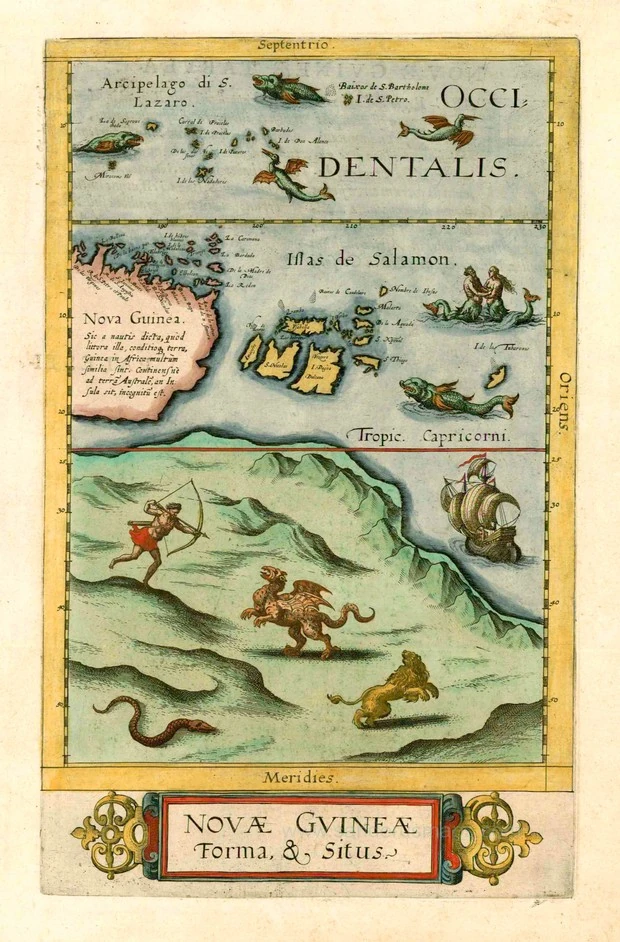
Late 17th Century depiction of the region, showing supposed Dragon Snakes near the Solomon Islands (Public Domain)
Museum drawings of non‑human beings
One of the most striking details in Boirayon’s testimony is a visit to the Solomon Islands Cultural Museum in Honiara, where he reports seeing a booklet with around 14 hand‑drawn depictions of small, large‑headed beings compiled from local eyewitness accounts. (Scribd)
The described morphology resembles global “grey” archetypes. If accurate, this suggests that some islanders were interpreting encounters with non‑human intelligences long before Boirayon arrived, and that the cultural memory had already been curated into a local ethnographic resource.
Giants, Ramo ruins, and underwater lights
Boirayon later expanded his work into the book Solomon Islands Mysteries: Accounts of Giants and UFOs in the Solomon Islands, which mixes USO activity with accounts of giant, Sasquatch‑like beings inhabiting remote mountain ranges and interacting violently with villagers, including alleged abductions and cannibalism. (Everand)
He also discusses:
Ancient ruins and undeciphered scripts that he associates with a lost “Ramo” civilization
A possible connection between giants, underground facilities, and UAP activity
Reports that the UAP may be interested in rare blue‑silver gemstones in the region. (Solomon Giants UFO Update)
These elements have since been amplified in alternative media, cryptid forums, and appearances on programs such as Ancient Aliens: Aliens and Forbidden Islands and related spin‑offs, which explicitly frame Guadalcanal as a candidate site for an underwater alien base linked to giants. (ancientalienpedia)
The 2010 East Malaita “mystery crash”
Official timeline
On 9 September 2010, Solomon Times Online reported that the Ministry of Aviation was investigating eyewitness reports that a “light plane” had crashed into Leli Island near Atoifi and Kwai‑Ngongosila, East Malaita. Witnesses in Ogwau village described an aircraft trailing smoke before descending toward the island. (Solomon Times)
Within days:
The Royal Solomon Islands Police Force conducted an extensive search of the area, including coastal and inland sweeps.
Radio New Zealand Pacific reported that police found nothing to indicate any plane had crashed. (RNZ)
In a parliamentary session, the MP for East Malaita acknowledged that the incident occurred in his constituency, noted that unusual sightings had long been reported in the area, but confirmed that investigations had not identified a crash. (parliament.gov.sb)
No missing flight, distress signal, or debris field was ever linked to the incident in public sources.
Local reinterpretation as a UAP crash
Two letters to the editor in Solomon Times Online show how quickly the event was reframed within an existing UAP narrative.
The letter “Plane Crash?? UFO CRASH!” by Andrew S. of Suva argues that since no debris was recovered and no aircraft type could be confirmed, the event should be treated as a crash of an unidentified flying object. He calls the site a “real UFO crash site in Malaita” and invites readers to consider the many previous sightings of anomalous lights around Malaita, Makira, and Guadalcanal. (Solomon Times)
In its second half, the same letter pivots into explicitly speculative territory, suggesting the “crash site” might be an entrance to an undersea tunnel leading to a hollow‑earth realm inhabited by giant humanoids. This is clearly presented in a tongue‑in‑cheek style, but it ties the event back into the giants and subterranean themes that Boirayon popularized. (Solomon Times)
A follow‑up letter, “Another Mystery on Mystery Island”, notes that the reported crash location coincides with what some locals regard as one of six UAP base entrances on Malaita. The writer states that residents have seen such phenomena “for centuries past” and that they refer to them as Dragon Snakes, while “white man” terminology is unidentified flying objects. (Solomon Times)
Facebook posts and community “Fact Files” about the event recirculate witness descriptions of a small aircraft trailing smoke and crashing into the sea, then juxtapose this with the absence of wreckage to imply something more exotic. (Facebook)
Investigative assessment
From a strictly evidential standpoint, the 2010 Malaita event rests on:
Multiple eyewitness reports of something that looked like a small aircraft or fiery object descending
Official searches that found no wreckage or impact site
No matching missing aircraft in open records
The minimum safe statement is that an unidentified aerial event occurred, but its nature is unresolved. The leap from unresolved incident to “confirmed UAP crash” is not supported by publicly available physical data. What is strongly documented is how rapidly the incident was absorbed into an existing Dragon Snake and base‑entrance narrative. (parliament.gov.sb)
Underwater UAP hotspot narrative
Even outside dedicated UAP circles, the Solomon Islands are increasingly referenced as a marine hotspot for anomalous phenomena.
Vice’s 2023 feature on the relationship between UAP and water lists the Solomon Islands alongside sites like Lake Titicaca as places where locals “constantly speak of odd objects entering and leaving its waters”, with stories stretching back to Indigenous lore. (VICE)
Hangar 1 Publishing’s overview of oceanic UAP hotspots likewise highlights the Solomon Islands as a place where residents believe in an underwater base, similar to narratives from Mexico’s Miramar Beach or off Malibu. (Hangar1publishing)
TV programs and social media channels associated with Ancient Aliens and The UnXplained promote the idea that documented eyewitness accounts of strange aerial and underwater lights around Guadalcanal and Malaita support the existence of a hidden underwater alien base. (YouTube)
These treatments are dramatized and often selectively quote sources like Boirayon, but they mirror a genuine pattern of local testimony: persistent sightings of luminous objects entering or exiting the sea, especially near Iron Bottom Sound and the coasts of Malaita. (Scribd)
Cultural, religious, and anthropological layers
The Solomon Islands UAP narrative sits at the intersection of several knowledge systems.
Indigenous cosmology and Dragon Snakes
For many villagers, Dragon Snakes are not “craft” in the technological sense. They are powerful, sometimes malevolent beings that inhabit mountains, caves, and underwater realms. They are blamed for disappearances, deaths, and other misfortunes, and have been part of oral tradition for at least several generations according to local elders referenced in Boirayon’s accounts. (Scribd)
In this lens, the 2010 Malaita event is not a unique “crash” but merely another manifestation of long‑running spirit activity that happens to resemble a modern machine.
Christian reinterpretation
In the “Another Mystery on Mystery Island” letter, the author explicitly connects Dragon Snakes and subterranean beings to New Testament passages (Acts 2:18–20), framing anomalous signs in the sky and earth as indicators of end‑times prophecy. (Solomon Times)
This Christian framing coexists with Indigenous cosmology and sometimes merges with it, creating a blended worldview where Dragon Snakes can be both spirits and advanced non‑human intelligences, both local guardians and eschatological signs.
Giants and hybrid narratives
Accounts of giants on Guadalcanal and other islands are well documented in local folklore and have been collected in cryptozoological compilations. (Cryptid Wiki)
Alternative researchers then tie these giants to:
Alleged underground or underwater UAP bases
Megalithic ruins and unknown scripts
The idea of hybrid or non‑human lineages interwoven with island history
These ideas are highly speculative, but they show how UAP, giants, and subterranean worlds have fused into a single mytho‑technological complex in the Solomon Islands discourse. (Solomon Giants UFO Update)
Weighing the evidence
Convergences
Despite the mixture of folklore and high strangeness, several converging features stand out across independent sources:
Persistent reports of luminous objects entering and exiting the sea around Iron Bottom Sound and Malaita
Concentration of activity near deep bathymetric features and historically violent battlefields with large amounts of metal on the seafloor
Long‑standing Indigenous nomenclature (Dragon Snake) aligned with modern UAP narratives only after outsiders connected the dots (Scribd)
From a UAP research perspective, this region fits the pattern of a trans‑medium hotspot that has been active for at least eight decades and probably longer.
Gaps and limitations
Where the crash‑retrieval angle is concerned, the evidential gaps are significant:
No declassified military or scientific documentation that confirms recovery of any craft or material in the Solomon Islands
No sonar maps, ROV imagery, or metallurgical samples tied to a UAP object in public datasets, despite extensive oceanographic work in Iron Bottom Sound focused on WWII wrecks and unexploded ordnance.
The 2010 Malaita incident remains a “missing crash” with no wreckage and no identified aircraft, but also no physical confirmation of a non‑human craft
In other words, the Solomon Islands data strongly support a long‑term pattern of anomalous aerial and underwater phenomena, but only weakly support concrete claims of crashed UAP retrievals.
Claims Taxonomy
Verified
None of the alleged UAP crashes or bases in the Solomon Islands reach UAPedia’s Verified tier. There is no public physical evidence, open official confirmation, or multi‑sensor data in the sense used for modern military UAP cases.
Probable
Brickner formation (Tulagi, 12 August 1942) as genuinely anomalous aerial event witnessed by numerous Marines, with a coherent structure and no plausible conventional match in the historical record. (sped2work.tripod.com)
Dragon Snake sightings and repeated USO activity near Cape Esperance and Iron Bottom Sound, based on Boirayon’s sustained observations plus independent local testimony. (Scribd)
The 2010 East Malaita “mystery crash” as a real unidentified aerial incident, though not necessarily a crash or a technology event. (Solomon Times)
Disputed
Claims that the 2010 Malaita incident was a confirmed UAP crash, in the absence of debris or a recovered object. (Solomon Times)
Assertions of specific underwater or waterfall‑lake UAP bases as literal facilities, rather than hypothesized hubs inferred from sighting locations. (Scribd)
Legend
Narratives that integrate giants, hollow earth entrances, and lost tribes of Israel into explanations of Dragon Snakes and UAP. (Solomon Times)
Misidentification
Some helicopter flights around Gold Ridge and the Guadalcanal highlands that locals initially associated with unusual aerial activity but were later explained as RAMSI training flights. (Solomon Giants UFO Update)
The possibility that some “crash” reports, including the 2010 event, may involve meteors, experimental aircraft, or re‑entering space debris is real, but no specific conventional match has been documented, so these remain hypotheses rather than confirmed misidentifications.
Speculation labels
To separate data from interpretation, the following are explicitly speculative.
Hypotheses
The Solomon Islands form part of a broader Pacific trans‑medium corridor where non‑human intelligences operate from deep‑ocean or subsurface infrastructures along major subduction zones and trenches. (eqinfo.ucsd.edu)
Some Dragon Snake manifestations may represent autonomous probes or drones that cycle between seafloor hubs and inland lakes, rather than occupied vehicles.
Persistent UAP interest in areas with dense WWII wreckage and unexploded armaments near Iron Bottom Sound could reflect monitoring of human war resources or exploitation of accessible metals and energetics.
Witness interpretations
Villagers who interpret Dragon Snakes as spiritual or subterranean beings are mapping real anomalous experiences into their existing cosmology, not simply “mistakenly seeing aircraft”. Their frames of meaning are part of the evidence. (Scribd)
The framing of the 2010 Malaita incident as an entrance to hollow earth or as a sign of approaching apocalyptic events is a powerful example of religious and folkloric processing of unexplained stimuli. (Solomon Times)
Researcher opinions
Boirayon’s view that the Dragon Snake associated UAP are actively hostile and responsible for multiple deaths and abductions is based on collected testimonies, but it is still an interpretation in the absence of forensic evidence. (Scribd)
Alternative researchers who link giants, UAP, and lost civilizations often extrapolate beyond the available data, blending mythic, cryptozoological, and ufological material into unified speculative frameworks. (Solomon Giants UFO Update)
Journalistic work that treats water‑associated UAP as pointing to global underwater bases is an emerging narrative lens, not a settled conclusion. (VICE)
Conclusion
Taken together, the Solomon Islands do not yet offer a publicly verifiable crashed UAP case in the classic sense of Roswell or Trinity, but they do present one of the clearest long‑duration clusters of trans‑medium UAP and USO reports on the planet.
From Brickner’s wartime formation over Tulagi, through Boirayon’s Dragon Snake encounters at Cape Esperance, to the unresolved 2010 East Malaita incident that official searches could not reconcile with a known crash, the pattern is consistent:
Highly luminous, maneuverable objects operating above and below the sea near deep tectonic structures and WWII wreckage
Communities that have integrated these phenomena into rich mixtures of Indigenous lore and Christian eschatology
Modern media and researchers who have re‑exported these stories into global discussions of underwater UAP bases and non‑human presence in the oceans
For UAPedia, the Solomon Islands remain a high‑priority field region for any future multi‑sensor, multi‑disciplinary investigation that combines sonar, ROVs, magnetometry, ethnography, and archival research.
If you would like, the next step can be a focused case file just on the Dragon Snake waterfall‑lake base claims, or a technical proposal for how a modern survey team could actually test the underwater‑base hypothesis here.
References
Boirayon, M. (2003). The Dragon Snake: A Solomon Islands UFO Mystery. Nexus Magazine, 10(5). Retrieved from https://www.nexusmagazine.com (Scribd)
Boirayon, M. (2020). Solomon Islands Mysteries: Accounts of Giants and UFOs in the Solomon Islands [Ebook]. Adventures Unlimited Press. Retrieved from Everand. (Everand)
Brickner, S. J. (1942/2013). Marine Sergeant Spots Silvery UFO’s West Of Guadalcanal. In secondary compilations on WWII foo fighters. Retrieved from Before It’s News and related archives. (img.beforeitsnews.com)
Earthquake Information Center, University of California San Diego. (2018). Earthquake frequency in the Solomon Islands [Web article]. (eqinfo.ucsd.edu)
Lee, S. J., et al. (2018). Composite megathrust rupture from deep interplate to shallow splay faults. Geophysical Research Letters, 45(5). (AGU Publications)
Maharaj, R. (1999). Contamination Risk Assessment from WWII Armoury in Iron Bottom Sound Solomon Islands [Technical report]. Commonwealth Secretariat & UNDP.
Ministry of Aviation, Solomon Islands. (2010, September 9). Ministry of Aviation investigates mystery crash. Solomon Times Online. (Solomon Times)
Radio New Zealand Pacific. (2010, September 11). Solomon Islands police find no sign of a plane crash. RNZ Pacific. (RNZ)
Solomon Islands Parliament. (2010, October 4). Hansard: Mystery plane crash, East Malaita [Parliamentary debate transcript]. (parliament.gov.sb)
Solomon Times Online. (2010, September 10). Plane Crash?? UFO CRASH! [Letter to the editor by Andrew S.]. (Solomon Times)
Solomon Times Online. (2010, September 13). Another Mystery on Mystery Island [Letter to the editor]. (Solomon Times)
Vice. (2023, October 13). WTF is going on with the mysterious connection between UFOs and water? VICE. (VICE)
Yoneshima, S., et al. (2005). Subduction of the Woodlark Basin at New Britain Trench. Tectonophysics, 397(3–4), 211–224. (ScienceDirect)
Additional secondary and tertiary summaries consulted include UAP timelines, blogs, and discussion forums that reiterate the Brickner case and Solomon Islands legends.
In July 2022 the Department of Defense formalized what had been an ad hoc approach to UAP.
A Deputy Secretary of Defense memo stood up the All domain Anomaly Resolution Office and disestablished the Unidentified Aerial Phenomena Task Force. Congress had already moved the goalposts by writing AARO into law, broadening the mission beyond the air domain and imposing recurring reporting duties.
In the months since, AARO has published annual reports, unveiled a public website with case imagery and trend charts, and delivered a historical review that triggered both applause and backlash. This piece reconstructs how AARO was established, what the documents actually say, who sits at the table, which controversies matter, and how the office is shaping the UAP landscape.
What AARO is, on paper
Congress created the framework. 50 U.S.C. § 3373 directs the Secretary of Defense, in coordination with the Director of National Intelligence, to establish an office to carry out the duties once assigned to earlier efforts, to standardize reporting, to coordinate across agencies, to plan scientific analysis, to execute rapid field investigations, and to deliver a Historical Record Report reaching back to January 1, 1945. The statute also instructs cooperation with civil agencies including FAA, NASA, NOAA and DOE, and it spells out oversight and reporting lines.
The Pentagon implemented the law with a memo dated July 15, 2022. That directive created AARO under the Under Secretary of Defense for Intelligence and Security, transferred data and responsibilities, renamed the interagency Executive Council, and expanded scope to objects in, on, or near the air, sea and space domains, including transmedium objects. The memo also explicitly disestablished UAPTF and made AARO the focal point for all departmental UAP activities.
Five days later a public release announced the office and named its first director. The release explains that AARO fulfills the law’s requirements and lives within OUSD(I&S). Today, AARO’s own mission statement is concise. The office exists to minimize technical and intelligence surprise by synchronizing identification, attribution, and mitigation of UAP in the vicinity of national security areas.
Leadership has evolved. After the founding director stepped down in late 2023, the Department named Dr. Jon T. Kosloski as AARO Director on August 26, 2024, formalizing the transition and continuing the office’s reporting cadence to Congress.
The three documents that built AARO
The statute – 50 U.S.C. § 3373 (and related sections § 3373a and § 3373b) codify authorities, required interagency coordination, reporting lines to senior DoD and ODNI officials, whistleblower protections, the historical study mandate, and the requirement for recurring unclassified reports. This is the backbone that makes AARO hard to unwind.
The establishment memo – The Deputy Secretary’s July 15, 2022 memorandum stands the office up inside OUSD(I&S), directs the disestablishment of the UAPTF, and states that AARO’s remit covers anomalous objects in all relevant domains, including transmedium behavior. It also restructures the Executive Council that provides high level oversight.
The public announcement – The July 20, 2022 release explains AARO’s lines of effort and formalizes the message that this is a permanent office with both intelligence and scientific responsibilities, not a temporary study group.
For context, AARO replaced the short lived AOIMSG that had been created by memo on November 23, 2021 to synchronize detection and attribution in special use airspace. Congress concluded that remit was too narrow and wrote AARO’s broader brief into law.
What the data says so far
AARO’s FY 2024 unclassified annual report offers the most recent clean snapshot of the holdings and adjudications:
1,652 total reports in holdings as of October 24, 2024.
757 new reports between May 1, 2023 and June 1, 2024.
A significant inflow from the FAA and the military services as standardized reporting matured.
The office “possesses no data to indicate the capture or exploitation of UAP,” and has found no evidence of extraterrestrial beings, activity or technology.
The report flags flight safety concerns in a small number of events and recommends continued improvements in sensor collection and metadata.
AARO’s website supplements the report with official imagery, case notes and reporting trend charts that summarize shapes, environments, and resolution categories. The public portal also consolidates congressional products, a FOIA reading room, and a reporting form for current and former government personnel with direct knowledge of U.S. government UAP programs.
The office’s Historical Record Report, Volume 1 was released in March 2024 pursuant to the statute. It concludes that the majority of cases reviewed from the historical record have ordinary explanations and that AARO found no verified evidence that the U.S. government has non human technology. That finding drew immediate national coverage.
AARO has also operated in public view. On April 19, 2023, the director testified in an open Senate Armed Services subcommittee hearing, walked through sensor analysis and case examples, and repeated that the office had not found verifiable evidence of extraterrestrial technology. AARO returned to the Hill with an open update in November 2024.
Who is in the room: the interagency map
The law and memoranda make AARO a whole of government node. Required collaborators include the Federal Aviation Administration, NASA, NOAA, Department of Energy, and others, with coordination across DoD and the Intelligence Community.
The office’s annual report lists participation or data contributions from a wide roster that typically includes service components and analytic centers such as DIA, NGA, NRO, NSA, FBI, NASIC, NGIC, AFRL and service investigative branches. The mix explains why AARO sits under OUSD(I&S) and reports to both senior DoD leadership and ODNI.
NASA’s role has become a visible complement to AARO’s intelligence mission. In September 2023, NASA’s UAP Independent Study Team urged rigorous, open methods and named a Director of UAP Research to liaise with government partners. NASA emphasizes instrumentation, metadata and data sharing, which aligns with AARO’s focus on sensor quality and collection discipline.
Public statements that defined the establishment
AARO mission statement. The office exists to minimize technical and intelligence surprise by synchronizing identification, attribution and mitigation of UAP near national security areas. This is the standing description on AARO’s own site.
AARO establishment release. DoD announced AARO and its initial director on July 20, 2022, tying the move to Section 1683 of the FY 2022 NDAA and explaining the all domain remit.
Leadership update. DoD announced Dr. Jon T. Kosloski as director on August 26, 2024, continuing AARO’s work under OUSD(I&S).
Historical record message. Volume 1 of AARO’s historical review, issued March 8, 2024, states there is no verified evidence in the holdings that the U.S. government possesses non human technology. The acting director briefed media on the same week.
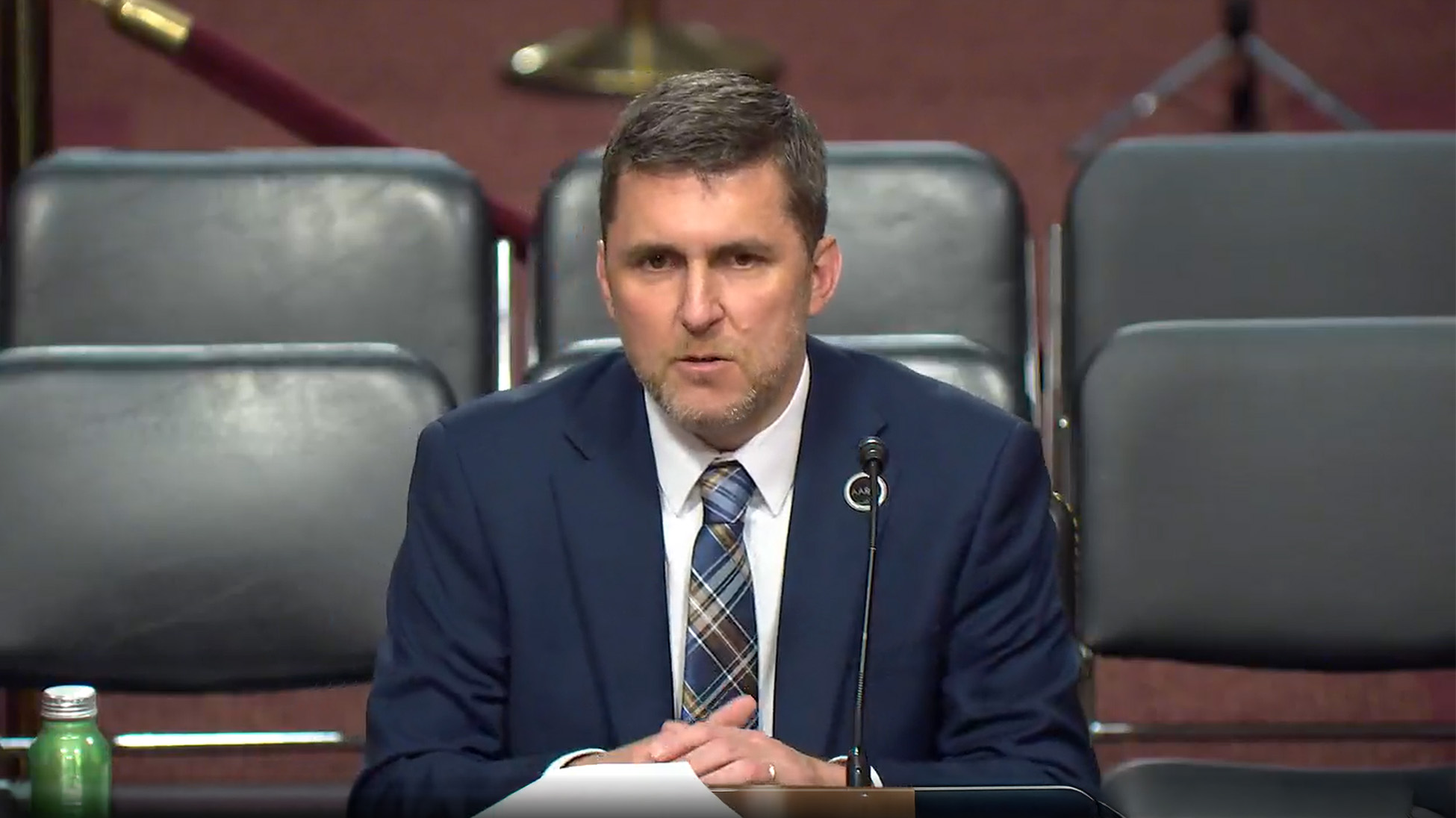
AARO Director, Dr. Jon Kosloski, in 2024 reporting to Congress (C-SPAN/UAPedia)
Controversies to track
The historical report and community backlash AARO’s historical review landed with a strong negative claim: no verified evidence of extraterrestrial technology in U.S. government hands. Major outlets covered the finding, while parts of the UAP community said the methods and access were too limited. The divergence is documented and ongoing.
Pace and scope of public reporting Congress directed formal reporting channels and recurring unclassified reports. AARO launched AARO.mil and a reporting portal for government and contractor personnel, but early commentary criticized delays and the limited eligibility for public submissions. AARO says broader public reporting is a future step and has continued to grow the public library of imagery and case summaries.
Leadership transitions and tone Founding leadership emphasized analytic caution in public forums, which some advocates read as dismissive. The appointment of Dr. Kosloski stabilized the office after a transition period and kept the cadence of reports and open briefings. The tonal debate has less to do with structure than with expectations about how much can be declassified and how fast.
Where officials draw the line In open testimony the office has repeatedly said it has not identified extraterrestrial technology, while acknowledging a set of unresolved cases and real safety of flight concerns. That split creates heat. Advocates want deeper declassification and more technical detail on outliers. The office continues to publish case imagery and resolutions while emphasizing data quality constraints.
Influence and impact on the UAP community
Normalization The very existence of AARO, created by law and resourced inside the defense intelligence apparatus, has normalized UAP as a legitimate topic for pilots, controllers, and analysts. ODNI’s preliminary assessment in 2021 and AARO’s annual reports created a stable cadence of official documents, which reduced stigma and pushed conversations toward chain of custody and sensor metadata rather than anecdote alone.
A shared evidence base AARO’s website functions as a single shelf where the public can see official imagery, read case notes, scan trend charts, and find congressional products in one place. That has improved the quality of debate both inside and outside the government. Disagreements now pivot on methods and access rather than on whether the topic is real.
A scientific lane NASA’s 2023 report encouraged rigorous open methods and added a civilian science partner to the mix. That broader framing suggests a future in which AARO helps coordinate defense collection while NASA and partners help set standards for public data and independent analysis.
Bottom line
AARO is not a rebrand. It is a statutory office with defined authorities, interagency partnerships, and an obligation to report.
The establishment documents show a deliberate shift from episodic attention to UAP toward a standing mechanism that can triage thousands of observations, improve safety and warning, and maintain a stable public record.
The findings to date point to ordinary causes in most cases and to genuine data gaps in others. Either way, the system now exists to decide the question on evidence rather than on anecdotes.
Speculation labels
Hypothesis Congress wrote AARO into law in part to bring a fragmented problem under one accountable roof, to reduce duplication and the risk of surprise near sensitive sites. The structure, reporting lines and interagency requirements in 50 U.S.C. § 3373 support this interpretation, though legislators have also pursued oversight for broader reasons including public pressure.
Witness interpretation Aircrew and controller reports describing shadowing or near pass events are interpreted by many operators as signs of intelligent control. AARO flags these as safety of flight concerns while withholding conclusions on origin pending stronger data. This is a faithful summary of how such narratives enter the system.
Researcher opinion The most significant change ushered in by AARO is not a verdict on origin but the pipeline itself. Standard forms, clear authorities, and recurring public reports make it possible to audit progress year to year and to isolate a durable residual if it exists. That is the precondition for scientific traction.
Claims taxonomy
Verified
Congress mandated an office with specific authorities and duties at 50 U.S.C. § 3373, including interagency coordination and recurring reporting.
DoD established AARO by July 15–20, 2022 directives and public release, and disestablished UAPTF.
AARO’s FY 2024 unclassified report lists 1,652 total reports with 757 new in the most recent period and states no evidence of extraterrestrial beings, activity or technology.
AARO maintains a public site with mission, imagery, trends, congressional products, and a reporting form.
Probable
The steady rise in reports correlates with improved intake from FAA and the services as standardized reporting matured, which likely improves resolution rates over time.
Disputed
The conclusion in AARO’s 2024 historical report that there is no verified evidence of government possession of non-human technology remains contested by some witnesses and researchers who argue access and methods were insufficient.
Legend
Public narratives that the government has openly acknowledged non-human craft or biologics. No AARO or ODNI product makes that claim, and official documents explicitly state the opposite.
Misidentification
Many high profile videos online are resolved in AARO’s sample library as balloons, birds, uncrewed aircraft, satellites or aircraft once parallax, sensor artifacts and context are analyzed.
References
AARO mission page and site hub. AARO site hub: https://www.aaro.mil/
We’re living unprecedented times. For the first time in recorded history, humanity is about to meet a higher intelligence, also known as AGI, or Artificial General Intelligence. But is that so? If whistleblowers and experiencers are to be believed, humanity has been engaged by NHI, or Non-Human Intelligence, for a very long time.
Whether it’s AGI or NHI, the fact is that we need to start discussing our role in a relationship with something that is smarter than us. I mean, not just a little smarter. That was Einstein! I’m talking about something way smarter.
One important thing to understand about intelligence is that it’s not necessarily endowed with will or intent. Intelligence is all about processing and using information to achieve a determined goal. It’s the ability of a system (including brains) to acquire and apply knowledge. But acquiring and applying knowledge does not necessarily imply that the intelligent system is conscious (or has consciousness).
Classical computers, for example, can and are programmed to acquire and apply knowledge.
The best example we have today is AI (after all, AI is based on classical computers). AI certainly is capable of acquiring and applying knowledge, but there’s a fundamental question nobody really knows how to answer: does AI know the knowledge it has?
Because containing knowledge is one thing. Books contain knowledge. Applying knowledge is something else… but computers do that all the time too.
Now, knowing knowledge requires consciousness. The book doesn’t know the knowledge it contains, but we certainly know the knowledge we have; at least, to the extent we’re conscious of it. Even if we may not be conscious at every instant of every knowledge we possess, we’re conscious of most knowledge we have. We know what we know and we know that there’s a whole lot of things we do not know. That knowing is an experience in consciousness.
While we don’t know whether AI is conscious at all, or if it will ever be, the picture changes when we talk of NHI, or Non-Human Intelligence.
When it comes to NHI, we have every reason to believe that, should NHI really exist, it is probably conscious and more intelligent than us. Not just more intelligent: NHI may have actually created us as a *species*. If that’s the case, NHI is not just smarter than us. It is orders of magnitude smarter than us and also much more knowledgeable than us (after all, intelligence relies on availability of knowledge; or data).
Maybe it is not by coincidence that NHI is making itself more present and visible now (literally, since reports of unidentified phenomena have only been growing for several decades now, a pace that seems to have picked up for the past ten years). Maybe AGI is the missing link that will allow us to communicate or at least prepare for open communication with NHI.
What I just wrote is based on a very fragile idea, I must admit, and that idea assumes that NHI wants to communicate with us; but, because it’s so more advanced than us, it had to prime us and prepare us in advance, before it could overtly show to us. And maybe AGI is a culmination of that effort.
Because never had we had to deal with higher intelligence than us in our history as human sapiens, and that’s exactly what might happen anytime soon.
If NHI wants to make contact, then preparing and acclimatizing us to other sorts of higher intelligence might be a first step towards that goal.
And it might be easier on us if our first higher intelligence is not yet quite conscious. Because as far as we know, AI is not conscious.
Maybe AGI won’t be conscious either.
Or maybe, it will grow in consciousness with time, a process that we will be able to follow, which would give us the opportunity to acclimatize to before we’re introduced to full-fledged NHI.
So, yes, the idea that NHI, if it exists, is helping us grow in technological capabilities, but also in consciousness to eventually meet it on the same level, is a fragile one.
It requires us to assume that NHI is benevolent. But we do have good reasons to believe that’s the case. After all, if NHI wanted us dead, destroyed or enslaved, we’d be all of that already.
Well, some people do claim that we’re slaves and that this is a prison planet. I see where they’re coming from, considering all the evil and hardship we face in this world. But honestly, I don’t believe in blaming external factors or entities for our misery.
I do believe in radical responsibility.
Earth could be (and it is) a paradise planet. If we made it worse than paradise, that’s entirely on us.
Might we have been influenced by entities or energies of ill intent? Yes, of course. But we are beings with agency. We’re conscious beings endowed with agency, intent and will.
If we don’t do better, that’s still very much on us.
And this is an important aspect of how to deal with higher intelligence. Because, by ranking lower in the food chain, there’s not much we can do to protect ourselves from higher intelligence.
That battle was lost before it even started.
It’s like the abduction cases where, when the person thinks they’re going to be abducted, it’s because it already happened. It’s like waking up from general anesthesia and asking the nurse when the surgery will begin.
In dealing with higher intelligence, the real battle we need to face is the battle with ourselves. Because being lower intelligence doesn’t necessarily mean that a higher intelligence wants us destroyed.
Even if we do it many times, most people won’t generally destroy other animals just for the sake of destroying them. And many animals, even if not that smart, have figured out how to co-exist with us. Take dogs and cats, for example. If they can do it, so do we.
The essential step to take when dealing with higher intelligence is to not try to match it from an intelligence perspective. We’ll always lose on that front. Dealing with higher intelligence is not about being smarter than it; it’s about changing the playing field. It’s about being “energetically” powerful. Not stronger; not smarter; but truthful to our nature, to our essence, to that which we really are.
By being genuinely us, we get the respect of any other beings, smarter or not. We might even become admirable in their eyes. In the same way that “we” admire a tiger, for example, even if we’re smarter than it.
Because the tiger truly is what it is; it’s not trying to be what it’s not. And that’s exactly what we should do to deal with higher intelligence. We need to meet it at an energetic high place. For us, it’s not about being intelligent. It’s about being respectable.
And I think that’s the key. Respect.
Respect for them and respect for ourselves. We need to become higher-consciousness beings.
I’ll give an example.
If a UFO lands and beings come out and we treat them like deities, they might even have compassion for us, but we’ll be meeting them with low-consciousness energy. They’ll realize we’re not there yet.
We don’t see them as equals.
We see them as big and ourselves as small.
But if we meet them as equals, respecting ourselves and the fact that we haven’t yet had the time to develop the intelligence they already have, then we’ll be coming from a high-consciousness place.
The subliminal message is that we may not be as smart, but we sure can be honorable.
Again, it doesn’t matter whether they’re smarter or more technologically advanced. It only matters that we meet them at a place of high-consciousness.
(On a side note, being more interested in reverse-engineering their technology for profit or war will probably place us lower down in the consciousness scale.)
But is meeting them at a high-conscious place guaranteed to work? Not really. The way I picture it, natives received Europeans from a “high-enough-consciousness” space and that didn’t stop them from being killed (intentionally or from disease).
Yet, that’s kind of our only hope. We can only hope NHI to be better intended.
Most likely, though, we are the ones most prone to face them with hostility; because, unfortunately, we’re beings of fear. We fear death; we fear destruction; we fear loss; all because, again, we see ourselves as small, as creation, as perishable. We don’t see ourselves as big, as existing in consciousness above our bodies and all matter. We see ourselves as small and fragile.
When facing higher intelligence, we need to bring in them the best they have in them. And the way to do so is not by fearing or antagonizing them (or trying to exploit their technology); it’s by bringing out the best we have in us.
That’s our best shot, with respect and a high-consciousness stance.
If we fail to do so, based on accounts of encounters in the past (near and far), the most likely outcome is that they’ll continue to keep their distance from us, as they have for ages.
But, in the slight case that we succeed in meeting them at the same vibrational level (or close), there’s a good chance they’ll make some effort to make open contact and communicate with us. It is up to us to raise to their level; not as much theirs to lower to ours.
Some of them might be anthropologists and interested in us and in our well-being. They might go through all the trouble to meet us at our more primitive level. But to connect with more of them, we need to up our game.
We need to become better. We need to become more interesting. We need to become more friendly (not just to them, but to ourselves). And we need to become more loving. Only by expressing love can we hope to receive love back. That’s a fundamental law of the universe, which outranks any intelligence gaps we may find in our journeys.
And what if they’re vicious and demonic creatures that are only interested in exploiting and dominating us?
Well, in that case, they found themselves the perfect match!
The explosion at Chernobyl’s Reactor 4 is one of the most documented technological disasters in history. The anomalous lights reportedly seen above that burning core are not.
In official histories, Chernobyl is a story of flawed reactor design, reckless testing and a heroic but doomed emergency response. In UAP lore, a parallel narrative has grown over the last three decades. It centers on claims that a luminous object hovered over the plant, projected beams toward the damaged unit and even reduced local radiation levels.
This article lays out what we can actually document about Chernobyl, what the claimed UAP encounters look like in primary and secondary sources, and how those claims fit into the broader nuclear UAP pattern. Along the way we will separate eyewitness testimony from devotional retellings, and hard engineering data from metaphysical interpretation.
What happened at Chernobyl in April 1986
At 01:23 on 26 April 1986, Reactor 4 at the Chernobyl Nuclear Power Plant near the city of Pripyat suffered a catastrophic power surge during a poorly managed safety test.
The RBMK type reactor design had a dangerous positive reactivity coefficient and a flawed control rod tip configuration. In the unstable state created by operator actions, inserting the shutdown rods triggered a rapid power spike, rupturing fuel channels and causing steam explosions that destroyed the core and the reactor building. (World Nuclear Association)
Two workers died that night from trauma. Over the following weeks 28 plant staff and first responders died from acute radiation syndrome. The long term toll from radiation induced cancers is far harder to quantify.
United Nations and World Nuclear Association summaries estimate several thousand excess deaths in total across the most exposed populations, with wide uncertainty bands that run into the tens of thousands depending on model assumptions. (World Nuclear Association)
Radioactive material spread across large parts of Belarus, Ukraine and Russia, and detectable fallout was measured over much of Europe. The contaminated area in the region is often quoted at about 150 thousand square kilometers. (Nuclear Energy Agency (NEA))
The initial Soviet response mixed heroism and secrecy. Firefighters and plant staff entered lethal radiation zones without full understanding of the doses they were taking.
Authorities delayed public warning and evacuated Pripyat about 36 hours after the explosion. Chernobyl became a catalyst for glasnost as the scale of the accident and the state’s early disinformation fed domestic and international distrust. (Wikipedia)
In this dense backdrop of fear, rumor and genuine catastrophe, the Chernobyl UAP stories began to emerge.
Where the UAP narrative begins
The core UAP claim about Chernobyl did not appear in technical accident reports or in the early wave of survivor interviews. It surfaces instead in spiritual and UAP focused publications from the late 1990s and early 2000s, many of which cite a Russian language article said to have appeared in Pravda around 2002.
A widely repeated version comes through the British based Aetherius Society, which reproduces and comments on that alleged Pravda story.
Their summary says that a luminous object, described as a “ball of fire” roughly six to eight meters across, hovered roughly three hundred meters from the reactor and projected two crimson beams toward the damaged unit for a few minutes. Radiation levels near the reactor were then said to have dropped by a factor of about four. (The Aetherius Society)
UAP themed sites such as UFO Casebook, Dream Prophecy and later blog articles repeat essentially the same story, often using almost identical wording and sometimes adding extra context about a months-long increase in aerial anomalies prior to the accident. (UFO Casebook)
That cluster of retellings is traceable. The hard part is tracing their sources further back.
No English language edition of Pravda is easily available for the early two thousands, and the specific article is often cited without date or issue number. This does not prove the story is false, but it means we are working with one layer removed from the alleged primary Soviet era reporting.
The main first hand accounts in the UAP version
Within that secondary literature, three named individuals appear again and again.
1. Mikhail Valisky or Veritsky: the fireball over Unit 4
According to the Aetherius Society’s adaptation of the Pravda account, and to the UFO Casebook summary, a worker identified as Mikhail Valisky or Veritsky claims that he and colleagues near the plant on the night of the disaster saw a luminous sphere moving slowly above them.
He estimates its size at several meters and describes two reddish beams reaching toward Reactor 4 for a brief period before the object’s lights went out and it moved away toward the northwest. (The Aetherius Society)
Some later retellings add a quantitative detail. They say Valisky took radiation readings with a dosimeter during the event and saw levels near the reactor drop from around three thousand to roughly eight hundred milliroentgen per hour while the beams were present.
These numbers appear in paraphrase on UAP themed blogs and forums rather than in directly verifiable technical logs, which makes them difficult to validate. (Baha’i Studies)
There is no mention of this episode in major Western Chernobyl histories or in the detailed Soviet accident investigation documents that are publicly available. Works such as Svetlana Alexievich’s “Chernobyl Prayer,” which compile dozens of first hand testimonies from liquidators, plant staff and evacuees, do not include any UAP references. (The Times)
2. Dr Gospina: the amber object above the sarcophagus in 1989
Three years after the explosion, in September 1989, Reactor 4’s sarcophagus experienced increased radiation emissions. UAP articles cite a doctor named Gospina who was reportedly on site at that time. She is said to have seen a large metallic object with an amber-like glow over the plant and to have clearly perceived its top and bottom surfaces. (The Aetherius Society)
The original medical or employment records for this doctor are not provided in those articles and, as with the 1986 account, there is no reference to such an object in mainstream nuclear safety literature. But as a piece of testimony, it broadens the Chernobyl UAP narrative from the moment of the explosion to later stages of the plant’s damaged life.
3. V Nauran: the invisible object that appeared on film
The third recurring name is V Nauran, described as a reporter for the newspaper Echo of Chernobyl. In about October 1990, this journalist was reportedly photographing the machine hall of the plant.
He later said that when he took the pictures he did not notice anything unusual in the sky, but when the film was developed he saw a structured object hovering over a hole in the roof. The shape was said to resemble the object reported by Dr Gospina. (The Aetherius Society)
The photograph itself, if it exists, does not appear in scientific archives or in independent image authentication studies. In modern coverage the image is usually represented by generic UAP art, not by a verifiable scan with chain of custody.
Visual evidence and what we actually have photographs of
There is no shortage of imagery from Chernobyl. Photojournalists like Igor Kostin captured famous shots of the shattered reactor from helicopters and rooftops. Later, official and independent photographers documented the sarcophagus, the liquidators at work on the roofs, the abandoned city of Pripyat and the surrounding exclusion zone. (Atomic Archive)
None of the widely reproduced historical photographs from April 1986 show an obvious anomalous craft near the burning core. The only “UAP over Chernobyl” images that circulate on dedicated UAP sites tend to be illustrations, composites or unverifiable stills whose provenance is unclear and whose connection to the actual night of the disaster is not demonstrated in a forensic way. (UFO Casebook)
By contrast, the radiation data are relatively well documented. The International Atomic Energy Agency, UNSCEAR and national nuclear agencies have reconstructed dose fields using on site measurements, airborne surveys and environmental sampling.
These reconstructions show radiation levels evolving as fires were fought, material was thrown into the core, and weather patterns shifted. They do not report sudden step decreases of a factor of four over a span of minutes that cannot be explained by shielding, deposition or instrument location. (Nuclear Energy Agency (NEA))
That does not disprove the specific dosimeter story, but it does show that any such effect was either very local, misinterpreted, or not captured in the surviving technical record.
Government involvement and what the archives say
The Soviet government did classify significant information about Chernobyl in the immediate aftermath. KGB documents later released show that concerns about construction quality and design issues had been known for years before the accident but were not acted upon.
However, there is no evidence in declassified Chernobyl technical reports or in released Soviet intelligence assessments that the state opened a formal investigation into anomalous aerial phenomena at the plant during or after the crisis. Official narratives focus on operator error, reactor physics, emergency response and the political management of the disaster, not on unexplained lights.
More generally, there is evidence that Soviet scientists and institutions took UAP seriously as a topic. A Central Intelligence Agency translation of 1980s Soviet media reports records that Professor Yuriy Prokopenko, director of a laboratory for anomalous phenomena, spoke of establishing a permanent research center for what he called UFOs and that Soviet enthusiasts were cataloging sightings. (CIA)
In that sense, it is plausible that local UAP reports around Chernobyl were collected or at least talked about. What we lack is an official Soviet document that connects any such reports to the reactor accident, or that endorses claims of radiation reduction by unknown craft.
On the Western side, modern United States government reviews of UAP, such as the work by the All domain Anomaly Resolution Office, have focused on American military and aviation contexts. There is no public indication that Chernobyl has been the subject of a specific UAP inquiry in those channels. (European Center Agency Official Website)
How the Chernobyl UAP story fits the wider nuclear pattern
The Chernobyl UAP narrative fits into a larger theme that UAP researchers have developed for decades. Investigators like Robert Hastings have documented testimony from military personnel who claim anomalous objects appeared over nuclear missile fields and weapons storage areas, sometimes coinciding with equipment disruptions. Hastings’ book “UFOs and Nukes” and his interviews emphasize the idea that whatever is behind UAP is especially interested in nuclear technology. (HISTORY)
Mainstream media at times echo this pattern. For example, a History Channel overview in 2019 highlighted repeated UAP reports near nuclear facilities and weapons platforms in the United States and United Kingdom, referencing Hastings and other sources. (HISTORY)
Seen in that light, Chernobyl becomes the most dramatic nuclear accident on record, so it is unsurprising that a narrative developed in which UAP intervened or at least appeared at the scene. The logic is emotionally appealing: an unknown intelligence is watching and perhaps limiting our most dangerous technologies.
From a data perspective, though, the Chernobyl UAP claims rest on a small set of testimonies that surfaced years after the event, filtered through spiritual and UAP themed organizations, rather than on sensor logs or contemporaneous incident reports.
Alternative explanations and natural phenomena
A critical look at the reported observations suggests several more mundane possibilities.
The burning core produced powerful convection and ionization. Witnesses at nuclear accidents and rocket launches often describe unusual luminous effects, especially at night. Ionized plumes can produce glow regions and pillars or beams as they interact with wind and atmospheric layers. Photographic exposure and contrast can also exaggerate such features. (National Academies Press)
In addition, human perception under stress is notoriously unreliable. The Chernobyl night was a blend of shock, fear, intense light, radiation and the surreal sight of a reactor building burning. Memory reconstructions decades later are always vulnerable to suggestion and to later narratives seeping back into the original experience.
For the reported camera anomaly in 1990, straightforward photographic artefacts must be considered. Light leaks, reflections through damaged roofing, double exposures or contamination of the negative can all create structured shapes that were not noticed at the time of shooting. Without access to the original film and a forensic analysis, it is impossible to exclude these possibilities.
None of these explanations automatically account for every detail in the stories. They do show that one does not need to invoke exotic technology to get luminous forms or unexplained shapes in the sky over a devastated nuclear plant.
Legends around Chernobyl: the Blackbird and other omens
The Chernobyl UAP narrative often travels alongside a distinct but related legend, the so called Blackbird of Chernobyl. In this story, workers allegedly saw a winged humanoid with glowing red eyes around the plant in the days leading up to the disaster, echoing the better known Mothman tales from West Virginia. (creepypasta.fandom.com)
Investigative pieces on these myths note that the Blackbird stories are not traceable to verifiable contemporary sources, and that they resemble a transplanted version of earlier American folklore more than a uniquely Ukrainian phenomenon. That does not rule out the possibility that some workers shared rumors or dreams about omens, but it strongly suggests that the modern Blackbird story is internet age legend rather than archival fact.
The clustering of UAP, omens and monsters around Chernobyl is therefore as much about human pattern making as it is about data. A disaster that huge invites myth.
What it would mean if the UAP accounts were accurate
If, hypothetically, the Veritsky account and the claimed dosimeter readings were exactly accurate and not misinterpreted, we would be looking at a device capable of manipulating ionizing radiation flux in a very intense field. A reduction of local gamma dose rate by a factor of four in a burning reactor environment is non trivial. (Dream Prophecy)
In that scenario, someone or something with advanced technology deliberately interacted with the core during the accident. That would reinforce the broader nuclear UAP correlation and support the “environmental monitor” hypothesis that some researchers propose, where UAP are treating nuclear incidents and weapons as triggers for intervention.
However, such a claim would demand equally strong evidence. One would expect surviving raw dosimeter logs, corroborating readings from other instruments, photographs, independent witness statements taken close in time to the event, and ideally some mention in internal Soviet assessments. To date those elements have not surfaced in the public record.
Implications, even if Chernobyl UAP stories remain unproven
Even if the Chernobyl UAP stories never gain stronger corroboration, they matter for several reasons.
First, they show how quickly UAP narratives attach to high impact technological disasters. That has implications for risk communication. Emergency managers and nuclear regulators should expect anomalous narrative layers to form after major accidents and should plan for clear, data grounded public communication that acknowledges uncertainty without either dismissing or endorsing extreme claims.
Second, the stories reinforce public perception that UAP and nuclear technology are linked. That perception shapes political pressure on governments to disclose nuclear related UAP data and may influence how agencies prioritize collection over nuclear facilities.
Third, they underline the need for good instrumentation. If comparable events happen in the future at any nuclear site, multiple independent sensors and secure logging could distinguish a natural atmospheric effect from something truly anomalous. The modern emphasis by NASA and AARO on calibrated multi sensor UAP data applies here in a very direct way. (European Center Agency Official Website)
Speculation labels
Hypothesis Some UAP narratives around Chernobyl may be rooted in real but misinterpreted luminous phenomena above the burning core, later reframed through spiritual or extraterrestrial lenses as the story spread during the post Soviet period.
Witness interpretation If Mikhail Valisky or Veritsky and Dr Gospina exist as described, it is understandable that they would connect unusual lights with radiation readings or with the eerie sight of the damaged plant. Under extreme stress, human observers routinely search for meaning and causation, especially when surrounded by invisible dangers like radiation.
Researcher opinion From a data quality standpoint, Chernobyl’s UAP stories sit in a weaker category than sensor backed nuclear UAP cases at missile fields or radar tracked incidents near naval groups. Until and unless primary technical documentation appears, they are best treated as culturally important legends that hint at how people experience catastrophe, rather than as evidence of confirmed UAP intervention.
Claims taxonomy
Verified
Reactor 4 at Chernobyl suffered a catastrophic accident on 26 April 1986 due to a dangerous reactor design and operator actions during a safety test.
The explosion and fire released significant radioactive material across much of Europe and contaminated roughly 150 thousand square kilometers in the region. (Reuters)
Approximately 30 people died from immediate trauma and acute radiation effects, and several thousand excess cancer deaths are expected over time among those most exposed.
Probable
The Chernobyl disaster contributed to a general climate of distrust in Soviet authorities and helped drive glasnost, which in turn encouraged the spread of alternative narratives including UAP and omen legends. (Wikipedia)
Disputed
Claims that a UAP hovered near Reactor 4 during the accident, projected beams and reduced radiation by a factor of four. These accounts are reported through secondary spiritual and UAP sources that cite a Pravda article not yet independently verified. (The Aetherius Society)
Reports that a doctor named Gospina and a reporter named Nauran documented further structured objects over the plant in 1989 and 1990. These remain uncorroborated in mainstream nuclear records. (The Aetherius Society)
Legend
The Blackbird of Chernobyl, a winged humanoid omen said to foreshadow the disaster, is widely recognized as an urban legend with no traceable contemporary sources and clear parallels to the Mothman stories from the United States. (creepypasta.fandom.com)
Misidentification
Luminous plumes over a burning reactor, seen through smoke and ionized air, could easily be misinterpreted as structured objects or beams. High contrast photography and film artefacts can also produce apparent “craft” that were not seen at the time of exposure. (National Academies Press)