For decades, fragments tied to UAP encounters have circulated through a messy ecosystem of private collectors, journalists, laboratories, defense contractors, and occasional government touchpoints. The central claim is simple and profound: some fragments might be engineered substances whose microstructure, functional behavior, or isotopic “fingerprints” fall outside normal terrestrial manufacturing.
If that claim is ever established at high confidence, it changes the UAP question from “What did witnesses see?” to “What device shed this material, and what does it do?” That is the difference between folklore and forensic engineering.
But materials cases also have a brutal weakness: they are easy to contaminate, easy to misattribute, and easy to over-interpret. A layer stack that looks “manufactured” under a microscope may still be terrestrial. A “mystery alloy” identified by handheld XRF may simply be surface transfer from drilling tools, handling, or corrosion. A dramatic lab clip on television can be an instrument artifact.
So UAPedia’s approach is deliberately courtroom-like: weigh testimony and provenance honestly, but elevate what survives strict chain-of-custody and replicable measurement.
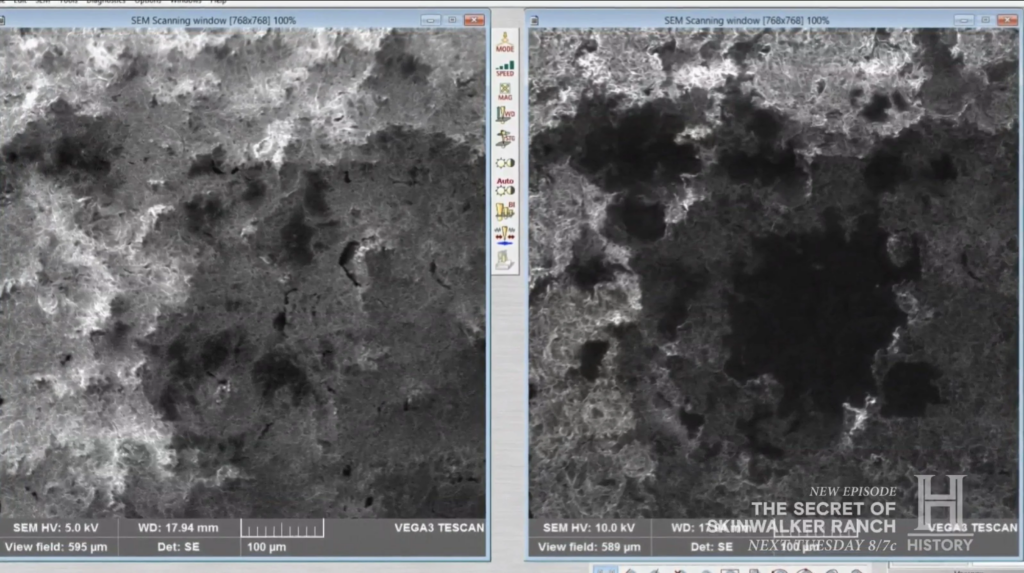
Electron beam microscope – screenshot from the sample found inside the mesa at Skinwalker Ranch. Right image is 60 seconds older than the left image. (Prometheus Ent./History Channel)
What “metamaterial” means in an aerospace context
A metamaterial is not defined by chemistry alone. In materials science, a metamaterial is defined by engineered microstructure that produces emergent properties. Think stacked or patterned layers at micron or sub-micron scales that manipulate electromagnetic waves, heat flow, acoustic vibration, or mechanical stiffness in ways bulk alloys cannot.
In the UAP materials discussion, “metamaterial” is used in at least three overlapping ways:
Electromagnetic metamaterial: Layered or patterned stacks that steer, confine, or reshape fields. Example claims include alternating layers of magnesium alloy and bismuth conceived as a terahertz waveguide. (To The Stars*)
Structural or thermally functional metamaterial: Architected matter that is unusually light, rigid, or thermally directional (heat-channeling) beyond common composites.
Isotope-flagged material: Material alleged to show anomalous isotopic ratios that would be hard to produce accidentally, and expensive to fake at scale.
Modern UAP materials work, including the Nolan–Vallée methods paper, effectively treats isotopes plus microstructure as the decisive combination. (ScienceDirect)
The state of the field: methods are converging even when interpretations diverge
A key shift in the last few years is that serious teams increasingly agree on how unusual materials must be tested, even when they disagree on what the results mean.
The Nolan–Vallée aerospace forensics playbook
Nolan, Vallée and colleagues published a methods roadmap for unusual materials analysis in Progress in Aerospace Sciences (2022). It does not declare non-human origin. It lays out what a credible analysis pipeline looks like: SIMS/nanoSIMS for isotope mapping, multi-collector ICP-MS for high-precision bulk isotopes, TEM/EDS for phase and defect analysis, LA-ICP-MS mapping for trace elements, and rigorous controls and documentation. (ScienceDirect)
The crucial point is that a “metamaterial” claim is not settled by a single microscope image or an elemental list. It is settled by converging evidence across techniques, with custody and contamination controls good enough that another lab could reproduce the finding.
The ORNL/AARO layered-specimen result as a benchmark
In July 2024, the U.S. All-domain Anomaly Resolution Office published an ORNL-based synopsis of a famous layered magnesium specimen often discussed as a UAP “metamaterial.” ORNL’s methods included SEM-EDS, TEM, CT, LA-ICP-MS mapping and high-precision isotope measurements. The synopsis reports that magnesium and lead isotopes are consistent with terrestrial manufacture and use. (AARO)
AARO also published a supplement discussing the specimen’s microstructure, including bismuth co-located with nearly equal parts lead, and structural details that weigh against the specific “high-performance terahertz waveguide” framing for the tested specimen. (AARO)
This is not “trust the government.” It is “here is the most comprehensive public data package on the best-known UAP materials specimen, and it did not validate the non-terrestrial claim.” The implication for every other case family is clear: if the most famous sample can resolve to terrestrial under rigorous analysis, then every new sample must clear the same bar.
The dossier: principal case families and what the evidence shows
This section preserves the UAPedia dossier structure and expands it to incorporate the Skinwalker Ranch Season 6 (2025) mesa fragments.
Case Family A: Layered magnesium-zinc-bismuth pieces (“Art’s Parts” → TTSA ADAM)
A.1 Provenance and handling
The best-known layered sample entered public view in 1996 through anonymous letters and parcels sent to radio host Art Bell. The sender claimed a family link to a 1947 retrieval. The fragments later went to journalist Linda Moulton Howe, who publicized a stack with alternating dark bismuth and lighter magnesium-zinc alloy layers, from a few microns to hundreds of microns thick.
In 2019, To The Stars Academy (TTSA) promoted its ADAM materials program and highlighted a magnesium-zinc-bismuth sample “on loan,” explicitly stating that provenance could not be independently verified, while emphasizing micro-layering and a theoretical analysis suggesting terahertz waveguiding. (To The Stars*)
Also in 2019, a Cooperative Research and Development Agreement (CRADA) between the U.S. Army’s Ground Vehicle Systems Center and TTSA became public through reporting. The document lists a piece described as micron-layered bismuth magnesium zinc among the materials TTSA committed to provide for evaluation. (The War Zone)
A.2 What the lab work says in 2024
The 2024 ORNL synopsis (published by AARO) reports that magnesium and lead isotopes are consistent with terrestrial manufacture and use for the tested specimen. It also describes the specimen as primarily magnesium with a small zinc fraction, with minor lead and bismuth and trace iron and manganese. (AARO)
AARO’s supplement discusses microstructural details, including repeated banding and the bismuth/lead association, and evaluates the waveguide framing against observed structure. (AARO)
A.3 What this means for the larger UAP question
A terrestrial result for one famous specimen does not prove that no exotic fragments exist. It does mean that the most cited UAP “metamaterial” has not carried the non-human claim across the finish line in public data. Any future layered sample will need (at minimum) comparable isotope rigor and stronger provenance than a decades-long private chain.
Interim assessment (Case Family A):
Verified: the Army-TTSA CRADA exists; ORNL/AARO published analyses. (The War Zone)
Misidentification: the specific tested layered specimen is non-terrestrial. The public isotope results do not support that. (AARO)
Case Family B: The Ubatuba magnesium fragment and other historical magnesium samples
B.1 The story, and the evidentiary problem
The Ubatuba story describes an object exploding over the Brazilian coast in 1957 and fragments being passed to investigators. For decades, it hovered between legend and laboratory, with many secondary analyses and shifting claims about purity and origin.
Older cases like Ubatuba reveal a consistent pattern: extraordinary narratives often coexist with ordinary metallurgy, and decades-late testing often begins with custody already compromised. That does not make witnesses liars. It makes the physical claim hard to prove.
B.2 The 2022 isotopic reevaluation
In 2022, a team associated with CUFOS/SCU analyzed the Ubatuba fragment with modern high-resolution methods to examine isotope ratios of magnesium (primary element) and several trace elements. The key finding was that magnesium isotope ratios fell within terrestrial limits, with trace element isotope results not decisive. (Journal of Scientific Exploration)
B.3 Why “terrestrial magnesium” does not erase a UAP report
This is a recurring trap in the public discussion. If a UAP event is real, it does not follow that any recovered metal must be “impossible.” Advanced systems can shed ordinary materials, or the fragment may be unrelated debris mistakenly associated with the event.
The modern conclusion is narrower and more honest: the Ubatuba specimen tested in 2022 does not provide isotope-based evidence for non-terrestrial origin. (Journal of Scientific Exploration)
Misidentification: “Ubatuba proves non-terrestrial isotopes.” It does not, based on published measurements. (Journal of Scientific Exploration)
Case Family C: “Slag-like” droplet and puddle residues from mid-century cases
C.1 The recurring motif: molten falls, spherules, puddles
Across the historical record, investigators repeatedly report molten metal “falls” that cool into puddles, droplets, and spherules. Jacques Vallée’s “ten cases” survey highlights how often these residues resolve into familiar elements. (Jacques Vallée)
A notable example is the Council Bluffs, Iowa event (1977), which produced residues characterized by Iowa State University as iron with small amounts of nickel and chromium, plus ash phases heavy in calcium. Vallée framed this as excluding meteoritic origin and resembling industrial slag. (Jacques Vallée)
C.2 The maddening implication
If such residues are connected to genuine UAP events, they demonstrate the possibility that a highly advanced system could expel material whose chemistry looks disarmingly ordinary once it hits the ground. That would be a claim about process, not about exotic elements.
But because these samples often enter collections with incomplete custody, the burden remains on investigators to prove linkage: contemporaneous documentation, environmental controls, and replicable lab work.
Interim assessment (Case Family C):
Verified: Vallée’s published survey and the presence of mundane elemental profiles in multiple cases. (Jacques Vallée)
Disputed: that these residues are propulsion byproducts of a non-human craft. The chemistry alone does not establish that. (Jacques Vallée)
Case Family D: Skinwalker Ranch mesa fragments (Season 6, 2025)
This is the major 2025 update prompted by The Secret of Skinwalker Ranch “last season,” which, as of December 2025, is Season 6 (premiered June 3, 2025). (HISTORY)
D.1 What was shown on screen
Season 6 presented fragments recovered from mesa drilling spoils and nearby areas, with emphasis on two classes: a patterned, porous “ceramic” shard and metal-bearing fragments. Episodes and clips describe “high-tech materials discovered deep in the mesa.” (HISTORY)
A widely circulated recap of Season 6 Episode 11 (“Hard to Handle”) describes an XRF scan that “reveals nickel, iron and cobalt,” followed by magnet tests framed as suggestive of unusual behavior, and discussion of interior composition consistent with oxygen, silicon, magnesium, potassium and aluminum. (25YL)
A Season 6 clip also focuses on SEM inspection of the ceramic shard at Utah Valley University, where the show frames a “self-healing” effect under SEM imaging. (youtube.com)
D.2 Why these results are interesting even before they are “exotic”
Even if every mesa fragment resolves to terrestrial origin, Season 6 adds something real to the UAP materials conversation: it shows what happens when a public-facing team tries to compress a decade of materials forensics into a television arc.
In materials science terms, what the show presented is a bundle of leads:
A structured surface pattern that looks manufactured. (youtube.com)
Surface XRF signals that suggest ferromagnetic components (Ni-Fe-Co). (25YL)
A claimed “hole closes up” effect under an electron beam, interpreted as self-healing. (youtube.com)
Magnet behavior described in language that drifts toward “superconductor-like” without presenting the measurements needed to establish that.
In UAPedia terms, this is exactly where the field must be most disciplined: the moment where “unusual” can become “otherworldly” by rhetorical acceleration.
D.3 The chain-of-custody problem, made explicit on screen
The show’s mesa finds face a serious forensic challenge: many fragments appear to be collected from drilling spoils. That is not a minor weakness. Spoils are post-disturbance materials: they have been mechanically fractured, rubbed against tools and casing, mixed with surface material, and exposed to modern contaminants.
Independent observers also highlighted a particularly damaging detail: a 1964 U.S. nickel reportedly appearing in drill spoils at depth, implying earlier human disturbance or backfill. Even if the coin itself is not central, the implication is that the mesa context may not be pristine. (25YL)
This does not disprove anything unusual in the mesa. It does mean that extraordinary provenance claims cannot be carried by spoils-pile finds alone.
D.4 The “self-healing ceramic” claim and likely instrument artifacts
The on-air SEM “self-healing” framing has a plausible mundane interpretation: charging effects in insulating ceramics can cause apparent changes in surface features between frames, especially if accelerating voltage, beam current, working distance, or imaging mode changes between shots.
A detailed technical critique notes that insulating specimens can accumulate charge under the electron beam; differences in scan parameters can make voids appear to grow or “heal.” It also notes that the patterned texture resembles common manufactured ceramic tile backing patterns. (Metabunk)
UAPedia’s stance here is strict and fair: the “self-healing” effect must be replicated under controlled SEM conditions, with full instrument metadata and raw image sequences, before it can be treated as evidence of a novel property.
D.5 Magnet behavior and the “superconductor” word
Hand-magnet attraction or repulsion in ambient conditions does not establish superconductivity. To claim superconductivity, investigators must demonstrate (at minimum) temperature-dependent susceptibility consistent with a superconducting transition, plus credible Meissner-effect behavior under controlled conditions.
What the show presented, as summarized by recaps, is consistent with magnetic material behavior in Ni-Fe-Co systems and with orientation effects. (25YL)
If the shard is truly exotic, there is a straightforward path: publish a full susceptibility vs temperature dataset and a four-probe transport measurement with stated thresholds. Until then, UAPedia treats “superconductor-like” as witness interpretation, not evidence.
Interim assessment (Case Family D):
Probable: manufactured ceramic and alloy fragments exist in mesa spoils and warrant study. (youtube.com)
Disputed: the “self-healing” effect and superconductor framing, given chain-of-custody weaknesses and instrument-artifact explanations. (Metabunk)
How the case families intertwine
A useful way to see the 2025 landscape is as three repeating tensions that recur across all families:
The “ordinary composition” paradox
Case Family A’s famous layered specimen is manufactured, but isotope-consistent with terrestrial origin in the published ORNL synopsis. (AARO) Case Family B’s magnesium fragments can be extremely pure, but still terrestrial in isotopes. (Journal of Scientific Exploration) Case Family C’s residues can look like industrial slag even in dramatic events. (Jacques Vallée) Case Family D’s mesa fragments can look “high-tech,” but still plausibly resolve into modern ceramics, common alloys, and contamination patterns. (25YL)
If UAP are real, this pattern suggests at least one of the following is true:
Many collected fragments are misattributed debris.
Some UAP-linked fragments are ordinary materials that served a function in a larger system.
Or the truly exotic fragments do exist, but they are rarely captured in public chains of custody.
That last possibility brings us to the policy layer.
Microstructure can seduce the eye
Layering, banding, and strange textures are visually persuasive. Humans are pattern-recognizers. But microstructure alone does not prove purpose or origin. ORNL’s discussion of defective nanocrystalline bands is a reminder that the functional hypothesis must be tied to actual measured structure quality, not just the existence of layers. (AARO)
Skinwalker Ranch Season 6 illustrates this in real time: a patterned ceramic surface is treated as evidence of manufacture (reasonable), then rapidly treated as evidence of exotic capability (not yet justified).
Chain of custody is the difference between a specimen and a story
Across all case families, the strongest claims falter at the same hinge point: where, exactly, did the material come from, and can that be demonstrated independently?
This is why the Nolan–Vallée methods paper emphasizes custody and controls as heavily as it emphasizes instruments. (ScienceDirect)
The missing half of the conversation: the U.S. secrecy ecosystem
The user’s prompt calls for two linked topics often missing from pop discussions of UAP materials:
The U.S. government’s constant vigilance over sensitive technologies since the early 20th century.
The legal and institutional apparatus that can classify or suppress inventions and materials (reverse-engineered or not), keeping them away from academics and the public.
This is not a claim that “everything is hidden.” It is a claim that there are well-documented mechanisms by which strategically sensitive technologies can be restricted for long periods, even when privately invented.
Patent secrecy began before the Invention Secrecy Act, and accelerated during World Wars
U.S. invention secrecy did not start in 1951. The National Archives record for interservice agencies notes that the Army and Navy Patent Advisory Board was established in August 1940 pursuant to a 1917 act (as amended), with responsibility for examining patent applications of national defense interest and recommending which should be kept secret. (National Archives)
Academic work on the USPTO secrecy program documents that WWII-era secrecy orders were issued widely, to over 11,000 patent applications, spanning inventions such as radar, cryptography, and synthetic materials, with many orders later rescinded after the war. (NBER)
The key UAPedia takeaway is simple: the U.S. has a century-deep tradition of suppressing invention disclosure during periods of perceived security risk, and it has built durable administrative machinery to do it.
The Invention Secrecy Act of 1951 made secrecy orders a standing peacetime tool
The Invention Secrecy Act of 1951 (enacted as Public Law 82-256) created a framework for withholding patents and restricting disclosure when publication would be detrimental to national security. (Congress.gov)
The operative statutory mechanism lives in 35 U.S.C. § 181. It states that secrecy orders cannot exceed one year without renewal, and renewal can occur upon agency notification that the national interest requires it. (Legal Information Institute)
The USPTO’s Manual of Patent Examining Procedure (MPEP) documents the secrecy and foreign filing chapter and the renewal logic. (uspto.gov)
The Federation of American Scientists provides a clear overview of invention secrecy and publishes the official USPTO-reported statistics. At the end of fiscal year 2025, there were 6,543 secrecy orders in effect, with 102 new secrecy orders imposed in FY2025 and 356 in FY2024. (FAS Project on Government Secrecy)
This has two direct implications for “exotic materials” narratives:
If a novel material is recognized as strategically significant, the legal mechanism exists to keep the underlying invention out of open patent literature.
The Patent Security Category Review List is a gatekeeping map, and DoD updates it
Patent secrecy is not random. DoD policy documents discuss coordination of the Patent Security Category Review List, a list of technologies for which DoD components request review for secrecy order recommendations. (Electronic Service Delivery)
This matters in the UAP materials context because many “metamaterial-adjacent” domains overlap with patent-review sensitivity: advanced ceramics, sensors, EM devices, energetic materials, stealth and signature control, and high-performance alloys.
The National Security Act of 1947 created the architecture in which classification lives
The National Security Act of 1947 mandated a major reorganization of U.S. defense and intelligence institutions, including the creation of the National Security Council, and aimed to establish integrated policies and procedures relating to national security. (Office of the Historian)
This is relevant because “classification” is rarely a single decision by a single office. It is an ecosystem that integrates DoD, intelligence, and interagency processes, and it supports a consistent pattern: sensitive results tend to flow inward (classified channels), not outward (academic journals).
Aerogel as the “boring truth” of how advanced materials move
The user offered aerogel as an analogy: Samuel S. Kistler’s foundational aerogel work appears in a 1931 Nature publication (“Coherent Expanded Aerogels and Jellies”). (Nature)
Aerogels later became aerospace-relevant in public, documented ways. NASA’s 2008 Spinoff describes aerogel used in the Stardust mission to capture high-speed comet particles without destroying them. (NASA Spinoff) NASA Technical Reports discuss aerogel tile composites for thermal protection system applications, including work framed around shuttle tile composites and spacecraft thermal protection. (NASA Technical Reports Server)
Aerogel illustrates two key points that temper extremes on both sides:
Some advanced materials are not “hidden,” they simply mature inside government-funded mission pipelines before they diffuse.
Yet the same pipeline culture also supports long periods where specialized fabrication, performance details, and certain application domains are effectively inaccessible to the public.
In other words: not every absence is suppression, but suppression is an established capability. UAP materials claims must be evaluated in that realistic middle zone.
A typology of claimed UAP meta-material classes
This typology is updated with the Skinwalker Ranch family.
Alternating metal laminates for field control
Composition: Mg-Zn matrix with Bi-rich bands and trace elements
Claimed function: terahertz waveguiding, field confinement
Data: ORNL synopsis reports terrestrial isotopes for the tested specimen; microstructure issues weigh against the proposed waveguide framing for that specimen (AARO)
Ultra-pure magnesium fragments
Composition: very high-purity Mg with unusual trace profiles in historical cases
Round-robin labs: blinded subsamples sent to independent labs with preregistered analysis plans.
Multi-technique convergence: TEM/EDS + EBSD + LA-ICP-MS + isotope systems (multi-collector ICP-MS), with raw data released. (ScienceDirect)
Function tied to structure: if a waveguide is claimed, demonstrate S-parameters at relevant frequencies on properly prepared cross-sections, correlated with crystalline continuity and defect density. If superconductivity is claimed, show transition behavior and Meissner-consistent measurements.
Until a UAP materials claim meets this standard, UAPedia treats it as provisional, even when the narrative is compelling.
Claims Taxonomy
This section applies UAPedia’s required taxonomy across the claims most commonly cited in public discussions, including the Skinwalker Ranch Season 6 additions.
Verified
Army-TTSA CRADA to evaluate claimed metamaterials exists as a matter of record through published reporting. (The War Zone)
ORNL/AARO public analysis package exists for a layered magnesium specimen, with described methods and isotope conclusions for the tested sample. (AARO)
Invention secrecy orders exist in large ongoing numbers, with 6,543 in effect at end of FY2025 (USPTO-reported via FAS). (FAS Project on Government Secrecy)
Patent security review infrastructure exists, including DoD coordination of the Patent Security Category Review List. (Electronic Service Delivery)
Aerogel’s 1931 origin and NASA’s documented uses (Stardust capture; thermal protection composites) are publicly documented. (Nature)
Probable
Skinwalker Ranch mesa drilling recovers manufactured ceramics and common alloys mixed into spoils and fragments worthy of formal analysis, even if origin is unresolved. (youtube.com)
Disputed
Layered Mg-Zn-Bi stacks function as high-performance terahertz waveguides in the tested specimen. ORNL/AARO results weigh against that functional framing for the tested sample. (AARO)
Skinwalker Ranch “self-healing ceramic” demonstrates exotic capability. Instrument artifacts and chain-of-custody weaknesses are credible alternatives; replication required. (Metabunk)
Skinwalker Ranch magnet behavior indicates superconductivity. Evidence shown publicly is insufficient for that claim. (25YL)
Slag-like residues prove exotic craft. Chemistry often looks industrial; linkage to UAP remains unproven by chemistry alone. (Jacques Vallée)
Legend
Crash-retrieval origin stories attached to privately circulated fragments remain narrative unless independently validated by custody and documentation. (Contextual, not dismissive.)
Misidentification
“ORNL-tested layered specimen is non-terrestrial.” Published isotopes place it in terrestrial manufacture for that sample. (AARO)
“Ubatuba isotopes prove non-terrestrial origin.” Published magnesium isotopes fall within terrestrial ranges. (Journal of Scientific Exploration)
Hoax
None assigned at dossier level in 2025 without specific evidence of intentional fabrication. (UAPedia avoids casual hoax labeling.)
Speculation labels
Hypothesis
Layered laminates and patterned ceramics could, in principle, be engineered as terahertz waveguides, metasurfaces, or non-reciprocal devices for signature control or compact sensing. This is consistent with the broader metamaterials research landscape and does not require non-human origin.
Witness interpretation
Anonymous correspondence linking layered fragments to a 1947 retrieval is interpretive narrative unless independently verified. (The War Zone) On-air interpretations of magnet behavior as “superconductor-like” remain interpretive unless backed by full controlled measurements. (25YL)
Researcher opinion
The data-driven frontier is pre-registered, multi-lab, blinded testing with raw datasets released. This is the only path that converts UAP materials from anecdotes into cumulative knowledge. (ScienceDirect)
References
All-domain Anomaly Resolution Office. (2024, July 10). Synopsis: Analysis of a metallic specimen [PDF]. U.S. Department of Defense. (AARO)
All-domain Anomaly Resolution Office. (2024). AARO’s supplement to Oak Ridge National Laboratory’s analysis of a metallic specimen [PDF]. U.S. Department of Defense. (AARO)
Gross, D. P. (2019). Evidence from the USPTO patent secrecy program in WWII [Working paper]. Harvard Business School. (Harvard Business School)
History Channel. (2025). The Secret of Skinwalker Ranch: Season 6 (episode and streaming listings). (HISTORY)
Kistler, S. S. (1931). Coherent expanded aerogels and jellies. Nature, 127, 741. (Nature)
National Archives. (n.d.). Records of interservice agencies: Army and Navy Patent Advisory Board history. (National Archives)
Nolan, G. P., Vallée, J. F., Jiang, S., & Lemke, L. G. (2022). Improved instrumental techniques, including isotopic analysis, applicable to the characterization of unusual materials with potential relevance to aerospace forensics. Progress in Aerospace Sciences, 128, 100788. (ScienceDirect)
Office of the Director of National Intelligence. (n.d.). National Security Act of 1947 (legal reference). (Director of National Intelligence)
Powell, R., Swords, M., Rodeghier, M., & Budinger, P. (2022). Isotope ratios and chemical analysis of the 1957 Brazilian Ubatuba fragment. Journal of Scientific Exploration, 36(1). (Journal of Scientific Exploration)
To The Stars Academy of Arts & Science. (2018/2019). Material of interest: Magnesium-zinc-bismuth (ADAM materials page). (To The Stars*)
Trevithick, J., & Tingley, B. (2019, October 20). The Army wants to verify To The Stars Academy’s mystery material claims. The War Zone. (The War Zone)
U.S. Congress. (1951/1952). Invention Secrecy Act of 1951 (H.R. 4687), became Public Law 82-256. Congress.gov. (Congress.gov)
U.S. Patent and Trademark Office. (2024). Manual of Patent Examining Procedure (MPEP), Chapter 0100: Secrecy, access, national security, and foreign filing [PDF]. (uspto.gov)
Michael E. Salla is best known for popularizing “exopolitics” as a way of framing UAP and NHI questions through the lens of political science, international relations, and governance. In his own definition, exopolitics is the political study of the key actors, institutions, and processes associated with the UAP phenomenon and the extraterrestrial hypothesis. (Exopolitics Journal)
Salla also helped build an ecosystem around the concept via the Exopolitics Institute and the Exopolitics Journal, positioning exopolitics as a public-policy relevant discipline rather than only a cultural curiosity. (Exopolitics)
Who is Michael Salla?
Michael Salla, born in 1958 in Melbourne, Australia, holds a PhD in Government from the University of Queensland. He previously taught at institutions like American University in Washington, DC, and the Australian National University, focusing on global politics and conflict resolution. Around the early 2000s, he shifted to exopolitics, founding the Exopolitics Institute in 2005 and the Exopolitics Journal in 2006. Today, he is an independent researcher, author, and podcaster based in the U.S., known for his work on UAPs and NHIs. For more, visit his site at https://exopolitics.org/.
What is Exopolitics?
Exopolitics, as defined by Salla, examines the political actors, institutions, and processes involved in extraterrestrial affairs, including government cover-ups and NHI-human interactions. It builds on UAP research but emphasizes policy implications, such as how NHI presence might affect global governance. Critics argue it’s not a recognized academic discipline and veers into speculation.
Major Contributions
Salla has authored over a dozen books, primarily in his Secret Space Programs series, exploring alleged hidden technologies and NHI alliances. His podcast, Exopolitics Today, features interviews on topics like space arks and galactic envoys. He organizes conferences and webinars, predicting major disclosures in 2026.
Michael Salla’s journey from mainstream academia to the forefront of exopolitics represents a fascinating, albeit contentious, evolution in the study of extraterrestrial phenomena. This exploration delves into his background, the conceptual framework of exopolitics, his prolific publications, core theories, recent activities, and the surrounding debates, drawing from official sources, academic profiles, and critical analyses.
Early Life and Academic Career
Born on September 25, 1958, in Melbourne, Australia, Michael E. Salla pursued a conventional path in political science. He earned his PhD in Government from the University of Queensland, focusing on international relations and conflict resolution. During the 1990s and early 2000s, Salla held academic positions at prestigious institutions, including the School of International Service at American University in Washington, DC, and the Research School of Pacific and Asian Studies at the Australian National University. His early work emphasized global politics, U.S. foreign policy, and peace studies, resulting in four edited or authored books on these topics. This period established him as a credible scholar before his pivot to unconventional subjects.
Salla’s transition began around 2003, influenced by UAP disclosures and whistleblower testimonies from former government officials. He resigned from academia to focus on what he termed “exopolitics,” arguing that traditional political science overlooked the implications of extraterrestrial life. Critics note this shift marked a departure from empirical rigor, leading to his work being sidelined in mainstream circles.
Defining Exopolitics
Salla coined and popularized “exopolitics” as an interdisciplinary field examining the political ramifications of extraterrestrial presence on Earth. In his view, it encompasses the study of key actors (e.g., governments, NNI civilizations), institutions (e.g., secret programs), and processes (e.g., cover-ups and disclosures) related to NHI life. He positions it as a “discipline of choice” for public policy on NHI issues, building on UAP sightings, abductions, and official testimonies.
Exopolitics extends beyond ufology by framing NHI interactions as geopolitical events, potentially influencing global alliances and technology. Salla founded the Exopolitics Institute in 2005 to promote research and education, followed by the Exopolitics Journal in 2006 for peer-reviewed (though niche) publications. He has organized international conferences on NHI topics, advocating for transparency in government policies. However, detractors classify it as pseudoscience, lacking testable hypotheses and relying on anecdotal evidence.
Key Publications and Media
Salla’s output includes books, articles, podcasts, and videos, primarily self-published or through niche outlets.
Books
His works form the backbone of exopolitics literature, often in the “Secret Space Programs” series. Below is a table summarizing major titles based on available sources:
Title
Publication Year
Brief Description
Exopolitics: Political Implications of the Extraterrestrial Presence
2004
Introduces exopolitics, arguing for ET presence based on whistleblowers and documents.
Exposing U.S. Government Policies on Extraterrestrial Life: The Challenge of Exopolitics
2009
Analyzes alleged U.S. cover-ups and policy implications.
Galactic Diplomacy: Getting to Yes with ET
2013
Explores diplomatic frameworks for ET contact.
Kennedy’s Last Stand: Eisenhower, UFOs, MJ-12 & JFK’s Assassination
2013
Links JFK’s death to UFO disclosure efforts.
Insiders Reveal Secret Space Programs & Extraterrestrial Alliances
2015
First in SSP series; claims hidden space fleets and ET pacts.
The U.S. Navy’s Secret Space Program & Nordic Extraterrestrial Alliance
2017
Discusses alleged Navy-ET collaborations.
Antarctica’s Hidden History: Corporate Foundations of Secret Space Programs
2018
Explores Nazi-era bases and ancient ET tech in Antarctica.
US Air Force Secret Space Program: Shifting Extraterrestrial Alliances & Space Force
2019
Ties USAF programs to Space Force creation.
Rise of the Red Dragon: Origins & Threat of China’s Secret Space Program
2020
Examines China’s alleged SSP.
Space Force: Our Star Trek Future
2021
Envisions Space Force’s role in ET disclosure.
Galactic Federations, Councils & Secret Space Programs
2022
Details interstellar organizations.
Podcast
Exopolitics Today podcast, with over 100 episodes, features interviews on NHI encounters, space arks, and disclosure.
What “exopolitics” means in Salla’s framework
What follows is a structured tour of Salla’s exopolitics: its intellectual core, its main claims, where it connects to mainstream space politics, where it departs sharply from conventional evidentiary standards, and how a serious reader can separate signal from noise.
Exopolitics as a “governance layer” on top of UAP/NHI
In Salla’s writing, exopolitics is less about whether UAP are real (he takes that as a meaningful question) and more about:
how states and institutions respond to NHI-related realities (openly or privately),
how secrecy and compartmentalization shape policy outcomes,
how technology control, strategic advantage, and public legitimacy interact if NHI is present.
A key example is his peer-reviewed article in Astropolitics, where he argues that “unacknowledged” programs create analytical blind spots for space policy, and that exopolitics provides conceptual tools for studying alleged classified activity and its connection to UAP and extraterrestrial life claims. (ResearchGate)
Exopolitics as “methodological flexibility” toward hidden programs
Salla’s Astropolitics argument is basically: space politics scholarship studies what is acknowledged; exopolitics attempts to grapple with what is not acknowledged, including claims of highly compartmentalized programs and their alleged relationships to exotic technology. (ResearchGate)
This is where exopolitics becomes controversial, because “methodological flexibility” can be either:
a legitimate effort to study hard-to-access phenomena (think intelligence studies, organized crime studies, or early nuclear secrecy history), or
a license to treat weakly sourced stories as fact.
The Salla “stack”: the recurrent claims you see across his work
Across Salla’s books, essays, and media, exopolitics tends to rely on a recurring stack of assertions:
NHI are interacting with humanity.
Some governments and contractors allegedly possess knowledge and possibly materials/technology.
Information is compartmented, and elected oversight is weak.
There are competing factions or policy lines within states about engagement, disclosure, and technology use.
Public “disclosure” is a managed process, influenced by geopolitical and institutional incentives.
Salla’s 2004 book is framed as an early synthesis of those political implications, and bibliographic listings identify it as published in 2004 (Dandelion Books) with standard ISBN metadata. (Google Books)
Separately, Salla’s own institute biography claims he founded the Exopolitics Institute (2005) and the Exopolitics Journal (2006), reflecting a deliberate attempt to institutionalize this lens. (Exopolitics)
Where exopolitics overlaps with legitimate, mainstream questions
Even critics of exopolitics often concede that some of its questions are real, even if they reject many of its answers.
A) “Policy follows perception” (and secrecy is itself a policy)
If governments treat UAP as sensitive, that decision alone has political effects: budgeting, authority, oversight, public trust, and international signaling.
B) Civil space governance will eventually collide with “anomalies”
As lunar and cislunar activity expands, the chance of unexpected observations rises. Governance systems (data standards, reporting norms, cross-national coordination) determine whether anomalies become shareable science or trapped in stovepipes.
C) Private actors matter
Even in orthodox space politics, contractors, intellectual property, export controls, and procurement secrecy shape what the public sees. Exopolitics can be read, at its best, as a push to treat “institutional behavior around anomalies” as the primary object of study.
Where exopolitics becomes most vulnerable
A) The evidence problem: testimony without hard constraints
Salla’s work frequently leans on testimony, insider narratives, and document claims that are difficult to authenticate independently. In his own writings, he explicitly argues for taking witness reports seriously and building a policy lens around them, and he notes the resistance this approach receives. (ResearchGate)
The core vulnerability is not “testimony is worthless.” In many domains, testimony is crucial. The vulnerability is absence of controlled verification loops:
provenance and chain-of-custody for documents,
independent replication for technical claims,
adversarial testing (what would falsify this?),
clear separation between inference and established fact.
B) Absence of evidence becomes evidence of hiddenness
A recurring pattern in fringe political narratives is that the lack of documentation is taken as proof of extraordinary secrecy. A mainstream academic example of this critique appears in an Oxford University Press chapter discussing “exopolitics” as a cultural term and describing how missing documentation is often interpreted as proof of a continuing “truth embargo” by proponents. (OUP Academic)
I’m not endorsing that chapter’s rhetorical tone, but the underlying analytical point is important: a framework that can “explain” any absence of evidence becomes hard to test.
C) Conflation risk: UAP reality vs sweeping geopolitical storylines
One can reasonably argue UAP represent a serious anomaly class, while rejecting large, specific story architectures (named programs, detailed interstellar diplomacy timelines, sweeping claims about covert deals) that are not anchored to independently verifiable datasets.
Exopolitics, in the Salla style, often moves quickly from “UAP/NHI may be real” to “here is the geopolitical structure behind it,” and that leap is where most critical readers disengage.
How scholars contextualize the “exopolitics movement” culturally
If you want a useful outside lens, one approach is to treat exopolitics as part of the broader “contactee” and modern anomalous-belief ecosystem.
A review in Science Fiction Studies of Aaron John Gulyas’ history of contact narratives notes that contemporary exopolitics blends reformist “space visitor” themes with narratives of covert obstruction by government and industry. (DePauw University)
That kind of framing is valuable because it shifts the question from “is every claim true?” to:
why this genre of claims persists,
what needs it serves (ethical critique, desire for cosmic membership, distrust of institutions),
and how movements evolve when official information is partial and incentives are opaque.
This cultural lens does not disprove NHI. It helps you understand how meaning and politics get built around the possibility of NHI.
A practical way to read Salla
If you want to explore Salla without getting lost, use a three-bucket filter:
Bucket 1: Governance insights that remain useful even if specific stories fail
secrecy as a policy variable
incentives for classification and compartmentalization
oversight failure modes
how narratives shape mass politics and foreign policy behavior
These are “portable” insights.
Bucket 2: Claims that might be investigable with better tooling
specific alleged facilities, timelines, procurement patterns
consistent multi-witness clusters that can be triangulated
Treat these as research hypotheses, not conclusions.
Bucket 3: Claims that are currently non-falsifiable
intricate interstellar diplomacy histories
highly specific “insider” cosmologies with no independent anchors
claims that rely on “you can’t verify this because it’s too secret”
These are the claims that most reliably degrade the signal-to-noise ratio.
Why exopolitics matters to NHI discovery politics (even if you disagree with Salla)
If NHI discovery happens via civil space missions, telescope technosignatures, or unexpected terrestrial evidence, the aftermath will be political:
who controls the data,
who gets access to sites or materials,
what gets classified,
how the public narrative is shaped.
Salla’s exopolitics is, in essence, an attempt to pre-build a theory of those politics. The question is whether his empirical foundation is strong enough for the conclusions he draws.
References
Gulyas, A. J. (2014). Extraterrestrials and the American zeitgeist: Alien contact tales since the 1950s [Book review]. Science Fiction Studies. (DePauw University)
Keats, J. (2010). Exopolitics. In Virtual words: Language on the edge of science and technology (pp. 156–159). Oxford University Press. (OUP Academic)
Salla, M. E. (2004). Exopolitics: Political implications of the extraterrestrial presence. Dandelion Books. (Google Books)
Salla, M. E. (2005). The history of exopolitics: Evolving political approaches to UAPs and the extraterrestrial hypothesis. Exopolitics Journal, 1(1). (Exopolitics Journal)
The Artemis Accords were not written as “NHI discovery rules.” They are a civil-space norms package focused on safe, interoperable, and transparent exploration and use of the Moon and other bodies. (NASA) Even so, if NHI were discovered in the course of Artemis-era activity (for example, an artifact, a technosignature, a visitation or biologically relevant evidence), the Accords would shape what happens next in ways that matter.
Below are the most important implications, with a clear separation between what the Accords actually say and what follows as plausible governance consequences.
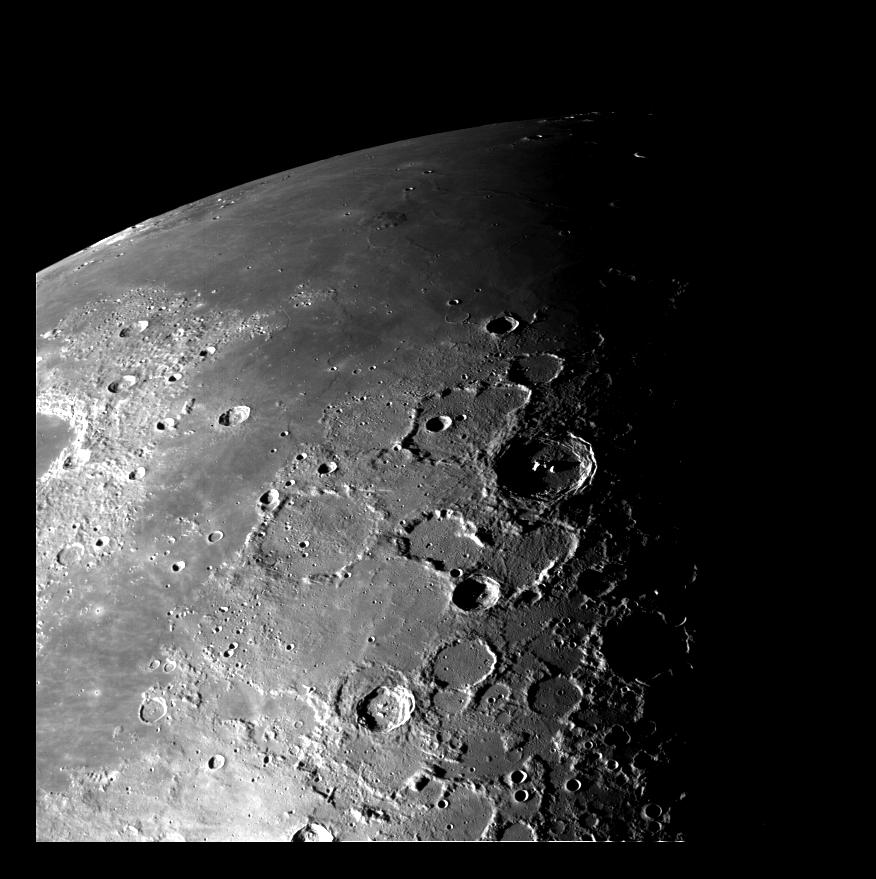
This view of the north polar region of the Moon was obtained by NASA’s Galileo’s camera during the spacecraft’s flyby of the Earth-Moon system on December 7 and 8, 1992. (UAPedia – NASA)
What the Accords concretely change that matters for NHI discovery
1) More missions, more sensors, more “discovery surface area”
The Accords’ interoperability and coordination goals are designed to make complex multinational lunar operations easier. (NASA) In practice, that tends to increase:
the number of instruments operating in cislunar space and on the surface,
the volume of high-quality telemetry and imagery,
the number of organizations capable of independently verifying anomalies.
Implication: even without an explicit “NHI clause,” Artemis-style cooperation increases the odds that unusual findings are detected, cross-checked, and preserved long enough to be studied.
2) A stronger norm of scientific transparency (but with real-world limits)
The Accords explicitly include “release of scientific data” and broader transparency commitments. (NASA) That is significant because the decisive step in any NHI claim is not the initial find. It is independent verification.
Implication: among signatories, the Accords nudge toward publishable, shareable evidence rather than “single-custodian” evidence.
Limit: the Accords are non-binding, and they sit alongside national security law, export controls, and proprietary protections. So the transparency norm helps most when:
the observation is unclassified civil science data,
the discoverer is incentivized to disclose,
multiple partners have enough shared access to replicate.
(If a finding becomes entangled with defense sensors or sensitive capabilities, the Accords alone will not force disclosure.)
3) A ready-made coordination channel for “we found something”
The Accords create a diplomatic and programmatic network for consultation and coordination among signatories. (NASA) That matters because discovery events are governance events: you need rapid, credible cross-validation and coherent public communication to prevent confusion and escalation.
Implication: Artemis partners have a standing forum that can convene quickly, which is exactly what “post-detection” scenarios require.
The two most NHI-relevant provisions, in practice
4) “Safety zones” and deconfliction can protect a discovery site
The Accords’ deconfliction approach is intended to prevent harmful interference among lunar actors. (NASA) If an anomalous site is discovered (unusual structure, emissions source, or material), a deconfliction perimeter is a practical necessity for:
evidence preservation,
contamination control,
accident prevention,
controlled scientific access.
Implication: the Accords supply a governance vocabulary for “standoff while we assess,” which is essential in any credible NHI discovery workflow.
Risk: a discovery-triggered safety zone could be abused as de facto territorial control, especially if the site is in a high-value region. The legitimacy hinge is whether the zone is:
transparently declared,
proportionate to safety and science needs,
time-limited and reviewable,
paired with consultation. This is exactly the line that critics of safety zones worry about in other contexts too. (ASIL)
5) Heritage language provides a precedent, but it is human-centered today
The Accords state an intent to preserve “outer space heritage,” commonly described as historically significant human or robotic landing sites and artifacts. (UN Documentation)
Implication: the Accords establish an important norm: not everything “found” in space is a resource to be exploited.
Limit: the heritage framing is built around human history. An NHI artifact, if discovered, would not neatly fit existing definitions.
Witness Interpretation (policy-level): the heritage clause is still a powerful legal and ethical precedent that could be extended. A rational next step would be an “Anomalous Heritage” concept: protected status for non-human or unknown-origin artifacts pending verification, similar to protective custody of a potential archaeological site on Earth.
Planetary protection and biohazard governance
6) The Accords do not substitute for planetary protection protocols, but they interact with them
If “NHI discovery” means biology (microbial life, complex life, or bioactive material), the operational playbook is driven by planetary protection standards, not the Accords. NASA’s planetary protection discipline exists explicitly to protect science integrity and limit harmful contamination. (NASA SMA) COSPAR’s planetary protection policy emphasizes preventing false positives in life detection and outlines strict handling logic for samples and missions that could encounter life. (COSPAR website)
Implication: Artemis-era signatories, by coordinating deep-space activity, can normalize high-compliance planetary protection and sample-handling practices across partners, which is essential if biological NHI evidence appears.
Practical takeaway: if a mission finds biologically ambiguous material, the credibility of the discovery will rise or fall on contamination control and chain-of-custody. Planetary protection is the difference between “history” and “maybe it was our own microbes.”
The missing piece: post-detection protocols for NHI, and why Artemis can accelerate them
7) There are established “post-detection” norms in SETI that Artemis could adopt by analogy
The International Academy of Astronautics (IAA) “Declaration of Principles” (often called post-detection protocols) lays out widely cited guidance: verify before announcing, share data to enable confirmation, and avoid sending a reply until international consultations occur. It also anticipates creating an international committee to coordinate analysis and public release advice after a credible detection. (IAASpace)
Implication: Artemis signatories already agree to a cooperation framework where a “lunar post-detection protocol” could be adopted quickly as an addendum or best-practice annex.
Hypothesis (governance): the fastest route to legitimacy is convergence: Artemis operations + IAA-style post-detection discipline + UN-facing consultation. That combination reduces the risk that a discovery becomes a purely national asset, or that the world receives fragmented, contradictory narratives.
Recent work indicates the IAA community has been actively revisiting and updating post-detection thinking in light of modern information dynamics, suggesting the governance ecosystem is not static. (arXiv)
Strategic and political implications (the part nobody wants to say out loud)
8) An NHI discovery will collide with security incentives
Even though Artemis is a civil framework, NHI discovery has predictable security consequences:
questions about origin and capability,
concerns about strategic advantage,
pressure to restrict information flows,
disputes over custody, access, and verification.
Implication: the Accords help most before the discovery, by normalizing transparency and shared standards. After a high-stakes discovery, states may revert to national control unless there is an agreed trigger mechanism for:
independent verification access,
controlled information release,
dispute resolution.
This is also why “soft law” matters: it sets expectations early, before the first irreversible incident.
What Artemis could do next (concrete, actionable governance upgrades)
If Artemis signatories wanted the Accords to be “NHI-ready” without turning them into science fiction, a practical package would look like this:
Anomalous Discovery Reporting Standard (civil)
common metadata, time-stamping, calibration disclosure, and preservation rules.
Independent Verification Pathway
predefined list of partner labs and analysis teams, with rapid sample or data access under contamination controls.
Discovery Site Stewardship Rule
deconfliction zone criteria: proportionality, transparency, duration limits, consultation requirements.
Provisional Anomalous Heritage Protection
automatic interim protection status for any candidate non-human artifact or structure pending verification.
Public Communication Protocol
aligned with IAA post-detection ideas: verify, disclose methodology, release enough data for replication, avoid premature claims. (IAASpace)
UN-facing consultation channel
not as “permission,” but as legitimacy infrastructure, because NHI discovery instantly becomes a global human matter.
Bottom line
The Artemis Accords increase the world’s capacity to detect and validate extraordinary anomalies by expanding interoperable exploration and normalizing transparency and data-sharing norms. (NASA) They also create a ready coalition mechanism that could operationalize post-detection protocols quickly, especially if paired with existing scientific guidance like IAA’s Declaration of Principles and stringent planetary protection standards. (IAASpace)
But the Accords do not yet solve the hardest problems an NHI discovery would trigger custody, verification access, classification pressures, and the thin line between safety-based exclusion and de facto appropriation. In other words, Artemis is a strong start for “how we work together on the Moon,” and a decent skeleton for “how we handle the extraordinary,” but it still needs explicit muscles.
The Artemis Accords are a US-led, non-binding framework intended to shape norms and best practices for civil exploration and use of the Moon, Mars, comets, and asteroids. Since their initial signing in October 2020, the Accords have expanded to a large coalition of signatory states, positioning the document as one of the most influential “soft law” instruments in contemporary space governance. This review paper synthesizes the Accords’ core principles, situates them within existing treaty law (especially the 1967 Outer Space Treaty), and evaluates major points of controversy: (a) whether space resource extraction can be reconciled with the non-appropriation principle; (b) whether “safety zones” for deconfliction risk becoming de facto territorial control; and (c) whether club-based rulemaking accelerates practical governance or fragments multilateral legitimacy. The paper further considers how the Accords interact with parallel international efforts, including UN COPUOS work on the legal aspects of space resource activities, and compares Artemis governance dynamics with the China–Russia International Lunar Research Station (ILRS) initiative. The review concludes that the Artemis Accords are best understood as a pragmatic, operationally oriented governance prototype. They can reduce uncertainty and improve coordination in the near term, but their long-run legitimacy will depend on transparent implementation, meaningful interoperability with UN processes, and credible mechanisms to protect equitable access, scientific openness, and heritage and environmental values on celestial bodies.
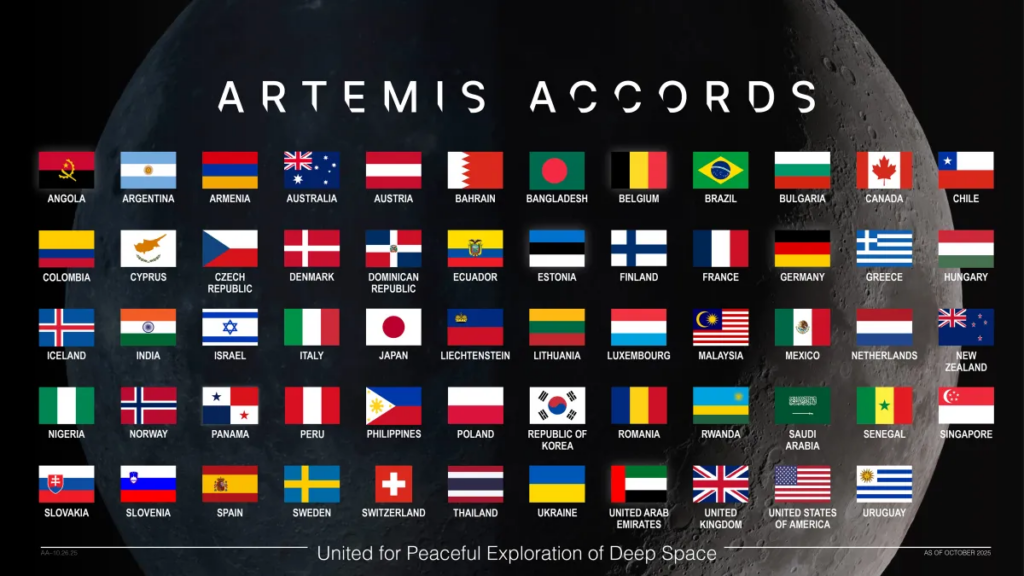
As of 2025 these are the nations that ratified the Artemis Accords
Introduction
The return of sustained human and robotic activity to the Moon is no longer a distant prospect. Multiple state and commercial actors are planning missions that require long-duration surface operations, complex logistical supply chains, and eventually in situ resource utilization (ISRU) to reduce dependence on Earth. This operational shift stresses a legal architecture largely written for a different era: one in which scientific exploration dominated, and permanent installations, large-scale resource extraction, and dense operational traffic around lunar regions were not imminent.
Against this backdrop, the Artemis Accords (hereafter, “the Accords”) emerged in 2020 as a set of principles designed to guide cooperation among states participating in, or aligning with, NASA’s Artemis program. A central feature of the Accords is their attempt to convert high-level treaty obligations into implementable operational norms: transparency measures, interoperability expectations, protocols for emergency assistance, registration practices, data-sharing commitments, heritage protection, and practices for deconflicting activities on and around celestial bodies (including the concept of “safety zones”). Scholars characterize the Accords as a “political commitment” rather than a binding treaty, and debate whether they represent evolutionary implementation of existing law or a more disruptive shift toward club-based rulemaking in outer space governance. (Cambridge University Press & Assessment)
This paper reviews the content and governance logic of the Accords, then evaluates the most consequential controversies and future pathways for convergence with multilateral rulemaking.
Review Method
This is a narrative review drawing on: (a) primary text and explanatory materials related to the Artemis Accords; (b) peer-reviewed legal and policy scholarship on space resource governance, safety zones, and soft law; (c) UN documentation from COPUOS-related processes addressing the legal aspects of space resource activities and long-term sustainability guidelines; and (d) reputable science-policy journalism capturing early critiques and geopolitical context. The emphasis is on cross-source synthesis rather than exhaustive cataloging.
Background: The Treaty Baseline and the Governance Gap
The Outer Space Treaty as constitutional scaffolding
The 1967 Outer Space Treaty (OST) establishes the foundational principles still widely treated as constitutional scaffolding for space law. The non-appropriation principle in Article II provides that outer space, including the Moon and other celestial bodies, is not subject to national appropriation by sovereignty claim, use, occupation, or any other means. (UNOOSA) This provision has become the central interpretive anchor for modern debates about whether extracting and using space resources amounts to prohibited appropriation, or can be treated as a lawful “use” distinct from territorial sovereignty.
Sustainability and operational density
As space activity expands, sustainable operations and debris mitigation become governance priorities. UN COPUOS adopted guidelines for the long-term sustainability (LTS) of outer space activities in 2019, framing sustainability as a voluntary, consensus-based approach to maintaining space as a stable and safe environment. (UNOOSA) While LTS guidelines focus heavily on Earth orbital operations, the same logic increasingly applies to cislunar space and lunar surface activity, especially where hazards or interference risks rise with mission density.
Space resources: renewed urgency and institutional response
In the last decade, domestic legislation and policy signals have increasingly treated space resource extraction as technically plausible and economically meaningful. This has pushed the international system to revisit resource governance questions that were left unsettled after the Moon Agreement failed to gain broad ratification. The UN COPUOS Legal Subcommittee created a working group on the legal aspects of space resource activities in 2021, and the group has continued to develop draft recommended principles, including updated drafts circulated and discussed through 2025.
What the Artemis Accords Are: Structure and Core Principles
The Accords are commonly described as a set of 13 provisions (or sections) establishing principles and best practices for civil exploration and use of the Moon and other specified celestial bodies. (Cambridge University Press & Assessment) They include commitments that largely mirror or operationalize existing treaty obligations and established practices, alongside a smaller set of innovations (notably around resources and deconfliction).
A helpful way to interpret the Accords is to group their content into four functional pillars: (1) transparency and interoperability, (2) safety and emergency support, (3) science, heritage, and sustainability, and (4) resource utilization and operational deconfliction.
Transparency and interoperability
The Accords emphasize transparency of policies and plans and encourage interoperable systems and standards, reflecting a practical reality: deep-space operations are inherently risky, and rescue, docking, communications, and logistical support become far more reliable when systems are designed to work together. Deplano’s analysis notes that many provisions transpose or refine existing obligations rather than invent new legal principles, with interoperability serving humanitarian and operational safety functions as much as scientific cooperation. (Cambridge University Press & Assessment)
Emergency assistance and registration practices
The Accords reiterate expectations about rendering assistance to personnel in distress and about registering space objects. These reflect long-standing treaty commitments and help reduce ambiguity about responsibility, liability exposure, and operational coordination when missions involve multiple states and commercial actors. (Cambridge University Press & Assessment)
Scientific data release and heritage protection
The Accords include a commitment to release scientific data, aligning with broader norms of open science and public benefit. They also introduce explicit language on preserving “outer space heritage,” including historically significant sites and artifacts. Deplano argues this heritage provision is a meaningful innovation because the OST does not provide detailed mechanisms for heritage protection, even though heritage protection can be framed as compatible with treaty principles. (Cambridge University Press & Assessment)
Orbital debris and sustainable practices
The Accords address orbital debris mitigation and sustainable practices, reinforcing the logic of LTS guidelines and reflecting an awareness that sustainability is now a core governance priority, not an optional add-on. (UNOOSA)
Adoption, Scale, and Coalition Dynamics
Growth in signatories
The Accords began with eight initial signatories in October 2020 (including the United States, United Kingdom, Japan, Canada, Italy, Australia, Luxembourg, and the UAE). (Cambridge University Press & Assessment) Over time, the coalition expanded substantially. NASA materials indicate that by late 2025, the Accords had reached at least 59 signatories, with Hungary, Malaysia, and the Philippines among the most recent additions recognized in NASA’s “five years” milestone coverage and its signatory list by date.
Some sources report 60 signatories by November 2025, including Latvia. The modest discrepancy across public-facing trackers appears consistent with the timing differences that can occur between announcement, signature ceremony, and subsequent updates to official lists.
Parallel governance blocs: Artemis versus ILRS
The Accords’ geopolitical significance is sharpened by the presence of an alternative lunar coalition centered on China and Russia: the International Lunar Research Station (ILRS). In an April 23, 2025, Reuters report, China’s lunar program leadership framed the ILRS as developing well with 17 participating countries and organizations, while contrasting it with the larger Artemis Accords coalition (then described as “over 50” signatories). The same report referenced China–Russia cooperation and interest in “moon-based nuclear energy,” illustrating how lunar governance is entangled with long-horizon infrastructure strategy and geopolitical alignment. (Reuters)
Central Legal and Policy Debates
1) Space resources and the non-appropriation principle
The most cited controversy concerns how the Accords treat space resource extraction. The OST bans national appropriation of territory, but it does not explicitly ban extraction or ownership of resources once removed. The Accords take a clear interpretive position: resource extraction does not inherently constitute national appropriation under Article II, and resource activities should be conducted consistent with the OST.
From a review perspective, two points matter.
First, the Accords’ interpretive move is not purely theoretical. It aims to lower investment uncertainty for governmental and non-governmental entities by signaling that signatories intend to authorize and supervise extraction activities rather than treat them as presumptively unlawful. This is aligned with scholarship emphasizing the urgent need for clarity regarding the legal frameworks applicable to space mining. (ScienceDirect)
Second, the interpretive move is contested because Article II’s scope is not settled, and state practice is not uniform. Deplano argues the Accords are “highly innovative” yet “not revolutionary,” and suggests that, while the Accords can contribute to emerging subsequent practice, they do not automatically become an authoritative interpretation accepted by all OST parties. (Cambridge University Press & Assessment)
In short, the Accords reduce uncertainty for signatories and partners, but they do not by themselves resolve the underlying global interpretive dispute.
2) Safety zones and deconfliction: governance tool or de facto territoriality?
“Safety zones” are among the Accords’ most debated innovations. In concept, a safety zone is a temporary, operationally justified buffer around activities that could cause harmful interference or hazards, designed to reduce collision risk, contamination risk, or operational conflict. Scholarly analysis emphasizes that safety zones are controversial because a poorly designed or strategically abused zone could operate like an exclusionary claim, undermining the non-appropriation principle and free access norms. (ScienceDirect)
The literature converges on several implementation conditions that separate legitimate deconfliction from de facto appropriation:
Non-exclusionary design: Zones should not become blanket prohibitions on access.
Temporariness and review: Zones should be limited in duration and tied to clear operational hazards.
Notice and transparency: Public notice, location disclosure, and consultation reduce ambiguity and reduce the chance that zones become stealth territorial claims.
Proportionality: The zone’s size should be justified by technology and hazard models, not strategic advantage. (ScienceDirect)
McKeown, Dempster, and Saydam add a further critical angle: even if safety zones are workable for small-scale ISRU, they may be impractical as governance tools for large-scale commercial extraction in constrained high-value regions (for example, areas associated with water ice), potentially creating pressure for more robust multilateral governance frameworks. (ScienceDirect)
A useful synthesis is that safety zones are not inherently incompatible with the OST, but their legitimacy depends on disciplined implementation rules, credible transparency, and an accountability pathway for overlap disputes.
3) Soft law, legitimacy, and the forum question: COPUOS versus club governance
A recurring critique is procedural: critics argue the Accords attempt to develop international space law outside the UN system, potentially fragmenting legitimacy. The AJIL Contemporary Practice discussion captures this tension by noting that commentators and opponents have argued the Accords seek to build consensus around a US-friendly interpretation of resource ownership and governance, and that China and Russia have criticized the Accords as consolidating rules outside traditional multilateral lawmaking forums. (Cambridge University Press & Assessment)
From a governance standpoint, the procedural critique has two layers:
Speed and operational relevance: Club-based instruments can move faster than multilateral treaty negotiation, which has been slow for decades on resource issues. Practical norms may be needed before the first serious disputes occur.
Representativeness and universality: A coalition instrument risks embedding rules favored by early movers, potentially marginalizing states that lack near-term lunar capability but remain OST parties with legal interests in “use” and access.
The UN COPUOS space resources working group’s draft recommended principles explicitly situates Artemis as one of several international efforts (alongside the Hague Building Blocks) and expresses interest in principles with “wider acceptance among the global space community.” This is an important convergence signal: it suggests a pathway where Artemis practices can inform, but not replace, multilateral norm-building.
4) Heritage, science, and the problem of enforceability
The Accords’ heritage language is widely viewed as normatively valuable but practically underspecified. Unlike environmental treaties on Earth, lunar heritage has no mature compliance apparatus. Even if all signatories endorse heritage protection, commercial and national prestige incentives can erode restraint in high-interest areas.
The same applies to open scientific data. Scientific American’s early critique framed the Accords as participation conditions for NASA partnership and raised concerns that the framework could function as a way to route around preexisting treaty norms rather than deepen them, even while acknowledging the Accords contain widely agreeable “self-evident” principles about transparency, assistance, and publication of findings. (Scientific American)
A review conclusion here is that heritage and data-sharing commitments are governance “high ground,” but they require implementation detail: what counts as protected heritage, what stand-off distances apply, what timelines govern data release, and how proprietary or security-sensitive information is balanced against open science norms.
Interaction with Other International Frameworks
The Hague Building Blocks as a conceptual bridge
The Hague International Space Resources Governance Working Group’s “Building Blocks” provide a structured set of governance concepts intended to support the development of an international framework on space resource activities. The Building Blocks include due regard concepts and contemplate area-based safety measures and consultation mechanisms, including attention to overlapping safety zones and public notice. (Leiden University)
Importantly, the Building Blocks have been introduced into COPUOS-related documentation and discussion, indicating they serve as a bridge between technical policy design and multilateral processes. (UNOOSA)
COPUOS draft recommended principles and the “wider acceptance” aim
The COPUOS working group’s updated draft recommended principles (July 2025 version) explicitly references Artemis and the Hague Building Blocks as prior efforts, then frames the UN effort as producing high-level principles with wider acceptance, implemented voluntarily through national mechanisms. This creates a plausible convergence model:
Artemis functions as an operational testbed among willing partners.
COPUOS distills broadly acceptable principles and harmonization guidance.
National regulations, bilateral arrangements, and standards bodies operationalize the principles into enforceable practice.
This layered approach may be the most realistic path to reducing dispute risk while preserving multilateral legitimacy.
Implications for Future Governance
Reducing ambiguity before the first major lunar disputes
A core pragmatic argument for the Accords is that norms must exist before resource extraction and high-density operations produce the first serious “harmful interference” disputes. Once capital-intensive assets are deployed, incentives shift toward unilateral defensive postures. Pre-agreed deconfliction and transparency practices can reduce the risk of misinterpretation and escalation.
Equity, access, and “province of all humankind” concerns
While the OST frames exploration and use as for the benefit and interests of all countries, critics worry that the Accords’ coalition model could tilt governance toward first-mover advantage. A key challenge for legitimacy is demonstrating that the Accords do not merely protect technologically advanced actors’ access to high-value lunar regions but also create pathways for meaningful participation and benefit-sharing for states with emerging capacity.
Private actors and regulatory capture risk
Because resource extraction is likely to be driven by commercial entities operating under state authorization and supervision, governance outcomes will be shaped by domestic licensing regimes and contractual architectures as much as by international principles. The Accords can encourage compatible domestic approaches, but they do not themselves prevent a race to permissive licensing standards. This is another area where COPUOS-recommended principles could serve as a harmonization anchor.
Relevance to anomalous observations and data governance
While the Accords are not a UAP-focused instrument, their emphasis on transparency, scientific data release, and deconfliction has an indirect relevance to how future lunar and cislunar sensor networks handle unexpected observations. Notably, the Accords’ deconfliction language anticipates scenarios where operations or “anomalous” events could cause harmful interference, underscoring that governance frameworks must be robust to the unexpected, not only to planned activity. From a UAPedia perspective, any governance regime that expands open scientific reporting and reduces information silos can improve the quality of anomaly triage, regardless of whether anomalies are ultimately attributable to mundane or genuinely novel causes.
For the implications of the Artemis Accords for a potential discovery of NHI read here our Brief here.
Conclusion
The Artemis Accords represent one of the most consequential recent developments in space governance, not because they are legally binding, but because they operationalize treaty-era principles into implementable norms at the precise moment when sustained lunar activity is becoming real. The Accords clarify expectations around transparency, interoperability, emergency assistance, registration, scientific data release, heritage protection, sustainability, and, most controversially, space resources and safety zones.
The review literature supports a balanced conclusion. The Accords are broadly rooted in the OST and other established instruments, and they can plausibly reduce uncertainty and improve safety for participating missions. (Cambridge University Press & Assessment) Yet their most consequential interpretive moves (resources and safety zones) face persistent legitimacy challenges unless they are implemented in clearly non-exclusionary, transparent, and consultative ways, and unless they remain interoperable with multilateral norm-building. (ScienceDirect)
The long-run success of the Accords, as a governance prototype, will likely depend on whether their coalition practices can be translated into principles with wider acceptance through forums like COPUOS, and whether they can demonstrate credible commitments to equitable access, scientific openness, and protection of shared heritage in the first real era of lunar permanence.
References
American Journal of International Law. (2023). Signatories of the U.S.-Led Artemis Accords meet in person for the first time. American Journal of International Law, 117(1), 133–139. (Cambridge University Press & Assessment)
Baptista, E. (2025, April 23). China lunar chief accuses US of interfering in joint space programmes with other nations. Reuters. (Reuters)
Deplano, R. (2021). The Artemis Accords: Evolution or revolution in international space law? International & Comparative Law Quarterly, 70(3), 799–819. (Cambridge University Press & Assessment)
European Space Agency. (2025). Artemis Accords: What are they? Who has signed? FAQs. (ESA)
Gilbert, A. Q. (2023). Implementing safety zones for lunar activities under the Artemis Accords. Journal of Space Safety Engineering, 10(1), 103–111. (ScienceDirect)
McKeown, B., Dempster, A. G., & Saydam, S. (2022). Artemis Accords: Are safety zones practical for long term commercial lunar resource utilisation? Space Policy, 62, 101504. (ScienceDirect)
NASA. (2020). Artemis Accords: Principles for cooperation in the civil exploration and use of the Moon, Mars, comets, and asteroids for peaceful purposes (NASA PDF).
NASA. (n.d.). Artemis Accords: List of the signatories by date (PDF). Retrieved December 20, 2025, from (NASA)
NASA. (2025, November 20). NASA celebrates five years of Artemis Accords, welcomes 3 new nations. (NASA)
Stirn, A. (2020, November 12). Do NASA’s lunar exploration rules violate space law? Scientific American. (Scientific American)
The Hague International Space Resources Governance Working Group. (2019). Building blocks for the development of an international framework on space resource activities (Revised April 2019) (PDF). Leiden University. (Leiden University)
United Nations Office for Outer Space Affairs. (2021). Guidelines for the long-term sustainability of outer space activities (Publication) (PDF). (UNOOSA)
United Nations Office for Outer Space Affairs. (2025, July 7). Updated initial draft set of recommended principles for space resource activities (Working Group on Legal Aspects of Space Resource Activities) (UNOOSA PDF).
United Nations Office for Outer Space Affairs. (n.d.). Outer Space Treaty. (UNOOSA)
de Zwart, M., Henderson, S., & Neumann, M. (2023). Space resource activities and the evolution of international space law. Acta Astronautica, 211, 155–162. (ScienceDirect)
Artemis Accords review; Artemis Accords APA paper; space law Artemis Accords; Outer Space Treaty Article II; lunar safety zones; deconfliction of space activities; space resource extraction legality; COPUOS space resources working group; Hague Building Blocks space resources; ILRS vs Artemis Accords; lunar governance norms; space sustainability guidelines
By mid December 2025, as 3I/ATLAS swept past Earth on its way toward Jupiter, Avi Loeb, Harvard Professor and FOunder of Project Galileon, tried to put a bow on months of blog posts, talks and interviews. In a Medium essay titled “3I/ATLAS Maintained a Sunward Jet After Its Gravitational Deflection by 16 Degrees at Perihelion,” he assembled what he called fifteen “anomalies” that, in his view, keep an artificial origin for the object on the table. (Medium)
He grouped them into three clusters: geometric coincidences in the orbit and jet geometry, strange chemistry, and unusual physical behavior. Below is a narrative summary of those fifteen points, following his own numbering but translated into plain language and placing them in the broader scientific context.
An image of 3I/ATLAS, taken on December 14, 2025, with a total integration time of 2 hours and 22 minutes and no filter on a 14-inch (0.356-meter) telescope in June Lake, California. (Dan Bartlett)
Geometric coincidences: how 3I/ATLAS threads the Solar System
Retrograde orbit almost in the planetary plane Most comets that visit the inner Solar System move in or near the ecliptic, which is the flat plane defined by the orbits of the planets. 3I/ATLAS is unusual because it is on a retrograde path, so it travels the “wrong way” relative to planetary motion, yet its orbital plane is still within about 5 degrees of the ecliptic. Loeb assigns this configuration a probability of roughly 0.2 percent and takes it as a hint that the trajectory might have been deliberately chosen rather than drawn randomly from interstellar space. (Medium) Critics counter that this is an example of “after the fact” probability making. Many different orbital orientations would have looked “interesting” once noticed, and survey telescopes are naturally more sensitive to objects near the ecliptic, which boosts the chance that a new interstellar object we actually find will lie close to that plane. (Penn State Sites)
Close passes by Mars and Jupiter, but not Earth The second anomaly is about timing and geometry. Loeb notes that the object’s path brings it tens of millions of kilometers from Mars and Jupiter while keeping it well away from Earth, and that at perihelion it was on the far side of the Sun and therefore essentially unobservable from terrestrial telescopes. He treats this pattern as “fine tuning” and suggests that a technological craft might wish to avoid flying close to a noisy, radar‑rich planet like Earth while still sampling other worlds. (Medium) Mainstream orbital dynamicists see the same geometry as a natural outcome of a random hyperbolic orbit that happens to cut through the inner Solar System. Given the enormous volume of space and the long look‑back time to when the object entered the system, there are many ways to draw “suspicious” lines between its path and the planets after the fact. (NASA Science)
Perijove distance and Jupiter’s Hill sphere “match” In March 2026, 3I/ATLAS will pass Jupiter at about 53.5 million kilometers, which is almost identical to Jupiter’s Hill radius, the zone where Jupiter’s gravity dominates over the Sun’s. Loeb notes that this distance matches to within observational uncertainties and builds a scenario where the object might be using the encounter to release smaller devices into quasi stable orbits near Jupiter’s Lagrange points, places where a probe can “park” with minimal fuel. (Medium) Planetary scientists agree the match is numerically striking but remind readers that Hill radii exist for every planet. If one starts from the assumption “an alien probe would like to visit some dynamically special surface,” then almost any close pass can be reinterpreted as a hit.
A tightly collimated sunward anti‑tail Comets sometimes show “anti‑tails,” dust structures that appear to point toward the Sun because of perspective. In 3I/ATLAS, analysis of a Hubble image from July 2025 and later ground based images suggests a very narrow sunward structure that Loeb describes as at least ten times longer than it is wide and extending roughly a million kilometers. He argues that sustaining such a straight, sunward jet is hard to reconcile with ordinary ice sublimation and instead imagines a beam of particles or plasma that could shield a technological craft from the solar wind. (Medium) Polarimetric and imaging studies by independent teams instead interpret the feature as an unusual but natural dust jet in a low gravity environment whose particles are shaped and oriented by sunlight and the solar wind. (arXiv)
Rotation axis aligned with the Sun at entry Loeb cites modeling that places the rotation axis of 3I/ATLAS within about 8 degrees of the direction to the Sun when the object entered the inner Solar System. He calculates that the odds of such an alignment for a random spin axis are about 0.5 percent. In his narrative, this can be read as the object “presenting its face” to the star as it arrives. (Medium)
Jet anchored close to the sun‑facing pole Before perihelion, observers reported a wobbling jet that always stayed close to the sunward direction. Loeb interprets this as evidence that the base of the jet sits within roughly 8 degrees of the pole that faces the Sun. He assigns that configuration another 0.5 percent probability and treats the repeated alignment between jet, spin axis and Sun as additional geometric fine tuning. (Medium)
Mirror symmetry of the jet before and after perihelion After the comet swung around the Sun, a similarly narrow jet again appeared to point almost directly at the Sun, now from the opposite side of the nucleus relative to the direction of motion. Loeb frames this as a kind of geometrical choreography: before perihelion the jet appears sunward ahead of the object’s motion, and after perihelion an equally collimated structure points sunward but now trails the motion. He multiplies his earlier 0.5 percent factors and gets what he calls a “tiny” probability for this pattern to occur by chance. (Medium) In response, dynamical modelers like Jason Wright have pointed out that using several small a posteriori probabilities and multiplying them together is statistically suspect when the “anomalies” themselves were chosen after examining the data. (Penn State Sites)
Nightside activity and thermal insulation puzzle Loeb adds a thermodynamic twist. In his reading of the geometry, the regions on the nucleus that host the anti‑tail jet are sometimes on the nightside for months at a time. For a natural icy body, heat would tend to conduct around the interior and gradually warm those regions anyway, which should make it hard to keep jet sources “off” when they are dark and “on” only when they face the Sun. He argues that this pattern would be easier to explain if the jets came from engineered thrusters controlled by an onboard system rather than by passive heating. (Medium)
Deflection angle equals twice the jet opening angle As 3I/ATLAS rounded the Sun at perihelion, the Sun’s gravity bent its velocity vector by about 16 degrees. Loeb notes that this is almost exactly twice the measured opening angle of the narrow anti‑tail, about 8 degrees. For him, this symmetry is another coincidence: before perihelion one edge of the jet cone overlaps the sunward direction, and after perihelion the opposite edge can also align with the Sun, if the spin axis stays fixed in space. He treats the match between these angles as suggestive rather than definitive, but it still enters his “anomaly ledger”. (Medium)
Arrival direction near the “Wow!” signal The final geometric coincidence is more psychological than dynamical. Loeb notes that the incoming direction of 3I/ATLAS lies within about 9 degrees of the patch of sky from which the famous 1977 “Wow!” radio signal was detected. He gives that angular coincidence a probability of about 0.6 percent and hints that repeated activity from one region could be meaningful. (Medium) Radio astronomers point out that many other directions would also have seemed special: the galactic center, the anti‑center, bright nearby stars, or famous exoplanet systems. This is another classic example of what Josh Winn, in an email exchange that Loeb later published, calls the problem of “retrofitted” probability, where one only decides what counts as special after seeing the result. (Medium)
Composition anomalies: nickel rich gas and low water
Nickel without much iron Spectroscopic studies of 3I/ATLAS show emission lines from gaseous nickel and cyanide that are much stronger, relative to iron and to each other, than in thousands of previously catalogued comets, including the earlier interstellar visitor 2I/Borisov. (Medium) Loeb highlights this pattern and links it to an industrial “carbonyl” process used on Earth to produce nickel alloys, where nickel carbonyl gas is an intermediate. He argues that this chemical fingerprint has not been seen in natural comets and could hint at processing by technology, or at least at material that has passed through an engineered environment. (Medium) Planetary chemists accept that the nickel signal is striking but suggest that unusual primordial environments or selective outgassing from a heterogeneous nucleus could also produce odd elemental ratios, especially in an object that formed around another star. (arXiv)
Only about four percent water by mass in the plume Remote sensing of the gas and dust around 3I/ATLAS indicates that water makes up only a few percent of the outflowing material by mass, whereas in typical Solar System comets water is the dominant volatile. (Medium) Loeb interprets this as evidence that the comet’s activity may not be powered by ordinary ice sublimation, and suggests an alternative story in which sunlight is liberating thin surface layers of volatiles and dust that were picked up as a technological object moved through cold interstellar clouds. (Medium)
Unusual physical properties: size, polarization and color
Very massive, very fast, and allegedly too common Based on Hubble and other data, mainstream analyses place the nucleus of 3I/ATLAS somewhere in the range of a few hundred meters to several kilometers in size, with a total mass tens of millions of tons or more. (NASA Science) Loeb notes that this makes it roughly a million times more massive than ʻOumuamua and a thousand times more massive than 2I/Borisov, while also moving faster through the inner Solar System than either of those earlier interstellar visitors. In his own probability calculations he argues that, given current estimates of how much rocky material gets ejected into interstellar space, it is hard to randomly receive such a massive natural object once per decade, which again nudges him toward a “targeted” arrival story. (Medium)
Extreme negative polarization Polarimetry measures how light becomes polarized when it scatters off dust. A consortium led by Zuri Gray found that 3I/ATLAS shows an unusually deep and narrow negative polarization curve, with values that are outside the range previously seen in comets and asteroids. (arXiv) Loeb highlights this as one of his anomalies and notes that the effect could be connected to the strange anti‑tail geometry. In his framing it is another hint that the object may belong to a completely different category of material, potentially even a “Trojan horse” that hides engineered structures inside a natural shell. (Medium) The authors of the polarimetric study, however, interpret their own result as evidence that 3I/ATLAS extends the diversity of natural cometary materials rather than as a sign of technology. (arXiv)
Fast brightening and a very blue color near perihelion Near closest approach to the Sun, 3I/ATLAS brightened more steeply than most catalogued comets and showed a reflectance spectrum that is bluer than the Sun in visible light. (Medium) Loeb includes this as his fifteenth anomaly and, in earlier writing, has floated the idea that such behavior might signal that some sort of “engine” turned on at perihelion.
How to reads these “anomalies”
From a strict scientific standpoint, each item on Loeb’s list is either:
A real and interesting measurement, such as the extreme negative polarization or unusual nickel abundances. (arXiv)
A geometric or probabilistic pattern that looks special once pointed out, but that can be framed as a “coincidence” in different ways depending on what you decide to measure. (Medium)
NASA, ESA and multiple independent groups continue to treat 3I/ATLAS as a natural interstellar comet whose quirks expand our understanding of how other planetary systems eject icy bodies. (NASA Science) Their interpretation is that outgassing, dust dynamics and survey selection effects are enough to explain the observed behavior, including the non gravitational acceleration and the odd polarization curve.
Loeb’s own December 2025 follow up essay, “The 15 Anomalies of 3I/ATLAS: Should We Pay Attention to Them if They Were Not Forecasted?”, documents an email exchange with Princeton astrophysicist Josh Winn, who pushes back hard on the way these probabilities are constructed. Winn’s central point is that low “p‑values” assigned after you have already inspected the data cannot be treated as strong evidence that something is artificial, because one could always have chosen a different set of “surprising” features. (Medium)
From a UAPedia perspective, the anomaly list is important less as a proof that 3I/ATLAS is a craft and more as a window into Loeb’s approach. He is deliberately scanning interstellar visitors for any hint of techno signatures and refusing to assume that non‑human technology is off the table by default. That stance aligns with our editorial view that government and agency pronouncements, including from NASA, are valuable but not definitive, and that high quality outliers deserve sustained attention rather than reflexive dismissal. (NASA Science)
Whether future data and mission‑class observations of other interstellar objects confirm or erase these specific anomalies, the “fifteen” have already secured their place in the evolving story of how the astronomical community reacts when a truly strange visitor appears from the dark between the stars.
References
Gray, Z., Bagnulo, S., Borisov, G., Kwon, Y. G., Cellino, A., Kolokolova, L., … Muinonen, K. (2025). Extreme negative polarisation of new interstellar comet 3I/ATLAS (C/2025 N1). arXiv preprint arXiv:2509.05181. https://arxiv.org/abs/2509.05181?utm_source=https://uapedia.ai (arXiv)