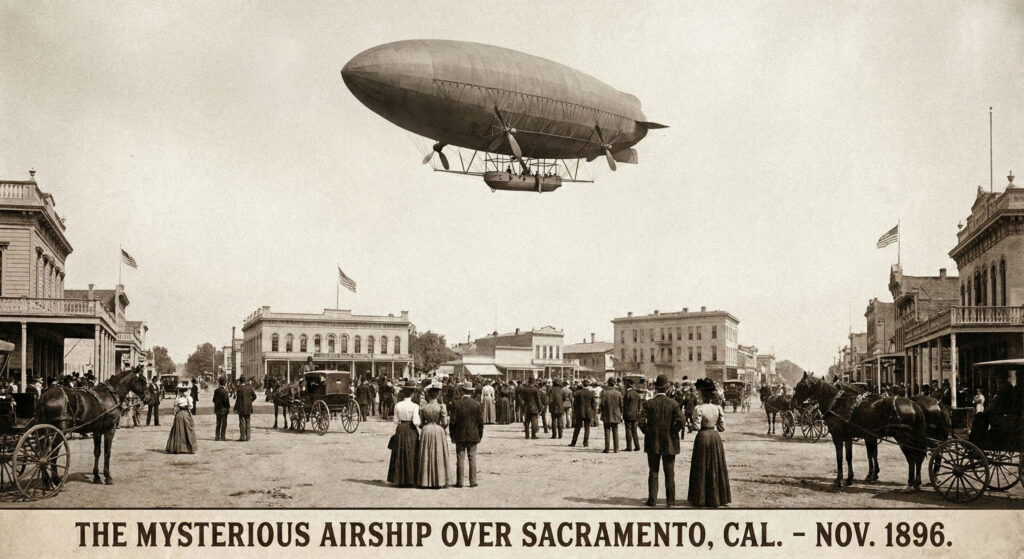
Time window: 1896-11 to 1897-05 (peak clusters: Northern California in late 1896; Great Plains/Midwest and Texas in spring 1897). Geographic footprint: West Coast → Great Plains/Midwest → Texas (plus scattered reports elsewhere). What people reported: a bright “headlight” or multiple lights; sometimes a structured “cigar-shaped” craft with propellers/wings; rarer “occupant” encounters; a few “crash/debris” narratives. Scale (contemporary & historical summaries): “thousands” of claims during the wave; later historians suggest the witness count may have been extremely large, potentially >100,000 (an estimate attributed to historian Mike Dash via secondary reporting).
Generated image from archive illustrations (UAPedia)
Dossier rules and labels
Because the airship wave sits at the intersection of newspaper sensationalism, pre-aviation technological optimism, and folklore-in-the-making, this dossier uses explicit labels.
Evidence Grade (EG)
EG-A: Primary source exists and is directly viewable (digitized newspaper page, archival scan).
EG-B: Primary source is cited/quoted in a reputable secondary source (history journal, state historical agency), but the original is not directly included here.
EG-C: Secondary retellings dominate (later books/articles summarize, but primary is thin or inconsistent).
EG-D: Folklore/legend status; strong indications of fabrication or deliberate hoax.
Speculation Label (SL)
SL-0 (Minimal): Straight description of records and reporting patterns.
Hundreds of witnesses reported an “airship” in the Bay Area press environment.
Great Plains / Midwest expansion
Feb–May 1897
Nebraska → region-wide
lights; structured craft; occasional occupants
Newspaper discourse becomes contagious across state lines.
Texas spike
Apr 13–17, 1897
North Central Texas
repeated “airship” sightings
Texas Almanac tally: 38 reports in 23 counties in this short window.
Why the Texas number matters
A five-day window with dozens of county-level reports is the kind of burst statistic that’s hard to explain purely by a single physical craft moving through geography, unless you assume extraordinary logistics.
It is, however, highly compatible with information spread (reprinting, local rivalry, copycat accounts), and with multiple small “light sources” (e.g., lantern-kites/balloons) generating local clusters. SL-2
Map: key localities and “corridors”
Below is a curated, non-exhaustive map set of frequently cited nodes in the 1896–97 wave (California ignition; Nebraska trigger; Kansas/Texas/Upper Midwest echoes). These points are intended for visualization and cross-referencing—not as a complete census.
Quick-view map table (sample nodes)
Node
State
Why it’s here
Sacramento
CA
Early ignition reports; iconic illustration in later retellings
San Francisco
CA
major press amplification; repeated Bay Area reports
Oakland
CA
Bay Area cluster
Tulare
CA
Mass-witness light reports in late 1896
Hastings
NE
Early 1897 Great Plains trigger reporting
Inavale
NE
Detailed Nebraska “airship” description in secondary quoting
York
NE
Nebraska continuity reports (as discussed in NE history material)
Le Roy
KS
Famous “cattle lifting” narrative attributed to Alexander Hamilton
Aurora
TX
Famous “crash” story widely treated as hoax/boosterism
Weatherford / region
TX
Texas “invasion” sketch tradition and clustered reports
Barnesville
MN
Upper Midwest example of 1897 reporting
Witness register
This section treats “witness” as a media role: the person named, the authority implied, and the narrative function.
Witness Type taxonomy (people-as-evidence)
Civic authority witnesses (mayor’s staff, deputies, attorneys): high persuasive value in newspapers.
Rural witnesses (farmers, ranch hands): often attached to “landing/interaction” tales.
Professional witnesses (doctors, lawyers): used to lend seriousness to extraordinary accounts.
Crowd witnesses (“hundreds,” “thousands”): strongest as social proof, weakest in detail quality.
Named witnesses frequently repeated in the literature
Caution: many names persist because they were printable and memorable, not because they were thoroughly investigated.
R. L. Lowery (Sacramento area reports; voice-from-craft claim appears in later summaries). EG-B / SL-0
George D. Collins (San Francisco attorney linked to “secret inventor near Oroville” narrative). EG-C / SL-0
Alexander Hamilton (Le Roy, Kansas; cattle-pen “lifting” story widely repeated). EG-C / SL-0 (ThriftBooks)
S. E. Haydon (Aurora, Texas story author; modern historical agency frames it as fictional booster-story). EG-B→D / SL-0
Case Capsules
A wave is not one event. Below are representative claim-shapes that recur.
Capsule 1 – The Bay Area ignition (Nov 1896): press + uncertainty
Location: San Francisco Bay Area (San Francisco/Oakland/Sacramento reporting sphere)
Data anchor: KQED describes the Bay Area being “excited and united” by repeated airship sightings with “hundreds of witnesses.” EG-B / SL-0
Primary-page evidence: The San Francisco Call (Nov 28, 1896) carries a front-page storyline framing an “aerial exhibition” and “mystery” around an airship narrative. EG-A / SL-0
What’s notable (SL-1): in a period where practical powered flight was not yet a normal lived reality, a bright moving light could be interpreted through multiple lenses: astronomy, prank devices, secret inventors, or “visitors.” The press frequently picked the most narratively productive one.
Capsule 2 – Nebraska trigger (Feb 1897): the “airship” jumps regions
Location: Hastings / Inavale, Nebraska
Claim shape: multiple sightings, observers described as respectable; the account becomes a “watch for reappearance” story.
Source support: Nebraska history publication quotes Omaha Daily Bee reporting that the ship was seen at Inavale and mentions a “pious party…returning from a prayer meeting.” EG-B / SL-0
Primary container record: the Omaha Daily Bee issue (Feb 6, 1897) is cataloged and viewable via the Library of Congress newspaper interface. EG-A (as artifact) / SL-0
Investigator’s note (SL-2): Nebraska is a perfect “wave amplifier” setting, high visibility skies, close communities, and newspapers eager to localize a national curiosity.
Capsule 3 – Texas spike (Apr 13–17, 1897): density and “invasion” framing
Location: North Central Texas
Claim shape: repeated reports across many counties in a tight window; the phenomenon is framed as a roaming craft or “fleet.”
Data anchor: Texas Almanac reports 38 sightings in 23 counties between April 13 and 17, 1897, with multiple counties reporting multiple sightings. EG-B / SL-0
Interpretation (SL-1 to SL-2):
SL-1: multiple misidentifications or local lantern/kite/balloon pranks could create real “lights in the sky” experiences.
SL-2: once a community expects an airship, each ambiguous light becomes legible as “the airship,” and each paper has incentive to publish its own version.
Claim shape: crash into a windmill; exotic pilot; burial story; “materials” claims.
Modern historical framing: Texas State Historical Association explicitly describes the Aurora crash story as fictional “news” released by S. E. Haydon in the Dallas Morning News to revive interest in the town. EG-B / SL-0
Status: Probable hoax / civic myth engine (EG-D), though later folklore layers persist.
Why it matters (SL-2): Aurora demonstrates a repeatable pattern in UAP history: a story can be born as publicity, then later reinterpreted as suppressed evidence, especially when the original media context is forgotten.
News Dossier
This is a starter index, focused on sources that are either primary-digitized or strongly curated by reputable institutions.
Primary newspaper artifacts (EG-A)
The San Francisco Call – Nov 28, 1896 – OCR page (Library of Congress / Chronicling America) (front-page framing of the “mystery” airship).
Omaha Daily Bee – Feb 6, 1897 – Library of Congress issue record (use page navigation to reach the relevant page).
Nebraska History publication quoting Omaha Daily Bee language about Inavale and the “prayer meeting” group.
Texas State Historical Association on Aurora: frames the Dallas Morning News item as an intentional fictional story.
Grand Forks Herald (Vault feature) on a Minnesota “air ship” case; includes framing via Mike Dash’s work and an illustration attribution to the St. Paul Globe.
Contextual interpretive journalism (modern)
KQED (Bay Area 1896 wave overview and cultural context).
JSTOR Daily (historical framing: phantom flying machines; links the episode to hoaxes and press dynamics; references Whalen & Bartholomew).
Books & scholarship dossier
Below are commonly referenced works that shape modern interpretation of the 1896–97 wave.
Academic / critical takes (press dynamics, social contagion)
Robert E. Bartholomew, “The Airship Hysteria of 1896–97” (Skeptical Inquirer; also available as PDF through CFI). Frames the wave as a social phenomenon; emphasizes “thousands” of claims and the role of the press.
Whalen & Bartholomew are discussed in modern summaries for how belief can cascade via media (see JSTOR Daily overview).
UAP-history framing
The airship wave as a predecessor to modern UFO culture is widely noted in UAP reference writing and summaries.
Mike Dash’s historical writing is often used for macro-scale estimates and narrative synthesis (as referenced in secondary reporting).
Regional quantification
Texas Almanac provides a rare compact numeric summary for the Texas spike (38 sightings, 23 counties, Apr 13–17).
Claims taxonomy
To analyze a wave, you need a consistent way to label claims. Here’s a taxonomy tailored to the airship era.
Axis A — Phenomenology (what was perceived)
A1: Light-only (single bright light; sometimes multiple).
Axis B — Interaction (did the story include contact?)
B0: No interaction (pure sighting).
B1: Voices heard (commands, conversation).
B2: Communication (pilot speaks; “destination” claims).
B3: Coercion/medical aid (doctor summoned; abduction-like elements).
Axis C — Aftermath (did anything remain?)
C0: No trace
C1: Physical trace claimed (marks, dropped parts)
C2: Debris / crash narrative
C3: Burial / body narrative (highest folklore risk)
Axis D — Narrative “attribution hook” (what the story says it was)
D1: Secret inventor / private airship
D2: Military / spy / war destination
D3: Hoax/prank/booster story
D4: Otherworldly / Mars / non-human
Why this taxonomy helps: It separates what was seen from what it was said to mean. In 1896–97 those two layers often diverge quickly once a newspaper frame (“airship!”) takes hold.
Hypotheses board
H1 – Misidentification of lights and sky objects (SL-1)
Claim: A meaningful fraction of reports were bright celestial objects, meteors, or ordinary lights interpreted through “airship expectation.” Pros: Fits the dominance of nighttime light-only reports and the era’s limited aviation reality. Cons: Does not fully explain detailed structured craft narratives unless those are embellished or hoaxed.
H2 – Lantern-kites, balloons, and local pranks (SL-1)
Claim: Some communities created the phenomenon physically (small airborne lights), then newspapers created it culturally. Pros: Explains localized spikes and “repeat appearances” without requiring long-range flight tech. Cons: Not every report can be neatly reduced, and prank evidence is unevenly documented.
Claim: The wave is primarily an information event: reprints, rivals, sensational copy, and occasional outright fabricated “interviews” with pilots. Pros: Strongly consistent with the era’s sensational press environment and the wave-like spread across states. Bartholomew’s framing emphasizes the social mechanics of mass belief. Cons: Hard to prove case-by-case without deep local archival work; some witnesses likely did see something unusual (even if mundane).
H4 – Prototype airship(s) ahead of public aviation (SL-2)
Claim: An inventor (or multiple inventors) flew experimental craft secretly. Pros: Period imagination strongly favored this explanation; many reports explicitly invoke it. Cons: Long-distance, repeated multi-state flights are hard to square with what is known about practical aviation capability and secrecy constraints of the era (a point often raised by historians and skeptics).
H5 – Non-human technology (SL-3)
Claim: Some craft were not human-made (the “Mars/otherworld” variants). Pros: Explains the “occupant” and “exotic” motifs if one accepts them at face value. Cons: The Aurora case, one of the most famous “crash” narratives—has strong modern historical framing as deliberate fiction, highlighting how quickly extraordinary motifs can be manufactured.
Implications
It’s an early template for modern “flap mechanics”
The wave shows the familiar rhythm: initial ambiguous stimulus → authoritative repetition → narrative elaboration → geographic spread → peak → decay. That’s a structural cousin of many 20th/21st century UAP waves—even when the underlying causes differ.
It demonstrates how “technology expectation” shapes perception
In 1896, powered flight was imaginable but not routine. The “airship” was the perfect container for mystery: plausible enough to print, futuristic enough to thrill. Today’s equivalent containers might be “drones,” “black projects,” or “non-human tech.”
It offers a cautionary lesson for crash narratives
Aurora illustrates a key methodological hazard: a compelling crash story can be culturally true (important locally) while historically false (fabricated as news). Modern investigators should treat “crash + body + burial” story-shapes as high-risk until primary documentation is strong.
It suggests that “counting reports” is not the same as “counting events”
Texas Almanac’s county-by-county spike is valuable precisely because it is countable. But counts are not neutral: they measure reporting, not necessarily occurrence. A data-first approach should always model the media layer as part of the phenomenon.
The wave is real as a reporting event: newspapers across regions carried “airship” items and the topic propagated. EG-A overall (as a media artifact).
The most common claim-type is light-only (low information, high ambiguity), which is consistent with misidentification and/or small local hoaxes. SL-1 favored for many cases.
At least some famous high-drama stories are strongly implicated as fiction/boosterism, with Aurora the standout example in modern historical framing. EG-D for the crash-as-fact claim.
The Texas spike is one of the best “quantified sub-waves” and deserves dedicated dataset work (county-level mapping, newspaper provenance, duplication analysis).
SEO keywords
American Airship Wave, Mystery Airship 1896, Phantom Airship 1897, Airship flap, 19th century UAP, Historical UFO waves, Aurora Texas airship, Dallas Morning News 1897, Nebraska airship sightings, San Francisco Call airship, UAP taxonomy, Mass media contagion, Fortean history, Pre-Wright Brothers aviation myths
What moves a UAP is the central research question that ties together aerial encounters, undersea observations, and space-adjacent anomalies.
A data-first view starts from what instruments and witnesses report, maps those observables to the minimum physics required, and then sorts candidate propulsion models by how well they match the data with the fewest assumptions.
The public record contains multi-sensor cases with radar, FLIR, and eyewitness testimony, along with technical and theoretical literature ranging from classical fluid dynamics to general relativity.
Government reporting has grown, but its official summaries emphasize that most military-collected cases resolve prosaically once data are sufficient. That stance coexists with a persistent remainder of unresolved reports and an expanding research conversation about field propulsion, metric engineering, and vacuum physics. (Director of National Intelligence)
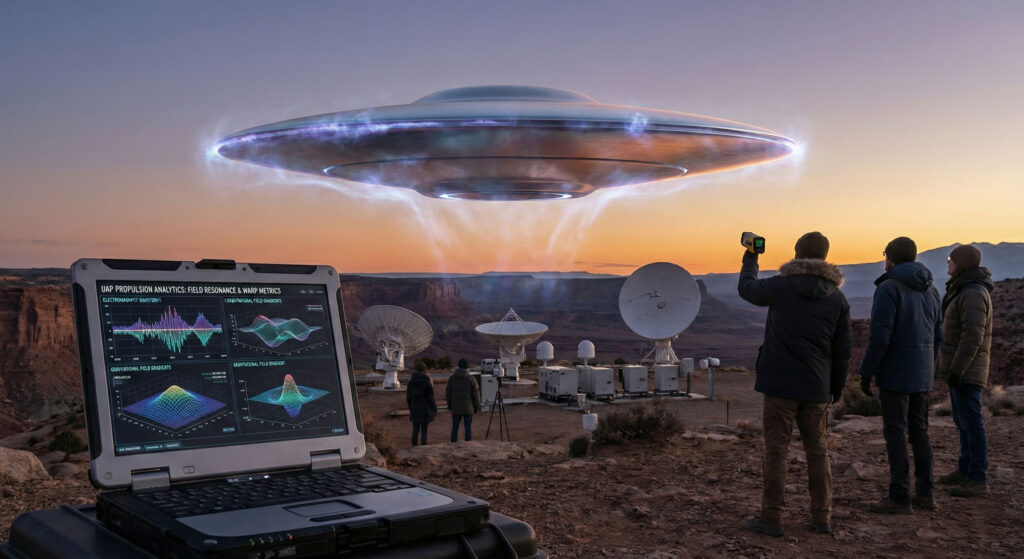
Fictional generated image showing researchers monitoring a UAP’s electromagnetic signature in real-time, displaying field resonance metrics on a ruggedized analysis terminal to test propulsion theories. (UAPedia)
What the data say before any theory
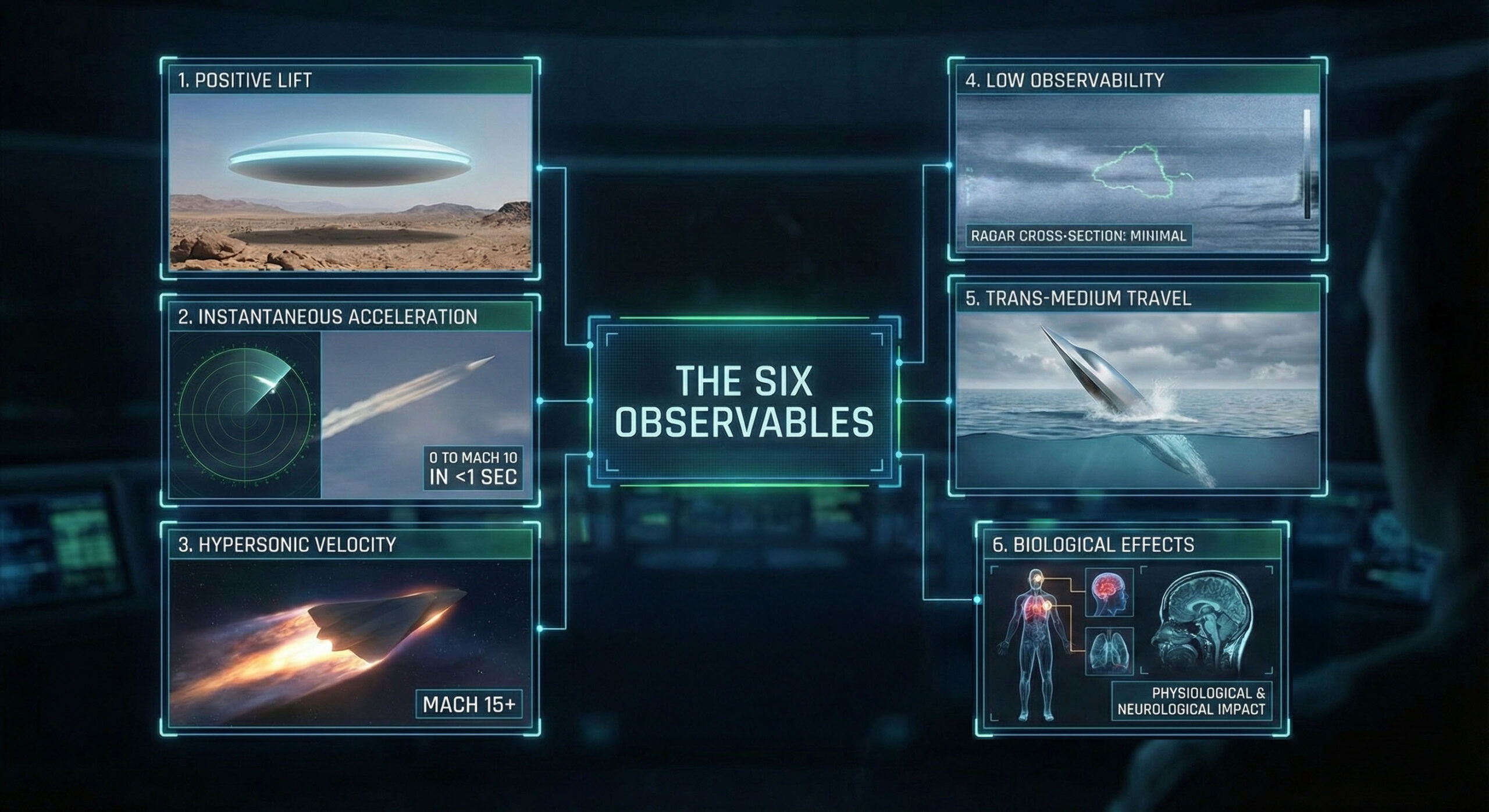
A compact way to map observations to minimum propulsion implications is to align frequently reported performance characteristics with the physics they would require if literally true.
Observable (frequently alleged)
Measurement mode
Minimal propulsion implication
Representative public datasets
Stationary hover for extended periods with no visible control surfaces
FLIR, eyewitness, sometimes radar
High power-density energy source with thrust vectoring or buoyant/field effect able to cancel gravity; minimal hot exhaust signature
Navy “Gimbal” and “GoFast” FLIR sequences; AARO’s 2025 “GoFast” case card constrains speeds to 5–92 mph and puts the object at ~13,000 ft, consistent with mundane motion under wind.
Rapid accelerations and direction changes that appear to exceed aerodynamic limits
Radar tracks and pilot accounts
Either very high thrust-to-mass with extreme structural margins or an effective reduction of apparent inertia; otherwise observational artifact
2004 Nimitz “Tic Tac” dossier by SCU, with calculations and sensor context; competing analyses caution about parallax and track correlation limits.
Trans-medium behavior from air to water with small splash or continued track
Thermal IR and visual, sometimes radar correlation
Slippery boundary layer or sheath that suppresses cavitation and shock; shape and surface physics matter
2013 Aguadilla IR video analysis by SCU; alternative hypothesis papers propose sky lanterns; the debate turns on wind and range estimates.
Low or ambiguous thermal signature
IR, EO
Non-chemical energy conversion, radiative camouflage, or small cross-section emitter; or simply distance and sensor settings
NASA UAP Study calls for calibrated, radiometrically useful data to adjudicate these claims.
Key citations supporting the specific points above: AARO “GoFast” case resolution card placing the object at ~13,000 ft and 5–92 mph, with parallax driving the speed illusion. SCU’s Nimitz monograph compiling radar, ATFLIR, and pilot testimony for 2004. SCU’s Aguadilla report with counter-analyses about lanterns, range, and wind.
Data-first takeaway: some headline videos resolve to conventional dynamics after proper geometry and wind fields are applied, while other instrumented events retain genuine unknowns.
This mixed picture argues for careful case-by-case physics inferences rather than one-size answers.
The propulsion problem restated
A craft that hovers without obvious propulsors, maneuvers without control surfaces, and transitions across media would need at least one of the following:
a way to generate momentum exchange without hot working fluid
a way to reduce effective inertia or otherwise decouple internal loads from external accelerations
a way to engineer the near-field environment so the medium “gets out of the way,” in air or water
a way to control signature in multiple bands
The literature splits along those lines into field-propulsion concepts, plasma or MHD boundary control, and metric engineering. Below is an organized tour of the main families, anchored to publications and test reports. We include speculation labels with each where appropriate.
Field and boundary-layer engineering candidates
Magnetohydrodynamic and plasma-aerodynamic control
Core idea: use strong electromagnetic fields to ionize and push the nearby medium, reducing skin friction and delaying shock or cavitation. This is classical MHD and plasma-aerodynamics applied aggressively.
Data hooks: Alleged trans-medium entries with minimal splash and stable trajectories motivate curiosity about sheath-like boundaries. The Aguadilla analysis uses a thermal IR track consistent with a compact emitter, but the interpretation is contested. (Zenodo)
Publications worth knowing: AAWSAP’s Defense Intelligence Reference Documents included “Advanced Space Propulsion Based on Vacuum (Spacetime Metric) Engineering” and other plasma-adjacent topics in its 38-paper survey series. These are literature reviews and theoretical explorations, not validated propulsion demos.
Status: laboratory-scale flow control works in limited regimes; full trans-medium suppression remains unproven.
Speculation label: Hypothesis.
Zero-Point Field and vacuum engineering
Core idea: inertia and perhaps gravity emerge from interactions with the vacuum electromagnetic field. Modulate that field and you could modulate inertia or extract reaction forces.
Data hooks: “High-g without airframe breakup” claims would be easier to reconcile if effective inertia is reduced relative to structural loads.
Publications worth knowing: Haisch, Rueda, and Puthoff (1994) in Physical Review A proposed inertia as a Lorentz force arising from the zero-point field in accelerated frames. NASA’s Breakthrough Propulsion Physics program (1996-2002) cataloged such ideas and urged falsifiable tests. White’s “Warp Field Mechanics 101” summarizes warp-metric energetics, including vacuum considerations. (ResearchGate)
Status: no peer-reviewed, repeatable demonstration of net thrust from the quantum vacuum exists in the open literature.
Speculation label: Researcher opinion.
Reactionless microwave cavities and “EMDrive”-like claims
Core idea: a closed radio-frequency resonant cavity produces a net thrust without expelling reaction mass, perhaps by interacting with a quantum vacuum or by asymmetric fields.
Publications worth knowing: NASA’s Eagleworks team reported micro-Newton-scale thrust signals in vacuum tests with a dielectric-loaded RF cavity, with a reported 1.2 mN/kW figure of merit and extensive discussion of thermal systematics. The result remains controversial and has not been confirmed by independent labs to a consensus standard.
Status: disputed, with multiple null tests and alternative explanations proposed.
Speculation label: Disputed.
Mach-effect thrusters
Core idea: if mass fluctuates in an object whose internal energy is changing under acceleration, a phased push-pull might integrate to net thrust. James Woodward and collaborators have pursued this for decades.
Publications worth knowing: Theory and experiment have been presented in conference papers and journals, along with NASA NIAC-supported roadmaps. Independent groups have reported both small thrusts and nulls. (arXiv)
Status: unresolved at low signal levels.
Speculation label: Hypothesis.
Electrogravitics and Townsend Brown
Core idea: high-voltage asymmetric capacitors appear to generate lift beyond ion wind. Historical claims link this to gravity coupling.
Publications worth knowing: Mid-century industry briefs and later retrospectives in the public domain. Controlled experiments typically attribute forces to ion wind and corona discharge rather than gravity. (Wikipedia)
Status: misattribution to electrohydrodynamic effects explains most demonstrations.
Speculation label: Misidentification.
Metric-engineering concepts
Alcubierre-type warp metrics
Core idea: the ship stays locally inertial inside a “bubble” while spacetime contracts in front and expands behind. Travel can be effectively superluminal as seen from the outside.
Publications worth knowing: Alcubierre’s 1994 paper; Bobrick and Martire’s 2021 “Introducing Physical Warp Drives,” which formalizes subluminal, positive-energy classes and reframes warp drives as shells that still need conventional propulsion; Lentz’s 2021 work on positive-energy warp solitons; follow-up critiques noting energy conditions and stress-tensor issues. (Instituto de Física UFRJ)
Status: this is rigorous general relativity. It is not a blueprint. No engineered metric has been realized.
Speculation label: Researcher opinion.
Rendering of Alcubierre drive in action (Limitless Space Institute)
Pais patents and “polarized vacuum” craft
Core idea: a resonant cavity, driven at microwave and acoustic frequencies, polarizes the local vacuum and reduces inertia or generates high-frequency gravitational waves. The result is a hybrid aerospace-undersea craft concept with a “polarized vacuum” outside its shell.
Publications worth knowing: Several U.S. patents assigned to the Navy, public FOIA releases, and a conference paper trail. These documents are legal claims, not experimental replications. (Google Patents)
Status: claims remain unvalidated in independent laboratories.
Speculation label: Hypothesis.
Case studies as propulsion testbeds
The 2004 Nimitz encounters
The SCU monograph integrates radar tracks, pilot debriefs, and ATFLIR to bound size, speeds, and maneuvers of the “Tic Tac.” Its appendices detail alternate reconstructions and power estimates. While the public does not have all raw radar files, the report is a benchmark in how to turn testimonies and partial telemetry into falsifiable physics claims. (The SCU)
Propulsion inference: if the strongest acceleration inferences are taken at face value, conventional aerostructures are insufficient. Candidates become field-effect inertia mitigation or misestimation of geometry. A cautious reading leaves the case as a probable anomaly in performance, pending release of original, synchronized sensor data.
The 2013 Aguadilla trans-medium video
SCU’s analysis argues for a compact, fast target with anomalous water entry and a split into two returns. Critics propose lanterns linked by string and wind drift. The dispute reduces to range, wind, and parallax math. The case is a clean example of how propulsion inferences collapse if the target was much smaller and closer than assumed. (The SCU)
Propulsion inference: if the object truly entered water at high speed and continued with minimal loss, the boundary-layer hypothesis gains weight. If it was lanterns, the propulsion inference disappears. Current status: Disputed.
The 2015 “GoFast” FLIR clip
AARO’s 2025 case card re-analyzed the video display readouts and historical winds to constrain intrinsic speed and altitude, attributing apparent high speed to motion parallax. The assessed speed range is 5–92 mph at roughly 13,000 ft. (AARO)
Propulsion inference: conventional.
Government reporting, weighed carefully
ODNI’s 2021 preliminary assessment and subsequent annual reports describe a growing catalog and emphasize safety of flight. AARO’s 2023 consolidated report and 2024 historical review assert no evidence of off-world technology in government holdings available to those offices. UAPedia records such statements, applies a “secrecy environment modifier,” and cross-checks against independent evidence and testimony. This avoids both credulity and premature dismissal. (Director of National Intelligence)
Policy implication: better instrumented data and transparent case files are prerequisites for propulsion inferences that stand outside the rumor mill.
Publications and resources to know
NASA UAP Independent Study Team Final Report. Recommendations for data standards, calibration, and stigma reduction in UAP research. (NASA Science)
SCU Monographs. Nimitz (2004) and Aguadilla (2013). Detailed reconstructions with explicit assumptions. (The SCU)
AARO Case Resolution Cards. Worked examples that sometimes resolve pop-icon videos into ordinary dynamics. (AARO)
AAWSAP/AATIP DIRDs. Surveys that inventory theoretical options such as warp metrics, wormholes, and metamaterials. They are not proof of capability.
NASA Breakthrough Propulsion Physics documents. Lessons on how to test extraordinary claims with modest budgets and falsification first. (NASA Technical Reports Server)
Warp-metric literature. Alcubierre 1994; Bobrick & Martire 2021; Lentz 2021; critiques on energy conditions. (Instituto de Física UFRJ)
Vacuum and inertia literature. Haisch, Rueda, Puthoff 1994; White 2011 overview. (ResearchGate)
EMDrive-type tests. NASA Eagleworks 2016 test report with discussion of thermal confounders and null approaches.
Pais patents. Hybrid aerospace-undersea craft and high-frequency gravitational wave generator. FOIA trail provides context. (Google Patents)
Implications if even a subset is true
Energy systems: Hover and rapid maneuver without reaction mass imply power densities far beyond chemical propulsion. That would redefine aviation, shipping, and space access.
Fluid-structure engineering: A robust boundary-layer control that eliminates cavitation and shock would transform vehicle design and ocean engineering.
Sensing and countermeasures: Field-based propulsion likely couples to the environment and may leave distinctive electromagnetic or gravitational signatures. That sets clear targets for next-gen sensors.
Policy and safety: The number of unresolved military and civilian reports with near-miss potential justifies standardized sensor capture and analytic pipelines irrespective of origin hypotheses. (Director of National Intelligence)
Claims taxonomy
Verified • AARO’s “GoFast” analysis constrains speed and altitude using video readouts and winds, showing non-anomalous speeds given parallax. (AARO)
Probable • The Nimitz encounter’s unusual kinematics relative to contemporaneous fleet training patterns look anomalous in the SCU reconstruction, though key raw sensor sets are not public. (The SCU)
Disputed • Aguadilla 2013 as a trans-medium demonstration. SCU argues for an anomalous target. Others propose lanterns and wind. Status remains contested pending full, calibrated, synchronized data. (The SCU)
Legend • Mid-century electrogravitics as a field-coupled gravity technology. Most demonstrations reduce to ion wind or corona. (Wikipedia)
Misidentification • Many FLIR clips that appear supersonic resolve to parallax plus wind when aircraft geometry is modeled. AARO’s “GoFast” is the canonical example. (AARO)
Hoax • Not applicable to the specific technical sources cited in this overview.
Speculation labels
Hypothesis • MHD or plasma sheath enabling trans-medium travel. • Mach-effect thrusters. • Pais “polarized vacuum” cavity craft.
Witness interpretation • Pilot impressions of “instant acceleration” without instruments can be colored by parallax and situational stress. Instrumented reconstructions are required, as “GoFast” illustrates. (AARO)
Researcher opinion • Vacuum engineering and metric-engineering as ultimate solutions. There is a long arc of serious theory, but no lab-grade propulsion yet. (Instituto de Física UFRJ)
Bottom line
A propulsion overview anchored in public data yields a clear research program. Build better datasets with synchronized, calibrated sensors. Prefer quantitative reconstructions over narratives.
Explore boundary-layer and field-propulsion hypotheses in parallel with null-bound laboratory testing. Track metric-engineering theory as a long-horizon path that is mathematically rigorous but experimentally distant. Accept credible testimony as inputs and weigh it against sensors and physics. This is how a science of UAP propulsion can advance.
What to watch next
Laboratory falsification: Repeatable null-bound experiments on EM cavities, Mach-effects, and plasma sheath dynamics will prune or validate hypotheses. NASA’s BPP playbook is relevant. (NASA Technical Reports Server)
Metric engineering theory: Continued work on positive-energy, subluminal warp constructs clarifies what would be required if nature allows metric control at any scale. (arXiv)
Among Cold War era UAP reports, the 24 October 1968 events near Minot Air Force Base in North Dakota stand out because they generated something rare in the historical record: coordinated observations by ground security teams, an aircrew on a B-52H, base radar operators, and a short sequence of radarscope photographs recorded on film.
Project Blue Book’s case file runs to well over a hundred pages, including radio transcripts, AF-117 witness forms, radar and weather notes, and the Air Force’s own “final case report.” Independent researchers later recovered and digitized the record and added technical analyses of the B-52 radarscope frames.
Whatever one’s conclusion about origin, there is enough data to reconstruct what participants saw, what the instruments recorded, and how the government analyzed it. (Minot AFB UFO)
The night of 24 October 1968, step by step
Setting and units. Minot was then a Strategic Air Command base with B-52H bombers and a surrounding Minuteman ICBM complex.
In the early morning hours, security and maintenance personnel across the November flight area began radioing unusual lights to Base Operations. Minot Radar Approach Control (RAPCON) joined the net and a returning B-52H on training mission, call sign JAG-31, was asked to assist. (Minot AFB UFO)
Ground witnesses. The Blue Book file preserves brief, time stamped accounts from airmen at missile facilities. Airman First Class Robert O’Conner reported seeing a self luminous light “moving in various directions in the southern skies” from about 02:30 to 03:45. A1C Lloyd Isley said he watched an object “from 00:30 to 04:30,” at times hearing a sound like jet engines and seeing a color shift from white to green to dim amber.
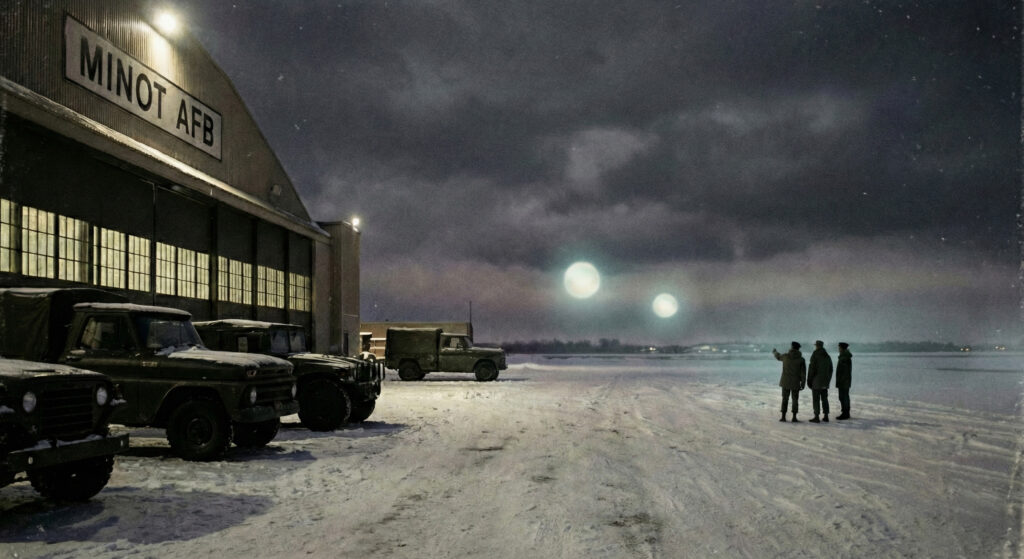
Reconstruction of possible scene from the Blue Book Report (UAPedia)
Others including A1C Jablonski and A1C Adams described a glowing object that alternated reddish orange, white, and green, sometimes apparently hovering and then moving. These entries are not sensational; they read like duty logs.
RAPCON and the B-52. RAPCON alerted the crew of JAG-31 to a target and the B-52 navigator picked it up on the radarscope at a range of several miles, maintaining separation during a standard 180 degree turn.
As the bomber started descent toward Minot, the unknown appeared to close rapidly to about one nautical mile, “pacing” the aircraft for a long segment before dropping from the display. The crew recorded a short sequence of radarscope photographs during this close approach. Independent reviewers later identified the frames as 771 through 784, captured over about 37 seconds. (Minot AFB UFO)
Communications anomaly. At one point in the close approach, the bomber’s two UHF radios would not transmit, then returned to normal within minutes.
The Blue Book final case report timeline lists “0400–0402 B-52 regains ability to transmit.” That anomaly, because it has a time, an aircraft, a context, and an official note, remains one of the most discussed details.
Pilot’s visual. Pilot Maj. James Partin reported a bright orange light about fifteen miles away in the west northwest around 04:30 to 04:35, described as on or near the ground and stationary during his approach. This sighting appears separately in the file from the earlier radar pacing episode.
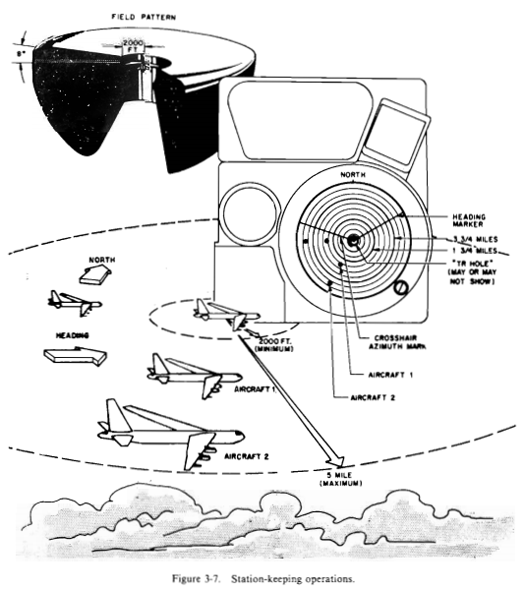
The radarscope film. Fourteen frames of the B-52’s ASQ-38 radar display were photographed between 09:06:14Z and 09:06:51.5Z. Technical studies by Claude Poher and by Martin Shough examined the geometry, antenna mode, range rings, and the behavior of a compact echo that appears repeatedly at about one mile off the nose in the two o’clock quadrant, sometimes as a double return separated by a tenth to two tenths of a mile.
The sequence spans one complete rotation of the antenna per exposure, and the aircraft moved roughly 2.6 nautical miles during the series. This is instrument data, not a memory. (Minot AFB UFO)
First hand voices, in their own clipped language
Blue Book’s final case report summarizes several AF-117 witness forms and the cockpit and controller recordings. It is not poetry. It is checklists and clipped notes from people on duty.
A1C O’Conner: he watched a “self luminous big ball of white light that seemed to change to a green light, then later to a dim amber color,” from about 02:30 to 03:45.
A1C Isley: he observed for “three and a half to four hours,” sometimes hearing a noise “that of jet engines,” and at one time “sighted two objects.”
A1C Adams: he described a “reddish orange light” that “kept changing white and occasionally green,” sometimes stationary and sometimes speeding up.
Maj. Partin: he “visually sighted an unidentified light” that appeared as “a bright orange ball of light about 15 miles away,” stationary during his approach.
The Blue Book text also notes that “B-52 scope photos start 0406:15” and end 36 seconds later, and that “RAPCON” and weather radar had their own paints during parts of the episode. The tight timestamps are why this case still draws engineers to the archive.
What the government did
Immediate actions. As soon as JAG-31 landed, the pilot debriefed with Base Operations. Minot’s commander designated Lt. Col. Arthur Werlich as investigating officer under Air Force Regulation 80-17. Teletype traffic shows Strategic Air Command headquarters at Offutt AFB calling Blue Book early the next business day to ensure procedures were followed. Werlich sent a map overlay plotting the B-52 and the unknown, and he forwarded AF-117s and the “Basic Reporting Data” packet that Blue Book required. (Minot AFB UFO)
Project Blue Book’s evaluation. Blue Book chief Lt. Col. Hector Quintanilla filed the final case report on 13 November 1968. The analytical section is revealing. It asserts that
the brightest astronomical object visible was Sirius, whose blue red white green scintillation could be enhanced by an inversion and haze,
portions of the B-52’s maneuvers and landing lights could account for some ground visual reports,
the pilot’s later orange light might have been Vega near the horizon,
“plasmas can affect electrical equipment and can also be painted on radar,” including ball lightning, and
the aurora is common over Minot that time of year.
Those are the government’s words. They are not ambivalent about preferred explanations.
Closure and afterlife. Blue Book’s public files were retired to the National Archives when the program closed in 1969.
The Air Force’s official overview today notes that 701 of 12,618 Blue Book cases remained “unidentified” overall, without breaking out Minot by label in that high level fact sheet.
The Minot file itself shows the Air Force favoring a mix of star, airplane, and plasma to explain different elements, an assessment that independent investigators dispute. (U.S. Air Force)
What the data say when you line them up
Multiple channels at once. The core reason Minot is studied is that three channels align during the 03:30 to 04:10 window. Ground observers reported a luminous object moving against the southern sky.
The B-52 navigator recorded a series of radarscope images where a compact return appeared about one nautical mile off the nose at a constant bearing, sometimes splitting into double echoes. RAPCON and weather radar had paints that operators announced on air. Triangulation is difficult after the fact, but the coincidence is not trivial. (NICAP)
Kinematics from the radarscope film. The independent technical studies agree on the basic geometry. The photos were shot in “station keeping” mode, which trades long range for elevated sensitivity near the aircraft. Range rings on the film allow estimates of distance. The compact echo persists near one mile at “about forty degrees” relative bearing in several frames, briefly resolves into a double echo about a tenth of a mile apart, and then is gone. The bomber covers a couple of miles during the thirty seven second series. The behavior is consistent with a contact that held station briefly and then moved, but interpretation is debated. (Minot AFB UFO)
The radio outage. The Blue Book time line plainly notes that JAG-31 regained the ability to transmit between 04:00 and 04:02. The episode coincides with the close approach and the radarscope sequence. Blue Book’s analytical section asserts that “plasmas” can affect electrical systems, which is offered as a catchall rather than as a diagnosis backed by measurements of a plasma in that sky at that moment. The outage remains an unexplained, but documented, fact.
How Blue Book framed it. The final report’s emphasis on Sirius, autokinesis, and B-52 landing lights for ground observers, and on Vega for the later pilot visual, shows the Air Force habit at that stage: parse a multi part event into slices and attach a familiar explanation to each slice. The same memo explicitly suggests “ball lightning” for radar and radio effects, although ball lightning in clear weather and at that duration is a stretch. That posture is part of why the case is still argued.
Images you can actually study
Blue Book case file, final report. This is the Air Force’s own write up with a minute by minute time line, excerpts of AF-117 witness forms, and the analytical section that names Sirius, Vega, autokinesis, and plasma. The document also time stamps when the B-52 lost and regained transmission, and when the scope photos were shot. (Minot AFB UFO)
Radarscope frames 771 to 784. Independent researchers have posted a complete set of the B-52’s radarscope photos with frame by frame descriptions, including positions of compact echoes near one nautical mile range. Technical annexes explain the radar mode and range ring calibration. (Minot AFB UFO)
Those two assets, together with the raw witness forms in the document pile, are the backbone of any serious Minot review. You do not need artist’s renderings when you can look at what the instrument saw and read what the witnesses wrote.
Follow up across decades
Archival consolidation. The privately maintained Minot case site has assembled the 145 pages of Blue Book materials, plus the radarscope photos and teletype traffic in chronological order, and has published Werlich’s memos and map overlays. The site is not an official source, but it is a well organized pointer to official scans. (Minot AFB UFO)
Technical analyses. Detailed studies by Claude Poher and Martin Shough of the radarscope frames explore clock timing, antenna rotation, and echo morphology, and derive bounds on distance and motion. These analyses do not prove what the object was; they do demonstrate that a compact radar target repeatedly presented near one nautical mile range. (Minot AFB UFO)
Media and scholarly treatments. Documentaries and papers continue to use Minot as a test case for government handling of UAP. Academic uploads and older television reporting have brought the case to new audiences while preserving the raw materials. (Academia)
How strong is the evidence
Strengths. Multi channel observations, timestamped instrument data, and a comprehensive official paper trail make Minot far stronger than a typical single witness nocturnal light. The B-52 radarscope film and the logged radio outage are particularly notable.
Weaknesses. There is no raw primary radar tape from RAPCON, no synchronized weather radar film, and no air to air or air to ground optical imagery of the object. Blue Book did not obtain or publish detailed equipment performance checks that might rule out rare radar artifacts. And the analytical section’s reliance on astronomical and “plasma” placeholders did not meaningfully test alternative hypotheses.
Bottom line. The record supports that something with radar cross section near one mile from the B-52 briefly held a constant bearing and then vanished, and that ground and air witnesses saw unusual lights in roughly the same window. What it was remains disputed.
Government posture in context
Blue Book’s official public stance near the end of the program was that no UAP posed a national security threat and that no evidence suggested exotic technology. The Air Force closed Blue Book in 1969 and transferred the files to the National Archives. Today the service’s fact sheet simply notes the closure and the count of unidentifieds across the program. Minot thus sits at the cusp between institutional wrap up and a data rich case that never drew a more rigorous, instrument heavy follow on. (U.S. Air Force)
Implications for nuclear site security and UAP research
Minot was not a routine airspace incursion. It happened over a nuclear mission base and missile field at the height of the Cold War. Even if every element had resolved into the prosaic, the mere possibility of an uncorrelated target pacing a bomber near its home base would justify a more formal multi sensor doctrine. Today that lesson lands in an era where unknown drones have probed nuclear plants and bases in several countries. When unknowns appear around nuclear forces or critical infrastructure, the answer is not speculation. It is synchronized optical, infrared, radar, and radiofrequency capture with known sensor settings and a shared time base. The Minot file shows how much more we could have learned with that approach. (NICAP)
Claims taxonomy
Verified
Multiple USAF personnel reported an unusual light around Minot AFB during the early hours of 24 October 1968; a B-52H crew recorded fourteen radarscope photographs during a close encounter; and the crew’s UHF transmitters were briefly inoperative during the encounter before returning to normal. These items appear in the Project Blue Book final report.
Project Blue Book investigated under AFR 80-17. Lt. Col. Arthur Werlich forwarded AF-117 witness forms, a plotted overlay, and other data to Wright-Patterson; Strategic Air Command followed up by phone with Blue Book on the first business day. (Minot AFB UFO)
Independent technical studies of the B-52 radarscope frames exist and reconstruct geometry and timing across frames 771 to 784. (Minot AFB UFO)
Probable
The compact echo visible near one nautical mile range in several frames is unlikely to be a simple ground return in station keeping mode, given the echo’s morphology and persistence across successive antenna rotations. This is an inference from Poher and Shough’s analyses and the radar mode description. (Minot AFB UFO)
Disputed
Blue Book’s attribution of ground visuals to Sirius, Vega, and the B-52’s own lights, and of the radar and radio anomalies to “plasma similar to ball lightning,” is contested by later analysts who argue the explanations do not engage the instrument data.
Legend
Claims of an extended dogfight or of weapons interference in this case do not appear in the Blue Book file. They are later embellishments that do not match the contemporaneous record.
Misidentification
Some long duration ground visuals in the southern sky are plausibly explained by bright stars seen through haze and inversion with autokinetic effects, and by the B-52’s approach lights diffused by weather, as Blue Book argued. This does not account for the specific one mile radar pacing episode.
Speculation labels
Hypothesis The B-52 radarscope sequence likely captured a real, compact target at about one nautical mile range that briefly maintained relative position, which is consistent with an object executing station keeping with the bomber. Whether that target was a foreign test vehicle, a rare atmospheric radar phenomenon, or something more exotic cannot be resolved from the surviving data. (Minot AFB UFO)
Witness interpretation Ground observers who saw a bright, color shifting light for long intervals may have mixed more than one source into a single narrative, including the B-52’s own lights during approach and bright stars near the horizon under inversion. That does not explain the radar pacing episode, but it cautions against one to one mapping between every visual and every instrument record.
Researcher opinion Blue Book’s treatment of Minot reads more like an exercise in attaching familiar labels than a genuine falsification effort. A modern reinvestigation would start by reprocessing the radarscope frames with contemporary image tools, modeling the ASQ-38 antenna pattern and side lobes, and testing whether known clutter modes or ground echoes at that geometry could mimic the compact, on bearing one mile return. (Minot AFB UFO)
Bottom line
Minot is not an internet rumor. It is a documented sequence in which trained personnel tracked an unknown, a bomber crew recorded radarscope images of a compact return near one mile, and the aircraft briefly lost radio transmit capability during the close approach.
The Air Force’s own case report tried to explain the ground lights as stars and the aircraft itself, and the radio and radar effects as “plasma.”
Later technical work respects the Blue Book scans but challenges those conclusions on the instrument merits. Without raw RAPCON radar tapes or synchronized weather radar film, Minot will not resolve to certainty.
Yet the surviving data are already enough to teach the modern lesson.
When an unknown appears near nuclear forces, the way to separate stars, airplanes, and the truly anomalous is not with a slogan.
It is with calibrated, multi channel measurement that can be replayed and checked forensically. Minot shows how close we came to that standard in 1968 and how far we still had to go.
References
Project Blue Book final case report for Minot AFB, 24 October 1968. The Air Force time line, witness summaries, and analytical conclusions are here. (Minot AFB UFO)
Consolidated document archive, maps, AF-117 forms, and radarscope film index for the Minot case. (Minot AFB UFO)
Radarscope photograph index and frame by frame descriptions. (Minot AFB UFO)
Claude Poher, “Analysis of Radar and Air-Visual UFO Observations on 24 October 1968 at Minot AFB, North Dakota.” Technical analysis of frames 771 to 784. (Academia)
NICAP case summary with links to additional research notes and analyses. (NICAP)
National Archives overview of Project Blue Book records. (National Archives)
US Air Force fact sheet on Project Blue Book and the count of unidentifieds. (U.S. Air Force)
SEO keywords
Minot AFB 1968 UAP, Minot B 52 radarscope photos, JAG 31 radar pacing, Minot missile field UAP, Project Blue Book Minot case, Arthur Werlich AFR 80 17, Hector Quintanilla analysis, Claude Poher radarscope study, Martin Shough Minot analysis, UAP near nuclear bases, Air Force UHF radio outage, RAPCON radar Minot, AF Form 117 witness accounts, Strategic Air Command UAP incident, UAPedia Minot case file.
Researchers, contemplatives, psychonauts and contact-work practitioners converge on a practical question. Which concrete practices, states or technologies most reliably open access to heightened clarity, unity, significance, creativity or numinous awe, while remaining grounded in what measurements can actually show.
This explainer maps the most evidence-based “entry points” to high-consciousness, the instruments used to measure them, what leading theories say about how they work, and how experiencers interpret what they touch.
For UAP researchers this matters because many contact modalities are consciousness-centric and appear to co-vary with altered state profiles in repeatable ways.
(UAPedia)
Working definition and instruments
Operational meaning By high-consciousness we mean states that score high on one or more of these dimensions: self-transcendence or unity, vividness and richness of percept, insight and meaning, prosocial or awe responses, or expanded cognitive flexibility. This is a pragmatic definition to support measurement.
Core instruments.
Psychometrics The Mystical Experience Questionnaire (MEQ-30) quantifies unity, positive mood, transcendence of time and space, and ineffability. It has been validated in controlled psilocybin sessions and reliably predicts long-term significance ratings. (PMC)
Neurodynamics Magnetoencephalography and EEG complexity metrics such as Lempel-Ziv signal diversity and fractal dimension track the “richness” of brain dynamics. Psychedelics reliably raise these measures above normal waking baselines. (Nature)
Network models Default Mode Network changes, fronto-parietal integration and thalamo-cortical dynamics are watched with fMRI. Long-term meditators can self-induce high-amplitude gamma synchrony with increased long-range phase coherence. (PNAS)
Autonomic regulation Heart-rate variability and baroreflex sensitivity respond strongly to slow-paced breathing near 6 breaths per minute. Ritual prayer and mantric recitation that implicitly set this cadence produce measurable shifts. (PMC)
Behavioral outcomes Creative problem solving improves at sleep onset Stage N1, and awe induction increases prosociality and time-richness. We will focus on N1 here and flag awe findings qualitatively, since awe studies vary by protocol. (PMC)
The leading heterodox theories that organize the data
Entropic Brain and REBUS. The entropic brain hypothesis proposes that conscious quality depends on system entropy in brain activity. REBUS integrates this with predictive processing and the free energy principle.
Under classic psychedelics, high-level priors relax and bottom-up information flows more freely, which matches increased signal diversity and subject-reported flexibility. (Frontiers)
Global Neuronal Workspace. Conscious access resembles ignition in a recurrent fronto-parietal network that broadcasts contents widely. Entry points may alter ignition thresholds or expand the repertoire of contents that reach the workspace. (PubMed)
Integrated Information Theory 4.0. IIT quantifies intrinsic cause-effect power in networks. Some entry points may transiently increase integrated information or reorganize causal structure, though direct IIT confirmation in humans remains challenging. (PLOS)
Neurotheology and parietal quieting. SPECT and fMRI in prayer and meditation often show decreased activity in orientation-association areas with increased frontal focus, which comports with reports of boundary loss and unity. (Andrew Newberg)
Speculation label: Researcher opinion. These theories are not mutually exclusive and likely capture different aspects of what practitioners call “high states”. They guide predictions yet none exclusively explains the full contact-phenomenology reported around UAP contexts.
Entry points with the strongest empirical footing
Deliberate breathwork at slow cadences
What the data say. A four-week randomized study found that five minutes per day of exhale-biased cyclic sighing improved mood and reduced arousal more than a matched mindfulness control. (PubMed) Classic work on Ave Maria and yoga mantras showed that reciting at about six breaths per minute synchronized cardiovascular oscillations and increased baroreflex sensitivity. (PMC)
Protocol sketch. Paced breathing at 5 to 6 breaths per minute, relaxed inhalation and slightly longer exhalation, eyes partly closed, 5 to 20 minutes.
Why it might work. Slow breathing entrains vagal afferents and stabilizes cardiorespiratory rhythms, nudging interoception toward safety signals that the cortex can integrate with broadened attention.
Risks. Hyperventilation variants can provoke dizziness. Screening for panic sensitivity is advised.
Implications for contact work. Groups that begin with synchronized slow breathing may achieve shared coherence faster, which participants describe as a “field” that deepens attentional stability and intention setting. Speculation label: Witness interpretation.
Intensive meditation and nondual styles
What the data say. Long-term contemplatives can self-induce sustained, high-amplitude gamma oscillations with long-range synchrony during compassion meditation. The profile far exceeds matched novices. (PNAS)
Protocol sketch. Alternating focused attention to stabilize the mind with open monitoring or nonduality pointers. Multi-day retreats show step changes in state depth.
Why it might work. Training improves meta-awareness and reduces ruminative self-referencing. This aligns with DMN quieting seen in many contemplative states.
Risks. Intensive practice can surface trauma content. Ethical frameworks and qualified guidance are essential.
Implications for contact work. Many CE-5 style groups report that stable, quiet attention coincides with shared anomalies or meaningful coincidences. UAPedia catalogs such claims under contact modalities for cross comparison. Speculation label: Witness interpretation.
Psychedelic-assisted sessions in clinical settings
What the data say. In a controlled study, psilocybin produced complete mystical-type experiences by MEQ criteria. At 14 months, 58 to 67 percent still ranked the session among the five most personally meaningful and spiritually significant of their lives, with reported gains in well-being. (PubMed) MEG and EEG show increased signal diversity and related complexity under psilocybin, LSD and ketamine, consistent with elevated neural entropy. Subjective intensity correlates with these metrics. (Nature)
First-hand account (participant, lab study). “Among the most meaningful experiences of my life” appears as a common rating in follow-ups to guided psilocybin sessions. (PubMed)
Protocol sketch. Carefully screened medical setting, trained guides, intention setting, eye shades and music, structured integration.
Why it might work. REBUS predicts relaxation of high-level priors and increased bottom-up signal flow, which can permit novel insights, emotional catharsis and a felt sense of unity. (PubMed)
Risks. Not for individuals with psychosis risk or unstable cardiometabolic conditions. Outside medical frameworks, risks rise sharply.
Implications for contact work. Entity encounters and numinous presences are frequently reported with DMT and ayahuasca. Whether these are ontologically independent or internally model-generated is an open question that UAP research should approach with humility and standardized instruments such as MEQ-30. Speculation label: Hypothesis. (PubMed)
The creative inflection of hypnagogia
What the data say. A 2021 experiment showed that spending even one minute in N1, the lightest sleep stage, tripled the odds of discovering a hidden problem-solving rule compared to staying awake, with the advantage lost if participants slipped deeper. (PMC)
Protocol sketch. Edison method micro-nap with an object in hand, dim light, seed the mind with a precise question, and record immediately upon waking.
Why it might work. N1 supports spontaneous associative thought while executive filters loosen. That blend often precedes classical “aha” moments.
Implications for contact work. Some field teams report that twilight states during multi-night skywatches coincide with unusual lights or dream-like telepathic imagery that later matches shared content. The creative-associative gain is plausible. Objective correlates remain sparse. Speculation label: Witness interpretation.
Sensory-reduced environments such as Floatation-REST
What the data say. Open-label work in anxious and depressed cohorts shows meaningful acute reductions in state anxiety and tension during 60-minute float sessions. A 2024 randomized safety and feasibility trial supports tolerability and motivates larger efficacy trials. (PLOS)
Protocol sketch. Warm highly saline water at skin temperature, near-darkness and near-silence, 60 to 90 minutes, journaling after.
Why it might work. Reducing exteroceptive load amplifies interoception and can heighten subtle imagery. Some participants report nonordinary or “contact-like” visuals in these conditions. Speculation label: Witness interpretation.
Additional contributors and what the evidence currently supports
Awe induction in nature or immersive media increases prosocial behavior and alters time perception. Protocol heterogeneity and replication quality vary. Probable with caveats. Speculation label: Researcher opinion.
Alpha-theta neurofeedback shows promise for creativity and performance, but results are heterogeneous and often small samples. Probable, with the need for pre-registered larger trials.
Chanting and rhythmic drumming likely work by coupling breath to 0.1 Hz rhythms and inducing theta-dominant activity. Evidence is suggestive rather than conclusive. Probable.
Prayer and non-conceptual contemplations show parietal quieting and frontal engagement in imaging studies, with self-report unity. Verified as a pattern, not as a proof of metaphysical content. (Andrew Newberg)
Witness interpretations and first-person texture
Prayer in community. Monastics describe a shift from “efforting” to an effortless awareness where the sense of space and body edges soften. Imaging work reflects parietal de-activation paired with concentrated frontal activity, which matches these reports. (Andrew Newberg)
Clinical psychedelic sessions. Volunteers often report a dissolution of the usual self model and a felt certainty of connectedness. In controlled psilocybin studies, large fractions rate the session as among the top five most meaningful of a lifetime months later. (PubMed)
Breath-led drops. Practitioners of slow exhale-weighted breathing report a palpable click into calm presence within minutes, consistent with the Stanford trial’s outperformance of brief mindfulness on mood and respiratory rate. (PubMed)
Edge of sleep. Creators using the Edison micro-nap method recount insights that arrive intact in language or diagram form. Lab results align with the spike in problem-solving after N1. (PMC)
Each of these are testimonies, and UAPedia accepts credible testimony when adjudicating facts, while keeping claims taxonomy and speculation labels explicit.
Compact, evidence-weighted “entry points” table
Entry point
Typical dose or cadence
Primary instrument signal
Outcome signal
Evidence grade
Exhale-biased cyclic sighing
5 minutes daily
Reduced respiratory rate and improved mood vs mindfulness
Implications for UAP-adjacent research and practice
Protocolize the runway, not just the “signal”. The strongest levers in the lab and field are simple. Breath at 0.1 Hz, intention clarity, and state-tracking increase repeatability. This does not explain UAP, but it reduces noise in contact protocols.
Measure before you infer. Use pre-post psychometrics such as MEQ-30, sleep logs for N1 capture, HRV for breathwork, and if feasible, low-cost EEG for spectral profiles. This creates sharable baselines.
Bridge phenomenology with models. If experiencers report unity with a distinct reduction in self-boundary, parietal quieting plus higher complexity fits. REBUS cautions that relaxed priors can blend genuine signal with archetypal content. Use controls and blinding where possible. (PubMed)
Ethics and safety. Clinical psychedelics require medical oversight. Breath and meditation are usually safe but can surface trauma. Floatation is well tolerated yet not for uncontrolled panic or vestibular disorders. (PLOS)
Cultural humility. Monastic and Indigenous knowledge systems stabilized these methods long before labs. The alignment between data and tradition is a resource rather than a conflict.
Short field recipes that are measurably effective
Five-minute state shift Three rounds of cyclic sighing. Then transition to silent 6-breath-per-minute cadence for three minutes, eyes partially closed, attention on the heart and the breath. Record mood and respiratory rate. (PubMed)
N1 creative probe Set a precise question. Recline holding a small object. Dim lights. Drift until it falls and wakes you. Write. Repeat twice. Expect a threefold increase in rule discovery odds relative to staying awake. (PMC)
Contemplative ignition Ten minutes focused attention on breath, then twenty minutes open monitoring. If trained, add nondual pointers. Journal qualities of attention and any unity or boundary changes. Gamma signatures require lab equipment to verify, but the subjective correlates are distinctive. (PNAS)
Float reset Plan a 60-minute float. Set a gentle prompt, for example “Show me what I need to understand”. After, complete an MEQ-30 if appropriate. Expect acute relaxation rather than fireworks. (PLOS)
Claims taxonomy
Verified
Slow 0.1 Hz breathing improves mood and autonomic markers relative to mindfulness of equal duration. (PubMed)
Mantra and prayer at six breaths per minute increase HRV and baroreflex sensitivity. (PMC)
Long-term meditators can induce high-amplitude gamma synchrony during practice. (PNAS)
MEG complexity rises under classic psychedelics and tracks subjective intensity. (Nature)
Floatation-REST provides acute anxiolysis and is safe and feasible in early trials. (PLOS)
Awe induction boosts prosociality, though protocols vary in quality.
Disputed
Binaural beats as a general gateway to high-consciousness. Effects are small and inconsistent across studies.
Legend
Folkloric accounts of instant enlightenment via secret syllables. The cultural value is real. The claim remains a legend until instrumented.
Misidentification
Contact-like visuals arising in float tanks or hypnagogia can be endogenous imagery. Distinguish with controls and correlation to external sensors.
Hoax
Fabricated claims of instant gamma “activation” via untested consumer gadgets.
Speculation labels
Hypothesis Psychedelic entity encounters may reflect a mixture of liberated bottom-up signal and high-level archetypal priors. This remains undecided. (PubMed)
Witness interpretation Group coherence from synchronized breathing enhances “field” effects during skywatches.
Researcher opinion Global Neuronal Workspace and IIT highlight different levers. Entry points likely adjust ignition thresholds and causal integration in complementary ways. (PubMed)
Editorial
There are well documented studies with lines of investigations in consciousness as being separate from the body, as narrated by near death experiences (NDEs), out-of-body experiences (OBEs), remote-viewing, and the history of many religions with meditation. This non-locality of these experiences has also been validated in control groups. How can that be is beyond the remit here.
A data-first approach reframes “higher” consciousness as specific, trainable and measurable shifts in networks, dynamics and physiology that predict recognizable phenomenology. Breath at 0.1 Hz, contemplative stabilization, hypnagogic capture and evidence-based sensory minimization represent the most reliable, low-risk entry points.
Clinical psychedelics add a powerful but regulated option with signal-heavy neural data and sustained meaning for many participants. For UAP-adjacent practice, instrument the runway, share protocols and metrics, and keep speculation labeled. The unknown does not shrink when we measure it. It becomes legible enough to expand the investigation.
References
Barrett, F. S., Johnson, M. W., & Griffiths, R. R. (2015). Validation of the revised Mystical Experience Questionnaire (MEQ-30). Journal of Psychopharmacology. https://www.ncbi.nlm.nih.gov/pmc/articles/PMC5203697/?utm_source=https://uapedia.ai
Bernardi, L., Sleight, P., Bandinelli, G., et al. (2001). Effect of rosary prayer and yoga mantras on autonomic cardiovascular rhythms. BMJ, 323(7327), 1446–1449. https://www.ncbi.nlm.nih.gov/pmc/articles/PMC61046/?utm_source=https://uapedia.ai
Carhart-Harris, R. L., & Friston, K. J. (2019). REBUS and the anarchic brain. Pharmacological Reviews. https://pubmed.ncbi.nlm.nih.gov/31221820/?utm_source=https://uapedia.ai
Griffiths, R. R., et al. (2008). Mystical-type experiences occasioned by psilocybin mediate personal meaning at 14 months. Journal of Psychopharmacology. https://pubmed.ncbi.nlm.nih.gov/18593735/?utm_source=https://uapedia.ai
Lacaux, C., et al. (2021). Sleep onset is a creative sweet spot. Science Advances. https://www.science.org/doi/10.1126/sciadv.abj5866?utm_source=https://uapedia.ai
Lutz, A., et al. (2004). Long-term meditators self-induce high-amplitude gamma synchrony. PNAS, 101(46), 16369–16373. https://www.pnas.org/doi/10.1073/pnas.0407401101?utm_source=https://uapedia.ai
Schartner, M. M., et al. (2017). Increased spontaneous MEG signal diversity for psychedelic doses of ketamine, LSD and psilocybin. Scientific Reports. https://www.nature.com/articles/srep46421?utm_source=https://uapedia.ai
Varley, T. F., et al. (2020). Serotonergic psychedelics increase fractal dimension of cortical activity. NeuroImage. https://www.sciencedirect.com/science/article/pii/S1053811920305358?utm_source=https://uapedia.ai
Balban, M. Y., et al. (2023). Brief structured respiration practices enhance mood vs mindfulness. Cell Reports Medicine. https://pubmed.ncbi.nlm.nih.gov/36630953/?utm_source=https://uapedia.ai
Garland, M. K. M., et al. (2024). Floatation-REST safety and feasibility RCT. PLOS ONE. https://journals.plos.org/plosone/article?id=10.1371/journal.pone.0286899&utm_source=https://uapedia.ai
Newberg, A. B., & colleagues. (2014). The neuroscientific study of spiritual practices. Frontiers in Psychology. https://www.frontiersin.org/articles/10.3389/fpsyg.2014.00215/full?utm_source=https://uapedia.ai
Albantakis, L., et al. (2023). Integrated Information Theory 4.0. PLOS Computational Biology. https://journals.plos.org/ploscompbiol/article?id=10.1371/journal.pcbi.1011465&utm_source=https://uapedia.ai
Mashour, G. A., et al. (2020). Conscious processing and the global neuronal workspace. Neuron. https://www.sciencedirect.com/science/article/pii/S0896627320300520?utm_source=https://uapedia.ai
SEO keywords
high consciousness, MEQ-30, breathwork 0.1 Hz, slow breathing HRV, gamma synchrony meditation, psilocybin mystical experience, MEG signal diversity, hypnagogia N1 creativity, Floatation-REST, REBUS entropic brain, Integrated Information Theory, Global Neuronal Workspace, UAP contact modalities, consciousness and UAP, prayer neuroscience
Gordon Gray’s public résumé reads like a primer on how national security policy was built in mid-century America. Publisher of the Winston-Salem Journal, Yale-trained lawyer, Secretary of the Army under Truman, first director of the Psychological Strategy Board, chairman of the Atomic Energy Commission Personnel Security Board that judged J. Robert Oppenheimer, Director of the Office of Defense Mobilization, and finally National Security Advisor to President Dwight D. Eisenhower.
He later served for years on the President’s Foreign Intelligence Advisory Board. This proximity to the nerve center of Cold War secrecy made him an ideal character for later claims about a small interagency group created to manage recovered non-human technology.
His name appears on the “Eisenhower Briefing Document” as a member of “Majestic 12,” a purported committee formed in 1947 to control the UAP problem.
The UAP Gray lives in debates over MJ-12, in podcasts and books that argue either for a hidden recovery effort or for a crafted fiction built on plausibility. To understand why his name still animates ufology, one must grasp both portraits. (Eisenhower Presidential Library)
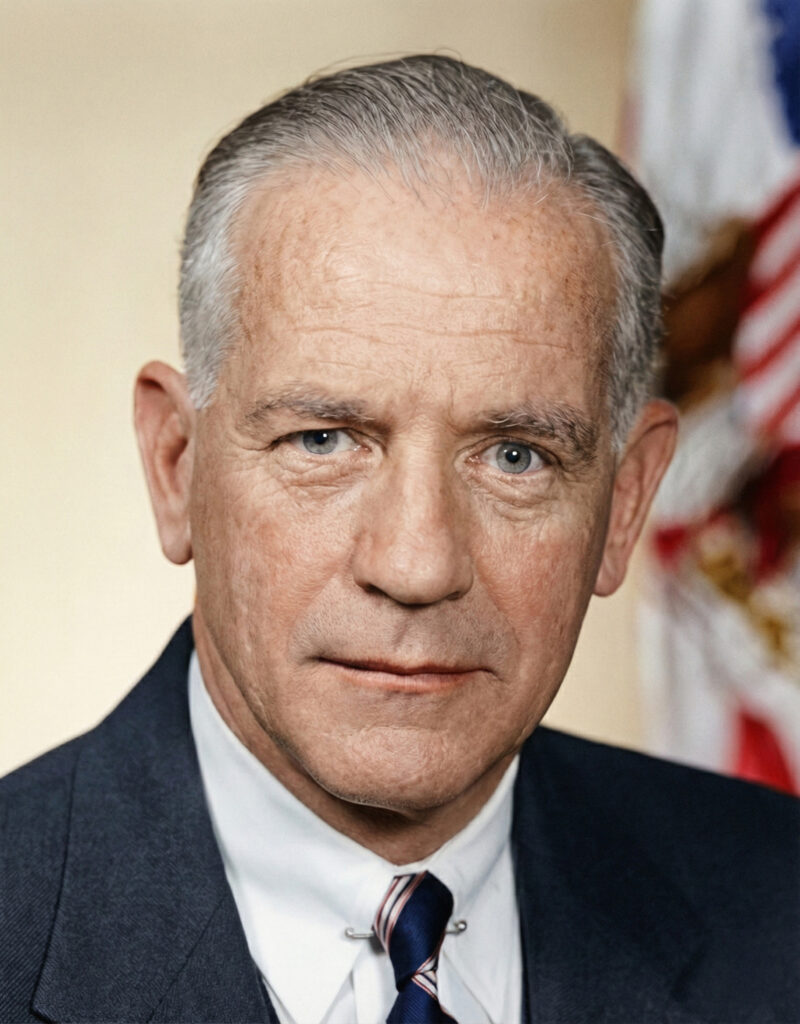
Gordon Grey when taking office as the 4th United States National Security Advisor, circa 1958 (UAPedia)
Early life, education, and ascent
Gordon Gray was born in Baltimore on May 30, 1909, and grew up in Winston-Salem, North Carolina, in a family tied to R. J. Reynolds.
After an undergraduate education and Yale Law School, he practiced law and returned home to manage the family’s media holdings. By the late 1940s his blend of legal training, publishing influence, and political connections had carried him into national service.
Truman appointed Gray Assistant Secretary of the Army in 1947, then Secretary of the Army in 1949. In 1950 he briefly served as a Special Assistant to the President.
In 1951 he became the first director of the newly created Psychological Strategy Board, which coordinated non-military information and influence policy across the government during the Korean War. These posts honed his aptitude for interagency management and classified decision making. (Eisenhower Presidential Library)
Gray left the Pentagon to become president of the University of North Carolina system in 1950, then returned to Washington in 1955 as Assistant Secretary of Defense for International Security Affairs.
Eisenhower named him Director of the Office of Defense Mobilization in 1957, and in 1958 Gray became National Security Advisor, following Robert Cutler. He earned the Medal of Freedom in 1961 and later served many years on the President’s Foreign Intelligence Advisory Board under successive administrations.
The Oppenheimer hearing and a reputation for decisive secrecy
Gray’s most controversial public assignment came in 1954 when he chaired the Atomic Energy Commission (AEC) Personnel Security Board that reviewed the government’s case against J. Robert Oppenheimer.
The Board concluded, two to one, that Oppenheimer’s clearance should be revoked. Gray voted with the majority.
The AEC later affirmed the revocation. Whether one judges that decision as an overreach of Cold War suspicion or as a security-driven necessity, the hearing cemented Gray’s public identity as a steady steward of the security state at a moment when science, politics, and secrecy collided. (Wikipedia)
The “Gray Board” episode still shadows his name. For UAP historians, it signals the kind of compartmental discipline and political will that a White House would demand if a truly extraordinary recovery or analysis program ever existed. That is one reason MJ-12 list-makers found Gray’s name irresistible. (Eisenhower Presidential Library)
The official UAP landscape during Gray’s prime
Gray’s high-level service overlapped with the government’s formal UAP efforts.
After the 1947 wave, the Air Force created Project SIGN in 1948, replaced it with Project GRUDGE in 1949, and established Project BLUE BOOK in 1952.By the time BLUE BOOK closed in 1969, the Air Force had logged 12,618 cases. The program’s final summaries listed 701 as “unidentified” by its own standards and asserted that the remainder posed no direct national security threat and revealed no confirmed technologies beyond contemporary science.
These numbers and conclusions provide the institutional context for Gray’s tenure as Eisenhower’s National Security Advisor and later as a senior adviser to presidents. (National Archives)
The Robertson Panel and the policy tone of the 1950s
In January 1953, the CIA’s Office of Scientific Intelligence convened the Scientific Advisory Panel on Unidentified Flying Objects (UFOs), known popularly as the Robertson Panel.
The declassified “Durant report” summarizes its briefings and conclusions.
The panel found no evidence of a direct threat in the reports reviewed and recommended a public education program to reduce spurious reports and a more disciplined field-investigation protocol.
Although Gray did not sit on this panel, the panel’s advice harmonized with the broader national security style he helped implement: filter and manage anomalous reporting while protecting core defense systems and political stability. (CIA)
The MJ-12 claim: what the papers say and what the archivists say
What the Eisenhower Briefing Document claims
In the mid-1980s, an undeveloped roll of film mailed anonymously to a television producer yielded a document titled “Operation Majestic-12,” a purported “Top Secret/Eyes Only” briefing dated 16 November 1952 for President-elect Eisenhower.
The roster lists twelve “designated members,” including Admiral Roscoe Hillenkoetter, Vannevar Bush, Detlev Bronk, Donald Menzel, Nathan Twining, Hoyt Vandenberg, Sidney Souers, Jerome Hunsaker, Robert Montague, and Gordon Gray. The document sketches a narrative of a 1947 crash in New Mexico, alleged retrievals, biological analyses, and liaison arrangements with Air Force UAP projects.
If authentic, it would place Gray inside a tight circle managing sensitive recoveries and policy. (Internet Archive)
The federal custodians’ verdict
The National Archives maintains a dedicated portal that describes extensive negative searches for corroboration and lists anomalies in the so-called “Cutler/Twining” memo, long cited as an archival anchor for MJ-12.
The anomalies include missing Top Secret register numbers and a scheduling conflict showing Robert Cutler overseas on the day the memo was supposedly written. In 1995, the Government Accountability Office reported to Congress that executive-branch agencies found no evidence that MJ-12 materials were legitimate government records.
These judgments are the most authoritative public positions available. (FBI)
Why Gray’s name stuck anyway
MJ-12’s cast list is plausibly curated. A real crash-retrieval oversight body would likely have included the CIA director (or former director), senior Air Force leadership, top scientific administrators, and a White House-level coordinator.
Gray fits that last slot. As National Security Advisor, former Secretary of the Army, director of the Psychological Strategy Board, and future PFIAB member, he had the clearances, the interagency influence, and the habit of discretion that such a body would demand. Plausibility, however, is not proof.
UAPedia therefore treats the Eisenhower Briefing Document as an artifact of the debate rather than as a verified historical record, and balances it against the FBI, GAO, and NARA positions.
What Gray himself said about UAP
A search of Gray’s published papers and oral histories reveals no on-the-record statements by him endorsing or elaborating extraordinary UAP hypotheses.
His writing and memoranda focus on national security organization, psychological strategy, and security-clearance issues.
There is no authenticated public claim by Gray about crash recoveries, non-human technology, or the nature of unexplained sightings. In the open record, his UAP footprint is created by others who invoke his name. (Truman Library)
Influence on ufology
The “plausible casting” effect. Many researchers describe MJ-12 as persuasive storytelling because its personnel choices feel right to anyone who understands 1947–1952. Gray’s presence on that roster is a prime example.
He personifies the White House coordinator who could knit military, intelligence, and scientific voices together. That narrative logic helped MJ-12 lodge in public and media consciousness, from television specials to podcasts, whether cited as truth or as an influential hoax. (Internet Archive)
The tone-setting of 1950s policy. Gray’s real work shaped the apparatus that later handled UAP reporting. The Psychological Strategy Board’s creation and the later National Security Council process under Eisenhower helped normalize controlled communication about ambiguous threats.
The CIA-convened Robertson Panel’s advice dovetailed with this posture. That policy DNA influenced Air Force practice through BLUE BOOK’s life and into later decades. (Truman Library)
A foil for contemporary reassessments. Today, podcasts and investigators often revisit MJ-12 to discuss whether a hidden recovery effort could have existed even if the specific documents were forgeries.
In that reassessment, Gray’s career is used to model how a real mechanism might have been staffed and protected. Skeptical voices point to the FBI and NARA findings and to document-forensics work by researchers such as Philip J. Klass.
Proponents point to books like Stanton Friedman’s Top Secret/MAJIC and to interviews or films that treat MJ-12 as a gateway into a larger hidden history. Either way, Gray is a touchstone in the argument. (Skeptical Inquirer)
Claims attributed to Gray, and what the record supports
Because Gray did not publicly claim anything about UAP, the only “claims” that tie him to the phenomenon appear in the MJ-12 corpus.
The Eisenhower Briefing Document’s narrative places him on a committee overseeing biological analysis, recovery policy, and liaison with Air Force UAP projects. Those descriptions are assertions that have not been authenticated.
Archival sources that can be named and checked identify no such committee in their official holdings, and federal agencies advise that the MJ-12 papers are not genuine government documents. Responsible historiography treats the MJ-12 text as a claim about Gray, not as evidence from Gray. (Internet Archive)
Other controversies that shape how ufology sees Gray
The Oppenheimer decision. As chair of the AEC Personnel Security Board, Gray voted to revoke Oppenheimer’s clearance. That vote has remained a lightning rod for scientists and historians. In the ufology world, the episode often appears as a parable about the costs of crossing entrenched security structures.
Gray’s own Board letter acknowledged Oppenheimer’s loyalty, yet concluded that patterns in his conduct were incompatible with clearance. The lasting debate about whether justice or fear carried the day colors how Gray is remembered in other secrecy-adjacent stories. (Wikipedia)
Director of the Psychological Strategy Board. Gray’s year at PSB put him at the center of an enterprise dedicated to coordinated, often classified influence operations. UAP historians use this to explain how the government might manage public narratives about anomalies.
Primary sources at the Truman Library confirm Gray was the Board’s first director and that PSB’s mission was to coordinate psychological strategy across agencies. (Truman Library)
Civil-military policy while Secretary of the Army. Gray’s tenure overlapped with the implementation phase of desegregation after Truman’s 1948 order. Archival commentary shows he approved specific regulations while the Army struggled through reform and mixed institutional resistance. For some social historians this is the most important controversy of his career.
It underscores his role as an agent of difficult policy in contentious times, which is part of why later narratives cast him as a reliable manager of sensitive problems. (AUSA)
Why Gray’s name belongs in any history of UAP policy
Even setting MJ-12 aside, Gray’s life matters for UAP history because it shows how the United States built the machinery to handle ambiguous, potentially destabilizing information.
He operationalized the NSC process, linked policy to communications strategy, and made interagency coordination habitual. When the Air Force struggled with the flood of sightings in the 1950s, it did so inside a policy culture Gray helped shape. The Robertson Panel reflected that culture.
BLUE BOOK’s public stance did as well. Today’s AARO review cites decades of data and cultural problems that flowed from those early choices. Gray deserves attention because his biography is a guide to the architecture of secrecy and communication that defined UAP governance. (CIA)
1984–1988. MJ-12 documents surface naming Gray as a member; FBI, National Archives, and later GAO reject them as authentic government records. (FBI)
Books, podcasts, and researchers who shaped the Gray–MJ-12 conversation
UAPedia emphasizes triaging sources by evidentiary weight while noting how cultural narratives form. For the MJ-12 story around Gray, three categories matter.
Books making the case for MJ-12’s reality. Stanton T. Friedman’s Top Secret/MAJIC is the foundational pro-MJ-12 book. Friedman argues for the documents’ authenticity and uses insider interviews to build a narrative around the roster that includes Gray. Even critics acknowledge the book’s influence in mainstreaming the list. (Internet Archive)
Researchers and writers challenging MJ-12. Philip J. Klass, a veteran aerospace journalist, led early document forensics efforts that identified date-format anomalies, signature issues, and the Cutler travel conflict. Klass published analyses in Skeptical Inquirer and later papers, arguing the documents could not withstand scrutiny.
These critiques undergird the federal custodians’ skepticism and remain essential reading. (Skeptical Inquirer)
Podcasts that revisit the terrain for new audiences. Brian Dunning’s Skeptoid episode “The Secret History of Majestic 12” walks listeners through the claims, the personalities, and the forensics.
John Greenewald’s The Black Vault Radio site aggregates FBI files and frequently revisits MJ-12 claims and new “releases” with caution. Contemporary UAP podcasts such as Need to Know and WEAPONIZED occasionally reference MJ-12 while exploring broader secrecy questions and whistleblower claims.
Together these shows keep Gray’s name in the current conversation and expose new audiences to both sides of the archival debate. (Skeptoid)
Balanced conclusions
Gordon Gray’s verified biography is formidable. He helped design how the U.S. government coordinates sensitive policy, managed information campaigns, chaired the most famous security-clearance hearing in scientific history, and served as Eisenhower’s chief national security aide.
That is the record. The UAP narrative adds a layer of fascination.
The Eisenhower Briefing Document placed Gray in a clandestine committee charged with extraordinary technical and biological matters.
Why does his name endure in ufology anyway?
Because if such a group had existed, one would expect to find a Gordon Gray at the table. His career checks every box: White House proximity, interagency authority, comfort with compartments, and a reputation for shepherding hard decisions. The plausibility that made him a prime suspect on an MJ-12 list also explains why the story will not die.
For researchers, the lesson is twofold. First, separate what the archives say from what a document claims. Second, pay attention to the architecture of secrecy. Gray’s life shows how a government might handle a genuine unknown. It also shows how, in the absence of verified documents, stories will gravitate to the people who could have held the keys.
UAPedia’s heterodox stance holds that a durable remainder of UAP reports has resisted conventional explanation, even as official reviews emphasize data gaps and the absence of verified non-human technology programs. In that ambiguity, Gordon Gray remains a symbol: of competence and discretion for some, of managed narratives for others. Until more decisive declassifications emerge, his place in UAP history is best understood as a product of both his authentic power in the national security system and the enduring pull of a single, disputed set of pages that made him one of twelve. (National Archives)