
The Rosicrucians enter European history the way conspiracies often begin: as literature that reads like a revelation.
In the early 1600s, three anonymously published books, later attributed by many scholars to Johann Valentin Andreae, outlined the supposed history and mission of a hidden fraternity, symbolized by the rose and cross.
In the narrative, a founder figure, Christian Rosenkreuz, travels in search of wisdom, returns to Germany, finds an order, and leaves behind a sealed legacy discovered generations later. (Encyclopedia Britannica)
Whether such an “early brotherhood” ever existed as described remains debated (the texts themselves blur utopia, satire, allegory, and program). But what is historically clear is the effect: the manifestos detonated in Europe’s intellectual world. One Rosicrucian publication summary notes that the manifestos triggered a flood of responses, hundreds of pamphlets, manuscripts, and books – within a few years.
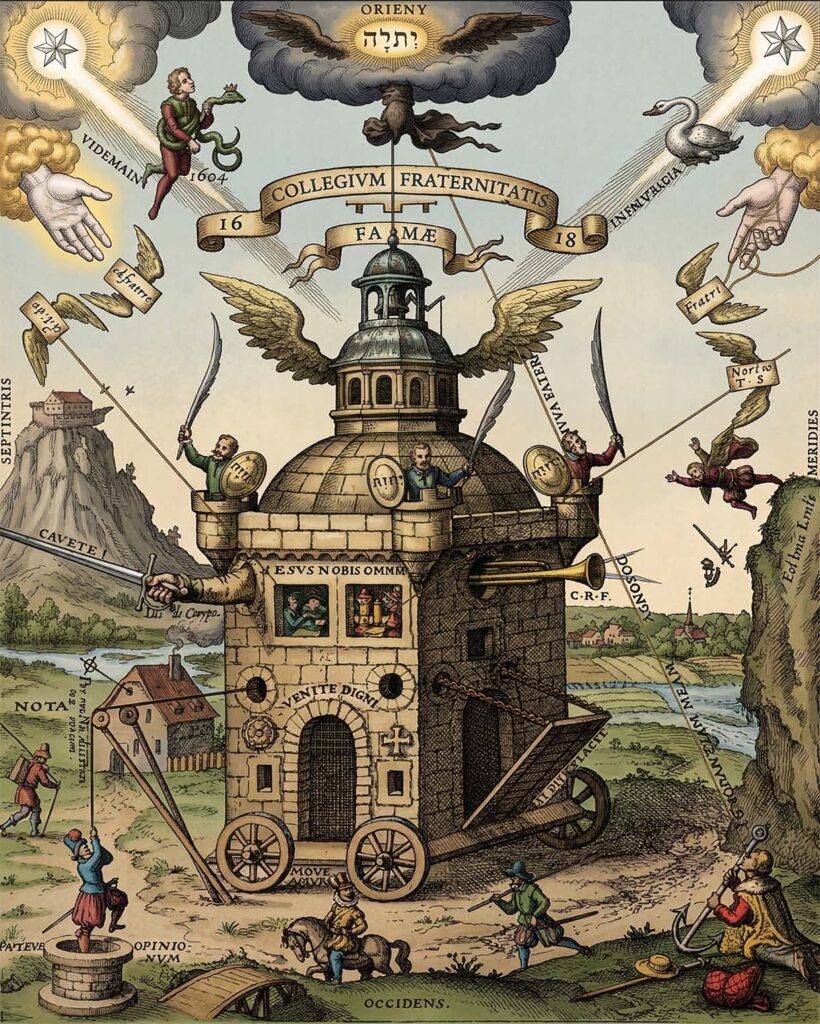
To understand how Rosicrucianism later intersects with UAP culture, you don’t start with spacecraft, you start with style:
- A promise of hidden knowledge (“esoteric wisdom handed down from ancient times”) [Reported] (Encyclopedia Britannica)
- A myth of concealment and revelation (a sealed tomb, a delayed unveiling, an invisible fraternity) [Reported] (Encyclopedia Britannica)
- A reform agenda framed as cosmic and moral (the manifestos positioned themselves amid Europe’s crisis and reform dreams) [Documented] (51dfe7d861b7ba94af5e-14cee6607d0a8a012f7e4ba696f24ff7.ssl.cf5.rackcdn.com)
- A symbolic language designed to survive translation: alchemy, hermeticism, gnostic motifs, mysticism [Reported] (Encyclopedia Britannica)
This is the Rosicrucian “interface”: it doesn’t require literal belief in a founding master to function. It’s a portable narrative engine – one that can snap onto many later mysteries, including UFOs.
Theology and worldview: not a church, but a metaphysical toolkit
Rosicrucianism is often discussed like a religion, but many Rosicrucian bodies reject that label, preferring “mystical,” “philosophical,” or “esoteric.”
On the modern organizational side, AMORC’s own FAQ is explicit: it says AMORC is not a religion, does not require a specific code of belief, and frames its path as incorporating both metaphysics (beyond the five senses) and mysticism (direct conscious union with “Absolute, Divine Mind, Universal Intelligence,” etc.). It emphasizes experiments, practical exercises, and “natural laws,” encouraging students not to accept teachings on faith alone. [Documented] (The Rosicrucian Order, AMORC)
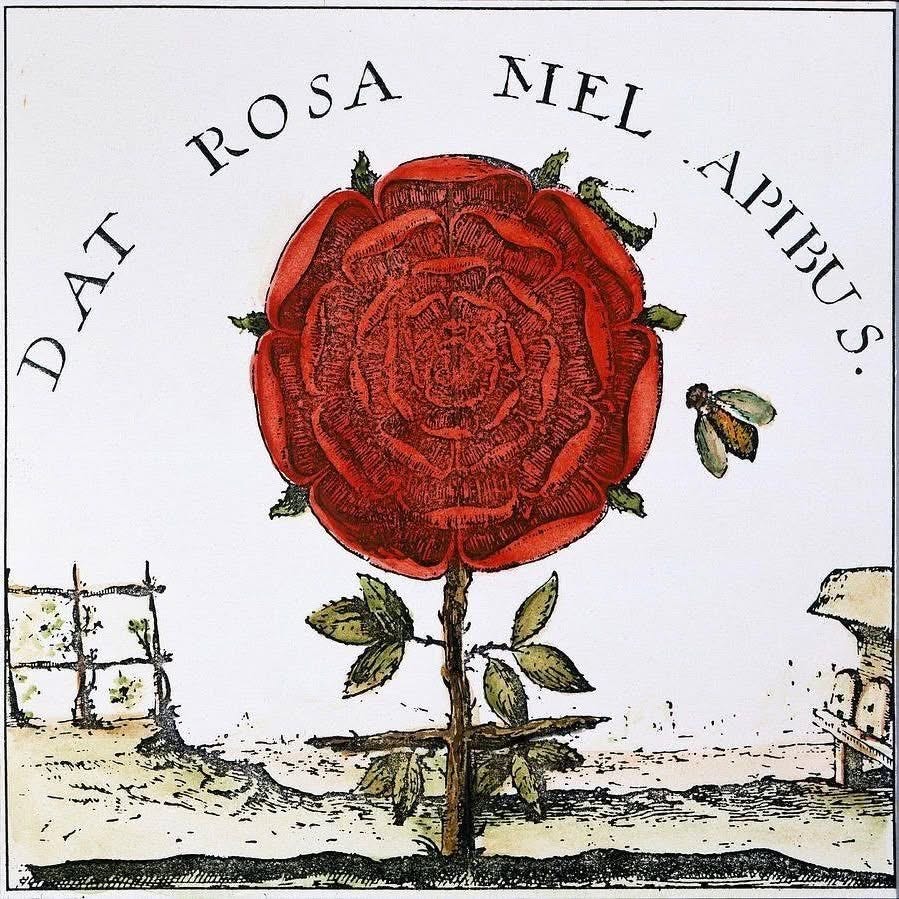
That matters for UAP because it sets expectation: within Rosicrucian spaces, anomalous experiences can be treated not only as “evidence,” but as interior data, symbols, intuitions, altered states, and meaning-making. That approach aligns neatly with how many experiencers narrate UAP encounters: less like a police report, more like an initiation.
Practices: initiation, correspondence, meditation, and the discipline of attention
When journalists cover Rosicrucians, the visuals are usually architectural (temple façades, museum grounds) and symbolic (the rose cross). The real “practice” is quieter.
In AMORC’s description, Rosicrucian study is structured around lessons and exercises designed to be applied over time, with a focus on inner development and direct experience rather than mere belief. (The Rosicrucian Order, AMORC)
Historically, Rosicrucianism also develops through fraternities and offshoots – some emerging from Freemasonry, some from 19th-century occult revival movements. Britannica notes multiple Rosicrucian societies appearing in the 19th century, and describes AMORC (founded 1915) as a major 20th-century organization distributing teachings through mail-order lessons. (Encyclopedia Britannica)
From a UAP-culture perspective, three practice-themes recur:
- Initiation logic: experiences arrive in stages; knowledge is “earned”
- Secrecy and privacy: not always sinister; often framed as psychological protection or sacred reserve
- Symbolic literacy: events are interpreted through archetypes, alchemy, cosmic mind, and metaphysical law
None of these require aliens. But all of them can absorb alien narratives.
Enter the UFO era: the same grammar, new nouns
By the mid-20th century, “flying saucers” had their own mythos, crash rumors, official investigations, contactee messages, and eventually abduction narratives. Rosicrucianism wasn’t the cause of this wave, but its cultural “grammar” proved compatible with it.
The UFO subculture’s recurring motifs map eerily well onto older esoteric ones:
- A hidden truth withheld from the public
- An initiatory minority who “knows”
- Signs in the sky that feel both external and intimate
- The promise of transformation—personal or civilizational
The Rosicrucian Digest meets UFOs: an underrated paper trail
If you want the Rosicrucian-UAP connection in ink rather than rumor, you go to the magazines.
In the 1970s, Rosicrucian Digest (an AMORC publication) ran multiple pieces engaging UFO questions. One 1975 piece cautions readers not to presume an “unidentified flying object” must be extraterrestrial – reminding them that UFO literally means unidentified and warning against “undisciplined imagination.”
A 1970 issue addresses the UFO topic with an almost sociological tone – placing “flying saucers” among popular wonders and stressing the need for qualified scientific attention to separate what’s explainable from what remains unknown.
The most consequential intersection, however, appears in a July 1977 issue: an article titled “A Study of UFO Interiors” by Alan C. Holt, F.R.C., identified in the magazine as a Crew Operations and Training Specialist at NASA’s Johnson Space Center, and a board trustee for an independent investigative effort called VISIT (Vehicle Internal Systems Investigative Team). The article explicitly notes that his UFO investigations were not a NASA project and that VISIT did not represent NASA or contractor companies.
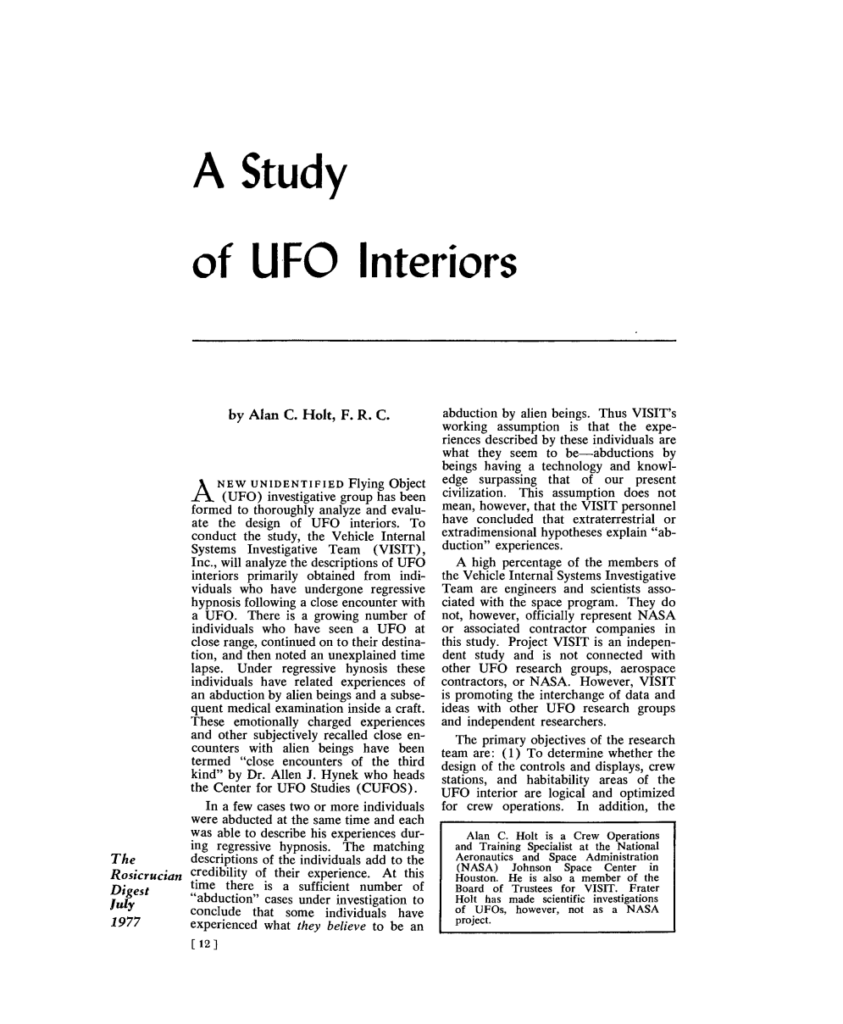
This is not a casual “UFOs are real” devotional. It’s an attempt – however controversial – to treat abduction testimony like engineering input.
Witness accounts, as filtered through a questionnaire
Holt’s 1977 article describes a growing number of people who reported close-range UFO sightings, continued driving, and then noticed an unexplained time lapse – later associated (under hypnosis) with abduction and onboard medical exams.
He states that VISIT planned to analyze descriptions of UFO interiors “primarily obtained from individuals who have undergone regressive hypnosis” following close encounters, and to use a detailed questionnaire covering sensory perceptions, background data, and even “extrasensory phenomena.”
Holt also references the term “close encounters of the third kind” and attributes it to Dr. J. Allen Hynek, who headed the Center for UFO Studies (CUFOS).
What counts as “witness accounts” here?
In strict journalistic terms, we are not looking at raw police reports; we’re looking at:
- Secondhand summaries of abductee narratives
- Institutional framing (how a Rosicrucian publication chose to present them)
- A research posture: treat testimony as data without committing to a single explanation
That last part is the most interesting. Holt notes a “working assumption” that abductees described experiences that seemed like abductions by beings with advanced technology, but he also states that VISIT personnel had not concluded that “extraterrestrial or extradimensional hypotheses” explain the experiences.
This combination, taking experiencers seriously while refusing to lock onto one ontology, is a recurring pattern in the better end of UAP discourse.
Implication for Rosicrucian-adjacent UFO material
If a Rosicrucian publication treats hypnosis-recovered abduction accounts as a data source, it inherits the core controversy: hypnosis can produce vivid narratives that feel meaningful and consistent, without guaranteeing historical accuracy.
That doesn’t mean abductees are lying. It means the method is epistemically unstable: it can amplify belief, coherence, and detail in ways that complicate verification.
Contested: Hypnosis-derived “findings” should be treated as testimony about experience and interpretation, not as reliable forensic reconstruction.
Official reports and institutional gravity: the “NASA” effect
UAP stories often become gravitational when they brush against official institutions, military, intelligence, aerospace. Holt’s 1977 article is careful: it identifies his NASA job and simultaneously erects a firewall, VISIT is independent and not officially NASA.
That tension, credentialed individuals pursuing anomalous research privately—has been part of the UAP ecosystem for decades.
For broader context, Dr. J. Allen Hynek’s career is often cited as a bridge between official investigation and civilian ufology. A mainstream biographical overview notes Hynek’s work as a consultant on U.S. Air Force UFO studies (including Project Blue Book) and his later push to treat ufology more seriously. (Biography)
Speculation: The Rosicrucian-UAP overlap becomes culturally “louder” when it features aerospace credentials, even if the work is unofficial. It’s a familiar pattern: the institution is denied, but the aura remains.
Jacques Vallée, occult organizations, and the UAP “hall of mirrors”
No dossier on esotericism and UFO culture is complete without Jacques Vallée, because he documented, sometimes with visible frustration, the way contact narratives braid together social influence, belief systems, and altered states.
In Messengers of Deception (1979), Vallée argues that investigating sightings alone will not explain the phenomenon, and he describes compiling profiles of leaders in a “new subculture” using interviews and observation.
He also explicitly traces some contactee themes to “active occult organizations,” warning readers to think twice before jumping on the “Outer Space Bandwagon” if they want to retain a balanced view.
Most relevant to this dossier: Vallée discusses AMORC in a passage about a French figure (Raymond Bernard) associated with the “Ancient and Mystical Order of the Rosy Cross,” and he quotes or paraphrases a claim that “true adepts” are “not of this Earth,” while also describing AMORC’s mail-based teaching model from its San Jose headquarters.
Handle with care
Vallée’s book is not an AMORC document. It’s an investigator’s narrative that mixes reportage, interpretation, and suspicion—including claims about hypnosis, suggestion, and manipulation. It is valuable as a historical artifact of serious UFO research culture in the late 1970s, but its more sweeping assertions should not be read as an established fact about any organization.
Contested: Vallée’s “manipulation” hypothesis remains debated, and his organizational claims require independent corroboration beyond a single author.
So what is the Rosicrucian–UAP relationship, exactly?
Let’s separate what can be said cleanly from what cannot.
What we can say with confidence
Rosicrucianism’s foundational literature is real, influential, and defined by themes of secrecy, esoteric wisdom, and symbolic reform.
Modern Rosicrucian bodies (at least AMORC) position themselves as non-religious, non-dogmatic, and oriented around personal experimentation and mystical development. (The Rosicrucian Order, AMORC)
At least one Rosicrucian publication in the 1970s published UFO-related content that referenced abduction narratives, “missing time,” and regressive hypnosis, while also stressing scientific/technical evaluation and caution around assumptions.
What is likely true, but needs nuance
Rosicrucian-adjacent cultural spaces have overlapped with UFO spirituality and contactee narratives, partly because both ecosystems reward symbolic interpretation and transformative “revelation.”
Hypnosis became a bridge technology between mystical frameworks and UFO narratives, because it produces vivid inner experiences that can be interpreted as encounters with nonhuman intelligences. (PubMed)
Implications: why this matters
UAP are not only aerial; they are cultural
Even if tomorrow’s best UAP case turns out to be misidentified aircraft, the myth-system remains. Rosicrucianism demonstrates how a worldview can hold “hidden knowledge” without needing constant empirical confirmation.
Esoteric frameworks can stabilize ambiguity
Rosicrucian approaches (especially modern “think for yourself” rhetoric) can coexist with both skepticism and belief, because meaning is anchored in inner development rather than public proof. (The Rosicrucian Order, AMORC)
Analysis of claims
Use this as a quick sorting tool when assessing Rosicrucian–UAP material.
Historical Rosicrucian claims (early modern)
- Manifestos exist, were published in the early 1600s, and shaped the Rosicrucian legend
- Christian Rosenkreuz as founder figure is widely regarded as fictional (or at least not historically demonstrated)
Organizational claims (modern Rosicrucian groups)
- AMORC frames itself as non-religious, open to varied beliefs, emphasizing mystical experience and personal experimentation (The Rosicrucian Order, AMORC)
- AMORC historically distributed teachings via correspondence lessons and built a public cultural footprint (Encyclopedia Britannica)
UAP research and publication claims (Rosicrucian-linked media)
- Rosicrucian Digest published cautionary and investigative UFO commentary in the 1970s
- VISIT (as described) sought to analyze “UFO interiors” using abductee reports under regressive hypnosis, while denying official NASA affiliation
Interpretive and speculative claims
- Rosicrucian “invisible fraternity” motifs influenced UFO religion/contactee movements
- UAP are “initiatory” phenomena designed to trigger spiritual evolution
References
Rosicrucian history and primary texts
Fama Fraternitatis (1614) [Reported/Documented] (Encyclopedia Britannica)
Confessio Fraternitatis (1615) [Reported/Documented] (Encyclopedia Britannica)
The Chymical Wedding of Christian Rosenkreuz (1616) [Reported/Documented] (Encyclopedia Britannica)
Encyclopaedia Britannica overview Rosicrucian | Britannica (Encyclopedia Britannica)
Christian Rebisse, “The Rosicrucian Manifestos” (Rosicrucian Digest, 2013, PDF) PDF (51dfe7d861b7ba94af5e-14cee6607d0a8a012f7e4ba696f24ff7.ssl.cf5.rackcdn.com)
Rosicrucian publications engaging UFO/UAP themes (primary dossier material)
Rosicrucian Digest (July 1977): “A Study of UFO Interiors” by Alan C. Holt (PDF) PDF
Rosicrucian Digest (1975): caution against assuming UFO = extraterrestrial (PDF) PDF
Rosicrucian Digest (1970): broader skeptical framing and need for qualified research (PDF) PDF
UFO culture, contactees, and esotericism (context)
Jacques Vallée, Messengers of Deception (1979, PDF scan) PDF
Hynek background overview (Project Blue Book consultant; ufology advocate) Biography.com profile (Biography)
Hypnosis and memory reliability (for evaluating abduction regression material)
PubMed abstract on hypnosis and recollection reliability PubMed (PubMed)
OSU summary: hypnosis may increase confidence in inaccurate memories OSU News (Ohio State News)
2025 review on hypnosis and false memories (open access) PMC article (PMC)
SEO Keywords
Rosicrucianism, Rosicrucians, AMORC, Rosicrucian Digest, esotericism, Western esotericism, Hermeticism, Christian mysticism, occult revival, secret societies, initiation, UAP, UFO, flying saucers, abduction phenomenon, missing time, regressive hypnosis, hypnosis and memory, false memories, Jacques Vallée, J. Allen Hynek, CUFOS, VISIT, Alan C. Holt, NASA Johnson Space Center, 1970s UFO research, UFO interiors, contactee movement, UAP culture history