
On a cold October evening in 1982, at a Soviet nuclear missile base in what is now northern Ukraine, launch officers watched their control panels suddenly blaze to life.
Warning lamps lit up. Indicators flipped from “safe” to “combat.” According to the officers on duty, highly guarded launch-auth codes appeared to have been entered correctly, all at once, by no one in the room. For roughly fifteen seconds, several R-12 nuclear missiles aimed at Western targets moved into full launch readiness, apparently outside human control. Then, just as abruptly, everything shut back down.
Above the base, hundreds of soldiers and officers were already staring at a huge, silent, disc-like object that had been maneuvering over their missile silos for nearly an hour. (The UFO Chronicles)
For decades this event survived as rumor inside Soviet circles. Today we have far more than rumors. We have:
- Internal Ministry of Defense reports carried to the Soviet high command
- Typed and signed witness statements from missile officers and technicians
- Interviews with the colonel who ran the USSR’s classified UAP investigation
- Secondary reporting by Western researchers and journalists across several decades
Those records, recently resurfaced via KLAS-TV’s “Russian UAP files” release and George Knapp’s 2025 congressional testimony, form one of the most alarming nuclear-related UAP cases ever documented.
This article is a data-first overview of that case, the broader Russian UAP program around it, and how it fits into what we now know about UAP interactions with nuclear weapons.
Cold War backdrop: hair-trigger nukes and secret UAP studies
By 1982, the Cold War nuclear posture on both sides was unforgiving. R-12 intermediate-range ballistic missiles in Ukraine could hit targets across Western Europe and, depending on deployment, help enable Soviet strategies against the United States. Publicly, the USSR portrayed reports of “flying saucers” as Western fantasy. Privately, it did something very different.
According to journalist George Knapp’s interviews and documents, the Soviet Ministry of Defense ran what may be the largest centralized UAP investigation in history. Beginning around 1978, all elements of the Soviet military were ordered to report every UAP incident, with data funneled into a dedicated office informally known as “Institute 22,” later linked to a broader program called Thread III and an umbrella unit, 73790.
Colonel Boris Sokolov, an engineer and senior officer who headed the Ministry’s program for part of its existence, told Knapp that thousands of reports were collected from pilots, radar operators, and ground units. The goal, he said, was simple: understand and copy the technology behind these objects’ performance, especially their extreme maneuverability and their puzzling visibility on sensors.
Sokolov’s files showed at least forty attempted fighter intercepts of UAP. In three cases where MiG pilots fired on the unknown objects, the fighters crashed; two pilots died. After that, General Igor Maltsev issued a standing order: if you encounter a UAP, do not engage, break off and leave the area.
The Russian UAP project was not academic. It was about survival and technological advantage in a world wired for nuclear catastrophe. Which is why the October 4, 1982 incident at a missile base near Byelokoroviche in northern Ukraine shook the people involved so deeply.
The Byelokoroviche / 50th Missile Division incident: what the data say
The base and its role
The incident occurred at an R-12 (SS-4) missile installation assigned to the 50th Missile Division of the Strategic Rocket Forces, near the town of Byelokoroviche in what is now Zhytomyr Oblast, Ukraine. The site hosted multiple silo-based nuclear missiles targeted at Western strategic sites. (The UFO Chronicles)
Photos in the KLAS-TV Russian file show R-12 hardware, bunker layouts, and stamped Ministry documents.
Evening visual sightings
In the early evening of 4 October 1982, conscript radio operator Vladimir Matveyev and hundreds of others on the base noticed a large, silent object hovering near the missile field. Soviet press coverage many years later, translated and analyzed by researcher Robert Hastings, quoted Matveyev as recalling an “elliptical-shaped object” roughly the size of a five-story house, hovering about 1.5 kilometers away over the R-12 silos. (The UFO Chronicles)
Key visual data points from converging testimonies and later reconstructions:
- Shape: Elliptical / disc-like
- Size: Comparable to a multi-story building
- Duration: Observed for roughly an hour by large numbers of personnel
- Motion: Slow lateral drift, occasional rapid movement, splitting into separate luminous segments that later recombined
- Sound: None reported; witnesses consistently described the object as silent
- Light: Bright, steady luminescence with smaller “lights” moving to and from the main object
Hastings’ article quotes a translated Russian report describing how “barely visible lights flew up to the object” and how an officer who tried to drive closer saw the object retreat, only to return to its previous position over the missile area. At the same time, radios in the bunker went dead and were later said to have been “burned out.” (The UFO Chronicles)
Several pages in the KLAS-TV document set show hand-drawn sketches of a disc with peripheral lights, along with typed statements in Russian and English translation referencing unusual luminescence and grouped light sources at low altitude.
Missile control anomaly
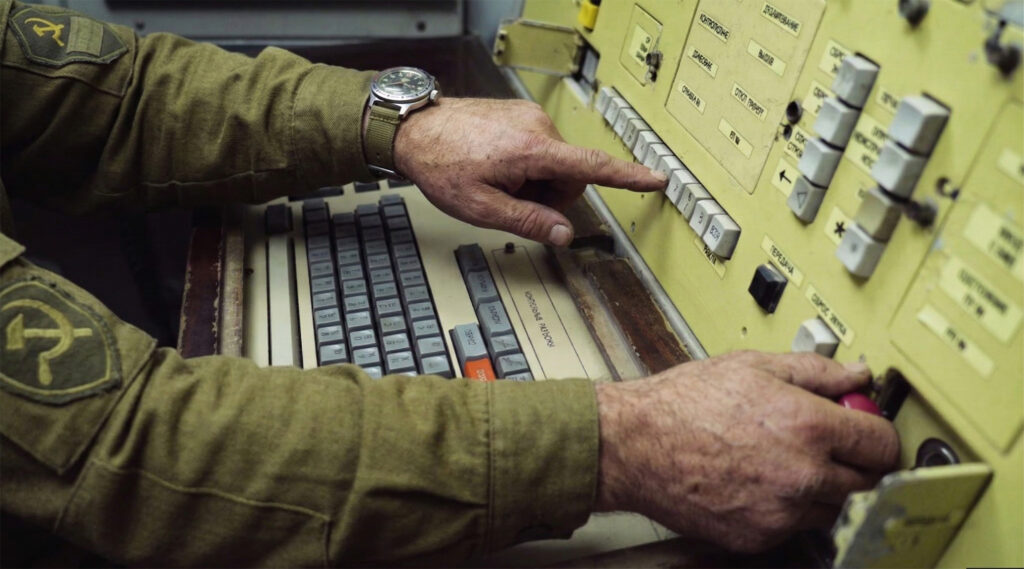
The most disturbing portion of the event unfolded underground, in the launch control bunker.
According to official statements later summarized in a Russian Life magazine article and translated by Hastings, Major Mikhail Kataman, responsible for missile guidance systems, reported that bunker control equipment and security systems were hit by a powerful electromagnetic impulse. He stated that all control panels lit up, indicating that multiple missiles were moving into launch sequence. (The UFO Chronicles)
Former missile division chief Yuri Zolotukhin told the same reporter that during the anomaly the control panel displays indicated that all safeguards against unauthorized launch had been bypassed. Launch officers believed, in that moment, that they had lost control of their nuclear weapons. When they called higher command, Moscow confirmed no launch order had been issued. About fifteen seconds after the activation began, all controls snapped back to normal. (The UFO Chronicles)
Knapp’s later retelling, based on direct interviews with Colonel Sokolov and access to the Ministry’s internal report, describes the same core features:
- A UAP observed over the base for roughly four hours
- The object splitting and recombining, performing extreme maneuvers
- “Spontaneous illumination of all displays” in the control room
- Apparent entry of correct launch codes without human action
- A brief period in which missiles appeared poised to launch, with officers unable to override
- Sudden termination of the anomaly at the exact moment the UAP departed
Knapp testified that Sokolov’s investigation team dismantled the control panels and could not find any technical cause. The Ministry of Defense, he said, concluded that the incident was a deliberate “message” from the phenomenon behind the UAP.
Map suggestion for UAPedia:
- Diagrammatic plan of a Soviet R-12 launch control bunker, showing where panels lit up, overlaid with a stylized depiction of the disc above the silo field.
The Russian files: what KLAS-TV handed to Congress
The 25-page PDF released by KLAS-TV in 2025 and supplied to the U.S. House “Task Force on the Declassification of Federal Secrets” contains scans of the original Russian documents: typed reports, witness statements, sketches, and cover sheets bearing official stamps.
Although the scan is image-only rather than text-searchable, visual inspection shows:
- A formal cover report addressed up the Soviet chain of command
- Multiple witness “explanations” signed by officers and enlisted personnel
- Technical diagrams of the object’s apparent shape, light configuration, and relative altitude
- Notations consistent with Strategic Rocket Forces documentation practice of the era
These documents are not Western hearsay about the Soviet event; they are the Soviet event, on paper. Their chain of custody runs from the missile division to Moscow, then from Colonel Sokolov’s archive to Knapp during his 1990s visits, then to the AAWSAP/BAASS research program, and now to U.S. congressional staff and the public.
Photo suggestion for UAPedia:
- Redacted scan of a signed missile-officer statement from the Russian packet, with names partially blurred but signature and unit stamps visible, emphasizing this as a primary government record.
Mystery Wire, 8NewsNow and the “chilling encounters” frame
The 8NewsNow Mystery Wire article “Russian UAP files reveal chilling encounters, near-miss nuclear launch” (KLAS-TV, Las Vegas) was one of the first mainstream outlets to highlight these specific documents and to tie them to Knapp’s long-running work on Russian UAP programs. Although the original KLAS page is not easily accessible via automated tools, derivative coverage by outlets such as the International Business Times, Yahoo and others summarize its core claims:
- KLAS obtained copies of Soviet Ministry of Defense UAP files in the 1990s
- Among them was the Byelokoroviche case, described as a nuclear near-miss
- Newly released scans were shared with the House Task Force in 2025
- Knapp and colleagues framed the event as evidence of UAP interest in nuclear arsenals and command-and-control systems
External link (with UAPedia UTM parameter):
- 8NewsNow / Mystery Wire article as cited by the user:
https://www.8newsnow.com/mystery-wire/russian-ufo-files-reveal-chilling-encounters-near-miss-nuclear-launch/?utm_source=uapedia.ai
Books, documentaries and the Weaponized podcast
The Byelokoroviche case sits at the intersection of several lines of independent research.
Robert Hastings has spent more than four decades documenting UAP incursions at nuclear weapons sites, interviewing over a hundred former U.S. and foreign military personnel. His book UFOs and Nukes: Extraordinary Encounters at Nuclear Weapons Sites devotes a section to the 1982 Soviet incident, based on the Russian Life article and on interviews with ex-Soviet rocketeers. (The UFO Chronicles)
Hastings’ documentary UFOs and Nukes: The Secret Link Revealed also touches the case within a broader global pattern of UAP activity around nuclear missile fields, storage depots and test ranges. (The UFO Chronicles)
George Knapp and Jeremy Corbell’s podcast WEAPONIZED released an episode titled “Russia’s Secret UFO Files,” which walks through Knapp’s 1990s trips to Moscow, his access to Unit 73790 material, and the broader context of the Ministry’s UAP programs. The episode situates the 1982 nuclear near-launch as the most alarming single event in a catalogue of Russian encounters that include fighter losses, EM effects on vehicles, and apparent “freezing” of ground troops who attempted to fire on UAP.
Other modern works that discuss UAP–nuclear interactions, though not always focusing heavily on the Russian event, include:
- Hastings, R. (2017). UFOs and Nukes (2nd ed.).
- Kean, L. (2010). UFOs: Generals, Pilots, and Government Officials Go on the Record.
- Coulthart, R. (2021). In Plain Sight, which devotes chapters to UAP near sensitive nuclear assets.
U.S. government posture: nuclear UAP narratives under review
While the Byelokoroviche incident itself involves Soviet systems, its themes echo U.S. missile stories from Malmstrom, Minot, Ellsworth, Vandenberg and other bases from the 1960s onward. Hastings and other researchers have long argued that UAP have on occasion disabled, or temporarily taken control of, nuclear weapons. (The UFO Chronicles)
The U.S. government has begun to acknowledge these narratives as topics of investigation, though not as established fact.
The 2022 unclassified UAP Annual Report by the Office of the Director of National Intelligence notes that UAP events continue to occur in “restricted or sensitive airspace,” and that some reports involve potential hazards to military assets and possible foreign-adversary collection platforms.
In its 2024 Historical Record Report, Volume I, the Pentagon’s All-domain Anomaly Resolution Office (AARO) explicitly discusses a “secondary narrative” in which UAP sightings near U.S. nuclear facilities allegedly led to malfunctioning or destruction of nuclear missiles and a test re-entry vehicle. AARO notes that it interviewed five former USAF members about such incidents at Malmstrom, Ellsworth, Vandenberg, and Minot between 1966 and 1977, and that some claimed UAP-related disruptions to ICBM operations or a mid-flight shoot-down of a test missile. AARO states it is still researching these events and related U.S. weapons-testing programs. (U.S. Department of War)
At the same time, AARO stresses that extraordinary claims require “provable facts,” that witness recollections can be unreliable, and that no official U.S. UAP-specific nondisclosure agreements have been found beyond standard classified-information NDAs. (U.S. Department of War)
UAPedia’s editorial standard is clear on how to weigh such documents: government statements are one evidentiary stream among several. They are “reliable for what they say, unreliable for what they omit, and incomplete by legal design.” (UAPedia – Unlocking New Realities)
In that light, the Russian nuclear near-launch case deserves to be considered alongside U.S. missile-site incidents, not superseded by any single government’s current public line.
Timeline: from 1982 panic to 2020s disclosure fights
Approximate high-level timeline, based on converging public sources:
- 4 October 1982
A large disc-like UAP is observed for roughly an hour over an R-12 missile base near Byelokoroviche, Ukraine. Missile control panels in the underground bunker suddenly light up, indicating launch prep, then reset after about fifteen seconds. Soviet personnel are debriefed; a formal report is sent up the Strategic Rocket Forces chain of command and onward to the Ministry of Defense. (The UFO Chronicles) - 1980s
The incident is folded into the broader Ministry UAP study run by Sokolov and associated units, as part of a ten-year program (1978–1988) that collects thousands of UAP reports across the Soviet military. - Early 1990s
After the Soviet Union collapses, Western journalists and researchers begin accessing previously secret Russian archives. George Knapp travels to Moscow, interviews Colonel Sokolov and other officials, and obtains copies of internal UAP files, including the Byelokoroviche dossier. - Mid-1990s
ABC’s Prime Time Live airs a segment mentioning the 1982 nuclear incident, using Russian material originally surfaced by Knapp, though without properly crediting him, according to Hastings. (The UFO Chronicles) - 2000s–2010s
Hastings, in articles and in UFOs and Nukes, highlights the Byelokoroviche case as a counterpart to U.S. missile incidents. Russian newspaper Life publishes a feature article drawing on interviews with Matveyev, Kataman and Zolotukhin, later translated and contextualized by Hastings in a widely circulated English-language piece. (The UFO Chronicles) - Late 2000s–2010s
Knapp shares portions of the Russian UAP files with the DIA-sponsored AAWSAP program and its contractor BAASS, which translate and analyze them. Their internal report, according to Knapp, identifies a larger covert structure, Unit 73790, coordinating multiple Soviet UAP projects. - 2020s
The U.S. creates AARO and mandates regular UAP reporting. AARO’s 2024 historical report acknowledges interviewing witnesses to U.S. nuclear-related UAP incidents and continues investigating. (U.S. Department of War) - September 2025
George Knapp testifies before the House Oversight Committee’s Task Force on the Declassification of Federal Secrets, calling the 1982 Ukrainian missile-base incident “the most disturbing” event he found in the Russian files. He provides the Task Force with copies of the original Russian witness statements and reports. - 2025–2026
KLAS-TV’s Mystery Wire publishes the “Russian UAP files” package, including scans of the Byelokoroviche documents, and runs the online feature “Russian UAP files reveal chilling encounters, near-miss nuclear launch.” International media, including IBTimes and Fox News, pick up the story, often framing it as an alien-driven nuclear near-apocalypse narrowly averted. (The UFO Chronicles)

What can we actually say happened? A data-first analysis
If we strip away interpretations and look only at converging data, we get something like this:
- Multiple Soviet military witnesses, from conscripts to senior officers, describe an extended visual event involving a large, silent, disc-like luminous object over an R-12 missile base.
- Radio systems in at least one bunker failed during the event, with later examination suggesting damage consistent with electrical overload.
- Launch control panels showed, for several seconds, indications that missiles had bypassed security interlocks and were preparing to launch without authorized input from Moscow.
- Post-incident technical inspection by Soviet specialists reportedly found no hardware faults or software anomalies sufficient to explain the activation.
- The incident was deemed serious enough to be reported to the equivalent of the Soviet Joint Chiefs, and to be preserved in a dedicated UAP program archive that also recorded fighter crashes and EM interference events. (The UFO Chronicles)
On the other side, plausible prosaic explanations have been suggested informally, including:
- A previously unacknowledged internal test of launch-control security systems using simulated signals
- A software bug or transient power anomaly coinciding with the visual event
- Human error or unauthorized tinkering by personnel in the bunker
So far, no evidence has surfaced to support these alternate explanations, and the Soviet investigators themselves seem to have ruled out known-cause hardware or software failure. But the original engineering logs and raw sensor traces remain classified or lost, limiting independent forensic review.
From a strictly evidential standpoint, the weakest chain in the story is not whether something anomalous happened at the base. The internal files and multiple independent interviews make that very likely. The weakest part is the exact mechanism by which an external phenomenon could “enter the codes” and put missiles in the launch sequence.
That is where we cross from observation into speculation.
Implications: UAP, nuclear command-and-control and global risk
If we take the core claims at face value, the Byelokoroviche event has unsettling implications:
- Non-human or unknown actors may be able to interfere with, or simulate interference with, nuclear command-and-control systems in ways that bypass existing safeguards.
- This capability appears to be exercised globally and not confined to one superpower, given similar testimony from U.S. and Soviet/Russian personnel. (The UFO Chronicles)
- Whatever is behind these UAP seems to have an enduring interest in nuclear weapons, dating from early Cold War test ranges up through modern missile defense installations. (U.S. Department of War)
Strategically, this creates at least three categories of concern:
Operational risk
If UAP can trigger or simulate launch sequences, even briefly, they introduce a new class of “nuclear close calls” that traditional risk assessments do not account for. Nuclear safety communities typically model accidents, human error, and cyber-attack. They do not model unknown intelligences probing silo logic. (Wikipedia)
Attribution ambiguity
If a future crisis saw nuclear systems behaving strangely in tandem with UAP events, it would be all too easy for each side to assume the other was using exotic technology to spoof or seize control. This mis-attribution risk could itself be catastrophic.
Policy and disclosure pressure
The fact that AARO now explicitly acknowledges ongoing investigations into nuclear-related UAP narratives, and that U.S. lawmakers have heard testimony about the 1982 Soviet incident in an official setting, raises the stakes. Suppressing or minimizing such cases carries its own risk if the pattern turns out to be real. (U.S. Department of War)
Within UAP studies, the case also strengthens a recurring motif: that whatever UAP represents, they appear to monitor, interfere with, and sometimes dramatically “flex” around humanity’s most destructive technologies.
Claims taxonomy
Applying UAPedia’s Claims Taxonomy to the main strands of this case:
Claim: A large disc-like UAP was observed for an extended period over an R-12 missile base near Byelokoroviche on 4 October 1982, by numerous Soviet military personnel.
- Classification: Verified
- Rationale: Multiple convergent eyewitness accounts from trained military observers, preserved in official Ministry of Defense reports and later interviews; no contradictory contemporaneous evidence has surfaced. (The UFO Chronicles)
Claim: Missile launch-control panels briefly showed unauthorized movement into launch-ready state, with apparent bypass of security interlocks, during the UAP event.
- Classification: Probable
- Rationale: Detailed descriptions from named officers (e.g., Kataman, Zolotukhin), internal documentation, and Sokolov’s investigation, but no independent access to raw engineering data. A prosaic technical anomaly cannot be fully ruled out. (The UFO Chronicles)
Claim: The UAP directly caused the missile activation, possibly by injecting or spoofing launch codes.
- Classification: Probable
- Rationale: Strong temporal and spatial correlation between the UAP presence, EM effects, radio failures, and the panel activation, combined with the investigators’ inability to find internal faults. However, causation is inferred, not instrumentally proven. (The UFO Chronicles)
Claim: The incident was a deliberate “message” from a non-human intelligence meant to warn humanity about nuclear weapons or signal control over them.
- Classification: Legend
- Rationale: This is an interpretation adopted by some Soviet investigators and echoed by later researchers, not a testable fact. It sits at the boundary between operational analysis and myth-making about UAP intent.
Claim: The entire episode was a misidentification or hoax.
- Classification: Misidentification / Hoax – Rejected on current evidence
- Rationale: The multi-witness, multi-document, high-stakes nature of the event, with career-risking testimony by named officers and archival records, makes both simple misidentification and deliberate hoax implausible. No evidence has surfaced to support such re-attribution. (The UFO Chronicles)
Speculation labels
To keep speculation clearly separated from evidence:
Hypothesis
A fraction of UAP incidents may involve an advanced non-human intelligence mapping and, when needed, temporarily overriding human nuclear command-and-control systems to ensure they cannot be used uncontrollably in a full-scale war. The 1982 Byelokoroviche event, along with U.S. missile cases, fits this pattern but does not prove it.
Witness Interpretation
Some Soviet officers interpreted the sudden activation and deactivation of their missiles as a warning not to use nuclear weapons, or as a demonstration that “they” can control our arsenals if necessary. This interpretation reflects their emotional and cultural processing of an extraordinary event, not hard data about UAP motive. (The UFO Chronicles)
Researcher Opinion
Analysts like Hastings and Knapp argue that UAP repeatedly demonstrate interest in nuclear weapons facilities and that this pattern is too consistent to be coincidence. Within that view, the Byelokoroviche incident is not an isolated oddity but a keystone example of a long-running UAP–nuclear interaction. Others caution that confirmation bias and incomplete archives may exaggerate this pattern, and that systematic, cross-national data aggregation is still in its infancy. (U.S. Department of War)
Suggested internal crosslinks for UAPedia
To situate this article within the broader UAPedia knowledge graph, editors may wish to link to:
- “UFOs and Nukes: Extraordinary Encounters at Nuclear Weapons Sites” (Robert Hastings profile or dossier)
- “Jeffrey Nuccetelli – The Vandenberg Incident” (U.S. missile defense UAP case) (UAPedia – Unlocking New Realities)
- “Chernobyl Disaster and UAPs (1986)”
- “AARO, by design: A permanent UAP office” (UAPedia – Unlocking New Realities)
- “How UAPedia Treats Government Sources” (editorial standard about weighting official records) (UAPedia – Unlocking New Realities)
- “GEIPAN: France’s Official UAP Unit” (international government UAP programs) (UAPedia – Unlocking New Realities)
- “Nuclear close calls and UAP” (if or when such a thematic timeline exists on UAPedia) (Wikipedia)
References
AARO. (2024). Report on the Historical Record of U.S. Government Involvement with Unidentified Anomalous Phenomena, Volume I (HRRV1). U.S. Department of Defense.
(U.S. Department of War)
Hastings, R. (2010, June 21). UFO activated nuclear missiles in the USSR in 1982, say former/retired Soviet Army personnel. The UFO Chronicles.
(The UFO Chronicles)
Hastings, R. (2017). UFOs and nukes: Extraordinary encounters at nuclear weapons sites (2nd ed.). Author.
International Business Times. (2026). Russian UFO files reveal chilling encounters, near-miss nuclear launch [Syndicated article summarizing KLAS-TV Mystery Wire report]. (IBTimes)
Knapp, G. (2025, September 4). Written testimony [Submitted to the House Oversight Committee Task Force on the Declassification of Federal Secrets]. U.S. House of Representatives. (US Congress)
Office of the Director of National Intelligence. (2023). 2022 Annual Report on Unidentified Aerial Phenomena. (ODNI)
Unidentified Phenomena. (2023, February 16). Nuclear missile base in Byelokoroviche, Ukraine (1982). (Unidentified Phenomena)
UAPedia Editorial Board. (2025). How UAPedia treats government sources. UAPedia.
(UAPedia – Unlocking New Realities)
WEAPONIZED with Jeremy Corbell & George Knapp. (2023). Russia’s Secret UFO Files [Podcast episode]. Spotify / Apple Podcasts. (Weaponized Podcast)
KLAS-TV. (2025). Russian UAP files [see above]. Supplied to the U.S. House Task Force on the Declassification of Federal Secrets.
SEO keywords
UAP nuclear missiles, Soviet UAP program, Byelokoroviche 1982 UFO incident, Russian Ministry of Defense UFO files, George Knapp Russian UFO archive, Boris Sokolov Institute 22, Thread III Unit 73790, UFOs and nukes Robert Hastings, UAP interference nuclear command control, AARO historical record nuclear UAP cases, House Oversight UAP hearings Knapp testimony, Mystery Wire Russian UFO files near miss nuclear launch