Quick Facts
| Title | Ancient Aliens |
| Years | 2010–present |
| Precursor | The 2009 television special Chariots, Gods and Beyond |
| Media type | TV series |
| Country | United States |
| Network / distributor | History / A+E Networks |
| Production company | Prometheus Entertainment |
| Key early executive producer | Kevin Burns |
| Directors and writers | Multiple across the series |
| Narrator | Robert Clotworthy |
| Principal recurring contributors | Giorgio A. Tsoukalos, Erich von Däniken, David Childress, William Henry, Linda Moulton Howe, Nick Pope and numerous guest researchers, witnesses and academics |
| Runtime | Commonly about 41–44 minutes for standard episodes; specials vary |
| Genre | Speculative documentary, mystery, paranormal and historical factual entertainment |
| Release status | Ongoing; History currently lists 22 seasons, while displayed episode totals have varied across catalogue pages |
| Source material | The ancient astronaut hypothesis, especially the tradition popularized by Erich von Däniken’s Chariots of the Gods?, alongside archaeology, mythology, religion, Forteana and modern UAP reports |
| UAPedia category | Media, Events, Books and News Outlets |
| Review type | Retrospective critical review and cultural analysis |
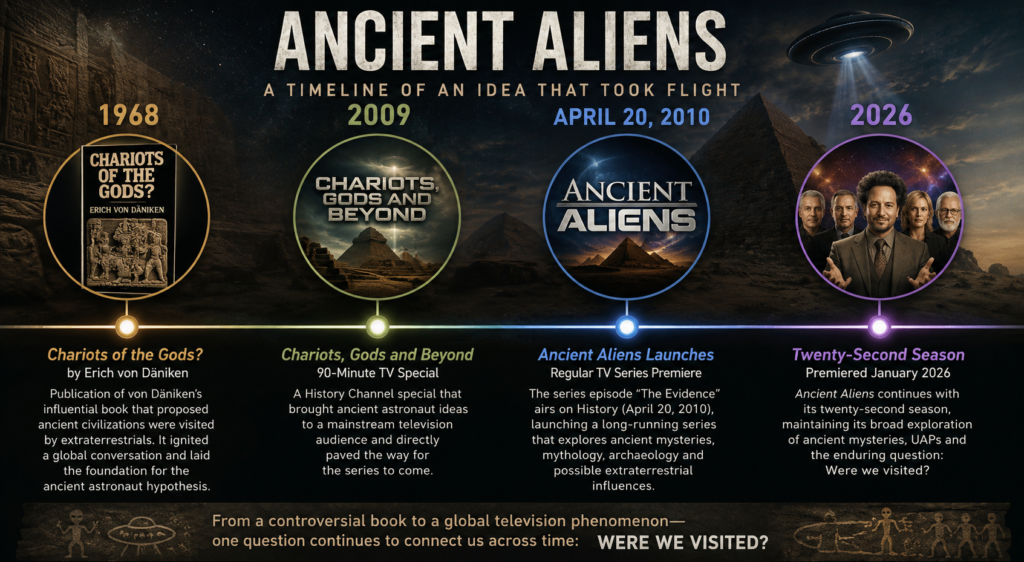
The franchise began with the 90-minute special Chariots, Gods and Beyond, released on March 8, 2009. The regular series began with “The Evidence,” which History dates to April 20, 2010. History’s current catalogue identifies 22 seasons, although its episode counter has varied across individual official pages, apparently reflecting differences in the treatment of specials, compilations and catalogue entries. No fixed episode total is therefore used here (Apple TV, 2009; HISTORY, 2010, 2026).
The Question Mark Is Its Most Important Special Effect
Ancient Aliens is brilliant at one thing: turning the existence of a mystery into the feeling of an answer.
A carved figure resembles a modern astronaut. A monument contains blocks whose transportation demanded formidable organization. A sacred text describes something descending from the sky. A witness remembers an anomalous object. A government file is incomplete or classified. Each element may be interesting in its own right, but Ancient Aliens edits them into a common atmosphere of implication.
The narrator asks whether an ancient object or story could preserve evidence of extraterrestrial intervention. Music rises. Computer graphics literalize the proposition. A contributor describes the possibility. Another apparently analogous example follows from a different culture or century. By the time the familiar formulation arrives, “ancient astronaut theorists say yes,” the programme has often made possibility feel cumulative even where the underlying claims remain independent, disputed or weakly connected.
That is the fundamental method of Ancient Aliens, and it explains both the programme’s remarkable durability and its evidentiary weakness.
History describes the series in expansive terms, ranging across ancient civilizations, religious traditions, unusual artifacts and modern anomalous phenomena. Its twenty-second season premiered in January 2026, continuing the same broad synthesis of archaeology, mythology and contemporary UAP material (HISTORY, 2026).
The show’s greatest accomplishment is cultural rather than historical. It has created a television language in which almost any unresolved object, tradition, aerial observation or institutional secret can be absorbed into one enormous mythology.
Its greatest weakness is exactly the same.
When almost every mystery can be interpreted as evidence of ancient NHI, the central hypothesis becomes difficult to test. It is instead repeatedly illustrated.
From a 2009 Special to a Television Cosmology
The intellectual ancestry of Ancient Aliens long predates television. Speculation about extraterrestrial intervention in ancient history appeared in various forms before Erich von Däniken, but his 1968 book Chariots of the Gods? gave the ancient astronaut hypothesis its most commercially successful modern expression.
Von Däniken’s recurring proposition was simple and enormously adaptable: some ancient accounts of gods, celestial vehicles and supernatural visitors might be misunderstood descriptions of technologically advanced beings.
The interpretive method mattered as much as any individual claim. Gods could become astronauts. Miracles could become misunderstood technology. Sacred architecture could become evidence of engineering intervention. A gap in conventional explanation could become an opening through which extraterrestrial agency entered the story.
Von Däniken died in January 2026 at the age of 90. The Associated Press reported his death on January 11 under the headline “Erich von Däniken, Swiss writer who spawned alien archaeology, dies at 90.” By then Ancient Aliens had carried his central ideas into a far larger audiovisual culture (Associated Press, 2026).
Producer Kevin Burns described the programme’s television origins in a 2016 interview with Tony Sokol. Burns said the idea grew from work on an Indiana Jones special connected with Indiana Jones and the Kingdom of the Crystal Skull, whose imagery renewed his interest in von Däniken and ancient astronaut theories. Burns approached Giorgio A. Tsoukalos, discussed the concept with the network and developed the project that became Ancient Aliens. Burns characterized himself as an “open-minded skeptic” and explained that the programme’s questioning narration reflected that stance, while acknowledging that some contributors advanced ideas even he considered far-fetched (Sokol, 2016).
That origin remains visible in the completed series. Ancient Aliens inherits the emotional vocabulary of the adventure serial: forbidden chambers, lost technology, hidden history, enigmatic priests, dangerous knowledge and gatekeeping institutions. Locations are introduced less as archaeological environments than as thresholds to revelation.
The camera does not simply visit a ruin.
It approaches a clue.
The Series as Television: The Machine of “Maybe”
As television craft, Ancient Aliens is considerably more sophisticated than a simple catalogue of unusual claims.
Robert Clotworthy’s narration is central to the programme’s identity. His voice is serious without being frantic, authoritative without usually sounding overtly theatrical. That restraint gives even extreme propositions a surface calm. The rhetoric may be speculative, but the delivery resembles conventional factual television.
The visual strategy is equally disciplined. Landscapes are photographed from the air. Monuments appear at sunrise and sunset. Maps collapse geographic distance. Reenactments supply ancient priests, witnesses, lights in the sky and moments of apparent revelation. Computer-generated imagery provides what the historical record cannot: ancient spacecraft hovering above temples, energy moving through monuments, machinery inside structures or figures presented as technological operators.
Scholar Shawn Malley has described this process as the “science fictionalizing” of archaeological material. His analysis is useful because it identifies something more important than mere visual excess. CGI can bridge an evidentiary gap by showing viewers what the hypothesis would look like if it were true. Once visualized, an interpretation becomes easier to remember as though it were part of the original evidence (Malley, 2018).
A carved image may be ambiguous.
An animated reconstruction of that image as a cockpit is not.
The programme’s recurring argumentative structure is similarly effective. First comes a genuine object, mystery or unresolved question. Then a conventional interpretation is summarized. A difficulty is identified. Other examples are introduced from different locations or traditions. A speculative explanation is offered. CGI gives that explanation in physical form. Finally, the narration asks whether these apparently converging mysteries might point to visitors from elsewhere.
Researcher Opinion The series’ characteristic question form is not neutral merely because it avoids declarative certainty. Repeated conditional questions can still narrow the viewer’s perceived choices when alternative explanations receive substantially less time, imagery or emotional emphasis.
This is why the programme can remain technically speculative while producing a strong cumulative impression of confirmation.
Calling that mechanism a “grammar of insinuation” is critical interpretation, but it is grounded in the show’s recurring form: conditional narration, selective contrasts, associative editing and visual literalization.
And it works superbly as television.
The show moves. A new mystery arrives before the previous one can become tedious. Every ruin has a secret and every sacred object may contain a second meaning. For viewers attracted to anomalies but disinclined to read excavation reports, translation histories or technical literature, Ancient Aliens offers a constantly refreshed invitation to wonder.
The price of that accessibility is context.
Spoiler Notice
There is no conventional plot or final revelation to spoil. The sections below discuss recurring conclusions, representative claims and the series’ evidentiary method.
What Ancient Aliens Is Actually Proposing
The original and dominant model is extraterrestrial: technologically advanced beings visited Earth in the remote past, interacted with humans and may have influenced religion, architecture, science or social development.
Over time, however, the franchise has become increasingly expansive. Interdimensional beings, hidden terrestrial populations, portals, time travel, genetic intervention, consciousness, artificial intelligence, supernatural traditions and modern UAP secrecy can all enter its orbit.
This plurality makes the series surprisingly flexible. A viewer does not need to accept extraterrestrial pyramid instructions to enjoy an episode about archaeoastronomy, unusual folklore or modern UAP. Ancient Aliens functions as a giant media crossroads where archaeology, paranormal belief, esotericism, mythology and disclosure culture meet.
The problem is that very different categories of evidence are often treated as though thematic similarity gives them mutual support.
A religious narrative is not a radar track. A disputed translation is not a physical artifact. A witness recollection is not a laboratory analysis. A government document showing institutional interest in UAP does not authenticate an ancient astronaut claim.
The programme nevertheless thrives on adjacency.
Hypothesis: Ancient NHI intervention
The central ancient astronaut proposition is best treated as a hypothesis. Scientific openness to extraterrestrial life in the universe does not establish visitation to Earth, still less intervention in a particular civilization or monument.
For ancient NHI contact to become a strong historical explanation, one would expect evidence capable of discriminating between that model and ordinary human cultural development: authenticated nonhuman technology, anomalous materials with secure archaeological provenance, unambiguous contemporary records, biological evidence, independently convergent measurements or other findings resistant to conventional explanations.
The series instead often begins with ambiguity and asks what extraordinary story could occupy it.
Giza: An Engineering Question Is Not an Evidentiary Vacuum
The pyramids of Giza are perfect Ancient Aliens material because they combine enormous scale, mathematical order and incomplete knowledge of every construction detail.
Archaeologists do not possess a surviving engineering manual explaining every phase of the Great Pyramid’s construction. Specific questions about hauling arrangements, ramps, workforce organization and sequencing remain subjects of research.
But uncertainty about some methods does not mean there is no human archaeological context.
Excavation at Giza has documented settlements and infrastructure associated with the people who worked around the pyramid complex. Ancient Egypt Research Associates identifies Heit el-Ghurab as a substantial settlement associated with the people involved in building the Giza pyramids (Ancient Egypt Research Associates, n.d.). Even more directly, the Wadi el-Jarf papyri preserve administrative records from the end of Khufu’s reign. Pierre Tallet’s publication of the archive describes logbooks associated with Inspector Merer and his team, including missions transporting limestone from the Tura quarries to Khufu’s Great Pyramid at Giza while the monument was under construction (Tallet, 2017).
This evidence does not supply a complete cinematic reconstruction of pyramid engineering. It does something more historically important: it places the project inside the administrative, logistical and human world of Fourth Dynasty Egypt.
Evidence: There is substantial archaeological and documentary evidence connecting Old Kingdom Egyptian society, administration and labour to pyramid construction.
Hypothesis: Builders were supplied with otherwise unattested engineering knowledge by NHI.
The second proposition is not disproved simply because it is extraordinary. It is weak because independent evidence requiring it has not been demonstrated.
That distinction is crucial. “We do not know every detail of how this was done” and “therefore an external intelligence may have supplied the missing knowledge” are not equivalent statements.
The programme repeatedly gains dramatic force by allowing the distance between them to collapse.
Pumapunku: Precision Without Its Archaeological Landscape
Pumapunku, within the Tiwanaku complex in Bolivia, has become one of the franchise’s signature locations.
Its precisely worked stone, unusual architectural components and high-altitude setting are visually ideal for ancient astronaut television. Contributors have emphasized the mass of some blocks, the precision of andesite pieces and questions about transport and tooling. Extremely early dates have also circulated in the programme’s own presentation. History’s episode “The Mystery of Puma Punku” promoted the site as approximately 14,000 years old, while associated Ancient Aliens material has entertained dates extending as far back as 15,000 BC (HISTORY, 2012).
The archaeological chronology is far later.
UNESCO describes Tiwanaku as a major spiritual and political center that flourished as a planned city principally between approximately AD 400 and 900 (UNESCO World Heritage Centre, n.d.-b). Research by archaeologist Alexei Vranich has used historical measurements and three-dimensional reconstruction to explore the modular architecture of Pumapunku and reassemble relationships among scattered stone elements (Vranich, 2018).
That does not answer every construction question. Nor should it have to.
A partially reconstructed human building process is still a better-supported explanation than a nonhuman one when the latter lacks independent physical evidence.
Evidence: Archaeological chronology places Tiwanaku and Pumapunku within the first millennium CE rather than in a 14,000- or 15,000-year antiquity.
Hypothesis: Claims that advanced or nonhuman machinery was involved remain unverified.
The larger issue is one of agency. When Pumapunku is presented principally as something its builders should not have been capable of making, Tiwanaku civilization becomes a supporting character in the story of hypothetical outsiders.
The monument is impressive precisely because humans built it. Reassigning ingenuity should require evidence, not astonishment.
Nazca: Aerial Appearance Is Not Aeronautical Function
The Nazca geoglyphs in Peru are another recurring ancient astronaut icon.
Their scale and visibility from elevated perspectives make them particularly receptive to modern technological analogy. Straight lines become imagined runways. Geometric forms become navigational systems. Huge figures become messages intended for beings overhead.
The archaeological evidence supports neither a single explanation for every Nazca geoglyph nor the specific claim that they functioned as extraterrestrial landing infrastructure.
UNESCO dates the lines and geoglyphs broadly between 500 BCE and AD 500 and describes them as designs produced by removing the darker surface material of the desert (UNESCO World Heritage Centre, n.d.-a). Archaeological interpretations have examined ritual movement, water, landscape, cosmology, pathways and other culturally grounded functions.
Some questions remain open, as they should.
But uncertainty about ritual or symbolic purpose is not positive evidence for aviation.
Researcher Opinion: The “runway” reading illustrates one of Ancient Aliens’ most characteristic habits. It asks first what an ancient form resembles to a modern technological observer, then reasons backward toward a hypothetical machine that would make the resemblance literal.
This is a powerful method for generating stories.
It is a weak method for reconstructing history.
The Dogon and Sirius: When Transmission Becomes the Mystery
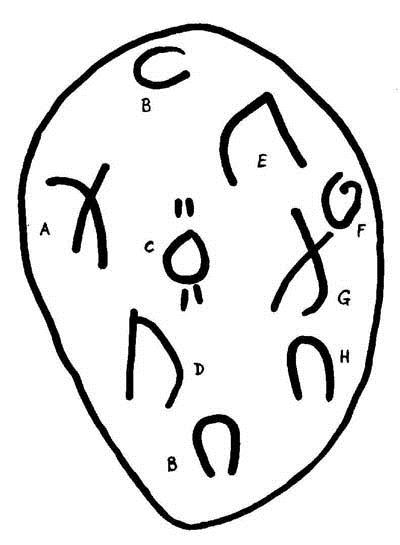
Claims concerning Dogon knowledge of the Sirius system are among the more complicated examples in ancient astronaut literature.
Marcel Griaule and Germaine Dieterlen reported an elaborate Dogon cosmology incorporating material that later writers connected with the companion star Sirius B. This became the basis for arguments that the Dogon possessed astronomical knowledge that could not have arisen through ordinary means.
Walter van Beek’s later field study reported that he could not reproduce important elements of the cosmological system attributed to the Dogon in the earlier research. His 1991 article provoked published criticism and responses. Geneviève Calame-Griaule, among those defending aspects of the earlier ethnography, challenged van Beek’s restudy in Current Anthropology later that year (Calame-Griaule, 1991; Van Beek, 1991).
The disagreement involves field methodology, individual informants, cultural change, researcher influence and what can legitimately be generalized as “Dogon knowledge.”
The responsible classification is therefore Disputed.
Even if particular Dogon informants possessed accurate information about Sirius B, the crucial historical question would remain: how did that information reach them?
Possible mechanisms involving missionaries, travelers, colonial-era astronomy, researchers or other forms of historical transmission would have to be excluded before NHI became necessary.
Ancient Aliens often compresses that methodological problem into the much more exciting question of whether somebody from Sirius told them.
The difference is enormous.
Vimānas: Ancient Myth Is Not a Twentieth-Century Aircraft Manual
Ancient Indian literature contains genuine traditions involving celestial vehicles commonly referred to as vimānas. Those narratives are historically important as religion, literature and mythology.
Their existence is documented. Their meanings are culturally complex.
They should not be conflated with the Vaimānika Shāstra, a much later Sanskrit work sometimes promoted as evidence that ancient India possessed technical knowledge of powered aircraft.
A 1974 technical study by H. S. Mukunda and colleagues at the Indian Institute of Science concluded that the work could not be dated earlier than the early twentieth century and that the aircraft described in it were aeronautically unworkable (Mukunda et al., 1974).
Evidence: Ancient Indian traditions genuinely contain accounts of celestial vehicles and aerial travel.
Hypothesis: Interpreting older vimāna traditions as literal descriptions of technological craft remains unverified.
The programme is most interesting when it leaves that interpretive space open.
It is weakest when myth is flattened into machinery.
What Ancient Aliens Gets Right
A rigorous criticism of Ancient Aliens should begin by acknowledging that some of its instincts are valuable.
The past is incomplete. Established chronologies can change. Archaeologists revise interpretations. Previously unknown sites are discovered. Museum identifications can fail. Governments classify information. Intelligence agencies have misled publics. Scientific institutions can develop orthodoxies and blind spots.
Anomalous testimony also deserves respectful investigation rather than automatic ridicule.
Those principles matter in UAP research as much as they do elsewhere. A witness account can be evidence without being conclusive. Its evidentiary value depends on factors such as proximity, consistency, expertise, contemporaneous documentation, personal risk, corroboration and independent convergence.
Ancient Aliens is usually better at granting witnesses dignity than at performing that second analytical step.
The series also understands something its critics sometimes miss: people are interested in ancient astronaut narratives because those narratives ask religious and existential questions, not merely engineering questions.
What if humanity is not alone?
What if ancient religious experience involved encounters with other intelligences?
What if myths preserve some memory of anomalous events?
What would contact mean for traditional categories such as gods, angels, demons, creation and revelation?
Those are legitimate questions even when a particular proposed answer fails.
The series’ invitation to wonder should not be confused with evidence, but neither should wonder itself be treated as an intellectual defect.
Where It Distorts the Record
The most persistent problem is not that Ancient Aliens considers unconventional explanations. It is how those explanations are compared with alternatives.
In serious investigation, uncertainty normally lowers confidence.
On Ancient Aliens, uncertainty can function in the opposite direction. The less certain we are about an object, construction method or tradition, the more narrative space becomes available for extraordinary interpretation.
Four habits recur.
The first is an argument from incredulity. A contributor cannot readily reproduce an ancient achievement using a simplified model of the tools available, so a lost or external technology is invoked.
The second is visual analogy. An object resembles a rocket, helmet, aircraft, antenna or astronaut to a modern viewer. Resemblance then begins carrying more argumentative weight than archaeological provenance or cultural context.
The third is chronological compression. Similar myths or visual motifs separated by vast intervals are brought into close editorial proximity, making resemblance feel like continuity.
The fourth is dependent sourcing. Claims repeated across books, television programmes and later websites can acquire the appearance of independent confirmation even when they ultimately derive from the same earlier interpretation.
None of these errors requires intentional deception.
They arise naturally from a television format designed to produce possibility, momentum and wonder.
The result can nevertheless be misleading.
Gods, Machines and the Limits of Literalism
Ancient Aliens is at its most culturally revealing when it deals with religion.
Its characteristic move is technological translation. Gods become visitors. Chariots become spacecraft. Divine weapons become advanced armaments. Heavenly journeys become physical transport. Radiant beings become figures in protective suits.
This can be a useful thought experiment.
A person in antiquity would not describe an unfamiliar aerial technology using the vocabulary of modern aerospace engineering. A witness would use the concepts available within their culture.
But the same caution applies to us.
A twenty-first-century audience is equally capable of translating symbolic, visionary or theological material into the technological vocabulary that dominates its own imagination.
A sky chariot does not become a spacecraft simply because spacecraft are our culture’s most familiar machines of the sky.
Researcher Opinion: The series’ technological gods may tell us as much about contemporary culture as about antiquity. They belong to a modern mythology in which scientific power and religious transcendence have partially merged.
This is why the programme has considerable mythic depth despite frequently oversimplifying mythology. It recognizes that anomalous experience, religion and human identity may be interconnected.
It simply tends to resolve that complexity too quickly into engineering.
Modern UAP and the Problem of “Unresolved”
As the franchise expanded, modern UAP became increasingly important to its overall mythology.
This creates an intuitively attractive continuity. If unexplained aerial phenomena are reported now, perhaps descriptions of strange objects in earlier centuries record the same thing. If contemporary governments classify UAP information, perhaps ancient truths could also have been hidden, suppressed or misunderstood.
Those connections are possible lines of inquiry.
They are not, by themselves, evidence that the underlying phenomena are identical.
Modern UAP research actually demonstrates why Ancient Aliens’ handling of uncertainty is problematic.
Ancient Aliens too often treats suspicion itself as cumulative support. If documents are missing, perhaps they were hidden. If officials deny a claim, perhaps that proves sensitivity. If evidence is unavailable, perhaps its absence is evidence of suppression.
Once a hypothesis can absorb both confirmation and non-confirmation, it becomes extraordinarily resilient and increasingly difficult to test.
Archaeology and the Ethics of Wonder
The programme’s most serious cultural criticism concerns human agency.
Ancient people were capable of extraordinary engineering, observation, craft specialization, religious imagination and collective organization. None of this means every archaeological question has been solved. It means that apparent difficulty should not automatically transfer explanatory agency away from the societies whose material cultures surround the monuments.
Criticism of “alien archaeology” has increasingly addressed not only factual inaccuracies but also the historical structures behind stories of external civilizers. Archaeologist Franco D. Rossi’s study of the public uptake of alien archaeology, based partly on observations at the 2018 Baltimore AlienCon, situates aspects of contemporary pseudoarchaeology within older settler-colonial-derived narratives and examines their relationship to heritage, belonging, nationalism and public misinformation. Rossi is careful about the terminology and does not reduce every enthusiast to an ideological caricature (Rossi, 2019).
That distinction is important.
It does not follow that every Ancient Aliens contributor or viewer holds racist or colonial beliefs. The programme also applies extraordinary explanations to European locations, including Stonehenge. Its audience is diverse, and fascination with ancient astronaut ideas can arise from curiosity, religious questioning, distrust of institutions or enthusiasm for the anomalous.
The problem is structural rather than reducible to individual motive.
Again and again, a civilization’s achievement becomes evidence for outsiders because the achievement is considered too sophisticated, too precise or too unexpected.
That framing can diminish the very people whose accomplishments make the locations worth filming.
The better response is not ridicule.
Archaeologist Donald Holly has argued that scholars should engage public fascination with alternative histories instead of simply mocking it. The popularity of shows like Ancient Aliens reveals a genuine appetite for mystery, archaeology and large historical questions (Holly, 2015).
That is an important lesson for both sides.
Speculative television needs better evidentiary discipline.
Academic archaeology needs to communicate human ingenuity with enough energy to compete.
Reception: A Show Its Critics Could Not Make Disappear
Scientific and archaeological criticism of Ancient Aliens has been severe almost from the beginning.
Critics have challenged its chronology, selective presentation of sources, visual analogies, decontextualized claims and tendency to give speculative interpretations far more dramatic weight than conventional scholarship.
A widely circulated 2012 Smithsonian essay by science writer Riley Black attacked an episode involving extraterrestrial explanations for dinosaur extinction, criticizing the programme for combining legitimate scientific material with conclusions that the underlying research did not establish (Black, 2012).
The criticism was substantial, although its derisive tone also demonstrated a recurring problem in public discussion of anomalous claims.
Mockery can communicate exasperation more effectively than it explains the method.
The endurance of Ancient Aliens suggests that simply declaring a claim ridiculous does little to address why viewers find the surrounding narrative compelling.
The show offers a universe of significance.
Nothing is merely old. It may be evidence.
Nothing is merely symbolic. It may be technological.
Nothing is merely uncertain. It may be hidden.
The viewer is invited not simply to consume information but to participate in discovery.
Researcher Opinion: This is one reason the series can feel emotionally satisfying even when its factual argument is weak. It transforms uncertainty from an uncomfortable limit on knowledge into a promise that reality is larger than official accounts admit.
Popularity does not establish accuracy.
But longevity does tell us something about cultural needs.
From Television Personality to Internet Meme
The cultural influence of Ancient Aliens extends well beyond its episodes.
Giorgio A. Tsoukalos became one of the most recognizable figures in paranormal television, and a still image of him evolved into the widely circulated “Ancient Aliens” image macro. Know Your Meme traces circulation of Tsoukalos-focused jokes to at least November 2010 and documents their expansion across major meme platforms and online communities during 2011 (Know Your Meme, n.d.).
The joke works because audiences immediately recognize the programme’s logic. Faced with an unexplained object, the caricatured Ancient Aliens answer is always the same.
Aliens.
The meme functions simultaneously as publicity and criticism. It reduces the show to a single argumentative reflex while making its central personality globally recognizable.
The franchise’s influence also became physical. AlienCon developed as a gathering closely associated with the programme and its contributors. Michael Hardy reported for WIRED in 2018 that the Baltimore AlienCon had attracted more than 15,000 enthusiasts over three days (Hardy, 2018).
That scale matters when evaluating Cultural Impact.
Ancient Aliens did not create the ancient astronaut hypothesis. It helped make that hypothesis visually ubiquitous.
It did not invent distrust of the government. It incorporated that distrust into an entertainment system where secrecy, mythology and anomalous aerial phenomena could reinforce one another.
It did not create an online conspiracy culture. But its form was unusually well suited to the culture that followed.
Ancient Aliens in the Wider UAP Screen Tradition
Compared with 2001: A Space Odyssey, Ancient Aliens performs an intriguing inversion.
Kubrick’s film uses possible ancient intervention as an ambiguous fictional device. The monolith is powerful partly because the film does not convert it into an explanatory lecture.
Ancient Aliens takes comparable imaginative material and surrounds it with documentary conventions.
That distinction is crucial.
Fiction can propose a startling possibility without pretending to demonstrate it. Factual television inherits an additional responsibility because archival imagery, experts, narration and location photography carry the visual authority of nonfiction.
The X-Files offers another useful comparison. Its Mulder-Scully structure turns belief and skepticism into an internal dramatic argument. Ancient Aliens has no consistent equivalent. Conventional scholarship usually appears briefly as the explanation to be transcended rather than as an investigative position given equal narrative energy.
A rigorous UAP documentary works differently again. It reconstructs chronology, identifies the quality of witnesses, distinguishes first-hand testimony from hearsay, examines sensor provenance, tests ordinary explanations and preserves unresolved cases as unresolved.
Ancient Aliens prefers resonance.
It asks whether one mystery resembles another.
That makes it valuable as a map of UAP mythology, but not as a reliable map of the underlying phenomenon.
Why Ancient Aliens Matters Now
The series looks different in 2026 than it did when the regular programme began in 2010.
UAP is no longer confined to fringe television, specialist magazines and enthusiast organizations. NASA has conducted a formal independent study. AARO maintains an official reporting and analytical function. Military reporting mechanisms, congressional activity and mainstream journalism have made anomalous aerial phenomena institutionally visible subjects of discussion.
None of those developments establishes extraterrestrial visitation.
They do, however, make one instinct of Ancient Aliens look less culturally eccentric than it once did: anomalous observations can deserve serious investigation.
The irony is that increased institutional attention should raise the evidentiary standard, not lower it.
Modern UAP research demonstrates the importance of metadata, sensor quality, calibration, chain of custody, witness evaluation and competing hypotheses. The fact that some modern observations remain unresolved does not validate claims about Nazca, Pumapunku or ancient religious texts.
A contemporary viewer may also notice how thoroughly Ancient Aliens anticipated the structure of algorithmic information culture.
Every few minutes comes another astonishing proposition.
Context is expensive. Association is cheap.
The viewer is encouraged to keep moving from connection to connection, accumulating the sensation of pattern before stopping to ask whether the components share a reliable evidentiary foundation.
The programme predates TikTok and much of the contemporary recommendation-feed environment, but it understands their underlying psychology remarkably well.
Everything might connect.
And another clue is always coming after the commercial break.
UAPedia UAP Cinema Rating
Phenomenon Fidelity: 1.5/5
The series discusses genuine monuments, traditions, documents and UAP reports, but frequently mixes evidence of very different quality. It relies heavily on resemblance, disputed chronology, argumentative gaps and incomplete comparison with conventional explanations.
Mythic and Religious Depth: 3.5/5
Religion and mythology are central to the series, and it correctly recognizes that potential contact with NHI would carry profound existential implications. Its weakness is technological reductionism: complex myths are too often treated as damaged technical reports.
Secrecy and Institutional Realism: 2.0/5
The programme recognizes real phenomena such as classification, institutional error, stigma and historical government secrecy. It is less convincing when resistance, missing information or lack of confirmation are treated as indirect support for concealment.
Experiencer Empathy: 3.0/5
Witnesses, contactees and anomalous experiencers are generally treated without ridicule. The series is considerably less consistent in evaluating testimony for proximity, independence, corroboration and competing explanations.
Cultural Impact: 5.0/5
The programme’s longevity, internationally recognized meme culture and ability to generate real-world fan events such as AlienCon make its influence on the popular vocabulary of ancient astronauts and anomalous history exceptional. The documented circulation of the Tsoukalos image macro and the scale of AlienCon provide visible evidence for that reach (Hardy, 2018; Know Your Meme, n.d.).
Total UCR score: 15.0/25
UAPedia verdict: Significant UAP-related TV
The rating reflects a production with major importance to UAP culture whose investigative and archaeological reliability is substantially weaker than its cultural power.
Claims Taxonomy
Claim: Intelligent NHI visited ancient Earth and guided major civilizations.
Classification: Disputed
Rationale: The ancient astronaut hypothesis is advocated by identifiable writers and programme contributors, but no authenticated nonhuman technology, securely provenanced anomalous artifact or independently convergent physical evidence currently requires that explanation.
Claim: Pumapunku is approximately 15,000 years old.
Classification: Misidentification
Rationale: Archaeological chronology places the Tiwanaku complex in the first millennium CE, with UNESCO identifying the civilization’s principal urban florescence between approximately AD 400 and 900 (UNESCO World Heritage Centre, n.d.-b).
Claim: Pumapunku required nonhuman or advanced powered tooling.
Classification: Disputed
Rationale: Questions remain about particular construction and transport procedures, but no physical evidence demonstrates nonhuman machinery.
Claim: The Nazca lines were extraterrestrial landing strips.
Classification: Misidentification
Rationale: The geoglyphs are shallow landscape features belonging to an archaeological and ritual context. No engineering evidence identifies them as runways (UNESCO World Heritage Centre, n.d.-a).
Claim: Dogon astronomical knowledge about Sirius B came from NHI.
Classification: Disputed
Rationale: The ethnographic record is itself contested, including disagreement between Walter van Beek’s restudy and responses from scholars associated with the earlier Griaule research. Ordinary historical transmission has not been excluded (Calame-Griaule, 1991; Van Beek, 1991).
Claim: The Vaimānika Shāstra is an ancient technical manual describing workable aircraft.
Classification: Misidentification
Rationale: The 1974 Indian Institute of Science analysis concluded that the text could not be dated earlier than the early twentieth century and that its aircraft designs were technically unworkable (Mukunda et al., 1974).
Claim: Ancient cultures preserved stories of celestial vehicles, descending beings and sky gods.
Classification: Legend
Rationale: Such narratives genuinely occur within religious, mythological and literary traditions. Interpreting them as literal reports of NHI technology remains a hypothesis.
Overall Verdict
Ancient Aliens is a remarkably effective machine for manufacturing wonder and an unreliable instrument for deciding what happened in antiquity.
Its television craft is real. The narration, editing, location photography, recurrent personalities and computer imagery produce an atmosphere that few factual franchises have sustained for so long. It encourages audiences to look at old monuments, myths and anomalous reports with curiosity rather than indifference.
That curiosity is valuable.
The method attached to it is much less reliable.
Again and again, resemblance substitutes for provenance. Incomplete knowledge is treated as an opening for a preferred explanation. Visually powerful reconstructions make hypotheses feel observable. Conventional archaeological context receives less emotional and visual investment than the extraordinary alternative.
The series should therefore be neither treated as disclosure nor discarded as meaningless nonsense.
It is one of the most important primary documents of twenty-first-century anomalous mythology.
It reveals how a technological culture reinterprets gods as visitors, sacred objects as machines and gaps in historical knowledge as signs of concealed cosmic history. It also reveals how easily legitimate questions about UAP, institutional secrecy and unresolved phenomena can become attached to much weaker claims through association.
For a UAP-oriented viewer, that makes Ancient Aliens genuinely useful, but perhaps not in the way its central thesis intends.
It is a case study in how claims acquire cultural force.
It demonstrates why experiencers deserve respect but testimony still requires evaluation.
It demonstrates why official statements require scrutiny but distrust alone is not evidence.
And, above all, it demonstrates why the most exciting explanation is not automatically the one best supported by the record.
The programme asks, episode after episode, whether something could be evidence of ancient NHI.
The more important question is what evidence would allow us to distinguish that possibility from all the others.
Until such evidence appears, the series’ ancient astronaut history remains a hypothesis.
Its place in cultural history is already secure.
Media Suggestions
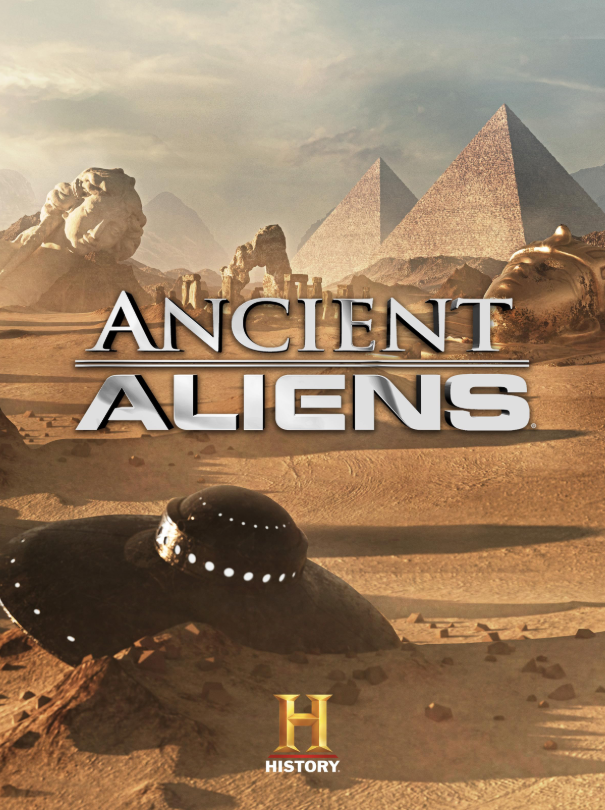
An official History key-art image or licensed season poster would provide the strongest lead visual. Image licensing and attribution should be confirmed before publication rather than inferred from online availability.
An embedded official trailer or authorized History clip could illustrate the series’ narration and editing style.
A timeline could connect von Däniken’s 1968 Chariots of the Gods?, the 2009 Chariots, Gods and Beyond special, the April 2010 launch of the regular series and the programme’s twenty-second season in 2026.
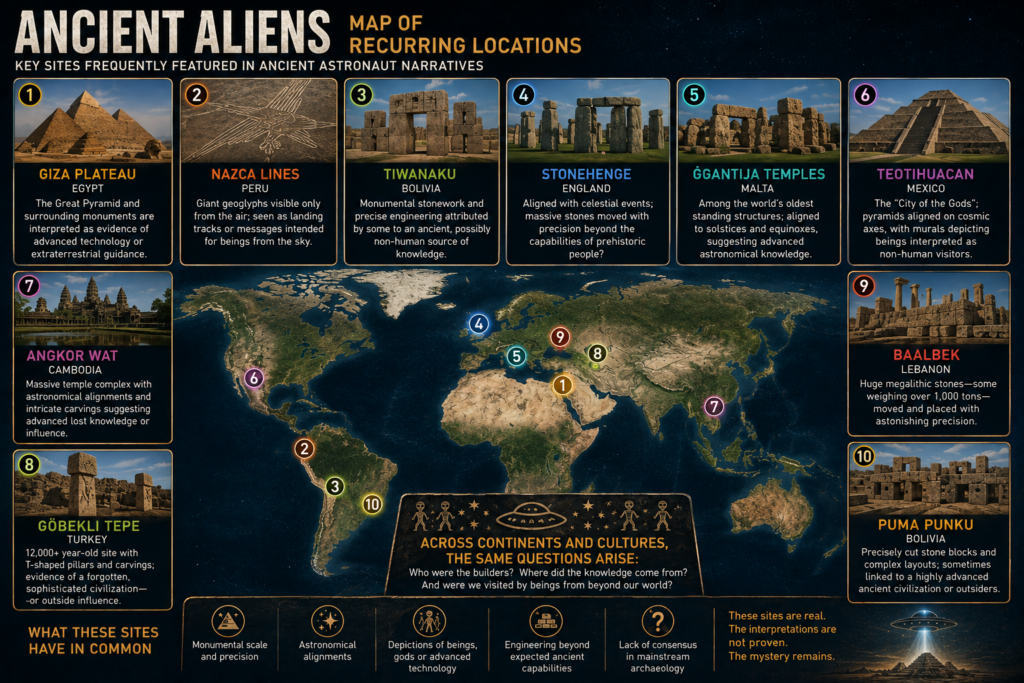
A map of recurring locations could show Giza, Nazca, Tiwanaku and other sites frequently incorporated into ancient astronaut narratives.
A particularly useful original graphic would place three images side by side: an archaeological artifact or monument, the programme’s visual interpretation, and the relevant archaeological context. That would make the distinction between evidence and reconstruction immediately visible.
A second graphic could diagram the evidentiary categories most often blurred by speculative factual television: observation, testimony, interpretation, hypothesis and verification.
References
Ancient Egypt Research Associates. (n.d.). Area C. https://aeraweb.org/projects/area-c/
Apple TV. (2009). Chariots, Gods and Beyond [Television special listing]. https://tv.apple.com/us/episode/chariots-gods-and-beyond/umc.cmc.2e1qrx3sqvc0azzv20jvzufrf?showId=umc.cmc.2eppjm9jx5oi7vaa2jolmuct6
Associated Press. (2026, January 11). Erich von Däniken, Swiss writer who spawned alien archaeology, dies at 90. https://apnews.com/article/57a8a84b8976475791eee82461d53138
Black, R. (2012, May 11). The idiocy, fabrications and lies of Ancient Aliens. Smithsonian Magazine. https://www.smithsonianmag.com/science-nature/the-idiocy-fabrications-and-lies-of-ancient-aliens-86294030/
Calame-Griaule, G. (1991). On the Dogon restudied. Current Anthropology, 32(5), 575–577. https://doi.org/10.1086/204001
Hardy, M. (2018, November 20). Close encounters at AlienCon, where Ancient Aliens fans meet. WIRED. https://www.wired.com/story/aliencon-photo-gallery/
HISTORY. (2010–present). Ancient Aliens [TV series]. Prometheus Entertainment / A+E Networks. https://www.history.com/shows/ancient-aliens
HISTORY. (2010). The Evidence. In Ancient Aliens, Season 1. https://www.history.com/shows/ancient-aliens/season-1
HISTORY. (2012). The Mystery of Puma Punku. In Ancient Aliens, Season 4. https://www.history.com/shows/ancient-aliens/season-4/episode-1
HISTORY. (2026). Ancient Aliens: Season 22. https://www.history.com/shows/ancient-aliens/season-22
Holly, D. H., Jr. (2015). Talking to the guy on the airplane. American Antiquity, 80(3), 615–617. https://www.cambridge.org/core/journals/american-antiquity/article/talking-to-the-guy-on-the-airplane/72758B1848A729A461E8742CCC52A24A
Know Your Meme. (n.d.). Ancient Aliens. https://knowyourmeme.com/memes/ancient-aliens
Malley, S. (2018). Ancient Aliens. In Excavating the future: Archaeology and geopolitics in contemporary North American science fiction film and television (pp. 82–94). Liverpool University Press. https://academic.oup.com/liverpool-scholarship-online/book/22841/chapter/183316823
Mukunda, H. S., Deshpande, S. M., Nagendra, H. R., Prabhu, A., & Govindraju, S. P. (1974). A critical study of the work “Vymanika Shastra.” Indian Institute of Science. https://hsmukunda.in/files/journal_other_papers/1974_hsm_etc_A%20Critical%20Study%20of%20the%20Work%20Vaimanika%20Shastra.pdf
Rossi, F. D. (2019). Reckoning with the popular uptake of alien archaeology. Public Archaeology, 18(3), 162–183. https://doi.org/10.1080/14655187.2021.1920795
Sokol, T. (2016, October 28). Kevin Burns interview: Ancient Aliens creator hits Alien Con. Den of Geek. https://www.denofgeek.com/tv/kevin-burns-interview-ancient-aliens-creator-hits-alien-con/
Tallet, P. (2017). Les papyrus de la mer Rouge I: Le “journal de Merer” (Papyrus Jarf A et B). Institut français d’archéologie orientale. https://www.ifao.egnet.net/publications/catalogue/9782724707069/
UNESCO World Heritage Centre. (n.d.-a). Lines and geoglyphs of Nasca and Palpa. https://whc.unesco.org/en/list/700/
UNESCO World Heritage Centre. (n.d.-b). Tiwanaku: Spiritual and political centre of the Tiwanaku culture. https://whc.unesco.org/en/list/567/
Van Beek, W. E. A. (1991). Dogon restudied: A field evaluation of the work of Marcel Griaule [and comments and replies]. Current Anthropology, 32(2), 139–167. https://doi.org/10.1086/203932
Vranich, A. (2018). Reconstructing ancient architecture at Tiwanaku, Bolivia: The potential and promise of 3D printing. Heritage Science, 6, Article 65. https://doi.org/10.1186/s40494-018-0231-0
SEO title
Ancient Aliens Review: Wonder, UAP and Archaeology
SEO keywords
Ancient Aliens, Ancient Aliens review, History Channel, Giorgio Tsoukalos, Kevin Burns, Erich von Däniken, Robert Clotworthy, ancient astronaut hypothesis, ancient NHI, UAP television, UAP in popular culture, archaeology, pseudoarchaeology, Pumapunku, Tiwanaku, Nazca Lines, Giza pyramids, Merer papyri, Dogon Sirius, vimānas, Vaimānika Shāstra, extraterrestrial contact, government secrecy, AARO, NASA UAP study, UAP disclosure, religion and UAP, Forteana, anomalous phenomena, AlienCon, Ancient Aliens meme, documentary television, Media Events Books and News Outlets