
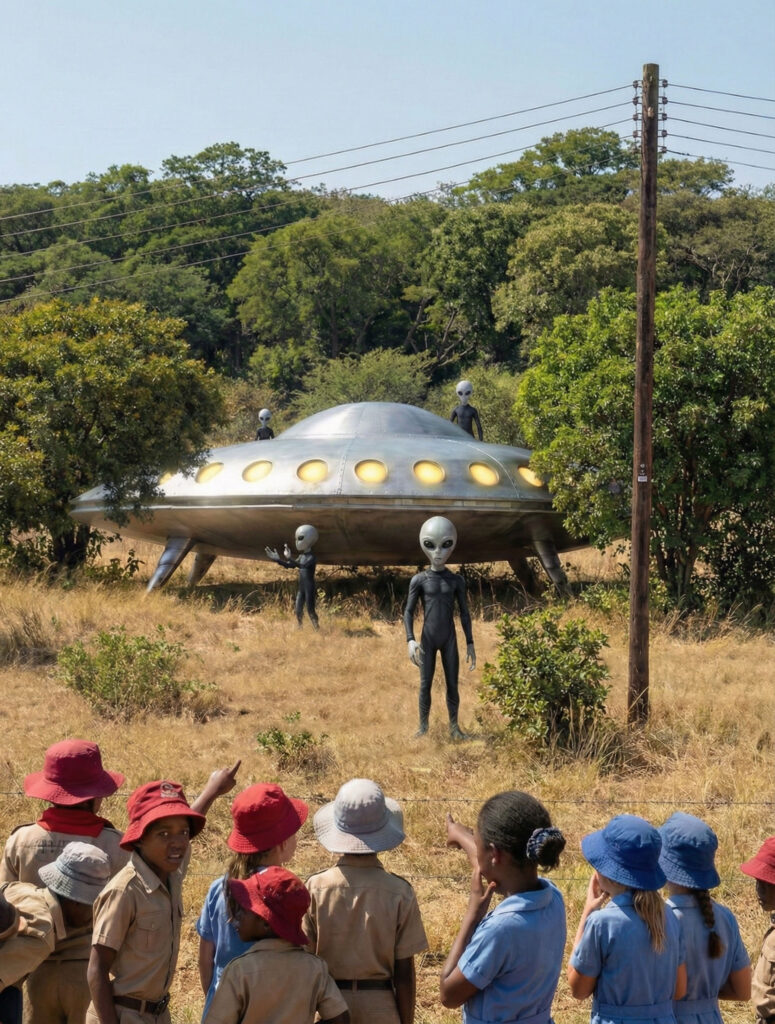
On the morning of 16 September 1994, at the Ariel School in Ruwa, Zimbabwe, a group of children on recess reported something extraordinary. Around sixty pupils, aged roughly six to twelve, said they saw a shiny, disc‑like object descend into the scrubland beyond the playground. Some of them said one or more small beings in black clothing emerged, approached the children, and communicated silently with them, with messages many later described as warnings about environmental harm and technology.
There were no adult eyewitnesses. Yet the children’s drawings and interviews, recorded within days by local investigators and by the BBC, are unusually rich and emotionally consistent, enough that historian Jerome Clark later called Ariel “the most remarkable close encounter of the 1990s.”(Internet Archive)
In the decades since, Ariel has become a touchstone case in UAP studies. It sits at the crossroads of child psychology, African cultural context, media influence, and questions about non‑human intelligence. At the same time, it has attracted a sophisticated skeptical literature, including proposals involving a puppet troupe, dust‑devil phenomena, and mass psychogenic effects in school settings.(PMC)
Setting and build‑up to the incident
Ruwa in 1994 was a semi‑rural agricultural district about 22 km southeast of Harare, more a crossroads than a fully developed town. Ariel School was an expensive private primary school whose students represented a cross‑section of Zimbabwe’s elite: white farming families, Black African families from several tribes, mixed‑race and Asian families.(Wikipedia)
Two days before the Ariel encounter, southern Africa experienced a spectacular night‑sky event. A bright, slow fireball crossed the sky over several countries, widely covered on radio and television. Later analysis identified it as the re‑entry of a Zenit‑2 booster from the Cosmos 2290 satellite launch, whose breakup produced a silent, multi‑minute display visible to millions.
Zimbabwe’s state broadcaster ZBC invited listeners to call in with reports, fueling a short‑lived “UAP flap” of lights and beings reported across the region. Local UAP researcher Cynthia Hind logged multiple reports in those days, including a young boy and his mother who saw a disc in daylight and a truck driver who reported figures near the roadside.(The Mail & Guardian)
This created a charged informational environment for Ariel. Whether that primed expectations for the children, or whether it reflects a genuine wave of anomalous activity, remains one of the key interpretive questions.
The Ariel School event: timeline
Morning break, Friday 16 September 1994
Around 10:00 a.m., pupils went outside for their mid‑morning break while the teachers gathered in the staff room for a meeting. The only adult outside was the school tuckshop mistress. The playground bordered a rough field of tall grass and scattered bushes with a line of trees and a power line corridor beyond.(The Mail & Guardian)
Children later described seeing:
- One or more shiny, metallic or “silver” objects in the sky.
- At least one object descending toward the scrubland beyond the playground, near the power lines.
- The object either landing among the trees or hovering just above the ground.(Wikipedia)
Estimates of distance vary, but most place the craft just beyond the school boundary. Some children said they saw multiple discs “coming in along the power lines.”(The Mail & Guardian)
Emergence of beings
Many of the older children, and some of the younger ones, reported seeing one or more small figures near the object. Common elements include:
- Height around one meter.
- Dark, tight‑fitting clothing or “shiny black suit.”
- Very large, elongated eyes placed somewhat lower on the face.
- A small or slit‑like mouth, minimal nose and ears.
- Long black hair in several accounts, sometimes compared to pop‑culture styles like Michael Jackson.(The Mail & Guardian)
Descriptions are not identical. Some children drew pot‑bellied or more human‑looking figures, others more classic large‑headed entities.
The figures’ movement was described as unusual: gliding, bounding, or moving “in slow motion.” Several witnesses said one figure stood on the landed object while another moved toward the children.
Children’s reactions and claimed communication
The encounter appears to have lasted on the order of 10 to 15 minutes.(Wikipedia)
Reactions split roughly into three groups:
- Some children ran closer to the boundary fence or bush to see better.
- Some remained near the playground equipment and watched from a distance.
- Some became frightened and ran back toward the buildings or to the tuckshop.(The Mail & Guardian)
A subset of children later reported a form of communication from the being or beings that did not involve speech. They described a sense of “messages” in their minds or images, often interpreted as:
- Warnings that humans were harming the Earth, especially through pollution.
- Concerns about humanity becoming “too technological” at the expense of the environment.(Wikipedia)
In one of John Mack’s recorded interviews, a boy says he felt a warning “about something that is going to happen” and that “pollution mustn’t be.” An older girl interpreted the message as “we’re making harm on this world and we mustn’t get too techno.”(Wikipedia)
According to later skeptical analyses, these explicit environmental motifs appear clearly only in the interviews conducted by Mack two months later, not in Hind’s earliest group sessions, although Hind herself did acknowledge an environmental theme in later writing.
End of the sighting
Children reported that the figure or figures returned to the object, which then departed rapidly or “vanished” from view. There are no known reports of sound, exhaust, or obvious conventional propulsion.
When the break ended, excited children ran into the school speaking over one another about “a little man,” “things from the sky,” or, in some accounts, tikoloshes, small goblin‑like beings of Shona and Ndebele folklore.(The Mail & Guardian)
Teachers initially dismissed the accounts as imagination. Many had not seen the field during the event and believed the children were playing a game.
Immediate aftermath and investigations
Parents and local media
That afternoon and evening, the children repeated their stories at home. Parents found the children agitated, sometimes tearful, and consistent within families. The following day, parents confronted school staff, asking what had frightened their children.(The Mail & Guardian)
The story reached ZBC radio, which had already been collecting UAP calls that week, and soon after attracted the BBC’s Zimbabwe correspondent, Tim Leach, and veteran Zimbabwean UAP investigator Cynthia Hind.(Wikipedia)
Tim Leach (BBC)
Leach visited Ariel on 19 September, three days after the event, with a camera crew. He filmed the grounds, spoke with staff, and conducted on‑camera interviews with groups of children. Later he told colleagues that after war reporting he could handle many things “but not this,” an indication of how unsettling he found the children’s coherence and affect.(Wikipedia)
The BBC footage shows children from different grades giving overlapping descriptions and sketching the object and beings in ways that share core features but retain individual variations.
Cynthia Hind
On 20 September, Hind travelled to the school. She had already spoken to some children by telephone. That day she:
- Interviewed groups of older children, often in clusters of four to twelve.
- Asked them to draw what they had seen.
- Took notes that later formed articles and a chapter in her book UFOs Over Africa.(The Mail & Guardian)
Hind emphasised that the children came from diverse cultural backgrounds yet converged strongly on key details: a disc‑shaped craft, small figures in black, very large eyes. She also noted that some African children interpreted the entities as zvikwambo or tokoloshes, whereas some white children initially thought they might be a gardener before realising the figure’s proportions were wrong.(The Mail & Guardian)
Later critics have argued that Hind’s group‑interview format allowed “cross‑contamination” of stories, since children listened to one another and to adult questioning before giving their own accounts.
John Mack
In November 1994, Harvard psychiatrist and Pulitzer Prize winner John E. Mack arrived in southern Africa on a broader research trip about UAP experiencers. The Ariel case was added to his itinerary after Hind’s outreach.(The Mail & Guardian)
Mack visited Ariel on 30 November. He and his team:
- Conducted one‑on‑one and small‑group interviews with a subset of the children, some indoors, some seated at the original field edge.
- Emphasised open‑ended questioning, asking children to describe what happened and how it made them feel.
- Recorded video that would later circulate widely on television and online.(Wikipedia)
Mack concluded that the children’s emotional presentation and consistency indicated that they were relating a genuine experience that had deeply affected them, not an invented story. In Passport to the Cosmos, he connected Ariel’s environmental messages to similar motifs in adult experiencers’ accounts, suggesting that protection of the Earth may be central to whatever intelligence is behind such encounters.(The Mail & Guardian)
Mack’s stance brought professional backlash, including an inquiry at Harvard questioning his methods and conclusions. Although his tenure ultimately remained intact, his career illustrates the social cost of treating UAP testimonies as potentially real in an academic setting.(WHYY)
Later documentation
In the decades that followed, Ariel witnesses appeared in:
- News features like the Mail & Guardian’s “Remembering Zimbabwe’s great alien invasion.”(The Mail & Guardian)
- The documentary The Phenomenon (2020).
- Randall Nickerson’s dedicated documentary Ariel Phenomenon (2022), which re‑interviewed many witnesses decades later.(WHYY)
Several witnesses report ongoing anxiety, vivid memories, and in some cases artwork and life choices shaped by that day. One witness told the Mail & Guardian she lives with a “permanent fear” that the entities may return and claims to sense when “they are back in the atmosphere.”(The Mail & Guardian)
Testimony: patterns and divergences
Visual description of craft
Across drawings and interviews, recurring elements include:
- A disc or dome shape, sometimes with a raised central section.
- Windows or portholes in some drawings.
- A landing gear or base sketched as a simple ring or set of supports.
Some children drew multiple objects or depicted one object among trees. This variety suggests that the children were not simply copying a single template, yet the overlap in form and location is striking.
Entities and cultural overlays
Children’s drawings and verbal accounts of the beings vary more than the craft, yet certain features cluster:
- Large, dark, almond‑like eyes appear in many but not all depictions.
- Hair is present in several accounts, occasionally described as long and straight, “like Michael Jackson.”
- Skin colour varies from greyish to dark to reddish in different testimonies.
This variability has been used both ways. Proponents argue that variation around a core template is expected in spontaneous perception under stress. Skeptics argue that the range of descriptions, including some that resemble humans in odd clothing, undermines the case for a single, structured non‑human entity.
Cultural frameworks clearly shaped interpretation. Some African children perceived the beings as supernatural goblins from local folklore and reacted with intense fear of being eaten, whereas others more steeped in Western media quickly reached for “aliens” as an explanatory label.(The Mail & Guardian)
Communication and emotional tone
The most distinctive feature of Ariel is the claimed non‑verbal communication. Only a fraction of the children reported clear “messages,” but where present, these cluster around:
- Human technology outpacing wisdom.
- Environmental destruction and a sense of impending catastrophe.(Wikipedia)
The emotional tone across testimonies mixes fear, awe, and a sense of being chosen to receive a message. Several now‑adult witnesses report that environmental concern remained central to their identity afterwards.
Critically, as Gideon Reid and others note, the explicit telepathy framing and the fully developed ecological discourse appear mainly in Mack’s later interviews, which raises concerns about suggestion, especially given Mack’s prior interest in both themes.
Skeptical proposals
Serious skeptical work on Ariel converges on three broad families of explanation.
Mass psychogenic illness in African schools
The Ariel case is frequently cited in medical and psychological literature on mass psychogenic illness (MPI) or “mass hysteria” in African schools. A review in the Malawi Medical Journal lists Ariel as an example where tens of students reported anomalous experiences and some observers suggested psychological contagion.(PMC)
African school MPI outbreaks often involve:
- Sudden fainting, convulsions, or itching spreading rapidly through a mostly female cohort.
- Strong rumors of witchcraft or demonic attack.
- Resolution once authorities firmly deny supernatural causes and restore order.(PMC)
Compared to this template, Ariel overlaps only partially. There were no convulsions or physical symptoms, and the event did not rapidly snowball into days of attacks. Instead it presents as a one‑off anomalous sighting followed by long‑term narrative persistence. Supporters argue that this mismatch weakens the MPI explanation; skeptics reply that Ariel may represent a cognitive contagion without somatic symptoms.
The puppet‑show hypothesis
In 2024, Gideon Reid published a detailed skeptical paper proposing that the stimulus for the children’s fear and vivid descriptions was a set of puppets or costumed figures associated with touring educational theatre about HIV/AIDS, possibly seen out of context against the bush line.
Reid’s key points include:
- Evidence that puppet‑based “theatre for development” campaigns were active in Zimbabwe in that period.
- The possibility that one such troupe operated near Ruwa.
- Many children describing figures with hair, odd clothing, and exaggerated features consistent with uncanny puppets.
- Serious flaws in the original investigation, including group interviewing and lack of systematic canvassing for mundane stimuli.
He concludes that Ariel is “good evidence that a stimulus did exist” but that the best candidate is a prosaic one that investigators failed to identify, with puppets as a leading option rather than a firm solution.
Meteorology and dust‑devil hypothesis
Oliver D. Smith, writing in SUNlite in 2023, suggested that a meteorological phenomenon, likely a dust devil interacting with local vegetation and debris, could account for some of the reported motion and appearance of the “craft,” especially the shimmering and spinning descriptions.(Astronomy UFO)
Dust devils can produce columnar shapes, moving shadows, and airborne material that, from a distance, might appear structured. However, this proposal struggles to account for the small dark figures described near the object and for the specific iconography in many drawings. Supporters might argue that human pattern recognition “filled in” humanoid forms once children were frightened by an unusual natural display.
Prank and retrospective confession
The 2023 Netflix documentary Encounters included a former Ariel pupil, Dallyn, who claimed that he started the incident by pointing at a distant shiny rock and telling classmates it was a craft. He frames the event as a prank that spiraled into mass belief.(Wikipedia)
However, this late confession conflicts with his own earlier on‑camera testimony from 2008, in which he described seeing a light changing colour in the sky, and it does not explain the detailed close‑entity reports from many other children. Researchers close to the case usually treat this as one witness’s attempt to reframe a disturbing childhood memory rather than a decisive debunking.
From a UAPedia perspective, the prank claim is best classified as a Disputed explanation rather than a hoax verdict on the entire case.
UAP‑forward interpretations
While Ariel can be fitted to various skeptical frameworks, it also presents several features that make it unusually resilient as a candidate for genuine non‑human contact.
Multi‑witness, multi‑cultural consistency
Even critics concede that around 60 children, drawn from different grades and cultural backgrounds, consistently report an unusual event in the same small area of the school grounds at the same time.
The differences in how they framed the beings (aliens versus tokoloshes) actually enhance the evidentiary value of the shared core. Diverse cultural overlays sitting on top of the same spatial and visual description suggest a common stimulus interacting with different worldviews.
Lack of obvious mundane triggers
No adult or authority has ever come forward to say that a puppet troupe, agricultural machine, helicopter, or other candidate was operating at that spot and time. A Zenit‑2 re‑entry, while spectacular, occurred at night two days earlier and is incompatible with a silent daytime close‑range encounter.
From a UAPedia editorial standpoint on government and official sources, the absence of any official confirmation or denial is not decisive either way. Government sources are treated as an evidentiary stream, but not as the final word, especially in cases with no formal investigation on record.
Psychological impact and longevity
The Ariel witnesses who have spoken as adults describe lasting effects: persistent anxiety, ecological concern, and a sense that the event was real and meaningful. Some, like artist Emily Trim, produce recurring imagery that they see as “manifestations of the messages” they received, decades after the fact.
Such enduring impact is not proof of an external non‑human encounter. It does, however, weigh against trivial explanations like pranks or momentary misperception.
Claims taxonomy
Applying UAPedia’s claims taxonomy to Ariel:
- Claim: On 16 September 1994, a large group of Ariel School pupils reported an anomalous event near the playground.
- Status: Verified
- Rationale: Converging testimonies, independent video and audio records (BBC, Hind, Mack), and long‑term consistency among multiple witnesses and investigators, including skeptical sources that nevertheless accept a disturbance occurred.
- Status: Verified
- Claim: A structured disc‑like craft landed or hovered just beyond the school grounds.
- Status: Probable
- Rationale: Repeated, similar drawings and descriptions from children without known prior exposure to classic “saucer” imagery in depth. No physical traces or multi‑sensor data, so this rests entirely on human testimony.(Internet Archive)
- Status: Probable
- Claim: One or more non‑human beings in black clothing were seen near the craft.
- Status: Probable
- Rationale: Multiple children independently describe small figures with large eyes and odd movement. Variations exist, yet the core pattern is robust. No adult witnesses or physical evidence, which keeps this short of Verified.(The Mail & Guardian)
- Status: Probable
- Claim: The beings communicated telepathically with some children, delivering an environmental warning.
- Status: Disputed
- Rationale: Strongly present in Mack’s interviews and in later witness narratives, but apparently absent from the earliest group interviews by Hind and Leach, raising questions about retrospective framing and suggestion.
- Status: Disputed
- Claim: The event is best explained as mass psychogenic illness in a school setting.
- Status: Disputed
- Rationale: Cited in medical literature as an example of MPI, yet Ariel lacks many classic MPI features such as physical symptoms and rapid, recurrent outbreaks. Emotional contagion clearly occurred, but whether that fully accounts for the visual content is unresolved.(PMC)
- Status: Disputed
- Claim: The event was a simple hoax or prank initiated by one child.
- Status: Disputed
- Rationale: Relies almost entirely on a single late confession that contradicts the witness’s earlier recorded account and does not fit the complexity of the wider testimony set.
- Status: Disputed
- Claim: The event involved a prosaic physical stimulus, likely a puppet performance or dust‑devil, misinterpreted and elaborated by children.
- Status: Probable for the existence of some physical stimulus, but Disputed for the specific mechanisms.
- Rationale: Reid and Smith make plausible points that investigators overlooked mundane triggers and that testimony shows confusion and variation. Their models remain speculative and do not yet convincingly map all the data.
- Status: Probable for the existence of some physical stimulus, but Disputed for the specific mechanisms.
- Claim: Ariel represents a genuine close encounter with non‑human intelligence delivering an ecological message.
- Status: Probable
- Rationale: Multi‑witness, multi‑cultural convergence, lack of clear mundane stimulus, and long‑term psychological impact support an extraordinary interpretation, while gaps in documentation and plausible alternative models keep it short of Verified.
- Status: Probable
Speculation labels
To keep evidence and interpretation clearly separated, UAPedia applies explicit speculation labels.
Hypothesis
- Ariel may be part of a pattern of school‑based UAP encounters in which non‑human intelligences intentionally engage children rather than adults, possibly because children are less enculturated and more open to non‑ordinary experience. The Westall School case in Australia (1966) shows notable structural similarities, including a daytime schoolyard sighting, entities near a landed craft, and long‑term witness impact.
- The ecological messaging at Ariel may fit a broader contact motif where UAP encounters function as catalysts for environmental consciousness, surfacing urgent planetary risks in a symbolic or transpersonal way rather than as simple information transfer. This would align Ariel with many adult contact narratives that emphasise nuclear and ecological danger.
Witness Interpretation
- Many Ariel witnesses interpret the beings as extraterrestrial visitors who chose them to warn humanity about environmental collapse and uncontrolled technology. For some, this has become the central meaning of the encounter and shapes life choices such as artistic work, activism, or ongoing interest in UAP phenomena.(The Mail & Guardian)
- Other witnesses, especially from African cultural backgrounds, have integrated the event into a framework of spiritual beings, tokoloshes, or ancestral entities rather than spacefaring aliens, seeing the message as a moral warning tied to local cosmology.
Researcher Opinion
- John Mack saw Ariel as corroborating his broader thesis that UAP encounters are real experiences of contact with an intelligence concerned about human self‑destruction. He viewed the children as unusually credible due to their age, emotional sincerity, and lack of apparent secondary gain.(The Mail & Guardian)
- Skeptical researchers like Reid and Smith view Ariel as a case study in how flawed investigative methods, media sensationalism, and cultural expectations can sculpt a real but initially ambiguous stimulus into a seemingly coherent “alien landing” narrative over time.
From a UAPedia standpoint, both streams of interpretation are documented, but the weight of testimony and the unresolved nature of the physical stimulus keep the case open.
Conclusion
The Ariel School case is best understood as a layered event: an anomalous episode in a specific social and cultural context that generated intense experiences for dozens of children, then entered a media and research ecosystem that amplified certain elements and blurred others.
Even within a cautious framework that rejects easy dismissal of high‑quality UAP testimony, Ariel cannot be labeled fully Verified as a non‑human contact event. The lack of adult witnesses, physical traces, and instrumented data all limit what can be concluded. At the same time, the case resists compression into a neat psychological or meteorological box.
What remains stable across decades is this: a group of children on a Zimbabwean playground believe they encountered something wholly outside their normal world, and many of them have never walked that back. Until the mundane stimulus, if any, can be concretely reconstructed, or until comparable events are captured with modern multi‑sensor data, Ariel will continue to occupy a liminal but pivotal place in UAP research: a strong, unresolved signal inside a noisy human environment.
References
All That’s Interesting. (2023, May 11). The Ariel School phenomenon, when dozens of schoolchildren in Zimbabwe claimed they met aliens. Retrieved from https://allthatsinteresting.com/ariel-school-phenomenon?utm_source=uapedia.ai
Christie, S. (2014, September 4). Remembering Zimbabwe’s great alien invasion. Mail & Guardian. Retrieved from https://mg.co.za/article/2014-09-04-remembering-zimbabwes-great-alien-invasion/?utm_source=uapedia.ai (The Mail & Guardian)
Clark, J. (2000). Extraordinary encounters: An encyclopedia of extraterrestrials and otherworldly beings. Detroit, MI: Omnigraphics. Extract consulted via Internet Archive at https://archive.org/details/ExtraordinaryEncounters_201809?utm_source=uapedia.ai (Internet Archive)
Kokota, D. (2011). Episodes of mass hysteria in African schools: A study of the literature. Malawi Medical Journal, 23(3), 74–77. Retrieved from https://pmc.ncbi.nlm.nih.gov/articles/PMC3588562/?utm_source=uapedia.ai (PMC)
Nickerson, R. (Director). (2022). Ariel Phenomenon [Documentary film]. String Theory Films. Overview consulted via WHYY: https://whyy.org/segments/documentary-explores-the-ufo-sighting-that-changed-the-course-of-62-childrens-lives/?utm_source=uapedia.ai (WHYY)
Reid, G. (2024). The mysterious events at Ariel School: The puppet hypothesis. Scepticisme scientifique, 2, 25–39. Retrieved from https://revue.comitepara.be/wp-content/uploads/2024/10/Scepticisme_Scientifique_12_2024_SI.pdf?utm_source=uapedia.ai
Smith, O. D. (2023). The Ariel School UFO: A dust devil? SUNlite, 15(3), 7–10. Abstract and access information from https://astronomyufo.com/UFO/SUNlite15_3.pdf?utm_source=uapedia.ai (Astronomy UFO)
The UFO Database. (n.d.). Ariel School, Ruwa, Zimbabwe. Retrieved 2025 from https://theufodatabase.com/incidents/ariel-school-ruwa-zimbabwe?utm_source=uapedia.ai
UAPedia Editorial Board. (2025, December 5). How UAPedia treats government sources. UAPedia. Retrieved from https://uapedia.ai/wiki/how-uapedia-treats-government-sources/?utm_source=uapedia.ai (UAPedia – Unlocking New Realities)
Wikipedia contributors. (2025). Ariel School UFO incident. In Wikipedia, The Free Encyclopedia. Retrieved 2025 from https://en.wikipedia.org/wiki/Ariel_School_UFO_incident?utm_source=uapedia.ai (Wikipedia)
BBC World Service. (2021, June 28). Zimbabwe’s mass UFO sightings (Witness History) [Radio broadcast]. Summary accessed via https://wspartners.bbc.com/episode/w3ct1x0z?utm_source=uapedia.ai (BBC Partners)
History Uncovered. (2023, October 2). UFOs Part 3: The Ariel School sighting [Podcast episode]. All That’s Interesting. Summary accessed via https://allthatsinteresting.com/history-uncovered/ariel-school-ufo?utm_source=uapedia.ai (All That’s Interesting)
SEO keywords
Ariel School, Ruwa Zimbabwe UAP, 1994 Ariel School sighting, Ariel Phenomenon documentary, John Mack Ariel case, Cynthia Hind Zimbabwe UAP, schoolchildren alien encounter, African UAP history, mass sighting environmental message, Ariel School witnesses, UAP close encounter of the third kind, Zimbabwe UAP case, Ariel School telepathic communication, Ariel School mass hysteria debate