
If there is a single object that crystallises the whole “reverse engineered UAP” narrative into one tangible machine, it is the Alien Reproduction Vehicle, usually shortened to ARV, and nicknamed the Fluxliner.
It is not just an idea. It comes with a full cutaway blueprint, dimensions, suggested materials, an internal crew cabin, capacitor stacks, Tesla coils and even ejection seats.
Yet no photograph of the craft has ever surfaced, and every public description ultimately flows from one illustrator and a friend who claims he saw it in a guarded hangar at Norton Air Force Base in California in 1988. (UFO History)
This article takes a data-first pass through that story: the witnesses, documents, technical claims, critics and the way the ARV has spread into modern UAP discourse. We treat it as a historical case file rather than a belief test.
The Norton Air Force Base Origin Story
The ARV narrative begins with a specific date and place:
Date
12 November 1988
Location
Norton Air Force Base, San Bernardino, California, during an “air show” and classified industry exhibit. (UFO 420 – Alien & UFO News)
Brad Sorensen and the hangar with the curtain
According to long-time aerospace illustrator Mark McCandlish, his college acquaintance Brad Sorensen, an aerospace designer, attended the 1988 Norton event to mingle with contractors and clients. Sorensen allegedly became separated from his group, joined another, and was inadvertently swept into a restricted presentation led by a three-star general. (PodScripts)
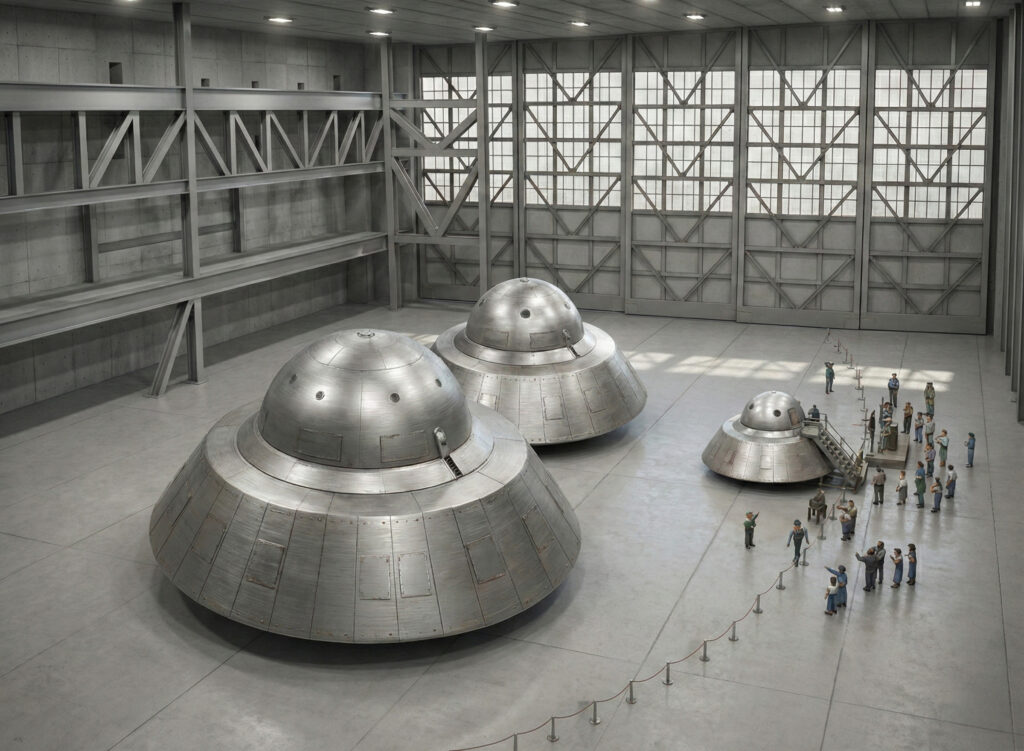
In that hangar, the general gave a walkthrough of advanced classified aircraft. Eventually, a curtain was pulled back to reveal three disc-shaped craft that looked, as Sorensen allegedly put it, “like something from the 1950s.” (PodScripts)
Key data points from the Sorensen account, as relayed by McCandlish and later writers:
- Three craft of different sizes, code-named “Baby Bear” (about 24 ft), “Mama Bear” (about 60 ft) and “Papa Bear” (around 120–130 ft diameter). (Spreaker)
- All shared the same general shape: a classic saucer form with a thick lower “skirt” and a hemispherical crew dome on top.
- A ring of large, greenish “capacitor plates” in the lower hull and a central column inside, with coils and components suggestive of high-voltage equipment. (Robert Francis Jr.)
- “Synthetic vision” camera system instead of conventional windows, feeding displays inside the crew cabin. (ResearchGate)
- The general allegedly stated that the craft used a kind of zero-point or “electrogravitic” propulsion and were capable of “light speed or better.” (Spreaker)
Sorensen himself has remained almost entirely silent in public. The story reaches the wider world through McCandlish interviews, Disclosure Project documents and secondary write-ups. That indirection is central to any assessment of the case.
From hangar story to blueprint
A few months after Sorensen’s account, McCandlish began drafting a detailed schematic of the craft, based on repeated conversations and sketches, combined with his own knowledge of aerospace hardware. The 1989 blueprint, now widely reproduced, shows: (Robert Francis Jr.)
- A circular craft with a cutaway revealing internal decks.
- A stack of three high-voltage capacitor “decks” in the lower skirt.
- A central vacuum column described as a mercury vapor device.
- A circumferential solenoid coil around the rim.
- A flywheel, crew seats, access hatch and peripheral systems.
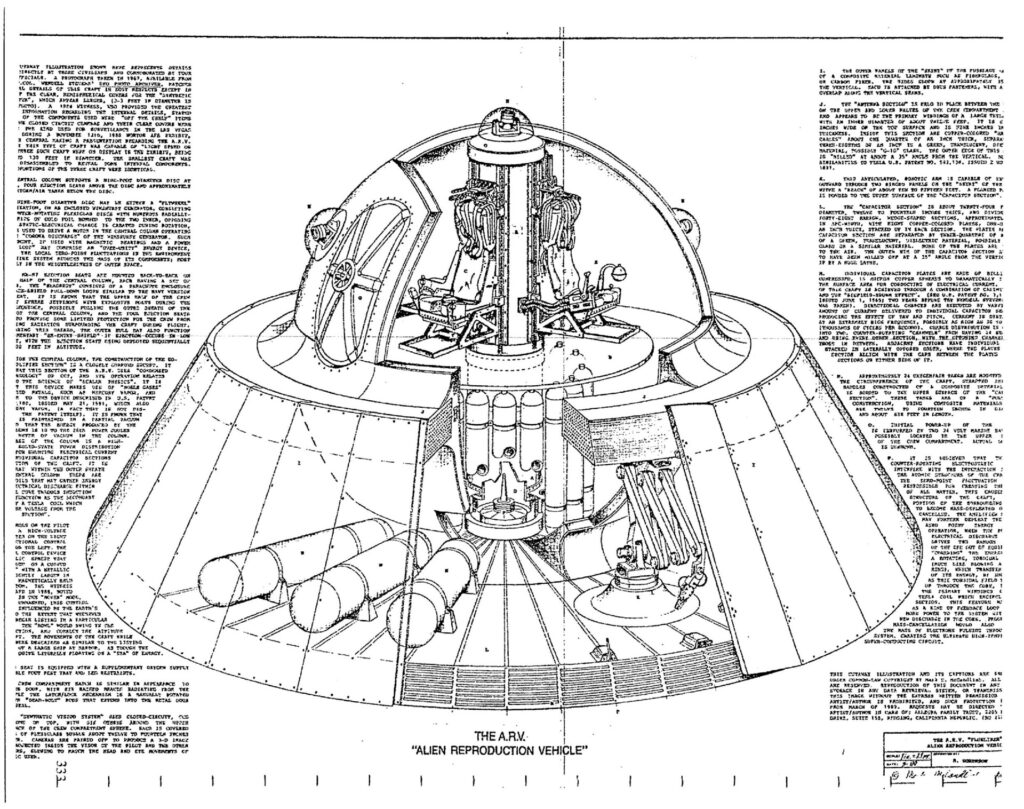
McCandlish copyrighted the drawing and circulated it within the UAP research community. Later, modelers, 3D artists and independent researchers further elaborated the design. (ResearchGate)
The ARV Enters The Disclosure Era
The Disclosure Project and antigravity testimony
In the late 1990s, Dr. Steven Greer began assembling military and intelligence witnesses for what would become the Disclosure Project. In an executive briefing document prepared around 2001, Greer cites “the testimony of Mark McCandlish” as evidence that human-made antigravity craft exist, using cameras in place of windows and operating in deep black programs. (Internet Archive)
McCandlish’s description of the ARV is presented alongside other witnesses who claim that:
- U.S. programs have mastered exotic propulsion, sometimes explicitly linked to reverse-engineered non-human craft.
- These vehicles can operate without conventional jet fuel and may use electrogravitics or vacuum energy.
Skeptical commentary quickly followed. Philip J. Klass, in his Skeptics UFO Newsletter (SUN #73, Fall 2002), highlighted Greer’s statements about “Alien Reproduction Vehicles” and argued that claims of a covert group staging fake UAP events with ARVs were unsupported.
Zero Point: the Story of Mark McCandlish and the Fluxliner
In 2013, filmmaker James Allen released the documentary “Zero Point: The Story of Mark McCandlish and the Flux Liner.” The film focuses on: (IMDb)
- McCandlish’s career as an aerospace illustrator for major contractors.
- His retelling of the Norton AFB episode and Sorensen’s role.
- Animated and live-action visualisations of the fluxliner ARV.
- Interviews with researchers interested in electrogravitics and zero-point energy.
The documentary, combined with online clips like “Blueprint for a UFO” and later YouTube explainers, pushed the ARV into a wider audience. (UFO History)
Gordon Novel, Robert Francis Jr and technical elaborations
Gordon Novel, a controversial figure with alleged intelligence connections, published “Supreme Cosmic Secret: How the U.S. Government Reverse-Engineered An Extraterrestrial Spacecraft!” in 2010, which featured an ARV-like craft on the cover and incorporated some of the same design motifs. (Robert Francis Jr.)
More recently, independent researcher Robert Francis Jr published an extensive breakdown of ARV components, treating the blueprint almost as an engineering requirements document. His article analyses: (Robert Francis Jr.)
- The parallel-plate capacitor array, interpreted as a Biefeld–Brown electrogravitic device.
- The circumferential electromagnetic coil, possibly using exotic conductor geometry.
- Hypothetical inertial mass reduction mechanisms tied to zero-point vacuum fluctuations.
Francis openly labels much of his work as hypothesis and citizen-science, but it shows how the ARV has become a living technical meme, not just a drawing.
Anatomy Of The Fluxliner
From a data perspective, the ARV is best understood as a specific machine concept, not a generic “secret saucer.” Its features can be compared against known physics and propulsion ideas.
Basic configuration
Across McCandlish’s schematic, Novel’s artwork and derivative diagrams, the ARV has a consistent architecture: (Robert Francis Jr.)
- The disc hull is about 60 ft diameter in the primary “Mama Bear” version.
- Lower capacitor stack
- Several concentric rings of triangular capacitor segments.
- Alternating metal plates and green dielectric layers.
- Central column
- Often described as containing mercury vapor or plasma.
- Associated Tesla-like coils and possibly Marx-generator style pulsed supplies.
- Rim coil
- Thick, heavily insulated solenoid running around the circumference.
- Hypothesised to generate strong, pulsed magnetic fields.
- Crew sphere
- Spherical compartment near the top with seats and control consoles.
- Surrounded by shielding materials, possibly with unusual nuclear spin properties. (Robert Francis Jr.)
According to McCandlish’s retellings, the general at Norton described the craft as operating on “zero-point energy” and capable of extreme accelerations that would normally kill human occupants without some form of inertial mitigation. (Spreaker)
Electrogravitics and the Biefeld–Brown effect
The ARV’s capacitor skirt strongly echoes the work of T. Townsend Brown, who in the 1920s–60s claimed that asymmetrical high-voltage capacitors could generate thrust through a coupling between electricity and gravity, a field he called electrogravitics. Modern mainstream analyses of the Biefeld–Brown effect, including NASA and independent academic studies, find that:
- Asymmetrical high-voltage capacitors do produce thrust in air.
- The force is explained by ion wind or ion drift in the surrounding medium, not true antigravity.
- Experiments in high vacuum have not found significant anomalous thrust beyond conventional electrohydrodynamics. (TU Dresden)
ARV proponents argue that Brown’s work was only a starting point and that the capacitor array in the fluxliner operates at much higher voltages and in regimes where coupling to the quantum vacuum might occur, rather than simple ion wind. This belongs firmly in the “hypothesis” category rather than established physics. (Robert Francis Jr.)
Zero-point energy and inertia control
In the ARV literature, the capacitor array and rim coil are often linked to attempts to harness vacuum fluctuations or zero-point energy (ZPE). Mainstream physics recognises ZPE as part of quantum field theory, yet is strongly skeptical that it can be used as a practical energy source or propellant.
Researchers like Francis and others propose that: (Robert Francis Jr.)
- Inertial mass arises from interactions between matter and vacuum fluctuations.
- Carefully structured EM fields could reduce effective inertia by redirecting or modulating those interactions.
- The ARV coil and capacitor geometry might be designed to create such a “mass reduction bubble,” allowing rapid acceleration without crushing the crew.
This is an intriguing line of thought but remains speculative and unverified in peer-reviewed experimental work. Even sympathetic academic treatments of exotic propulsion emphasise that repeatable lab confirmation is lacking. (APEC)
Who Is Connected To The ARV Story
Mark McCandlish
- Profession: Aerospace and technical illustrator for major contractors such as Lockheed and Rockwell. (The UFO Spotlight On…)
- Role: Primary public source and visualiser of the ARV concept.
- Evidence:
- He never claimed to have seen the craft himself.
- His knowledge is second-hand, transmitted from Sorensen and reinforced by later conversations with other insiders and researchers. (Spreaker)
- He drew and copyrighted the widely circulated blueprint. (Robert Francis Jr.)
McCandlish became a Disclosure Project witness, and his fluxliner story has been repeated in radio interviews, the “Zero Point” documentary and numerous podcasts until his death in 2021. (cdn.preterhuman.net)
“Brad Sorensen”
Sorensen, as described by McCandlish, is the original Norton AFB witness:
- Background: Aerospace designer who gained clients in classified aerospace work. (The UFO Spotlight On…)
- Claim: Accidentally attended the Norton hangar presentation, saw the three ARVs demonstrated and later described them in detail to McCandlish. (PodScripts)
In late 2024, journalist Michael Shellenberger submitted written testimony to the U.S. House Oversight Committee that referenced Sorensen’s story explicitly, describing a “Fluxliner, aka an Alien Reproduction Vehicle (ARV)” displayed at Norton and noting that Brad had given all the details to McCandlish. (House Docs)
As of now, there is no widely accessible, long-form on-camera interview with Sorensen equivalent to McCandlish’s many appearances. This gap is one of the key weaknesses in the evidentiary chain.
Steven Greer and the Disclosure movement
Greer popularised the broader ARV idea, often using the term for any advanced man-made craft allegedly derived from non-human technology. In SUN #73, Klass quotes Greer describing a covert multinational group that has “mastered the technologies” and can deploy Alien Reproduction Vehicles to simulate hostile non-human attacks, a claim Klass sharply criticises.
Regardless of one’s view of Greer, his amplification of the ARV story helped move it from a narrow UAP-research subculture into a wider disclosure narrative.
Other researchers and cultural spread
- Richard Dolan lists McCandlish among important modern whistleblower-type witnesses and treats the ARV case as suggestive but not proven.
- Darcy Weir’s TR-3B documentaries sometimes frame the triangular TR-3B craft as a later generation ARV, implying a lineage of black-project vehicles built from reverse-engineered UAP technology. (Google Play)
- The Why Files, YouTube explainer channels and podcasts like “The US Military’s Secret Flying Saucer Project” introduce the ARV to a broader online audience with simplified retellings of the Norton story. (PodScripts)
The result is that, by the mid 2020s, the fluxliner had become a kind of canonical saucer in alternative aerospace lore, with 3D models, fan art and even desk-sized “ARV” models sold online. (Aquila)
Critics, Counter-Evidence And The AARO Report
Internal skepticism
Even within UAP-interested communities, several consistent criticisms appear:
- The idea that someone could simply “wander into” a presentation of the most advanced secret craft by attaching to the wrong tour group is seen as operationally implausible. (Reddit)
- No independent photos, videos or physical documents that conclusively show the craft have emerged, despite the event allegedly occurring in front of multiple VIPs and industry representatives.
- The ARV blueprint combines recognisable off-the-shelf concepts (capacitors, Tesla coils, solenoids) in a way that may be more aesthetically compelling than physically justified.
Philip Klass’s SUN article mocked Greer’s reliance on ARV claims as evidence for a staged alien attack narrative and pointed out that, if antigravity vehicles existed for decades, it is difficult to explain why expensive jet aircraft and aerial refuelling remain dominant in visible military operations.
AARO and official reverse-engineering denial
In March 2024, the Pentagon’s All-domain Anomaly Resolution Office (AARO) released its Historical Record Report, Volume 1, which surveyed U.S. government UAP programs from 1945 onward. The report concluded: (U.S. Department of War)
- AARO found no empirical evidence that the U.S. government or private industry has ever successfully reverse-engineered extraterrestrial technology.
- Alleged reverse-engineering programs and named companies were investigated, and no off-world materials or unreported black programs were confirmed.
- Claims of secret reverse-engineering efforts are assessed as largely the result of circular reporting within a small community of individuals who reinforce each other’s narratives.
Mainstream media headlines summarised this as “no evidence of alien tech or hidden UAP craft,” which implicitly pushes ARV-type claims into the “unsubstantiated” category. (The Guardian)
From a UAPedia perspective, and in line with our editorial policy on government sources, that report is an important data point but not a final verdict. A review authored inside a security apparatus will naturally be constrained by classification boundaries, political incentives and the scope of what investigators are allowed to see. At minimum, however, AARO’s statements mean that anyone asserting the ARV exists must now explain why neither AARO nor Congress could find confirming documentation.
Physics-based skepticism
Physicists and propulsion engineers who have examined electrogravitics and zero-point propulsion consistently stress:
- Biefeld–Brown devices appear to be electrohydrodynamic thrusters, not gravity manipulators, when examined under controlled conditions. (Wikipedia)
- The zero-point field is real, but there is no experimentally validated way to tap it as a net energy source or reactionless propellant, and most “free energy” style devices fail under rigorous testing. (Wikipedia)
This does not prove the ARV cannot exist, but it places a heavy burden of proof on claims that its capacitor stack and coil can do something qualitatively beyond known physics.
Applications And Strategic Implications (If ARVs Are Real)
Even critics usually concede that, if a craft like the fluxliner actually exists and performs as described, the implications are profound.
Military and aerospace applications
Hypothesised performance attributes:
- Vertical takeoff and landing with silent or near-silent operation.
- Extreme acceleration, possibly without sonic booms due to local manipulation of air density or plasma sheaths. (Robert Francis Jr.)
- Long-duration flight or space travel without conventional fuel, if some form of vacuum energy or advanced power source is used. (Robert Francis Jr.)
Such a vehicle would:
- Render most existing air and space fleets obsolete.
- Collapse the cost of moving mass around Earth orbit and beyond.
- Provide unprecedented strategic mobility and reconnaissance capability.
The absence of overt, undeniable uses of such capabilities in open warfare or space operations is often cited as a major argument against ARVs being fully operational in large numbers.
Civilisational implications
For the broader UAP discourse, the ARV occupies a liminal zone:
- On one hand, it is offered as proof that UAP-like performance can be achieved by human technology, which would explain at least some disc sightings as secret terrestrial craft.
- On the other hand, ARV advocates nearly always trace the origin of that technology to crashed non-human craft and reverse-engineering programs, which in turn presuppose a long history of non-human presence.
AARO’s report explicitly addresses this narrative and finds no evidence for successful reverse-engineering or hidden extraterrestrial technology, although researchers like Marik von Rennenkampff have criticised that report for selective framing, indicating continued debate. (New Paradigm Institute)
Claims Taxonomy
Given the available data, UAPedia classifies the core ARV propositions as follows. These are provisional and may change as new evidence appears.
Core claims
Claim A
In November 1988, three disc-shaped craft known as Alien Reproduction Vehicles were displayed inside a restricted hangar at Norton Air Force Base and demonstrated for VIPs.
- Evidence: Second-hand testimony via Mark McCandlish, attributed to Brad Sorensen, plus layered secondary accounts and derivative media. (House Docs)
- Contradictions: No independent photographic record; no other named witnesses publicly confirming the demonstration at a similar level of detail; AARO’s 2024 review finding no supporting program documentation. (U.S. Department of War)
- Claims taxonomy: Disputed
Claim B
The ARVs use a combination of high-voltage capacitors, Tesla-type coils and rim solenoids to generate a genuine gravitational or inertial mass-reduction field, not just ion wind.
- Evidence: Conceptual arguments, some fringe experiments on Biefeld–Brown dynamics, speculative zero-point models and the detailed ARV blueprint. (Robert Francis Jr.)
- Contradictions: Mainstream experimental work explains observed thrust as electrohydrodynamics; no peer-reviewed replication of strong anomalous gravity-like forces. (Wikipedia)
- Claims taxonomy: Probable from the perspective of advocates, but given current public data UAPedia classifies this as Disputed.
Claim C
The United States and possibly other nations have operational fleets of ARVs capable of interstellar travel.
- Evidence: Assertions in disclosure-movement literature, some testimony referencing long-range missions, consistent reuse of ARV imagery in “secret space program” narratives. (UFO 420 – Alien & UFO News)
- Contradictions: Lack of clear, open demonstrations of such capabilities; AARO’s explicit finding of no evidence for reverse-engineered extraterrestrial technology or hidden fleets of off-world craft. (U.S. Department of War)
- Claims taxonomy: Legend
Speculation labels
To make the evidentiary boundaries explicit:
- Hypothesis
- That inertial mass can be significantly reduced by structuring EM fields to manipulate vacuum fluctuations, as posited in some ARV analyses. (Robert Francis Jr.)
- That zero-point energy can be practically harvested as a high-density power source for such craft. (Wikipedia)
- Witness Interpretation
- Sorensen’s interpretation of what the general said and what the displays in the hangar meant. Even if his recollection is accurate, he may have been interpreting a classified but terrestrial HV-propulsion testbed rather than a fully interstellar vehicle.
- McCandlish’s technical extrapolations when turning verbal descriptions into a cutaway blueprint.
- Researcher Opinion
- The expanded technical treatments by Francis, Novel and others, which attempt to connect the ARV to broader theoretical frameworks of electrogravitics and vacuum engineering. (Robert Francis Jr.)
How UAPedia Treats The ARV Case
Consistent with UAPedia’s editorial stance, we:
- Do not dismiss ARV claims simply because they conflict with current official reports. AARO and similar bodies are important sources, but not exclusive arbiters of truth. (New Paradigm Institute)
- Give weight to detailed testimony, especially when a witness has relevant professional background. In this case, however, the strongest testimony is second-hand, which reduces its legal-style probative power.
- Distinguish carefully between evidential statements (what was seen, who said what, which documents exist) and speculative architectures built upon them.
At present, the ARV sits at an interesting crossroads: there is enough detail that engineers can debate its feasibility, build models and propose experiments, yet not enough corroboration to move it out of the disputed category.
If future whistleblowers or declassifications reveal technical drawings, program budgets, or test reports that match the fluxliner blueprint independent of McCandlish, that categorisation may change quickly.
Suggested Internal Crosslinks For UAPedia
- Area 51 Reverse-Engineering Claims (Bob Lazar)
- UAP Whistleblower Claims & Congressional Testimony
- Anti-gravity & Field Propulsion Systems
- Exotic Energy Sources in UAP Propulsion Systems
- Black Budget Programs: Overview & Historical Context
- Trans-medium Craft: Capabilities & Observed Examples
- Steven Greer and the Disclosure Project (2001)
- Wright-Patterson AFB & Reverse-Engineering Activities
Selected References
AARO. (2024). Report on the historical record of U.S. Government involvement with unidentified anomalous phenomena (UAP), Volume I. U.S. Department of Defense. Retrieved from https://media.defense.gov/2024/Mar/08/2003409233/-1/-1/0/DOPSR-CLEARED-508-COMPLIANT-HRRV1-08-MAR-2024-FINAL.PDF?utm_source=https://uapedia.ai
Bahder, T., & Fazi, C. (2003). Force on an asymmetric capacitor. U.S. Army Research Laboratory. Retrieved from https://ntrs.nasa.gov/api/citations/20040171906/downloads/20040171906.pdf?utm_source=https://uapedia.ai
Francis, R. (2023). Alien Reproduction Vehicle aka Fluxliner – breakdown and analysis. Retrieved from https://robertfrancisjr.com/breakdowns/alien-reproduction-vehicle-breakdown.html?utm_source=https://uapedia.ai
Greer, S. M. (Ed.). (2001). Disclosure Project briefing document. The Disclosure Project. Retrieved from https://archive.org/details/DisclosureProjectBriefingDocument?utm_source=https://uapedia.ai
Klass, P. J. (2002). Skeptics UFO Newsletter, 73, 1–4. Retrieved from https://centerforinquiry.s3.amazonaws.com/wp-content/uploads/sites/29/2022/09/26195537/SUN-73-Fall-2002.pdf?utm_source=https://uapedia.ai
McCandlish, M. (1989). The A.R.V. “Fluxliner” Alien Reproduction Vehicle [technical illustration]. Reproduced at https://robertfrancisjr.com/images/Alien%20Reproduction%20Vehicle%20Schematic%20by%20Mark%20McCandlish.jpg?utm_source=https://uapedia.ai

NASA. (2024). Biefeld–Brown effect [background summary]. Retrieved from https://en.wikipedia.org/wiki/Biefeld%E2%80%93Brown_effect?utm_source=https://uapedia.ai
Tajmar, M. (2004). The Biefeld–Brown effect: Misinterpretation of corona wind phenomena. AIAA Journal. Preprint retrieved from https://tu-dresden.de/ing/maschinenwesen/ilr/rfs/ressourcen/dateien/forschung/folder-2007-08-21-5231434330/ag_raumfahrtantriebe/Biefeld-Brown-Effect-AIAA-Journal-Revised.pdf?utm_source=https://uapedia.ai
UFO History Project. (n.d.). Alien Reproduction Vehicle (ARV) displayed at Norton Air Force Base (1988). Retrieved from https://ufohistory.netlify.app/events/1988-arv-display/?utm_source=https://uapedia.ai
Zero Point Project. (2013). Zero Point: The Story of Mark McCandlish and the Flux Liner [Documentary film]. Retrieved from https://www.imdb.com/title/tt6111304/?utm_source=https://uapedia.ai
Shellenberger, M. (2024). The United States Department of Defense and the destruction of U.S. accountability on unidentified anomalous phenomena (UAP) [Written Congressional testimony]. Retrieved from https://docs.house.gov/meetings/GO/GO12/20241113/117721/HHRG-118-GO12-Wstate-ShellenbergerM-20241113.pdf?utm_source=https://uapedia.ai
SEO keywords:
Alien Reproduction Vehicle, ARV, fluxliner, Mark McCandlish, Norton Air Force Base 1988, electrogravitics, Biefeld–Brown effect, zero point energy propulsion, secret space program, UAP reverse engineering, antigravity craft, black budget programs, Steven Greer Disclosure Project, TR-3B, advanced aerospace vehicle