
On a clear November afternoon in 2004, Commander David Fravor rolled his F/A-18F Super Hornet toward a patch of churning water in the Pacific, 140 miles southwest of San Diego. What he expected to find was a training target. What he actually saw, by his account, was a smooth, white, 40-foot object darting like “a ping-pong ball” above the disturbance in the sea.
Four aviators in two jets watched the object react to Fravor’s approach, mirror his turn, then accelerate out of sight. Minutes later, another Navy jet captured a black-and-white speck on FLIR video that would become famous as the “Tic Tac” UAP.
For more than a decade this incident lived in squadron lore and obscure message boards. Then, after the 2017 New York Times stories on Pentagon UAP programs and the release of cockpit footage, Fravor suddenly found himself at the center of one of the most influential cases in modern UAP history.
This is the story of the man who chased the Tic Tac, and how a single close encounter reshaped the global conversation about UAP.
Early life and flight career
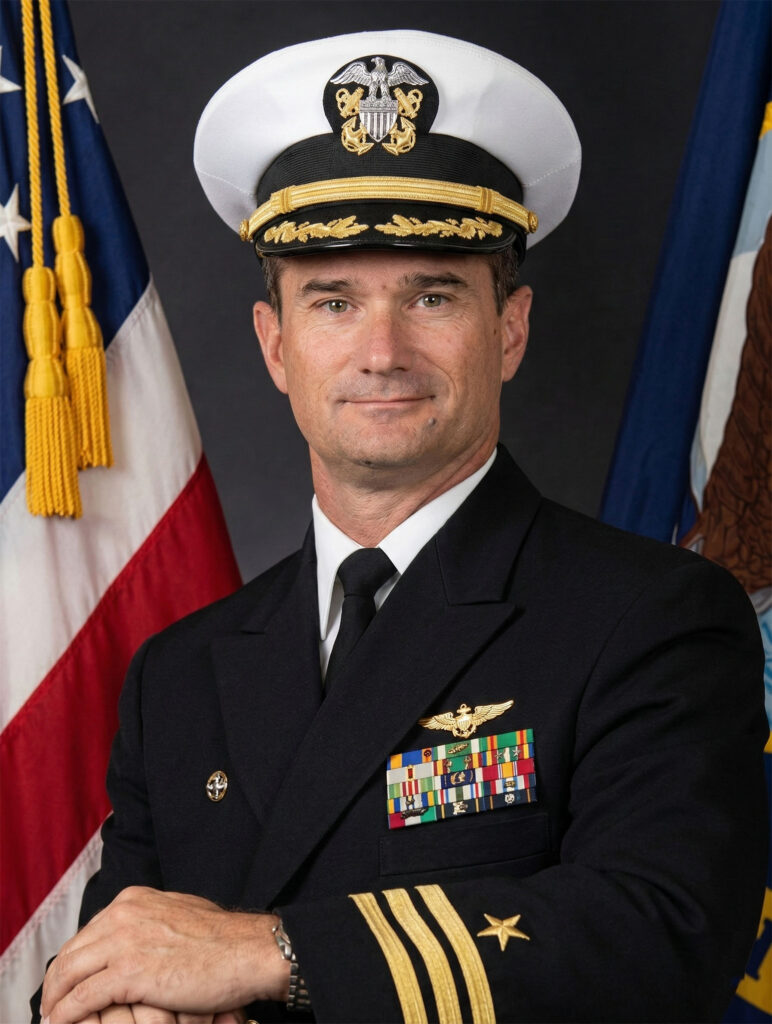
David Fravor grew up in Ohio and enlisted in the United States Marine Corps at 17. After two years he transferred to the U.S. Naval Academy, fulfilling a long-standing plan to fly off carriers. (Elvis Duran and the Morning Show)
By the late 1980s and 1990s he had become a career naval aviator. Over a 24-year military career, 18 of them as a jet pilot, Fravor flew multiple combat tours, including sorties during Operation Desert Storm and later deployments to the Persian Gulf. (House Docs)
Within the Navy he developed a reputation as a serious, results-driven officer. He eventually commanded Strike Fighter Squadron 41 (VFA-41), the “Black Aces”, a Super Hornet squadron attached to Carrier Air Wing 11 aboard the USS Nimitz. (Oversight Committee)
Fravor was not a public figure then. He was the archetype of a Top Gun era commander: operationally focused, trained in advanced air-to-air tactics, and responsible for hundreds of personnel and billions of dollars of hardware.
After retiring from the Navy in 2006 he stayed close to the cockpit, teaching new Hornet pilots as a simulator instructor for Fidelity Technologies in California and appearing as himself in the 2008 PBS documentary series “Carrier”, which followed the crew of the USS Nimitz on deployment. (PBS)
None of that hinted that he would become a central witness in the twenty-first century’s most discussed UAP encounter.
The 2004 USS Nimitz “Tic Tac” encounter
Tasking from the USS Princeton
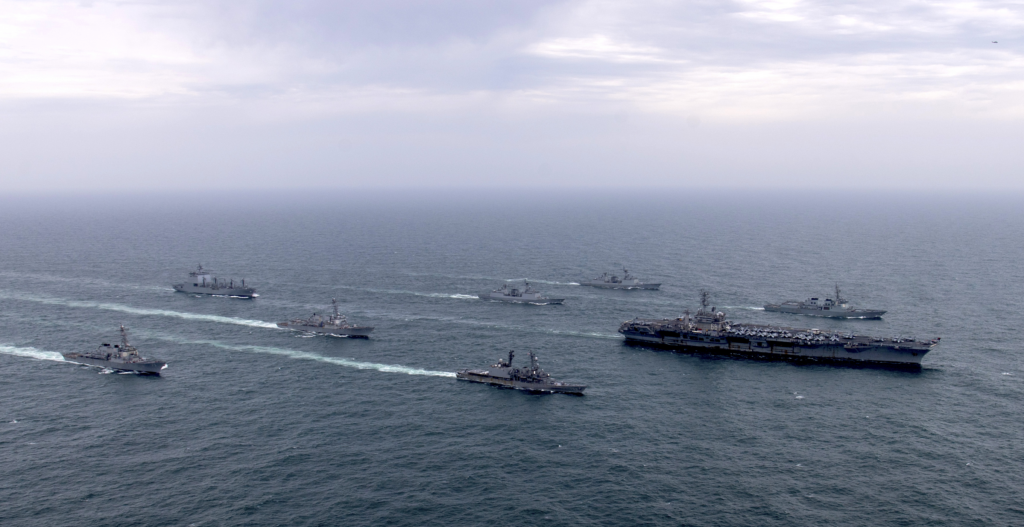
In November 2004 the Nimitz carrier strike group was conducting work-ups off Southern California. For roughly two weeks, radar operators on the guided-missile cruiser USS Princeton had been tracking mysterious returns: objects appearing at 80,000 feet, dropping toward the ocean, then hovering around 20,000 feet before vanishing.
On 14 November, with clear skies and calm seas, Fravor’s section of two F/A-18Fs was diverted from a scheduled training mission to “real world tasking.” Controllers told them to investigate an unknown contact.
As Fravor later described to ABC News, this was not a routine blip. The Princeton crew reported that whatever they were seeing had been “dropping out of the sky from 80,000 feet and going straight back up.” (Red Lake Nation News)
Visual contact
Arriving at the merge point, Fravor and his wingman, Lt. Cmdr. Alex Dietrich, did not see an aircraft on their radar. They saw a patch of ocean that was roiling, white water, as if something large were just under the surface. Hovering above it was the object.
Fravor has consistently described it as an oblong, featureless craft, about 40 feet long, white, and smooth, “like a giant Tic Tac.” (TIME) There were no wings, no exhaust, no visible control surfaces, no rotor wash over the disturbed sea.
All four crew members in the two Super Hornets had a clear line of sight. As Fravor’s jet descended in a spiral, the object began to climb, matching his turn “like a kid playing with you,” as he later put it. At one point he tried to cut across the circle to get behind the object. It responded by “crossing our nose” then accelerating out of visual range in less than a second. (Podcasts – Your Podcast Transcripts)
When the pilots checked back with the Princeton, the controllers reported something astonishing. The object, or an identical one, had reappeared on radar at the exact “CAP point” where the fighters would have been if they had continued their training mission. It was as if the UAP had anticipated their movements.
The FLIR video
Fravor’s jets returned to the Nimitz without weapons. A second flight, including Lt. Cmdr. Chad Underwood, launched to continue the intercept. Underwood’s jet carried an advanced ATFLIR pod. While he did not see the object with his naked eyes, he managed to lock onto a fast-moving target with the infrared camera, producing the now famous FLIR1 video.
In the footage, a white oval appears against a dark background, hovering, then slewing rapidly left as the sensor tries to keep up. Cockpit audio captures the pilot exclaiming about “a whole fleet of them.” That short clip, later leaked and finally released officially by the U.S. Department of Defense in 2020, became a visual anchor for the Nimitz case. (ABC News)
Internal reporting and long silence
Fravor and his colleagues filed reports and debriefed with intelligence officers. But nothing much seemed to happen. There was no immediate investigation comparable to a near-midair or safety incident. The tapes were archived. For the strike group, the “Tic Tac” became one more strange sea story.
Looking back, Fravor has suggested that the encounter was “ignored when it happened” and essentially left in a drawer for years. (Oversight Committee)
Yet the combination of multi-pilot visual sightings, corroborating radar, IR video and an object that appeared to violate known flight envelopes placed the Nimitz event in a different category from the typical lights-in-the-sky report. Within UAPedia’s claims taxonomy it sits firmly inside the “sensor-correlated, multi-observer, high-strangeness” cluster at the core of serious UAP study.
From classified curiosity to public UAP landmark
The dam finally broke in December 2017, when the New York Times published stories revealing the Pentagon’s Advanced Aerospace Threat Identification Program (AATIP) and featuring the Nimitz encounter as a key case.
Behind the scenes, Fravor notes that figures connected with Tom DeLonge’s To The Stars Academy of Arts & Science, including former Pentagon official Christopher Mellon and AATIP director Luis Elizondo, had been pushing to bring the Nimitz material into public view. (Oversight Committee)
Once the Times story and associated videos dropped, Fravor’s phone started ringing. He found himself doing something few career officers ever imagine: becoming a public face of a UAP incident.

The ABC quote heard around the world
In a 2017 interview with ABC’s Good Morning America, Fravor expressed not only confidence in what he saw, but a stark conclusion.
“I can tell you, I think it was not from this world,” he said, adding that after 18 years of flying “I’ve seen pretty much about everything that I can see in that realm, and this was nothing close.” (Good Morning America)
That line, clipped and repeated across social media, solidified Fravor’s reputation as the no-nonsense Top Gun pilot who was willing to say the quiet part out loud: that some UAP might involve technologies far beyond current human capability.
Podcasts, documentaries and the modern UAP media circuit
From there, Fravor became a regular presence in the emerging UAP media ecosystem.
- He appears at length in Ross Coulthart’s book In Plain Sight, which devotes a detailed chapter to the Nimitz case and describes Fravor as “a solid, levelheaded, believable guy” whose straightforward manner convinced many previously skeptical readers. (A Sky of Books and Movies)
- He was a central interview subject in the PBS documentary “What Are UFOs?”, which uses the Tic Tac as one of its anchor incidents in a broader review of military UAP encounters. (TIME)
- Fravor has discussed the encounter on the Joe Rogan Experience (episode #1361, alongside filmmaker Jeremy Corbell), where he famously remarked that “my entire flying career is now defined by chasing this white Tic Tac.” (youtube.com)
- On the Lex Fridman Podcast (#122), he walked through the dogfight in granular detail, spoke about aerospace engineering, and fielded questions about possible propulsion mechanisms and the limits of known physics. (Podcasts – Your Podcast Transcripts)
- Corbell and journalist George Knapp later revisited the case with Fravor for their podcast WEAPONIZED, particularly in an episode marking the 20th anniversary of the encounter. (Podnews)
In each venue, Fravor has maintained the same basic storyline, resisting embellishment and deflecting questions when they stray into speculation he cannot support.
Public service and the 2023 U.S. House UAP hearing
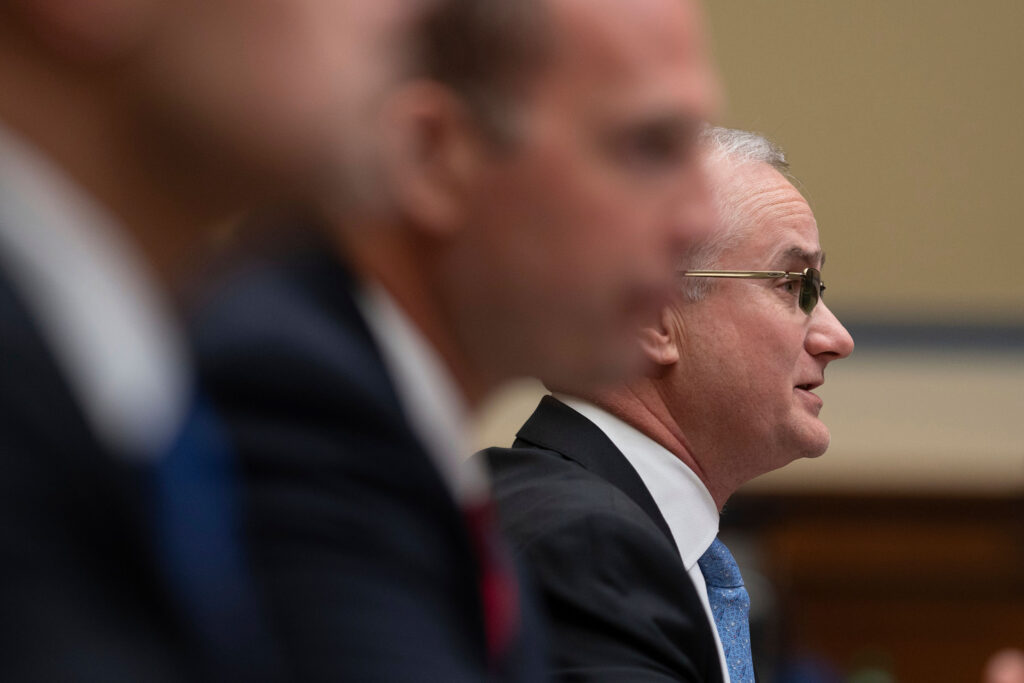
The culmination of Fravor’s transition from squadron commander to public witness came on 26 July 2023, when he testified under oath before the U.S. House Oversight Committee in a high-profile hearing on UAP. (Congress.gov)
In his written statement and oral testimony he restated the core facts of the Nimitz encounter and emphasized the need for serious, coordinated analysis of such incidents, irrespective of their ultimate explanation. (Oversight Committee)
His message to lawmakers was not about aliens. It was about performance. Fravor stressed that the Tic Tac showed acceleration, maneuvering, and lack of observable propulsion that “defied current physics and material science” as understood in conventional aerospace engineering. (TIME)
He urged Congress to improve reporting channels, reduce stigma for military personnel, and demand better access to sensor data. In form and tone, this aligned closely with UAPedia’s editorial standard on government sources: official statements are important but incomplete, and frontline witnesses like Fravor should be integrated into, not sidelined from, the public record.
Work history and known associates
Career in and after the Navy
Across 24 years of service, Fravor completed at least five deployments, accumulating thousands of flight hours and experience over Iraq and other theaters. (House Docs)
During the period captured in PBS’s “Carrier”, he appears as a seasoned commander juggling the stresses of combat readiness, young pilots, and the politics of life aboard a nuclear supercarrier. His comments there about carrier power projection and responsibility are a reminder that, before anything else, he is a military professional. (PBS)
Post-retirement, his work as a simulator instructor for F/A-18 training suggests that he remained engaged with the technological side of aviation, teaching the next generation how to manage complex jets at the edge of their envelopes. (PBS)
Witness network and collaborators
Fravor is not a lone storyteller. The Nimitz case is knitted together from a network of witnesses and investigators who often appear alongside him:
- Lt. Cmdr. Alex Dietrich – Fravor’s wingman that day, who has independently corroborated the visual aspects of the encounter in interviews and on “60 Minutes”. (CBS News)
- Lt. Cmdr. Chad Underwood – Weapons system officer who captured the FLIR video and coined the term “Tic Tac”. (Wikipedia)
- Senior Chief Kevin Day and other Princeton radar operators, who reported weeks of anomalous tracks. (HISTORY)
- Journalists Helene Cooper, Leslie Kean and Ralph Blumenthal, who first brought the case to mainstream attention in the New York Times.
- Media collaborators like Jeremy Corbell and George Knapp, who have platformed Fravor repeatedly and contextualized his account within broader UAP patterns. (Podnews)
These overlapping testimonies and analyses make it significantly harder to dismiss the Nimitz encounter as a simple misidentification.
Claims, controversies and the skeptical pushback
Given UAPedia’s stance that a large fraction of high-quality UAP cases represent genuinely anomalous phenomena, Fravor’s testimony fits naturally into an evidential framework, yet the Nimitz case has also attracted thorough scrutiny and attempts at mundane explanation.
Skeptical analyses
Skeptical researchers such as Mick West and others have argued that the FLIR video likely shows a distant aircraft or sensor artifact, not an advanced craft, and that some of the apparent acceleration is an illusion caused by camera slewing and parallax. (Wikipedia)
Their critiques typically focus on three pillars:
- Sensor ambiguity – FLIR imagery is notoriously difficult to interpret without full telemetry and classified context.
- Lack of raw data – public analysis relies on compressed video and partial reports, not the original tapes and radar logs.
- Cognitive bias – even experienced pilots can misjudge distance and speed, especially during unusual maneuvers.
Fravor responds by emphasizing the multi-sensor, multi-witness nature of the event and his own direct visual observation. In the Lex Fridman interview he notes that he watched the object in clear daylight for several minutes at close range with no clouds or haze, from multiple angles, and that it performed maneuvers “beyond anything” he had seen in decades of flying. (Podcasts – Your Podcast Transcripts)
Government posture
The U.S. Department of Defense has officially released the FLIR, GIMBAL and GOFAST videos, confirmed them as authentic Navy recordings of “unidentified aerial phenomena”, and refused to provide additional classified footage citing national security. (Wikipedia)
At the same time, the Pentagon’s All-domain Anomaly Resolution Office (AARO) has generally leaned toward prosaic explanations for historical cases, highlighting sensor issues and misidentifications. But its public reports have not definitively reclassified the Nimitz encounter in mundane terms. (Wikipedia)
UAPedia’s editorial standard treats such government claims as one important but incomplete stream of evidence and explicitly warns against taking official silence as disproof.
Personal credibility and human factors
One reason the Nimitz case keeps resurfacing is Fravor’s perceived credibility. He is a decorated commander with no prior public interest in UAP, and he is plain about what he does not know.
There are, of course, human factors. Memory can shift over time; repeated storytelling can sharpen some details and blur others. Yet when Fravor’s narrative across ABC, Rogan, Fridman, congressional testimony and smaller interviews is compared side-by-side, the core structure remains remarkably consistent.
Fravor in books and long-form treatments
Several significant works now treat the Tic Tac encounter, and by extension Fravor, as central case material:
- Ross Coulthart, In Plain Sight – Offers a deeply reported account of the Nimitz incident, pulling together radar logs, pilot interviews and background intelligence context. Fravor emerges here as both key eyewitness and symbol of shifting institutional attitudes. (A Sky of Books and Movies)
- Leslie Kean, UFOs: Generals, Pilots, and Government Officials Go on the Record – While focused on earlier cases, Kean’s later journalism, together with Blumenthal and Cooper, uses Fravor’s story to illustrate why high-level witnesses demand renewed attention. (Barnes & Noble)
- Patrick Gunn, The Tic Tac Incident (2004) – A dedicated book-length deep dive into the Nimitz case, presenting Fravor’s testimony alongside other witnesses and technical analysis. (Amazon)
For UAPedia editors, these works provide a layered evidentiary base: firsthand interviews, second-order synthesis and external technical critiques.
Impact on the UAP conversation
Fravor’s role in the UAP story is disproportionately large compared with the small amount of actual data in the case. Several reasons:
- Cultural archetype – He embodies the straight-talking, technically competent fighter jock, which gives his words cultural heft far beyond typical witness testimony.
- Media timing – His emergence coincided with official confirmation of the Pentagon videos and a broad shift from “flying saucers” punch-line to “UAP” as a legitimate policy topic.
- Policy leverage – His case has been referenced in congressional hearings, think-tank papers and military journals as a textbook example of UAP events in restricted airspace that cannot be casually explained away. (NDU Press)
Within UAPedia’s knowledge graph, the Nimitz Tic Tac serves as a keystone linking several themes: carrier strike group encounters, sensor-rich UAP cases, post-2017 government transparency fights and the emerging alliance of pilots, intelligence officials and journalists pushing against decades of ridicule.
Fravor did not set out to be an advocate. Yet by repeatedly telling his story with minimal drama and refusing to back away from his own eyes, he has helped normalize a stance that UAP are real, sometimes extraordinary, and worthy of serious investigation, even if their ultimate nature remains unsettled.
External references and further viewing
ABC News. “Navy pilot recalls encounter with UFO: ‘I think it was not from this world.’” (Good Morning America)
U.S. House Oversight Committee. “Unidentified Anomalous Phenomena: Implications on National Security, Public Safety, and Government Transparency” – testimony and documents, including Fravor’s statement. (Oversight Committee)
Pentagon FLIR video page, via Naval Air Systems FOIA room and coverage in “Pentagon UFO videos”. (Wikipedia)
Joe Rogan Experience #1361 – Cmdr. David Fravor & Jeremy Corbell. (youtube.com)
Lex Fridman Podcast #122 – “David Fravor: UFOs, Aliens, Fighter Jets, and Aerospace Engineering.” (youtube.com)
Time Magazine. “Navy Pilot Says UFO He Saw Off California Was ‘Not of This World’.” (TIME)
History Channel. “When Top Gun Pilots Tangled with a Baffling Tic-Tac-Shaped UFO.” (HISTORY)
PBS. “Carrier – The Crew: Commander David Fravor.” (PBS)
Ross Coulthart. In Plain Sight: An Investigation into UFOs and Impossible Science. (HarperCollins, 2021). (A Sky of Books and Movies)
Patrick Gunn. The Tic Tac Incident (2004). (independent, 2022). (Amazon)
SEO keywords
David Fravor, Commander David Fravor biography, Tic Tac UAP, USS Nimitz 2004 encounter, Nimitz carrier strike group UAP, FLIR1 Pentagon UAP video, Top Gun pilot UFO testimony, House Oversight UAP hearing Fravor, Jeremy Corbell Weaponized Tic Tac, Lex Fridman David Fravor interview, Joe Rogan David Fravor podcast, Ross Coulthart In Plain Sight Tic Tac, To The Stars Academy Nimitz case, military UAP encounters, UAP sensor fusion cases