
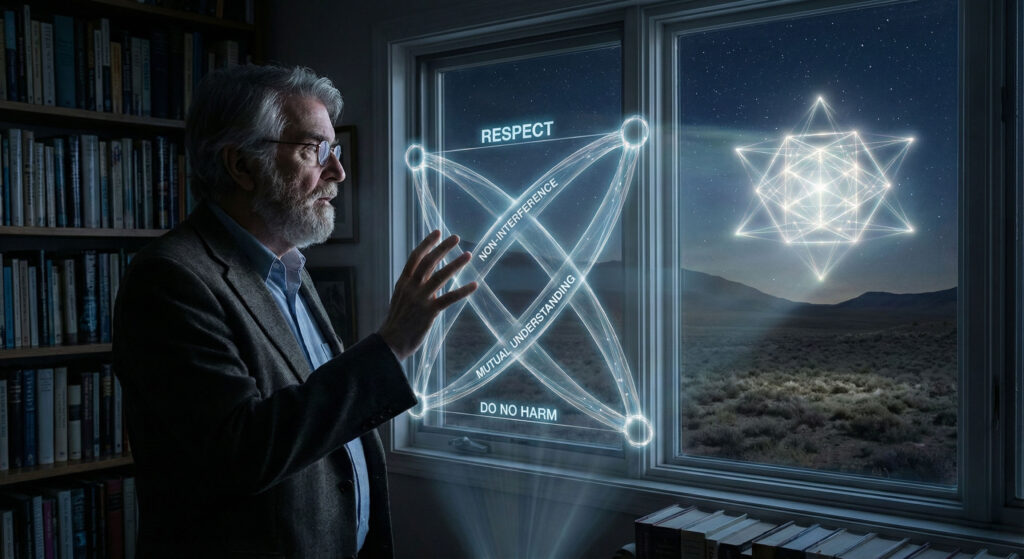
Ethics in human-UAP contact is not a thought experiment. It sits at the crossroads of public safety, human-subjects research, planetary protection, data privacy, and culture.
In the last decade, formal institutions have moved from stigma to structure. The United States created the All-domain Anomaly Resolution Office (AARO) to synchronize detection and analysis across agencies. NASA issued an independent study urging rigorous, multi-sensor, open standards for UAP data.
France’s CNES/GEIPAN continues to operate an official intake, anonymization, and publication pipeline for civilian witnesses.
Chile’s civil aviation authority maintains a dedicated section (SEFAA, formerly CEFAA) to investigate anomalous aerial events as an aviation concern.
Together these actions create a scaffolding where ethics is not optional but operational. (U.S. Department of War)
This explainer distills a code of conduct for human-UAP contact that draws on established bioethics (Belmont Report, Common Rule), planetary protection (COSPAR), post-detection norms from the search for extraterrestrial intelligence (IAA SETI protocols), and the lived knowledge of experiencers studied by scholars and clinicians.
It situates respected voices, notably Jacques Vallée and J. J. Hurtak, inside a practical framework that researchers, officials, and communities can use today. (HHS)
Why ethics, why now
AARO’s charter states a mission to synchronize efforts to detect, identify, and attribute objects of interest across all domains, with a commitment to transparency while safeguarding classified and controlled-unclassified information.
NASA’s 2023 study frames UAP as a unique opportunity that demands FAIR data, calibrated instruments, and stigma reduction to raise signal-to-noise in the public record.
These documents implicitly require ethical guardrails.
They also signal that contact scenarios are not purely speculative but part of aviation safety, scientific integrity, and citizen trust. (U.S. Department of War)
Outside the United States, France’s GEIPAN operates a reproducible seven-step methodology: collect testimony, create a record, conduct first analysis, investigate, classify, anonymize, and inform the witness with public posting.
Chile’s SEFAA (ex-CEFAA) remains embedded in the Directorate General of Civil Aeronautics, with a mandate to support safety of operations. Both organizations show that ethical handling of human reports is practical at national scale. (CNES GEIPAN)
The legal outer perimeter is set by international space law and SETI norms.
The Outer Space Treaty requires states to avoid harmful contamination and to authorize and continually supervise non-governmental space activities.
The International Academy of Astronautics’ post-detection Declaration of Principles encourages verification, open dissemination, and coordinated analysis before any reply.
Even if most UAP never touch space law directly, these texts offer binding and advisory models for restraint, verification, and global coordination. (UNOOSA)
The ethical baseline: what existing bioethics already tells us
The Belmont Report (1979) defines respect for persons, beneficence, and justice as pillars for human-subjects work.
The Common Rule (45 CFR 46) operationalizes those principles via Institutional Review Boards, risk minimization, informed consent, and special protections.
The APA Ethics Code guides trauma-informed, confidential, and non-exploitative work with clients and research participants.
These are not abstract ideals. They directly map to UAP witness interviewing, experiencer studies, physiological testing, and data sharing. (HHS)
Practical translation for UAP contexts
- Informed consent and autonomy.
Before any interview, medical exam, or data capture, participants must understand purpose, risks, benefits, data uses, and their right to withdraw without penalty. Use plain language and allow time for questions, especially for people reporting high-stress events. (HHS)
- Risk minimization and beneficence.
Encounters are often emotionally charged. Researchers should anticipate trauma reactions, avoid leading questions, and offer referral options. APA standards on competence, privacy, and non-maleficence apply, regardless of one’s beliefs about UAP causation. (APA)
- Justice and inclusion.
Sampling should not concentrate only on sensational cases or on populations with limited power to withhold consent. Ethical justice requires attention to marginalized communities whose sightings or health effects have been historically ignored. (HHS)
- Confidentiality and legal shields.
Certificates of Confidentiality at NIH and FDA can protect identifiable, sensitive information from compelled disclosure. For non-federally funded projects, discretionary Certificates can still be issued. These instruments matter if witness accounts intersect with security-sensitive locations or personal risk. (U.S. Food and Drug Administration)
Planetary protection and biosafety for physical contact
If human–UAP contact yields artifacts, residues, biological exposure, or environmental effects, we must avoid two ethical failures: exposing people to unknown hazards and contaminating ecosystems.
COSPAR’s Planetary Protection Policy is the global reference for avoiding forward and backward contamination. It calls for comprehensive protocols for human missions and sample handling, a risk-management posture, and special safeguards for sensitive regions.
While written for spaceflight, the logic generalizes to Earthbound unknowns: minimize contamination, document chain of custody, and segregate high-risk materials until characterized.
The National Academies’ planetary protection studies reinforce a risk-based approach with zones of minimal biologic risk, cleanliness provisions, and traceable bioburden control. (COSPAR website)
Laboratory practice should follow the WHO Laboratory Biosafety Manual, 4th edition.
That means project-specific risk assessment, good microbiological practice, appropriate PPE, validated decontamination, and incident reporting.
If samples are suspected to carry novel agents, escalate to appropriate containment and independent verification at a qualified facility. Ethics requires investing in biosafety before curiosity. (World Health Organization)
Operational guidance for field teams
• Treat unknown materials as potentially hazardous until proven otherwise.
• Log GPS, time, environmental conditions, and chain of custody.
• Split samples for blind replicate testing at independent labs.
• Separate research roles from law-enforcement roles to reduce coercion risk for witnesses; when command authorities must be involved, disclose this in consent forms.
These steps flow directly from planetary protection and biosafety norms, adapted to Earth cases. (COSPAR website)
Communication ethics: post-detection norms that already exist
The IAA Declaration of Principles for SETI post-detection recommends independent verification, consultation with international bodies, prompt public dissemination of confirmed signals, and careful consideration before any reply.
While aimed at radio detections, the values transfer to UAP: do not rush to sensational claims; prioritize verification; share data with qualified communities; and consider global implications of messages that could be interpreted as official replies. Work is under way to modernize these protocols for the current information ecosystem, which includes social media virality and open citizen science. (SETI League)
The Outer Space Treaty and Article IX’s “harmful contamination” clause add a legally salient anchor. If an object or actor is space-connected, states bear responsibility for authorization and continuing supervision, including of non-governmental entities. Communication or physical interaction that risks contamination or escalation is not merely a scientific question but a treaty issue. (UNOOSA)
What witness and experiencer research says about ethics
Two modern sources help structure ethical care.
1) Clinical and survey work with experiencers.
John E. Mack’s PEER program at Harvard’s Center for Psychology and Social Change explored extraordinary experiences with clinical safeguards, using psychotherapy and qualitative methods.
Whatever one concludes about ontology, Mack’s case shows that mainstream institutions can engage experiencers without humiliation and with attention to care, autonomy, and academic freedom. (John E. Mack Institute)
2) Large-scale survey research.
A 2018 paper in the Journal of Scientific Exploration reported patterns in contact experiences, including frequent reports of non-verbal communication, transformational effects, and complexity that challenged simple “nuts and bolts” assumptions.
Claimed outcomes are controversial, yet the dataset highlights participant priorities: safety, comprehension, and dignity. Ethical frameworks must accommodate people who interpret their encounters as meaningful, sometimes spiritually. (Journal of Scientific Exploration)
Practical standards for experiencer work
• Trauma-informed practice.
Avoid leading language; normalize uncertainty; allow participants to control pacing; screen for acute distress; maintain a referral network. APA’s code is the baseline. (APA)
• Privacy by design.
De-identify data at ingestion, segregate contact info, and use Certificates of Confidentiality when warranted. Publish aggregated findings, not identifying narratives, unless a participant opts in with specific, revocable consent. (U.S. Food and Drug Administration)
• Open science with safeguards.
Pre-register hypotheses; document instruments and prompt wording; release code and anonymized data when possible. GEIPAN’s anonymization and publication workflow is a functioning model for public-facing archives. (CNES GEIPAN)
Vallée and Hurtak on contact: how to use their ideas ethically
Jacques Vallée has long argued that the phenomenon couples physical effects, information patterns, and human meaning.
In Messengers of Deception he warned of manipulative dynamics among contact groups and of staged absurdity as a means to steer belief.
In technical venues with Eric W. Davis he proposed a six-layer model for analyzing anomalies, spanning physical, anti-physical, psychological, physiological, psychic, and cultural layers.
The ethical translation is clear. Investigators must guard against cultic dynamics, handle physiological and psychological claims with sober protocols, and analyze meaning effects without dismissing witnesses. Vallée’s work also implies that engaging only one layer invites harm, either by medicalizing everything or by romanticizing everything. (Internet Archive)
J. J. Hurtak writes from a consciousness-first perspective, arguing that contact includes multidimensional and nonlocal aspects. Through the Academy for Future Science and contributions to public anthologies on “making contact,” he emphasizes preparation, nonviolence, and integrative ethics that link science, spirituality, and planetary stewardship.
Even if one does not accept metaphysical claims, an ethical takeaway remains: approach contact with humility, respect for free will, and a planetary commons mindset. (Affs)
Using both lenses responsibly
• Vallée’s cautions inform safeguards against manipulation, secrecy games, or coercive group dynamics around contact work.
• Hurtak’s emphasis on benevolence and stewardship encourages non-militarized protocols, ecological respect, and care for human dignity.
Neither replaces data discipline. Both inform the ethical posture of teams that will meet the public at the most sensitive edge of ambiguity. (Internet Archive)
Government involvement and what it implies for ethics
United States. AARO’s creation formalized UAP reporting and analysis, while the U.S. Navy updated pilot reporting guidelines to reduce stigma and create a standardized pipeline.
Public-facing tools now include a web portal where personnel and many civilians can submit UAP reports.
Ethical implications include the need for transparent data retention policies, privacy protections, and safeguards against retaliation for good-faith reporting. NASA’s UAP study amplifies the call for better data, open methods, and broad engagement. (U.S. Department of War)
France. GEIPAN shows that state programs can protect witnesses through anonymization and clear classification criteria while publishing cases for public scrutiny. It sets a precedent for how to balance citizen privacy with scientific openness. (CNES GEIPAN)
Chile. SEFAA (formerly CEFAA) integrates UAP into civil aviation risk management, a useful model for separating scientific and safety questions from ideology. Chile has publicly released anomalous cases after internal review, which encourages public trust when combined with sober uncertainty. (SEFAA)
International law. The Outer Space Treaty’s responsibility and contamination provisions and IAA post-detection guidelines provide soft and hard law frameworks for escalation control and public communication. (UNOOSA)
A code of ethical practice for human–UAP contact
The following is a data-first, field-ready code that synthesizes the sources above. It can be adopted by research groups, first responders, journalists, and community organizations.
- Non-maleficence first. Protect life and health before curiosity. Assume unknown materials or close-range phenomena may carry physical risk. Use WHO biosafety risk assessment and appropriate PPE. Escalate containment until hazards are characterized. (World Health Organization)
- Respect and consent. Treat witnesses and experiencers as partners, not subjects. Obtain informed consent for interviews, recordings, and sample collection. Offer a plain-language summary of how data may be used and stored. (HHS)
- Privacy by default. De-identify records on intake. Use Certificates of Confidentiality where legal protection is warranted. Publish only what is necessary for verification, and only with participant approval. (U.S. Food and Drug Administration)
- Independent verification. Separate documentation from interpretation. Share raw data with independent teams before making claims. Track provenance and chain of custody. Follow SETI post-detection principles for verification and restraint. (SETI League)
- Open methods. Pre-register study designs; use standardized instruments; release code and de-identified datasets where possible. GEIPAN’s practice of anonymized case releases is a suitable model for public accountability. (CNES GEIPAN)
- Non-weaponization. Public agencies and private groups should renounce kinetic engagement with unknown phenomena except for immediate self-defense consistent with domestic and international law. First contact ethics should prioritize de-escalation and observation. The Outer Space Treaty and NASA’s ethics work for Artemis and space data highlight stewardship and restraint as core values. (UNOOSA)
- Planetary protection mindset. Treat physical contact scenarios as potential contamination risks in both directions. Use COSPAR principles to inform quarantine, sample handling, and release decisions. Coordinate with public health when warranted. (COSPAR website)
- Aviation safety frame. Route airspace incidents into standard aviation safety systems, as NTSB equivalents and civil aviation authorities already do for other hazards. Reduce stigma in pilot reporting as the U.S. Navy has done. (TIME)
- Cultural humility. Accept that experiencers may interpret contact through spiritual, folkloric, or scientific lenses. Do not pathologize meaning. Vallée’s six-layer model shows why purely material or purely psychological reductionism can harm participants and impede understanding. (Jacques Vallée)
- Governance for data. Adopt space-data ethics principles for UAP imagery, sensor logs, and geospatial traces. This includes transparency on data provenance, equity in access, and protections against misuse. (NASA)
Historical references that sharpen today’s ethics
The 1977 Colares events in Brazil, investigated by the Brazilian Air Force, created a complex record of medical complaints and official skepticism.
Vallée’s Confrontations discussed injury reports consistent with radiation-like effects. Later public documents and skeptical summaries emphasized lack of conclusive evidence for extraordinary causes.
The ethical lesson is not to litigate a definitive verdict here. It is to establish procedures for field medicine, documentation, and independent study when communities report harm, without ridiculing witnesses or rushing to closure. (Wikipedia)
Vallée’s Messengers of Deception documented manipulative currents around contact claims. Today’s social media environment magnifies those risks.
Ethics requires careful separation of research, counseling, belief advocacy, and commercial interests, with explicit disclosures. (Internet Archive)
Implications for policy, science, and society
Policy. Agencies should harmonize UAP reporting with human-subjects protections and privacy rules. AARO and civil aviation organizations can publish de-identified safety data while shielding individuals.
Legislatures can encourage Certificates of Confidentiality for sensitive UAP projects and fund biosafety-ready testing facilities. (U.S. Department of War)
Science. NASA’s UAP call for calibrated, multispectral data should be paired with open methods, independent replication, and sample-handling protocols that anticipate unknowns.
National Academies planetary protection work provides a blueprint for risk-based decisions on sample collection and release. (NASA Science)
Society. Contact narratives can reshape identity, purpose, and community. Avoiding stigma helps people seek help when needed. Lived experience is data, not dogma. Ethical practice protects dignity while inviting scrutiny. (Journal of Scientific Exploration)
A ready-to-use checklist for field teams and labs
- Before engagement
• Define purpose, roles, and data flows.
• Prepare consent forms and de-identification plan.
• Stage biosafety gear and chain-of-custody materials. (World Health Organization) - On scene
• Stabilize safety; separate witness care from evidence collection.
• Record time, location, environmental conditions; avoid leading questions.
• If physical samples are present, collect minimally, containerize properly, and log custody. (COSPAR website) - After action
• Offer participants copies of their consent and contact for follow-up.
• Enter case into a reproducible workflow with classification and anonymization.
• Share de-identified data and methods for independent review; consider SETI post-detection norms for communications. (CNES GEIPAN)
Closing thought
The ethics of human-UAP contact is not about dampening curiosity. It is about building trust so that curiosity can be safely satisfied. AARO’s existence, NASA’s open-science push, GEIPAN’s anonymization pipeline, SEFAA’s civil aviation framing, and the long arc of Belmont, COSPAR, and SETI norms already give us a robust toolkit.
When combined with careful attention to experiencer dignity and to the layered nature of the phenomenon described by Vallée, and with Hurtak’s reminder that contact changes us as much as it informs us, the field can set standards now that protect people, protect the planet, and produce the kind of data that future theories deserve. (U.S. Department of War)
References
American Psychological Association. (2017). Ethical principles of psychologists and code of conduct. https://www.apa.org/ethics/code/ethics-code-2017.pdf (APA)
AARO. (n.d.). All-domain Anomaly Resolution Office website. https://www.aaro.mil/ (AARO)
Department of Defense. (2022, July 20). Establishment of the All-domain Anomaly Resolution Office. https://media.defense.gov/…/ESTABLISHMENT-OF-THE-ALL-DOMAIN-ANOMALY-RESOLUTION-OFFICE.PDF (U.S. Department of War)
Department of Defense. (2022, July 20). Establishment, resourcing, and leadership of AARO. https://media.defense.gov/…/ESTABLISHMENT-RESOURCING-AND-LEADERSHIP-OF-THE-ALL-DOMAIN-ANOMALY-RESOLUTION-OFFICE.PDF (U.S. Department of War)
GEIPAN. (n.d.). A reproducible methodology. https://www.cnes-geipan.fr/en/node/58788 (CNES GEIPAN)
GEIPAN. (n.d.). How does GEIPAN classify observation cases? https://www.cnes-geipan.fr/en/node/412 (CNES GEIPAN)
HHS Office for Human Research Protections. (1979). The Belmont Report: Ethical principles and guidelines for the protection of human subjects of research. https://www.hhs.gov/ohrp/sites/default/files/the-belmont-report-508c_FINAL.pdf (HHS)
HHS OHRP. (2018). The Common Rule, Subpart A of 45 CFR 46 (2018 Requirements). https://www.hhs.gov/ohrp/sites/default/files/revised-common-rule-reg-text-unofficial-2018-requirements.pdf (HHS)
IAA SETI Committee. (2010). Declaration of Principles Concerning the Conduct of the Search for Extraterrestrial Intelligence following detection. https://www.setileague.org/iaaseti/protocols_rev2010.pdf (SETI League)
International Council for Science, COSPAR. (2021). Policy on Planetary Protection. https://cosparhq.cnes.fr/assets/uploads/2021/07/PPPolicy_2021_3-June.pdf (COSPAR website)
NASA. (2023). Unidentified Anomalous Phenomena Independent Study Team Final Report. https://science.nasa.gov/wp-content/uploads/2023/09/uap-independent-study-team-final-report.pdf (NASA Science)
NASA. (2024). Space Data Ethics: The Next Frontier in Responsible and Equitable Use of Space-based Data. https://www.nasa.gov/…/white-paper-space-data-ethics-2023-12-01-final-002.pdf (NASA)
National Academies of Sciences, Engineering, and Medicine. (2018). An astrobiology strategy for the search for life in the universe. https://www.ncbi.nlm.nih.gov/books/NBK540091/ (NCBI)
National Academies of Sciences, Engineering, and Medicine. (2021). Evaluation of bioburden requirements for Mars missions. https://nap.nationalacademies.org/catalog/26336 (National Academies)
NIH & FDA. (2020–2025). Certificates of Confidentiality guidance. https://www.fda.gov/media/132966/download; https://www.hhs.gov/ohrp/regulations-and-policy/guidance/certificates-of-confidentiality/index.html (U.S. Food and Drug Administration)
SEFAA (DGAC Chile). (n.d.). Sección de Estudios de Fenómenos Aéreos Anómalos. https://sefaa.dgac.gob.cl/ (SEFAA)
United Nations Office for Outer Space Affairs. (2002). Treaty on Principles Governing the Activities of States in the Exploration and Use of Outer Space, including the Moon and Other Celestial Bodies. https://www.unoosa.org/pdf/publications/STSPACE11E.pdf (UNOOSA)
Vallée, J. F. (1979). Messengers of Deception: UFO Contacts and Cults. (archival PDF reference). https://archive.org/…/Messengers%20of%20Deception…pdf (Internet Archive)
Vallée, J. F., & Davis, E. W. (2003). Incommensurability, orthodoxy and the physics of high strangeness: A 6-layer model for anomalous phenomena. https://www.jacquesvallee.net/wp-content/uploads/2018/11/Incommensurability_Orthodoxy_and_the_Phy.pdf (Jacques Vallée)
WHO. (2020). Laboratory Biosafety Manual, 4th ed. https://www.who.int/publications/i/item/9789240011311 (World Health Organization)
U.S. Navy. (2019). Guidelines for reporting UAP (news coverage and confirmations). https://time.com/5577853/navy-ufo-reporting-guidelines/ (TIME)
Hernandez, R., et al. (2018). A Study on Reported Contact with Non-Human Intelligence. Journal of Scientific Exploration. https://journalofscientificexploration.org/index.php/jse/article/view/1282 (Journal of Scientific Exploration)
John E. Mack Institute. (2003). Program for Extraordinary Experience Research (PEER). https://johnemackinstitute.org/2003/01/program-for-extraordinary-experience-research-peer/ (John E. Mack Institute)
Hurtak, J. J., & Hurtak, D. (2021). Chapter in Steinfeld, A. (Ed.), Making Contact: Preparing for the New Realities of Extraterrestrial Existence. (catalog entry). https://basalt.marmot.org/Record/.b64232608 (Basalt Regional Library District)
The Academy for Future Science. (2024). Mission and publications. https://affs.org/; https://futurescience.org/ (Affs)
Claims Taxonomy
Verified
• Existence of U.S. AARO and its mission to synchronize anomaly detection across domains. (U.S. Department of War)
• NASA’s 2023 independent UAP study calling for rigorous, multi-sensor, open data approaches. (NASA Science)
• GEIPAN’s reproducible methodology that includes anonymization and public release. (CNES GEIPAN)
• COSPAR planetary protection policy as the international reference standard. (COSPAR website)
• UNESCO’s Universal Declaration on Bioethics and Human Rights and the Belmont/Common Rule frameworks. (UNESCO)
Probable
• Certificates of Confidentiality can materially reduce privacy risk in experiencer research and sensitive UAP interviews, thereby increasing participation and data quality. (U.S. Food and Drug Administration)
• Medical injury patterns reported during the 1977 Colares wave, interpreted by some as radiation-like effects.
Legend
• Metaphysical accounts in J. J. Hurtak’s Keys of Enoch milieu and related contact narratives are best treated as spiritual or cultural testimony unless corroborated by multi-sensor evidence or witness testimony. They are important for ethics because they shape expectations and behavior. (Keys of Enoch)
Misidentification
• A significant portion of UAP reports resolve to aircraft, balloons, drones, astronomical objects, and sensor artifacts, as noted in NASA’s study and national programs. This strengthens the case for disciplined intake and classification. (NASA Science)
Speculation section
Hypothesis
An ethically guided, multi-layer contact protocol that respects autonomy, minimizes harm, and protects ecosystems will produce higher quality data and fewer social pathologies than ad hoc, secrecy-heavy responses. If UAP involves a responsive intelligence, transparent, non-aggressive observation may be more informative than confrontation. This is consistent with post-detection norms and with Vallée’s emphasis on information dynamics in contact. This is a testable hypothesis about outcomes under different policy regimes. (SETI League)
Witness interpretation
Some experiencers describe nonlocal communication, benevolent intent, and transformative after-effects. Others report fear or physiological distress. An ethical framework accepts both patterns as real experiences for the individuals reporting them, without presuming a single cause. Practitioner stance should be validating but non-leading, with clear consent for any regression, somatic, or transpersonal techniques. (Journal of Scientific Exploration)
Researcher opinion
Combining GEIPAN-style anonymization, AARO-level coordination, NASA’s open science recommendations, COSPAR biosafety, and APA trauma care would give the field a coherent spine. This does not solve the ontology problem. It does reduce harm and produce replicable data that future theory can use. (CNES GEIPAN)
SEO keywords
UAP ethics, human–UAP contact principles, Belmont Report UAP research, COSPAR planetary protection UAP, SETI post-detection protocols, AARO reporting guidelines, NASA UAP study ethics, GEIPAN anonymization methodology, SEFAA CEFAA Chile UAP, Jacques Vallée six-layer model ethics, J. J. Hurtak contact stewardship, experiencer research privacy, Certificates of Confidentiality UAP, WHO biosafety UAP samples