
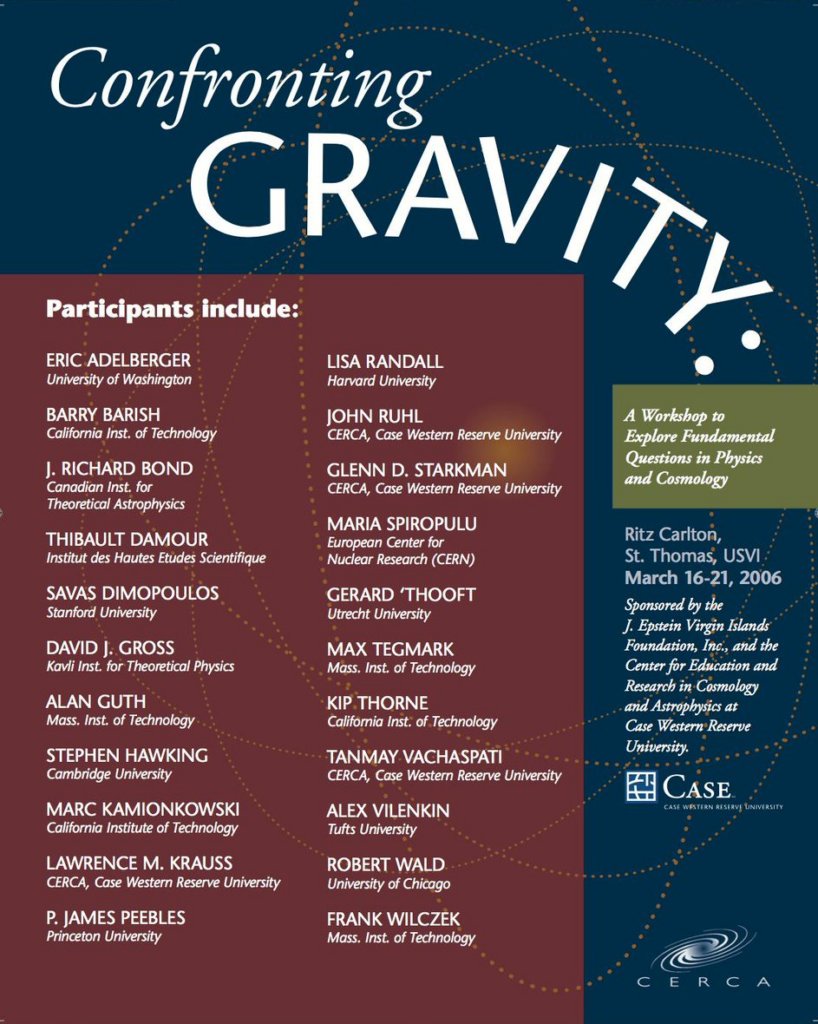
In March 2006, a small group of elite physicists gathered at a Caribbean resort to talk about gravity, dark energy, black holes, and the stubborn mismatch between quantum mechanics and general relativity. The location was St. Thomas, U.S. Virgin Islands. The venue was the Ritz-Carlton. The sponsor was the J. Epstein Virgin Islands Foundation. (St. Thomas Source)
“Confronting Gravity” has become a recurring keyword in how journalists, researchers, and public audiences triangulate a murky overlap between frontier physics, defense-adjacent research culture, and a class of patrons who can purchase proximity to both.
The overlap is further complicated by an older, stranger chapter from the mid-20th century: inventor T. Townsend Brown, his electrogravitics claims, and a corporate footprint that includes “RAND International, Ltd., for more than a decade. (Wsimg)
Then there is RAND Corporation itself: an institution with deep ties to U.S. defense analysis that has authored both historical and contemporary work on “UFOs” and UAP reporting standards, including a 1968 draft report bluntly titled UFOs: What To Do? (RAND Corporation)
So what is real, documentable, and time-stamped? What is merely adjacent, rhetorically convenient, or algorithmically amplified?
This article treats the problem like an evidence ledger first, and a story second.
The Evidence Ledger: five artifacts that anchor the investigation
Below are the most load-bearing data points that can be sourced to documents, public records, or attributable public appearances.
Artifact 1: “Confronting Gravity” takes place in St. Thomas (March 2006)
A St. Thomas Source report describes a week of debate by top physicists at a seminar called “Confronting Gravity,” held at the Ritz-Carlton on St. Thomas, and notes that the Epstein Foundation sponsored the conference and a related student event. (St. Thomas Source)
Artifact 2: Lawrence Krauss publicly describes a private-island visit tied to the event (July 2006)
In an Edge.org essay, physicist Lawrence Krauss states he organized a small St. Thomas conference with 21 physicists on “Confronting Gravity,” describing that attendees could “meet, discuss, relax on the beach,” and take a trip to the “nearby private island retreat” of Jeffrey Epstein, who funded the event. (Edge)
Artifact 3: T. Townsend Brown’s “Rand” trail includes Nassau, Bahamas (1958–1974)
A short biography page (presented as “From Who’s Who in American Science”) lists Brown’s work experience as “1958–74: President RAND International, Ltd., Nassau, Bahamas.” (Wsimg)
Artifact 4: Brown’s electrokinetic patents are assigned to “Whitehall-Rand, Inc.” in Washington, D.C.
A U.S. patent for Brown’s “Electrokinetic Transducer” identifies him as “assignor to Whitehall-Rand, Inc., Washington, D.C., a corporation of Delaware,” filed July 3, 1957 and issued in 1962. (Google Patents)
Artifact 5: Epstein’s flight logs show Bahamas routings (2002–2003)
Unredacted flight logs associated with Epstein’s aircraft include entries for Nassau (MYNN) and Great Exuma (MYEF).
These five artifacts do not, on their own, prove a single unified operation. They do something subtler and more useful: they establish repeated intersections between (1) gravity research as a social project, (2) antigravity as an entrepreneurial claim, (3) offshore geographies (the Bahamas and neighboring island chains), and (4) defense-adjacent analytic culture.
Now we can responsibly ask: do the lines connect, or are they merely parallel?
Epstein’s Gravity Salon
The St. Thomas Source account is unusually concrete for a topic that usually swims in insinuation. It provides:
- A date (March 2006).
- A named event (“Confronting Gravity”).
- A location (Ritz-Carlton, St. Thomas).
- Named participants (including Nobel laureates Gerard ’t Hooft, David Gross, and Frank Wilczek, plus Lawrence Krauss and Edward Thomas Jr.). (St. Thomas Source)
- A sponsorship statement: “The Epstein Foundation sponsored last week’s conference.” (St. Thomas Source)
The same report credits the “director of the J. Epstein Virgin Islands Foundation” as a key organizer for the student-facing portion. (St. Thomas Source) That detail matters because it makes the sponsorship operational rather than symbolic.
Edge.org then adds a second, independent public description from Krauss: a 21-person, invitation-only workshop, organized around the “key issues facing fundamental physics and cosmology,” paired with leisure activities and an island visit. (Edge)
Two observations follow from this, staying strictly inside the documentary boundary:
- Epstein’s involvement was not “supporting science” in a generic sense. It was targeted toward a specific domain: gravity, cosmology, and foundational physics.
- The setting was not incidental. Island geography was part of the design, including a “private island retreat” visit described in public by the organizer. (Edge)
That is the first “why” of this investigation: Why does the Caribbean, and the cultural logic of private islands, recur in gravity-adjacent patronage networks?
Townsend Brown’s Antigravity Claim
T. Townsend Brown is a central figure in the cultural genealogy of antigravity. He is often invoked as a precursor to disc-shaped craft narratives, and as a bridge between electrical engineering and gravitational speculation. Jesse Michels’ documentary treatment is a major contemporary amplifier of this storyline. (YouTube)
But “antigravity,” as used in the Brown context, is a contested label. Two parallel tracks must be kept separate:
What Brown claimed (and patented)
Brown’s patents are not framed as mystical texts. They are engineering documents describing forces generated when high voltages interact with electrodes in a dielectric medium, explicitly noting air as an example. (Google Patents)
This is important because it establishes a testable mechanism category: electrohydrodynamic (EHD) thrust via ionized air, even if Brown personally interpreted it as “electrogravitics.”
What modern replication attempts find
A widely cited technical rebuttal line in the engineering literature is that “Biefeld–Brown” effects are misinterpretations of corona wind phenomena, not gravitational control. In one AIAA-associated paper, Martin Tajmar frames the effect as a misinterpretation tied to ion wind and argues that under proper vacuum conditions the force vanishes. (ResearchGate)
Similarly, peer-reviewed work on the “Brown–Biefeld effect” in electrostatics literature analyzes the phenomenon in terms consistent with charged particle dynamics in air rather than new gravitational physics. (ScienceDirect)
For UAPedia readers, the key point is not to “debunk” Brown as a character. The key point is methodological: if UAP propulsion involves gravity control or field effects, we cannot afford to confuse atmospheric ion thrust demonstrations with vacuum-capable drive physics.
And yet Brown remains relevant because his work, whatever its ultimate physical explanation, served as a social attractor for defense contractors, curious funders, and secrecy-adjacent narratives. That is where the Bahamas and “Rand” matter.
Nassau as a Recurring Coordinate
Here is a clean, documentable fact: a short biographical sheet attributed to Who’s Who in American Science lists Brown as “President RAND International, Ltd., Nassau, Bahamas” from 1958 to 1974. (Wsimg)
This is not RAND Corporation. It is “RAND International, Ltd.” The similarity of names is part of the confusion space, and likely part of the marketing value.
But Nassau itself becomes a point of interest for another reason: Epstein’s flight logs include Bahamas routings, including Nassau and Great Exuma.
A data-first interpretation of this coincidence is modest:
- Nassau is a major regional node for private aviation and offshore corporate administration.
- Both Brown (mid-century) and Epstein (early 2000s) show Bahamas adjacency in different ways: Brown via corporate title and location, Epstein via flight movements.
A narrative-forward interpretation is more provocative: islands are not merely backdrops. They can be infrastructure. They can be jurisdictional tools. They can be social filters.
This is where investigative discipline matters. We should not claim a direct operational linkage between Brown’s Nassau-era company and Epstein’s Bahamas flights unless a document ties them together. No such direct document is established in the public sources cited above.
But we can responsibly flag Nassau as a recurring coordinate that deserves further document retrieval.
“Whitehall-Rand” and the problem of name collision
Brown’s patent record provides a second “Rand” thread: he assigns at least one electrokinetic patent to “Whitehall-Rand, Inc., Washington, D.C.” (Google Patents)
Now we have three separate “Rand” surfaces:
- RAND International, Ltd. (Nassau, Bahamas) tied to Brown by biography. (Wsimg)
- Whitehall-Rand, Inc. (Washington, D.C.) tied to Brown by patents. (Google Patents)
- RAND Corporation (Santa Monica, CA) tied to defense analysis and UAP studies by publications. (RAND Corporation)
An investigative journalist’s instinct is to assume that at least two of these are connected. Sometimes that instinct is correct. Often it is a trap.
At minimum, the naming collision creates a built-in ambiguity generator: readers see “Rand” next to “antigravity,” and the mind supplies institutional gravity (RAND Corporation) where the paperwork may only support corporate branding or unrelated entities.
This is not a minor point. In UAP research, ambiguity is often weaponized by accident. A narrative becomes “sticky” because a name resembles another name.
So the correct move here is separation:
- Brown’s “Whitehall-Rand” and “RAND International” appear tied to a specific electrokinetic R&D ecosystem and corporate vehicle. (Wsimg)
- RAND Corporation is a separate institution, with its own publication trail on UAP reporting and analysis. (RAND Corporation)
If a future document shows overlap (shared directors, shared addresses, shared contracts), the story changes. Until then, we treat “Rand” as a linguistic tripwire.
RAND Corporation’s UAP Institutional Memory
RAND’s 1968 draft “UFOs: What To Do?” is not an internet rumor. It is hosted on RAND’s own site as an archival draft (DRU-1571), with a summary describing brightness, size, maneuvers, and a concluding emphasis on standardized reporting to generate objective data. (RAND Corporation)
That single publication is important for two reasons:
- It demonstrates that a premier defense-adjacent think tank treated “UFOs” (read: UAP in today’s terminology) as an analytic problem requiring better instrumentation and reporting discipline, not merely ridicule. (RAND Corporation)
- It shows that “data-first” UAP thinking has a long lineage inside institutions usually assumed to be either dismissive or purely secrecy-focused. (RAND Corporation)
RAND has also produced modern work on public UAP reporting patterns, including a 2023 report mapping public reports of UAP. (RAND Corporation)
In other words, RAND Corporation is a persistent actor in the informational ecology around UAP, even if its conclusions are cautious and method-bound.
So why does RAND belong in an Epstein-Brown-Bahamas investigation?
Because RAND represents the institutional pole of the same triangle that Epstein and Brown represent in different ways:
- Brown: the inventor-claimant pole (devices, patents, experimental culture).
- Epstein: the patron-network pole (money, convening power, private space).
- RAND: the analytic-legibility pole (formal reports, standardized data talk). (Google Patents)
If you want to understand how “antigravity” persists as an idea, you study the entire triangle, not just one vertex.
DOJ documents: why they matter to an antigravity investigation at all
At first glance, DOJ documentation about Epstein seems unrelated to propulsion.
DOJ material matters because it shapes what can be responsibly asserted about Epstein’s role as a patron and convenor. A person’s network-building behavior does not occur in a vacuum. The legal and reputational environment affects who shows up, who leaves paper trails, and who speaks after the fact.
Two DOJ documents are especially relevant as boundary markers:
- A DOJ Office of Professional Responsibility (OPR) report (executive summary) describes the 2006–2008 federal investigation and the 2007 non-prosecution agreement (NPA) resolution process, including issues around victim notification and how the case was handled.
- A DOJ Office of Public Affairs press release (Jan 30, 2026) states DOJ published nearly 3.5 million pages in compliance with the Epstein Files Transparency Act, including videos and images, and describes the scope and caveats of that release. (Department of Justice)
For UAPedia readers, the practical takeaway is simple: if you want to know whether “antigravity” appears in Epstein-related communications, travel, or contacts, the post-2025 document dump is now a primary hunting ground. (Department of Justice)
Do the lines connect?
Here is what can be stated with confidence:
- Epstein funded and enabled gravity-focused convenings in the U.S. Virgin Islands, documented by local reporting and by a first-person account from the organizer. (St. Thomas Source)
- Townsend Brown operated within an electrokinetic R&D world that used “Rand” branded corporate vehicles, including a Bahamas-based entity per a biographical sheet, and a D.C.-based corporate assignee per patent records. (Wsimg)
- Epstein’s travel history includes Bahamas nodes (Nassau, Great Exuma) in flight logs.
- RAND Corporation has a documented publication history on UAP/UFO reporting and analysis, including a 1968 draft explicitly calling for standardized reporting and objective data collection. (RAND Corporation)
Here is what cannot be responsibly claimed from the cited public record alone:
- That Epstein directly funded Townsend Brown research (no direct document established here).
- That Brown’s “Rand International” is organizationally connected to RAND Corporation (name similarity alone is not evidence).
- That Brown achieved true gravitational control as understood in physics (the mainstream literature attributes observed thrust to ion wind effects in air, and vacuum results are generally negative). (ResearchGate)
But the investigative value remains high, because the pattern is not “one secret.” The pattern is a recurring format:
- Wealthy patrons convene high-status scientists around foundational physics questions (gravity being a central one).
- Inventor-claimants propose engineering analogs or hacks (electrogravitics, field propulsion, vacuum energy).
- Institutions like RAND attempt to formalize ambiguous phenomena into data problems.
- Islands and offshore jurisdictions repeatedly appear as staging environments.
In UAP studies, formats matter. Formats repeat because they work.
Speculation Labels
Hypothesis
- The repeated use of island geographies (St. Thomas, Nassau-adjacent routes) is not merely lifestyle. It may function as a structural enabler for privacy, deniability, and selective access in frontier-science networking. (This is a structural hypothesis, not a claim of a specific operation.)
- “Rand”-branded entities in Brown’s orbit may have benefited from the implied credibility and ambiguity created by name similarity to RAND Corporation, intentionally or unintentionally.
Witness Interpretation
- Townsend Brown interpreted the force effects in his high-voltage devices as evidence of an electricity-gravity coupling (“electrogravitics”), even though later analyses attribute the effect to ionized-air dynamics rather than new physics. (Google Patents)
- Lawrence Krauss publicly framed the “Confronting Gravity” gathering as a way to confront foundational physics issues, noting gravity’s central role and describing the event as privately funded with a social component that included Epstein’s island. (Edge)
Researcher Opinion
- Jesse Michels’ Townsend Brown documentary and Epstein-focused episode present an interpretive synthesis in which antigravity, intelligence history, elite patronage, and UAP narratives are treated as interlocking domains. These are research claims and narrative frames that require independent documentary corroboration to be treated as evidentiary. (YouTube)
Claims Taxonomy (UAPedia)
Verified
- “Confronting Gravity” (March 2006) occurred on St. Thomas and was sponsored by the Epstein Foundation, per local reporting. (St. Thomas Source)
- Lawrence Krauss publicly stated he organized a 21-person St. Thomas gravity meeting and described a visit to Epstein’s private island retreat as part of the event context. (Edge)
- T. Townsend Brown’s patent US3018394A identifies him as assignor to “Whitehall-Rand, Inc., Washington, D.C.” (Google Patents)
- A Brown biography sheet lists “President RAND International, Ltd., Nassau, Bahamas” for 1958–1974. (Wsimg)
- Epstein flight logs contain Bahamas entries including Nassau and Great Exuma.
- RAND Corporation hosts the 1968 draft report “UFOs: What To Do?” on its official site. (RAND Corporation)
- DOJ publicly described releasing nearly 3.5 million pages under the Epstein Files Transparency Act (Jan 30, 2026). (Department of Justice)
- DOJ OPR published an executive summary describing its review of the 2006–2008 federal investigation resolution and the 2007 NPA.
Probable
- Brown’s devices produced thrust effects in air consistent with electrohydrodynamic ion wind, aligning with published analyses rather than gravitational control. (ResearchGate)
- Epstein’s interest in gravity-focused physics is strongly supported by the documented conference sponsorship and related public accounts. (St. Thomas Source)
Disputed
- That Brown achieved true “antigravity” (in the sense of controllable gravity cancellation or mass-reduction in vacuum) remains disputed, with mainstream technical literature attributing observed effects to non-gravitational mechanisms. (ResearchGate)
- That Epstein’s physics patronage constituted directed funding toward “antigravity” specifically (rather than broad foundational physics interest) is not established in the cited primary sources and remains unresolved pending deeper corpus review. (Department of Justice)
Legend
- Broad claims that a complete, operational antigravity craft program was built directly from Brown’s work (without showing vacuum-capable propulsion evidence and a traceable procurement chain) remain cultural narratives until corroborated by documents.
Misidentification
- Treating “RAND International, Ltd.” or “Whitehall-Rand” as automatically equivalent to RAND Corporation is a name-based misidentification risk unless direct corporate linkage is demonstrated. (Wsimg)
Hoax
- No specific hoax claim is asserted in this article. (Note: DOJ cautions that public submissions within the Epstein Files production may include fake or false materials, which is relevant to any future document-mining work.) (Department of Justice)
References
Department of Justice, Office of Public Affairs. (2026, January 30). Department of Justice publishes 3.5 million responsive pages in compliance with the Epstein Files Transparency Act. (Department of Justice)
U.S. Department of Justice, Office of Professional Responsibility. (2020, November). Executive summary of report: Investigation into the U.S. Attorney’s Office for the Southern District of Florida’s resolution of its 2006–2008 federal criminal investigation of Jeffrey Epstein… (Department of Justice)
St. Thomas Source. (2006, March 21). Top physicists talk gravity at Antilles School. (St. Thomas Source)
Krauss, L. M. (2006, July 5). The energy of empty space that isn’t zero. Edge.org. (Edge)
Brown, T. T. (1962). Electrokinetic transducer (U.S. Patent No. 3,018,394). (Google Patents)
(Attributed) A short biography (From Who’s Who in American Science): Thomas Townsend Brown. (2001, June 17). (Wsimg)
Kocher, G. (1968). UFOs: What to do? RAND Corporation (DRU-1571). (RAND Corporation)
Posard, M. N., et al. (2023). Mapping public reports of unidentified aerial phenomena (UAP)… RAND Corporation. (RAND Corporation)
Michels, J. (2024). The CIA scientist who built UFOs before Bob Lazar (Townsend Brown Documentary). YouTube. (YouTube)
Michels, J. (Host). (2025, July 17). Epstein & UFOs: The secret science honeypot (Ft. Jay Anderson & Kurt Metzger) [Audio podcast episode]. American Alchemy. Apple Podcasts. (Apple Podcasts)
Federal court exhibit compilation (archived). (n.d.). Flight logs unredacted. (Internet Archive).
Tajmar, M. (2004). Biefeld–Brown effect: Misinterpretation of corona wind phenomena. (AIAA context). (ResearchGate)
Ionescu, M. (2011). Analysis of the Brown–Biefeld effect. Journal of Electrostatics. (ScienceDirect)
SEO keywords
Jeffrey Epstein antigravity, Confronting Gravity conference, T. Townsend Brown electrogravitics, Biefeld–Brown effect, Whitehall-Rand, RAND International Nassau Bahamas, Epstein flight logs Bahamas, RAND Corporation UFOs What To Do, UAP propulsion, field propulsion, electrohydrodynamics ion wind, exotic propulsion research