
On a January 2026 episode of American Alchemy, the title alone felt like a shot across the bow of respectable science:
“NASA Whistleblower: ‘We Systematically Suppress UFO Data!’” (podbean.com)
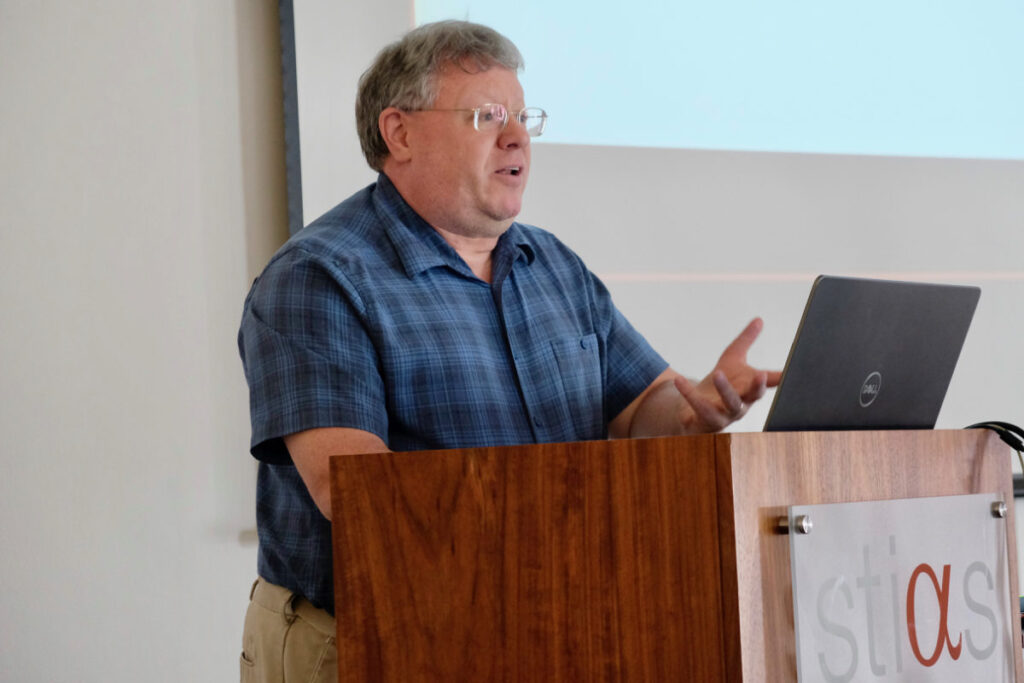
The “whistleblower” in question was Dr Kevin H. Knuth, a soft-spoken professor of physics from the University at Albany, SUNY, and a former research scientist at NASA’s Ames Research Center. For nearly two hours, Knuth talked Jesse Michels through cattle mutilations, nuclear-era UAP, the Catalina Island instrumented mission, secrets inside NASA, and why he believes the phenomenon represents technology far beyond any known nation. (podbean.com)
Knuth is not a hobbyist or a YouTube pundit. He is a specialist in information-based physics and Bayesian inference, an exoplanet researcher, editor-in-chief of the journal Entropy, and lead author on one of the first peer-reviewed physics papers to quantify “impossible” UAP flight performance. (University at Albany)
At a moment when mainstream science is finally edging toward the UAP problem, Knuth has become one of its most visible and controversial bridge figures. He is a career physicist who openly entertains the idea that some UAP may be “visitors from afar,” and who calls the failure to study them “one of the greatest intelligence failures in history.” (brainworldmagazine.com)
Early life and academic formation
Kevin H. Knuth’s path to UAP began with very conventional science.
He earned a double major in physics and mathematics at the University of Wisconsin–Oshkosh in 1988, followed by an MS in physics from Montana State University in 1990 and a PhD in physics (with a mathematics minor) from the University of Minnesota in 1995. (University at Albany)
His early career sequence reads like a tour of late-20th-century applied science:
- Instructor posts at Albert Einstein College of Medicine and Cornell University Medical Center
- Research Scientist at the Center for Advanced Brain Imaging, Nathan Kline Institute
- A GS-14 Research Scientist in the Intelligent Systems Division at NASA Ames Research Center, where he worked on robotics, intelligent instruments and data analysis (University at Albany)
By 2005 he had joined the physics faculty at the University at Albany, climbing from assistant professor to full professor, and developing a reputation in “information physics” – a program that treats physics as emerging from deeper rules of inference and information theory. (University at Albany)
He published widely on Bayesian methods, exoplanet characterization, quantum foundations and intelligent instrumentation, and became editor-in-chief of Entropy, a peer-reviewed MDPI journal. (University at Albany)
From the outside, this is exactly the sort of CV you expect from a mid-career physicist, not from someone who will eventually argue on podcasts that UAP may represent nonhuman technology hiding in our skies and oceans.
The quiet fascination: from cattle mutilations to Malmstrom
Knuth has said his interest in anomalous craft goes back to childhood, when the possibility of interstellar travel fascinated him more than the “aliens” themselves. (brainworldmagazine.com)
A pivotal moment came in 1988, during his second week of graduate school at Montana State. Over coffee, several students were talking about a recent cattle mutilation case reportedly associated with UAP. A physics professor joined in and casually mentioned that colleagues at Malmstrom Air Force Base were having problems with “UFOs shutting down nuclear missiles.” Knuth initially dismissed this as nonsense. (brainworldmagazine.com)
Twenty years later he watched a press conference where former U.S. Air Force personnel from Malmstrom and other bases described near-identical events: UAP over nuclear missile sites, followed by sudden malfunctions. “Clearly there must be something to this,” he later wrote. (brainworldmagazine.com)
For Knuth, this was the first big pattern. If the reports are even partly accurate, then whatever UAP represent, they seem to pay attention to humanity’s most destructive weapons.
That motif – UAP and nukes – now threads through much of his public commentary, and it is no accident that Knuth’s work often intersects with nuclear-focused researchers like Robert Hastings and with civilian organizations such as UAPx that include Nimitz witnesses Kevin Day and Gary Voorhis. (UAPx Inc)
“Are we alone?”: arguing for a scientific UAP reboot
In 2018, Knuth broke cover as a public UAP advocate in an essay for The Conversation, later republished by Brain World under the title “Are We Alone? The Question is Worthy of Serious Scientific Study.” (brainworldmagazine.com)
In that article he walked readers through the Fermi paradox, the vast number of likely habitable planets, and the long history of UAP reports. He acknowledged Carl Sagan’s famous maxim that “extraordinary claims require extraordinary evidence” yet argued that the taboo around UAP has choked off the very science needed to test those claims. (brainworldmagazine.com)
He admitted the data are messy. UAP encounters are not repeatable experiments, and witness testimony is fraught. Still, after reviewing military pilot cases and nuclear-base incidents, he concluded:
We need to face the possibility that some of the strange flying objects that outperform the best aircraft and defy explanation may indeed be visitors from afar. (brainworldmagazine.com)
This was already a break with the dominant academic line that “most sightings are misidentifications.” Knuth was not saying all UAP are nonhuman craft. He was insisting that a non-trivial subset looks genuinely anomalous, that governments have covered up and classified key information, and that scientists have been complicit by looking away. (brainworldmagazine.com)
Turning UAP into data: the 2019 flight-characteristics paper
Knuth’s best-known technical contribution to UAP studies is the 2019 paper “Estimating Flight Characteristics of Anomalous Unidentified Aerial Vehicles,” co-authored with Robert Powell and Peter Reali and published in Entropy. (grafiati.com)
The team took a handful of what they regarded as well-documented encounters, including the now-famous 2004 Nimitz “Tic Tac” event, and used radar tracks and pilot reports to estimate lower bounds on acceleration. Their conclusion: some objects executed maneuvers corresponding to anywhere from ~100 g to thousands of g, with no sonic booms or aerodynamic heating signatures that should accompany such energy dumps. (grafiati.com)
When Texas Public Radio interviewed Knuth in 2021, the reporter highlighted his estimate that one Nimitz object descended from about 28,000 feet to sea level in roughly 0.7 seconds. Knuth explained that this implied accelerations on the order of “about 5,000 g’s,” compared with the roughly 13 g’s that would rip the wings off a modern fighter jet. (TPR)
The same interview contains one of his most quoted lines. Reflecting on seven decades of UAP in restricted airspace, often near nuclear facilities, he said:
When we finally learn what these things are, this is going to be one of the greatest intelligence failures in history. (TPR)
Here Knuth is not just quantifying crazy accelerations. He is indicting a multi-generational culture of neglect across intelligence, defense and science.
UAPx and instrumented fieldwork
Knuth’s ideas about turning UAP into hard data found a home at UAPx, a non-profit built by Nimitz veterans to conduct instrumented expeditions off the U.S. West Coast and elsewhere.
A 2021 UAPx announcement promoted him from head of Science and Technology to Vice President, noting that he was a founding member and would “lead the scientific and research endeavors of UAPx.” The same statement called his 2019 Entropy article “one of the first peer-reviewed scientific papers on UAPs.” (UAPx Inc)
The UAPx leadership team around Knuth includes figures deeply embedded in the Nimitz case: Kevin Day, the radar operator who first tracked the anomalous “Tic Tacs,” Gary Voorhis, and former USS Princeton sailor Jason Turner. Additional collaborators include physicist Matthew Szydagis, legal advisor Michael Hall, technical operator Jeremy McGowan and others, giving UAPx an unusual blend of military witness, academic and citizen-scientist talent. (UAPx Inc)
UAPx expeditions off Southern California were filmed for the 2022 documentary A Tear in the Sky and fed directly into a more formal collaboration with the University at Albany.
The UAlbany–UAPx collaboration: “The New Science of UAP”
By 2025, Knuth’s UAP work had moved from the edges of academia into its visible core.
In June that year the University at Albany announced that a team led by physicist Matthew Szydagis, with Knuth and Cecilia Levy as co-authors and UAPx’s Ben Kugielsky, had published a paper in Progress in Aerospace Sciences detailing a rigorous, multi-sensor method for documenting UAP in the field. (University at Albany)
The study described a 2021 field deployment in Laguna Beach, California, using:
- Forward-looking infrared (FLIR) cameras
- Optical cameras
- Radiation detectors (Cosmic Watch)
- Public weather radar data
- Coincidence timing between detectors
The team was able to plausibly explain all but one anomaly in their data, and crucially, they set out a repeatable framework that minimizes reliance on eyewitness testimony. (University at Albany)
A companion paper, “The New Science of Unidentified Aerospace-Undersea Phenomena (UAP),” again with Knuth as lead author, provided a sweeping historical review of government and civilian UAP studies from 1933 to the present and argued for a coordinated, multi-instrument, international research effort. (University at Albany)
Universe Today’s summary quoted the authors’ stark opening: after “decades of dismissal and secrecy,” many governments now quietly admit that they take UAP seriously yet “still seem to know little about them.” The paper calls for adopting the high standards of particle physics and multi-messenger astronomy, insisting that only long-term, trans-generational research programs will finally resolve what UAP are. (universetoday.com)
From a UAPedia perspective, this pair of papers matters because they combine three things:
- A physics-grade field methodology tested in real skywatching.
- A historical, global review of UAP projects that treats government archives as one evidence stream among many, consistent with UAPedia’s editorial approach to official sources.
- A frank acknowledgment that some cases remain anomalous even after thorough analysis.
Sol Foundation, Galileo Project and the wider network
The 2024–26 period also saw Knuth join a new ecosystem of academically adjacent UAP initiatives.
- Sol Foundation: That UFO Podcast describes him as an advisory board member and notes his Sol Foundation presentations on the physics of UAP. (Premium Podcasts | Lyssna i Podme-appen)
- Galileo Project: Public sources list him as one of several research affiliates connected to Avi Loeb’s Harvard-based search for unambiguous technological signatures, both in space and in Earth’s atmosphere. (Apec Conference)
- Scientific Coalition for UAP Studies (SCU): UAPx notes that he is an active SCU member, further tying him into a network of technically trained UAP analysts. (UAPx Inc)
This network matters because it demonstrates that Knuth is not an isolated outlier. He is part of a growing cadre of scientists who treat UAP as a serious interdisciplinary problem spanning astronomy, aerospace engineering, plasma physics, information theory and security studies.
American Alchemy: nuclear patterns, NASA culture and “water worlds”
Knuth’s January 2026 appearance on American Alchemy is currently his most widely shared long-form interview. In Michels’ description, he “lays out the most concrete physics-first framework” the host has heard for what UAP are and what they can do. (podbean.com)
The show notes and timestamps paint a roadmap of the conversation:
- The cattle mutilation incident and his change of perspective: A callback to his 1988 graduate-school conversation and the later realization that Malmstrom-type cases kept recurring.
- The nuclear connection: Knuth walks through the pattern of UAP around nuclear weapons, echoing themes from his Malmstrom reflections and paralleling Hastings’ work on UAP and nukes. (brainworldmagazine.com)
- Underwater and undersea UAP (USOs): He and Michels explore the “water world” hypothesis and the case for underwater bases, consistent with his later “Aerospace-Undersea” terminology. (podbean.com)
- The Catalina mission and instrumented skywatching: Knuth discusses the Laguna Beach / Catalina Island expedition that fed the Progress in Aerospace Sciences papers and the documentary A Tear in the Sky. (University at Albany)
- NASA culture and data suppression: Per episode timestamps, he addresses “Secrets Within NASA,” “NASA’s UFO obstruction,” and “NASA’s UFO encounters.” The show markets him as a “NASA whistleblower” arguing that anomalous data are downplayed or buried rather than followed up, especially when they threaten to derail mission narratives. (podbean.com)
From a UAPedia editorial standpoint, this is best understood not as legalistic whistleblowing about one secret program, but as a culture critique from someone who has seen from inside how uncomfortable data get deprioritized. It aligns with our policy that government and agency records are “reliable for what they say, unreliable for what they omit.”
That UFO Podcast: the physics of UAP
In March 2024 Knuth appeared on That UFO Podcast for a two-part episode titled “Kevin Knuth; The physics of UFOs.” Host Andy introduces him as a professor of physics, former NASA scientist and Sol Foundation advisory-board member. The episode outlines:
- His journey into the topic
- Early academic conversations about UAP and cattle mutilations
- His Sol Foundation presentation
- What intrigues him most about the phenomenon
- Underwater UAP, “high strangeness,” and listener questions (Premium Podcasts | Lyssna i Podme-appen)
The episode description links to a ResearchGate article on “Extraterrestrial Life in Space Plasmas in the Thermosphere: UAP Pre-Life, Fourth State of Matter,” which gives a sense of the kind of speculative physics ideas circulating in his orbit. (Premium Podcasts | Lyssna i Podme-appen)
In the broader media ecosystem, these appearances position Knuth as the “physics explainer” of UAP, someone hosts call when they want an academic to talk through why Tic Tac-style performance violates conventional propulsion frameworks.
Known associates and collaborators
Knuth’s UAP-relevant network spans military witnesses, civilian researchers and mainstream academics:
- UAPx leadership: Kevin Day, Gary Voorhis, Jason Turner, Jeremy McGowan and Christopher Altman; these individuals bring Nimitz-radar, shipboard and technical expertise. (UAPx Inc)
- UAlbany colleagues: Matthew Szydagis and Cecilia Levy, co-authors on the Laguna Beach instrumented study; their dark-matter detector experience cross-pollinates with UAP data analysis. (University at Albany)
- International UAP scholars: The “New Science of UAP” paper lists over 30 co-authors from Europe and North America, including Tim Lomas and others engaged in academic UAP research. (universetoday.com)
- UAPx / UAlbany bridge figures: Ben Kugielsky serves as a hybrid node between the university project and UAPx’s field program. (University at Albany)
These alliances help explain why Knuth’s influence extends beyond his own papers. He is a connector who makes it easier for military witnesses, civilian technologists and academics to talk to one another without default ridicule.
Controversies and criticisms
Knuth’s UAP stance has naturally drawn pushback.
- Extraordinary accelerations
Skeptics argue that the 2019 flight-characteristics paper leans heavily on uncertain sensor data, pilot recollections and assumptions about geometry. Getting from vague radar plots to precise 5,000 g accelerations requires choices about distance and timing that could, in principle, be wrong. (grafiati.com) - Nonhuman-technology hypothesis
His suggestion that some UAP “may indeed be visitors from afar” is seen by conservative colleagues as a step too far given the incomplete data. (brainworldmagazine.com) - NASA “suppression” framing
The “NASA Whistleblower” branding of his American Alchemy episode is polarizing. Without full document disclosures, claims about systematic suppression remain partly anecdotal, even if they resonate with many researchers’ experiences of institutional inertia. (podbean.com) - Academic risk-taking
Within physics, working openly on UAP is still a reputational risk. Some colleagues quietly criticize Knuth for diverting his talents from more conventional lines of inquiry. Others admire the courage but worry that strong public statements could get ahead of the data.
Knuth himself often invokes Sagan’s “extraordinary claims require extraordinary evidence” quote and argues that the whole point of his work is to build that evidence base. (brainworldmagazine.com)
Impact on the UAP landscape
Despite, or perhaps because of, the controversy, Knuth’s impact on the UAP field is considerable:
- Normalizing UAP as a scientific topic
His role as a mainstream physics professor and journal editor who takes UAP seriously has given cover to other academics who want to get involved without being dismissed as fantasists. (University at Albany) - Quantitative framing of “impossible” performance
The 2019 acceleration paper gave journalists and policymakers concrete numbers to talk about when discussing Tic Tac–style encounters. Whether or not those numbers hold up perfectly, they changed the conversation from “weird things in the sky” to “objects apparently pulling thousands of g.” (grafiati.com) - Methodological blueprint
The UAlbany–UAPx work lays out a roadmap for future field studies, explicitly arguing for multi-sensor, multi-site, open-data campaigns inspired by multi-messenger astronomy. (University at Albany) - Integration with disclosure politics
By highlighting patterns like UAP interest in nuclear weapons and by emphasizing how little governments claim to know even after secret programs like AATIP and AAWSAP, Knuth has helped frame UAP not only as a scientific puzzle but as a governance and intelligence failure. (universetoday.com)
In short, he functions as a translator between the physics classroom, the classified world and the rapidly growing public UAP discourse.
Implications for UAP research
If Knuth is broadly right, several implications follow:
- Physics must expand its comfort zone
His work suggests that even if 90 percent of UAP reports are misidentifications, the remaining sliver may point to new physics or engineering regimes. - Long-baseline, open-data programs are essential
The UAlbany–UAPx methodology, with its emphasis on multiple sensor types and open analysis, illustrates how UAP research can grow out of the “anecdote trap” and into something more like dark-matter or exoplanet hunts. (University at Albany) - Government archives are necessary but not sufficient
Knuth’s focus on both U.S. and foreign UAP programs fits UAPedia’s stance that official documents are valuable but incomplete by design. They must be cross-checked against independent data, field work and citizen science. - The nuclear connection deserves systematic study
The recurring presence of UAP near nuclear assets hints at a non-random relationship. Whether that is surveillance, signaling, or something stranger remains an open question, but ignoring it looks increasingly irresponsible.
Key external links
- UAlbany physics profile for Kevin Knuth
https://www.albany.edu/physics/faculty/kevin-knuth - “Physicist Takes a Serious Look at Unidentified Aerial Phenomena” (Texas Public Radio, 2021)
https://www.tpr.org/science-technology/2021-06-18/physicist-takes-a-serious-look-at-unidentified-aerial-phenomena - “Are We Alone? The Question is Worthy of Serious Scientific Study” (The Conversation / Brain World, 2018)
https://brainworldmagazine.com/are-we-alone-the-question-is-worthy-of-serious-scientific-study/ - “Estimating Flight Characteristics of Anomalous Unidentified Aerial Vehicles” (Entropy, 2019)
https://doi.org/10.3390/e21100939 - “The New Science of Unidentified Aerospace-Undersea Phenomena (UAP)” (Progress in Aerospace Sciences special issue, preprint)
https://arxiv.org/abs/2401.00027 - UAlbany news release: “UAlbany Physicists Test Scientific Approach to UAP Research” (2025)
https://www.albany.edu/news-center/news/2025-ualbany-physicists-test-scientific-approach-uap-research - UAPx announcement: “UAPx Inc. Announces Promotion of Dr. Kevin Knuth to Vice President” (2021)
https://www.uapexpedition.org/news-1/uapx-inc.-announces-promotion-of-dr.-kevin-knuth-to-vice-president - American Alchemy episode: “NASA Whistleblower: ‘We Systematically Suppress UFO Data!’”
https://www.podbean.com/podcast-detail/2a69c-3233e4/episode-52-nasa-whistleblower-kevin-knuth - That UFO Podcast: “Kevin Knuth; The physics of UFOs, Pt.1”
https://podme.com/no/episode/kevin-knuth-the-physics-of-ufos-pt1/3534063
References
Clayton, J. (2021, June 19). Physicist takes a serious look at unidentified aerial phenomena. Texas Public Radio. (TPR)
Gough, E. (2025, February 18). What would actual scientific study of UAPs look like? Universe Today. (universetoday.com)
Knuth, K. H. (2018, July 2). Are we alone? The question is worthy of serious scientific study. The Conversation / Brain World. (brainworldmagazine.com)
Knuth, K. H., Powell, R. M., & Reali, P. A. (2019). Estimating flight characteristics of anomalous unidentified aerial vehicles. Entropy, 21(10), 939. (grafiati.com)
Knuth, K. H., Szydagis, M., Levy, C., Kugielsky, B., & co-authors. (2025). The new science of unidentified aerospace-undersea phenomena (UAP). Progress in Aerospace Sciences. (Preprint version). (universetoday.com)
University at Albany. (2025, June 4). UAlbany physicists test scientific approach to UAP research. University at Albany News Center. (University at Albany)
UAPx Inc. (2021, October 10). UAPx Inc. announces promotion of Dr. Kevin Knuth to Vice President. (UAPx Inc)
University at Albany. (n.d.). Kevin Knuth. Department of Physics faculty profile. (University at Albany)
SEO keywords
Kevin Knuth UAP, Kevin Knuth UFOs, Kevin Knuth American Alchemy, Kevin Knuth That UFO Podcast, UAPx vice president, New Science of UAP paper, Nimitz Tic Tac acceleration 5000 g, UAlbany UAP research, Sol Foundation advisory board, Galileo Project UAP, UAP nuclear weapons sites, NASA UFO data suppression, Laguna Beach UAP field expedition, A Tear in the Sky Kevin Knuth, information-based physics and UAP