
For more than four decades, Linda Moulton Howe has pursued a deceptively simple question: if non-human intelligences are engaging with Earth, where is the physical evidence?
The journey took her from award-winning environmental documentaries to the edge of materials science, where thin films of magnesium, zinc, bismuth and lead, photographed in cross-section and pored over with spectrometers, became the focal points of a wider inquiry into UAP.
Howe’s career sits at the unusual intersection of journalism, laboratory analysis, and public storytelling.
She has championed the idea that anomalous materials, properly vetted, could reveal engineering signatures of advanced craft and reframe the UAP debate from speculation to testable hypotheses. The 2025-2026 discussion around Dr. Garry Nolan, Jacques Vallée, Ubatuba, Council Bluffs, and Roswell-linked samples makes that legacy more relevant, but also more demanding: isotopic anomalies and complex alloys are clues for investigation, not proof of extraterrestrial manufacture. (Earthfiles; Nolan et al., 2022; Mayim Bialik’s Breakdown, 2026)
Early experiences and the pivot toward physical evidence
Born in Boise, Idaho, Howe earned a B.A. from the University of Colorado and an M.A. in Communication from Stanford University.
After early stints at WCVB-TV in Boston and as Director of Special Projects at KMGH-TV in Denver, she built a reputation for rigorous reporting on public-health and environmental issues, culminating in notable awards and an Institutional Peabody shared with the WCVB team.
Her 1980 documentary A Strange Harvest investigated bloodless cattle mutilations and won a Regional Emmy, a project that marked her first enduring step into high-strangeness reporting.
From 1991 into the 2000s, Howe’s media reach expanded through radio and television, notably as supervising producer and original concept creator for UFO Report: Sightings, the syndicated show that helped bring eyewitness UAP testimony into living rooms around the country.
She later founded the Earthfiles news site, where she has published thousands of investigative posts that bridge science, environment, and what she calls the Real X-Files. (Earthfiles)

The catalyst: “Art’s Parts” arrive in 1996
The inflection point for Howe’s materials work began in the spring of 1996, when late-night radio host Art Bell received packages containing odd metal fragments and letters from a correspondent who identified himself only as “A Friend.”
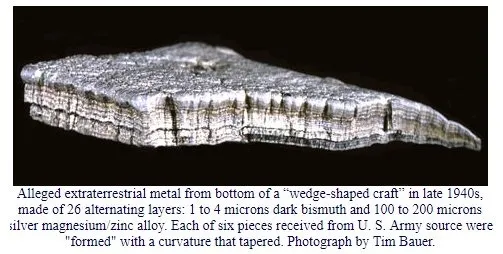
The letters described a family connection to the 1947 Roswell incident and claimed the pieces came from the underside of a wedge-shaped craft.
Shortly after the first shipments to Bell, the sender wrote directly to Howe, explaining his intent to route the “artifacts” to the research community through Bell as a neutral trustee.
These letters, preserved by Bell’s team, outline a narrative of debris with layered construction and a purported aerospace purpose. (artbelllegacy.com)
From the outset Howe moved to document, photograph and test the materials. Among the most discussed samples was a layered piece whose cross-section showed alternating bands.
The specimen’s profile and micrographs, which Howe published and revisited for decades, would later be central to renewed laboratory testing in the 2010s and 2020s.
Early laboratory forays: 1996 to the 2010s
Howe sought mainstream labs willing to examine the layered sample.
She has said that in 1996 she took a piece to Carnegie Science’s Department of Technical Magnetism, which could not establish an off-planet origin.
She also consulted physicist Hal Puthoff, who studied the fragment on multiple occasions; in a 2012 note to Howe he reported that experiments applying various fields did not yield anomalous results, though he outlined theoretical questions worth pursuing if the structure proved to be engineered at micron scales.
These episodes illustrate Howe’s insistence on repeatedly re-testing the same specimen as instrumentation improved. (VICE)
Across Earthfiles, Howe published a seven-part series that compiled the specimen’s backstory, cross-section imagery, and earlier analytical snapshots.
The series helped cement shared vocabulary in the UAP community, including discussion of “micron-layered bismuth and magnesium-zinc” laminates and terahertz-frequency behavior.
Even prior to the 2019 resurgence of interest, her archive served as a living dossier for future testing. (Earthfiles)
TTSA, ADAM, and the Army CRADA: institutionalizing the question
In July 2019, To The Stars Academy of Arts & Science (TTSA) announced it had acquired multiple pieces of “metamaterials” and an archive of prior analyses for its ADAM Research Project.
TTSA’s release noted that some of these items had been “retained and studied” for years by Howe.
This was a pivotal institutional handoff. It moved the specimen from a journalist-curated archive into a program designed to solicit structured laboratory evaluations and to explore potential applications.
Media coverage and filings indicated that TTSA paid to obtain several items, including six pieces of the Bismuth/Magnesium-Zinc material, plus a piece of aluminum. (To The Stars*)
Within months, TTSA inked a cooperative research and development agreement with the U.S. Army Combat Capabilities Development Command. The CRADA referenced testing “novel materials” among other topics.
Although the agreement did not commit direct U.S. funding to TTSA, it opened federal laboratory doors, where some of the most capable instrumentation on the planet could be applied to long-debated samples.
Journalists at The War Zone documented the scope of the Army collaboration and connected it directly to the ADAM material stream. (The War Zone)
AARO and Oak Ridge National Laboratory: 2023–2024 deep characterization
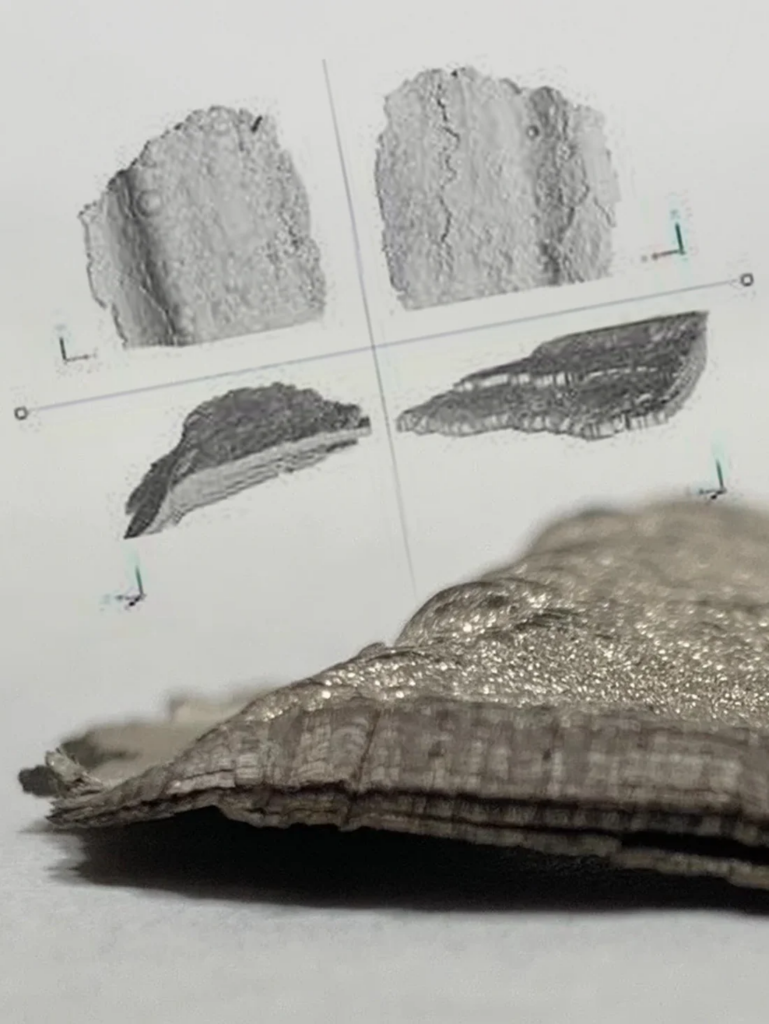
In 2024 the U.S. Defense Department’s All-domain Anomaly Resolution Office (AARO) released a synopsis of an analysis performed at Oak Ridge National Laboratory (ORNL) on a magnesium-based metallic specimen accessed via a TTSA–DEVCOM agreement. ORNL applied a suite of techniques, from CT scanning and SEM-EDS to TEM and high-resolution mass spectrometry, to characterize morphology, elemental makeup, crystal structure, and isotopic signatures.
The results identified a magnesium matrix with about 2 percent zinc, along with banded layers in which bismuth and lead were tightly co-located in roughly equal proportions. ORNL reported that the magnesium and lead isotope ratios fell within terrestrial ranges. (AARO)
AARO’s supplement emphasized that the specimen was highly unlikely to have functioned as a bismuth terahertz waveguide because the bismuth bands were not single, pure crystalline layers and because lead was co-mixed with bismuth in the bands.
The supplement also noted that while the specimen showed layered structure and evidence of heat and mechanical stress, those features did not constitute proof of non-terrestrial origin.
The analysis did not trace chain-of-custody to the 1940s and treated the material as a modern sample of uncertain provenance. (AARO)
TTSA publicly acknowledged the reports and stated that, while the analyses offered hypotheses about provenance, they did not settle the material’s original purpose or all observed anomalies, and that further study would continue.
Whatever one’s interpretation, Howe’s decades-long curation of the layered sample is inseparable from why top national-lab instruments ultimately touched it. (To The Stars*)
The Nolan-Vallée parallel track: 2025-2026 update
As of 2025-2026, the most consequential update to the Howe materials story is not a reversal of the 2024 ORNL findings, but a widening of the research frame. Dr. Garry Nolan, a Stanford pathology professor and co-founder of the Sol Foundation, has continued discussing UAP-related material analysis in public interviews, including work associated with Jacques Vallée and samples tied by claim or provenance to Ubatuba, Council Bluffs, and Roswell. The careful reading is important: Nolan has not published peer-reviewed proof that these fragments are extraterrestrial technology. He has instead emphasized advanced isotopic and atomic-scale analysis, with anomalies treated as research targets rather than final answers. (Nolan et al., 2022; Mayim Bialik’s Breakdown, 2026)
The Ubatuba material remains central. Earlier public discussion focused on magnesium fragments from the 1957 Brazil case, including Nolan’s report that one sample showed magnesium isotope ratios roughly 30 percent away from expected terrestrial ratios while another sample tested in the same instrument appeared normal. More recent discussion complicates the picture: Nolan has said that material obtained through Vallée, once thought to be primarily magnesium, appears instead to be highly pure silicon with anomalous silicon isotope distribution. That distinction matters because it implies at least two claimed chains of material from the same historical event, not one simple sample set. (Campion, 2021; Sentinel News, 2026)
Council Bluffs provides a different kind of signal. Vallée and Nolan’s 2022 paper and related reporting described the Iowa material as isotopically ordinary but atypically mixed, with a molten mass reportedly deposited after multiple witness observations. This makes Council Bluffs less an isotope anomaly case than an “incomplete mixing” or unusual alloy case. For UAPedia, that distinction should be explicit: the scientific question is not merely whether the isotopes are strange, but whether the physical structure, thermal history, chain of custody, and local explanations cohere better with ordinary industrial residue or with an event that remains unresolved. (Nolan et al., 2022; Scoles, 2022)
Roswell-linked material claims should be treated with even more caution. Nolan has publicly discussed alleged artifacts connected to Roswell and atomic-level analysis of metal fragments, but the publicly available record does not yet provide a peer-reviewed chain of custody tying any sample directly to the 1947 event. In the Howe biography, these claims belong in the “research frontier” category, not in the “resolved physical evidence” category. (Mayim Bialik’s Breakdown, 2026)
Nolan’s broader interpretation has also evolved beyond materials alone. He has argued in interviews that non-human intelligence may have been present on Earth for a long time and has speculated that some UAP could be autonomous or AI-like emissaries rather than crewed craft. Separately, he has discussed cases of alleged UAP-related biological injury, including neurological effects and damage patterns in white matter. These claims belong alongside the materials discussion because they point toward a combined research program: physical fragments, witness biology, and anomalous event context need to be evaluated together, not in isolation. (Mayim Bialik’s Breakdown, 2026)
The editorial bottom line is therefore stronger, not weaker, than before. Howe’s decades of archiving helped keep anomalous-material claims available for later testing. ORNL’s 2024 work narrowed claims around the Art’s Parts laminate. Nolan and Vallée’s work widens the field again by emphasizing more precise isotopic tools, Ubatuba’s unresolved sample history, Council Bluffs’ unusual alloy characteristics, and the possibility that material evidence may be only one layer of a larger UAP evidence chain. The evidence remains provocative, incomplete, and worthy of further study.
What, exactly, is the layered specimen?
The layered piece long associated with Howe and Bell has been described in public reporting as alternating bands of magnesium-zinc alloy and bismuth at micron scales.
Advocates proposed that, if intentionally manufactured, such a structure might influence terahertz propagation or electromagnetic behavior.
Skeptical critics countered that similar laminates can arise in terrestrial alloys and that without airtight chain-of-custody, mundane origins cannot be excluded.
The 2024 ORNL work grounded this dialogue by mapping banding and co-location at high resolution and by placing the magnesium and lead isotopes firmly within solar-system norms.
No waveguide function was demonstrated in the configuration observed. (AARO)
Separate pieces in the broader “Art’s Parts” cache, such as thin louvered aluminum sheets, have been plausibly matched to heat-exchanger fins by independent investigators, which reinforced the case for cautious, piece-by-piece vetting.
Yet the specific magnesium-bismuth-lead-zinc laminate that Howe elevated remains the most technically scrutinized member of the set. (Metabunk)
Other materials Howe has chronicled
Beyond the wedge-craft sample, Howe has reported on historical cases such as the 1957 Ubatuba, Brazil fragments. That case has become more important in light of Nolan and Vallée’s renewed isotopic work, especially because public discussion now distinguishes highly pure magnesium claims from a separate sample path that may involve high-purity silicon with anomalous isotope ratios. (Campion, 2021; Sentinel News, 2026)
Those samples have been the subject of multiple lab campaigns over the decades. Recent peer-reviewed work and technical summaries have not resolved origin, but they show why high-resolution isotopic analysis, careful contamination controls, and sample-by-sample provenance are essential. Earlier work found some magnesium isotope ratios within terrestrial limits, while Nolan has highlighted at least one Ubatuba-related sample with ratios substantially outside expected terrestrial standards. (Journal of Scientific Exploration; Nolan et al., 2022; Campion, 2021)
Howe has also revisited earlier claims, compared lab notes across eras, and argued that only sustained, cross-lab replication will resolve outstanding anomalies. The 2025-2026 Nolan discussion reinforces that point: Ubatuba, Council Bluffs, Roswell-linked samples, and Art’s Parts should not be collapsed into one conclusion. Each requires its own chain of custody, control samples, isotopic profile, structural analysis, and published methodology.Journal of Scientific Exploration
Books, films, and key media projects
Howe’s writing and films form a parallel spine to her materials work.
Her book An Alien Harvest (1989, expanded in 2014) pulled together interviews and documents on animal mutilations and potential non-human involvement.
The two-volume Glimpses of Other Realities series, published in the 1990s, compiled testimony and case files across multiple phenomena.
Mysterious Lights and Crop Circles (2002) explored patterns reported in English, North American, and Norwegian fields. (Wikipedia)
Her filmography includes the 1980 Emmy-winning A Strange Harvest and its 1993 follow-up Strange Harvests 1993, both of which helped fix the mutilation mystery within the larger UAP conversation.
More recently, History Channel’s Ancient Aliens devoted a 2024 episode to Howe’s body of work, underscoring her continued cultural visibility. (IMDb)
Known associates and research network
Howe’s materials arc is braided with a network of investigators and institutions:
Art Bell. The radio host who first received the “Art’s Parts” shipments in 1996 and posted the letters that mentioned Howe by name. His platform catalyzed the public phase of the saga. (artbelllegacy.com)
Budd Hopkins. Abduction researcher who appeared with Howe on Coast to Coast programs as the materials story unfolded. (Coast to Coast AM)
Hal Puthoff. Physicist who examined the layered specimen in the 1990s and 2012 and later co-founded TTSA, which acquired pieces previously curated by Howe. His correspondence to Howe documented non-anomalous results in certain field tests while outlining theoretical questions. (VICE)
Tom DeLonge and the TTSA team. Howe’s transfer of material and archives dovetailed with TTSA’s ADAM program and the Army CRADA that eventually enabled ORNL’s testing. (To The Stars*)
Jacques Vallée and Garry Nolan now form the most important parallel scientific track adjacent to Howe’s material work. Their published work in Progress in Aerospace Sciences proposed modern mass spectrometry, including SIMS and isotopic analysis, as a disciplined pathway for evaluating unusual materials with potential aerospace-forensics relevance. Their public comments and later interviews place Ubatuba, Council Bluffs, Roswell-linked samples, and other alleged fragments inside the same broad question Howe helped popularize: can anomalous physical specimens be moved from lore into repeatable laboratory science? (Nolan et al., 2022; Scoles, 2022; Mayim Bialik’s Breakdown, 2026)
Controversies that shaped the narrative
The Kirtland AFB document episode
In April 1983, while developing a television project on UAP, Howe met with Air Force Office of Special Investigations sergeant Richard Doty at Kirtland AFB.
She has long stated that Doty showed her purported briefing pages describing crash retrievals and a secret oversight group, material that later intersected with the MJ-12 document controversy.
Subsequent journalistic and scholarly treatments have framed those pages as fabrications connected to broader disinformation efforts of that era.
The episode remains a key flashpoint in assessments of Howe’s sources and an instructive caution about document provenance even as laboratory work proceeds on physical samples.
Crop-circle photography and interpretive disputes
Howe’s photographic interpretations of lights and energy near crop circles drew sharp rebuttals from skeptics who argued that certain images were consistent with mundane camera artifacts.
This back-and-forth, which played out in Skeptical Inquirer and beyond, became a proxy for a larger methodological debate: when data are ambiguous, how far should interpretation go, and how quickly should photography yield to lab-grade measurement? (Center for Inquiry)
Solving the wrong puzzle piece
A subset of “Art’s Parts,” notably thin louvered aluminum sheets, were convincingly identified as radiator-fin stock used in heat exchangers.
That finding does not resolve the layered magnesium specimen at the heart of Howe’s campaign, but it reinforced community norms around chain-of-custody, comparative sampling, and the risk of mixing disparate industrial odds-and-ends into a single narrative. (Metabunk)
Predictions, claims, and bounded hypotheses
Over the years Howe has amplified two technical hypotheses around the layered specimen:
1. Terahertz behavior.
The idea that micrometer-scale bismuth layers between dissimilar dielectrics could function as a waveguide at terahertz frequencies.
ORNL’s 2024 analysis challenged this in the tested sample because the bismuth was nanocrystalline and co-mixed with lead in multiple layers rather than existing as a single pure crystalline film. (AARO)
2. Electrostatic effects.
Early demonstrations reported by Howe showed sideways motion of the layered piece under a high-voltage field that did not occur with a control piece of aluminum.
The effect, as documented by Bell’s site at the time, invited replication but did not establish net lift or exotic performance. (artbelllegacy.com)
3. Isotopic and incomplete-mixing anomalies.
Nolan and Vallée’s work adds a third bounded hypothesis: some alleged UAP-related samples may show anomalous isotope ratios or unusual elemental mixing that is not immediately explained by common industrial processes. Ubatuba is the strongest isotopic discussion, while Council Bluffs is better described as an unusual alloy or incomplete-mixing case. This remains a research hypothesis unless independent laboratories reproduce the findings, publish the methods, and clarify provenance. (Nolan et al., 2022; Campion, 2021; Scoles, 2022)
Howe has also reported testimonies and documents alleging deep government knowledge of non-human craft and programs.
These claims have inspired some and alienated others.
The most lasting outcome is not any single forecast, but Howe’s insistence that claims be buttressed by measured properties, repeatable tests, and the willingness to submit samples to dispassionate labs. (Earthfiles)
Impact on the UAP community
Howe’s impact on UAP discourse is multifaceted:
Normalizing laboratory engagement.
Long before “metamaterials” became a headline word in UAP circles, Howe was asking metallurgists and physicists to look at specific pieces and to publish results.
That drumbeat, and her Earthfiles archiving, made it easier for later entities such as TTSA to point to existing data and propose new testing, for AARO to task ORNL, and for researchers such as Nolan and Vallée to frame material analysis as aerospace forensics rather than mere artifact collecting. (Earthfiles; Nolan et al., 2022; AARO)Earthfiles
Expanding audience and vocabulary.
Through A Strange Harvest, Sightings, Earthfiles, and a persistent presence on History Channel, Howe helped mainstream a language of materials, isotopes, laminates, and terahertz that reframed UAP from “lights in the sky” to industrial artifacts. (Earthfiles)
Catalyzing scrutiny.
Critics engaged because the claims were testable. The heat-exchanger identification and ORNL’s isotopic results are examples of the community policing its own narratives through hard measurement.
Howe’s willingness to hand samples to other parties, even ones likely to offer skeptical conclusions, marks a consequential posture for evidence-based UAP work. (Metabunk)
Current work and presence
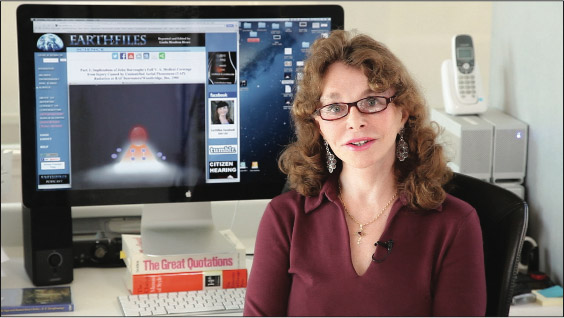
Howe remains prolific.
Earthfiles publishes weekly video and podcast updates that cover new science, environmental anomalies, and continuing UAP leads, including ongoing commentary about national-lab analyses, TTSA, ORNL, AARO, and future testing pathways. In parallel, Nolan’s 2025-2026 interviews have renewed public attention on whether Ubatuba, Roswell-linked materials, and witness-injury data can be studied together under a more rigorous scientific program. (Mayim Bialik’s Breakdown, 2026)
In 2024 the History Channel’s Ancient Aliens aired a profile episode, and Howe’s long-form Earthfiles podcasts revisited the layered specimen in light of AARO’s and ORNL’s documents.
Her personal bio and Earthfiles site enumerate awards, milestones, and continuing speaking engagements. (Apple TV)
Selected timeline: Howe’s investigations
1980. A Strange Harvest airs in Denver and wins a Regional Emmy, establishing Howe’s reputation in anomalous phenomena with on-camera reporting and field forensics. (IMDb)
1996. Art Bell receives shipments of metal fragments with Roswell-linked letters. The sender writes separately to Howe. Early bench tests and microscope imagery begin to define the “layered sample.” (artbelllegacy.com)
1996–2012. Howe coordinates tests at Carnegie Science and with Hal Puthoff. Results are inconclusive for non-terrestrial origin, which drives calls for more advanced analysis. (VICE)
2019. TTSA acquires pieces and Howe’s archive for the ADAM program, then signs a CRADA with the U.S. Army for laboratory collaboration. (To The Stars*)
2019. Howe publishes a consolidated seven-part Earthfiles series on the magnesium-bismuth sample’s research history. (Earthfiles)
2022. Nolan, Vallée, Jiang, and Lemke publish a peer-reviewed methods paper in Progress in Aerospace Sciences describing modern isotopic and materials-analysis techniques applicable to unusual materials and aerospace forensics, with Council Bluffs as a key case study. (Nolan et al., 2022)
2023–2024. AARO commissions ORNL to perform deep materials characterization, then releases public synopses with conclusions that the isotopes are terrestrial and waveguide hypotheses are unlikely in the sample as analyzed. TTSA acknowledges the reports and continues pursuit of additional testing. (AARO)
2025-2026. Nolan publicly discusses renewed Ubatuba analysis, including the claim that one Vallée-obtained sample thought to be magnesium appears to be highly pure silicon with anomalous isotope distribution. He also discusses Roswell-linked material claims and UAP-related biological injury research, while continuing to stress that anomalous measurements are not yet peer-reviewed proof of extraterrestrial technology. (Mayim Bialik’s Breakdown, 2026; Sentinel News, 2026)
Books and films: a concise dossier
- An Alien Harvest (1989; expanded 2014). Howe’s foundational book on patterns surrounding mutilations and alleged non-human involvement. (Wikipedia)
- Glimpses of Other Realities Vol. I (1993/1994) and Vol. II (1997/1998). Collections of testimony and documents across UAP, abductions, and anomalous technology. (Biblio)
- Mysterious Lights and Crop Circles (2002). Field accounts and photographic case files. (Earthfiles)
- A Strange Harvest (1980) and Strange Harvests 1993 (1993). Award-winning documentaries that established Howe’s on-camera investigative style in anomalous domains. (IMDb)
A critical synthesis: what Howe’s material investigations changed
Linda Moulton Howe did not settle the origin of the layered specimen. She did change the terms of engagement. By insisting that claims be tested, preserved, and re-tested as new instruments come online, she helped pull UAP discourse toward the bench.
When ORNL releases elemental maps and isotopic plots, or when AARO publishes method notes and CRADA pathways, those outputs exist in part because a journalist kept asking labs to look, and because she curated samples well enough to survive multiple analytical generations.
Her approach also set expectations. The community now recognizes that chain-of-custody matters. That aluminum fin stock cannot be folded into the same narrative as magnesium-bismuth banding. That a photograph of “something weird” is not the same as a diffraction pattern. And that when a federal lab says “terrestrial isotopes” and “no waveguide,” the appropriate response is not retreat but better questions and cleaner experiments.
The biography of Howe as it pertains to UAP materials is, therefore, less about any single conclusion and more about building a durable culture around testable artifacts.
If there is truly engineered UAP material in private or institutional hands, the investigative framework that Howe helped normalize is what will ultimately surface it. (AARO)
Claims Taxonomy
Verified
Howe received, documented, preserved, and circulated anomalous-material claims and samples for testing across multiple decades.
TTSA acquired materials and archives associated with Howe’s work, and ORNL/AARO later analyzed a magnesium-based specimen accessed through the TTSA-DEVCOM pathway.
The ORNL/AARO findings are verified as published government and national-lab outputs, though UAPedia should apply its government-source caution when interpreting their framing.
Probable
Howe’s archiving materially influenced later institutional and scientific attention to UAP materials.
Nolan and Vallée’s 2022 peer-reviewed paper demonstrates that unusual materials can be studied using modern aerospace-forensics methods, even when origin remains unresolved.
Disputed
The origin and function of the Art’s Parts layered specimen, the Ubatuba fragments, Council Bluffs material, and Roswell-linked samples remain unresolved.
Some isotopic or structural findings are provocative, while chain-of-custody, contamination, industrial explanations, and independent replication remain live issues.
Misidentification
Some material in the broader Art’s Parts cache, especially louvered aluminum sheets, has been plausibly identified as terrestrial heat-exchanger fin stock.
This does not settle the layered magnesium-bismuth-lead-zinc specimen, but it warns against treating mixed caches as one evidentiary object.
Speculation Labels
Hypothesis
Some alleged UAP materials may preserve signatures of advanced manufacturing, unusual thermal history, isotopic manipulation, or incomplete elemental mixing that warrant independent replication.
Witness Interpretation
Claims that specific materials came from Roswell, Ubatuba, Council Bluffs, or other UAP events depend on testimony, letters, investigator memory, and chain-of-custody narratives. These may be sincere and valuable, but they are not equivalent to direct physical proof without corroborating documentation.
Researcher Opinion
Howe argues that anomalous materials could become a bridge from testimony to laboratory science. Nolan has publicly suggested that non-human intelligence may be present and that some UAP could be autonomous or AI-like emissaries. These interpretations should be clearly separated from the measured data.
References
AARO. (2024, July 10). Synopsis: Analysis of a metallic specimen. https://www.aaro.mil/Portals/136/PDFs/Information%20Papers/ORNL-Synopsis_Analysis_of_a_Metallic_Specimen.pdf
AARO. (2024, July). AARO’s supplement to ORNL’s analysis of a metallic specimen. https://www.aaro.mil/Portals/136/PDFs/Information%20Papers/AAROs_Supplement_to_ORNLs_Analysis_of_a_Metallic_Specimen.pdf
Earthfiles. (2019, Sept. 6–12). 7-Part: Mysterious Bismuth and Magnesium-Zinc metal from bottom of wedge-shaped UFO. https://www.earthfiles.com/bismuth/
Earthfiles. (n.d.). Linda Moulton Howe – Bio. https://www.earthfiles.com/linda-moulton-howe-bio/
Fox 10 Phoenix. (2019, Oct. 22). US Army partners with Tom DeLonge’s UAP research company. https://www.fox10phoenix.com/news/us-army-partners-with-former-blink-182-frontman-tom-delonges-ufo-research-company-to-develop-future-tech
History.com Editors. (2021, Apr. 27). The mysterious history of cattle mutilation. https://www.history.com/articles/cattle-mutilation-1970s-skinwalker-ranch-ufos
IMDb. (n.d.). A Strange Harvest (1980). https://www.imdb.com/title/tt6362274/
IMDb. (n.d.). Strange Harvests 1993. https://www.imdb.com/title/tt37762019/
Micah Hanks Program. (2024, Jul. 17). The Roswell material: Oak Ridge & AARO analyze ‘Art’s Parts’. https://micahhanks.com/podcast/2024/07/17/07-17-24-the-roswell-material-oak-ridge-aaro-analyze-arts-parts/
Popular Mechanics. (2019, Jul. 29). Tom DeLonge’s organization says it obtained ‘metamaterials’. https://www.popularmechanics.com/space/deep-space/a28539617/tom-delonge-ufo-metamaterials/
The War Zone / The Drive. (2019, Oct. 18). What we know about the Army teaming up with Tom DeLonge’s company. https://www.twz.com/30481/what-we-know-about-the-army-teaming-up-with-rockstar-tom-delonges-ufo-research-company
The War Zone / The Drive. (2019, Oct. 20). The Army wants to verify TTSA’s mystery material claims. https://www.twz.com/30498/the-army-wants-to-verify-to-the-stars-academys-fantastic-ufo-mystery-material-claims
To The Stars Academy. (2019, Jul. 25). Makes groundbreaking metamaterials acquisition. https://tothestars.media/blogs/press-and-news/to-the-stars-academy-of-arts-science-makes-groundbreaking-metamaterials-acquisition
To The Stars (2024, Jul.). ORNL and AARO material analysis update. https://tothestars.media/blogs/press-and-news/ornl-and-aaro-material-analysis
Vice / Motherboard (Banias, M.). (2019, Nov. 14). UFO researcher explains why she sold ‘exotic’ metal to Tom DeLonge. https://www.vice.com/en/article/ufo-researcher-explains-why-she-sold-exotic-metal-to-tom-delonge/
Wikipedia contributors. (n.d.). Linda Moulton Howe. https://en.wikipedia.org/wiki/Linda_Moulton_Howe
Wikipedia contributors. (n.d.). To The Stars Inc. (ADAM and materials section). https://en.wikipedia.org/wiki/To_The_Stars_Inc.
Art Bell Legacy. (n.d.). Roswell Crash anonymous letters, including letter to Linda Howe. https://artbelllegacy.com/ArtBell/roscrash.html
Skeptical Inquirer / Nickell, J. (2002). Circular Reasoning: Crop circles. https://centerforinquiry.s3.amazonaws.com/wp-content/uploads/sites/29/2002/09/22164740/p17.pdf
Metabunk. (2019, Jul. 31). Identified: Art Bell’s “UFO” aluminum louvered sheets. https://www.metabunk.org/threads/identified-art-bells-ufo-aluminum-louvered-sheets-heat-exchanger-fins.11012/
Journal of Scientific Exploration. (2022). Isotope ratios and chemical analysis of the 1957 Brazilian Ubatuba fragment. https://journalofscientificexploration.org/index.php/jse/article/view/2415/1565
Sentinel News. (2026, April 14). Dr. Nolan: “It’s a laboratory where both sides, at least at this point now, are the rats.” https://www.sentinel-news.org/p/dr-nolan-its-a-laboratory-where-both
Scoles, S. (2022, March 21). Jacques Vallée still doesn’t know what UAP are. Wired. https://www.wired.com/story/jacques-vallee-still-doesnt-know-what-ufos-are/
Nolan, G. P., Vallée, J. F., Jiang, S., & Lemke, L. G. (2022). Improved instrumental techniques, including isotopic analysis, applicable to the characterization of unusual materials with potential relevance to aerospace forensics. Progress in Aerospace Sciences, 128, 100788. https://doi.org/10.1016/j.paerosci.2021.100788
Mayim Bialik’s Breakdown. (2026, January 27). The CIA’s UAP & alien research! “Their brains looked fried” | Stanford’s Garry Nolan. https://www.bialikbreakdown.com/episodes/the-cias-uap-alien-research-their-brains-looked-fried-stanfords-garry-nolan
Campion, T. (2021, December 10). Stanford professor Garry Nolan is analyzing anomalous materials from UAP crashes. Vice / Motherboard. https://www.vice.com/en/article/stanford-professor-garry-nolan-analyzing-anomalous-materials-from-ufo-crashes/
SEO keywords
Linda Moulton Howe, Earthfiles, A Strange Harvest, UAP materials, metamaterials, Art’s Parts, bismuth magnesium zinc layers, TTSA ADAM, Oak Ridge National Laboratory, AARO, terahertz waveguide, Hal Puthoff, Art Bell, Coast to Coast AM, Ubatuba magnesium, Sightings TV series, Ancient Aliens, laboratory analysis of UAP debris, isotopic ratios, chain of custody, Garry Nolan, Jacques Vallée, Ubatuba silicon isotope anomaly, Ubatuba magnesium isotope ratios, Council Bluffs molten metal, incomplete mixing alloy, Roswell-linked materials, aerospace forensics, SIMS, nanoSIMS, atomic probe tomography, non-human intelligence materials, UAP witness injury, white matter damage, Sol Foundation