
Roy Neary, Richard Dreyfuss’s character in Close Encounters of the Third Kind, does not become obsessed in a grand, heroic way. He becomes obsessed the way real humans do. In the kitchen. At a table. With tired eyes and a half-eaten dinner.
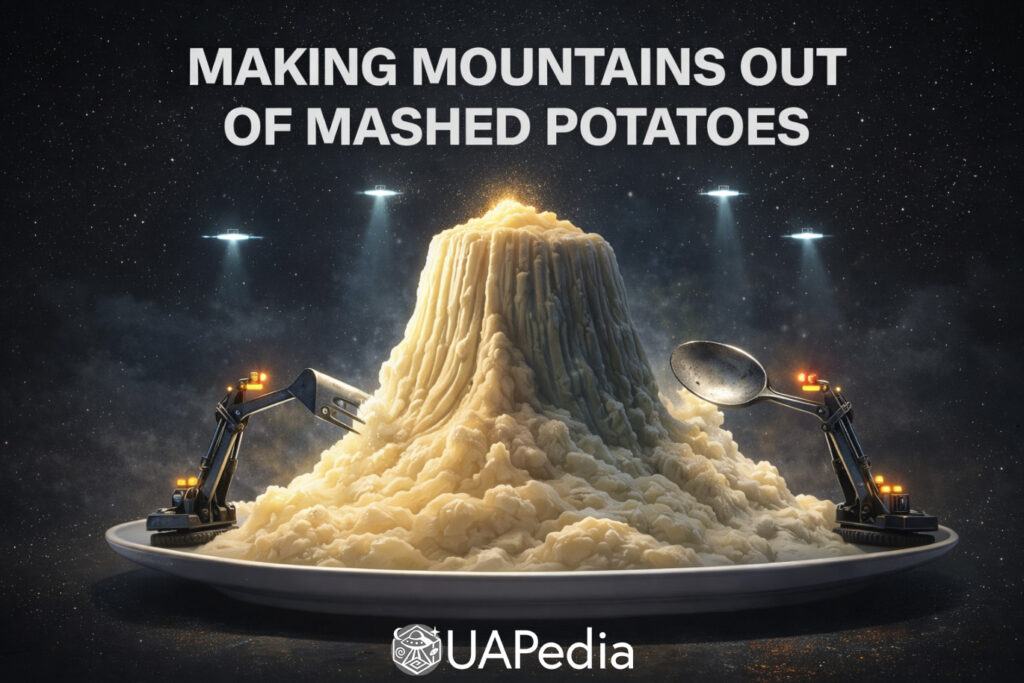
He stares at his plate, then starts sculpting a little mountain out of mashed potatoes. Not because it is delicious. Because it is urgent. His family watches, horrified, as he builds the shape that has been haunting him since his encounter with a UAP. The scene is funny until it is not. It is funny because it is ridiculous. It is not funny because it is recognizable.
Most of us do not turn dinner into Devil’s Tower. We do something more modern. We turn life into tabs: podcasts, PDFs, witness accounts, sensor debates, documentaries, conference notes, and late-night messages that begin with “You have to see this.”
In other words, we make mountains out of mash potatoes.
UAPedia’s editorial standards insist on two things at once: distinguish evidence from interpretation, and do not dismiss credible human experience. That balanced posture is the only way to survive a subject that lives equally in the sky and in the psyche.
This is an editorial about the “why” underneath the fascination. What is the common thread? Why do we keep building the mountain?
The common thread is not belief, it is a call to participate
UAP does something unusual. It recruits.
Sometimes it recruits via direct experience: a sighting, a close encounter, a string of anomalies that refuse to stay “small.” Sometimes it recruits second-hand: a pilot’s testimony, a journalist’s investigation, an archival discovery, a friend’s shaken voice describing what happened to them. Either way, the result is similar: the mind feels addressed.
The phenomenon does not only present an object to observe. It presents a question that observes us back.
That is why the community is so diverse. It is not one hobby. It is a migration route for different temperaments: the experiencer, the scientist, the activist, the archivist, the storyteller, the meditator, the policy wonk, and the person who swears they are “just curious” while bookmarking their 400th link.
So here is a deliberately simple framework to name the pull. You asked for “XXXX.” Let’s treat it as four intersecting Xs, four motives that keep the mountain growing.
XXXX: The Four Xs behind our fascination
X1: eXperience
This is the Roy Neary entry point: “I saw something, and now reality has a seam.”
UAPedia’s CE-1 to CE-5 explainer notes how “close encounter” classifications originated as a modest investigative shorthand, and how pop culture later expanded the idea far beyond its initial boundaries. The taxonomy is useful, but the more important point is what it implies: proximity changes people.
Experience is why the subject never stays academic. It keeps producing witnesses, and witnesses keep producing aftershocks.
X2: eXplanation
This is the Jacques Vallée entry point: “Whatever this is, it does not fit a single box, so build a better box.”
UAPedia describes Vallée as a foundational figure in modern UAP studies, arguing for rigor without prematurely collapsing the phenomenon into one explanation. It also notes the cultural loop that Spielberg baked into Close Encounters: Vallée helped inspire the French scientist Claude Lacombe.
Explanation is also why archives matter. Vallée’s UAP and paranormal papers, including field notes and correspondence spanning decades, are preserved at Rice University as a major collection. It is an institutional signal that the topic has enough intellectual gravity to deserve serious preservation. (archives.library.rice.edu)
X3: eXposure
This is the Ross Coulthart and Steven Bassett entry point: “If this is real, then who has been managing the story, and why?”
UAPedia’s dossier on David Grusch notes that Grusch’s interview with journalist Ross Coulthart helped push whistleblower claims into a wider public arena, intensifying debate and pressure for transparent adjudication.
Coulthart’s book In Plain Sight is written as a journalist’s investigation into a story that mainstream coverage has often handled cautiously. (HarperCollins)
Steven Bassett’s Paradigm Research Group, by its own description, was established in 1996 to lobby for “Disclosure,” advocating an end to what it calls a government-imposed truth embargo about an extraterrestrial presence. (Paradigm Research Group)
Exposure is where UAP becomes political: not only “What is it?” but “Who controls the narrative, and who gets oversight?”
X4: eXistential meaning
This is the Kelly Chase, Linda Moulton Howe, and Jesse Micheal’s entry point: “Even if we never get a clean answer, this is doing something to human consciousness and culture.”
Kelly Chase’s podcast Cosmosis (formerly The UFO Rabbit Hole) frames itself as exploring UAP, non-human intelligence, consciousness, and “the hidden architectures of reality.” (Apple Podcasts)
Jesse Michels’ American Alchemy pitches weekly conversations with “heretical thinkers/ideas,” a tone that fits the UAP world perfectly: you come for the science and tech, and then the conversation slips into ontology like a banana peel. (Apple Podcasts)
Linda Moulton Howe is the reporter and editor behind Earthfiles, an extensive archive of reports covering science, environment, and unexplained “Real X-Files” mysteries. (Earthfiles)
Existential meaning is why the subject refuses to stay inside “nuts-and-bolts” arguments. Even the people who insist they only care about sensors eventually find themselves asking: What does this mean for being human?
The mashed potatoes problem
Now the uncomfortable part.
The same impulse that makes us brave enough to investigate also makes us vulnerable to overbuilding. Humans hate unfinished shapes. We see fragments and want wholeness. We get a blurry clip and want a complete craft blueprint. We get a testimony and want a unified theory of everything.
Roy Neary’s mountain is comedic because it is disproportionate. A pile of potatoes becomes a cosmic monument.
In UAP research, disproportion looks like this:
- Treating every new anecdote like a verdict.
- Treating every debunk like a funeral.
- Treating every data gap as proof of a hidden answer.
UAPedia’s standards explicitly reject false certainty and premature conclusions, while also rejecting dismissive reductionism. That means the discipline is not “believe everything.” The discipline is “weight evidence, track uncertainty, respect witnesses, and keep your mind flexible.” (UAPedia)
So yes, laugh at the mashed potatoes. Then notice the deeper message: obsession is not the enemy. Undisciplined obsession is.
Implications: why this matters beyond curiosity
Cultural rehearsal
The Library of Congress notes that Close Encounters of the Third Kind was added to the National Film Registry in 2007, recognizing its cultural significance. (The Library of Congress)
That matters because culture is where humanity practices its reactions to the unknown before the unknown arrives in the daytime.
Scientific triage and better measurement
UAPedia’s “Six Observables” article frames Elizondo’s list as a field heuristic, not a government standard. It also emphasizes evidence caveats: a single video rarely proves an observable on its own, and real progress requires multi-sensor, time-synchronized data.
That is the grown-up version of the mashed potatoes: stop sculpting vibes, start sculpting protocols.
Archives as a form of legitimacy
When Rice University hosts their conference “Archives of the Impossible” and preserves major UAP-related collections, it normalizes something that used to be relegated to ridicule: interdisciplinary inquiry into anomalous experience as a serious human problem. (Rice News)
Governance and accountability
Advocacy and journalism exist because people suspect there is more documentation than is publicly accessible, and because credible witnesses increasingly speak in official contexts. That tension will not disappear, even if the origin question remains unresolved.
The psychological frontier
UAPedia’s consciousness-focused articles explicitly use speculation labeling while discussing the recurring “life after the extraordinary” pattern: shifts in worldview, values, and meaning-making that follow anomalous experiences.
Whether you treat this as signal, side effect, or something stranger, it is part of the phenomenon’s footprint.
References
American Film Institute. (n.d.). AFI Catalog entry: Close Encounters of the Third Kind. (AFI Catalog)
Chase, K., & King, J. C. (n.d.). Cosmosis (formerly The UFO Rabbit Hole). Apple Podcasts. (Apple Podcasts)
HarperCollins. (n.d.). In Plain Sight (Ross Coulthart). (HarperCollins)
Howe, L. M. (n.d.). Linda Moulton Howe – Bio. Earthfiles. (Earthfiles)
Library of Congress. (2018, December 1). “Close Encounters of the Third Kind”: National Film Registry #19. (The Library of Congress)
Michels, J. (n.d.). American Alchemy with Jesse Michels. Apple Podcasts. (Apple Podcasts)
Paradigm Research Group. (n.d.). About PRG. (Paradigm Research Group)
Rice University. (n.d.). Collection: Jacques F. Vallee UAP and paranormal phenomena papers (ArchivesSpace record). (archives.library.rice.edu)
Rice University News. (2025, April 9). Exploring the unexplained: A new chapter in the Archives of the Impossible… (Rice News)
UAPedia. (n.d.). UAPedia Editorial Standards – Navigating the Mystery. (UAPedia – Unlocking New Realities)
UAPedia. (n.d.). The Six Observables – Elizondo Model. (UAPedia – Unlocking New Realities)
UAPedia. (n.d.). Jacques Vallée: The Father of Modern UAP Studies. (UAPedia – Unlocking New Realities)
SEO keywords
UAP, unidentified anomalous phenomena, USO, unidentified submerged objects, Close Encounters of the Third Kind, Roy Neary, Devil’s Tower, Jacques Vallée, Ross Coulthart, Kelly Chase, Jesse Michels, Linda Moulton Howe, Steven Bassett, disclosure, Six Observables, CE-1, CE-5, consciousness and UAP, ontological shock, UAP research, UAPedia