
Among Cold War era UAP reports, the 24 October 1968 events near Minot Air Force Base in North Dakota stand out because they generated something rare in the historical record: coordinated observations by ground security teams, an aircrew on a B-52H, base radar operators, and a short sequence of radarscope photographs recorded on film.
Project Blue Book’s case file runs to well over a hundred pages, including radio transcripts, AF-117 witness forms, radar and weather notes, and the Air Force’s own “final case report.” Independent researchers later recovered and digitized the record and added technical analyses of the B-52 radarscope frames.
Whatever one’s conclusion about origin, there is enough data to reconstruct what participants saw, what the instruments recorded, and how the government analyzed it. (Minot AFB UFO)
The night of 24 October 1968, step by step
Setting and units. Minot was then a Strategic Air Command base with B-52H bombers and a surrounding Minuteman ICBM complex.
In the early morning hours, security and maintenance personnel across the November flight area began radioing unusual lights to Base Operations. Minot Radar Approach Control (RAPCON) joined the net and a returning B-52H on training mission, call sign JAG-31, was asked to assist. (Minot AFB UFO)
Ground witnesses. The Blue Book file preserves brief, time stamped accounts from airmen at missile facilities. Airman First Class Robert O’Conner reported seeing a self luminous light “moving in various directions in the southern skies” from about 02:30 to 03:45. A1C Lloyd Isley said he watched an object “from 00:30 to 04:30,” at times hearing a sound like jet engines and seeing a color shift from white to green to dim amber.
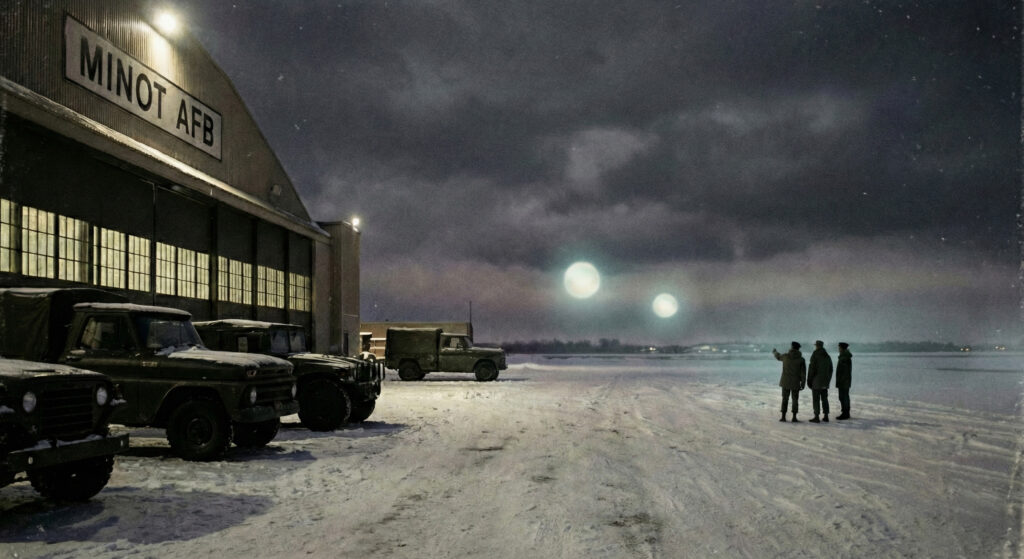
Others including A1C Jablonski and A1C Adams described a glowing object that alternated reddish orange, white, and green, sometimes apparently hovering and then moving. These entries are not sensational; they read like duty logs.
RAPCON and the B-52. RAPCON alerted the crew of JAG-31 to a target and the B-52 navigator picked it up on the radarscope at a range of several miles, maintaining separation during a standard 180 degree turn.
As the bomber started descent toward Minot, the unknown appeared to close rapidly to about one nautical mile, “pacing” the aircraft for a long segment before dropping from the display. The crew recorded a short sequence of radarscope photographs during this close approach. Independent reviewers later identified the frames as 771 through 784, captured over about 37 seconds. (Minot AFB UFO)
Communications anomaly. At one point in the close approach, the bomber’s two UHF radios would not transmit, then returned to normal within minutes.
The Blue Book final case report timeline lists “0400–0402 B-52 regains ability to transmit.” That anomaly, because it has a time, an aircraft, a context, and an official note, remains one of the most discussed details.
Pilot’s visual. Pilot Maj. James Partin reported a bright orange light about fifteen miles away in the west northwest around 04:30 to 04:35, described as on or near the ground and stationary during his approach. This sighting appears separately in the file from the earlier radar pacing episode.
The radarscope film. Fourteen frames of the B-52’s ASQ-38 radar display were photographed between 09:06:14Z and 09:06:51.5Z. Technical studies by Claude Poher and by Martin Shough examined the geometry, antenna mode, range rings, and the behavior of a compact echo that appears repeatedly at about one mile off the nose in the two o’clock quadrant, sometimes as a double return separated by a tenth to two tenths of a mile.
The sequence spans one complete rotation of the antenna per exposure, and the aircraft moved roughly 2.6 nautical miles during the series. This is instrument data, not a memory. (Minot AFB UFO)
First hand voices, in their own clipped language
Blue Book’s final case report summarizes several AF-117 witness forms and the cockpit and controller recordings. It is not poetry. It is checklists and clipped notes from people on duty.
- A1C O’Conner: he watched a “self luminous big ball of white light that seemed to change to a green light, then later to a dim amber color,” from about 02:30 to 03:45.
- A1C Isley: he observed for “three and a half to four hours,” sometimes hearing a noise “that of jet engines,” and at one time “sighted two objects.”
- A1C Adams: he described a “reddish orange light” that “kept changing white and occasionally green,” sometimes stationary and sometimes speeding up.
- Maj. Partin: he “visually sighted an unidentified light” that appeared as “a bright orange ball of light about 15 miles away,” stationary during his approach.
The Blue Book text also notes that “B-52 scope photos start 0406:15” and end 36 seconds later, and that “RAPCON” and weather radar had their own paints during parts of the episode. The tight timestamps are why this case still draws engineers to the archive.
What the government did
Immediate actions. As soon as JAG-31 landed, the pilot debriefed with Base Operations. Minot’s commander designated Lt. Col. Arthur Werlich as investigating officer under Air Force Regulation 80-17. Teletype traffic shows Strategic Air Command headquarters at Offutt AFB calling Blue Book early the next business day to ensure procedures were followed. Werlich sent a map overlay plotting the B-52 and the unknown, and he forwarded AF-117s and the “Basic Reporting Data” packet that Blue Book required. (Minot AFB UFO)
Project Blue Book’s evaluation. Blue Book chief Lt. Col. Hector Quintanilla filed the final case report on 13 November 1968. The analytical section is revealing. It asserts that
- the brightest astronomical object visible was Sirius, whose blue red white green scintillation could be enhanced by an inversion and haze,
- portions of the B-52’s maneuvers and landing lights could account for some ground visual reports,
- the pilot’s later orange light might have been Vega near the horizon,
- “plasmas can affect electrical equipment and can also be painted on radar,” including ball lightning, and
- the aurora is common over Minot that time of year.
Those are the government’s words. They are not ambivalent about preferred explanations.
Closure and afterlife. Blue Book’s public files were retired to the National Archives when the program closed in 1969.
The Air Force’s official overview today notes that 701 of 12,618 Blue Book cases remained “unidentified” overall, without breaking out Minot by label in that high level fact sheet.
The Minot file itself shows the Air Force favoring a mix of star, airplane, and plasma to explain different elements, an assessment that independent investigators dispute. (U.S. Air Force)
What the data say when you line them up
Multiple channels at once. The core reason Minot is studied is that three channels align during the 03:30 to 04:10 window. Ground observers reported a luminous object moving against the southern sky.
The B-52 navigator recorded a series of radarscope images where a compact return appeared about one nautical mile off the nose at a constant bearing, sometimes splitting into double echoes. RAPCON and weather radar had paints that operators announced on air. Triangulation is difficult after the fact, but the coincidence is not trivial. (NICAP)
Kinematics from the radarscope film. The independent technical studies agree on the basic geometry. The photos were shot in “station keeping” mode, which trades long range for elevated sensitivity near the aircraft. Range rings on the film allow estimates of distance. The compact echo persists near one mile at “about forty degrees” relative bearing in several frames, briefly resolves into a double echo about a tenth of a mile apart, and then is gone. The bomber covers a couple of miles during the thirty seven second series. The behavior is consistent with a contact that held station briefly and then moved, but interpretation is debated. (Minot AFB UFO)
The radio outage. The Blue Book time line plainly notes that JAG-31 regained the ability to transmit between 04:00 and 04:02. The episode coincides with the close approach and the radarscope sequence. Blue Book’s analytical section asserts that “plasmas” can affect electrical systems, which is offered as a catchall rather than as a diagnosis backed by measurements of a plasma in that sky at that moment. The outage remains an unexplained, but documented, fact.
How Blue Book framed it. The final report’s emphasis on Sirius, autokinesis, and B-52 landing lights for ground observers, and on Vega for the later pilot visual, shows the Air Force habit at that stage: parse a multi part event into slices and attach a familiar explanation to each slice. The same memo explicitly suggests “ball lightning” for radar and radio effects, although ball lightning in clear weather and at that duration is a stretch. That posture is part of why the case is still argued.
Images you can actually study
- Blue Book case file, final report. This is the Air Force’s own write up with a minute by minute time line, excerpts of AF-117 witness forms, and the analytical section that names Sirius, Vega, autokinesis, and plasma. The document also time stamps when the B-52 lost and regained transmission, and when the scope photos were shot. (Minot AFB UFO)
- Radarscope frames 771 to 784. Independent researchers have posted a complete set of the B-52’s radarscope photos with frame by frame descriptions, including positions of compact echoes near one nautical mile range. Technical annexes explain the radar mode and range ring calibration. (Minot AFB UFO)
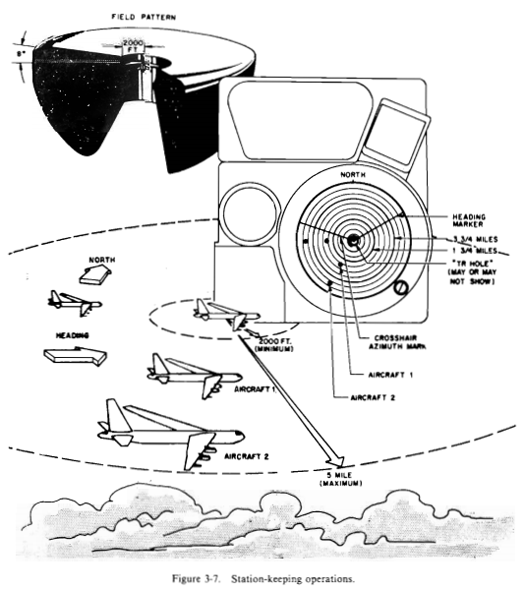
Those two assets, together with the raw witness forms in the document pile, are the backbone of any serious Minot review. You do not need artist’s renderings when you can look at what the instrument saw and read what the witnesses wrote.
Follow up across decades
- Archival consolidation. The privately maintained Minot case site has assembled the 145 pages of Blue Book materials, plus the radarscope photos and teletype traffic in chronological order, and has published Werlich’s memos and map overlays. The site is not an official source, but it is a well organized pointer to official scans. (Minot AFB UFO)
- Technical analyses. Detailed studies by Claude Poher and Martin Shough of the radarscope frames explore clock timing, antenna rotation, and echo morphology, and derive bounds on distance and motion. These analyses do not prove what the object was; they do demonstrate that a compact radar target repeatedly presented near one nautical mile range. (Minot AFB UFO)
- Media and scholarly treatments. Documentaries and papers continue to use Minot as a test case for government handling of UAP. Academic uploads and older television reporting have brought the case to new audiences while preserving the raw materials. (Academia)
How strong is the evidence
Strengths. Multi channel observations, timestamped instrument data, and a comprehensive official paper trail make Minot far stronger than a typical single witness nocturnal light. The B-52 radarscope film and the logged radio outage are particularly notable.
Weaknesses. There is no raw primary radar tape from RAPCON, no synchronized weather radar film, and no air to air or air to ground optical imagery of the object. Blue Book did not obtain or publish detailed equipment performance checks that might rule out rare radar artifacts. And the analytical section’s reliance on astronomical and “plasma” placeholders did not meaningfully test alternative hypotheses.
Bottom line. The record supports that something with radar cross section near one mile from the B-52 briefly held a constant bearing and then vanished, and that ground and air witnesses saw unusual lights in roughly the same window. What it was remains disputed.
Government posture in context
Blue Book’s official public stance near the end of the program was that no UAP posed a national security threat and that no evidence suggested exotic technology. The Air Force closed Blue Book in 1969 and transferred the files to the National Archives. Today the service’s fact sheet simply notes the closure and the count of unidentifieds across the program. Minot thus sits at the cusp between institutional wrap up and a data rich case that never drew a more rigorous, instrument heavy follow on. (U.S. Air Force)
Implications for nuclear site security and UAP research
Minot was not a routine airspace incursion. It happened over a nuclear mission base and missile field at the height of the Cold War. Even if every element had resolved into the prosaic, the mere possibility of an uncorrelated target pacing a bomber near its home base would justify a more formal multi sensor doctrine. Today that lesson lands in an era where unknown drones have probed nuclear plants and bases in several countries. When unknowns appear around nuclear forces or critical infrastructure, the answer is not speculation. It is synchronized optical, infrared, radar, and radiofrequency capture with known sensor settings and a shared time base. The Minot file shows how much more we could have learned with that approach. (NICAP)
Claims taxonomy
Verified
- Multiple USAF personnel reported an unusual light around Minot AFB during the early hours of 24 October 1968; a B-52H crew recorded fourteen radarscope photographs during a close encounter; and the crew’s UHF transmitters were briefly inoperative during the encounter before returning to normal. These items appear in the Project Blue Book final report.
- Project Blue Book investigated under AFR 80-17. Lt. Col. Arthur Werlich forwarded AF-117 witness forms, a plotted overlay, and other data to Wright-Patterson; Strategic Air Command followed up by phone with Blue Book on the first business day. (Minot AFB UFO)
- Independent technical studies of the B-52 radarscope frames exist and reconstruct geometry and timing across frames 771 to 784. (Minot AFB UFO)
Probable
- The compact echo visible near one nautical mile range in several frames is unlikely to be a simple ground return in station keeping mode, given the echo’s morphology and persistence across successive antenna rotations. This is an inference from Poher and Shough’s analyses and the radar mode description. (Minot AFB UFO)
Disputed
- Blue Book’s attribution of ground visuals to Sirius, Vega, and the B-52’s own lights, and of the radar and radio anomalies to “plasma similar to ball lightning,” is contested by later analysts who argue the explanations do not engage the instrument data.
Legend
- Claims of an extended dogfight or of weapons interference in this case do not appear in the Blue Book file. They are later embellishments that do not match the contemporaneous record.
Misidentification
- Some long duration ground visuals in the southern sky are plausibly explained by bright stars seen through haze and inversion with autokinetic effects, and by the B-52’s approach lights diffused by weather, as Blue Book argued. This does not account for the specific one mile radar pacing episode.
Speculation labels
Hypothesis
The B-52 radarscope sequence likely captured a real, compact target at about one nautical mile range that briefly maintained relative position, which is consistent with an object executing station keeping with the bomber. Whether that target was a foreign test vehicle, a rare atmospheric radar phenomenon, or something more exotic cannot be resolved from the surviving data. (Minot AFB UFO)
Witness interpretation
Ground observers who saw a bright, color shifting light for long intervals may have mixed more than one source into a single narrative, including the B-52’s own lights during approach and bright stars near the horizon under inversion. That does not explain the radar pacing episode, but it cautions against one to one mapping between every visual and every instrument record.
Researcher opinion
Blue Book’s treatment of Minot reads more like an exercise in attaching familiar labels than a genuine falsification effort. A modern reinvestigation would start by reprocessing the radarscope frames with contemporary image tools, modeling the ASQ-38 antenna pattern and side lobes, and testing whether known clutter modes or ground echoes at that geometry could mimic the compact, on bearing one mile return. (Minot AFB UFO)
Bottom line
Minot is not an internet rumor. It is a documented sequence in which trained personnel tracked an unknown, a bomber crew recorded radarscope images of a compact return near one mile, and the aircraft briefly lost radio transmit capability during the close approach.
The Air Force’s own case report tried to explain the ground lights as stars and the aircraft itself, and the radio and radar effects as “plasma.”
Later technical work respects the Blue Book scans but challenges those conclusions on the instrument merits. Without raw RAPCON radar tapes or synchronized weather radar film, Minot will not resolve to certainty.
Yet the surviving data are already enough to teach the modern lesson.
When an unknown appears near nuclear forces, the way to separate stars, airplanes, and the truly anomalous is not with a slogan.
It is with calibrated, multi channel measurement that can be replayed and checked forensically. Minot shows how close we came to that standard in 1968 and how far we still had to go.
References
Project Blue Book final case report for Minot AFB, 24 October 1968. The Air Force time line, witness summaries, and analytical conclusions are here. (Minot AFB UFO)
Consolidated document archive, maps, AF-117 forms, and radarscope film index for the Minot case. (Minot AFB UFO)
Radarscope photograph index and frame by frame descriptions. (Minot AFB UFO)
Claude Poher, “Analysis of Radar and Air-Visual UFO Observations on 24 October 1968 at Minot AFB, North Dakota.” Technical analysis of frames 771 to 784. (Academia)
NICAP case summary with links to additional research notes and analyses. (NICAP)
National Archives overview of Project Blue Book records. (National Archives)
US Air Force fact sheet on Project Blue Book and the count of unidentifieds. (U.S. Air Force)
SEO keywords
Minot AFB 1968 UAP, Minot B 52 radarscope photos, JAG 31 radar pacing, Minot missile field UAP, Project Blue Book Minot case, Arthur Werlich AFR 80 17, Hector Quintanilla analysis, Claude Poher radarscope study, Martin Shough Minot analysis, UAP near nuclear bases, Air Force UHF radio outage, RAPCON radar Minot, AF Form 117 witness accounts, Strategic Air Command UAP incident, UAPedia Minot case file.