Project Blue Book is often treated like a single government “answer” to the UAP question. It was not. It was a long-running interface between the public and the U.S. The Air Force was built to handle one problem that never stayed inside a neat box: reports of unknown objects in the sky arriving through military channels, civilian channels, and media pressure, year after year, during the tensest decades of the Cold War.
Blue Book mattered for two reasons that are easy to miss.
First, it produced a huge record set that still anchors serious historical work.
Second, it set the tone, for better and worse, for how institutions talk about UAP when they want to investigate without inflaming public attention.
Even today, arguments about transparency, stigma, and “unknowns” usually end up back at Blue Book, because Blue Book is where the modern template was stress-tested.
The timeline people blur, and why it matters
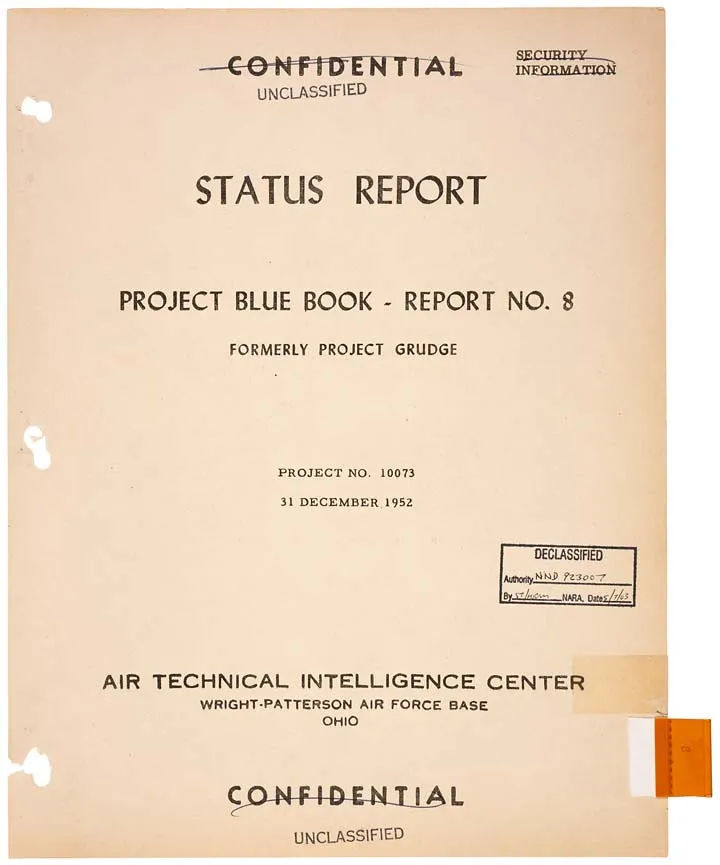
Project Blue Book ran from 1952 to 1969. The Air Force’s broader effort started earlier under different names, beginning with Project Sign, then Project Grudge, and then reorganizing under the Blue Book name. That chronology is stated plainly in official material and in Air Force reporting regulation language. (WHS ESD)
You can see the continuity in Air Force Regulation 200-2 (AFR 200-2). The regulation defined what counted as an “unidentified flying object,” established reporting responsibilities, and framed the two core purposes that remained consistent throughout the era: assess possible threat to the security of the United States and determine technical or scientific characteristics that might be involved. (WHS ESD)
This is one reason Blue Book cannot be dismissed as a passing curiosity. The reporting pipeline was built into the logic of air defense. An Air Force that collects such reports can choose blind spots.
Blue Book’s mission on paper
A U.S. Department of Defense information paper released via the Washington Headquarters Services FOIA Reading Room describes Blue Book’s objectives as “two-fold”: determine whether UAP pose a threat to U.S. security and determine whether they exhibit any technological principles beyond known science. (WHS ESD)
That same document also outlines the program’s process: initial investigation and local reporting, deeper analysis at Wright-Patterson Air Force Base, and public dissemination through Air Force information channels. (WHS ESD)
This is where readers sometimes leap to an overconfident conclusion. It is a verified fact that Blue Book’s workflow included public communication. (WHS ESD) It is an analytical interpretation, not a proven institutional intent, to claim that Blue Book “was public relations.” The historically fair statement is that the program was asked to investigate and to communicate, and those goals sometimes pulled in different directions.
Ruppelt: first-hand insight from inside the machine
Captain Edward J. Ruppelt led Blue Book in the early 1950s and later published The Report on Unidentified Flying Objects, one of the most important first-hand accounts of the program’s internal life. Ruppelt describes the daily reality of case intake, interviews, categorization, and briefing pressure, and he also describes efforts to professionalize how the Air Force handled reports.
One of his most enduring contributions is linguistic: he pushed for more neutral terminology, understanding that “flying saucer” language amplified ridicule and sensationalism, which can distort both reporting and investigation.
Ruppelt is not a final authority on every case, but he is a crucial witness to how Blue Book operated as an institution, and why it struggled to meet scientific expectations while also surviving public attention.
1952: the year everything got louder
By mid-1952 the UAP question was no longer confined to scattered reports. It became a national mood.
Washington, D.C., 1952: radar, visuals, and an official statement
The Washington, D.C. events of July 1952 brought intense attention because they involved radar activity and visual sightings in the airspace around the capital. The Air Force responded publicly.
A National Archives educational record of Major General John A. Samford’s statement shows how the institution framed the issue: most reports were attributed to conventional causes, a smaller remainder involved credible observations, and there was no known threat.
This is best treated as a disputed case cluster. The historical fact of the episode, its prominence, and the official statement are well supported. The adequacy of prosaic explanations for every component remains debated.
What Washington undeniably did was demonstrate that uncertainty itself could become operationally significant. The CIA’s later historical study of its involvement notes that surges in sightings raised concerns about potential interference with air defense operations. (cia.gov)
The Robertson Panel: attention becomes a security variable
In 1953, the CIA convened the Robertson Panel, which is widely associated with recommendations emphasizing public education and improved recognition of conventional objects, partly to reduce the reporting burden and public excitement. CIA records in the Reading Room reflect this “training and education” framing.
It is verified that officials discussed strategies to reduce confusion and manage the impact of reporting waves. (cia.gov) A scholarly interpretation is that such strategies can contribute to long-term stigma around reporting, even if stigma was not explicitly stated as the goal.
The statistics beneath the stories: Special Report No. 14 and the “unidentified remainder”
Blue Book is remembered for dramatic cases, but it also treated the phenomenon as a dataset. Project Blue Book Special Report No. 14 (1955) is central to that statistical turn, analyzing large numbers of reports and trying to correlate report quality with identification outcomes. A CIA Reading Room-hosted copy of the analysis exists and is often referenced in technical discussions of the era’s statistical approach. (Physics SMU)
The larger point, echoed across multiple official summaries, is that even after years of classification effort, a remainder persisted.
The U.S. Air Force’s own fact sheet summarizes the headline totals most often cited: 12,618 sightings reported to the Air Force’s investigative effort, and 701 remaining “unidentified.” It also states that Project Blue Book was terminated on December 17, 1969. (NSA)
The National Archives likewise states that the Secretary of the Air Force announced termination on December 17, 1969 and that the Blue Book records are held in archival custody and available for research. (National Archives)
Those numbers do not prove any particular origin. What they do prove is that, within the investigative and institutional constraints of the time, the Air Force could not make every case behave.
Case study: Socorro, 1964 and the power of proximity
On April 24, 1964, Socorro police officer Lonnie Zamora reported a close-range encounter: a loud roaring sound, a flame-like descent, a white object on the ground, and two small figures nearby. The case became one of Blue Book’s most discussed close encounter files, often highlighted for trace claims and immediate law enforcement reporting.
Socorro’s durability comes from its structure as testimony: a named professional witness, a specific time and place, rapid reporting, and a scene that was examined. That does not guarantee perfect perception or eliminate alternative explanations, but it raises the evidentiary bar compared with anonymous, distant light sightings.
Skeptical analyses have proposed prank or misinterpretation hypotheses, and those deserve engagement rather than ridicule, because the strongest cases are exactly the ones that demand the hardest tests. Socorro remains unresolved in publicly available records, which is precisely why it continues to function as a benchmark for how Blue Book handled high-impact, close-range reports.
Case study: Michigan, 1966 and how one phrase became a political crisis
In March 1966, Michigan produced a wave of reports that gained national attention. The “swamp gas” explanation associated with J. Allen Hynek became a cultural shorthand for dismissiveness, whether or not it addressed some portion of the sightings.
The political backlash is documented. In the Ford Library’s 1966 UAP press packet, Congressman Gerald R. Ford pressed for congressional attention and criticized the ease with which the reports were being explained away.
This episode is important for a reason that goes beyond Michigan. It shows how quickly public trust can be damaged when official explanations feel rhetorically dismissive. That is a narrative observation, not a scientific claim, but it matters because Blue Book’s credibility depended on witnesses continuing to report, especially trained witnesses.
Case study: Portage County, 1966 and the pursuit problem
In April 1966, deputy sheriffs in Portage County, Ohio reported a long-duration encounter and vehicle pursuit of a bright object. The persistence of the case in UAP literature comes from duration and apparent behavior rather than a fleeting sighting.
Some widely used scans of the file are hosted by secondary repositories rather than by the National Archives itself. A publicly accessible copy is available and commonly cited.
This is exactly the sort of case where Blue Book’s triage approach can run into limits. Long-duration events are vulnerable to perceptual confusion, but they also generate richer testimony that is harder to compress into a one-word label. The case remains disputed, and it illustrates why the “unknowns” problem does not vanish simply because you would like it to.
Case study: Lakenheath–Bentwaters, 1956 and what radar-visual cases did to the debate
One of the most historically significant mid-era incidents connected to Blue Book-era documentation is the radar-visual event over eastern England on August 13–14, 1956, commonly called the Lakenheath–Bentwaters incident. It is frequently discussed because it involved radar tracking and trained personnel at U.S. Air Force facilities, and it has long been treated as a hard test for simple misidentification narratives.
A CIA Reading Room PDF discussing “UFO Encounter II” describes the events at Bentwaters based on the Blue Book file and presents the Lakenheath incident primarily through the night-watch supervisor’s account and radar context. (cia.gov)
This source is useful not because the CIA document magically “solves” the case, but because it shows how the incident was framed through official-adjacent analysis: structured narrative, radar considerations, and an attempt to work with what was recorded rather than with rumor.
Lakenheath–Bentwaters is best handled with the same disciplined humility as Washington. Radar systems can produce anomalous returns under certain conditions, and human interpretation of radar displays can be shaped by expectation. At the same time, radar-visual combinations are exactly what air defense systems are designed to interpret, and that is why these cases remain provocative decades later.
If Blue Book had only dealt in distant lights, it would not have become culturally permanent. It became permanent because of cases like this, where the witness set was trained and the reporting context was operational.
The closing argument: Condon, NAS review, and formal termination
By the late 1960s, Blue Book’s critics and defenders both wanted a definitive scientific evaluation. The result was the University of Colorado study led by physicist Edward U. Condon. The Condon Report is widely available in complete form through established repositories, and it reflects the study’s breadth, from case analysis to photographic and radar issues to broader conclusions. (The Black Vault)
The National Academy of Sciences review of the Colorado study, available through the WHS FOIA Reading Room, endorsed the broad conclusion that further extensive study was not justified on the expectation of scientific payoff, while still treating this as a judgment based on the evidence reviewed. (WHS ESD)
Then came the formal punctuation: a December 17, 1969 press release announcing that the Air Force would terminate Project Blue Book. (documents.theblackvault.com)
The verified historical story is therefore clean: study, review, termination, archive transfer. (National Archives) The controversy is interpretive: whether the closing posture adequately reflects the complexity and unresolved residue that many readers find inside the case record.
Controversies: incentives, criticism, and the boundary between analysis and accusation
Serious scientific criticism of Blue Book existed inside its own era, not only in hindsight. Atmospheric physicist James E. McDonald argued that official posture and investigative culture could create incentives to minimize the “unidentified” category, and he criticized what he viewed as prematurely dismissive tendencies.
This is the correct framing: McDonald’s argument is criticism and analysis, not a proven finding of intent. What can be established from primary documents is that the Air Force had formal objectives, formal reporting procedures, and a public communication function embedded in the workflow. (WHS ESD) Whether those structures “shaped outcomes” is a matter of scholarly assessment, and different researchers weigh the evidence differently.
A careful reader can still draw a reasonable inference that institutional pressures existed. Cold War organizations value stability, and UAP surges created noise, anxiety, and operational concerns. The CIA history makes clear that officials worried about interference with air defense systems during the 1952 wave. (cia.gov) It is not a stretch to conclude that institutions would prefer fewer unknowns, but it is still an inference, and it should be labeled as such.
Blue Book’s legacy: the archive, the template, and the unresolved remainder
The National Archives holds Blue Book records and notes their custodial status and availability for research, which is why Blue Book remains more than lore. It is a researchable corpus. (National Archives)
Blue Book’s cultural legacy is harder to quantify but impossible to ignore. Many researchers argue that public-facing debunking and dismissive tone contributed to stigma around reporting. That claim is best treated as scholarly interpretation, supported indirectly by documented attention-management discussions and by the documented political backlash when official explanations felt too casual.
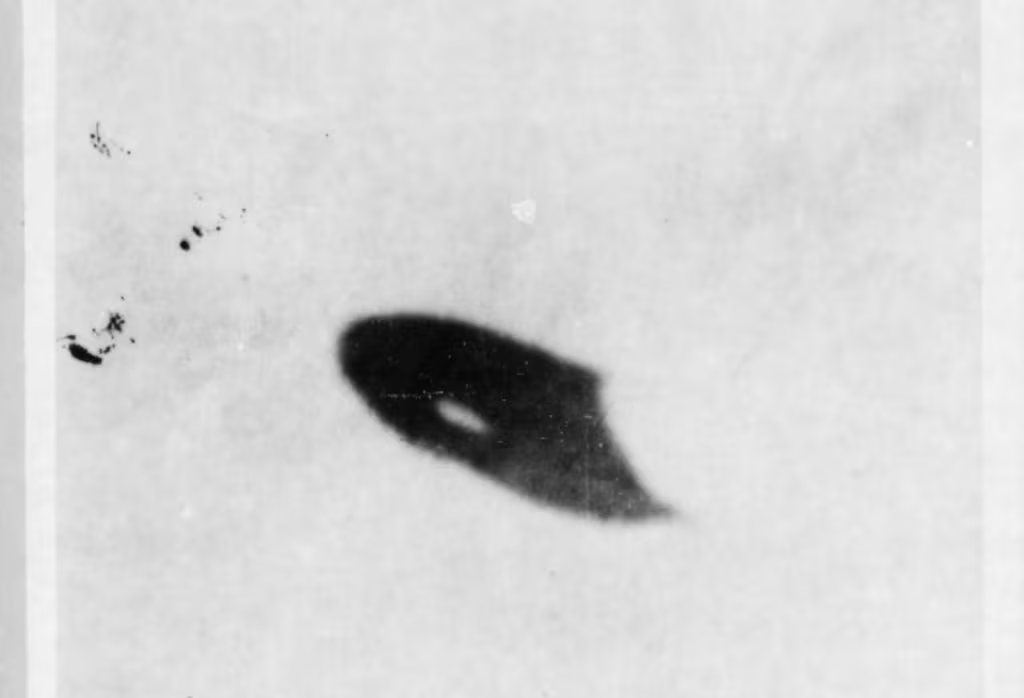
And then there is the remainder: 701 cases that remained “unidentified” in the Air Force’s own summary. (NSA) That remainder is not a proof of origin. It is a proof of limits, and it forces modern readers to ask what a more scientifically resourced, less socially stigmatized, better-instrumented approach might discover.
Blue Book ended in 1969. The question of how to study persistent anomalies in a way that is both rigorous and socially workable did not end. It simply moved forward into new agencies, new vocabulary, and new political cycles.
Claims taxonomy
Verified
Project Blue Book operated as a U.S. Air Force program from 1952 to 1969, within a broader Air Force investigative effort that began earlier under Projects Sign and Grudge. (WHS ESD)
The U.S. Air Force reports that 12,618 cases were investigated and 701 remained “unidentified,” and that the project was terminated on December 17, 1969. (NSA)
The National Archives states that the Secretary of the Air Force announced termination on December 17, 1969 and that records are held in archival custody for research. (National Archives)
The DoD / WHS FOIA Reading Room information paper states Blue Book’s two-fold objectives and references AFR 200-2 as the procedural basis for reporting. (WHS ESD)
Probable
Socorro (1964) remains among the strongest Blue Book-era close encounter reports in public documentation, with rapid law enforcement reporting and trace claims, while still lacking definitive attribution in the public record.
Disputed
The Washington, D.C. events (1952) are documented as a major episode prompting official public statements, while the adequacy of explanations for all components remains debated. (cia.gov)
The Lakenheath–Bentwaters incident (1956) is documented through radar-visual narrative and official-adjacent discussion, while definitive attribution remains contested in open literature. (cia.gov)
Misidentification
A large portion of reports were resolved as conventional objects or phenomena, consistent with Air Force summaries and the program’s stated investigative purpose. (NSA)
Speculation labels
Hypothesis
The “unidentified” remainder in Blue Book reflects a recurring class of anomalous events that becomes clearest in close-range or radar-visual cases and that mid-20th-century investigative workflows could not consistently resolve. (NSA)
Witness Interpretation
In close-range cases like Socorro, the witness interpretation “a craft landed” follows naturally from perceived proximity and scene detail, even though interpretation alone does not establish origin or mechanism.
Researcher Opinion
Blue Book’s most lasting contribution is its record set, and its most damaging side effect was credibility loss when official explanations sounded rhetorically dismissive. This is an interpretive synthesis grounded in the documented public communication role of the program and in documented political backlash episodes such as Michigan 1966. (WHS ESD)
Selected active links
United States Air Force (USAF) fact sheet PDF (USAF Fact Sheet 95-03):
DoD / WHS FOIA Reading Room (Project Blue Book information paper, Feb 1, 1966):
https://www.esd.whs.mil/Portals/54/Documents/FOID/Reading%20Room/UFOsandUAPs/proj_b1.pdf
DoD / WHS FOIA Reading Room (Air Force investigation timeline fact sheet):
https://www.esd.whs.mil/Portals/54/Documents/FOID/Reading%20Room/UFOsandUAPs/2d_af_1.pdf
National Archives: Project Blue Book records:
https://www.archives.gov/research/military/air-force/ufos
CIA (Haines) “CIA’s Role in the Study of UFOs, 1947–90” (PDF):
https://www.cia.gov/resources/csi/static/cia-role-study-UFOs.pdf
CIA Reading Room (UFO Encounter II / Lakenheath–Bentwaters discussion):
https://www.cia.gov/readingroom/docs/CIA-RDP81R00560R000100010010-0.pdf
Ruppelt (public domain):
https://www.gutenberg.org/ebooks/17346
Condon Report (complete scan):
https://documents2.theblackvault.com/documents/ntis/CondonReport-Complete.pdf
References
Condon, E. U. (1968). Scientific study of unidentified flying objects (Final report). University of Colorado. (The Black Vault)
Central Intelligence Agency. (1953). Robertson Panel-related document entry (FOIA Reading Room).
Haines, G. K. (1997). CIA’s role in the study of UFOs, 1947–90. Central Intelligence Agency, Center for the Study of Intelligence. (cia.gov)
Ruppelt, E. J. (1956). The report on unidentified flying objects. Doubleday.
U.S. Department of Defense, Washington Headquarters Services. (1966, February 1). Project Blue Book (information paper, FOIA Reading Room). (WHS ESD)
United States Air Force. (1995). USAF Fact Sheet 95-03: Unidentified flying objects and Air Force Project Blue Book (publicly released PDF). (NSA)
U.S. National Archives and Records Administration. (n.d.). Project BLUE BOOK: Unidentified flying objects. (National Archives)
SEO keywords
Project Blue Book, Project Blue Book 1952–1969, UAP history, United States Air Force UAP investigations, Project Sign, Project Grudge, AFR 200-2, Wright-Patterson AFB ATIC, Edward J. Ruppelt, Washington D.C. UAP 1952, Robertson Panel 1953, Blue Book Special Report No. 14, Socorro landing 1964, Michigan 1966 UAP, Gerald Ford UAP letter 1966, Portage County chase 1966, Lakenheath Bentwaters 1956, radar-visual UAP cases, Condon Report 1968, National Archives Project Blue Book records, DoD WHS FOIA Blue Book documents