If you drive into Utah’s Uinta Basin with daylight left, the land does something subtle to your sense of scale. The horizon stretches wider than you expect. The roads feel longer than they should. The sky becomes a kind of lid, close and immense at the same time. Then, tucked into that spaciousness, you find a patch of private property that has spent three decades refusing to behave like a normal place.
Skinwalker Ranch, also known in earlier reporting as the Sherman ranch, is not a single story. It is a stack of stories, laid down in layers: a family’s frightened months with cattle and lights; a billionaire’s long, mostly private attempt to instrument the weirdness; a later era of cameras, teams, and televised experiments; and, threaded through it all, a paper trail that proves at least one thing beyond argument: serious people with resources believed the reports were worth time, money, and attention.
That last point matters, because Skinwalker Ranch sits at the intersection where UAP research often breaks: between what witnesses insist happened, what investigators claim they documented, and what the public can actually audit. The ranch has become famous partly because it promises a simple deal. Go there. Record the phenomena. Show the world.
But the deal has never stayed simple.
Where it is, and why that matters
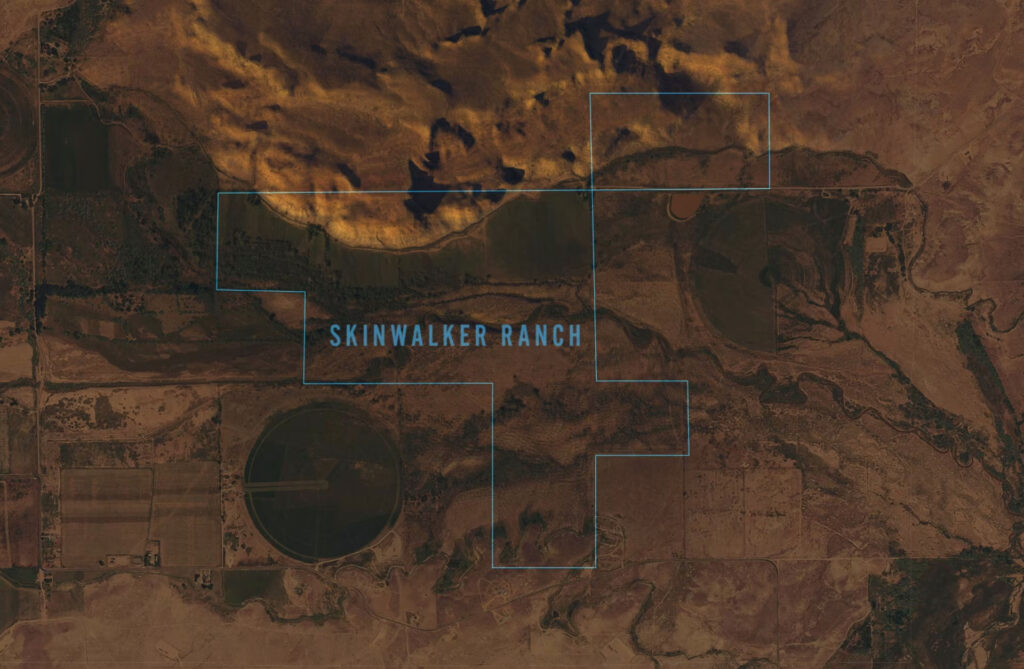
The ranch lies in Uintah County in northeastern Utah, in the Uinta Basin region referenced in early local reporting, near communities such as Fort Duchesne and Randlett. (Deseret News) The geography is not just scenery. Big skies, low light pollution, and a long local tradition of “something in the air” all feed the modern narrative. Deseret News reported in 1996 that a retired schoolteacher, Joseph “Junior” Hicks, had investigated hundreds of sightings in the basin since the early 1950s, and that locals had their own long-running sense of recurring aerial oddities. (Deseret News)
This is also where an explainer has to be honest: a region having a culture of sightings does not prove a region is generating anomalies. It does, however, shape how witnesses interpret events, how often they report them, and how quickly a location’s reputation compounds. The Uinta Basin can be both a real place and a symbolic magnet.
Skinwalker Ranch became the basin’s most powerful symbol because the events reported there were not “one weird light, one weird night.” They were described as sustained, varied, and intimate, involving animals, family members, and allegedly close-range interactions.
How the ranch entered the record: the Sherman years
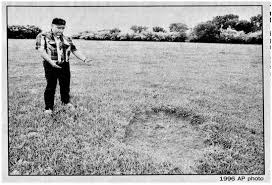
In June 1996, Deseret News pushed the ranch into public view with a piece that did two important things at once. It treated the witnesses as real people with a real problem, and it treated the claims as extraordinary. The article described the Shermans’ ranch as a “hotbed” for what it called UFOs and “bizarre paranormal activity,” noting that the family claimed to have witnessed events with their own eyes and a video camera. (Deseret News)
The details matter because they set the template that still defines the ranch today.
The Shermans described repeated sightings of multiple types of aerial objects. They described lights emerging from circular “doorways” in midair. They described patterns in grass and soil that felt less like random damage and more like intentional marking. They described a light that followed a car. (Deseret News)
They also linked the aerial phenomena to livestock losses: cows disappearing without a trace, and others found dead with unusual mutilations. (Deseret News)
A skeptical voice was present even in that first wave. The same Deseret News reporting included commentary from skeptics who argued that eyewitness testimony alone is not enough, and that many elaborate sightings turn out to be misidentifications. (Deseret News)
That tension, between human testimony and the demand for hard physical proof, is the ranch’s permanent weather system. But the testimony is not flimsy. It is detailed, persistent, and consistent enough in its core motifs that it attracted a new kind of attention very quickly.
The Bigelow purchase: when private money met the problem
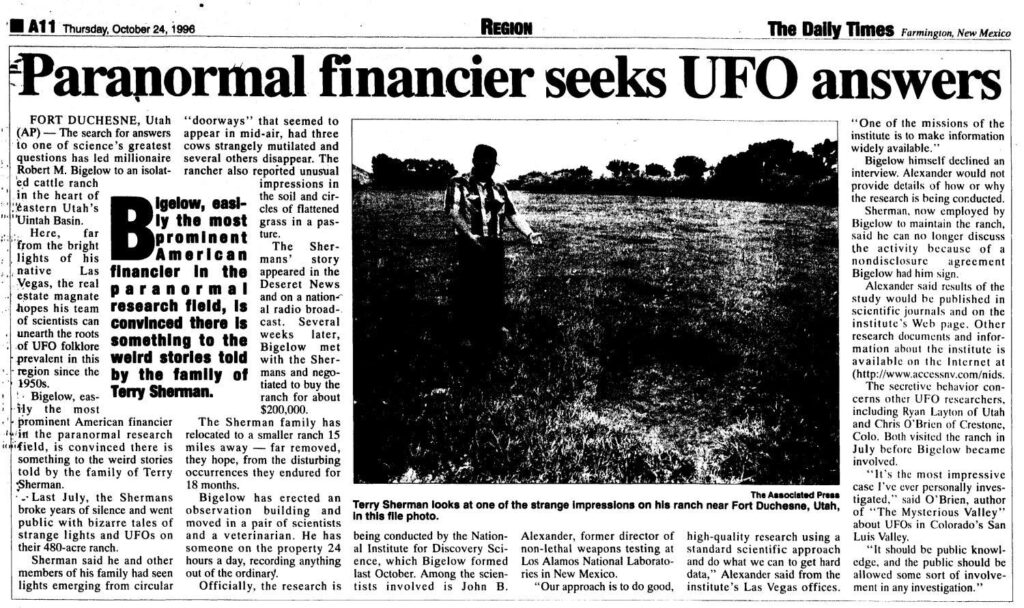
By October 1996, Deseret News reported that Las Vegas businessman Robert Bigelow had bought the ranch after reading the Shermans’ account and meeting them. The article framed Bigelow as convinced there was more happening than “simple misidentification,” and reported that he erected an observation building and moved in researchers to keep watch around the clock. (Deseret News)
This is one of the most concrete historical moments in the Skinwalker Ranch saga: a change of ownership driven directly by reported UAP and related anomalies, followed by an explicit plan to record and study. (Deseret News)
In later years, WIRED summarized this same chain of events while adding a critical cultural note: the ranch’s modern mythology often blends contemporary reporting with later retellings, particularly via the 2005 book Hunt for the Skinwalker. (WIRED) That observation is not a dismissal. It is a reminder of how quickly this story became a self-reinforcing ecosystem: reporting inspires investigation, investigation inspires books, books inspire television, television reinforces public expectation, and expectation changes how every new event is interpreted.
Still, the Bigelow era did not stay loud in public. It became quieter, even secretive, and that secrecy became one of the ranch’s biggest controversies.
“Watched pot” science: the NIDS years and the problem of vanishing phenomena
In April 1997, Deseret News ran a headline that has haunted the ranch ever since: researchers had taken control of the property, but had not seen the dramatic phenomena they expected. John Alexander, associated with the National Institute for Discovery Science (NIDS), described the early results as “minor observations” and suggested that such events can be “fragile,” “like a watched pot.” (Deseret News)
This statement is important for two reasons.
First, it is a candid admission that instrumented observation did not immediately reproduce the Shermans’ most sensational claims. (Deseret News)
Second, it introduces a theme that appears in many high-strangeness cases: witnesses and investigators sometimes describe the phenomenon as evasive, intermittent, or apparently reactive to attention. The responsible way to phrase that, as the fact-check correctly demanded, is not “the phenomenon is responsive,” but “witnesses and investigators have described it as if it were responsive.” The ranch’s public record supports that people involved have used that kind of language. (Deseret News)
By August 1998, Deseret News reported that Bigelow acknowledged unusual animal deaths and continued strange activity, while still urging caution about conclusions. The article also reported that the Shermans agreed to keep quiet as a condition of sale, and it emphasized the frustration of outside researchers with the lack of released findings. (Deseret News)
This is where Skinwalker Ranch becomes more than a case. It becomes a debate about methods.
If an event is real but sporadic, what do you do? You deploy instrumentation and wait. If nothing happens on your schedule, skeptics conclude nothing is there. Believers conclude the effect is avoiding detection. Either way, the absence of public, independently reviewable data becomes the story.
That problem did not end in the 1990s. It simply changed costumes.
Case study 1: the “ball of light” encounter and animal loss
Among the more striking elements in the Deseret News reporting is the repeated description of small, luminous objects behaving like more than distant lights.
In the October 1996 report, a UAP researcher (Ryan Layton) described an incident relayed by the Shermans: a bluish-white ball of light, roughly tennis-ball sized, emerging from a field, circling a horse’s head, approaching Gwen Sherman, and retreating when she shined a flashlight at it. (Deseret News)
The same report connects the “light ball” to animal loss. It states that dogs vanished after chasing such a light, and that a circular burn mark was found near where they were last seen. (Deseret News)
What can be responsibly said here?
Verified: local journalism documented that these claims were made publicly and attributed to named witnesses or intermediaries at the time. (Deseret News)
Unverified: the nature of the light, whether it was an intelligent probe, an electrical phenomenon, misperceived conventional light, or something else, is not established by publicly available data.
But as a case study, it reveals why the ranch grabs people. “Lights in the sky” are easy to ignore. A small luminous object approaching within ten feet, reacting to a flashlight, and coinciding with animal disappearances is harder to wave away, even if you cannot prove what it was.
It also reveals the ranch’s enduring evidentiary vulnerability: much of the story lives in reported experiences that the wider public cannot independently check.
Case study 2: cattle mutilations, missing cattle, and what “unusual” actually means
Cattle mutilation claims are not unique to Skinwalker Ranch. But the Shermans’ descriptions landed inside a long American pattern: animals found dead with missing organs, minimal blood, and odd absence of tracks. In the June 1996 Deseret report, the family described cattle deaths and disappearances linked, in their view, to the aerial activity. (Deseret News)
Later in that same article, Deseret News describes classic mutilation patterns, including “laser-like precision” and absence of blood, while also noting the lack of contemporaneous sheriff department reports in “recent memory.” (Deseret News)
This split matters. If a phenomenon is truly affecting livestock, why are official reports sparse? Possible answers include reluctance to report, delayed reporting (making investigation difficult), or the possibility that some cases collapse into natural causes when examined closely.
But the ranch’s history includes law enforcement awareness, even if not proof. In October 1996 reporting, a sheriff’s department representative is quoted describing the challenges of investigating decomposed animals and offering a definition of what an “authentic” mutilation would look like. (Deseret News)
So what does the ranch add to the cattle mutilation topic?
It adds proximity: witnesses claim to see aerial phenomena and then find missing or mutilated cattle, repeatedly, over months. (Deseret News)
It adds escalation: the Shermans described moving from mutilations to disappearances “altogether.” (Deseret News)
And it adds a long-term echo: Bigelow’s later comments in 1998 suggested continued interest in necropsies and reporting unusual animal deaths, even while refusing definitive conclusions. (Deseret News)
As with the “light ball,” the publicly available evidence supports that these claims were made, documented, and taken seriously enough to influence decisions. It does not publicly establish the mechanism.
Case study 3: “doorways,” voices, and the ranch’s strangest motif
If you want the simplest explanation for Skinwalker Ranch, you usually reach for misidentified aircraft, hoaxes, predators, or folklore. But the motif that keeps wrecking simple explanations is not “a craft.” It is the combination of motifs.
The June 1996 Deseret report says the Shermans described orange circular “doorways” appearing in midair, with lights emerging from them. (Deseret News)
It also says Terry Sherman reported hearing male voices speaking an unfamiliar language, seemingly above him, with no visible source, while dogs reacted frantically. (Deseret News)
Even if you suspect misinterpretation, you are left with a hard question: why do so many elements cluster in the same location during the same period? And why do those clusters resemble high-strangeness reports from other contexts, where UAP, poltergeist-like activity, and animal effects are bundled rather than separate?
That does not prove an exotic cause. It does show why the ranch became a magnet for researchers who suspect the UAP problem is not only aerospace.
The Pentagon paperwork: AAWSAP, AATIP, and the Utah property
What is documented beyond reasonable doubt is the existence of a Defense Intelligence Agency managed contract known as the Advanced Aerospace Weapon System Application Program (AAWSAP). A 2009 memorandum associated with Senator Harry Reid’s request for special access protection states that the program Reid called AAITP was “officially” AAWSAP, managed by DIA, and aimed at investigating “revolutionary advances in future aerospace technologies.” (Defense Intelligence Agency)
That is the backbone.
Now, what about the ranch?
In 2024, the Department of Defense’s All-domain Anomaly Resolution Office (AARO) published a Historical Record Report that discusses AAWSAP/AATIP. The report notes that AAWSAP and AATIP were used interchangeably in documentation, and it adds a key clarification: AATIP was not an official DoD program in the same way AAWSAP was, and the name later functioned as an informal moniker used by some individuals after AAWSAP ended. (U.S. Department of War)
More directly relevant to Skinwalker Ranch, AARO states that AAWSAP-related work included investigating “an alleged hotspot of UAP and paranormal activity at a property in Utah” owned at the time by the head of the private sector organization performing the contract. It specifically references examinations of “shadow figures,” “creatures,” “remote viewing,” and “human consciousness anomalies,” and adds an essential qualifier: DIA “did not seek, nor specifically authorize” that paranormal line of work. (U.S. Department of War)
AARO does not name the property in that excerpt. However, combining AARO’s description with contemporaneous reporting that Bigelow owned the ranch for that period makes it a reasonable inference that this refers to Skinwalker Ranch, or at least to the same Utah property cluster associated with Bigelow’s investigations. That inference should be held as an inference, not a standalone fact. (U.S. Department of War)
This tighter framing solves a common error: the DIA memo proves AAWSAP existed; it does not, by itself, document “a Skinwalker-focused paranormal program.” The AARO report provides a clearer statement about a Utah property and paranormal investigative activity, while also explicitly cautioning that DIA did not authorize that aspect. (Defense Intelligence Agency)
“Human effects” and the limits of what documents can prove
You will often see Skinwalker Ranch discussed alongside stories of injuries, illness, and lingering aftereffects. These claims deserve serious attention because human harm is not a storytelling flourish. It is a potential operational hazard.
But a clean evidentiary approach means separating three things:
First, witnesses and investigators have described injuries and physiological effects in connection with anomalous events. For example, KSL reported claims from ranch superintendent Thomas Winterton about a rapidly developing head injury after earthmoving work, framed as part of the ranch’s lore of “don’t dig,” and it also reported broader accounts of unusual events including radiation spikes. (KSL)
Second, U.S. government linked research documents show interest in the possibility of “biological effects.” One AAWSAP-associated Defense Intelligence Reference Document by Dr. Christopher “Kit” Green, available through the DIA reading room, addresses “anomalous acute and subacute field effects on human biological tissues.” (Defense Intelligence Agency)
Third, none of that automatically proves Skinwalker Ranch caused a specific injury, or that any particular “field effect” documented in a paper occurred at the ranch. The DIRD reflects research interest and threat-modeling around reported effects. It is not, by itself, a confirmed causal chain from “ranch event” to “medical outcome.” (Defense Intelligence Agency)
This distinction is not a downgrade of testimony. It is the difference between “credible report” and “publicly demonstrated mechanism.”
The modern era: Brandon Fugal, instrumentation, and television
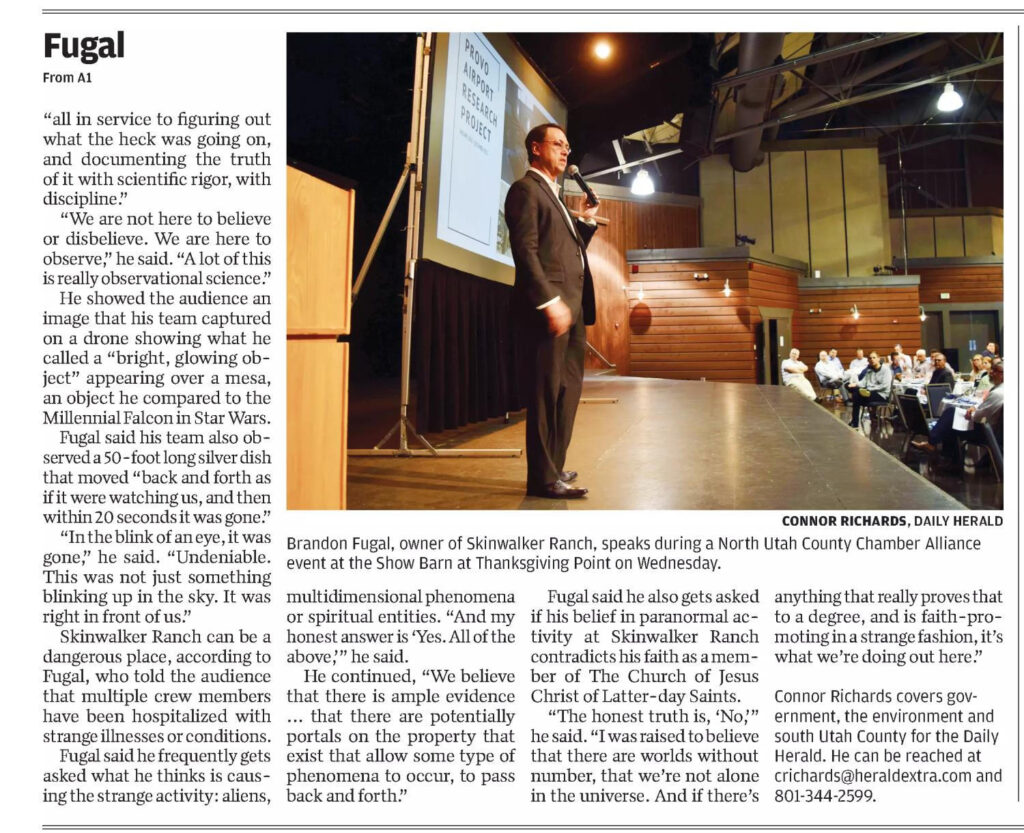
In 2016, Utah real estate investor Brandon Fugal purchased the ranch, later revealing his ownership publicly. (KSL) In 2020, both local and national outlets reported on his emergence as owner and on the new phase of investigation centered on extensive surveillance and a multi-disciplinary team. (KSL)
This era is defined by visibility. Cameras are part of the method and part of the message.
The History Channel series The Secret of Skinwalker Ranch brought the ranch into a broader mainstream, framing it as an active investigation with recurring experiments. (History) KSL reported that Fugal claimed his team recorded phenomena he said “defies all natural explanation,” and it also documented that visitors and investigators discussed a “hitchhiker effect,” where experiences allegedly follow people home. (KSL)
A key editorial adjustment is necessary here: phrases like “there is definitely an intelligence” are not neutral statements of fact. They are witness assertions. KSL quoted Fugal describing an “intelligence” interacting with people on the property. In an explainer, the correct phrasing is that “Fugal described the activity as if it involved intelligence,” not that intelligence is established. (KSL)
This also brings us to the central modern controversy: data access.
Television creates an illusion of transparency because you see devices, graphs, and excited reactions. But the public still rarely gets full raw sensor datasets, full calibration details, and full chain-of-custody documentation. A dramatic claim can be sincerely experienced, and still remain unverified if the underlying data is not released in a form independent analysts can audit.
One sentence that belongs in any responsible Skinwalker Ranch explainer is this: several of the ranch’s most dramatic claims remain primarily testimony-based in the public record, and the instrumented evidence that might corroborate them has not been released in a way that allows broad independent replication and review.
That reality does not mean “nothing happened.” It means the ranch remains, in part, a closed laboratory whose strongest data are not fully public.
The “hitchhiker effect”: contagious anomaly or contagious story?
The hitchhiker concept is one of the ranch’s most unsettling ideas: that whatever the phenomenon is, it is not confined to geography, and it can attach itself to people.
KSL’s reporting places the term in the ranch’s contemporary discourse and attributes it to people connected to visits and research. (KSL) Colm Kelleher, who served as a senior figure in Bigelow’s NIDS effort, has also discussed the hitchhiker phenomenon in writing, framing it as something reported by individuals associated with UAP-related work. (theblackvault.com)
But in a careful explainer, you have to keep two truths in view at the same time.
One truth is experiential: some witnesses and investigators insist these follow-on effects are real, disturbing, and not reducible to imagination.
The other truth is methodological: contagion is a tricky metaphor. Humans share stories, expectations, anxieties, and interpretive frames. Some “spread” can happen through narrative alone, without requiring an external agent.
In UAP studies, the mistake is assuming only one of these truths can be real. Skinwalker Ranch is famous precisely because it keeps forcing a third option: that the phenomenon may operate through channels that look psychological and physical at the same time.
That is not proven. It is a hypothesis shaped by a pattern of testimony. And it is precisely why the ranch, for many researchers, feels less like an isolated UAP case and more like a boundary case for how we model anomalous experience.
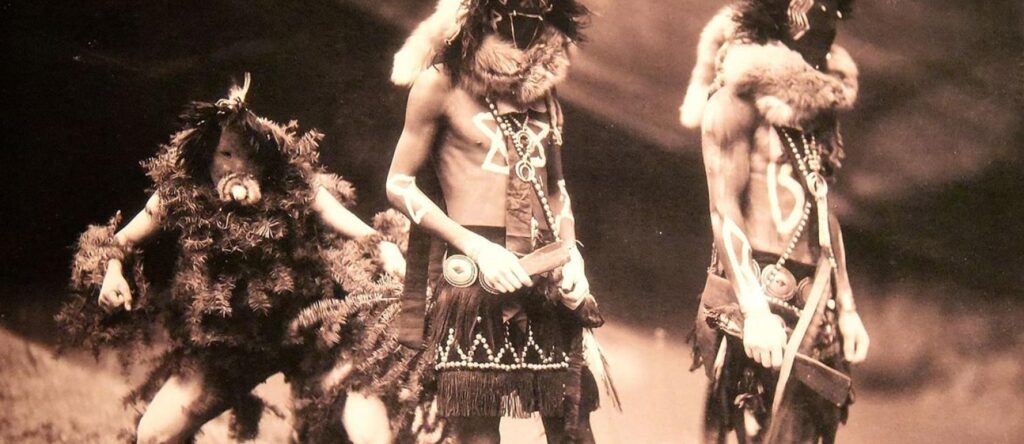
(Edward S. Curtis | Public Domain)
The name “skinwalker” and why cultural precision matters
There is a temptation in pop culture to treat “Skinwalker Ranch” as a spooky brand, detached from living cultures. That is a mistake.
VICE’s reporting includes commentary from Indigenous officials that complicates the oversimplified “curse narrative.” A Navajo Nation Parks and Recreation spokesperson noted that skinwalkers are not something many Navajo discuss casually, and framed some elements as possible within oral tradition without confirming a specific “curse” placed on that land. (VICE)
More pointedly, Betsy Chapoose, identified as Cultural Rights and Protection Director for the Ute tribe, told VICE she had never heard the “curse” story in her decades of tribal administration, while also urging respect for local stories and traditions. (VICE)
For an explainer, the correct takeaway is not “there is no Indigenous dimension.” It is that outsiders should not flatten multiple cultures into one spooky narrative, and should not treat a modern media brand as a transparent window into Indigenous belief.
The ranch can be a genuine investigative problem without being dressed up as a caricature of Native tradition.
The core controversies
Skinwalker Ranch is controversial for reasons that have nothing to do with whether you believe in UAP.
One controversy is data scarcity. From the NIDS era onward, critics have argued that extraordinary claims require extraordinary transparency, while defenders argue that premature release invites interference, misinterpretation, or contamination of the site. This tension was visible as early as 1997, when outside researchers expressed frustration that NIDS did not release details, and NIDS suggested findings would be posted on its site if and when released. (Deseret News)
A second controversy is narrative drift. The ranch’s mythology is built from journalism, books, interviews, and television, each with different incentives. WIRED’s treatment of the ranch highlights how later retellings can harden into “fact-feeling” even when the underlying evidence remains contested. (WIRED)
A third controversy is scope confusion around AAWSAP. The DIA paperwork proves the contract and its official framing; the AARO report adds nuance about what contractors did and did not have formally authorized scope to do. Blending those into a single “the Pentagon studied portals at Skinwalker Ranch” headline is exactly the kind of overreach that damages credibility. (Defense Intelligence Agency)
And a fourth controversy is television itself. Filmed investigations do not automatically equal scientific investigations. They can overlap, but the incentive structures differ. If Skinwalker Ranch wants to become a true cornerstone dataset for UAP science, the path is not more dramatic editing. It is more publishable, reproducible instrumentation, with calibration, baselines, and controlled comparisons.
What Skinwalker Ranch has already changed
Even with all its evidentiary messiness, Skinwalker Ranch has had outsized impact.
It helped cement the Uinta Basin as a modern UAP hotspot in the public mind, in part because the story was early, local, and detailed. (Deseret News)
It influenced how policymakers and the public talk about UAP adjacency. AARO’s report, whatever you think of its conclusions, explicitly documents that AAWSAP-linked work included interest in paranormal lines of effort at a Utah property, even while noting DIA did not authorize that work. That alone shows how UAP discussions inside official-adjacent contexts can blur into broader “high strangeness” questions. (U.S. Department of War)
And culturally, it has become the model for the “hotspot” frame: not a single craft, not a single incident, but a persistent geography where witnesses report a portfolio of anomalies.
Implications: what the ranch suggests about the UAP problem
Skinwalker Ranch is often treated like a question: is it real?
A better question is: what kind of reality is it?
If the ranch’s phenomena are misidentifications, hoaxes, or folklore feedback loops, then it is a case study in how belief ecosystems form around ambiguous stimuli. If the ranch’s phenomena include genuinely anomalous events, then it is a case study in how those events intersect with biology, cognition, and environment, and why conventional aerospace-only models may be incomplete.
Either way, the ranch points to an uncomfortable implication for UAP research: the next leap is not merely better cameras. It is better epistemology. Better rules for what counts as evidence, better safeguards against narrative contamination, and better ways to honor credible testimony while still demanding public-grade documentation.
Skinwalker Ranch is not a conclusion. It is a pressure test.
And the test is still running.
Claims Taxonomy
Verified
Deseret News documented the Shermans’ claims in 1996 and described the ranch as a “hotbed” of reported activity; Bigelow’s purchase and NIDS presence were reported contemporaneously; DIA documentation confirms AAWSAP existed and its official purpose; AARO’s 2024 report documents that AAWSAP-linked work included investigating a Utah property described as a UAP/paranormal hotspot, while noting DIA did not authorize the paranormal scope. (Deseret News)
Probable
The ranch functions as a long-running cultural and investigative hotspot in the Uinta Basin, drawing repeated reports, sustained interest, and ongoing surveillance efforts. The continuity across decades is well supported, even if the nature of the reported phenomena remains unresolved. (KSL)
Disputed
Claims that the phenomena are definitively responsive, intelligent, or causally linked to specific injuries remain disputed because public, independently reviewable sensor and medical evidence is limited, and alternative explanations are not fully excluded in many publicly described incidents. (Deseret News)
Legend
“Curse” narratives tied to the ranch are best treated as contested cultural storytelling in popular retellings. Indigenous officials quoted in mainstream reporting complicate and, in some cases, directly dispute simplistic versions of the curse story. (VICE)
Misidentification
Some aerial reports in the region, as with any UAP hotspot, likely include misidentified conventional objects and phenomena. The ranch’s record itself includes skeptical commentary emphasizing this risk. (Deseret News)
Speculation Labels
Hypothesis
Skinwalker Ranch represents a “multi-phenomenology” hotspot where UAP activity, luminous phenomena, animal effects, and human-perception anomalies cluster, potentially indicating a single underlying driver that can present differently depending on context. This remains a hypothesis because publicly auditable datasets do not yet conclusively unify these categories. (Deseret News)
Witness Interpretation
Many ranch-associated witnesses interpret close-range lights, apparent surveillance-like behavior, and timing correlations as signs of intelligence. This interpretation is recorded in reporting, but it is not the same as proof of intelligence. (KSL)
Researcher Opinion
Some investigators argue the ranch exhibits evasive or “fragile” behavior, akin to a watched pot. This may reflect observer effects, operational security issues, selection bias, or genuinely intermittent phenomena. The public record supports that investigators have said this; it does not establish the mechanism. (Deseret News)
References
All-domain Anomaly Resolution Office. (2024). Report on the Historical Record of U.S. Government Involvement with Unidentified Anomalous Phenomena (UAP), Volume I. U.S. Department of Defense.
Defense Intelligence Agency. (2009). Senator Harry Reid’s Request to Put the Advanced Aerospace Threat and Identification Program (AAITP) under Special Access Protection (FOIA release, FileId 170015). U.S. Department of Defense.
Green, C. H. (2010). Anomalous Acute and Subacute Field Effects on Human Biological Tissues (Defense Intelligence Reference Document). Defense Intelligence Agency (FOIA reading room).
Van Eyck, Z. (1996, June 30). Frequent Fliers? Deseret News.
Van Eyck, Z. (1996, October 20). Millionaire leads quest for UFO data. Deseret News.
Van Eyck, Z. (1997, April 27). No UFOs or ETs have dropped in at spooky ranch. Deseret News.
Van Eyck, Z. (1998, August 10). Private UFO study takes a public turn. Deseret News.
Adams, A. (2020, October 27). Mystery of Utah’s Skinwalker Ranch very much alive. KSL.com.
Banias, M. J. (2020, January 30). Inside Skinwalker Ranch, a paranormal hotbed of UFO research. VICE.
Scoles, S. (2018, February 24). Inside Robert Bigelow’s decades-long obsession with UFOs. WIRED.
Relevant cross links
UAPedia: Global High-Strangeness Hotspots
UAPedia: Origins of AATIP/AAWSAP: Programs & DIRDs
SEO keywords
Skinwalker Ranch, Skinwalker Ranch Utah, Uinta Basin UAP, Sherman Ranch, cattle mutilations Utah, UAP hotspot, AAWSAP, AATIP, BAASS, NIDS, Brandon Fugal Skinwalker Ranch, Erik Bard, Thomas Winterton, hitchhiker effect, AARO historical record report, DIA FOIA AAWSAP, high strangeness Utah, paranormal UAP overlap