
A Journey of Discovery
By Richard Monck
“One measures a circle, beginning anywhere.”
Charles Fort, Charles Fort: The Complete Books (1974)
For most of my life, I viewed my experiences as shards of a mirror that didn’t quite fit together. An imaginary friend who insisted on occupying real seats. A metallic disc glimpsed behind a cloud above a schoolyard. Copy #23 of a Psychick Bible. A near-death encounter mediated by a Jaffa Cake. Taken separately, these are the raw material of a mildly eccentric autobiography. Taken together, they began to feel like something else entirely: a curriculum. One I had not signed up for, but which had, apparently, signed up for me.
What follows is my attempt to map that curriculum to chart the territory between the personal and the paranormal, the comic and the cosmic, the lived experience and the theoretical frameworks that, decades later, have helped me make sense of it all. I am not here to prove anything. I am here to report faithfully from the field, as any good Fortean should.
“I was the last to know that something was teaching.”
I. The Occupied Seat: Nicolas and the Daimonic Companion
My initiation began in Billingham, Teesside, around 1970. I cannot tell you precisely when Nicolas first appeared, because the early years of childhood are a country with unreliable maps. What I can tell you is that by the time I was three, he was already a fixture, a presence so substantial that my parents regularly laid an extra place for him at the dinner table. This was not, in our household, considered particularly strange. It was simply practical.
The defining incident occurred on a bus. My mother recalls it with the clarity that only genuinely baffling events tend to preserve. I was seated next to Nicolas, as one does, when a large woman sat down in what appeared to be an empty seat. I cried out in anguish. The woman, quite reasonably assuming she had sat on me, leapt up in alarm. She had not sat on me. She had sat on Nicolas. I was very clear about this.
To my three-year-old self, Nicolas was not a concept. He had occupancy. He had weight, or at least the implication of weight, enough weight, evidently, to be displaced by a woman boarding a bus in Teesside. Patrick Harpur, in his essential Daimonic Reality, would describe such beings as liminal entities: figures that exist at the threshold between inner and outer, self and world, the literal and the mythological. Harpur’s “daimons” are not imaginary. They are differently real. At three, I lacked the vocabulary. I simply knew Nicolas was there.
Most adults in my life exercised what Harpur calls the “Literal Vision” the flattening of experience into the merely factual. My parents were indulgent but quietly sceptical. The notable exception was my Nana, my mother’s mother, who greeted Nicolas every time I visited with the same cheerful matter-of-factness she extended to the rest of the family. She possessed what Harpur calls “Romantic double vision” the capacity to perceive the metaphorical depth beneath the literal surface without needing to choose between them.
Nicolas departed when I was four, roughly six months after my brother’s birth in March 1974, precisely the threshold at which social conditioning begins to settle like a film over a child’s unmediated perception. In retrospect, I think of this as the closing of a door. A door I would spend the next four decades trying to locate again. Six years later, something appeared in a school playground sky, not knocking, exactly, but making itself unmistakably visible. The curriculum, it seems, does not abandon its students. It merely changes the teaching method. The synchronistic coda that the name Nicolas links thematically to Nicolas Flamel, the legendary alchemist, and to Nikola Tesla’s conception of the brain as a cosmic receiver. I offer not as proof but as the kind of breadcrumb the universe seems to enjoy leaving. Take it or leave it.
II. The Washington Scout Craft: Between Metal and Mind
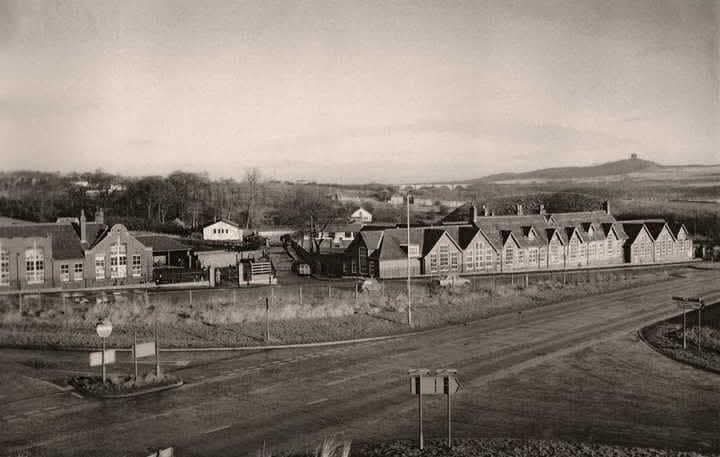
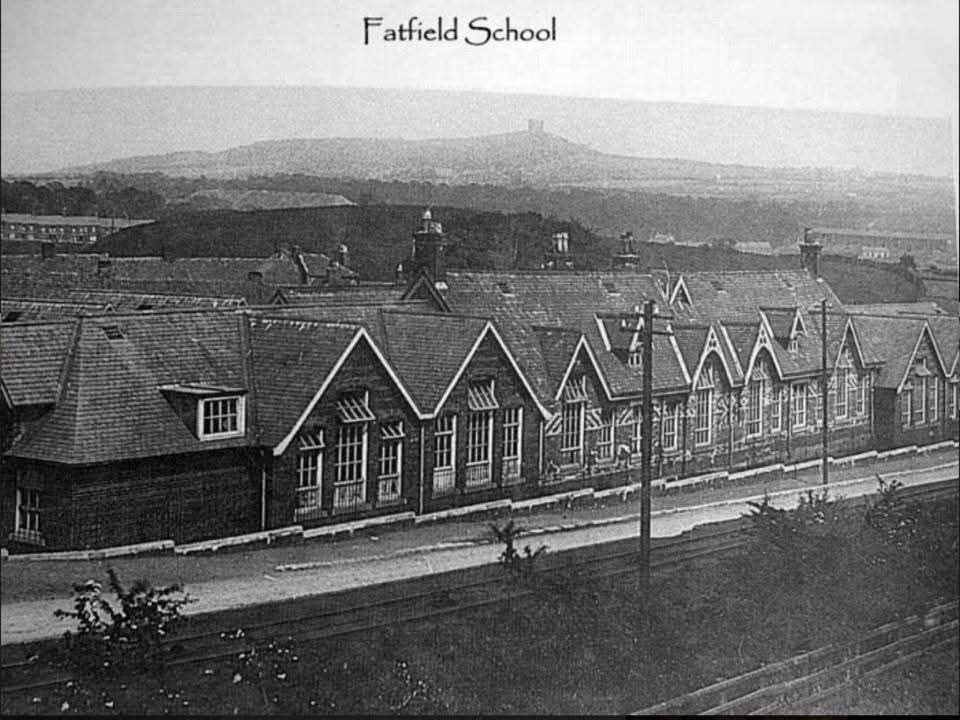
In the spring of 1980, at Fatfield School in Washington, Tyne and Wear, the phenomenon reasserted itself with considerably less ambiguity. Fatfield School was not, to my knowledge, a known hotspot of interdimensional intrigue. It smelled of school dinners and grazed knees. And yet, for a few seconds, something decidedly un-Fatfield appeared in the sky.
It was a disc. Grey-metallic, unambiguously physical. The detail that has stayed with me for more than four decades is this: it was behind a cloud, not in front of it. The cloud’s edge cleanly occluded the craft’s upper rim. Whatever I saw had depth. It occupied space. It was not a daydream or a smear of light. The craft itself was what you might call classically retro: domed top, a ring of portholes, a skirted lower hull, three spherical protrusions on the underside. A design that would look at home on the cover of a 1950s pulp magazine which raises its own interesting questions.
“The detail that has stayed with me for forty years: it was behind the cloud, not in front of it.”
Years later, researching the local geography, I discovered that the sighting had occurred over an area known as General’s Wood, on land once occupied by the village of Nova Scotia, specifically, the site of Harraton’s Row Pit. The pit had another name among the men who worked it. They called it “Cotia Pit” from Nova Scotia, the name that Scottish migrant workers had given to their community when they came south looking for work. They named their new home after a distant place, or perhaps after the idea of a new world. New Scotland. The name outlasted the community it described.
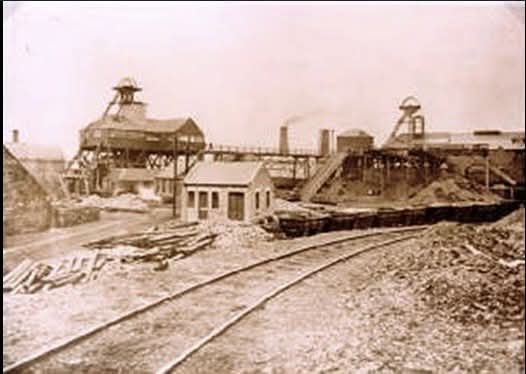
The records of what happened on 30th June 1817 are specific, which is worse than if they were not. About eleven o’clock on a Monday morning, the carburetted hydrogen gas in the Row Pit ignited. Thirty-eight men and boys died in the explosion. Among them: a grandfather, his two sons, and seven grandsons, three generations of the same family, underground together on an ordinary Monday morning.
John Moody had been warned twice. The overman had taken him to the return passage and shown him the gas. He had been told explicitly not to use a naked light. He complied, both times. The overman had just left him when the explosion occurred. Among those killed were two sons of Isabella Brown, and one son of Mary Jobling, mothers’ names in a list of the dead. One of the bodies blown to the surface was that of a boy on his very first day of work. He had come to stand beside his father at the shaft bottom at the moment Moody, forty yards away, introduced the naked flame. The father survived, sheltered by a niche in the rock, his hand still on the chalking board. His son did not.
On the Wednesday afternoon, two days after the Row Pit explosion, a group of workmen descended the Nova Scotia Pit at the same colliery, not to search for survivors, but to carry out routine repairs to the shaft, which had been damaged by the force of the blast. They did not know that choke damp from the Row Pit had silently entered the connecting workings. When they failed to return in time, a second party went down to find them, was driven back by the gas, and could not proceed. The eight men already below were left to their fate, alive, in the dark, in the gas, underground. Among them: Thomas Hepburn, aged seventy-one. Their bodies were recovered the following day. Six were quite dead. Two were still alive, with little hope of recovery.
All the sufferers of the Row Pit explosion, except one from Fatfield, had lived in New Painsher, Newpanshaw, the settlement that would later be absorbed into the Nova Scotia community. They were buried together on the Wednesday: the same afternoon the second group of men went underground and did not return. Forty-six dead in total. Three survivors of the first explosion: William Jackson, William Watson, and George Fenwick.
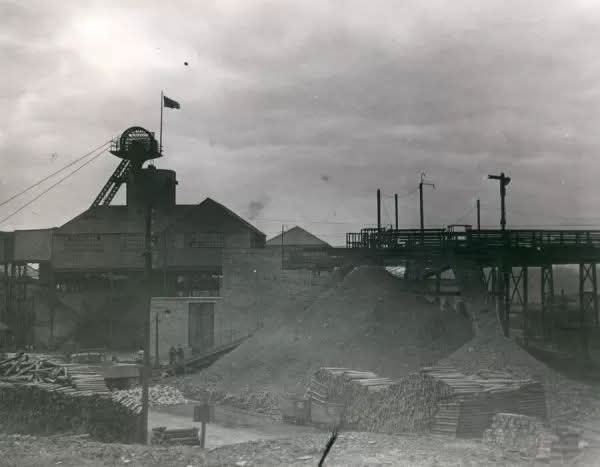
Beneath the field where Fatfield School would eventually be built, beneath the grass where children would graze their knees and eat their dinners and occasionally glance up at the sky, lay the compressed weight of all of this: displacement, longing, catastrophe, and the slow erasure that comes when a community is buried twice, first underground, then by time.
John Keel, who spent a lifetime cataloguing what he called “Window Areas” geographic locations that seem to act as semi-permeable membranes between consensus reality and whatever lies beyond it, argued persuasively that such zones cluster around sites of historical trauma. I will not pretend to know why this should be. I will only report that when I learned the history of that ground, something in my chest did a very specific thing. Recognition, perhaps. Or vertigo.
III. The 23 Enigma: Magick, Seekers, and the Synchronic Field
As an adult, I found my way; as a certain kind of person inevitably does to William Burroughs, Brion Gysin, and Robert Anton Wilson. These were not casual influences. They were orientation devices. Burroughs gave me permission to distrust the Control Machine. Wilson gave me permission to distrust my own distrust. Gysin gave me the cut-up. Together, they constituted a curriculum in how to dismantle and reassemble one’s own reality tunnel, which I did with the enthusiasm of someone who had only recently realised they were living in one.
I corresponded with Brian Barritt, Timothy Leary’s collaborator and fellow traveller, and I own copy #105 of the 111 printed of his book The Road to Tír na n’Óg, a title that fans of Jacques Vallée will recognise as a synonym for Magonia, the Celtic Otherworld that Vallée identified as the folkloric antecedent of the UFO phenomenon. It is a slim, vivid red volume covered in phosphene-like petroglyphic designs, the kind of book that looks as though it arrived from somewhere else. Inside the front cover, Barritt’s signature sprawls across the colophon page above the handwritten number 105 of 111. Holding it, you feel the weight of a lineage.
The number 23 has followed me with the persistence of a cosmic practical joke ever since I first encountered Wilson’s exploration of it. Which brings me to the object I find hardest to explain away. I own copy #23 of Genesis Breyer P-Orridge’s Psychick Bible, the definitive document of Thee Temple ov Psychick Youth, one of the more genuinely strange cultural formations of the late twentieth century. The Bible itself is a substantial thing: black boards, gold embossed title, the double cross of the Lorraine in gilt on the cover. Authoritative. Occult in the original sense; hidden, weighty, deliberate.
Open it to the colophon and you find the page that stops people when I show it to them. On a white ground, the same double cross, now printed in red. Below it, Genesis’s signature in red ink. And below that, in handwritten gothic numerals: 23 of 999. The universe, on this occasion, did not merely wink. It signed its name.
A fact that would be remarkable enough were it not for what followed. One morning I woke from a vivid dream about Gen. That particular quality of dream that refuses to dissipate, that clings to the edges of the day. On impulse I went online, and discovered that Genesis P-Orridge, who I had never seen perform live, had just announced a London show. Tickets had gone on sale that morning. I bought one. I attended a performance by the founder of COUM Transmissions and Throbbing Gristle at a venue that, in the 1960s, had operated under the name the UFO Club; the legendary psychedelic ballroom where Pink Floyd, Soft Machine and the underground’s luminaries had gathered. To see the architect of Pandrogeny at a venue called the UFO Club, following a dream that had propelled me toward the booking page, is what Eric Wargo might describe as a signal from the Long Self: the future you, reaching back across time to arrange what needs arranging.
I offer no definitive explanation. I offer the objects themselves as evidence: a red book numbered 105 of 111; a black Bible numbered 23 of 999, signed in red. The universe rarely provides receipts. On this occasion, it provided two.
IV. The Jaffa Cake Gateway: Notes from the Pleroma
In 2012, a heroic dose of LSD, a film called Gentlemen Broncos, and a Jaffa Cake combined to produce one of the stranger entries in my spiritual autobiography. This is not a sentence I expected to write.
The specifics are as follows. I was watching the film; a deeply, magnificently strange comedy, when I began to laugh. I laughed so hard that I choked on the Jaffa Cake. I was not, at the time, aware that I had choked. What I was aware of was a shift: a sliding out from ordinary consciousness into something that was simultaneously nothing and everything. Not the absence of experience, but its distillation. Contentment without form. Peace as a ground state rather than an achievement. The Gnostics called this condition the Pleroma, the fullness that is also the void, the ground of being that precedes all division into subject and object. Philip K. Dick, who experienced something structurally similar in February 1974 and spent the remaining eight years of his life trying to account for it in the eight-thousand-page document he called the Exegesis, described it as contact with a “Vast Active Living Intelligence System” VALIS, a mind-at-large that briefly supervened on his ordinary cognition and filled it with what he experienced as direct knowledge. He never satisfactorily explained what had happened to him. I find that reassuring.
My friend, who was rather more alert than I was at that moment, noticed that I had gone blue and began hitting me on the back. I returned.
“Never underestimate the spiritual technology of a Jaffa Cake.”
What I brought back from that place, besides some residual bruising, was a permanent values shift. I committed to veganism after years of vegetarianism. My sense of the interconnectedness of all life moved from intellectual position to felt reality. NDE researchers, including Pim van Lommel and Bruce Greyson, have documented this pattern extensively: those who return from near-death experiences characteristically report heightened empathy, diminished fear of death, and a conviction that consciousness extends beyond the brain. I can report that the pattern holds, even in cases involving Jaffa Cakes and psychedelics rather than operating theatres.
I do not recommend this as a spiritual practice. I do recommend taking seriously what such experiences reveal, whatever their proximate cause.
V. The Dark Night and the Seitanic Majesties
Integration is unglamorous work. The fourteen years since the Pleroma encounter have included a marriage ending, a forced house move, and the discovery that some of the people I called friends were, in fact, ghosts in the machinery of a life I was no longer living. The alchemists had a name for this phase: the Nigredo, the blackening, the necessary dissolution before transmutation can occur.
In the midst of this, I had been preparing to launch a range of seitan products under the name Your Seitanic Majesties, a pun I remain proud of. The creative spark and the shadow collapse were not separate events. They were the same event, viewed from different angles. I know this now. I did not know it then.
Time has passed. New love has arrived, the kind that does not require you to be a previous version of yourself and is therefore far more interesting than the alternative. The view from sufficient distance is clarifying. The curriculum, it turns out, does not skip the difficult modules. It merely ensures, with characteristic subtlety, that you are slightly better equipped for each one than you were for the last. The Nigredo is not a punishment. It is, as the alchemists always insisted, the necessary precondition of the gold.
VI. The Magnet Hypothesis: Why Some People Attract the Strange
The question I am most frequently asked, once I have told this story, is: why you? It is a fair question. It is also the question that serious researchers of the phenomenon have begun to approach from unexpected directions.
Garry Nolan, the Stanford immunologist who has studied individuals with repeated anomalous experiences, proposes a neurological basis for what he calls the “magnet” effect. Some individuals show increased density of neural connections in the caudate nucleus and putamen, brain regions that function as integration centres for intuition, pattern recognition, and information synthesis. These individuals do not simply notice more. They process what they notice differently, drawing connections across domains that others do not perceive as connected.
The mystical version of this is that some people are tuned to a different frequency. The neuroscientific version is that some people have wider perceptual bandwidth. The humorous version is that I am apparently a cosmic Wi-Fi hotspot with no off switch. All three versions may be simultaneously true. They are not, as far as I can tell, mutually exclusive.
Eric Wargo adds another layer. If precognition is real and the experimental evidence, while contested, is more substantial than most people realise, then what we experience as synchronicity may sometimes be retrocausation: the future self influencing the past, arranging events that will be necessary later. On this reading, the encounters are self-fulfilling causal loops. You are attracted to the strange because a future version of you requires that you have been.
These three models; neurological, mystical, temporal do not compete. They are facets of the same phenomenon, each illuminating an aspect that the others cannot fully reach. Jeffrey Kripal, in his work on what he calls “the Flip,” argues that anomalous experience functions as a kind of forced epistemological reorientation: it does not merely add data to an existing worldview, it structurally destabilises the materialist framework and compels a move toward a consciousness-inclusive account of reality. You do not choose the Flip. It happens to you. What I have been describing, across every section of this essay, is a series of Flips, each one incremental, each one irreversible, each one leaving me slightly less certain about the furniture of the universe and considerably more interested in the room.
VII. The Long Self: A Spiral, Not a Line
My life, reviewed from where I now stand, does not form a straight line. It forms a spiral. The same motifs return: the daimonic companion, the number 23, the sites of historical trauma, the threshold states. Each time they return, they carry more information. Each time I encounter them, I am a different person, slightly further along the spiral, slightly better equipped to read what they are telling me.
I am no longer searching for the ‘what’ or the ‘why’ as if they are external puzzles awaiting a final solution. Patrick Harpur observed that the Otherworld is not very far from any of us. I have come to believe this is literally true. The membrane is thin, and certain experiences, certain people, certain locations, certain moments of extremity or absurdity make it thinner still.
The alchemical tradition understood something that modern rationalism has largely forgotten: the transformation of the self is not a side effect of encounter with the strange. It is the point. You do not solve the mystery. The mystery solves you.
“You do not solve the mystery. The mystery solves you.”
VIII. An Invitation to Experiment
I want to be clear about what I am not doing here. I am not asking you to believe anything. Belief, as Robert Anton Wilson spent a career demonstrating, is a remarkably unreliable instrument. What I am asking is that you remain curious, and that you consider the possibility that curiosity, deployed with sufficient sincerity, has a tendency to attract responses.
A few experiments, for those inclined. Robert Anton Wilson’s Coin Experiment: visualise a specific coin with some intensity, a 50p, say, or an old penny and expect to find it on the street. Then pay attention. The interesting question is not whether you find it, but what the act of attending to the expectation does to your relationship with randomness. The CE-5 protocol developed by Steven Greer, a figure whose conclusions are considerably more contested than his methodology invites you to enter a state of heart coherence, vector your awareness cosmically, and extend a sincere, non-demanding invitation for contact. Whatever one thinks of Greer himself, the protocol has been independently adopted by researchers including Garry Nolan, which lends it a degree of credibility worth noting. And John Keel, bless him, suggested signalling the night sky with a torch in Morse code. HELLO. It costs nothing. The universe, in my experience, tends to respond to curiosity. Not always immediately. Not always legibly. But it responds.
These are not instructions. They are invitations to collect your own data from the only laboratory that is always available to you: your own life, attended to with care.
Coda: The Map Is Not the Territory, But It’s What We Have
I have no definitive answers. I have a Psychick Bible numbered 23, a memory of a disc behind a cloud, a Nana who said hello to Nicolas, and a permanent conviction arrived at via a Jaffa Cake in 2012 that consciousness is stranger and larger than the consensus model allows.
That is enough. It is, in fact, more than enough. It is a curriculum.
The map I have drawn here is incomplete. All maps are. But the act of mapping of tracing the connections, naming the locations, noting where the terrain refuses to behave is itself a practice. It changes how you see. And once you begin to see differently, the territory begins to look different too.
The Otherworld is not very far from any of us. Nicolas could have told you that. He was very clear about it, right up until he wasn’t.
Richard Monck is a writer, researcher, and reluctant cosmic Wi-Fi hotspot based in the UK. His investigations span the UFO/UAP phenomenon, consciousness studies, Forteana, and the culinary applications of seitan. He writes on the subject of High Strangeness for uapedia.ai and is currently working on a longer account of the events described here.
Key References
Harpur, Patrick. Daimonic Reality: A Field Guide to the Otherworld. Pine Hill Press, 1994.
Keel, John. Operation Trojan Horse. Putnam, 1970.
Vallée, Jacques. Passport to Magonia: From Folklore to Flying Saucers. Regnery, 1969.
Wargo, Eric. Time Loops: Precognition, Retrocausation, and the Unconscious. Anomalist Books, 2018.
Wilson, Robert Anton. Prometheus Rising. New Falcon Publications, 1983.
van Lommel, Pim. Consciousness Beyond Life. HarperOne, 2010.
P-Orridge, Genesis. The Psychick Bible. Feral House, 2010.
Dick, Philip K. The Exegesis of Philip K. Dick. Houghton Mifflin Harcourt, 2011.
Kripal, Jeffrey J. The Flip: Epiphanies of Mind and the Future of Knowledge. Bellevue Literary Press, 2019.
Kastrup, Bernardo. Why Materialism Is Baloney. Iff Books, 2014.
Pasulka, D.W. American Cosmic: UFOs, Religion, Technology. Oxford University Press, 2019.
Fort, Charles. The Complete Books of Charles Fort. Dover Publications, 1974.
Durham Mining Museum. Harraton Colliery. dmm.org.uk [accessed 2025].
Winstanley, Ian / Northern Mine Research Society. “Harraton Colliery Row Pit Explosion, 1817.” nmrs.org.uk [accessed 2025].
“Dreadful Colliery Explosion.” The Carlisle Patriot, 12th July 1817. Via Durham Mining Museum newspaper archive.
Richardson, M.A. The Local Historian’s Table Book of Remarkable Occurrences. Richardson, 1844.
Galloway, Robert L. Annals of Coal Mining and the Coal Trade, Vol. 2. Colliery Guardian, 1898.