
The Rendlesham Forest incident has a peculiar gravity in the UAP world. Not because it is the loudest case, or the most cinematic, but because it is one of the rare incidents where we can point to a compact bundle of primary artifacts: a contemporaneous memorandum, recorded audio, and later-released official files sitting in a national archive.
And then there are the “hieroglyphics.” A row of markings on the hull of a close-range craft, became a kind of symbol inside the symbol: proof for some, embellishment for others, and a semiotic Rorschach test for everyone. The problem is not that “symbols” are too strange for UAP study. The problem is that the symbol-claim arrives with a complicated chain of documentation. If you are doing a data-first investigation, that chain matters as much as the glyphs themselves.
This article treats the Rendlesham hieroglyphics claim as a forensic object. What exactly is asserted? Where does it appear in the record? What do independent sources support, and what do they not? How did books and podcasts amplify (or distort) the symbol story? And if the markings were real, what do they imply for the broader UAP phenomenon?
Separating the incident from the symbol-claim
The Rendlesham “hieroglyphics” are not the whole incident. They are a specific sub-claim nested inside a larger close-encounter narrative.
“Unexplained lights” and an object in the forest (strong documentation)
The single-page memo commonly called the “Halt memorandum,” dated 13 January 1981, describes security patrolmen seeing unusual lights and a “strange glowing object” described as metallic and triangular, roughly 2–3 meters across, and about 2 meters high. It notes colored lights, movement through the trees, later sightings, ground depressions, and radiation readings.
Crucially for our purposes: the memo does not mention symbols, writing, or markings on the object.
Physical traces and instrument readings (documented, interpretation disputed)
The same memo reports three depressions (with specific dimensions) and radiation meter readings in and around the depression area.
“Hieroglyphics on the craft” (late-emerging, documentation contested)
This module depends heavily on later testimony and later-revealed drawings attributed to one principal witness (Sgt. Jim Penniston), plus secondary retellings in books and media.
In other words: the broader incident has an early paper trail. The hieroglyphics claim largely does not.
That does not make it false. It does mean we have to handle it like an evidence problem, not a vibe.

The Halt memorandum as baseline
Because it is dated close to the event and written in an official reporting context, the Halt memo becomes the baseline artifact for what was considered reportable at the time.
The memo describes:
- A triangular, metallic-appearing object with lights.
- Ground depressions and radiation readings.
- Later “star-like” lights and a beam-like effect.
The memo does not describe:
- Any physical contact with the object by a patrolman.
- Any “writing,” “symbols,” or “hieroglyphics” on a hull.
- Any “downloaded” message, cognitive effect, or informational transfer.
This absence matters because “symbols on a craft” is exactly the kind of detail that would typically stand out in a formal narrative, especially one already describing a structured object with distinct lighting and geometry. If symbols were seen and recognized immediately, the memo’s silence becomes an evidentiary tension that any serious investigation must explain.
The archival context: what government custody implies (and what it doesn’t)
The UK National Archives catalogs a MoD file connected to the Rendlesham incident (DEFE 24/1948), and Hansard records a 2001 statement indicating the MoD held only the Halt memo as the relevant USAF material, with “no evidence” of other official investigation or documentation.
UAPedia’s editorial posture toward government sources is simple: treat them as data, not as final truth. Bureaucracies misfile, redact, minimize, and sometimes ignore. At the same time, official absence is not proof of presence. If we want the hieroglyphics claim to carry weight, it must stand on its own evidentiary legs, not on the aura of an archive.
The symbol-claim: what is actually asserted
Penniston’s description: “writing of some kind”
In later testimony reproduced online, Penniston describes “writing of some kind” on the “smooth exterior shell,” with lettering described at about three inches in size and extending for roughly two feet.
That description is already more specific than most UAP “markings” claims, which often stay vague. The claim is not “it looked like scratches.” It is “there was writing,” with scale and extent.
The “hieroglyphics” label
Many retellings use “Egyptian hieroglyphics” as a shorthand for “unfamiliar symbols,” not as a literal claim that the markings correspond to an Egyptian writing system. You can see this framing echoed in media and discussion summaries that describe Penniston’s sketch as resembling “Egyptian hieroglyphs.”
A data-first investigator should treat “hieroglyphics” as a witness-adjacent metaphor unless a source explicitly claims script equivalence.
The drawings: notebook scans and “official sketch” images
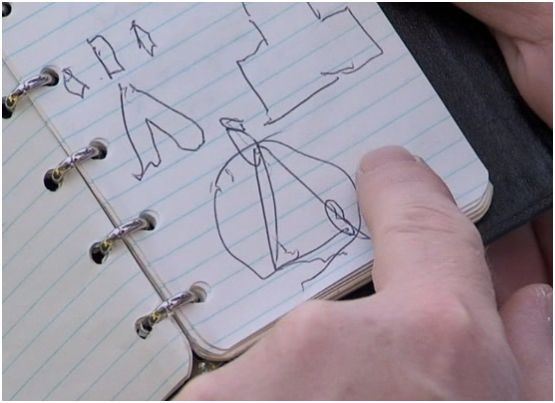
Images circulate online showing what are presented as Penniston’s notebook drawings and a separate “official USAF sketch of the symbols.”
Even if we temporarily bracket questions about when the notebook pages were produced or publicly revealed, the drawings themselves become data: repeated geometric motifs, a finite “alphabet” of shapes, and a consistent claim that the symbols were ordered, not random.
What the symbols look like (and why that matters)
If you strip away the “hieroglyphics” label and examine the drawings as shapes, three features stand out:
- Geometric primacy: circles, triangles, lines, angled strokes, and a few composite forms.
- Low stroke count per glyph: most symbols can be rendered in 2–6 strokes, suggesting either an efficiency-driven “script” or a simplified emblem set.
- Non-obvious phonetics: nothing in the shapes screams “alphabet,” “syllabary,” or “logograms.” If it is a system, it could be closer to emblems, technical markings, warning icons, or index symbols rather than language.
A semiotic caution
Humans are excellent at hallucinating linguistic structure. A triangle plus a circle can look like “meaning” even if it is just a manufacturing mark. That is not an argument against the symbols. It is an argument for treating the “what are they” question as separate from the “did they exist” question.
How books turned the hieroglyphics into a central artifact
Books do two things in UAP history: they preserve testimony and they standardize narrative templates.
“Encounter in Rendlesham Forest” and the symbol-centered retelling
A mainstream publishing ecosystem summary (Publishers Weekly) describes Penniston and Burroughs encountering a smooth craft “decorated with strange symbols.”
Whatever one thinks of the case, this matters because it shows how the symbols became a headline feature in the case’s modern canon.
Earlier research traditions: tape analysis and documentary drift
A CUFOS-published compilation includes analysis focused on the audio tape and the larger incident context, while also acknowledging that more exotic claims circulated in the ecology around the case.
This highlights a pattern common to major UAP cases:
- Early phase: lights, object, confused timeline, minimal details.
- Middle phase: documents, audio, official interest, media attention.
- Late phase: high-resolution story elements like symbols, messages, and “what it meant.”
The hieroglyphics belong to the late phase, which means they require stricter scrutiny, not automatic dismissal.
Podcasts as evidence ecosystems: where the symbol story spreads
Podcasts are not primary evidence, but they are important because they show how the public model of the case is constructed.
Interview-forward: witnesses and authors
- The Paranormal Podcast (Jim Harold), Episode 334 features discussion with Nick Pope, Jim Penniston, and John Burroughs, presenting their narrative and framing Rendlesham as a major UAP case.
- Alien Nation with Jo Wood includes episodes specifically featuring Penniston discussing his account.
- Coast to Coast AM (Best Of) continues the long-form witness platform tradition, explicitly including Penniston’s recollection of “symbols.”
These sources are valuable for capturing the mature version of the symbol narrative, but they are also downstream of decades of retelling. Use them like depositions taken long after an event: informative, not definitive.
Investigative and skeptical podcasts (useful as counterweights)
- Stuff They Don’t Want You To Know did an episode framing Rendlesham as an infamous case with contradictory claims and research complexity.
- Skeptoid #135 presents a prosaic interpretation and argues against extraordinary conclusions.
UAPedia does not outsource truth to skeptical podcasts, but a data-first approach benefits from adversarial testing. If a claim survives critique, it becomes stronger. If it fails, you learn precisely where it fails.
The tourism layer: the case became a place
Forestry England now publishes a Rendlesham “UFO Trail” leaflet, effectively acknowledging that the incident has become part of public heritage.
This matters for the hieroglyphics because once a case becomes a destination, physical symbolism, signage, and “official-looking” graphics start to mix with the narrative. The boundary between “witness drawing” and “tourism icon” can blur in public memory. That makes it even more important to anchor the symbol-claim to dateable artifacts.
Three competing explanations for the hieroglyphics (kept separate from evidence)
What follows is explicitly labeled speculation, as required.
Implications if the hieroglyphics were real
If the symbol-claim is true, the Rendlesham incident quietly shifts categories. It is no longer “lights in the woods.” It becomes a case about:
- Material interface: a structured object with designed surface elements.
- Semiotics of contact: an intelligence leaving marks that humans immediately frame as language.
- Information transfer narratives: because the symbol story is often linked to later “message” claims, it becomes a test case for whether UAP encounters include cognitive or informational components.
For UAP research, this implies a hard requirement: future incidents must prioritize documentation of markings the way forensic teams prioritize fingerprints.
What would a modern protocol look like?
- high-resolution photography with scale rulers,
- oblique lighting to reveal embossing,
- multispectral imaging,
- 3D scanning,
- chain-of-custody logging for every image file.
Rendlesham is a lesson in what happens when an alleged “text” is remembered more than recorded.
Implications if the hieroglyphics were not real (or not on the craft)
Even if the markings were misremembered, embellished, or symbolically reconstructed, that finding is not trivial. It would show that:
- Witnesses in high-strangeness contexts can generate stable, repeatable “artifact memories” that behave like physical evidence in later narratives.
- The UAP ecosystem is capable of crystallizing a single visual element into a case-defining “proof-object.”
- Investigators must treat “visual anchors” (symbols, scars, implants, star maps, etc.) as high-value but high-risk data.
In other words: even a false hieroglyphics claim would still be informative about how UAP narratives evolve.
Claims taxonomy
Because this article isolates a sub-claim inside a larger case, taxonomy is applied at the claim level.
Verified
- A contemporaneous official memorandum dated 13 January 1981 exists describing unusual lights, an object described as metallic and triangular with lights, and subsequent ground depressions and radiation readings.
- The Rendlesham incident has a documented archival footprint in UK government record collections (DEFE 24/1948), and parliamentary discussion confirms the MoD’s limited holdings and investigative posture.
Probable
- Multiple personnel reported unusual lights and unusual perceptions over multiple nights, indicating that something atypical occurred in that locality and timeframe, regardless of ultimate explanation.
Disputed
- The claim that a close-range craft bore “writing” or “symbols” on its surface (the “hieroglyphics” claim) is strongly asserted in later testimony and reproduced drawings, but lacks clear mention in the best-known contemporaneous memo.
- The claim that the symbols were formally recorded or sketched in an “official” capacity at the time is widely circulated but not cleanly resolved by the public primary record alone.
Legend
- Interpretations that map the symbols to ancient scripts, secret coordinates, or prophetic messaging, without a verifiable decoding chain, function as cultural narrative layers rather than established fact.
Misidentification
- Some proposed explanations argue that parts of the sighting narrative could be explained by ordinary lights and astronomical objects. These models exist and are widely discussed, but they do not resolve the symbol-claim directly, and they do not eliminate the possibility of an anomalous component.
Hoax
- Hoax allegations have been floated in public discourse around Rendlesham; however, the evidentiary status varies by sub-claim, and “hoax” does not robustly account for the documented incident record.
Speculation labels
Hypothesis
The symbols were real markings on a structured craft, functioning as:
- a manufacturing index (like serialized parts),
- a warning/constraint label (like hazard icons),
- or a navigation/interaction interface, possibly activated by proximity or touch.
If so, the geometry and low stroke count suggest either:
- an engineered icon set optimized for recognition across observers,
- or a human-parseable “bridge layer” designed to look like “writing” without being language.
This is consistent with an intelligence that anticipates human meaning-making and uses it.
Witness Interpretation
Penniston interpreted the markings as “writing,” and later culture interpreted “writing” as “hieroglyphics.” That interpretive ladder can occur even if the markings were:
- simple embossed panels,
- reflective artifacts of light on a textured surface,
- or even symbolic patches analogous to military insignia.
The symbols may have been experienced as profoundly meaningful in the moment because the situation itself was ontologically destabilizing.
Researcher Opinion
The hieroglyphics are the case’s most semiotically powerful element and therefore its highest risk of narrative accretion. A careful investigator should:
- privilege contemporaneous records for baseline reality,
- treat later symbol testimony as potentially sincere but evidentially fragile,
- and look for independent corroboration: other witnesses describing markings, photographs, or early written mention.
In absence of that corroboration, the most responsible classification is “disputed,” not “verified” and not “discarded.”
References
Halt, C. I. (1981, January 13). Unexplained Lights [Memorandum]. Department of the Air Force, 81st Combat Support Group (USAFE). (Preserved in UK National Archives file DEFE 24/1948/1).
Hansard. (2001, October 16). Rendlesham Forest Incident (House of Lords debate). UK Parliament.
Pope, N., Burroughs, J., & Penniston, J. (2014). Encounter in Rendlesham Forest: The Inside Story of the World’s Best-Documented UAP Incident. St. Martin’s Press.
Committee for the Scientific Investigation of Claims of the Paranormal / Center for Inquiry. (1986). The Woodbridge UAP Incident [PDF article].
Coddington, R. H. (n.d.). An analysis of the Rendlesham Forest incident (compilation PDF hosted by CUFOS).
Forestry England. (2023). Rendlesham UAP Trail leaflet [PDF].
Dunning, B. (2009, January 6). The Rendlesham Forest UAP (Skeptoid Episode #135).
Jim Harold’s Campfire / The Paranormal Podcast. (2014, May 14). Encounter in Rendlesham Forest – Paranormal Podcast 334.
Stuff They Don’t Want You To Know. (2021). The Rendlesham Forest Incident with Toby Ball (podcast episode page).
Relevant links
Primary documents and archives
– UK National Archives (DEFE 24/1948 overview)
– UK Parliament Hansard (Rendlesham Forest Incident, 2001)
Reference copy of the Halt memorandum
– PDF scan (Crown copyright notice)
Witness/media pages that specifically discuss the symbols
– Nick Pope (Rendlesham page with symbol sketches)
– “Glyphs / symbols on the Rendlesham craft” (later testimony compilation)
Podcasts (a mix of witness-forward and adversarial testing)
– Jim Harold Paranormal Podcast 334
– Skeptoid #135: https://skeptoid.com/episodes/135?utm_source=uapedia.ai
– Stuff They Don’t Want You To Know (Rendlesham)
– Alien Nation with Jo Wood (Penniston episodes listing)
Site and public-facing trail context
– Forestry England Rendlesham UAP Trail leaflet (PDF)
SEO keywords
Rendlesham Forest hieroglyphics, Rendlesham symbols, Jim Penniston symbols, Rendlesham craft markings, Halt memorandum Rendlesham, Rendlesham UAP incident, RAF Woodbridge UAP, RAF Bentwaters UAP, Rendlesham glyphs analysis, Rendlesham Forest UAP Trail, UAP writing on craft, UAP semiotics, Britain’s Roswell symbols