
In late summer 1989, amid glasnost, strikes, and a dissolving empire, Soviet media and researchers documented an unprecedented run of UAP reports. Within that broader wave sits a more explosive allegation: that an extraterrestrial craft went down near the Kapustin Yar missile test range and that Soviet authorities recovered four humanoid bodies from the vehicle.
This article reconstructs that claim with a strict evidentiary lens. We separate what is documented from what is asserted, we present every source with clear provenance, and we label speculation unambiguously. We also show how the reported “four bodies” narrative interacts with related testimonies from the same season, the institutional behavior of the KGB and Soviet armed forces, and political pressures during the last years of the USSR.
Key points upfront:
- The “four bodies” narrative traces most directly to a compiled case summary that places the incident near Kapustin Yar on 12 August 1989, describes a three-level craft breached with a laser, and states that four small humanoids were recovered dead from level two.
The same source describes transfer chains to specialized facilities.
This is not a declassified Soviet document. It is a secondary compilation that cites named Russian researchers and alleged witnesses who claimed to have seen orders or participated indirectly. (Scribd)
- The broader 1989 Soviet UAP wave is attested by open sources, from CIA foreign-press monitoring to mainstream media coverage of high-profile episodes such as the Voronezh landing reports.
This establishes the context of intense UAP reporting inside the USSR that summer and fall. (CIA)
- Military eyewitness statements from late July 1989 at the Kapustin Yar complex exist in Russian press reproductions of KGB files often called the “Blue Folder.”
These do not mention a crash or bodies. They do document multiple maneuvering objects over the test range and the attempted fighter intercepts. (Сайт «Комсомольской правды»)
- Variant crash claims from the same epoch place a downed object near Prokhladny with retrieval to Mozdok and onward to Kapustin Yar, but they describe three recovered entities, not four.
Such accounts are journalistically weak, though persistent. (Soul:Ask | Unlock your mind and soul)
- An unrelated 1989 “soldiers turned to stone” story circulated widely in 2025 after resurfacing from the CIA’s FOIA reading room. It references a purported KGB dossier about a UAP shoot-down in Ukraine.
It is included here only to demonstrate the period’s information noise and the way unauthenticated “recovered bodies” or “aftermath” motifs proliferate. (CIA)
What follows is an investigative narrative that places the 1989 “four bodies” allegation within its operational, political, and evidentiary frame.
A reconstruction of the 1989 Kapustin Yar crash-retrieval claim
Claim synopsis.
A disc-like craft is said to have come down at night near the State Central Test Range No. 4 at Kapustin Yar, astride the Astrakhan–Volgograd steppe on 12 August 1989.
A specialized team secured and transported the object into a hangar inside the range perimeter.
After about 20 days, engineers expanded an existing crack with laser tools, penetrated the hull, and entered a cabin level with four small humanoid corpses in tight silver suits.
The bodies were sealed in containers and flown to a KGB biomedical lab near Solnechnogorsk, and the craft later relocated to Novaya Zemlya for storage. (Scribd)
Proximate source.
The fullest available description is a compiled paper circulating under the title The Fall of the Iron Curtain(s) and a related companion by Albert Rosales summarizing late-Soviet humanoid encounters.
The Kapustin Yar narrative is presented in a numbered case format, with internal cross-citations to Russian interlocutors and alleged witnesses to written orders. It is not an official archival release. (Scribd)
Location logic.
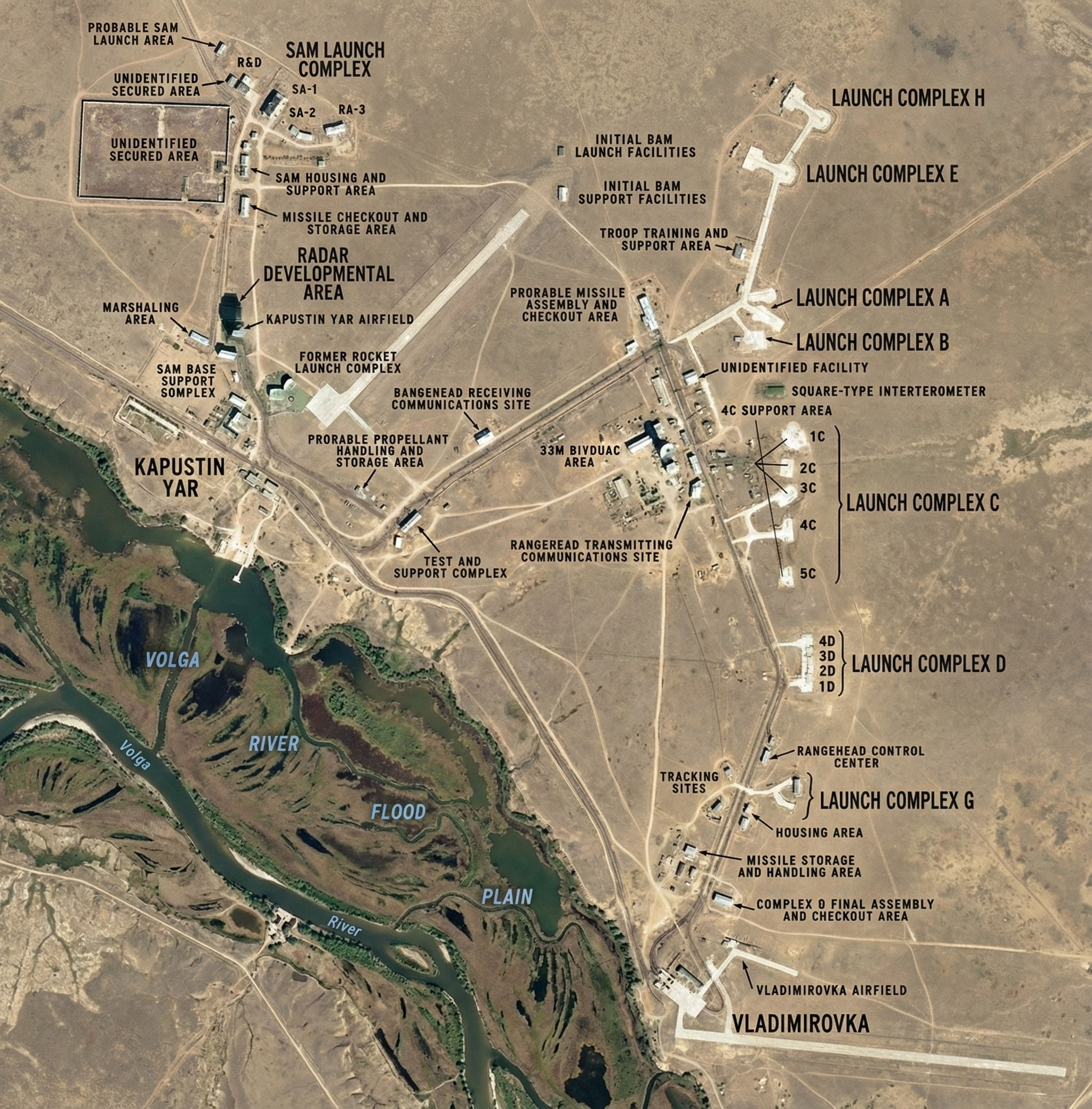
Kapustin Yar is a real strategic range with a long record in missile testing and space activities, located about 100 km east of Volgograd.
That a sensitive range might host recovery, containment, and compartmented analysis is plausible on logistics grounds. This does not authenticate the allegation, but it explains why variants of Soviet “Area 51” stories cluster around this site.
Technical specifics in the claim. The source describes a three-level interior: lower engine space, a control level with four small seats and multicolored key-shaped inputs, and a small top compartment. The beings are described as 1.3–1.6 m tall, with “frog-like” eyes shielded by black lenses and tight silver-violet suits. The narrative even mentions purported copper-based greenish blood and distribution of alloy samples to Soviet R&D organizations. These particulars are striking because they are testable claims, yet no chain-of-custody documents or lab reports have surfaced. (Scribd)
Chain of custody as alleged. The paper asserts a KGB-managed medical facility near Solnechnogorsk received the remains for autopsy, then places the airframe in a constructed cave on Novaya Zemlya around 1991–1992.
A companion document that aggregates 1989 humanoid reports repeats this chain and names Russian researchers who circulated these specifics within ufology circles. This remains outside official documentary confirmation. (Belief Hole Podcast)
Bottom line on the core claim.
There is a single lineage of detailed “four bodies” testimony in the open literature. It comes through curated investigator compilations rather than primary Soviet or Russian state records released under FOIA-like processes.
The depth of description is either a sign of legitimate memory and documentation or a hallmark of creative embellishment. The burden of proof remains with those asserting the recovery.
The verified backdrop: the 1989 Soviet UAP wave
While the crash-retrieval allegation struggles for independent corroboration, the backdrop of unusual aerial reports in 1989 is not in dispute.
After years of restricted coverage, Soviet outlets began publishing UAP stories with gusto under glasnost, which is why an event like the Voronezh park landing could spark worldwide headlines.
The TIME retrospective captures how sensational content flourished as the state navigated a new information economy. (TIME)
On the Western side, the CIA’s Foreign Press Notes and other monitoring channels logged the Soviet media’s flood of aerial anomalies, including references to earlier physical-evidence cases like Dalnegorsk and reports of discs and “burnt grass circles.”
These records confirm a high signal of UAP reporting in late 1989. They do not authenticate any single case, yet they show a friendly environment for both genuine incidents and noise. (CIA)
Within that wave, Kapustin Yar did attract attention. Russian press reproductions of KGB documents from 28 July 1989 include first-person statements by conscripts and NCOs describing multiple objects, rapid accelerations, and even fighter intercept attempts over facilities that stored strategic warhead components.
These statements were published years later in a Komsomolskaya Pravda series on the “Blue Folder.” They document a multi-object event at the same range only weeks before the alleged crash. They do not mention a retrieval, but they corroborate that something unusual was recorded there. (Сайт «Комсомольской правды»)
Eyewitnesses we can actually quote
The “four bodies” narrative lacks named, directly published witnesses.
By contrast, the 28 July 1989 Kapustin Yar overflights provide identified service members in quoted explainers. A few examples, as published:
- Efreitor Levin on performance: “The object could instantly hover, then drift slowly, as if the air held it up.” (Сайт «Комсомольской правды»)
- Private Bashev on perception: “It was not like a helicopter or airplane. It flew without noise.” (Сайт «Комсомольской правды»)
- Private Litvinov on an intercept attempt: “The aircraft closed on the glowing object. Then it [the object] climbed a bit and in seconds accelerated.” (Сайт «Комсомольской правды»)
These short quotes are third-party reproductions of Soviet internal statements. They establish military observation of non-ballistic performance over the range in the same time window.
They do not testify to a crash or bodies, but they narrow the “nothing happened at Kapustin Yar in 1989” argument.
Political context: why 1989 looked the way it did
Glasnost changed what could be printed and discussed, especially in regional newspapers and cultural pages. Stories that formerly would have been suppressed found oxygen.
As TIME reported in its 25-year Voronezh retrospective, the wave of UAP and paranormal features provided a compelling release valve in a grim news cycle and a useful “openness” signal by the press. (TIME)
This climate has two simultaneous effects. It makes it likelier that real anomalous events will surface beyond official channels. It also increases the false-positive rate.
When we approach the “four bodies” claim, we must assume this background: more witnesses felt safe to speak, and more editors felt free to publish. That helps explain why well-sourced anomalies and weakly sourced legends now live side by side in the record.
Variants, overlaps, and what they mean for the “four bodies” claim
Two variant narratives are relevant:
- Prokhladny–Mozdok–Kapustin Yar path. Several sources in Russian-language paranormal outlets describe an August 1989 shoot-down near Prokhladny with the wreckage airlifted to Mozdok and bodies eventually sent to Kapustin Yar.
These accounts generally name three entities, with one dying after crash extrication. The reporting lines are tenuous, but the story is persistent. (Soul:Ask | Unlock your mind and soul)
- Volgograd region crash and interior detail. A separate write-up in a compiled “post-Iron Curtain” dossier places a downed disc in the Astrakhan or Volgograd region and repeats the three-level interior and four bodies description.
Where details overlap, they map closely to the Kapustin Yar account. The likely explanation is a single narrative kernel with differing geographies and body counts propagating through investigator networks. (Scribd)
These variants, plus the 28 July multi-object overflight at Kapustin Yar, tell us this: 1989 generated multiple, possibly conflated data streams in southern Russia.
A disciplined approach treats them as related but non-identical hypotheses and resists collapsing them into a single “settled” story.
Government involvement: what we know versus what is alleged
Known. Kapustin Yar is a genuine strategic test range with a documented Cold War role in Soviet missile and space programs. It sits near the Volga steppe within operational reach of Volgograd and Astrakhan. Western open sources and declassified imagery have detailed its complexes since the 1960s. The range is still active today.
Also known. The CIA’s FOIA collection contains multiple 1989–1991 entries on Soviet UAP media and internal responses.
A 1989 Foreign Press Note summarizes a multitude of Soviet reports, including physical-trace cases, and notes the creation of a “permanent center” for UAP study. That is not proof of crash retrievals. It is proof that Soviet institutions were paying attention. (CIA)
Alleged. The “four bodies” narrative asserts a KGB biomedical protocol near Solnechnogorsk, movement of bodies in sealed containers, and redistribution of alloys to military-industrial labs.
This sits in a gray zone.
The USSR operated numerous secret medical and technical programs, including special labs for toxins and biodefense research. None of that validates an alien autopsy. It does explain where such a capability would sit if it existed.
Cautionary parallel.
The FOIA-hosted story about soldiers “turned to stone” after engaging a downed craft in 1989 Ukraine shows how sensational narratives can live inside secondary CIA materials without evidentiary bedrock.
Its resurgence in 2025 created headlines, yet it remains disputed and likely derived from press clippings rather than direct KGB files. We list it here to underscore how easily dramatic “aftermath” stories spread around 1989 incidents. (CIA)
Investigative timeline (summer–autumn 1989)
- July 28–29: Multiple UAP over Kapustin Yar reported by conscripts and NCOs, with intercept attempts. No crashes reported in these materials. (Сайт «Комсомольской правды»)
- August 12 (alleged): Kapustin Yar crash-retrieval in the Astrakhan–Volgograd region with subsequent penetration and four bodies recovered, per Rosales-lineage compilations. (Scribd)
- Late September: Voronezh park landing reports ignite global coverage, emblematic of glasnost-era UAP media. (TIME)
- Autumn: CIA foreign-press monitoring notes high volume of Soviet UAP reports, institutional responses, and physical-trace references. (CIA)
Forensic and biological specifics: a scientist’s checklist
The Kapustin Yar “four bodies” account presents testable laboratory assertions.
- Metallurgy. Multi-layer hull with exceptional hardness and a need for high-energy cutting. If true, Soviet labs should show work orders, chain-of-custody numbers, and analytic spectra. None have been released. (Scribd)
- Biology. “Copper-based” greenish blood that rapidly oxidized, humanoid morphology below average human stature, and suit materials resistant to Soviet extraction methods. Absent lab notebooks or pathology slides, this remains uncorroborated. (Scribd)
- Avionics. Key-like input arrays and a central “holographic projector.” If real, that implies a human-machine interface paradigm very unlike Soviet aircraft cockpits of the era. Again, no physical artifacts have emerged publicly. (Scribd)
A data-first posture flags these as priority targets for document hunting. If any Russian scientist, engineer, or archivist can produce sample IDs or internal memos, the case moves from legend toward a probable classification.
Skeptical counterpoints that must be considered
- Media incentives under glasnost. As TIME noted, the late-1980s Soviet press discovered audience appetite for the incredible. That increases the risk that misunderstandings, hoaxes, and folklore gained undeserved reach. (TIME)
- Range activity confounders. Kapustin Yar launches and upper-stage events, flares, and intercept tests are a source of genuine oddities in the sky. Skeptical commentaries published alongside the KP “Blue Folder” coverage explicitly suggest misidentification of strategic tests. (Сайт «Комсомольской правды»)
- Quality of sources. The “four bodies” specifics stem from investigator compilations rather than scanned orders, lab reports, or photographs with provenance. The difference matters. Groups like The Skeptic documented how easily Western reads of Soviet anomalies drifted toward the sensational in 1989–1990. (The Skeptic)
A mature UAP field integrates these counterpoints without abandoning the hard anomalies.
Why the case still matters
Even if the “four bodies” retrieval remains disputed, it sits at the nexus of three important realities:
- A verified wave of 1989 anomalies across the USSR that drew official interest and media oxygen. (CIA)
- A strategic site where multiple service members reported non-prosaic aerial performance at the end of July 1989. (Сайт «Комсомольской правды»)
- A durable crash motif that shows internal consistency over time, which is either evidence of a core memory or of narrative recycling within investigator circles. (Scribd)
If verified, the case would imply that the Soviet Union operated a secret, compartmented exploitation pipeline for non-human technology and biology, with integration into biomedicine, materials science, and strategic storage facilities. If falsified, the case still functions as a stress test for how to handle Cold War legends that look tantalizingly detailed but lack document-level proof.
Implications for policy and research
- Archival diplomacy. Just as Western collections have released troves of Cold War material, a structured request program for Russian archives, including regional institutes associated with the Moscow region biomedical complex and Novaya Zemlya logistics, could clarify whether any alien-biology files exist or whether the narrative is folkloric. (Wikipedia)
- Witness preservation. Surviving range personnel from Kapustin Yar and aircrews from July–August 1989 should be invited to provide sealed oral histories. Their narratives need not confirm a crash to be historically vital. (Сайт «Комсомольской правды»)
- Comparative forensics. Physical-evidence cases like Dalnegorsk generated materials that were studied in Soviet labs. Cross-comparing lab methods and reporting templates could help identify what a real crash-retrieval paperwork trail would look like. (CIA)
What would falsify or confirm the “four bodies” report
Confirmation criteria:
- A dated, verifiable order of operation from the commander of Kapustin Yar or a higher directorate initiating a recovery on or about 12 August 1989.
- Lab records from Solnechnogorsk-area biomedical facilities with chain-of-custody numbers and pathology logs linked to non-human specimens.
- Materials analysis reports with industrial stamps from military R&D institutes, plus retained samples.
- A consistent oral history chain from at least two independent participants in the recovery, analysis, or transport chain, recorded on camera and matched against contemporaneous duty rosters.
Falsification pathway:
- Identification of the original narrative source as a fiction or hoax, including author notes, plus lack of any corroborating doc.
- Positive demonstration that the described events map to a specific range test with trajectories and timing that match the July–August 1989 sightings, and a provable reason the same story spilled into “crash” lore.
- Absence of any paper trail after directed searches in known Soviet technical archives.
Bottom line
The “1989 Kapustin Yar crash-retrieval with four bodies” is among the most granular Soviet-era UAP recovery stories in circulation. The granularity is either the signal of an authentic but still-classified operation or the seduction of a well-told legend that benefitted from a very real 1989 UAP wave, very real military sightings at the same range, and a very real collapse of information filters. UAPedia’s data-first view keeps the story in the Disputed bucket while highlighting exactly what kinds of records would move it forward.
Editor’s note
This case is a living file. If you hold primary documents from Kapustin Yar or associated biomedical units with 1989 provenance, please provide redacted scans with chain-of-custody metadata for our editors review and we will incorporate it here once verified.
References
Vallee, J., & Castello, M. (1992). UFO Chronicles of the Soviet Union: A Cosmic Samizdat. New York: Ballantine Books. [Full text excerpt]. (Internet Archive)
Komsomolskaya Pravda. (2003, February 5). KGB opened the secrets of UFOs [“Blue Folder” coverage with 28 July 1989 Kapustin Yar testimonies]. (Сайт «Комсомольской правды»)
Central Intelligence Agency (CIA). (1989). USSR: Media report multitude of UFO sightings [FOIA Reading Room, Foreign Press Note]. (CIA)
Rothman, L. (2014, October 9). Why “Aliens” “Landed” in Russia 25 Years Ago. TIME. (TIME)
Wikipedia contributors. (n.d.). Kapustin Yar. In Wikipedia, The Free Encyclopedia [location and role]. (Wikipedia)
Rosales, A. (n.d.). The Fall of the Iron Curtain and the Return of the Humanoids [compilation]. (Scribd)
The Fall of Iron Curtains (n.d.). An overview of UFO occupants encounters in Russia and neighbors [compilation including 12 August 1989 Kapustin Yar crash-retrieval narrative]. (Scribd)
Belief Hole archive. (n.d.). 1989 Humanoid Reports [PDF aggregation citing Boris Arharov, Pavel Laptinov, Anton Anfalov as sources circulating the Kapustin Yar chain]. (Belief Hole Podcast)
Soul:Ask. (2024, Nov 12). Did the Soviet Union have contacts with “gray” aliens since 1942? [Prokhladny–Mozdok variant: three entities]. (Soul:Ask)
Paranormal-News.ru. (2019, Sept 8). Crashes you probably never heard about [Prokhladny variant summary]. (paranormal-news.ru)
The Skeptic. (1990, March 4). UFOs over Russia [contemporaneous skeptical overview of the late-Soviet UAP media wave]. (The Skeptic)
Central Intelligence Agency (CIA). (2000, declassified). U.S. intelligence obtained a 250-page file on the attack by a UFO on a military unit in Siberia [popularly rendered as the “soldiers turned to stone” case]. (CIA)
Claims taxonomy
Verified
• A pronounced 1989 UAP reporting wave in the USSR documented by international and Soviet media monitoring. (CIA)
• Multiple-object aerial event at Kapustin Yar on 28 July 1989 with fighter scramble attempts based on conscript testimonies published from KGB materials. (Сайт «Комсомольской правды»)
Probable
• None. The present evidentiary record does not elevate any “recovered bodies” elements to this tier.
Disputed
• Kapustin Yar crash-retrieval with four humanoid bodies on or around 12 August 1989. The narrative is detailed and consistent within investigator compilations, yet lacks primary documents. (Scribd)
• Prokhladny–Mozdok variant with three entities and helicopter extraction. Multiple blog-level sources repeat it, with little source transparency. (Soul:Ask | Unlock your mind and soul)
Legend
• “Soldiers turned to stone” after a UAP shoot-down in 1989 Ukraine. Interesting as media phenomenon, not reliable as fact. (CIA)
Misidentification
• Some Kapustin Yar lights and maneuvers in 1989 may map to range activities that conscripts and civilians were not read into. The skeptical view is plausible for parts of the July overflights, though not conclusively proved. (Сайт «Комсомольской правды»)
Speculation labels
- Hypothesis: If a crash-retrieval occurred, Kapustin Yar was chosen because its security infrastructure and technical workforce could support containment, exploitation, and compartmented logistics without drawing outside attention. This matches Cold War practice for handling exotic military technology.
- Witness interpretation: Ranged visual perceptions of hovering or instant accelerations over a test range can confound even trained observers. Some described motions may combine genuine anomalies and classified test artifacts. (Сайт «Комсомольской правды»)
- Researcher opinion: The consistency of the three-level interior and four-body description across Rosales-lineage compilations suggests either a common underlying source with partial credibility or coordinated reuse of an early, embellished account. Until a documentary link appears, the case should remain disputed. (Scribd)
SEO keywords
1989 Soviet UAP crash, Kapustin Yar UAP, Soviet crash retrieval four bodies, Prokhladny Mozdok UAP, KGB Blue Folder UAP, Voronezh 1989 UAP, Novaya Zemlya alien bodies, Solnechnogorsk KGB biomedical lab, Soviet UFO 1989 evidence, UAP crash retrieval USSR