
On the evening of 13 March 1997, Arizona’s skies became a stage for one of the most discussed mass UAP events in modern history. Thousands across the state reported two distinct aerial phenomena: first, a slow-moving “V” or boomerang of lights crossing Arizona; second, a later string of stationary lights hanging over the Phoenix metro for several minutes before winking out one by one. The second sequence has long been attributed by authorities to illumination flares dropped by A-10 jets training to the southwest, but key witnesses, including the sitting governor at the time, insisted the earlier overflight was a single, enormous, silent craft. The result is a case that is partly explained, partly unresolved, and still culturally formative nearly three decades on.
What happened: a clean timeline
7:55 p.m. MST – Henderson, Nevada. The earliest widely cited report came from Henderson: a witness described a large, V-shaped arrangement of lights moving southeast toward Arizona.
~8:15 p.m. – Paulden/Prescott area. Minutes later, observers near Paulden and Prescott/Prescott Valley reported reddish or amber lights, some describing an object with lights “embedded” in a structured, carpenter’s-square shape. Multiple accounts placed the formation moving generally southward.
~8:30–8:45 p.m. – North of Phoenix, Glendale/Scottsdale corridor. Many in Phoenix’s northern suburbs saw the formation pass overhead. An air traffic controller at Phoenix Sky Harbor later said the lights were bright, and did not show up on radar, a point the base PIO at Luke AFB also echoed – but both noted that primary radar and transponder practices could make a tight formation of aircraft effectively invisible if the lead transponder were off. (Tucson Weekly)
~8:45–9:00 p.m. – South toward Tucson. Reports continued as the formation moved south. Tucson media and military spokespeople initially said there were no airborne planes matching the event; later reporting from within the Arizona National Guard community and visiting Guard units would complicate that picture (see below). (Tucson Weekly)
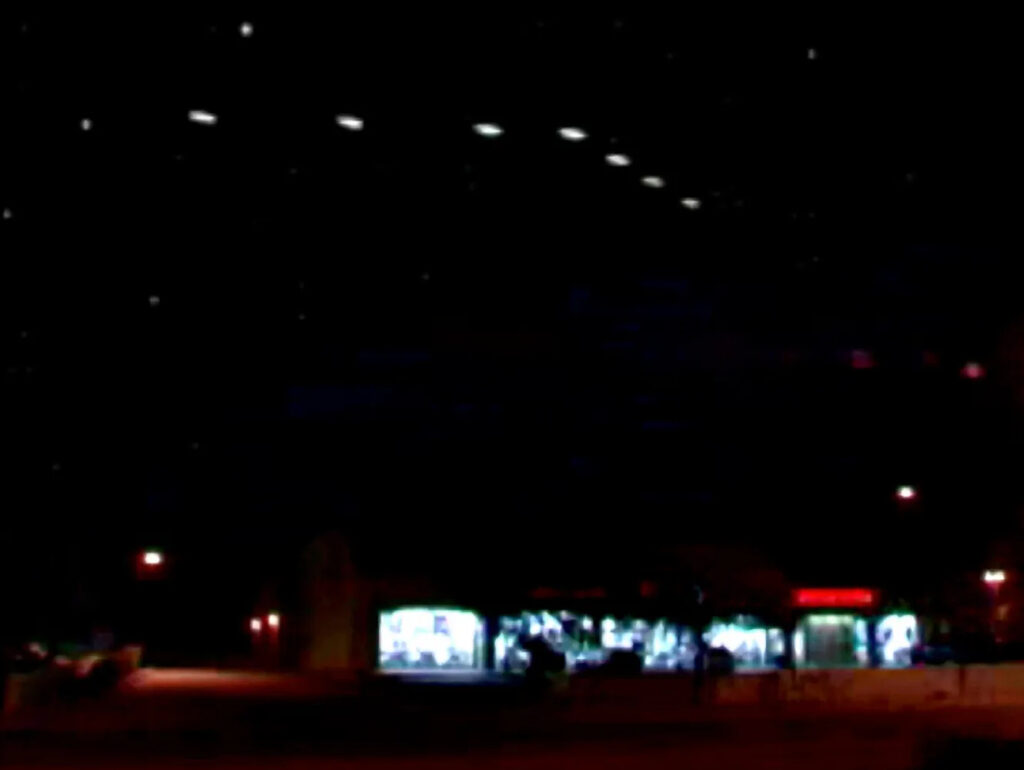
~10:00 p.m. – Southwest of Phoenix, near/behind the Estrella range. A separate display, a row of bright, seemingly stationary lights, appeared, hung in the sky for several minutes, and then extinguished one after another. This is the most heavily videotaped segment and replayed on local and national news. Analysis and later official statements connected this second event to parachute-suspended illumination flares dropped by A-10s training at the Barry M. Goldwater Range (BMGR) as part of Operation Snowbird, a winter detachment hosted out of Davis-Monthan AFB. The sequence of appearances and disappearances matches expectations for flare burn and occlusion behind the Sierra Estrella mountains southwest of the Valley. (Las Vegas Sun)
Two different sky events on one night were quickly fused into a single mythos. Untangling them is key to understanding why the Phoenix Lights remain both explainable and debated, depending on which portion you mean.
Witness testimony: from living rooms to the governor’s mansion
Thousands of residents called media outlets, police, and nearby Air Force facilities, especially after the 10 p.m. display. Luke AFB’s records manager later wrote (in a FOIA-released letter) that Luke received numerous public calls that night and afterward, and that Luke’s pilots were not involved – a statement that addressed Luke’s F-16 mission and did not preclude other units operating in southern Arizona.
Among the notable witnesses:
- Kurt Russell, a licensed pilot, later identified himself as the civilian pilot who radioed Sky Harbor about unusual lights while approaching Phoenix in a Cessna with his son. Local media summarized his 2017 BBC interview and the associated tower call. (AzCentral)
- Fife Symington III, Arizona’s governor in 1997, mocked the frenzy months later with a press gag featuring an aide in an alien costume. A decade afterward, he said publicly that he, too, had seen a “dramatically large,” delta-shaped, silent craft and did not accept flares as an explanation for what he observed earlier that evening. (ABC News)
- Mitch Stanley, a 21-year-old amateur astronomer in Scottsdale, viewed the earlier formation through a 10-inch Dobsonian telescope, resolving individual airplanes with wing-mounted lights. His account, recorded weeks after the event, remains one of the most technically specific early observations of the 8–9 p.m. overflight. (Tucson Weekly)
- Dr. Lynne Kitei, a Phoenix physician, filmed lights on multiple occasions, including March 13; her footage became a focal point in documentaries and local coverage. (Her website hosts background on her images and advocacy.) (Phoenix Lights Network)
Politically, Phoenix City Councilwoman Frances Barwood publicly asked for a city inquiry. She later said she fielded hundreds of witness contacts and was frustrated by official disinterest – a stance widely covered in local press at the time and in retrospectives. (Phoenix New Times)
The flare claims: what is firmly on the record
Within months, journalists traced the 10 p.m. event to A-10 Thunderbolt II jets from the Maryland Air National Guard’s 104th Fighter Squadron, deployed to Arizona for winter training. Spokespersons acknowledged an evening flare drop near 10 p.m. over the BMGR north tactical range, roughly 30 miles southwest of Phoenix. In 2007, a Maryland ANG pilot (Lt. Col. Ed Jones) was reported confirming he flew one of the aircraft that dropped illumination flares that night. These statements appear in multiple contemporary and anniversary articles, including The Arizona Republic’s 1997 coverage and later summaries. (Las Vegas Sun)
The U.S. Air Force’s Operation Snowbird is officially documented as a Davis-Monthan AFB program that supports visiting Guard units for winter training in southern Arizona’s ranges – exactly the context for the Maryland A-10 detachment in March 1997. (Defense Media Agency)
Technically, the flares in question were LUU-2-series (visible-light) parachute flares – long-burn, slow-descent devices used to illuminate ground targets. Manufacturer data and defense reporting describe typical outputs on the order of hundreds of thousands to around a million candela with burn times of several minutes, deployed on parachutes that can “balloon” in heated air – providing a stationary appearance and later “winking out” as they slip behind terrain features.
In addition to testimonies and official program context, topographic and video analyses match: several independent reconstructions and local news tests (e.g., KPNX-TV) showed flare drop arcs beyond the Sierra Estrella that closely reproduce the geometry and staggered disappearances seen on March 13. (The Underground Bunker)
Two FOIA records are also frequently cited in discussions of the Phoenix Lights:
- A Luke AFB letter (May 1, 1997) responding to a FOIA request, stating no Luke aircraft were involved and clarifying the base did not tell media that “aerial flares” were the cause; the letter also notes the large volume of public calls Luke received about the event.
- A Davis-Monthan AFB FOIA response (Aug. 8, 2013) explaining that operational logs relevant to the 1997 flare exercise had been destroyed per records-retention rules after six months, leaving no retrievable paperwork to release in 2013.
Together, this corpus makes the 10 p.m. lights the best-documented portion of the night – and the part most consistent with a known military activity. (Las Vegas Sun)
What flares explain and what they do not
What flares explain well (10 p.m. over the Estrellas)
The lights’ brightness, duration, steady positions, and sequential disappearance map naturally to long-burn, parachute-suspended illuminants drifting and then slipping behind a mountain ridgeline. The BMGR is the exact place such flares would be used; Operation Snowbird is the reason a non-Arizona unit (Maryland ANG) would be present; and contemporaneous press reporting quotes Guard and PIO sources to that effect. (Defense Media Agency)
What flares do not explain (8–9 p.m. moving “V”)
The earlier, state-long overflight is categorically different: it was described as a moving formation (or a structured object with fixed lights) that crossed large distances in under an hour. A telescope-equipped witness (Mitch Stanley) resolved what he says were individual aircraft – a direct observational datapoint – but others, including Gov. Symington, perceived a single, massive, silent craft that blocked stars. Radar non-returns can be consistent with formation flying under certain transponder conditions (and at altitude), but primary-radar and visual ambiguity leave room for debate. (Tucson Weekly)
This is why careful investigators treat the Phoenix Lights as two unrelated events on the same night. The flare solution fits event #2 robustly. Event #1 remains a disputed mix of formation-flight hypothesis versus giant structured craft testimony.
Media, memory, and the politics of response
Outside Arizona, national attention didn’t peak until USA Today ran a front-page story in June 1997, after which the case went primetime. Locally, Gov. Symington’s summer press event lampooning the incident is infamous; his 2007 admission that he, too, had seen a “craft of unknown origin” reframed the debate and is still widely cited. (ABC News)
At the city level, Councilwoman Frances Barwood called for an official inquiry and publicly collected witness testimonies, a stance covered repeatedly in Phoenix-area outlets. Her efforts fed the narrative that citizens’ experiences were dismissed too quickly – a dynamic that helped propel the case into long-term civic memory. (Phoenix New Times)
The archival picture (and its gaps)
Researchers often mention that the paper trail is sparse. On one hand, Arizona and national outlets documented ANG flares and Operation Snowbird activity. On the other, Luke AFB’s early FOIA letter said Luke neither launched intercepts nor had a flare story to offer, and Davis-Monthan later explained training logs from 1997 would have been purged under retention schedules. That mix – public statements, strong video/terrain fit, but thin surviving logs – helps explain why debate about event #1 endures.
Aftershocks: 2007 and 2008 “lights,” and why they matter
The Phoenix metro has seen repeat “mystery lights” incidents. In February 2007, lights were filmed and quickly ascribed to flares dropped by F-16s from Luke AFB. In April 2008, red lights over Phoenix were traced within 48 hours to a local resident attaching flares to helium balloons, a finding rounded out by police helicopter confirmation. These later episodes underscore how easily flare-like displays (military or civilian) can be mistaken for structured objects at night – without telling us what the 8 p.m. 1997 overflight actually was.
Interdisciplinary read: why mass UAP nights get “sticky”
From an anthropological perspective, the Phoenix Lights exhibit features typical of mass sighting events: a shared stimulus spawning divergent interpretations, later harmonized by media into a singular “incident.” From a perceptual science angle, angular-speed illusions, the lack of distance cues at night, and terrain occlusion can create powerful impressions of size and solidity. Meanwhile, the religious/cultural imagination of Phoenix – southwestern sky lore, the proximity to sacred mountains like the Estrellas, and a 1990s pop-culture moment primed by anniversaries (Roswell 50th) – made meaning-making almost inevitable. None of this negates anomalous observations; it contextualizes why eyewitness narratives diverge and harden. The Phoenix Lights endure because the second event is mundane but spectacular (flares), while the first event resists easy closure, especially for witnesses who insist they saw a coherent craft.
Assessment
Event #1 (≈8:00–9:00 p.m. moving formation / “V” over Arizona)
Evidence: Widespread testimony; telescopic resolution of aircraft by an amateur astronomer; ATC and base PIOs citing no radar target yet allowing that formation operations could escape standard transponder-based radar; divergent perceptions of structure vs. discrete lights. (Tucson Weekly)
Assessment: Disputed. Credible observers disagree. A formation-flight explanation remains plausible, but multiple responsible witnesses, including a state governor, described a single, enormous, silent craft, a claim not falsified by surviving records. (See speculation labels below.) (ABC News)
Event #2 (~10:00 p.m. stationary string of lights southwest of Phoenix)
Evidence: Time/position correlation with ANG flare drop during Operation Snowbird; multiple official and media statements; LUU-2 performance characteristics; terrain-matched video analyses; strong fit to Sierra Estrella occlusion and burn-out sequencing. (Las Vegas Sun)
Assessment: Probable (very strong). The flare explanation accounts for the videos, the timing, the geometry, and contemporary official statements. The absence of surviving range logs (per records retention) does not materially weaken the fit.
Mass sighting reality (public impact, volume of reports)
Evidence: Contemporary and retrospective coverage; FOIA letter noting volume of public calls to Luke AFB; city officials publicly engaging (Barwood).
Assessment: Verified. The mass sighting and its civic footprint are beyond reasonable dispute.
Why the Phoenix Lights still matter
The case reshaped public conversation about UAP in the American Southwest. It became a policy touchpoint (citizen complaints, media scrutiny, a governor’s reversal), and it has served as a teaching example in everything from human perception to range safety. The night also illustrates how two unrelated sky events can become fused into a single legend – one part now well-explained, the other stubbornly contested.
Claims Taxonomy
Verified
A large mass sighting occurred across Arizona on 13 March 1997, with extensive media documentation and official acknowledgment of public concern.
Probable
The 10 p.m. stationary lights were LUU-series illumination flares dropped by A-10s from a visiting Air National Guard unit training under Operation Snowbird at the BMGR; video geometry matches occlusion behind the Sierra Estrella. (Las Vegas Sun)
Disputed
The 8–9 p.m. moving “V”: aircraft formation vs. single massive craft. Mitch Stanley’s telescope view supports aircraft; multiple high-credibility witnesses assert a structured object. No conclusive radar or unambiguous imagery settles it. (Tucson Weekly)
Legend
Later retellings that all 1997 lights were a single giant craft over Phoenix conflate two events and overgeneralize the record. (Useful cultural shorthand, but not evidentially precise.)
Misidentification
2008 Phoenix lights (helium balloons with flares) and 2007 Valley lights (Luke AFB flares) demonstrate how non-UAP stimuli can mimic March 13 visuals. (Live Science)
Speculation labels
Hypotheses (for Event #1):
- Single structured craft hypothesis. A large, silent, wedge-shaped platform of unknown origin transited Arizona using low-observable tactics (minimal strobes, no transponder). This aligns with some witness narratives (e.g., Symington). It conflicts with the telescope-resolved airplanes and with the lack of corroborating radar, but the latter can be equivocal at altitude in formation. Status: Unresolved. (ABC News)
- Multiple military aircraft hypothesis. A flight of A-10s or similar transited on a southern corridor under VFR/formation lighting during Snowbird rotations; visual misperception of size/altitude created the “single craft” impression. Status: Plausible; consistent with some testimony and transponder/radar caveats. (Tucson Weekly)
Witness Interpretation:
Many Event #1 witnesses experienced a solid craft blocking stars and producing an uncanny sense of nearness and scale. That interpretation is an important human datum even if aerodynamic or optical models offer different readings.
Researcher Opinion:
Given the clean separation between the 10 p.m. flare event and the 8–9 p.m. overflight, collapsing both into one explanation erases facts. Our view is that Event #2 is extremely well accounted for by military activity; Event #1 remains a live evidentiary dispute deserving of open data (e.g., releasable FAA/DoD primary radar archives if any exist) and careful re-examination of original videos, photographs, and unedited interviews. (Defense Media Agency)
References (selected)
Tucson Weekly (Tony Ortega), “Answering the ‘Arizona Question’” – early on-scene analysis of the moving “V,” including Mitch Stanley’s telescope observation and ATC/radar context. (Tucson Weekly)
Las Vegas Sun (AP), July 25, 1997 – “Military now says flares may be cause…” summarizing Capt. Eileen Bienz’s findings and the Maryland ANG’s training role. (Las Vegas Sun)
Arizona Republic (Richard Ruelas), July 25, 1997 – “Air Guard unit sheds light on Valley’s UFOs” (archival clipping referenced widely in later reports). (Newspapers)
Davis-Monthan AFB – Operation Snowbird fact sheet – official description of Snowbird’s mission supporting visiting Guard units in southern Arizona. (Defense Media Agency)
Northrop Grumman LUU flare data (as reported via defense/aviation sources) – burn times, output, and parachute behavior consistent with 10 p.m. lights.
Phoenix New Times / KPNX reconstructions – terrain-matched comparisons showing lights winking out behind the Sierra Estrella ridgeline. (The Underground Bunker)
Luke AFB FOIA letter (May 1, 1997) – confirms no Luke aircraft involvement and clarifies what the base did and didn’t say to media about flares, while noting public call volume.
Davis-Monthan AFB FOIA response (Aug. 8, 2013) – records regarding 1997 flare activity destroyed per retention schedule, leaving no logs to release.
ABC News (2007) – Gov. Fife Symington’s on-record description of witnessing a “dramatic” craft and skepticism about the flare explanation for the early overflight. (ABC News)
azcentral (2017) – report on Kurt Russell identifying himself as the pilot who radioed in a lights sighting on approach to Phoenix. (AzCentral)
Phoenix New Times – coverage of Frances Barwood’s calls for investigation and critical looks at post-hoc video “spectral” claims. (Phoenix New Times)
SEO keywords
Phoenix Lights 1997, Arizona UAP, Maryland Air National Guard flares, Operation Snowbird Davis-Monthan, Barry M. Goldwater Range, Sierra Estrella lights, Fife Symington Phoenix Lights, Mitch Stanley telescope, LUU-2 illumination flares, Phoenix mass UAP sighting