
At 7:14 a.m. local time on June 30, 1908, a blast over the Stony Tunguska River in Siberia flattened trees across a vast swath of taiga. No crater was found. No definitive fragments were recovered on site. Yet shock waves circled the globe and night skies were reported bright across Europe in the days that followed. For more than a century, Tunguska has been a touchstone in debates about cosmic hazards, atmospheric airbursts, and the boundary between extraordinary natural events and claims of the truly anomalous. This explainer takes a data-first approach. It lays out the core measurements and eyewitness testimony, the competing physical models, and the fringe alternatives; it then situates Tunguska within today’s UAP conversation by showing what the case teaches about standards of evidence, sensor corroboration, and how to keep natural sky phenomena separate from unknowns.
Time, place, and scale
On the morning of June 30, 1908, a powerful atmospheric explosion occurred above remote forest near the Podkamennaya (Stony) Tunguska River, in what is now Krasnoyarsk Krai, Russia. The blast produced a butterfly-shaped pattern of forest fall and scorching that radiated from an epicentral zone later documented by Soviet expeditions beginning in the late 1920s. Published estimates of the flattened area range around eight hundred to more than one thousand square miles, on the order of two thousand square kilometers, making Tunguska the largest impact-related event in recorded history. There is broad scientific agreement that the energy release was in the multi-megaton range and that no impact crater formed because the object disintegrated in the atmosphere. (Earth Observatory)
Eyewitnesses at trading posts like Vanavara and in Evenki communities reported a bright fireball, a flash, multiple concussions, and powerful winds that knocked people off their feet. Much of the testimony was recorded years after the event, but several accounts were documented earlier and have consistent features: an approach from the southeast, dazzling light, intense heat, and a sequence of shock waves. (aps.org)
In the modern policy sphere the date of the Tunguska blast is institutionalized. The United Nations established International Asteroid Day on June 30 specifically to commemorate Tunguska and raise awareness about impact hazards. (United Nations)
The first field science
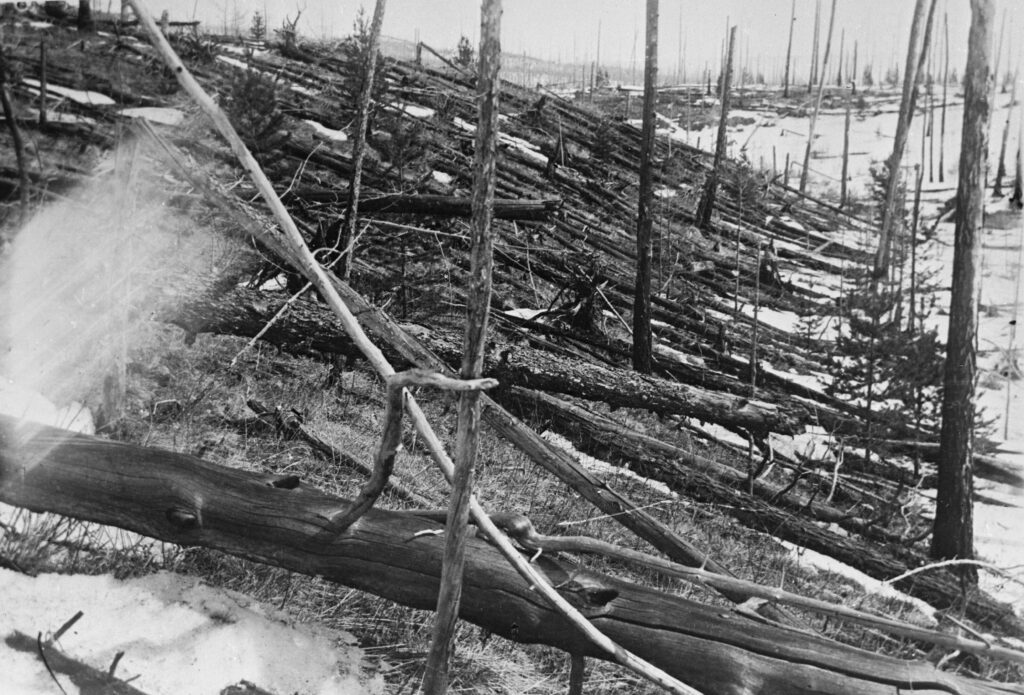
The best known on-site investigations were led by Leonid Kulik of the Soviet Academy of Sciences. After several failed attempts to reach the region, Kulik and teams visited the epicentral area beginning in 1927 and photographed massive radial tree fall, with standing, branch-stripped trunks close to the presumed airburst locus and flattened trees outward for tens of kilometers. Those photographic records remain foundational. (The Linda Hall Library)
Kulik’s expeditions did not recover an obvious impact crater or large meteoritic masses. Later researchers sampled soils and peat and reported enrichments in elements common to meteoritic material, but the absence of a crater and of definitive macroscopic fragments at ground zero steered scientific models toward a high altitude airburst rather than a classical impact. (Encyclopedia Britannica)
What the leading physical models say
Airburst of a stony asteroid or meteoroid
The prevailing consensus is that Tunguska was caused by the atmospheric entry of a stony asteroid or meteoroid tens of meters in diameter, traveling at cosmic velocities and disintegrating at altitude. The energy deposition produced a powerful blast wave that felled trees and ignited surface fires, while the object’s mass and momentum were mostly dissipated aloft, explaining the lack of a crater. This interpretation is endorsed by multiple reference sources and aligns with modern computational models of low-altitude airbursts. (Encyclopedia Britannica)
Computational shock-physics work using codes like CTH has explored parameter space for Tunguska-scale airbursts, showing how entry angle, composition, velocity, and fragmentation depth affect overpressure footprints and thermal flux on the ground. These simulations help reconcile the large tree-fall area with the absence of a crater and predict damage radii consistent with mapped forest blowdown. (The University of New Mexico)
Cometary nucleus hypothesis
A competing school—historically more common in Russia—has favored a volatile-rich cometary body that disrupted and vaporized more completely, leaving less solid residue. NASA and other summaries often present the airburst as either a stony asteroid or a comet fragment, with present-day modeling favoring the former but allowing cometary possibilities under some parameter sets. (NASA Technical Reports Server)
Lake Cheko as a candidate crater
A minority hypothesis proposes that nearby Lake Cheko, about eight kilometers northwest of the epicentral zone, is a small impact crater formed by a surviving fragment. The original 2007 paper in Terra Nova presented bathymetry and sediment data consistent with a young basin, though subsequent work has challenged this on geomorphic and stratigraphic grounds. More recent analyses place Cheko outside modeled strewn fields and argue against an impact origin, but research continues. The debate is instructive for method, as it shows how new geophysical data can test appealing but contested claims. (Wiley Online Library)
Extreme alternatives
A variety of nonstandard ideas have circulated, including deep-gas explosions, kimberlite pipe eruptions, and other endogenic mechanisms. These are not broadly accepted and generally struggle to explain the well-documented aerial shock phenomena and the regional reports of a fireball and trail. They are part of the historical literature and are worth knowing about because they highlight how critical multi-disciplinary constraints are when reconstructing a rare event. (ResearchGate)
What the documents and witnesses actually say
Selected primary descriptions
A frequently cited witness near Vanavara described the sky splitting, an intense heat wave, a shock that threw him and others, and a series of loud bangs akin to artillery. Other accounts mention a white or bluish trail in the sky and a sound sequence over several minutes. These motifs recur across collections. Modern English language summaries collate these testimonies and track how distance from the epicentral zone modulated experiences of heat and blast. (aps.org)
Ethnographic material collected among Evenki communities adds cultural context and sometimes downplays meteor explanations, reflecting different interpretive frames. These interviews, some of which were gathered decades after 1908, still register a dramatic luminous event in the sky and an aftermath of fires and dead reindeer. A careful analyst logs what is directly observed, what is inference, and what is cultural framing. (arXiv)
What was measured later
Kulik’s 1927 and subsequent expeditions mapped a radial “butterfly” of destroyed forest. Photographs from 1929 show tree trunks snapped or uprooted and laid pointing away from a central zone where trunks remained standing but branch-stripped and scorched, a pattern consistent with a downward-directed blast at altitude. These iconic images still underpin modern reconstructions. (The Linda Hall Library)
The Chelyabinsk comparator
On February 15, 2013, a stony asteroid roughly twenty meters across exploded over Chelyabinsk, Russia, injuring more than a thousand people and damaging buildings across a wide area—an event captured by hundreds of dashcams and measured by infrasound, satellites, and seismic networks. NASA’s immediate assessment called it the most energetic recognized impact since Tunguska, providing a modern, sensor-rich analogue of a smaller airburst. Chelyabinsk validates the airburst pathway and shows how such events deposit energy and create window-shattering shock waves without cratering. (NASA Jet Propulsion Laboratory)
What Tunguska means for UAP standards
A modern UAP case file seeks multi sensor data, chain of custody, and physics-consistent motion descriptions. Tunguska predates that infrastructure, yet it still provides cross-disciplinary constraints: regional eyewitnesses, mapped blowdown consistent with a downward blast, lack of a crater, and global atmospheric effects. The weight of the combined evidence supports a natural cosmic airburst, not a structured craft under control.
That conclusion matters for UAP research. Tunguska reminds us that some spectacular sky events are both natural and outside ordinary experience, and that they can produce “agency-like” narratives in witness language without implying vehicles. It also reminds us that even when fragments are scarce or absent, independent physical signatures can converge on a natural cause.
The persistent questions
- Object type and entry parameters
Was the body a stony asteroid, a carbonaceous object, or a volatile-rich cometary fragment The present balance of modeling and residue arguments favors a small, stony asteroid, but uncertainties in entry angle, velocity, fragmentation height, and strength mean both classes have been argued. NASA and reference works present this as an asteroid or comet airburst, with an asteroid favored today. (NASA Technical Reports Server) - Craterlessness
Why no crater? If the breakup occurred between roughly five and ten kilometers altitude, then dynamic pressure and ablation would have dispersed mass over a wide area as microfragments and aerosols while the blast wave reached the ground with destructive overpressure. That picture is consistent with mapped damage and the lack of a central pit. (The University of New Mexico) - Lake Cheko
Is Cheko a secondary crater The 2007 Terra Nova proposal remains debated. Follow-on modeling and mapping argue Cheko’s position and sediment history make an impact origin unlikely. This is a live scientific question that illustrates how single-site anomalies must be weighed against whole-scene dynamics. (Wiley Online Library) - Rare electromagnetic reports
Some accounts mention unusual luminosities or electromagnetic effects. Given the time lag in documentation and the mixture of direct and second-hand testimony, these are difficult to calibrate. The Chelyabinsk dataset shows that bright flashes, shock waves, and intense sound sequences are expected for airbursts and can be strikingly misremembered or amplified in retellings. A rigorous filter treats such details with caution unless they can be tied to instrumental records. (NASA Jet Propulsion Laboratory)
Mentions, stories, and how to use them
“The sky split and the north was on fire”
Classic witness language evokes agency and purpose. A data-first method extracts the physical descriptors embedded in the prose: angular approach, color, comparison objects, sequence of bang and wind, duration, and direction. When collated, these fields fit an oblique entry and fragmentation path. Resist the temptation to read verbs like “chased” or “turned” as control inputs. They are human verbs applied to physics. (aps.org)
“The forest lay like grass after a scythe”
Kulik’s photographs remain among the most compelling physical exhibits. Radial fall vectors and a central zone of vertical spires are precisely what an elevated blast predicts. Those images are not just dramatic. They are vector data. (The Linda Hall Library)
“A small round lake appeared”
Local memory and later proposals about Lake Cheko are powerful because the human brain prefers a visible hole. This is where geophysics and sedimentology are essential. The Cheko debate is not resolved for all readers, but the most recent modeling and strewn-field work argue against an impact origin. Hold this hypothesis as possible but unsupported. (Wiley Online Library)
Declassified curiosities
Because Tunguska looms large in twentieth century imagination, it appears in unexpected government files. A declassified CIA “remote viewing” training document from the 1990s used Tunguska as a practice target. This is not scientific evidence about the event. It does show how Tunguska entered Cold War and post-Cold War archives in unusual ways. Use such documents as cultural artifacts, not as data about the physics. (CIA)
Planetary defense: the policy angle
Tunguska is the reason June 30 is International Asteroid Day, and it is the historical benchmark for “city-killer” airbursts. The United Nations and the space agencies use Tunguska as the teachable case for why discovery, tracking, and deflection capabilities matter. Chelyabinsk, with its flood of sensor data, is the modern tutorial. Together they motivate surveys like NASA’s NEO programs and missions such as DART, and they frame how UAP dialogue should separate atmospheric optics and natural airbursts from the small residual class of truly unexplained aerial cases. (United Nations)
Implications for UAP research
- Data discipline pays
Tunguska shows how multi-domain constraints: maps of physical damage, witness fields, and physics models, can converge on a natural cause even when a crater and large fragments are absent. That is the standard UAP work should emulate. (The University of New Mexico) - Beware single-site seductions
Candidate features like Cheko are seductive. The right response is to model the full system, check positional consistency with strewn-field expectations, and test age with independent methods. (ScienceDirect) - Use modern analogues
Chelyabinsk is the Rosetta stone for airbursts. It bridges human narrative and instrument data and helps calibrate memory and metaphor. Screen historical “mystery blasts” against the Chelyabinsk physics before invoking unknowns. (NASA Jet Propulsion Laboratory) - Communicate clearly
A powerful natural event can feel like an encounter with agency. UAP communicators should explain how airbursts generate sequences of flash, heat, shock, and wind that map directly onto witness language. That approach respects witnesses and keeps the unknowns category meaningful.
Data-first cautions
- Time lags in testimony
Many accounts were collected years after 1908, which increases the risk of contamination and narrative smoothing. Weighted analyses privilege earlier, location-anchored reports. (aps.org) - Genre matters
Scientific expedition reports, peer-reviewed modeling, and museum-curated archives carry different evidentiary weights from popular summaries and news features. Use primary science where possible for energy, altitude, and composition claims. (The University of New Mexico) - Beware arguments from absence
No crater does not mean no impactor. Airburst physics explains craterless devastation. This is now well established in the literature and confirmed by Chelyabinsk. (NASA Jet Propulsion Laboratory)
Claims taxonomy
Verified
- A very large atmospheric explosion occurred over Siberia on June 30, 1908, flattening trees across hundreds of square miles and leaving no central crater. Multiple scientific and reference sources concur. (Earth Observatory)
- The event is widely interpreted as an airburst from a small cosmic body. Modern simulations of Tunguska-scale airbursts reproduce ground damage patterns without a crater. (The University of New Mexico)
- International Asteroid Day is held each June 30 in reference to Tunguska. (United Nations)
- The 2013 Chelyabinsk airburst is the most energetic recognized event since Tunguska and validates the airburst damage pathway. (NASA Jet Propulsion Laboratory)
Probable
- The impactor was a stony asteroid tens of meters across that fragmented at altitude, depositing energy between roughly five and ten kilometers and generating a megaton-class blast. Reference syntheses and NASA materials support this as the leading interpretation today. (Encyclopedia Britannica)
Disputed
- Lake Cheko as an impact crater. Original Terra Nova work argued for a young, impact origin; subsequent modeling places the lake outside likely strewn-field bounds and disfavors impact. The question is testable and remains a minority view. (Wiley Online Library)
Legend
- Claims that Tunguska was caused by endogenic explosions or exotic technologies. These are not supported by physical mapping, eyewitness trajectories, or modern airburst modeling. (ResearchGate)
Misidentification
- Treating the absence of a crater as evidence for a non-cosmic cause. Craterless devastation is precisely what a high-altitude disintegration predicts, as modern modeling and the Chelyabinsk comparator demonstrate. (The University of New Mexico)
Speculation labels
Hypothesis
Small surviving fragments may exist as microtektites or meteoritic dust mixed into peat and lake sediments downwind of the blast corridor, with enrichments in elements such as nickel. Stratigraphic work could continue to refine residence times and constrain composition, indirectly informing whether the parent was asteroidal or cometary. (This remains an inference from general meteoritic fallout processes and sediment studies noted in reference syntheses.) (Encyclopedia Britannica)
Witness interpretation
Language of pursuit, turn, and battle in some narratives likely reflects the human tendency to ascribe intent to dynamic natural events. A structured sequence of flash, thermal pulse, shock, and wind is expected from an oblique airburst and maps well to the most consistent details in early reports. (aps.org)
Researcher opinion
The highest value of Tunguska for UAP studies is as a method lesson. It shows how to combine dispersed and imperfect human testimony with hard physical mapping and physics-based modeling to collapse a spectacular unknown into a specific natural class. It also shows how to keep lively minority hypotheses open to testing without letting them dominate communication.
References
NASA Earth Observatory, “A Cosmic Explosion Over Siberia.” (Earth Observatory)
Royal Observatory Greenwich, “The Tunguska event explained.” (Royal Museums Greenwich)
NASA NTRS, “Applying Modern Tools to Understand the 1908 Tunguska Impact.” (NASA Technical Reports Server)
Boslough and Crawford, “Low-altitude airbursts and the impact threat.” (The University of New Mexico)
Britannica, “Tunguska event.” (Encyclopedia Britannica)
UN, “International Asteroid Day.” (United Nations)
UNOOSA, “International Asteroid Day, 30 June.” (UNOOSA)
JPL NASA, “Chelyabinsk fireball details.” (NASA Jet Propulsion Laboratory)
Terra Nova papers and follow-ons on Lake Cheko. (Wiley Online Library)
APS News History, “June 30, 1908: The Tunguska Event.” (aps.org)
CIA FOIA Reading Room, declassified training file referencing Tunguska. (CIA)
SEO keywords
Tunguska Event UAP, 1908 Siberia airburst, Tunguska asteroid or comet, Lake Cheko crater debate, Leonid Kulik expedition photos, Chelyabinsk comparison Tunguska, International Asteroid Day UN, Boslough airburst modeling, NASA Tunguska explainer, Britannica Tunguska facts, UAP data standards airburst