
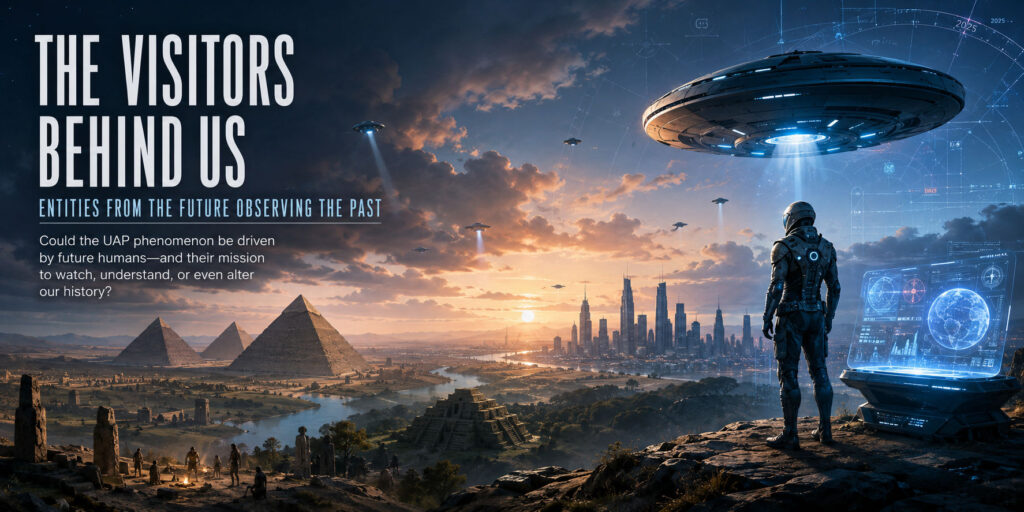
The most unsettling possibility in the UAP debate is not that the visitors are from another star. It is that they are from here.
Not here as in a hidden base, a lost civilization, or a breakaway aerospace project, though those ideas sit nearby in the wider field of UAP hypotheses. Here as in Earth. Here as in our evolutionary tree. Here as in the future looking backward.
This is the core of the future-observer hypothesis: some portion of the UAP phenomenon may be driven by humans, post-humans, artificial descendants of humanity, or another Earth-origin intelligence traveling backward, or projecting backward, to observe earlier periods of planetary history. In its stronger form, the hypothesis proposes something even more provocative: that future terrestrial intelligences may not merely be observing the past. They may be nudging it, sampling it, warning it, stabilizing it, or attempting to prevent outcomes that threaten their own existence.
It may also be one of the few UAP hypotheses that explains why the phenomenon so often appears intimate. It does not always behave like distant alien exploration. It behaves, at times, like surveillance of family history.
The hypothesis in plain language
The future-observer model begins with a deceptively simple proposition: if a terrestrial intelligence survives long enough to develop extraordinary control over spacetime, energy, gravity, perception, or information, then its most precious archive would not be a museum. It would be the past itself.
A civilization that has mastered backward observation would have reason to study origin points: the rise of agriculture, the emergence of organized religion, wars, nuclear weapons, ecological collapse, artificial intelligence, pandemics, genetic engineering, and the psychological thresholds at which humanity either matures or destroys itself. A future civilization would not only ask, “Where did we come from?” It would ask, “Where did we almost fail?”
That question changes the UAP problem. Modern UAP are often discussed as intrusions into airspace, but under this hypothesis they are also intrusions into historical time. A sphere over a nuclear facility, a silent object near a military training range, an encounter that leaves witnesses with ecological warnings, or a close-contact event centered on reproduction or genetic sampling may become data points in a larger temporal anthropology.
This does not mean every UAP sighting is a time-travel event. It does not mean every entity report is future human. It does mean that the future-observer hypothesis deserves a serious place among UAPedia’s explanatory frameworks because it connects several recurring features that other models often treat separately: humanoid entities, interest in human biology, warnings about technology and ecology, temporal distortion, extreme evasiveness, and the strangely pedagogical quality of many close encounters.
Why the idea has gained intellectual traction
The most visible modern advocate of a future-human interpretation is Dr. Michael P. Masters, a biological anthropologist at Montana Tech. His 2019 book, Identified Flying Objects, argues that many alleged entities in UAP contact narratives could be interpreted as distant human descendants returning to study their own hominin past. Montana Tech’s repository summarizes the premise directly: Masters examines the possibility that reported visitors are “our distant human descendants” returning from the future to study their evolutionary past. (digitalcommons.mtech.edu)
Masters’ argument is anthropological before it is technological. He notes that many reported beings are bipedal, large-brained, hairless, human-like, and communicative in ways that often mirror human cognition and language. In a 2020 interview hosted by the Blog of the American Philosophical Association, Masters argued that these recurring descriptions appear consistent with possible long-term biological and cultural trends in human evolution, while also acknowledging that testimony alone does not constitute scientific proof. (blog.apaonline.org)
That caution matters. The future-human model is not verified. It is a hypothesis. But it is not random. It tries to explain why so many “others” in the UAP literature look oddly close to us, not radically alien. The classic question has always been: why would beings from distant stars resemble Earth primates? The future-observer answer is blunt: because they may be Earth primates, or what Earth primates become.
The model also avoids one of the hardest problems in the extraterrestrial hypothesis: distance. If the visitors are from another star system, they must cross enormous spatial distances or use physics far beyond known propulsion. If they are from Earth’s future, the barrier is different. It is not primarily distance across space. It is access across time.
That is not easier. But it is a different problem.
What physics allows, and what it does not yet allow
The first thing to say is that time travel is not entirely fictional. Relativity already tells us that time does not pass identically for every observer. NASA’s public explanation of time travel notes that Einstein’s relativity links space and time, and that the faster one travels, the slower one experiences time relative to others. GPS itself must account for relativistic clock differences to remain accurate. (NASA Space Place)
But this is forward time travel in the relativistic sense, not a machine that lets someone step into 1947, 1561, or 10,000 BCE. Traveling backward is far more difficult. In modern physics, the technical doorway is usually discussed through closed timeline curves, spacetime paths that loop back into their own past. The Stanford Encyclopedia of Philosophy notes that general relativity made time travel a serious topic for physicists, while the grandfather paradox remains the classic logical challenge. (Stanford Encyclopedia of Philosophy)
The time-machine literature is not merely fantasy. Philosophers and physicists have examined whether spacetimes containing closed timeline curves could exist, and whether paradoxes are truly fatal to the concept. The Stanford Encyclopedia’s entry on time machines notes that many discussions in physics equate time travel with the existence of closed timeline curves, while emphasizing that the real physical debate concerns whether such structures could form or operate. (Stanford Encyclopedia of Philosophy)
Stephen Hawking’s chronology protection conjecture remains the major caution sign. It proposes that the laws of physics may prevent closed timeline curves from forming in a usable way. The Stanford entry on time travel quotes Hawking’s view that the laws of physics may prevent such curves, thereby avoiding paradoxes. (Stanford Encyclopedia of Philosophy)
So the physics verdict is not “yes.” It is also not a clean “no.” The honest answer is narrower: forward time dilation is real; backward time travel remains unproven; some mathematical frameworks permit scenarios resembling backward travel; and no known civilization, human or otherwise, has publicly demonstrated a functioning device capable of it.
That places temporal visitation in the category of live hypothesis, not established fact.
UAP as time probes
If future entities are involved, UAP may not be “craft” in the ordinary sense. They may be probes, sensor platforms, biological sampling devices, information-gathering shells, or projected bodies. Their odd behavior would make more sense if they are not designed for ordinary transportation.
Consider the classic UAP traits: sudden acceleration, hovering, low observability, trans-medium reports, absence of obvious propulsion, and apparent interest in military and nuclear contexts. ODNI’s 2021 preliminary assessment reported that limited data left most military UAP cases unexplained, with 144 U.S. government reports reviewed and 80 involving multiple sensors. The same report noted that limited high-quality data and inconsistent reporting made firm conclusions difficult, even while many reports likely represented physical objects.

A future-observer reading does not simply say, “These are time machines.” A better version says: if a future intelligence were monitoring historical stress points, it would likely use systems designed to minimize interaction, gather multi-domain data, avoid capture, and appear only when necessary or unavoidable. That sounds less like a spaceship landing on the White House lawn and more like a distributed reconnaissance ecology.
The U.S. Navy’s public FOIA reading room includes the GOFAST and GIMBAL videos, which remain central to modern UAP discussion because they helped shift the topic into mainstream defense and aerospace discourse. (Naval Air Systems Command) Those videos do not prove future observers, but they do show why the problem has moved beyond folklore. The question is no longer whether trained observers and sensors sometimes register unresolved anomalies. They do. The question is what category of intelligence, technology, or phenomenon could account for the strongest cases.
NASA’s 2023 UAP study did not endorse an origin theory, but it did recommend a more rigorous scientific approach, asking what data should be collected and how NASA could help move the field forward. (NASA Science) That is important because the future-observer hypothesis can only improve if it becomes testable.
Why would the future watch us?
There are several plausible explanations.
The first is anthropology. We study Neanderthals, Denisovans, ancient DNA, lost languages, burial practices, cave art, early cities, and extinct ecosystems. A future human civilization with temporal access would be almost irresistibly drawn to direct observation of its own emergence. Archaeology would become fieldwork across time.
The second is existential risk. Future observers may be interested in moments when the timeline nearly collapses: nuclear weapons, climate instability, artificial intelligence, engineered pathogens, ecological tipping points, and civilizational violence. UAP interest in nuclear facilities and weapons systems has long been reported by researchers and witnesses, and UAPedia should continue to treat these cases as a major cross-case pattern requiring careful documentation rather than a settled explanation.
The third is genetic and biological continuity. Abduction and contact narratives often include reproductive, medical, or hybridization motifs. Under an extraterrestrial model, those motifs suggest an outside species studying or altering humans. Under a future-terrestrial model, they could suggest descendants studying the fragile biological bridge that leads to them. That does not verify the abduction literature. But it does reframe the repeated concern with embryos, heredity, family lines, bodily samples, and reproductive systems.
The fourth is moral intervention. Some witnesses report ecological warnings or anti-technological messages. The Ariel School case in Zimbabwe remains one of the most discussed examples: 62 children were reported to have witnessed an anomalous event in 1994, later investigated through journalist Tim Leach’s reporting and John Mack’s interviews, with some accounts including environmental themes. (WHYY) This case is also methodologically contested, with critics emphasizing interview contamination, delayed interviews, selective archival release, and possible prior cultural priming. (skepticalinquirer)
That tension is exactly why the future-observer model must be disciplined. The model cannot cherry-pick emotionally powerful testimony and ignore weaknesses. But neither should it discard durable testimony simply because the content is strange. Our own editorial standard treats testimony as data while distinguishing evidence from interpretation, and it accepts multiple evidence domains including sensor data, official records, credible eyewitness testimony, medical reports, historical sources, and scientific research. (UAPedia)
Future humans, post-humans, AI descendants, or other Earth species?
The phrase “future humans” may be too narrow.
A future terrestrial intelligence could be post-human: biologically descended from Homo sapiens but genetically altered, cybernetically integrated, or adapted to off-world environments. It could be artificial intelligence descended from human civilization, not human bodies. It could be a human-AI hybrid society. It could even be a future Earth species that inherits intelligence after us, such as a lineage emerging from cetaceans, corvids, cephalopods, or another branch of life we currently underestimate.
This broader framing solves a problem. Some reported entities are humanoid, but others are not. Some seem biological, others mechanical or luminous. Some appear emotionally engaged, others indifferent. If the phenomenon is multi-source, then a future-terrestrial component could coexist with extraterrestrial, interdimensional, cryptoterrestrial, spiritual, plasma-like, and advanced human technology components. UAP probably does not have one driver. But the future-observer model may explain a meaningful subset of cases that include humanoid forms, time distortion, biological interest, and civilizational warnings.
The deeper question is not whether future visitors look like us. It is whether their behavior reflects ancestry. Do they care about us as cousins, specimens, ancestors, or unstable children? That distinction matters. Observation is not automatically benevolent. A future intelligence could be protective, exploitative, academic, desperate, or divided among factions.

Could they alter the past?
This is the most dangerous part of the hypothesis and the most fascinating.
Hollywood imagines time alteration as dramatic: kill one person, change one war, prevent one disaster. A more subtle model is better. Future observers may not be able to change the past freely. They may operate under constraints resembling self-consistency: they can only do what already happened. In that case, their “interventions” would not rewrite history. They would be part of history all along.
That idea sounds strange, but it fits many UAP narratives. The phenomenon appears, creates confusion, leaves traces, changes beliefs, then withdraws. It rarely provides unambiguous proof. It rarely allows simple capture. It often seems to influence consciousness more than policy. It does not conquer. It perturbs.
Jacques Vallée’s long-standing “control system” interpretation is relevant here, even if one does not adopt it fully. In that model, anomalous encounters function as symbolic, cultural, and behavioral regulators. A future-observer model could be one mechanism for such regulation. The phenomenon may not need to alter a missile launch or stop a war directly. It may only need to seed myths, accelerate disclosure, warn children, haunt pilots, unsettle governments, inspire researchers, or change the imagination of a civilization at the edge of self-destruction.
If this sounds too soft, remember that human societies are changed by stories. Religions, scientific revolutions, civil rights movements, military strategies, financial markets, and technologies all move through narrative fields. A controlled anomalous encounter, precisely timed, could shape the future without breaking the past.
The strongest clues the hypothesis would need
The future-observer hypothesis needs evidence patterns, not just vibes. The most important would include:
- Multi-sensor UAP events clustered around historically significant thresholds, especially nuclear, ecological, AI, genetic, or spaceflight milestones.
- Entity descriptions showing consistent future-terrestrial morphology, such as human-like anatomy modified in ways plausible under long-term evolution, genetic engineering, or space adaptation.
- Physical artifacts with terrestrial isotopic origin but future-level manufacturing, meaning materials that are not “alien” in elemental signature but impossible for the period in which they appear.
- Information transfer that is historically specific, verifiable, and not explainable by ordinary prediction.
- Biological sampling patterns that map onto future ancestry questions rather than random medical theater.
- Temporal anomalies that recur across independent cases: missing time, time dilation, loops, slowed motion, frozen environments, or synchronized clocks.
- Cross-cultural continuity without simple media contamination: ancient, medieval, early modern, and modern reports showing similar operational patterns under different symbolic clothing.
The Aguadilla case is useful as an example of why data-rich cases matter. SCU’s report describes a Homeland Security thermal video in which an object was tracked, with authenticity assessed through radar correlation to metadata, and with reported behavior including night travel without lights, low-altitude movement, water entry, and apparent splitting. (Zenodo) This does not prove a time hypothesis. It shows the kind of instrumented case where competing models can be tested.
The hardest objections
The future-observer model has real problems.
First, backward time travel is not demonstrated. Any article that skips this fact is not serious. Relativity gives us time dilation, not a public method for visiting the past.
Second, the model risks explaining too much. If every strange feature becomes “future technology,” the hypothesis becomes unfalsifiable. That is intellectually weak. The model must specify what would count against it.
Third, humanoid appearance can be read in multiple ways. Human-like entities may reflect witness perception, cultural expectation, screen memories, symbolic overlays, or a deeper archetypal structure. Masters’ anthropological argument is provocative, but resemblance is not proof.
Fourth, alteration of the past creates paradox pressure. A self-consistency model helps, but it also limits intervention. If future entities cannot change anything meaningful, why come? If they can change meaningful things, why is history not obviously rewritten?
Fifth, there is no verified artifact from the future. This is the biggest gap. A recovered object with terrestrial materials but impossible temporal provenance would transform the debate. Until then, the hypothesis remains a structured interpretation of patterns, not a proven explanation.
Why treat the hypothesis seriously
The strength of the future-observer model is not that it is proven. It is that it asks better questions.
It tells researchers to stop treating “alien” as the only non-prosaic category. It asks whether some UAP are not visitors from elsewhere but descendants from else when. It makes entity morphology relevant to anthropology. It makes time distortion relevant to physics. It makes ecological warnings relevant to civilizational risk. It makes genetic and reproductive motifs relevant to ancestry. It makes the persistent elusiveness of the phenomenon potentially functional rather than accidental.
It also fits UAPedia’s editorial posture. Government sources are essential but incomplete. UAPedia’s government-source standard says government records are “inputs, not verdicts,” and warns that absence of evidence in government records does not automatically mean evidence of absence. This is especially important for origin hypotheses. A government office may document that an object was seen, tracked, or unresolved. It is far less likely to resolve whether the driver is extraterrestrial, interdimensional, future-terrestrial, or something beyond current categories.
The future-observer model should therefore be framed as a research program. It is not a belief system. It is a question generator.
What events would future historians want to see directly? Why do certain UAP cases cluster around weapons, schools, ecological messages, military exercises, and thresholds of technology? Why do so many entities appear close enough to human to disturb us, yet distant enough to destabilize identity? Why does time itself so often appear as a motif: missing time, slowed movement, loops, prophetic imagery, or messages about what humanity is becoming?
If future Earth is watching, the UAP question becomes more than “Are we alone?” It becomes: “Are we already in relationship with what we become?”
Bottom line
It can explain why some entities appear humanoid. It can explain why contact narratives often focus on environmental collapse, nuclear danger, reproduction, and human destiny. It can explain why UAP behave as if they are gathering data while avoiding decisive disclosure. It can explain why the phenomenon feels both alien and ancestral.
The future-observer hypothesis is not the safest UAP theory. It is not the easiest to prove. It is certainly not accepted science. But it has unusual explanatory reach.
The model should be neither inflated nor dismissed. The right UAPedia position is disciplined openness: future terrestrial intelligences remain unverified, but the hypothesis is coherent enough to deserve systematic comparison against case data.
And if it is even partly true, then UAP are not merely visitors. They are a mirror pointed backward through time. What we call “the phenomenon” may be our descendants studying the dangerous century when their existence was not yet guaranteed.
Claims Taxonomy
Verified
Time dilation is a verified physical effect within relativity, and UAP have been officially recognized as a legitimate subject for structured data collection by NASA, ODNI, and other institutions.
Probable
Some UAP cases represent real physical events rather than mere perception, especially where multiple sensors and trained witnesses converge. This does not identify origin.
Disputed
The claim that UAP are driven primarily by future humans, post-humans, AI descendants, or future Earth species remains disputed and unverified. It is supported by interpretive pattern-matching, not decisive evidence.
Legend
Some temporal visitation narratives, ancient sky-being accounts, and prophetic contact motifs should be treated as cultural or religious narratives unless independently corroborated.
Misidentification
Reports involving “time anomalies,” lights, or apparent craft may prove to be aircraft, balloons, satellites, atmospheric effects, camera artifacts, or psychological effects.
Speculation Labels
Hypothesis
Future terrestrial intelligences may be a major driver behind a subset of UAP events, particularly those involving humanoid entities, temporal distortion, ecological warnings, genetic themes, or surveillance of civilizational thresholds.
Witness Interpretation
Reports of messages, warnings, downloads, or future-origin identities should be treated as the witness’s meaning-making unless independently corroborated.
Researcher Opinion
The future-human model, especially as developed by Michael P. Masters, is a researcher-generated interpretive framework. Some apparent patterns and intriguing data suggest it is valuable but not verified.
References
Masters, M. P. (2019). Identified Flying Objects. Montana Tech Digital Commons. (digitalcommons.mtech.edu)
Rawls, C., & Masters, M. (2020). Time Will Tell: Interview with Michael P. Masters. Blog of the American Philosophical Association. (blog.apaonline.org)
NASA. (2023). Unidentified Anomalous Phenomena Independent Study. NASA Science. (NASA Science)
NASA Space Place. (2020). Is time travel possible? NASA/JPL-Caltech. (NASA Space Place)
Office of the Director of National Intelligence. (2021). Preliminary assessment: Unidentified Aerial Phenomena.
Smith, N. J. J. (2013). Time travel. Stanford Encyclopedia of Philosophy. (Stanford Encyclopedia of Philosophy)
Smeenk, C., & Wüthrich, C. (2000/2023). Time travel and modern physics. Stanford Encyclopedia of Philosophy. (Stanford Encyclopedia of Philosophy)
Earman, J., Smeenk, C., & Wüthrich, C. (2004/2020). Time machines. Stanford Encyclopedia of Philosophy. (Stanford Encyclopedia of Philosophy)
Powell, R. M., Beall, M., Cates, L., Paulson, C., Hoffman, R., & Chaviano, D. (2015/2024). 2013 Aguadilla Puerto Rico UAP: The detailed analysis of an Unidentified Anomalous Phenomenon captured by the Department of Homeland Security. Zenodo. (Zenodo)
NAVAIR FOIA. (n.d.). Document Library: GOFAST and GIMBAL. Naval Air Systems Command. (Naval Air Systems Command)
WHYY. (2023). Documentary explores the sighting that changed the course of 62 children’s lives. (WHYY)
Skeptical Inquirer. (2025). A closer look at Encounters and the Ariel School sighting. (skepticalinquirer.org)
UAPedia. (2026). UAPedia Editorial Standards: Navigating the Mystery. (UAPedia – Unlocking New Realities)
UAPedia. (2025). How UAPedia treats government sources. (UAPedia – Unlocking New Realities)
Additional internal crosslinks
Temporal Distortion and UAP
Missing Time and UAP
Ariel School Incident, Zimbabwe
USS Nimitz 2004 UAP Case File Encounters
Aguadilla Airport Incident, Puerto Rico
The Control System Theory
Non-Human Intelligence
UAP as AI or Autonomous Entities
Human Consciousness Anomalies
UAP Witness Reliability & Cognitive Bias
SEO keywords
future humans UAP, future entities observing the past, time travel UAP hypothesis, UAP time probes, chrononauts and UAP, post-human UAP, future Earth intelligence, anthropological time travel hypothesis, Michael Masters UAP, temporal distortion UAP, missing time UAP, UAP and human evolution, future observers UAPedia, UAP as time probes, UAP origins, non-human intelligence, post-human entities, UAP consciousness, UAP ecological warnings, UAP genetic sampling.