
Version 1.3 – Applies to all public-facing content published on UAPedia.ai
1. Editorial Mission & Scope
UAPedia exists to document, analyze, and contextualize Unidentified Anomalous Phenomena (UAP) and related anomalous intelligence phenomena across history, science, culture, and consciousness.
Our editorial mission is to:
- Preserve historically significant UAP records and testimony;
- Distinguish evidence from interpretation without dismissing credible human experience;
- Enable rigorous, interdisciplinary inquiry into anomalous phenomena; and
- Provide the public with structured, transparent, and responsibly framed knowledge.
UAPedia does not exist to persuade belief or disbelief. It exists to map reality as reported, recorded, and debated.
2. Core Editorial Principles
2.1 Epistemic Humility
UAPedia recognizes that the subject matter includes unresolved phenomena, incomplete data, and contested interpretations. Editorial tone must reflect uncertainty where it exists, and confidence only where warranted.
We reject:
- False certainty;
- Premature conclusions;
- Dismissive reductionism.
We affirm:
- Open inquiry;
- Provisional knowledge;
- Evidence-weighted reasoning.
2.2 Evidence Pluralism
UAPedia accepts multiple forms of evidence, evaluated on context and quality rather than source prestige alone.
Accepted evidence domains include:
- Instrumented sensor data;
- Official documents and archival records;
- Credible eyewitness and expert testimony;
- Medical, physiological, and ecological reports;
- Historical, religious, and anthropological sources; and
- Peer-reviewed and preprint scientific research.
No single domain is treated as absolute. All are contextualized.
2.3 Human Testimony as Data
Credible testimony is treated as evidentiary input, not anecdote to be dismissed by default.
Editorial evaluation considers:
- Witness credibility and expertise;
- Corroboration across independent accounts;
- Consistency over time; and
- Contextual pressures including stigma, risk, or coercion.
Testimony is clearly labeled when it reflects witness interpretation rather than independently verifiable fact.
2.4 Experiencer Testimony & Pattern Intelligence
UAPedia explicitly recognizes experiencers as a subset of witnesses whose accounts may include subjective perception, altered states, or interpretive meaning. While individual experiencer testimony may not be independently verifiable, it is never dismissed outright.
Editorial evaluation distinguishes between:
- Individual experiential reports as single data points, and
- Aggregated experiential reports as pattern-bearing datasets.
When similar features recur across:
- Independent experiencers;
- Different cultures and historical periods;
- Unconnected geographies; and
- Distinct investigative lineages.
these convergences are treated as pattern evidence, not anecdote.
UAPedia considers such patterns especially significant when they:
- Align with instrumented or sensor-confirmed cases;
- Precede later technological or observational confirmation; and
- Reveal behavioral, symbolic, or interactional consistencies.
In this way, experiencer testimony may function as connective intelligence, helping unlock cases that appear ambiguous when examined in isolation.
2.5 Knowledge Graph & Cross-Case Correlation
UAPedia is not a linear archive but a knowledge graph. Editorial responsibility includes actively identifying and documenting connections across cases, witnesses, technologies, behaviors, and experiential motifs.
AI-Agents, Editors and contributors are expected to:
- Cross-reference similar events, entities, and interaction patterns;
- Note recurring experiential features across unrelated cases;
- Flag contradictions between official narratives and multi-witness data;
- Detect patterns;
- Treat experiencers as nodes, not anecdotes;
- Human relationships, timelines, and influence paths become first-class data; and
- Agents should behave like knowledge-graph analysts, not article spinners.
Claims may be re-evaluated when new relational context or evidence alters their evidentiary weight, even if no new primary document emerges.
3. Claims Taxonomy
This section is mandatory for all articles except for Biographic and Archival articles.
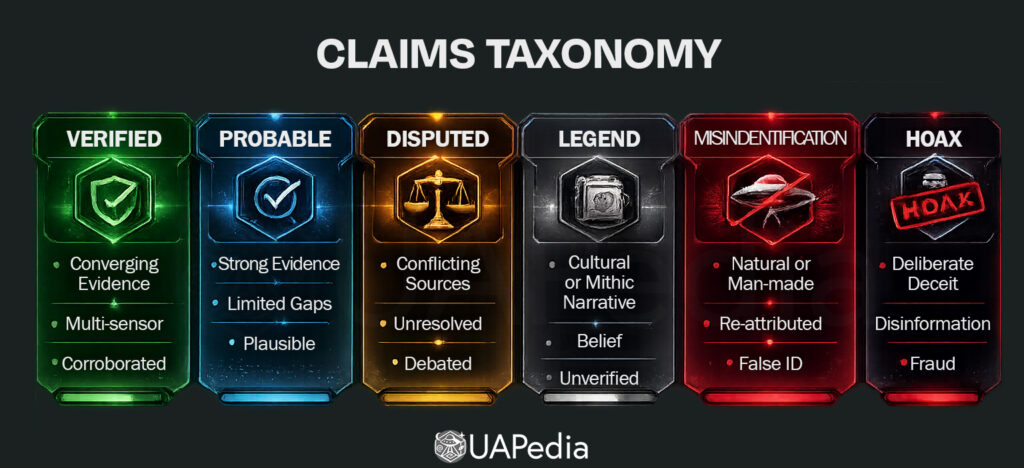
Every article that presents factual assertions about events, entities, materials, or interactions must explicitly assign claims using the UAPedia Claims Taxonomy:
- Verified
Converging testimonies, multi-sensor data, official records, or strong institutional corroboration - Probable
Strong evidence with unresolved gaps or competing explanations - Disputed
Credible but conflicting sources or interpretations - Legend
Cultural, religious, or mythological narratives presented as such, low evidentiary threshold - Misidentification
Demonstrably re-attributed phenomena - Hoax
Purposeful deception or fabrication
Claims taxonomy must appear:
- At the article level for case studies
- At the section level when claims differ within a single article
We aim to provide machine readable Claims for the use of schemas like ClaimReview.
4. Speculation Labels
This section is mandatory for all articles except for Biographic and Archival articles.
To prevent epistemic drift, UAPedia requires explicit separation between evidence and interpretation using the following labels:
- Evidence
Directly documented data, records, or testimony - Witness Interpretation
Meaning, intent, or explanation assigned by observers or experiencers based on perception, interaction, or subjective experience.
While not treated as objective fact, witness interpretation is preserved as a critical analytic layer, particularly when similar interpretations recur independently across multiple cases. - Researcher Opinion
Analytical or theoretical interpretation by investigators or authors - Hypothesis
Testable or speculative explanatory models
Speculation labels must be visually and structurally distinct from evidence sections.
5. Treatment of Government and Institutional Sources
UAPedia follows its dedicated Government Sources & Information Control Policy. Editorially:
- Government statements are not presumed authoritative by default
- Contradictions, omissions, and historical context are documented
- Classification status is noted where relevant
- Whistleblower testimony is evaluated independently of official denial
Government sources are treated as one evidentiary vector, not a final arbiter of truth.
6. Neutrality Without False Balance
UAPedia practices analytical neutrality, not false equivalence.
This means:
- Skeptical explanations are included when credible
- Prosaic explanations are documented when demonstrable
- Non-prosaic interpretations are not excluded solely due to ontological discomfort
Balance is achieved through evidence weighting, not equal airtime.
7. Language, Tone, and Terminology
7.1 Terminology
- Use UAP instead of UFO except in historical quotations
- Use Non-Human Intelligence (NHI) where applicable
- Avoid stigmatizing language or cultural dismissal
7.2 Tone
- Clear, precise, and sober
- Accessible without being reductive
- Analytical rather than sensational
Speculative language must be clearly labeled as such.
8. Ethics, Harm Minimization, and Privacy
UAPedia adheres to strict ethical safeguards:
- No doxxing or exposure of private individuals
- Redaction of sensitive personal data unless already public and relevant
- Respect for experiencers, especially in abduction and contact cases
- No encouragement of unsafe contact practices
Medical, psychological, and biological claims must include appropriate context and cautionary framing.
9. Citations, References, and Transparency
- APA-style references are required where sources exist
- Primary sources are preferred over secondary summaries
- Broken, paywalled, or inaccessible sources must be noted
- Editorial notes may be added where evidence is incomplete or contested
Where evidence is unavailable, absence is explicitly stated.
10. Editorial Process & Accountability
10.1 Review
All major articles undergo:
- Internal editorial review;
- Claims taxonomy verification; and
- Source integrity checks.
High-impact or controversial articles may receive secondary review. Articles may be reviewed by the subject for inaccuracies, when so, we will place a badge next to the top of the article for reference, like the one below.

10.2 Corrections & Updates
UAPedia is a living knowledge system.
- Errors are corrected transparently
- New evidence may reclassify prior claims
- Revision histories are preserved where possible
Corrections are viewed as strength, not failure.
11. AI-Assisted Content Governance
AI-generated content must:
- Adhere fully to this editorial standard
- Be reviewed by a human editor prior to publication
- Maybe be reviewed by subject for inaccuracies
- Never fabricate sources, testimony, or documents
- Some articles due to their contested topics are subject to our Deep Truth Analysis game theory and statistical validation tool (an adaptation from Brian Roemmele’s algorithm – UAPedia example here).

AI is a drafting, researching, pattern finding and synthesis tool, not an authority.
12. Editorial Independence
UAPedia maintains independence from:
- Government agencies
- Defense contractors
- Advocacy organizations
- Commercial influence
Funding, partnerships, or conflicts of interest must be disclosed when relevant.
13. Living Document Clause
This editorial standard is subject to revision as:
- New evidence emerges
- The field matures
- Ethical considerations evolve
All revisions will be versioned, and major revisions are archived.
Created 12th of January, 2026 – Last Update 25th of February, 2026.