
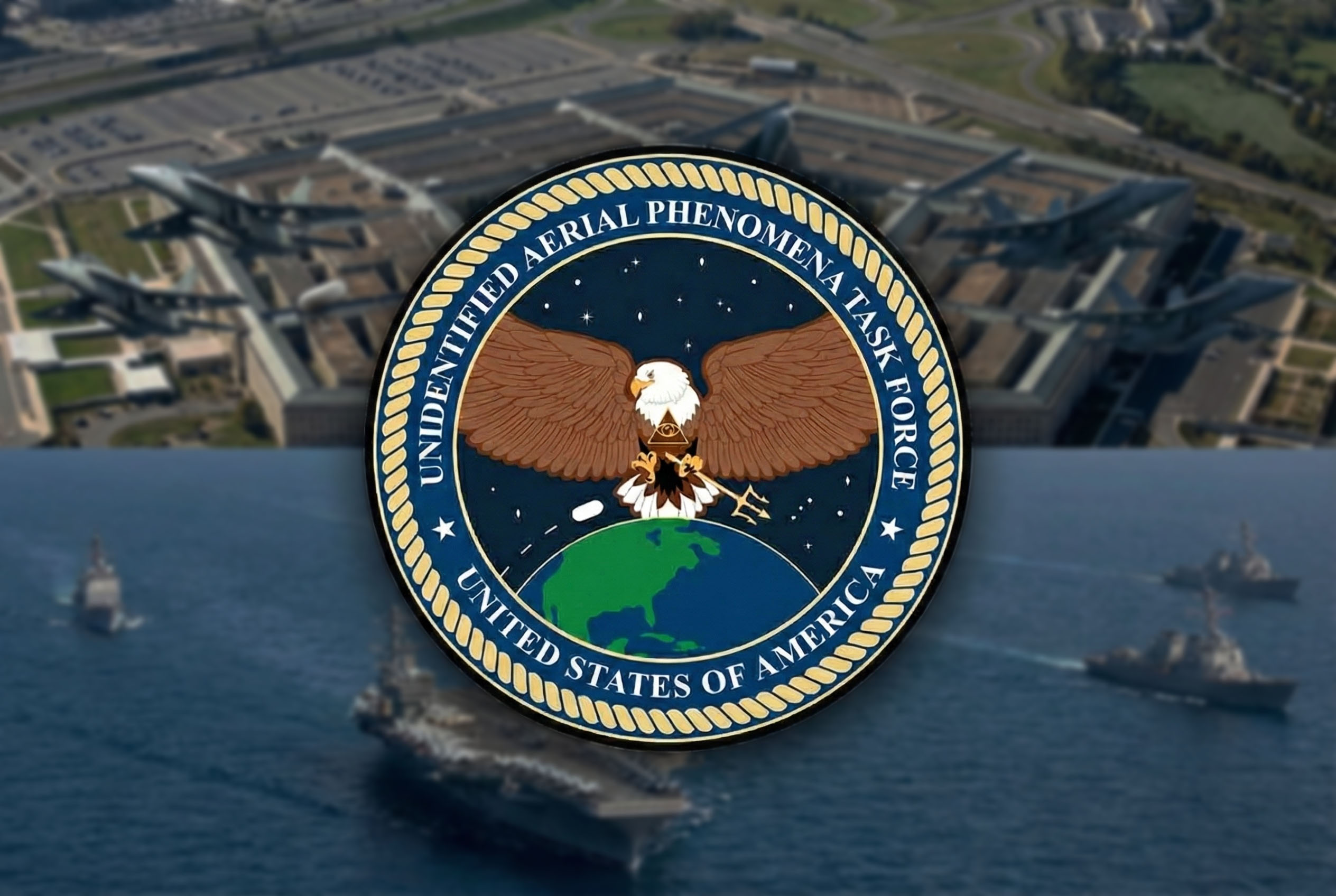
In August 2020 the Department of Defense quietly stood up the Unidentified Aerial Phenomena Task Force inside the Department of the Navy.
Its remit was limited and pragmatic. Detect, analyze, and catalog UAP that might threaten national security.
Fifteen months later a Deputy Secretary of Defense memo created a replacement group with a dense title, the Airborne Object Identification and Management Synchronization Group.
Eight months after that, the Pentagon announced the All domain Anomaly Resolution Office (AARO) and named a career intelligence scientist as its first director. The acronyms changed as Congress rewrote the task, broadened the domain beyond air, and demanded reporting to lawmakers and the public.
That administrative shuffle is the most important U.S. government evolution in UAP since Project Blue Book closed in 1969. This investigation reconstructs how and why the UAPTF morphed into AARO, what officials have said on the record, who was involved, where controversies came from, and how this reshaped the UAP community. (U.S. Navy)
The short timeline
August 14, 2020 UAPTF is announced. DoD states the new task force will improve understanding of UAP and “detect, analyze and catalog” objects that could pose a threat. The Navy mirror of the release sets the mission in the defense mainstream rather than in a special access corner. (U.S. Navy)
June 25, 2021 ODNI’s preliminary assessment. Congress asked for an intelligence overview. ODNI reports 144 incidents examined by the task force, only one resolved, and calls out the need for standardized collection. It recognizes a safety and security issue without stating origin. (ODNI)
November 23, 2021 AOIMSG is created. A Deputy Secretary of Defense memorandum establishes the Airborne Object Identification and Management Synchronization Group and an executive council for oversight. The memo and press release say AOIMSG will succeed the Navy’s UAPTF and synchronize detection and attribution in special use airspace. (U.S. Department of War)
July 20, 2022 AARO replaces AOIMSG. A DoD release announces the All domain Anomaly Resolution Office in the Office of the Under Secretary of Defense for Intelligence and Security and names Dr. Sean M. Kirkpatrick as director. The formal memo says AARO fulfills section 1683 of the FY2022 National Defense Authorization Act and expands focus to objects “in, on, or near” air, sea, space, and transmedium. (U.S. Department of War)
August 31, 2023 AARO launches a public website. DoD opens AARO.mil to publish imagery, case resolutions, reporting trends, legal references, and an electronic FOIA reading room. (war.gov)
March 2024 AARO’s historical report. Under congressional direction, AARO releases Volume 1 of a historical review that finds no evidence of U.S. programs holding non human technology and says most cases in holdings have ordinary explanations. The acting director briefs media the same week. (AARO)
Leadership changes. DoD announces in November 2023 that Kirkpatrick will retire in December; Tim Phillips serves as acting director in early 2024, and in August 2024 DoD names Dr. Jon T. Kosloski as director. (war.gov)
Architecture and mandate: what changed and what did not
UAPTF (2020). A Navy led task force to catalog and analyze UAP, created after a wave of Navy reporting and the 2020 formal release of three Navy videos that DoD described as “unidentified.” The task was narrow. The goal was to understand the problem and any threat it posed. (U.S. Navy)
AOIMSG (2021). A short-lived synchronizer. The Deputy Secretary’s memo created a group to harmonize detection and identification inside special use airspace and stood up an executive council of DoD and Intelligence Community members for oversight. Critics in Congress said the scope was too narrow. The creation of AARO months later explicitly cites NDAA 2022 requirements that went beyond air. (U.S. Department of War)
AARO (2022–present). The office model. The chartered mission is to “synchronize efforts across the Department and with other Federal departments and agencies to detect, identify, and attribute objects of interest in, on, or near” key domains and to mitigate threats. The mission page condenses this to minimizing technological and intelligence surprise near national security areas. In practice that means a fusion of intelligence tradecraft and scientific method, with formal lines of effort and regular reports to Congress. (U.S. Department of War)
ODNI’s role. ODNI produced the 2021 Preliminary Assessment that set the initial baseline and now co publishes annual consolidated UAP reports with DoD. The 2022 unclassified annual report raised the database to 510 reports with improved reporting processes cited as the main driver of growth. The 2023 consolidated report continued that trend. The 2024 consolidated report page confirms continuing joint publication. (ODNI)
NASA’s lane. NASA’s UAP Independent Study Team report in September 2023 recommended rigorous, open scientific approaches and affirmed a whole of government framework led by AARO. NASA named a Director of UAP Research to partner on data and methods. This is not mission creep. It is a recognition that better sensors and open data can reduce ambiguity. (NASA Science)
What officials have actually said
- UAPTF mission, in DoD’s words. “Detect, analyze and catalog UAPs that could potentially pose a threat to U.S. national security.” This appears in the August 14, 2020 Navy press release. (U.S. Navy)
- AOIMSG’s purpose. The November 23, 2021 release said it would synchronize detection, identification and attribution in special use airspace and assess threats to safety of flight and national security. An attached PDF shows the Deputy Secretary of Defense directive and AOIMEXEC governance. (war.gov)
- AARO’s charter. The July 20, 2022 establishment release named Dr. Sean M. Kirkpatrick director and placed AARO in OUSD(I&S), referencing NDAA 2022. The mission memo says AARO fulfills AOIMSG duties with a broader all domain scope. (U.S. Department of War)
- AARO’s mission line today. “Minimize technical and intelligence surprise by synchronizing identification, attribution, and mitigation of UAP in the vicinity of national security areas.” That is the office’s own mission page. (AARO)
- Historical report findings. Volume 1 of AARO’s 2024 historical review states that the majority of publicly disclosed cases have ordinary explanations and that AARO has not seen evidence of U.S. government possession of non human technology after cross agency interviews and record reviews. Acting Director Tim Phillips briefed media on the same findings. (AARO)
Data first: how the numbers moved
- 144 cases as of mid 2021. ODNI’s Preliminary Assessment counted 144 incidents reviewed by UAPTF, one explained, the rest needing more data. It made the case for standardized collection and reduced stigma. (ODNI)
- 510 cases by August 30, 2022. ODNI’s 2022 annual report logged 510 UAP reports, with 247 new and 119 that were older but newly discovered or reported since the preliminary assessment. The increase was attributed primarily to better reporting channels. (Director of National Intelligence)
- Database growth through 2023–2024. The ODNI page for the 2023 consolidated report and DoD’s November 2024 release noted more than 1,600 total cases in AARO’s holdings as of June 1, 2024. The majority had routine explanations; a small fraction remained unresolved due to limited data. (ODNI)
- Mission metrics. AARO’s public briefs emphasize case triage, cause attribution, and safety of flight assessments, including published examples where “metallic orb” imagery was later judged to be consistent with balloons or other ordinary sources. (AARO)
The controversies
“AOIMSG was too narrow.” The November 2021 group was criticized by some lawmakers and advocates as focused on airspace and process rather than on broad anomaly resolution. The July 2022 AARO memo explicitly states it was being established to meet NDAA 2022 requirements, replacing the AOIMSG and widening scope to all domains and transmedium. (war.gov)
Leadership and messaging. DoD announced in November 2023 that Director Sean Kirkpatrick would retire. He later published a Scientific American op ed stating AARO found no evidence of aliens and describing recurring allegations as circular and sourced to a small interconnected group. Supporters applauded the clarity; critics said the tone antagonized witnesses and the community. DoD named Tim Phillips acting director, then appointed Dr. Jon T. Kosloski in August 2024. (war.gov)
The historical report backlash. AARO’s March 2024 historical review concluded it found no verifiable evidence of U.S. programs holding non human technology and judged most cases in the archive to be misidentifications or lacking data. Mainstream outlets reported the finding; community voices disputed methodology and access. The divergence is documented and ongoing. (AARO)
Congress and public hearings. The May 17, 2022 House Intelligence subcommittee hearing put UAPTF and its successors on camera and on record, favoring destigmatized reporting and transparency. That visibility both legitimized the topic and raised expectations that AARO would produce regular, public detail. (Congress.gov)
Influence and impact on the UAP community
Normalization. The existence of UAPTF, the ODNI preliminary assessment, and later AARO annual reports normalized UAP as an object of government attention. This made it easier for pilots and controllers to report without career risk and pushed the conversation toward data, chain of custody, and sensor metadata rather than anecdote. (ODNI)
Data transparency. The AARO website and ODNI report library created a stable place to find official documents, imagery, and case resolutions. That has shifted community debates from “is anything being done” to “is what is being done sufficient and fair.” (AARO)
Scientific lane. NASA’s involvement clarified that study of UAP can be a legitimate scientific problem, provided methods are rigorous, metadata rich, and transparent. That stance aligns with AARO’s stated mission and reduces stigma across universities and labs. (NASA Science)
Polarization. The same official posture also intensified splits. AARO’s historical report and leadership statements that there is no evidence of non human technology collided with testimonies and media narratives claiming crash retrievals. This tension energizes FOIA work and congressional oversight but can erode trust if not managed with clear public declassification pathways. (AARO)
Investigative notes: what changed in law and process
From task force to office. UAPTF was a Navy led team. AOIMSG moved coordination into OUSD(I&S) with an executive council. AARO formalized a permanent office with a charter to coordinate across DoD and other federal departments and agencies, in line with NDAA 2022 section 1683. That is a structural escalation, not a rebrand. (U.S. Department of War)
Reporting cadence. ODNI’s 2021 Preliminary Assessment set a baseline. The 2022 and 2023 annual reports created a regular cadence, with 2024 continuing the practice. AARO’s own site posts congressional products, images, and case resolutions, and the office has run media engagements to explain findings. (Director of National Intelligence)
Public intake and FOIA. While AARO’s current intake is limited to government and contractor personnel with direct knowledge of U.S. government UAP programs back to 1945, the office says it will expand to public sighting reports. A public FOIA reading room centralizes released records. (AARO)
Implications
For national security. AARO gives the department a single shop to minimize technical surprise near sensitive areas and to deconflict balloons, drones, clutter, and potential adversary platforms. Even if most cases end up routine, the program reduces risk and improves warning. (AARO)
For science. NASA’s partnership and recommendations push the problem toward better data and open methods. That will either collapse the residual unknowns or isolate a smaller set that justifies dedicated study. Either outcome advances knowledge. (NASA Science)
For the public. AARO’s website and ODNI reports have already de-stigmatized reporting and centralized records. The next credibility test is consistent declassification pipelines and case level transparency that allow independent replication. (AARO)
Bottom line
The path from UAPTF to AARO is not an alphabet soup of rebrands.
It is a stepwise institutionalization of UAP as a legitimate defense and science problem with accountability to Congress and the public.
The UAPTF counted cases and set a minimal frame. AOIMSG attempted to synchronize inside airspace. AARO now stands as an all domain office with a mission to minimize technical surprise, publish annual reports, and coordinate with partners like NASA.
The result is a more serious, more transparent, and more testable environment. If most cases continue to resolve into the ordinary, the system will have worked. If a hard unknown survives rigorous data collection, the same system gives us a path to discover it. (U.S. Navy)
References
DoD – Establishment of the UAP Task Force (Aug 14, 2020)
https://www.navy.mil/Press-Office/Press-Releases/display-pressreleases/Article/2314280/establishment-of-unidentified-aerial-phenomena-task-force
ODNI – Preliminary Assessment: Unidentified Aerial Phenomena (June 25, 2021)
https://www.odni.gov/files/ODNI/documents/assessments/Prelimary-Assessment-UAP-20210625.pdf
DoD – Establishment of the AOIMSG (Nov 23, 2021) memo
https://media.defense.gov/2021/Nov/23/2002898596/-1/-1/0/ESTABLISHMENT-OF-THE-AIRBORNE-OBJECT-IDENTIFICATION-AND-MANAGEMENT-SYNCHRONIZATION-GROUP.PDF
DoD – AOIMSG press release (Nov 23, 2021)
https://www.defense.gov/News/Releases/Release/Article/2853121
DoD – Establishment of AARO (July 20, 2022) press release
https://www.defense.gov/News/Releases/Release/Article/3100053/dod-announces-the-establishment-of-the-all-domain-anomaly-resolution-office
DoD – Establishment of AARO memo (July 20, 2022)
https://media.defense.gov/2022/Jul/20/2003039074/-1/-1/1/ESTABLISHMENT-OF-THE-ALL-DOMAIN-ANOMALY-RESOLUTION-OFFICE.PDF
AARO – Mission/Vision page
https://www.aaro.mil/About/Mission-Vision
AARO – Official site, imagery, case resolutions, FOIA
https://www.aaro.mil
AARO – Historical Record Report, Volume 1 (March 2024)
https://www.aaro.mil/Portals/136/PDFs/AARO_Historical_Record_Report_Vol_1_2024.pdf
ODNI – 2022 Annual Report on UAP
https://www.dni.gov/files/ODNI/documents/assessments/Unclassified-2022-Annual-Report-UAP.pdf
ODNI – FY2023 Consolidated Annual Report page
https://www.odni.gov/index.php/newsroom/reports-publications/reports-publications-2023/3733-2023-consolidated-annual-report-on-unidentified-anomalous-phenomena
DoD – 2024 Annual UAP report release (Nov 14, 2024)
https://www.defense.gov/News/Releases/Release/Article/3964824/department-of-defense-releases-the-annual-report-on-unidentified-anomalous-phen
NASA – UAP Independent Study Team Final Report (Sept 14, 2023)
https://science.nasa.gov/wp-content/uploads/2023/09/uap-independent-study-team-final-report.pdf
NASA – Update and appointment of Director of UAP Research
https://www.nasa.gov/news-release/update-nasa-shares-uap-independent-study-report-names-director/
House hearing transcript (May 17, 2022)
https://www.congress.gov/117/meeting/house/114761/documents/HHRG-117-IG05-Transcript-20220517.pdf
Speculation labels
Hypothesis. AARO’s migration from UAPTF suggests DoD concluded that a centralized all domain office with formal resourcing would centralize the issues in one office, reduce duplication, improve control, produce better attribution, and reassure Congress, even if most cases prove routine. The AARO establishment memo’s reference to NDAA 2022 supports this reading. (U.S. Department of War)
Witness interpretation. Community backlash to AARO’s 2024 historical report often reflects lived experience of pilots and analysts who felt their cases were not fully considered, and the contentious relationship with previous directors, accused of lying and segregating incidents from the public eye. That sentiment is real, but it is interpretation until case files and methods are publicly comparable. (PBS)
Researcher opinion. NASA’s 2023 report is the template for building a durable scientific lane. If AARO follows NASA’s shared calibre, with open datasets with clear metadata standards, the debate will shift from personalities to reproducible analysis. (NASA Science)
Claims taxonomy
Verified
- DoD established the UAPTF on August 14, 2020 to detect, analyze, and catalog UAP. (U.S. Navy)
- The Deputy Secretary of Defense created AOIMSG and an executive council on November 23, 2021, as the successor to UAPTF. (war.gov)
- DoD established AARO on July 20, 2022 within OUSD(I&S) and named Dr. Sean M. Kirkpatrick director; AARO replaced AOIMSG to meet NDAA 2022 requirements. (U.S. Department of War)
- ODNI’s Preliminary Assessment (June 25, 2021) counted 144 incidents, one resolved. The 2022 unclassified annual report raised the total to 510. (ODNI)
- AARO’s 2024 historical report states that most cases have ordinary explanations and finds no verified evidence that the U.S. government holds non human technology. (AARO)
Probable
- The step from AOIMSG to AARO reflects congressional pressure for broader scope and accountability, as indicated by the AARO establishment memo’s explicit tie to NDAA 2022. (U.S. Department of War)
Disputed
- Community claims that AARO’s conclusions were shaped by bias rather than data are debated. AARO’s published imagery and resolutions show ordinary causes in many cases, while some witnesses and researchers argue data access remains incomplete. (AARO)
Legend
- Assertions that UAPTF or AARO officially confirmed extraterrestrial origin. No official report or press release makes that claim; ODNI and AARO publications do not support it. (ODNI)
Misidentification
- Social media claims that the Navy videos or later AARO imagery prove alien craft. DoD’s 2020 video release describes the targets as “unidentified” and AARO case pages often attribute imagery to balloons or atmospheric effects after analysis. (U.S. Navy)
SEO keywords
UAPTF to AARO timeline, AARO mission, AOIMSG memo, ODNI UAP preliminary assessment 2021, UAP annual report 2022 2023 2024, NASA UAP Independent Study, AARO website imagery and case resolutions, congressional UAP hearing 2022 transcript, all domain anomaly resolution office controversy, UAP data first analysis, national security and UAP, UAP community impact