There’s a particular feeling you get in places like Clonmacnoise. Even in daylight, even with tourists and camera shutters, the Shannon still carries that old monastery hush: wind in the reeds, stone underfoot, sky overhead that feels too big for its own good. It’s the kind of setting where a line written a thousand years ago can land in your mind like it happened yesterday.
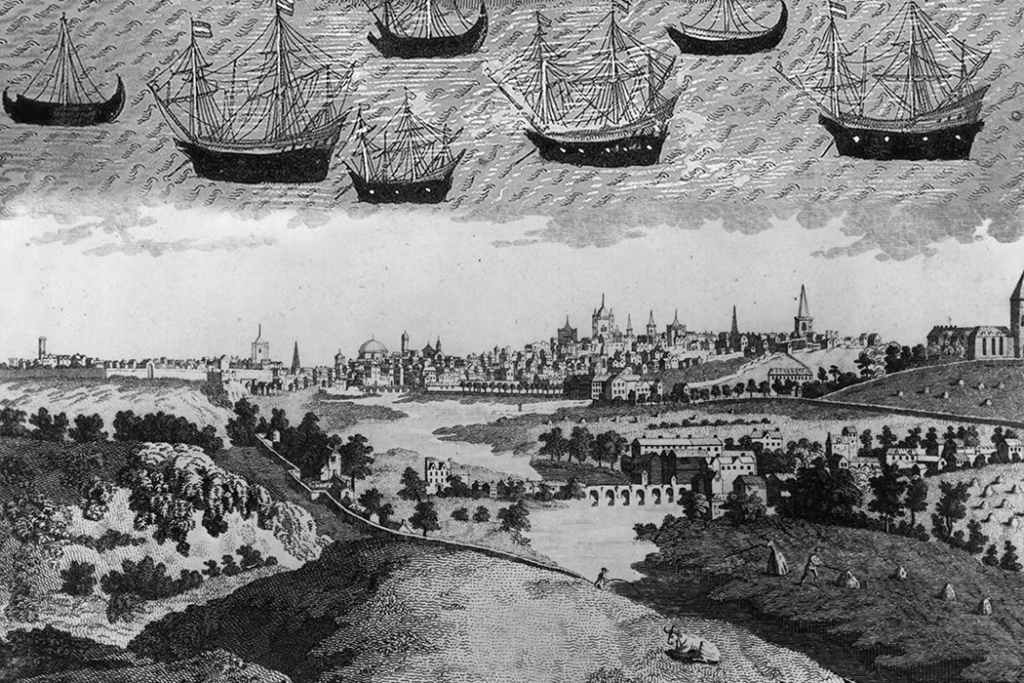
In a medieval Irish chronicle known as the Annals of Ulster, a short entry associated with Clonmacnoise states: “Ships with their crews were seen in the air above Cluain Moccu Nóis.” (celt.ucc.ie)
That sentence is real, recorded, and accessible in a modern scholarly edition. What it is not, on its own, is a solved case file. It doesn’t come with radar data, chain-of-custody photographs, or the kind of technical trace evidence modern UAP investigators would dream of. It is, instead, the kind of historical “needle” that folklorists, historians, and UAP researchers keep finding in the haystack: a human report, preserved by a culture with its own assumptions, metaphors, and narrative habits.
This article follows those needles across Celtic and Norse worlds, from Irish monastic chronicles to Icelandic survey research, from saga-poetry to Norway’s instrumented Hessdalen observation station. We will treat poetic and saga materials as cultural testimony rather than direct empirical proof, and we will keep a clean boundary between what a source documents and what any of us might infer from it.
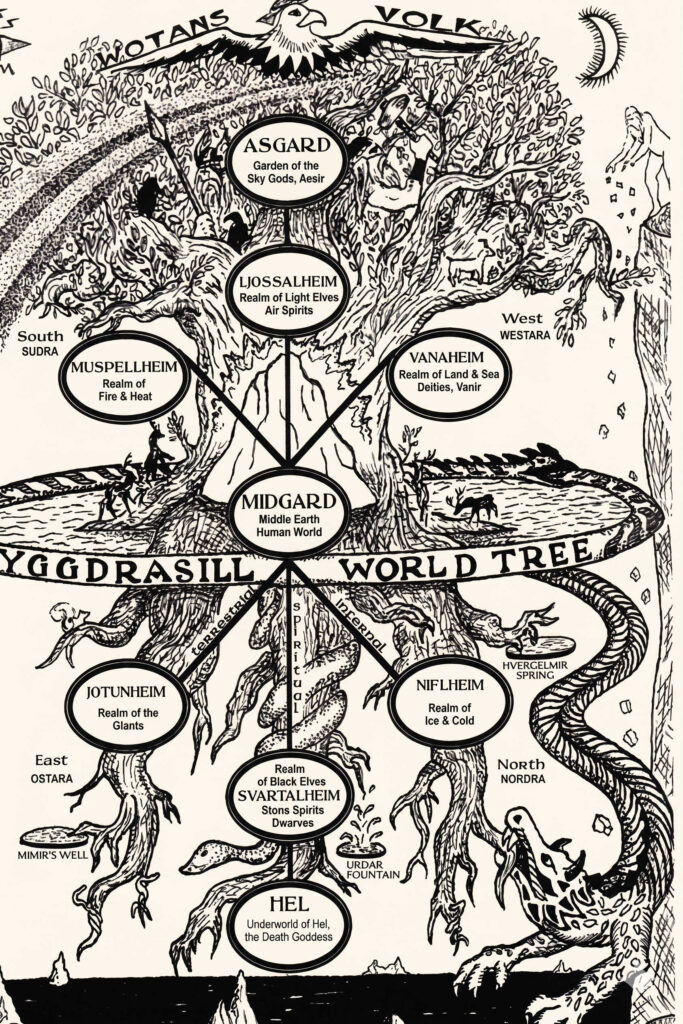
How folklore becomes “data” without pretending it’s a lab report
If you’ve ever tried telling a strange story to a friend, you already understand the first rule of folklore: experience gets translated. It gets squeezed through language, belief, and whatever comparisons your brain can reach for in the moment.
In medieval Ireland, “ship” was not just a vehicle. It was a familiar technology, a religious metaphor, and a symbol that could carry meaning far beyond wood and sail. Michael McCaughan, writing about “ships in the sky” traditions, stresses that understanding “the cultural gulf that exists between medieval and modern thinking is central to the concept of ‘ships in the air.’” (UNB Journals)
So when we read “ship” in the sky, we have to hold at least two ideas at once. One: a witness (or a chain of witnesses) reported something that looked enough like a ship to be described that way. Two: the description is shaped by its era’s mental furniture, including theology, symbolism, and literary convention. Both can be true at the same time.
That’s not a downgrade. It’s simply the price of using ancient and mythic materials responsibly.
Case study: Clonmacnoise and the “ships in the air”
Let’s return to that Annals line, because it’s easy to rush past how unusual it is. “Ships with their crews” implies not just a light, not just a sign, but an object-like form and apparent occupants. Yet the entry is also characteristically brief, as annalistic writing often is. The annals tell you something happened, not how it happened, and rarely how a modern investigator would want it described. (celt.ucc.ie)
McCaughan’s work is useful here because he doesn’t try to flatten medieval reports into modern categories. He treats “airship” accounts as mirabilia traditions, wonders that sit at the edge of the natural and the sacred, and he emphasizes the symbolic and cultural dimensions that medieval writers and audiences would have brought to the table. (UNB Journals)
So what can we responsibly say?
We can say the source exists and it records a claim of aerial ships above Clonmacnoise. (celt.ucc.ie)
We can say the text does not, by itself, verify what the witnesses objectively saw in the way a modern multi-sensor case might.
We can also say it is striking that the report is not framed as a dragon, an angelic host, or a simple celestial omen. It is framed as something structured and familiar, displaced into the wrong domain.
That last sentence is interpretation, not proof. But it’s a grounded interpretation, and it’s exactly where folklore becomes useful to UAP research: it shows us what kinds of anomalies communities found worth repeating.
Case study: the sky-anchor in The King’s Mirror
If Clonmacnoise gives us a single line, Norse tradition gives us something far more cinematic.
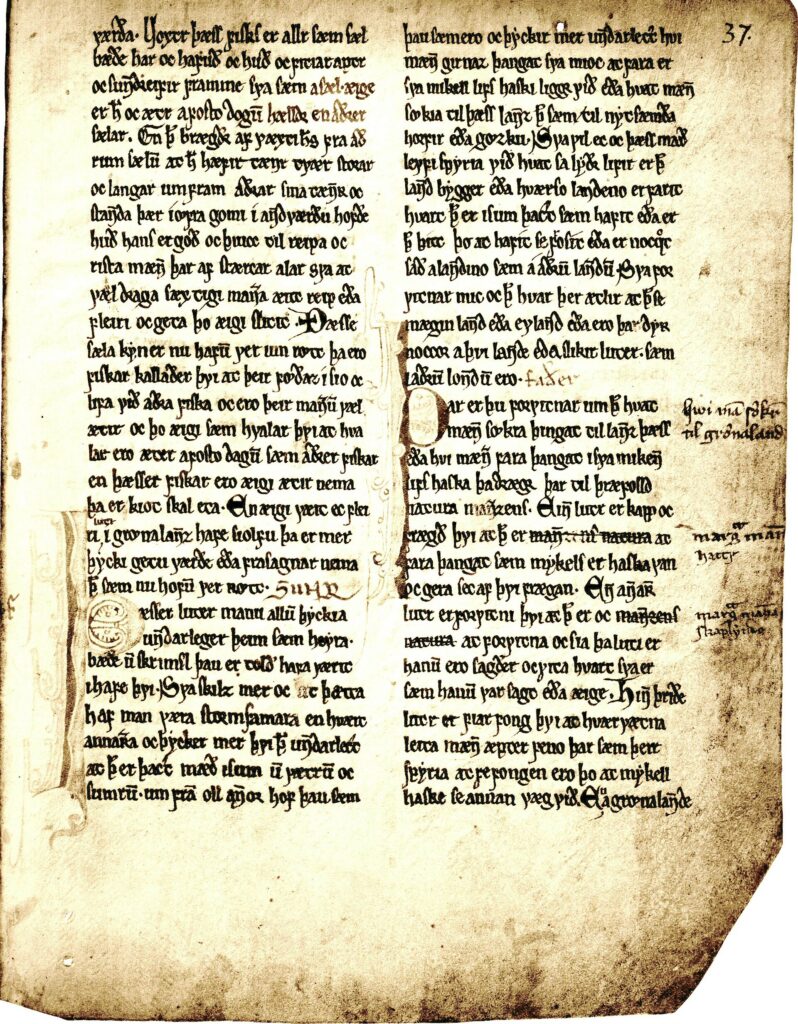
In the Norwegian didactic work Konungs skuggsjá (The King’s Mirror), a story is told about an anchor dropping from the air during Mass at a church in a place identified with Clonmacnoise. People look up, see a ship above, and a man “dives” down the rope as if swimming. The bishop warns that grabbing him would “drown” him in our air. The rope is cut, the ship sails away, and the anchor is said to remain as a testimony. (Project Gutenberg)
The translation includes the line: “the anchor has remained in the church since then as a testimony to this event.” (Project Gutenberg)
This story is often treated in UAP circles as an ancient “trans-medium” vignette: sky as sea, air as water, and a being adapted to a different density. It’s easy to see why. The narrative logic maps uncannily well onto modern reports where witnesses describe objects moving between air and water, or entities behaving as if the environment isn’t the one we’re standing in.
But again, a sober reading matters. The King’s Mirror is not a neutral incident report. It is a didactic text that uses examples, and it circulates wonder-stories in a moral universe where the marvelous can be both literal and instructive. McCaughan, quoting and discussing the same sky-anchor material, notes scholarly arguments that some Irish mirabilia in the Speculum Regale tradition were based on oral information obtained in Ireland rather than copied from a single written source, which is interesting, but it still leaves us with layered transmission rather than direct verification. (UNB Journals)
So here’s the careful bottom line:
The sky-anchor episode is a well-preserved narrative of an aerial-ship motif, complete with “swimming” motion and a boundary between worlds. (Project Gutenberg)
What it demonstrates is that people in the medieval North Atlantic world circulated coherent stories about structured aerial conveyances and non-human-like environmental physics.
What it does not demonstrate, by itself, is the physical existence of an anchor in a church that can be independently verified today.
Even so, the narrative is valuable because it is specific. And in anomalous research, specificity is often the signal worth protecting.
A second Irish “airship” motif: Teltown’s falling dart
The sky-ship motif isn’t confined to Clonmacnoise traditions. McCaughan reproduces another mirabilia account associated with the fair of Teltown. In this story, a man named Congalach sees a ship in the air; someone aboard throws a dart at a salmon; the dart falls; a man comes down after it; when someone below grabs the dart, the descending man says he is being drowned and is released, then “swimming” back upward. (UNB Journals)
Notice what repeats: an object falls from above, a boundary is crossed, and the visiting figure experiences our environment as lethal in the way water is lethal to us when we can’t breathe.
Is that evidence of a literal craft? Not in the strict sense. It is evidence of a stable narrative pattern that medieval Irish tradition found plausible enough to preserve in multiple variants.
Norse poetry and the language of light in the sky
Not all “aerial” material is even trying to be reportage. Some of it is poetry doing what poetry does best: compressing experience into images that feel more real than a transcript.
In Helgakviða Hundingsbana I (in Henry Adams Bellows’ 1923 translation), a battle scene includes a vivid description: “Then glittered light from Logafjoll, / And from the light the flashes leaped.” (en.wikisource.org)
In the stanzas around that line, the sky fills with helmeted figures and sparks from spears, and the world becomes a stage for supernatural battle-presences. (en.wikisource.org)
This is not a UAP case file, and it should not be treated as one. What it does show is that Norse tradition had an established vocabulary for luminous descent, flashing aerial manifestation, and beings whose arrival is experienced as light first, identity second.
That matters because modern encounter narratives often begin the same way. People report light, then form, then presence. Folklore doesn’t prove continuity, but it can show that the human side of the encounter, the perceptual sequence and the emotional framing, has deep roots.
Huldufólk and the modern persistence of “hidden people”
If Irish sources give us early medieval needles, Iceland gives us something modern researchers love: numbers.
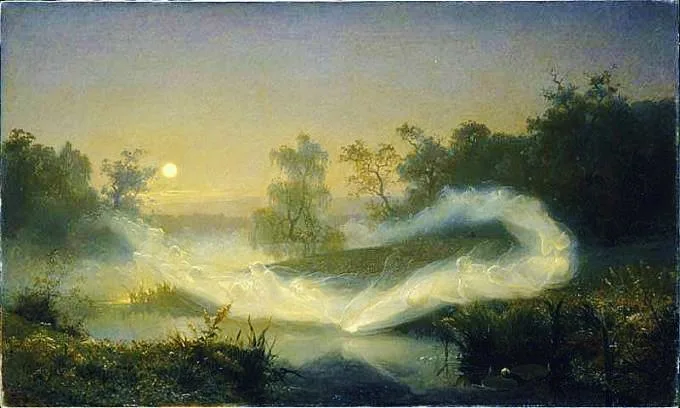
A 2023 panel survey conducted by the Social Sciences Institute at the University of Iceland (with questions and tables credited to folklorist Terry Gunnell) reports that 2,792 panel members answered the survey, and it describes a methodology based on a net-panel originally drawn from a randomly chosen group from the National Register. (ssri.is)
In that survey, respondents are asked: “Have you ever seen álfar/ ‘elves’ or huldufólk (‘hidden people’)…?” In the “Total” results table, 5.9% answered “Yes, I think so.” (ssri.is)
This is not proof that “hidden people” exist as an objective biological species. It is something else, and arguably just as important: a modern, structured dataset showing that a meaningful minority of adults in a contemporary European nation report personal experiences they interpret as encounters with such beings.
From a UAP research perspective, two implications stand out.
First, the “entity encounter” side of anomalous phenomena is not a modern invention and not confined to fringe subcultures. It exists inside mainstream populations in culturally sanctioned forms.
Second, surveys like this help us separate three layers that often get tangled: belief, experience, and interpretation. A person can report an experience without claiming certainty about ontology, and Icelandic survey design is explicit about capturing gradations of belief and reporting. (ssri.is)
When folklore affects infrastructure, it stops being “just a story”
One of the easiest ways to dismiss folklore is to treat it like entertainment. But in Iceland and Ireland, folklore has teeth because it shapes choices.
In a 2026 article for the Institution of Civil Engineers, the author notes that in Iceland “modern infrastructure projects like roads and bridges sometimes must bend to accommodate areas believed to be elf dwellings.” (Institution of Civil Engineers (ICE))
Whether an engineer personally believes in huldufólk is almost beside the point. Social reality is real. If communities treat certain rocks, hills, or lava fields as inhabited by unseen residents, planners either negotiate with that worldview or they risk conflict, delay, and backlash. (Institution of Civil Engineers (ICE))
This is the living edge of Norse folklore. It is not medieval. It is not “mythic.” It’s the present tense. And for UAPedia readers, it’s a reminder that anomalous beliefs and anomalous experiences can persist in a population without needing institutional endorsement.
Ireland’s living archive: Dúchas, fairy forts, and reported lights
On the Celtic side, one of the most valuable resources is not a medieval manuscript at all, but a 20th-century collection effort that captured local voices at scale.
Dúchas.ie describes the Schools’ Collection as “a collection of folklore compiled by schoolchildren in Ireland in the 1930s.” (Dúchas)
That detail matters because it means we are often reading fresh local testimony, filtered through a child’s handwriting, a teacher’s guidance, and the norms of the time. It is not perfect. But it is closer to lived community memory than most “fairy books” sold for entertainment.
In one Schools’ Collection item under “Fairy Forts,” the text includes a simple line: “There was a light seen at Brassil’s fort about a month ago.” (Dúchas)
This is small. It’s not dramatic. It’s exactly the kind of line that makes experienced investigators pause, because it is mundane testimony about something not mundane. It reads like what people say when they’re not trying to sell you anything.
In the same item, the narrative also records a local moral ecology: the idea that interfering with fairy places has consequences, including stories of illness or death following the cutting of “fairy bushes.” (Dúchas)
As evidence, what does this give us?
It gives us a documented cultural pattern: certain landscape features are treated as inhabited; lights are reported in association with them; and taboo-breaking is narratively linked to misfortune. (Dúchas)
Whether that pattern is best explained as social control, psychological suggestion, environmental hazard, or genuine anomalous interaction is an open question. What matters is that the pattern exists, it is recorded, and it is consistent enough to shape behavior.
Second sight: the Celtic interface of perception
Celtic folklore is not only about “beings out there.” It is also about perception itself.
Martin Martin’s A Description of the Western Islands of Scotland (1703) includes a section titled “A particular account of the second sight,” a phenomenon described in Highland tradition as a kind of anomalous perception, often precognitive or clairvoyant. (Internet Archive)
Robert Kirk’s The Secret Commonwealth of Elves, Fauns and Fairies (published in a later edition, though traditionally linked to the late 17th century) sits at the intersection of theology, folklore, and what we would now call psychical research. (ia601701.us.archive.org)
And in a scholarly review, Shari A. Cohn’s “A Historical Review of Second Sight: the Collectors, their Accounts and their Ideas” maps how second sight was recorded and interpreted over time, including how collectors framed what they heard and what they thought it meant. (Edinburgh Diamond)
Why include second sight in an article that’s partly about aerial ships and lights?
Because UAP encounters are not only “objects.” They are experiences. They have cognitive and perceptual components: altered time sense, strange certainty, intrusive imagery, and sometimes information effects that witnesses struggle to explain. Folklore traditions like second sight show that cultures have long had categories for anomalous perception that do not fit ordinary sensory life, and that these categories can coexist with pragmatic, hard-working communities.
Second sight doesn’t prove UAP. What it does is widen our lens: it suggests that in Celtic regions, “the phenomenon” may be as much about how reality is apprehended as about what crosses the sky.
Where folklore meets instrumentation: Hessdalen’s modern bridge
If you want a place where “lore” and “study” actually touch, Hessdalen is hard to beat.
Massimo Teodorani’s “A Long-Term Scientific Survey of the Hessdalen Phenomenon” describes recurring “balls of light” in Norway’s Hessdalen valley and emphasizes that “the recurrence of the phenomenon and the existence of an instrumented observation station makes this area an ideal research site.” (Project Hessdalen)
Teodorani is explicit about uncertainty. He writes that “a self-consistent definitive theory of the phenomenon’s nature and origin… cannot be constructed yet quantitatively,” while also discussing electrochemical models and the need for better instrumentation. (Project Hessdalen)
Project Hessdalen’s own materials describe the Automatic Measurement Station established in 1998 and the infrastructure built to monitor the phenomenon. (old.hessdalen.org)
Hessdalen matters here because it reminds us of something easy to forget: some luminous, recurrent phenomena really do persist in specific valleys and regions for decades, long enough to attract serious measurement campaigns. That does not automatically mean “non-human intelligence,” but it does mean the world contains repeatable anomalies that resist simple closure.
It also suggests a productive approach for ancient material: treat folklore as a map of attention. Where did people say strange lights occurred? Where did they place “otherworld” boundaries? If a place keeps showing up in story after story, it might be worth asking what environmental, psychological, or anomalous variables cluster there.
The main controversy: source existence versus UAP interpretation
This is where careful UAP scholarship either earns trust or loses it.
The Celtic and Norse materials we’ve touched are real sources. The Clonmacnoise “ships in the air” entry exists. (celt.ucc.ie)
The sky-anchor story exists in The King’s Mirror tradition. (Project Gutenberg)
Dúchas preserves a vast archive of 1930s school-collected folklore, including notes that mention lights at forts. (Dúchas)
Hessdalen has been monitored with instruments, and published scientific discussion describing correlations, uncertainties, and competing models. (Project Hessdalen)
Iceland has modern survey data that includes self-reported experiences of huldufólk encounters. (ssri.is)
The controversial step is what we do next.
One camp, especially in mainstream folklore studies, will treat many of these narratives as symbolic, social, and psychological artifacts: meaningful stories rather than empirical claims. Another camp, including some UAP researchers, sees the persistence and specificity of motifs as suggestive of a deeper continuity, possibly involving non-prosaic phenomena that adapt their “interface” to culture.
The evidence we’ve presented supports the first step, that the sources exist and preserve encounter-like motifs. It does not compel a single ontological conclusion. If you want to argue for continuity with modern UAP, you have to label it as a hypothesis, build it carefully, and remain honest about what the sources can and cannot do.
McCaughan provides a helpful cautionary anchor even for enthusiasts: he highlights the “cultural gulf” between medieval and modern thinking, and he illustrates how some “ship in the sky” reports can be explained in historically grounded ways, including later events attributed to fleets seen under unusual conditions. (UNB Journals)
That doesn’t debunk the medieval material. It simply reminds us that humans have always had reasons, natural and uncanny, to see the world strangely.
Implications for UAP research that stay inside the evidence
If you take Celtic and Norse folklore seriously without treating it as a literal lab notebook, you get several practical implications.
First, the “structured aerial object” motif is older than modern aerospace, even if it’s mediated by symbol and genre. (celt.ucc.ie)
Second, “entity ecology” is central. The Norse huldufólk tradition and the Celtic aos sí complex are not mere side characters. They are the main cast, and modern survey work suggests that entity-style interpretations of anomalous experience remain active in at least some populations. (ssri.is)
Third, the overlap of place, taboo, and light recurs. Dúchas entries linking forts and lights may be read as cultural patterning, environmental patterning, or something stranger. But in any case, they point toward the value of location-based pattern analysis, the same logic that makes Hessdalen so useful. (Dúchas)
Finally, these traditions demonstrate why UAP research can’t only be aerospace engineering. It has to be anthropology, history, psychology, and folklore studies too, because the phenomenon, whatever its source, is entangled with human meaning-making.
Speculation labels
Hypothesis
Some portions of Celtic and Norse “otherworld” narratives preserve culturally translated memories of non-prosaic encounters, including structured aerial phenomena and boundary-crossing “environmental physics” motifs. The repeated “drowning in air” element in sky-ship narratives is a notable example, though it remains interpretive. (Project Gutenberg)
Witness Interpretation
Many historical witnesses and tradition-bearers interpreted anomalous lights, voices, or presences through the culturally available categories of their time: saints and wonders in medieval monastic contexts, or hidden people and fairy places in later rural traditions. This tells us how experience was framed, not what the ultimate cause was. (celt.ucc.ie)
Researcher Opinion
A careful comparative approach treats folklore motifs as pattern data rather than as automatic proof. Researchers like McCaughan argue for the necessity of accounting for medieval symbolic frameworks and for avoiding direct projection of modern categories onto older sources, while still taking the records seriously as records. (UNB Journals)
Claims taxonomy
Verified
The primary and secondary sources cited here exist and contain the passages described, including the Annals of Ulster “ships… in the air” entry; the King’s Mirror sky-anchor narrative; the Dúchas Schools’ Collection description and sample “light… at Brassil’s fort”; the Icelandic 2023 folk belief survey question and its reported 5.9% “Yes, I think so” result; and the existence of instrumented Hessdalen research and published analysis noting that a definitive theory is not yet available. (celt.ucc.ie)
Probable
Hessdalen represents a recurrent luminous phenomenon with a long observational history and enough measured correlations to justify continued study, even though specific causal models remain incomplete or contested in the literature. (Project Hessdalen)
Disputed
Any claim that medieval sky-ship narratives or huldufólk reports demonstrate literal craft or confirmed non-human entities in the modern evidentiary sense remains unresolved. The materials support documented reporting and cultural persistence, but they do not supply the kind of corroboration required for stronger ontological conclusions. (celt.ucc.ie)
Legend
Much of the saga and poetic material, including luminous aerial battle imagery such as the “glittered light” passage, functions primarily as literary and mythic narrative rather than as incident reporting. It is valuable as cultural testimony, not as direct empirical documentation. (en.wikisource.org)
Misidentification
Some “ships in the sky” traditions can plausibly arise from misperceived natural or human activities, including unusual atmospheric conditions or distant fleets, and historical discussion of such possibilities exists in the scholarly literature. (UNB Journals)
References
Bellows, H. A. (Trans.). (1923). The Poetic Edda: Helgakviða Hundingsbana I (public domain translation). Wikisource. (en.wikisource.org)
Bennett, C. (2026, March 17). Guardians of the landscape: when folklore shapes infrastructure. Institution of Civil Engineers. (Institution of Civil Engineers (ICE))
Cohn, S. A. (2009). A historical review of second sight: The collectors, their accounts and their ideas. Scottish Studies, 33, 41–62. (Edinburgh Diamond)
Dúchas.ie. (n.d.). The Schools’ Collection (National Folklore Collection, UCD). (Dúchas)
Dúchas.ie. (n.d.). Fairy Forts · Na Tearmoinn (B.) (Schools’ Collection item). (Dúchas)
Gunnell, T. (2023). Survey of Icelandic folk belief and belief attitudes (Panel survey: Social Sciences Institute, University of Iceland; July–September 2023). (ssri.is)
McCaughan, M. (1998). Voyagers in the vault of heaven: The phenomenon of ships in the sky in medieval Ireland and beyond. Material Culture Review / Revue de la culture matérielle, 47. (UNB Journals)
Project Gutenberg. (n.d.). The King’s Mirror (Speculum Regale / Konungs Skuggsjá). (Project Gutenberg)
Project Hessdalen. (n.d.). The Automatic Measurement Station (AMS). (old.hessdalen.org)
Royal Irish Academy. (n.d.). The Annals of Ulster (CELT: Corpus of Electronic Texts, University College Cork, online edition). (celt.ucc.ie)
Teodorani, M. (2004). A long-term scientific survey of the Hessdalen phenomenon. Journal of Scientific Exploration, 18(2), 217–251. (Project Hessdalen)
SEO keywords
Celtic UAP folklore, Norse UAP folklore, Clonmacnoise ships in the air, Annals of Ulster aerial ships, King’s Mirror sky anchor, Konungs skuggsjá sky ship, huldufólk sightings survey, Iceland folk belief survey 2023, fairy forts lights Dúchas, aos sí encounters, second sight Scottish Highlands, Robert Kirk Secret Commonwealth, Hessdalen lights scientific study, medieval mirabilia aerial phenomena, ancient mythological UAP accounts