On the evening of June 27, 1959, Anglican priest William Booth Gill stood outside the mission at Boianai, on the southeastern coast of what is now Papua New Guinea. A brilliant object was visible in the sky. Figures appeared to move on an upper section. Gill raised an arm and waved.
“To our surprise the figure did the same,” he wrote.
Others waved. The figures reportedly responded. Gill aimed a torch towards the object, which then appeared to sway or move in acknowledgement. The event was not preserved solely as a late-life recollection. Gill recorded it at the time, and the account was incorporated into a March 1960 report compiled by fellow Anglican missionary Norman Cruttwell.
The surviving report states that 38 people were associated with the observations and that 25 signed one principal statement. It identifies five Papuan teachers and three medical assistants among those present. These figures require care. The archive does not contain 38 equally detailed, independently recorded testimonies. Gill’s written voice dominates, and it is not always possible to determine which phase each named person witnessed.
Cruttwell’s statement concerning the witness and signature totals appears on page 2 of the surviving report. Gill’s observation notes and contemporary correspondence appear on pages 8 and 9. (Cruttwell, 1960, pp. 2, 8–9)
Whether the apparent exchange was physical, perceptual or something more complicated remains disputed. What the record establishes is that witnesses understood the episode as reciprocal. They did not believe they had merely seen something. They believed something had seen them back.
That distinction takes us to the heart of contact modalities.
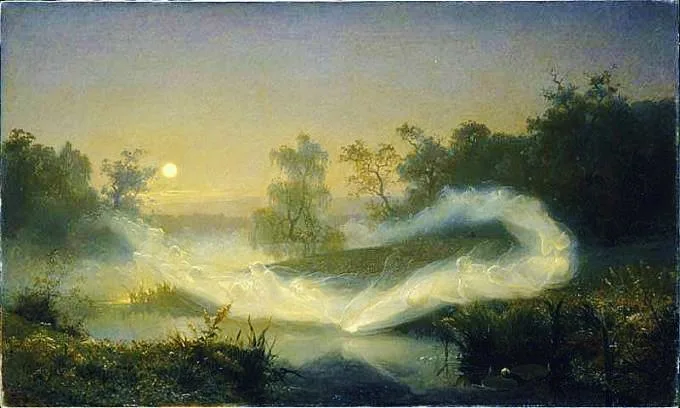
The painting depicts ethereal figures dancing in the morning mist over a tranquil riverbank.
Contact is a verb, not a verdict
A contact modality is the reported channel through which an encounter unfolds. It describes how interaction appears to occur, not who or what caused it.
A distant light is primarily an observation. A light that changes direction after a witness signals it becomes an alleged interaction. A figure seen near an object suggests embodied contact. A message perceived without audible speech suggests noetic or telepathic contact. Burns, numbness, paralysis or other symptoms introduce a physiological modality. Meditation followed by an apparently scheduled appearance belongs to human-initiated contact.
These categories can overlap. One encounter may begin visually, become responsive, produce bodily effects and end in a lasting psychological or spiritual transformation.
Astronomer J. Allen Hynek introduced his close-encounter classification in The UFO Experience: A Scientific Inquiry, published in 1972. Hynek distinguished distant observations from close encounters and divided the latter into three categories involving proximity, physical effects and reported occupants. His original system did not include a fifth category. (Hynek, 1972)
The expression “close encounter of the fifth kind” appeared later in contact-oriented literature and was used by the Center for the Study of Extraterrestrial Intelligence to describe allegedly human-initiated communication. Richard Haines, Steven Greer and other contributors subsequently used the term in CE-5: Close Encounters of the Fifth Kind, published in 1999. That later terminology extends Hynek’s framework but should not be attributed to Hynek himself. (Haines et al., 1999)
A modality is not an origin claim. Telepathy, for example, is a witness description of apparently receiving information without ordinary speech. It does not by itself establish an extraterrestrial, interdimensional, spiritual or neurological source. It identifies the type of experience that needs to be explained.
Contact before the aerospace age
Modern UAP contact is often described through technological imagery: structured objects, control rooms, beams, screens, instruments and figures wearing fitted clothing. Older traditions frequently use another vocabulary: ancestors, messengers, spirits, luminous persons, heavenly vehicles, dream visitors and journeys beyond the ordinary world.
The parallels can be striking, but comparison demands restraint. A Marian apparition is not automatically a mislabelled UAP encounter. An Indigenous account of sky beings is not a primitive version of a modern aerospace report. Each tradition possesses its own theology, language, history and internal authority.
A more productive comparison examines structure. Did the encounter occur while awake, asleep or in ritual? Was the presence luminous, embodied or unseen? Was information conveyed through speech, imagery, dreams or direct knowing? Were physical traces reported? Did the experience alter the witness’s behaviour, social role or understanding of reality?
Anthropologist Susan Lepselter has examined how anomalous narratives gather personal memory, political history, power and cultural symbolism into a shared language of the uncanny. Religious-studies scholar Diana Walsh Pasulka has explored how modern contact experiences can develop communities, sacred locations, technological symbols and authoritative interpreters.
These approaches do not decide the ultimate cause of an encounter. They show how an experience becomes culturally recognisable and tellable. (Lepselter, 2016; Pasulka, 2019)
Culture may supply the grammar through which an experience is interpreted without necessarily creating the entire experience. That distinction is essential.
Boianai: the wave that came back
The Boianai observations of June 26 and 27, 1959, remain among the clearest early examples of reported responsive signalling. Gill described a brilliant object, smaller associated lights and figures that appeared on the larger form. His notes record movement, a blue light, prolonged observation and attempts to communicate by waving, shouting and using a torch.
The interaction was not first introduced through hypnosis or recovered many years later. Gill’s interpretation that the object was controlled by “beings of some kind” appears in his contemporary correspondence. This makes clear that the extraordinary conclusion was Gill’s own early interpretation rather than a later editor’s addition. (Cruttwell, 1960, pp. 2, 8–9)
The record nevertheless contains a major cultural imbalance. Gill’s literate English-language account was preserved in detail. The Papuan witnesses are represented mainly through names, signatures and Gill’s summary of group agreement. Their individual descriptions, disagreements and cultural interpretations were not recorded with equal care.
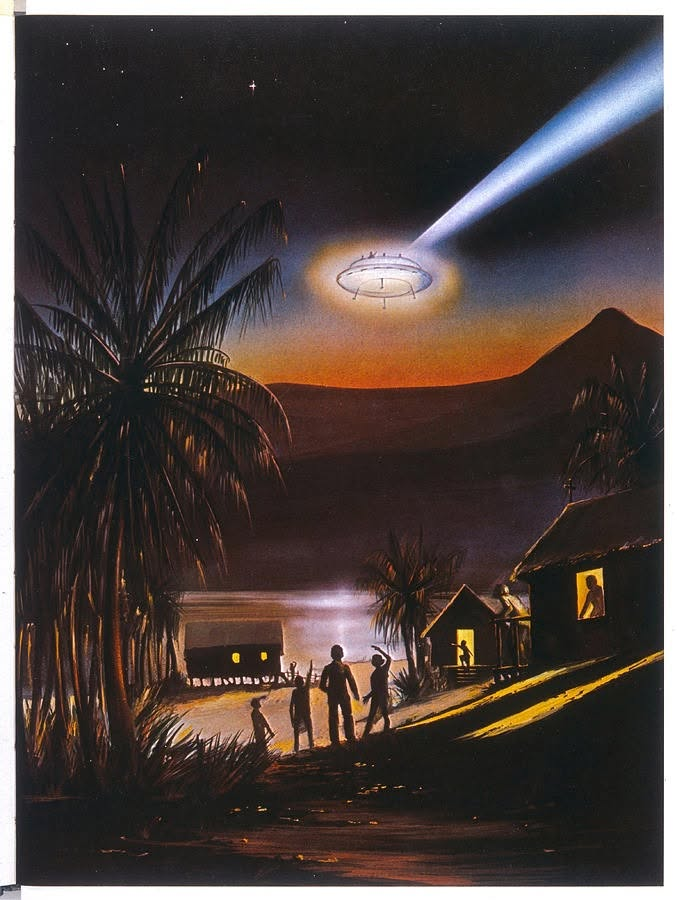
A cross-cultural event was therefore filtered through an Anglican mission, a colonial setting and the documentary practices of its period.
The Royal Australian Air Force later reviewed the reports. Its response said that no positive conclusion could be reached and suggested that some lights might have involved Jupiter, Saturn and Mars viewed through unstable atmospheric conditions. That proposal may address some luminous elements. It does not independently reconstruct the reported figures, the waving episode or the apparent sequence of responses.
Religious historian David Halperin has proposed that astronomical stimuli became the focus of a collective visionary experience shaped by religious expectations and social tensions. This is an analytical interpretation rather than a demonstrated reconstruction. It does not show how the specific gestures and figures recorded by Gill would have emerged from the proposed mechanism. (Halperin, 2022)
Boianai’s principal modality is responsive visual contact. Multiple witnesses reported what they perceived as an unusual external light. The interpretation of visible occupants and reciprocal intent remains disputed.
Cussac: figures at close range
On the morning of August 29, 1967, a 13-year-old boy and his nine-year-old sister were tending cattle outside Cussac in France’s Cantal region. They reported seeing four small, dark figures near a brilliant spherical object. In the account later examined by French investigators, the figures appeared to rise towards or enter the object before it departed.
The local gendarmerie investigated on the day of the report. The principal early narrative already contained the children, the small dark figures, a bright spherical form and its rapid departure. Observations concerning an unusual smell and disturbed cattle also appear in accounts attributed to the immediate inquiry, although the exact wording and level of detail vary between surviving summaries.
France’s Groupe d’Études des Phénomènes Aérospatiaux Non-identifiés, or GEPAN, began a more extensive reinvestigation in 1978, eleven years later. Investigators reconstructed the landscape and reinterviewed witnesses.
A summary of the investigation was subsequently reproduced on page 35 of the privately produced COMETA report. COMETA included former military and institutional figures, but it was not an official CNES finding. Hosting the document through a CNES-accessible archive does not transform its conclusions into institutional determinations. (COMETA, 1999, p. 35)
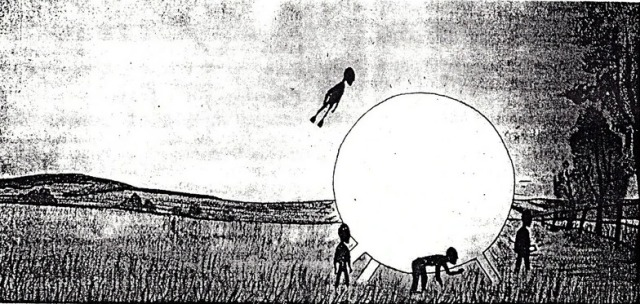
The delay creates an evidentiary problem. The central encounter was recorded in 1967, but later accounts offered greater precision concerning the figures’ movements, the sound of departure, the cattle’s behaviour and the duration or intensity of the smell.
The public documentary chain does not make every early-to-late comparison equally transparent. These details should therefore be attributed according to the record in which they appear rather than presented as though every feature had been documented with equal precision on the day of the encounter.
Critics David Rossoni, Éric Maillot and Éric Déguillaume argued that delayed French investigations sometimes presented evolved testimony as if every detail had been captured immediately. In Cussac, they explored a possible helicopter-related interpretation and questioned the increased precision of later recollections.
Their critique identifies genuine methodological weaknesses. It does not provide a documented aircraft, crew or flight path conclusively tied to the reported time and location. (Rossoni, Maillot, & Déguillaume, 2009)
The case is often reduced to a false choice between literal non-human occupants and childhood invention. Other possibilities remain open. The children may have truthfully reported an intensely strange perception while misunderstanding its cause. They may have observed an unusual conventional vehicle under confusing conditions. They may have encountered an event absent from surviving aviation records. Different elements could also have had different causes.
Cussac’s primary modality is embodied proximity. Figures and an object were perceived as part of one close-range scene. The environmental details are relevant, but their evidential weight depends on the date, wording and independence of the record in which each first appears.
Colares: when contact is felt in the body
In 1977, residents of Colares and neighbouring communities in Brazil’s Pará state reported luminous objects moving at low altitude, approaching people and, in some accounts, directing narrow beams towards them. Local speech transformed the lights into the chupa-chupa, something that sucked, drained or weakened its targets.
The reports produced real social consequences. Residents organised vigils, changed sleeping arrangements and avoided going outside after dark. The Brazilian Air Force responded with Operação Prato, or Operation Saucer, a military observation and documentation mission. Surviving records include field reports, drawings, photographs and testimony collected from residents and medical personnel.
Brazil’s National Archive preserves a wider Air Command collection containing 743 records dated between 1952 and 2016. That number refers to the broader archival collection, not to 743 separate Colares encounters. (Brazilian National Archive)
A primary Operation Prato document records information attributed to local physician Wellaide Cecim, identified as a general practitioner. She reported examining four patients who associated their symptoms with exposure to unusual lights. The recorded complaints included nervous distress, headache, dizziness, tremors, local weakness or numbness, superficial burns and small puncture-like marks.
The material appears in Brazilian National Archive file BR DFANBSB V8.MIC.GNC.KKK.83003252, within the section headed “Dra. Wellaide Cecim.” The public scan combines irregular image pagination with original document pagination, making the archival identifier and section heading more reliable than an approximate page range. (Operation Prato archival file)
This is significant first-hand medical testimony. It establishes that patients presented with symptoms and connected them to luminous encounters. It does not independently prove that a directed beam caused those symptoms, identify a particular form of radiation or establish the source of the lights.
Colares represents somatic contact. The witness does not simply see something. The event is experienced as touching, burning, weakening or penetrating the body.
That modality requires a different standard of investigation. A medical case needs baseline health information, original clinical notes, photographs with scale, exposure timing, laboratory analysis and long-term follow-up. Without these, dramatic symptoms remain difficult to attribute.
Dismissing symptoms merely because the reported trigger sounds extraordinary is equally unsound. The responsible position is documented care followed by disciplined causal analysis.
Ariel School: warning without words
On September 16, 1994, pupils at Ariel School in Ruwa, Zimbabwe, returned from morning break reporting an unusual event beyond the playground. Approximately 60 to 62 children became associated with the case, although a smaller number supplied the most detailed accounts.
Some described one or more shiny objects and small dark figures with prominent eyes. No teacher is known to have witnessed the central event from the field.
BBC correspondent Tim Leach filmed pupils within days of the event. The surviving footage provides a near-contemporary record of children speaking, drawing and responding to questions. It is primary audiovisual evidence of what they were reporting at that stage, although it is not a sensor record of the event itself. (WHYY discussion of Leach’s reporting)
Cynthia Hind, a regional investigator, visited shortly afterwards and interviewed children at the school. Parts of the early questioning occurred in groups. The recordings and notes are historically valuable, but group interviewing creates a recognised possibility of cross-influence because witnesses can hear one another’s language and details.
John E. Mack interviewed selected children during a November–December 1994 African research trip. The John E. Mack Institute’s PEER Perspectives publication places his relevant African work within that period and discusses approximately 60 Ariel pupils. Without a dated original interview log, a more precise day should not be treated as established. (John E. Mack Institute, 1996)
The surviving interview material records several recurring motifs: a reflective or luminous object, dark figures, large eyes and unusual or gliding movement. It also records substantial variation. Some children described one figure and others more than one. Some were closer to the boundary. Some focused on the object, while others concentrated on the figures.
Cultural language varied as well. Several children used concepts associated with unusual small beings or spirits, while others reached for technological or internationally familiar imagery. These differences may reflect cultural interpretation, unequal viewing conditions or genuinely different perceptions within the same event.
Some witnesses later described receiving a warning without spoken language, particularly about environmental destruction and humanity’s use of technology. This noetic component became one of the most famous aspects of the case.
Its chronology requires qualification. The environmental message is most explicit in Mack’s later recorded interviews and subsequent witness recollections. It is less developed in the earliest filmed material. This does not prove that the message was invented. It means the evidential status of the message differs from the basic report that children saw an unusual object or figures.
A widely reported aerial event, later identified by some analysts as a rocket-body re-entry, occurred over southern Africa two nights earlier. Because the event occurred at night and the school encounter was reported in daylight two days later, it cannot directly reconstruct the Ariel episode. It may nevertheless have influenced regional attention, conversation or the categories used to interpret something unusual.
Researcher Gideon Reid has proposed that the pupils may have seen puppets or a performance-like stimulus partly obscured by vegetation. The proposal attempts to account for the figures’ odd movement and varied appearance without accusing the children of deliberate fabrication. No performers, equipment or puppet troupe have been tied to the school at the relevant time, so the proposal remains an unverified reconstruction. (Reid, 2024, pp. 25–39)
Ariel’s evidential core is not that every child gave an identical account. They did not. Its core is that numerous pupils reported a disturbing shared event, a subset described overlapping features, early filmed interviews and drawings exist, and several witnesses continued to affirm the experience as adults.
The visual testimony is documented through contemporary and later recordings. The external identity of the object and figures, and the source of the alleged mental warning, remain disputed.
A dedicated case chronology is available in UAPedia’s Ariel School Encounter dossier.
Mission Rama: deciding to answer back
The previous cases were apparently uninvited. Mission Rama, founded in Peru in 1974 and later widely styled Mission Rahma, represents another modality: organised human-initiated contact.
Sixto Paz Wells’s participant account states that the movement began after he attended a discussion of telepathy. Paz and family members practised relaxation, meditation and automatic writing. Messages attributed to an external intelligence reportedly proposed times and locations for visual demonstrations near Chilca, a desert area south of Lima.
Participants later described seeing unusual lights or objects at appointed times. These details come mainly from participant memoir, retrospective interviews and movement histories.
Paz’s book The Invitation is useful for understanding what the group believed it was doing, how members interpreted apparent responses and why the movement expanded. It is not independent verification of the claimed communicating source. (Paz Wells, 2002)
Historical support is stronger for the movement’s existence and international spread than for its claimed contact results. Giorgio Piacenza’s 2012 paper discusses Mission Rama’s Peruvian emergence, spiritual methods and later organisation.
Piacenza had personal involvement in contact-oriented and esoteric circles, and his paper should be read as a participant-researcher interpretation published in the Exopolitics Journal, not as an institutionally independent or clearly peer-reviewed history. (Piacenza, 2012)
Later Mission Rama histories associate Spanish journalist J. J. Benítez with a predicted Chilca observation in 1974. Those accounts say he witnessed unusual lights after being invited to the location. A dated primary Benítez account demonstrating exactly what was predicted before the observation has not been identified in the sources used here. The episode should therefore be treated as part of the movement’s retrospective history rather than independent confirmation.
The surviving public record does not provide complete preregistered predictions, continuous calibrated imaging, independent astronomical controls, aviation data or a full accounting of unsuccessful sessions. It is also unclear whether the original automatic-writing records are preserved with a demonstrable chain of custody.
Mission Rama remains historically important because it shows that organised consciousness-based contact practices existed in Latin America before recent North American CE-5 branding. This is a historical statement about contact culture, not proof that meditation caused an external UAP to appear.
The most testable aspect of the practice is the scheduled prediction. A message specifying a place and time could be examined through independent teams, control nights, calibrated cameras, flight and satellite data and success criteria established beforehand.
The evidence is strongest for the existence of the movement, the sincerity of many participants and its international cultural influence. Claims that Mission Rama successfully summoned externally controlled UAP remain disputed.
One word, several experiences
The cases reveal why “contact” becomes unhelpful unless its internal structure is examined.
At Boianai, contact meant apparent response. A witness acted and believed an observed figure mirrored that action.
At Cussac, contact meant co-presence. Figures and an object were experienced within one close-range scene.
At Colares, contact was physiological. Light was reported as something that touched or injured the body.
At Ariel, contact included a possible noetic component. Some witnesses believed information had been conveyed without audible speech.
In Mission Rama, contact was initiated and ritualised. Intention, meditation, expectation and scheduled observation formed part of the process.
These modalities are not interchangeable. Sleep-related sensed presence may illuminate one category while saying little about a daylight multiple-witness report. A planet may account for a distant light without automatically explaining a close-range figure. A sincere mental impression may be psychologically authentic without having been externally transmitted.
The investigator’s first question should not be, “Was this contact?” Better questions are: What was reported? Through which sensory or mental channel? What was recorded at the time? Which details were independently shared? Which appeared later? What evidence exists outside the narrative?
The signal-and-decoder hypothesis
One way to approach cross-cultural contact is to imagine an encounter as an interaction between a signal and a decoder.
The signal could be an external object, an environmental stimulus, a neurological event, a social cue, an anomalous intelligence or a mixture of causes. The decoder is the human perceptual system: eyes, ears, nervous system, memory, language, expectation, religion and cultural imagery.
Under this hypothesis, recurring structures do not require identical descriptions. A stable stimulus could be interpreted differently by an Anglican mission community in Papua, children in rural France, Amazonian villagers, Zimbabwean pupils and Peruvian meditators.
The reverse is also possible. Shared human neurobiology could generate recurring experiences without a common external agent.
A third possibility is interaction. An external anomaly may be real while its perceived form, message or meaning is partly constructed by the witness. Ordinary perception already involves interpretation. The brain builds a coherent model from incomplete information rather than recording an untouched image of reality.
This model explains why culture may matter without turning culture into a universal dismissal. It also explains why one case can contain stable and unstable elements. A stimulus might remain consistent while language, memory and interpretation evolve.
The signal-and-decoder model is a hypothesis, not a conclusion. Its value is found in the research questions it produces. Which details remain stable across separately interviewed witnesses? Which details cluster by cultural background? Do alleged messages contain verifiable information unavailable to the witness? Do predicted appearances exceed control-night rates? Do reported bodily effects correspond to measurable exposure?
Psychology matters, but it cannot explain everything
Some contact experiences occur near sleep. Sleep paralysis can include immobility, chest pressure, vivid intruder imagery and an overwhelming sense that another presence is nearby.
Folklorist David Hufford documented a recurring experiential core across cultures while showing that interpretation varies. Brazilian researchers have compared sleep paralysis with the Pisadeira, a folkloric figure said to press upon sleepers. These studies demonstrate that physiology can generate an encounter-like state and that culture can help define the identity of the visitor. (Hufford, 2005; de Sá & Mota-Rolim, 2016)
Sleep paralysis cannot account for reports occurring outdoors, in daylight and among several awake witnesses. It is a relevant mechanism for a subset, not a universal solution.
Richard McNally and Susan Clancy studied ten people whose reported abduction experiences were associated with sleep paralysis and hypnopompic imagery. Their work illustrates how an unfamiliar physiological event may be interpreted through an available cultural narrative. The small and specifically selected sample does not justify applying the model to every contact report. (McNally & Clancy, 2005)
Clancy and colleagues also reported elevated false recall and recognition in a laboratory task among some individuals who described abduction experiences. This is relevant to memory reliability. It does not show that participants knowingly fabricated their accounts or establish the cause of any specific encounter. (Clancy et al., 2002)
Interview technique is equally important. Leading questions, repeated interviewing, group discussion, hypnosis and exposure to an investigator’s preferred theory can alter recollection. Information emerging only under hypnosis should remain in a low-confidence evidentiary layer unless independently corroborated.
Testimony is evidence, but evidence has weight rather than magic. Courts examine opportunity to observe, consistency, motive, independence and corroboration. UAP research should apply comparable principles. Respecting a witness does not require accepting every interpretation. Questioning an interpretation does not require portraying the witness as dishonest or irrational.
What publications have added
The study of contact has developed through several kinds of publication.
Hynek’s encounter framework supplied a practical vocabulary for distance and physical effects. Later contact movements expanded that language to include deliberate initiation.
Paz Wells’s The Invitation documents Mission Rama from a participant’s viewpoint. Its value is interpretive and historical rather than independently confirmatory.
Lepselter’s The Resonance of Unseen Things examines anomalous narratives ethnographically, asking what they preserve about power, memory and social history. Pasulka’s American Cosmic studies the meeting point of technology, secrecy, religion and personal experience. Both widen the discussion beyond a simplistic choice between spacecraft and imagination.
The 2018 study by Reinerio “Rey” Hernandez, Robert Davis, Russell Scalpone and Rudolph Schild surveyed 3,256 self-selected respondents who reported contact experiences associated with or without UAP. Phase 2 included 1,919 participants. The online survey contained 554 questions and attracted respondents from more than 100 countries.
The authors explicitly stated that their conclusions applied only to the selected experiencer population. Approximately 64.1 per cent of respondents were from the United States, and 70.7 per cent identified as white or Caucasian. The sample was international in reach but not globally representative. (Hernandez et al., 2018, pp. 298–348)
Critical publications also belong at the centre of the field. Halperin’s Boianai interpretation, Rossoni and colleagues’ Cussac criticism, Reid’s Ariel reconstruction and McNally and Clancy’s sleep research challenge contact interpretations without reducing every witness to a liar.
No single discipline can resolve the entire subject. Witness history, anthropology, medicine, neuroscience, astronomy, archival research and sensor science address different parts of the problem.
The central controversies
The first controversy concerns universality. Do recurring motifs indicate a common external source, or do they reflect shared neurobiology and globally circulated imagery?
The answer may not be absolute. Sleep paralysis demonstrates that human physiology can produce recurring encounter structures. Global media distribute particular visual forms. At the same time, many reports discussed here occurred while witnesses described themselves as awake, outdoors and in groups.
The second controversy concerns memory. Early accounts are often less elaborate than later versions. This can indicate contamination, rehearsal or ordinary reconstruction. It can also reflect frightened witnesses initially communicating only fragments. Investigators need dated versions rather than selecting the most dramatic telling.
The third concerns cultural translation. When one child uses a local spirit term and another uses technological language, are they describing different experiences or decoding one stimulus differently? Investigators should preserve original words, document their local meanings and avoid replacing them with preferred categories.
The fourth is contact inflation. An unidentified light may become a “confirmed craft.” A reported sensation may become a “directed-energy attack.” A witness interpretation may be repeated as an official finding. The final narrative can become more certain than its sources.
The fifth is explanation by subtraction. A planet, aircraft, puppet, sleep episode or rocket re-entry may account for one component and then be presented as a complete solution. A satisfactory explanation should address timing, geometry, witness independence, environmental effects and the evolution of testimony.
This total-report principle applies in both directions. Conventional explanations should not be declared complete when major observations remain unaddressed. Extraordinary interpretations should not be accepted merely because a conventional candidate has weaknesses.
The impact on witnesses
Contact reports can reorganise a life. Witnesses describe fear, disrupted sleep, stigma, damaged relationships and concern that they will be regarded as unstable. Others describe reduced fear of death, increased environmental concern, new spiritual commitments or an intensified sense of connection.
The Hernandez survey found that reported outcomes varied by subgroup and claimed frequency of contact. Approximately one-half to three-quarters of respondents in the analysed groups described positive effects, while roughly 15 to 20 per cent described negative effects. More frequent experiencers were more likely to report positive transformation.
These figures describe a self-selected population. They do not validate the attributed source of the encounters. (Hernandez et al., 2018, pp. 314–316)
Clinical care and evidential assessment must be separated. A therapist does not need to confirm an external entity to treat anxiety, trauma or sleep disruption. Therapy should also not begin by forcing a witness to declare the experience unreal.
The immediate task is to reduce harm, restore functioning and allow the person to describe the event without coercion.
How future contact cases should be studied
Witnesses should be interviewed separately and quickly, preferably in their first language. Interviews should begin with uninterrupted free recall. Each session should be dated, preserved in full and accompanied by a record of what the witness had already heard from other people or media.
Investigators should separate observation from inference. “I saw a dark form” is not the same as “I saw a non-human being.” “I felt a warning” is not the same as “an external intelligence transmitted a warning.” Both statements belong in the record, but they occupy different evidentiary levels.
Physical claims require a chain of custody. Images need metadata and scale. Medical findings require original clinical records, comparison values and follow-up. Sensor records need instrument specifications, position, orientation, calibration and environmental context.
Human-initiated contact is suitable for controlled research because sessions can be scheduled. Researchers can preregister times, locations and success criteria, use matched control nights, blind independent analysts and monitor aviation, satellites and astronomical conditions.
Failures must be recorded. A protocol that produces one striking observation during one session and nothing during 20 others must report all 21 sessions. Without the denominator, coincidence can resemble causation.
Participants should never aim lasers at the sky. Lasers can endanger aircraft and may violate aviation-safety laws, depending on jurisdiction. Passive monitoring and low-risk signalling are safer and more scientifically defensible.
What global contact would imply
If even a fraction of high-quality contact reports involve an external intelligence, the implications extend beyond aerospace.
Communication might not rely mainly on radio, speech or conventional visual signals. It could involve imagery, emotion, perception or forms of cognition that current instruments do not measure well. Neuroscience, linguistics, anthropology and consciousness research would become central to UAP investigation.
Cross-cultural differences would have operational importance. A contact effort designed around one society’s assumptions might be misunderstood elsewhere. Humanity would not approach contact with one political authority, religion or vocabulary.
A global response framework would require cultural and religious literacy alongside scientific expertise.
The ethical problems would also be substantial. Who has the right to initiate contact on behalf of other people? What constitutes informed consent if a practice may affect bystanders? How should alleged messages be authenticated before influencing policy? What protections are owed to children and isolated communities?
Even when an encounter ultimately involves sleep, perception, memory or social influence, it may reveal something important about how human beings confront radical uncertainty.
The phenomenon sits where body, culture, technology and meaning meet.
That intersection is real, whatever the final cause.
One mystery, many languages
Global contact reports do not produce one clean narrative. They produce a family of experiences.
A priest in Papua waves towards figures in the sky. Two French children watch dark forms leave a pasture. Amazonian residents describe light that touches the body. Zimbabwean pupils speak of figures beyond a school boundary and, in some later accounts, a warning received without speech. Peruvian meditators enter the desert expecting an answer.
The similarities are difficult to ignore. So are the differences.
A strong explanatory framework must leave room for sincere testimony, cultural interpretation, neurological mechanisms, ordinary misidentification and genuinely anomalous interaction. It must resist declaring every extraordinary account literally correct. It must also resist treating every recurring report as a cultural error.
One mystery may speak in many languages. The task is not to translate all of them into the same answer. It is to listen closely enough to discover whether anything beneath those languages is answering back.
Claims Taxonomy
Verified
The Boianai archive contains Gill’s contemporary notes, correspondence and a compiled statement reporting dozens of associated witnesses and 25 signatures. French authorities recorded the Cussac report, and GEPAN later reinvestigated it. The Brazilian Air Force conducted Operation Prato and produced records concerning Colares. Early filmed Ariel interviews and witness drawings exist. Mission Rama existed as a Peruvian contact movement and published participant accounts. NASA, GEIPAN and the DIA have produced relevant reports or institutional records.
Verified status applies to documentation and institutional activity, not to a non-human explanation.
Probable
It is probable that many principal witnesses sincerely described events they regarded as extraordinary. It is also probable that culture, expectation, interview conditions and memory influenced at least some details. Reported psychological and social effects are likely genuine even where the cause remains unknown.
Disputed
The identity of the apparent figures at Boianai, Cussac and Ariel is disputed. The causal relationship between Colares lights and reported injuries is disputed. The external transmission of telepathic or environmental messages is disputed. Claims that Mission Rama or similar protocols cause UAP appearances are disputed.
Legend
Ancient, Indigenous and religious accounts may offer valuable comparative material, but they should remain classified as cultural or religious narratives unless specific historical claims can be independently corroborated. Similarity to modern contact motifs does not turn a sacred narrative into an aerospace case.
Misidentification
At Boianai, the Royal Australian Air Force’s astronomical proposal may account for some lights but does not independently explain the full reported interaction.
Speculation Labels
Evidence Boundary
The records establish that the witnesses, investigations, interviews, publications and official missions discussed here exist. They establish reported observations, social responses and, in some cases, documented symptoms. They do not establish a common non-human source.
Witness Interpretation
Gill and other Boianai witnesses interpreted apparent gestures and object movements as responses to signalling. The Cussac children interpreted dark figures as unusual beings associated with a sphere. Colares residents interpreted luminous exposures as intentional attacks. Some Ariel witnesses interpreted internal impressions as warnings from encountered figures. Mission Rama participants interpreted scheduled lights as responses to meditation and attributed messages.
These interpretations are evidence about what witnesses experienced and believed. They are not independently verified source identifications.
Hypothesis
The signal-and-decoder hypothesis proposes that some contact reports combine a stimulus with culturally and neurologically shaped perception. The stimulus may be ordinary, anomalous, internal, external or mixed.
A second hypothesis is that human-initiated contact practices may produce measurable deviations from ordinary observation rates. This can be tested only through preregistration, control sessions, complete reporting and independent sensor review.
Researcher Opinion
Halperin interprets Boianai as an astronomically stimulated collective religious vision. Rossoni, Maillot and Déguillaume emphasise delayed investigation and evolving testimony at Cussac. Reid proposes a puppet-like stimulus at Ariel. McNally and Clancy emphasise sleep paralysis and culturally shaped interpretation for some bedroom encounters. Contact-oriented researchers argue that intention or consciousness may have a causal role.
Each is an analytical position. None presently explains the full global range of contact reports.
References
Arquivo Nacional. (n.d.). Fundo Comando da Aeronáutica: Registros sobre objetos voadores não identificados, 1952–2016. Official archival collection description. Collection page.
Brazilian Air Force. (1977). Relatório de missão: Operação Prato. Arquivo Nacional, file BR DFANBSB V8.MIC.GNC.KKK.83003252, section headed “Dra. Wellaide Cecim.” Archival scan.
Centre National d’Études Spatiales. (n.d.). GEIPAN. Official institutional description. CNES page.
Clancy, S. A., McNally, R. J., Schacter, D. L., Lenzenweger, M. F., & Pitman, R. K. (2002). Memory distortion in people reporting abduction by aliens. Journal of Abnormal Psychology, 111(3), 455–461. PubMed record.
COMETA. (1999). UFOs and Defense: What Should We Prepare For? Cussac case summary, p. 35. Privately produced report hosted through GEIPAN/CNES. PDF.
Cruttwell, N. E. G. (1960). Flying Saucers Over Papua: A Report on Papuan Unidentified Flying Objects. Primary compiled missionary and witness report, March 1960, pp. 1–9. Archival PDF.
Defense Intelligence Agency. (2010). Anomalous Acute and Subacute Field Effects on Human Biological Tissues. Defense Intelligence Reference Document. DIA Electronic Reading Room.
de Sá, J. F. R., & Mota-Rolim, S. A. (2016). Sleep paralysis in Brazilian folklore and other cultures: A brief review. Frontiers in Psychology, 7, Article 1294. https://doi.org/10.3389/fpsyg.2016.01294.
Haines, R. F., Greer, S. M., Kitei, L., & Talbott, N. C. (1999). CE-5: Close Encounters of the Fifth Kind. Source documenting later contact-oriented use of the CE-5 designation. Bibliographic record.
Halperin, D. J. (2022). Paper concerning the June 1959 Papua New Guinea sightings. Researcher interpretation presented through the International Association for Jungian Studies conference collection. Duquesne University repository.
Hernandez, R., Davis, R., Scalpone, R., & Schild, R. (2018). A study on reported contact with non-human intelligence associated with unidentified aerial phenomena. Journal of Scientific Exploration, 32(2), 298–348. Journal PDF.
Hufford, D. J. (2005). Sleep paralysis as spiritual experience. Transcultural Psychiatry, 42(1), 11–45. https://doi.org/10.1177/1363461505050709.
Hynek, J. A. (1972). The UFO Experience: A Scientific Inquiry. Chicago, IL: Henry Regnery Company. Original source for Hynek’s close-encounter classification. Internet Archive record.
John E. Mack Institute. (1996). PEER Perspectives, Number One. Institutional publication describing Mack’s November–December 1994 African research trip. PDF.
Lepselter, S. (2016). The Resonance of Unseen Things: Poetics, Power, Captivity, and UFOs in the American Uncanny. University of Michigan Press. Publisher page.
McNally, R. J., & Clancy, S. A. (2005). Sleep paralysis, sexual abuse, and space alien abduction. Transcultural Psychiatry, 42(1), 113–122. https://doi.org/10.1177/1363461505050715.
National Aeronautics and Space Administration. (2023). Unidentified Anomalous Phenomena Independent Study Team Report. Official study report, pp. 5 and 9. NASA PDF.
Pasulka, D. W. (2019). American Cosmic: UFOs, Religion, Technology. Oxford University Press. Publisher page.
Paz Wells, S. (2002). The Invitation. Participant memoir and retrospective contact account. 1st World Publishing. Internet Archive record.
Piacenza, G. (2012). Extraterrestrial contact and integral theory: The case of Mission Rama. Exopolitics Journal. Participant-researcher interpretation of movement history. PDF.
Reid, G. (2024). The mysterious events at Ariel School: The puppet hypothesis. Scepticisme scientifique, 2, 25–39. Sceptical reconstruction. PDF.
Rossoni, D., Maillot, É., & Déguillaume, É. (2009). An assessment of thirty years of official studies in France. Skeptical Inquirer, 33(1). Critical analysis of French case investigation. PDF.
WHYY. (2023, October 23). Documentary explores the UAP sighting that changed the course of 62 children’s lives. Retrospective journalism discussing Tim Leach, John Mack and the Ariel School interviews. Article.
SEO keywords
global contact modalities, cross-cultural UAP contact, UAP experiencers, telepathic contact, human-initiated contact, CE-5, Hynek close encounters, Ariel School encounter, Operation Prato, Colares UAP, Boianai Papua New Guinea, Cussac France, Mission Rama Peru, contactee history, contact narratives, consciousness and UAP, UAP witness testimony, comparative experiencer research, cultural interpretations of UAP