
Psychic contact begins somewhere less accessible to instruments. It may start as a sentence that appears fully formed in the mind. It may arrive as an image, a dream, an emotional impression or a sudden conviction that another intelligence is present. In automatic writing, a person may feel that the hand is moving with little conscious planning. During trance channelling, the voice, vocabulary or apparent personality of the speaker may change. In human-initiated contact sessions, meditation and directed intention may be followed by unusual lights that participants interpret as responsive.
To the experiencer, the distinction between thinking and receiving may feel unmistakable. To the investigator, that distinction is the beginning of the inquiry.
Channelling and psychic contact have influenced modern UAP history more deeply than is sometimes recognised. They helped create contact movements, spiritual texts, desert gatherings, distinctive architecture and consciousness experiments. They have also produced failed predictions, disputed revelations, methodological controversies and cases in which the authority of an alleged communicator has been used irresponsibly.
The subject cannot be handled well through automatic belief or automatic dismissal. A sincere experience is not necessarily an externally transmitted message. A psychologically generated message is not necessarily meaningless. A measurable altered state does not authenticate the claimed source. An unusual result in an information experiment does not establish communication with non-human intelligence, or NHI.
A careful approach begins by separating questions that the experience itself tends to combine.

Four questions hidden inside one contact claim
When someone says, “I received a message from a non-human intelligence,” at least four claims may be present.
The first is that an unusual experience occurred. Contemporaneous notes, recordings, changes in speech, physiological measurements, witnesses and repeated episodes can help establish that the person underwent something outside their ordinary state.
The second is that the experience contained information unavailable through ordinary means. This requires concealed targets, secure procedures, specific predictions or independently verifiable information that could not reasonably have reached the practitioner through memory, inference, leakage or suggestion.
The third is that the source has been correctly identified. Even a successful demonstration of anomalous information transfer would not automatically distinguish among telepathy, clairvoyance, unconscious inference, an unknown feature of cognition, communication with deceased persons or contact with NHI.
The fourth is that an external UAP event occurred in response. A light appearing after meditation may feel interactive, especially when its timing appears meaningful. Timing alone does not establish causation. Satellites, aircraft, drones, astronomical objects, meteors and atmospheric effects continue to operate while contact attempts are under way.
These layers are often compressed because the witness experiences them as one event. A message feels intelligent, its source feels external and a light appears at the emotionally appropriate moment. Investigation must separate the components before testing them.
What channelling and psychic contact mean
Channelling is the claimed reception and expression of communication from an intelligence experienced as distinct from the practitioner’s ordinary self. The alleged source may identify itself as an extraterrestrial visitor, interdimensional intelligence, collective consciousness, spiritual teacher, deceased person or higher aspect of the practitioner.
In conscious channelling, the practitioner usually remains aware and translates impressions into speech or writing. This creates an immediate source problem. The practitioner may receive what feels like non-verbal information, but the final wording is produced through the individual’s language, cultural background and expectations.
In deep-trance channelling, the practitioner may report reduced agency, altered speech, partial amnesia or the feeling that another identity is using the body. Research on possession-form and mediumistic trance indicates that such states can occur without necessarily being pathological. That finding concerns the psychology of the state, not the external reality of the claimed communicator. (Wahbeh et al., 2022)
Automatic writing, sometimes called psychography, transfers the claimed communication to the hand. Practitioners may describe words arriving too rapidly for conscious composition or may experience the movement as partially independent.
One recognised explanation for apparently involuntary movement is the ideomotor effect. This describes subtle motor activity produced without full conscious awareness, particularly when expectation and suggestion are involved. It has been discussed in relation to pendulums, talking boards and other practices in which movement is experienced as originating outside the participant’s conscious intention. (Hyman, 1999)
Cryptomnesia creates another possibility. Previously encountered information can return without its original source being consciously remembered, giving the material an impression of novelty. Experimental research has shown that people can unintentionally reproduce ideas they encountered earlier while believing those ideas to be original. (Marsh & Bower, 1993)
Possible interpretations of automatic writing therefore include ideomotor action, dissociated cognition, forgotten memories, creative flow, anomalous information acquisition and external agency. The feeling that the writing was not consciously planned is testimony about agency. It is not proof of who or what produced it.
Psychic contact is broader. It includes alleged telepathy, symbolic imagery, emotional impressions, sudden “downloads,” remote perception, dreams associated with UAP events and the experience of receiving meaning without spoken language.
Remote viewing sits close to this category but is not identical to channelling. A remote viewer generally attempts to describe a concealed target. The task does not require dialogue with a self-identifying entity. That makes remote viewing easier to test as an information problem, although its interpretation remains disputed.
Modern human-initiated contact practices, often described through CE-5 terminology, combine meditation, focused intention, visualisation and sky observation. CE-5 is a protocol for attempting contact, not a conclusion that contact has occurred. The fact that a session was performed establishes only that an attempt was made. For the wider typology, see CE-1 to CE-5: Contact Protocols and Typologies.
From spirits to space intelligences
Methods resembling channelling long predate the modern UAP era. Oracular speech, spirit possession, revelatory dreams, automatic expression and inspired prophecy appear across numerous religious and cultural traditions.
These practices provide historical comparisons, but they should not automatically be reclassified as UAP contact. Similarity of form does not establish identity of source.
Nineteenth-century Spiritualism gave Europe and North America a recognisable vocabulary of mediums, trance speech, spirit writing and communication across an invisible boundary. Theosophical and esoteric movements added hierarchies of advanced teachers, hidden masters and non-physical planes.
The arrival of aviation, rocketry and the space age changed the language used for some of these experiences. A communicator who might previously have been identified as an angel, spirit or master could now be described as a visitor from Venus, Mars or another star system.
Anthropologist Michael F. Brown examined channelling as a modern spiritual practice involving direct, improvisational contact with purported non-human personalities. James R. Lewis documented how contact movements gave religious meaning to beings described as visitors from other worlds. These works show that channelling sits at the intersection of anomalous experience, spiritual authority, technological imagery and the desire for direct revelation.
The transition from spirits to space intelligences has at least two broad interpretations. One is that people interpret internally generated anomalous experiences through the symbolic language available in their period. Another is that a genuine external intelligence presents itself through culturally intelligible forms. The historical record demonstrates the transformation in language, but it does not resolve which explanation is correct.
George King and the public channel
George King became one of the most visible early practitioners of claimed extraterrestrial channelling.
According to the Aetherius Society’s own historical account, King’s foundational experience occurred on 8 May 1954, when he received a message instructing him to become the “voice of Interplanetary Parliament.” He subsequently attributed communications to advanced extraterrestrial intelligences and established the Aetherius Society around those teachings. Because this account comes from the organisation King founded, it should be treated as a primary institutional record of the claim rather than independent corroboration. (Aetherius Society)
King did not restrict his practice to private meetings. In 1959, he appeared in a BBC television interview with psychiatrist David Stafford-Clark and demonstrated what he described as communication with an extraterrestrial intelligence. A surviving copy preserves King’s voice, presentation and behaviour during the claimed communication. (BBC interview recording)
The recording is valuable primary evidence because it documents what King publicly did and claimed. It shows him entering a recognisable performance or altered state, speaking as an alleged extraterrestrial intermediary and accepting questioning in a public setting.
It does not identify the source of his speech. The demonstration did not use concealed targets, independent judges or simultaneous external detection of the alleged communicator. It therefore verifies a public act of channelling and a documented claim of extraterrestrial contact, not the identity of the voice.
King’s broader importance is historical. His movement helped establish a pattern later seen in other contact groups: a selected intermediary, advanced space teachers, warnings about human conduct, spiritual development and the expectation of planetary transformation.
George Van Tassel and a building born from contact
George Van Tassel transformed claimed psychic contact into a physical structure.
During the early 1950s, Van Tassel organised meditation meetings beneath Giant Rock in California. He later described telepathic messages and encounters with beings he associated with Venus and the Ashtar tradition. According to the Integratron organisation’s self-history, Van Tassel attributed important elements of a proposed rejuvenation machine to telepathic instructions, combined with ideas he associated with Nikola Tesla and biblical design principles. (Integratron history)
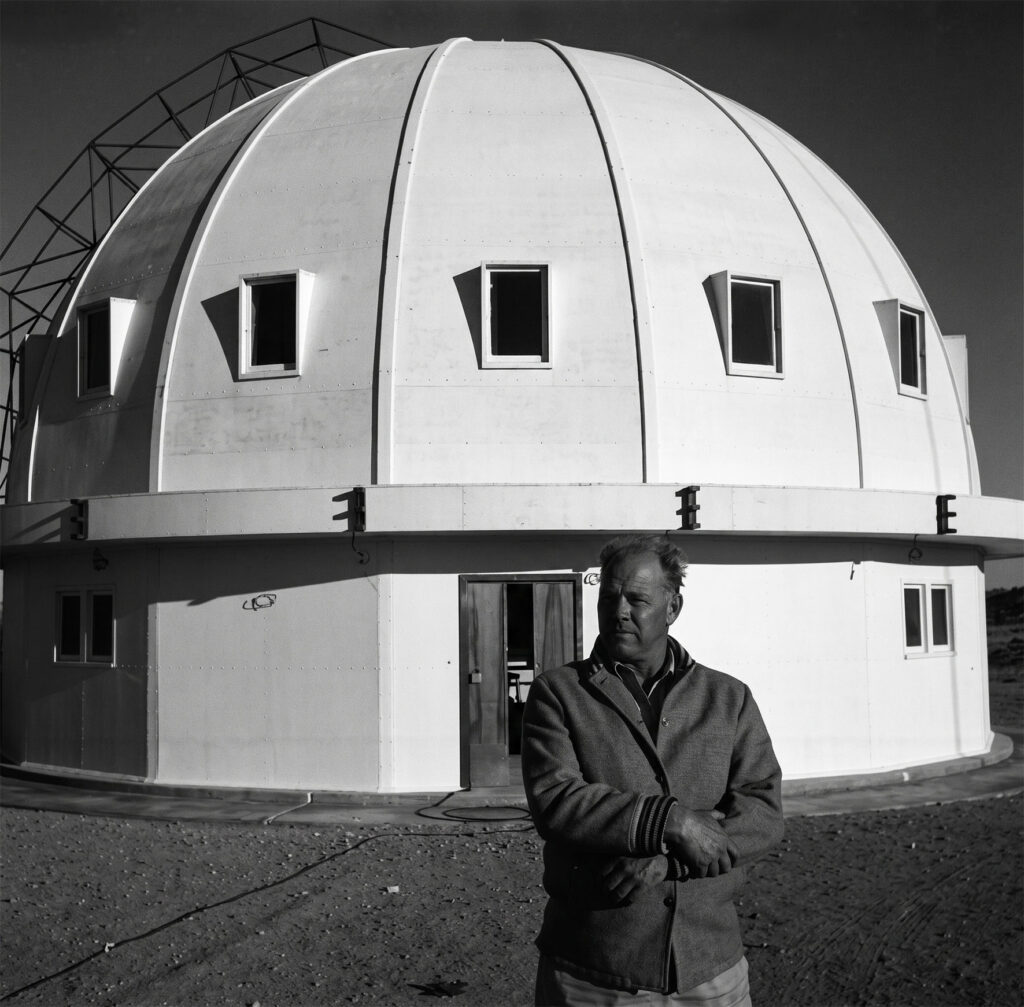
The result was the Integratron, a wooden dome in Landers, California, approximately 38 feet high and 55 feet in diameter. Van Tassel intended it to operate as an electrostatic generator connected with cellular rejuvenation and other extraordinary effects.
The machine was not completed or demonstrated in the way Van Tassel envisioned. The building nevertheless survived and was listed in the United States National Register of Historic Places. (National Park Service record)
The evidentiary boundaries are clear. The Integratron exists. Van Tassel’s authorship and contact claims are historically documented. Its role in contact culture is verifiable. These facts do not establish that the design came from NHI or that the proposed rejuvenation effects were physically achievable.
The case still matters because it demonstrates how an unverifiable inner experience can generate material consequences. A claimed message became architecture, community, pilgrimage and cultural memory.
Dorothy Martin and a prophecy that failed
In 1954, Dorothy Martin used automatic writing and said she was receiving messages from advanced beings associated with a planet called Clarion. One message predicted that a catastrophic flood would strike and that believers would be rescued by a spacecraft.
The predicted flood and rescue did not occur.
The group became famous through Leon Festinger, Henry Riecken and Stanley Schachter’s 1956 book When Prophecy Fails. The book was widely interpreted as showing that believers responded to the failed prediction by increasing their commitment and attempting to recruit others.
That interpretation has been challenged by archival research.
In a paper published online on 4 November 2025 and assigned to the journal’s 2026 volume, historian Thomas Kelly argued that the classic account seriously misrepresented the group’s activities before and after the prediction. Kelly reported that the group had promoted its beliefs before the anticipated event, rapidly abandoned the failed prophecy and was subjected to intervention by researchers who were not merely passive observers. His study also reported that members of the research team introduced fabricated psychic messages into the group. (Kelly, 2026)
None of this validates Martin’s prediction. The event she forecast did not happen, which is strong evidence against the specific message.
The reassessment changes the lesson in another way. Investigators can influence a case, select evidence and become attached to an explanatory model just as witnesses can. The Martin episode therefore cautions against granting automatic authority either to an alleged communicator or to the researcher claiming to have explained it.
A failed prophecy should not automatically be labelled a hoax. Hoax requires evidence of intentional deception. A person may sincerely misattribute an internally generated message, misunderstand ambiguous impressions or make an incorrect prediction without deliberately fabricating the original experience.
Jane Roberts and the Ra Contact archive
Jane Roberts began producing material attributed to a personality called Seth during the 1960s. The work became one of the most influential bodies of modern channelling literature.
The Jane Roberts Papers at Yale University contain manuscripts, correspondence, publications and records associated with her work. The archive establishes that Roberts produced a substantial and culturally influential collection of channelling material. It does not independently authenticate Seth as a separate intelligence.
The Ra Contact archive provides another unusually extensive record. Between 15 January 1981 and 15 March 1984, Carla L. Rueckert, Don Elkins and Jim McCarty recorded 106 sessions attributed to an intelligence called Ra. L/L Research preserves transcripts, recordings and contextual material from the sessions. (L/L Research)
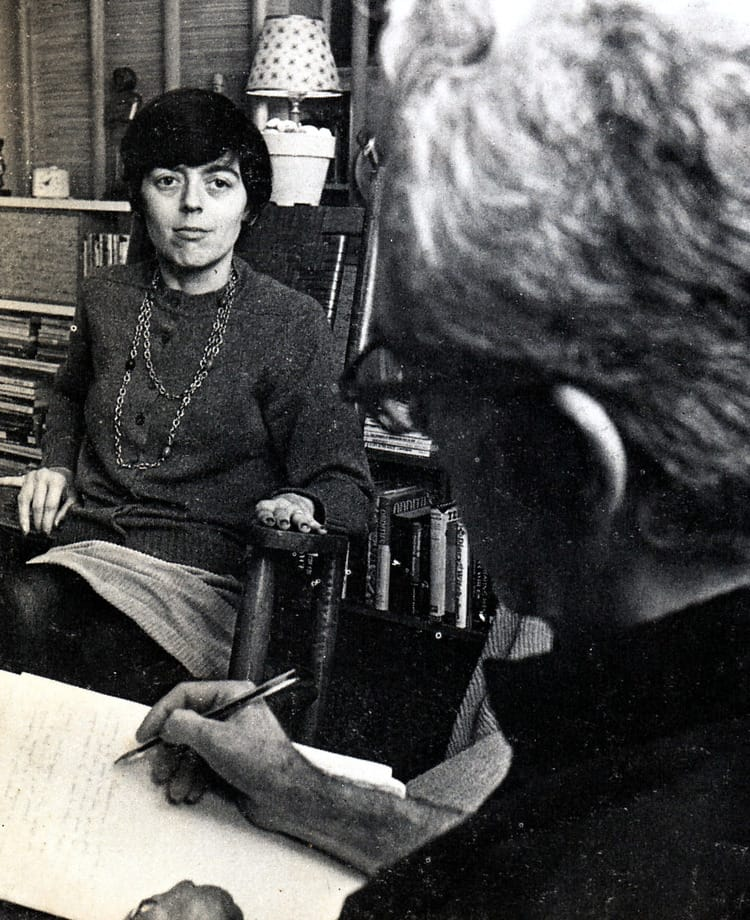
Such archives are valuable because they preserve wording, dates, questions, editorial history and conceptual development. Researchers can examine whether claims changed over time, whether information appeared before or after it became publicly available and how the alleged personality interacted with participants.
An archive proves that a communication was recorded. It does not, by itself, identify who or what communicated.
This is one of the most persistent problems in evaluating channeling. A complex or moving philosophy can feel as though it must have come from a profound external source. Yet human minds can produce novels, improvised performances, dream narratives and unexpected insights without conscious step-by-step planning.
The existence of unconscious creativity does not disprove anomalous information transfer. It does prevent literary quality, internal consistency or emotional power from functioning as proof of NHI authorship.
The rise of channeling with J.Z. Knight and Ramtha
J. Z. Knight is best known for her claim of channeling an ancient warrior named Ramtha, presented within the Ramtha teachings as a teacher who lived approximately 35,000 years ago and ultimately transcended ordinary physical existence. Academic treatments place Knight and the Ramtha School of Enlightenment within the modern channeling and New Age traditions. Gail Harley describes the Ramtha narrative as identifying him as a warrior associated with Lemuria and Atlantis, while J. Gordon Melton situates the movement within a broader history of contemporary alternative spirituality (Harley, 2004; Melton, 1998). Ramtha’s School itself describes Knight as Ramtha’s channel and presents the teachings as addressing human origins, consciousness, divinity, death, space, time, reality, and human potential (Ramtha’s School of Enlightenment, n.d.).
The case is unusual in the persistence and structure attributed to the communicating personality. Across public appearances, recorded teachings, books, and instructional programs, Ramtha is presented as possessing a recognizable voice, biography, vocabulary, philosophical system, and cosmology. The teachings emphasize personal transformation, consciousness, self-mastery, and the possibility that human beings possess capacities beyond those ordinarily recognized within conventional models of mind and identity (Harley, 2004; Melton, 1998). Whether this coherence reflects an independently existing intelligence, a psychologically generated personality, or some more complex interaction between consciousness, culture, and altered states remains unresolved.

Critical interpretations have focused on precisely this problem of source attribution. Psychological models applicable to trance channeling include dissociation, absorption, expectancy, hypnotic susceptibility, and altered source attribution. A particularly relevant investigation by Krippner, Wickramasekera, Wickramasekera, and Winstead examined seven long-term participants in Ramtha’s consciousness-training practices. The researchers found psychological profiles characterized by relatively “thin boundaries,” high absorption, and high dissociative capacities. Importantly, these findings demonstrate measurable psychological characteristics associated with the practice, but they neither establish nor disprove Ramtha’s claimed independent existence (Krippner et al., 1998).
This distinction is important. The existence of altered states, dissociation, or unusual absorption does not by itself demonstrate that a communicating intelligence is internally generated. Conversely, the consistency, complexity, or perceived usefulness of communicated material does not establish that its source exists independently of the channel. Anthropologist Michael F. Brown’s broader ethnographic study of American channeling similarly emphasizes the importance of examining the phenomenon as an experiential and social system rather than assuming that either supernatural or reductionist interpretations have already settled its ontology (Brown, 1997).
Supporters emphasize the profound experiential effects reported by adherents, including personal transformation, community formation, changes in worldview, and practices intended to develop attention, intentionality, and perceived non-ordinary capacities. The Ramtha School explicitly frames these practices as methods for expanding human potential and understanding consciousness (Ramtha’s School of Enlightenment, n.d.). Scholars studying the movement have likewise documented its emphasis on transformation, consciousness, personal divinity, and the construction of a coherent spiritual worldview without necessarily endorsing the claimed provenance of the teachings (Harley, 2004; Melton, 1998).
From an information-problem standpoint, Ramtha’s communications therefore raise questions about source attribution, content reliability, and the possibility that cumulative patterns can emerge through disciplined ritual, expectancy, altered states, and cultural framing. Proponents argue that the material contains practical insights concerning empowerment, resilience, consciousness, and human development. Critics and researchers emphasize the need to distinguish three different propositions: that an experience genuinely occurred, that meaningful information emerged from that experience, and that the information originated from the external intelligence claimed by the experiencer. These propositions require different kinds of evidence and should not be collapsed into a single judgment.
In evaluating Knight’s Ramtha phenomenon, the most productive approach is therefore to separate the experiential phenomenon from the ontological claim. Knight’s public channeling practice, the continuing existence of the Ramtha School, its extensive body of teachings, and the communities built around those teachings are historically demonstrable. The independent existence and claimed history of Ramtha remain unverified. This distinction allows the phenomenon to be studied seriously without requiring either prior acceptance or prior rejection of its proposed source. Brown’s anthropological approach and the psychological research conducted by Krippner and colleagues both support this kind of layered analysis (Brown, 1997; Krippner et al., 1998).
Edgar Cayce: an early American precursor to modern channeling
Edgar Cayce occupies an important position in the history of American trance communication, although describing him as the first American channeler would be historically inaccurate. His mature practice developed after a prolonged problem with his voice beginning in 1900. According to the chronology maintained by the Association for Research and Enlightenment (A.R.E.), a traveling hypnotist temporarily restored Cayce’s normal speech while he was under hypnosis. On March 31, 1901, with the assistance of Al Layne, Cayce entered a trance state and gave what became regarded as his first psychic reading, diagnosing his own condition. He subsequently began giving readings for others (Association for Research and Enlightenment [A.R.E.], n.d.-a).
Over the following decades, Cayce produced thousands of trance readings addressing health, psychology, spirituality, reincarnation, history, dreams, and metaphysical questions. His work expanded significantly in 1923, when readings requested by Arthur Lammers introduced astrology, reincarnation, and broader philosophical and metaphysical subjects. The surviving archive maintained by A.R.E. contains 14,306 readings, making Cayce one of the most extensively documented trance practitioners of the early twentieth century (A.R.E., n.d.-a, n.d.-b; Johnson, 1998).
Cayce’s own account of where his information originated is more complex than the idea of a single external intelligence speaking through him. According to A.R.E., when asked about the source of his information, Cayce identified two principal sources: the subconscious mind of the person receiving the reading and what he called the Akashic Records, conceived within his metaphysical framework as a universal repository of information (A.R.E., n.d.-b). Other interpretations of the Cayce material have involved subconscious processes, clairvoyance, spiritual sources, and forms of universal consciousness.
Cayce also did not originate the broader practice now called channeling. American trance mediumship and purported communication with nonphysical intelligences were well established during the nineteenth century. Andrew Jackson Davis, born in 1826, was entering hypnotic or trance states, giving clairvoyant medical diagnoses, reporting communication with unseen beings, and producing extensive trance-derived writings by the 1840s. Significantly, the Edgar Cayce Foundation itself describes Davis as Cayce’s “19th Century Predecessor” and notes that Cayce later considered Davis’s abilities unusually similar to his own (Newell, 2020).
Nor does the evidence support the frequently repeated claim that Cayce coined the word “channeling” in its modern spiritual sense. Historical reference literature describes channeling as a modern term applied to practices that had previously been classified as mediumship and traces philosophical trance communication at least to Andrew Jackson Davis. More specifically, the modern use of “channeling” appears to have developed within the UAP contactee communities of the 1940s and 1950s, where the language of radio and television offered a new technological metaphor for receiving communications from purported non-human intelligences. Cayce died in 1945, before this usage became established (Encyclopedia.com, 2018).
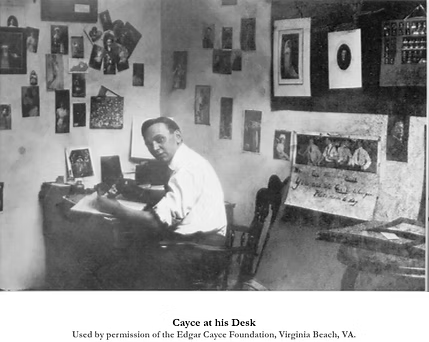
Cayce is therefore better understood not as the first American channeler or the inventor of the term, but as a major transitional figure between nineteenth-century trance mediumship and the forms of channeling that became prominent during the twentieth century. Scholar K. Paul Johnson describes Cayce as a pivotal figure connecting late nineteenth-century esoteric and metaphysical traditions with what would later become the New Age movement. Johnson’s examination of more than 14,000 readings also argues for a mixed evidentiary picture: some material is interpreted as unusually suggestive, while other historical and clairvoyant claims demonstrate the fallibility of information produced in trance and appear influenced by the knowledge and interests of Cayce and his subjects (Johnson, 1998).
Seen in this historical continuum, Cayce’s importance lies less in originating channeling than in helping establish a durable twentieth-century model of altered-state information reception: disciplined trance, reduced ordinary agency, apparently structured information, and the belief that consciousness may gain access to sources unavailable to normal waking cognition. Later channelers transformed that model by increasingly identifying the source as a named, autonomous personality, extraterrestrial intelligence, multidimensional being, collective consciousness, or other form of non-ordinary agency. The development from nineteenth-century Spiritualist mediumship through Cayce and the mid-century UAP contactee movement to figures such as J. Z. Knight is therefore best understood as an evolving historical continuum rather than as an invention attributable to any single practitioner.
What the STAR GATE studies showed
No publicly available official study cited here has established that channelling produces communication with NHI. The closest relevant government-sponsored research concerns anomalous cognition, particularly remote viewing.
Beginning in the 1970s, several United States defence and intelligence organisations funded experiments and operational work involving remote viewing. The programmes eventually became associated with the name STAR GATE.
Remote viewing was treated as a potential information-gathering method. Participants attempted to describe concealed locations, objects or activities without receiving ordinary sensory access to the target.
In 1995, the American Institutes for Research, or AIR, evaluated the experimental and operational record. The evaluation accepted that statistically significant laboratory results had been reported, while its reviewers disagreed about whether those results supported a paranormal interpretation.
Statistician Jessica Utts considered the evidence supportive of anomalous cognition. Psychologist Raymond Hyman argued that methodological and interpretive problems prevented such a conclusion. The AIR report stated that the source or nature of the reported statistical effect had not been established. (AIR evaluation)
The operational record was much less persuasive. Intelligence users described remote-viewing material as vague, inconsistent and inaccurate in important details. It required substantial subjective interpretation and was not considered sufficiently reliable for actionable intelligence. The report did not recommend continued operational use.
This finding resists two popular extremes. The programme did not officially prove psychic functioning as a dependable intelligence capability. The laboratory literature was also not summarised as uniformly indistinguishable from chance.
For UAP research, the key point is source attribution. Even a robust above-chance result would establish an information anomaly before it established NHI communication.
Further documentary context is available in Project STAR GATE: The CIA’s Psychic Spies, the Cold War Data Trail, and the UAP Edge and the IRVA CIA Star Gate Archives.
What happens in the brain during trance?
Neuroscience can test whether mediumistic trance is associated with measurable changes. It cannot identify the metaphysical source of a message.
A 2012 PLOS ONE study examined ten Brazilian psychographers, five experienced and five less experienced, using single-photon emission computed tomography during ordinary writing and psychography. Experienced practitioners produced more complex texts during psychography while showing reduced activity in several regions associated with planning, language and cognitive control.
The sample was very small, and the authors explicitly called for replication. The findings suggested that psychography among the experienced participants was associated with within-person changes relative to ordinary writing. They did not establish that the texts came from deceased persons, NHI or any independent intelligence. (Peres et al., 2012)
A controlled EEG study published in 2026 initially recruited ten mediums and ten matched controls. One matched pair was excluded from the EEG analysis, leaving nine participants in each group.
The study found that the mediums’ trance-writing EEG differed from the controls’ simulated mediumistic writing across theta, alpha and beta bands. It did not find a significant within-medium EEG difference between ordinary waking writing and psychographic writing.
The mediums’ trance texts scored higher than their own waking texts. The researchers did not find a significant overall difference in text quality between mediums and controls. (Pinto et al., 2026)
Taken together, these small studies suggest that mediumistic trance can be associated with measurable neurophysiological differences, although no reliable or diagnostic neural signature of channelling has been established.
That is a narrower conclusion than saying that neuroscience can authenticate an individual channel. Brain imaging can reveal patterns associated with a task or state, but it cannot determine whether a message came from imagination, dissociated cognition, anomalous information or an external intelligence.
Ariel School at the edge of the category
The 16 September 1994 Ariel School encounter in Ruwa, Zimbabwe, was not a planned channelling session. The pupils did not gather to summon an intelligence. It belongs near psychic-contact research because some witnesses later described apparent non-verbal communication associated with the reported beings.
The surviving testimony comes from several periods and should not be treated as one uniform body of evidence.
BBC correspondent Tim Leach recorded pupils and staff shortly after the incident. Portions of his contemporary reporting survive in later broadcasts and documentary presentations. A 2021 episode of BBC World Service’s Witness History revisited the event and placed Leach’s reporting within the early chronology. (BBC World Service, 2021)
Zimbabwean researcher Cynthia Hind also interviewed pupils and collected drawings soon after the event. Her published account appears in the Ariel School chapter of the 1996 first edition of UFOs Over Africa. Hind’s work is a significant early source, but the interview conditions visible in surviving footage and described in later analyses were not equivalent to individually isolated, blinded forensic interviews.
John E. Mack travelled to Zimbabwe approximately two months later. His recorded sessions contain the clearest descriptions of apparent telepathic impressions and environmental themes. Some pupils described receiving images or a sense that humanity was damaging the planet through technology and pollution.
The Mack material is represented in the John E. Mack Institute audiovisual archive and in Randall Nickerson’s documentary Ariel Phenomenon. The film combines early reporting, Mack’s later interviews and testimony recorded from adult witnesses. These layers should be distinguished by recording date rather than treated as simultaneous evidence.
Later adult testimony shows that several witnesses continued to affirm that they had experienced something extraordinary. Such retrospective testimony is relevant to the event’s lasting impact, but it is not equivalent to testimony recorded within days of the incident. Memory is reconstructive and can be influenced by subsequent discussion, repeated retelling and later interpretive frameworks. (Schacter, 1999)
The case contains convergence around a broad event involving unusual objects or figures near the school boundary. It also contains variation in the reported number, appearance, motion and interpretation of the objects and beings. Not every pupil reported telepathic communication, and the environmental component is most clearly documented in Mack’s later interviews.
Critics argue that group discussion, interviewing methods, prior regional excitement and memory development may have influenced parts of the narrative. Supporters emphasise the children’s apparent distress, the persistence of testimony and recurring visual features in their accounts and drawings.
The psychic component should therefore be classified as disputed. The recordings document that some children described non-verbal impressions. They do not establish that an external being transmitted those impressions.
For the wider case file, see Ariel School Encounter, Zimbabwe 1994: A Dossier.
How psychic contact is practised today
Modern practice ranges from quiet inner listening to organised field experiments.
In conscious channelling, the practitioner relaxes, attends to impressions and speaks while remaining aware. Some describe the process as receiving a flow of concepts rather than hearing sentences. The practitioner then translates those concepts into language.
Deep-trance channelling places greater emphasis on altered identity and reduced agency. A facilitator may ask questions while the practitioner adopts a different voice or manner. Memory gaps and altered presentation can occur in dissociative or hypnotic states, so they do not establish external possession or NHI contact.
Suggestive memory-recovery procedures, including hypnosis, can increase the risk of distorted or false recollections and should not be treated as reliable methods for improving factual recall. (Lynn et al., 2015)
Automatic writing involves allowing words or symbols to emerge with minimal conscious planning. The method is easy to record but difficult to interpret. The text may draw from subconscious associations, forgotten material, creative processes or something genuinely anomalous.
Telepathic contact is often described as imagery, emotion, pressure, symbolic meaning or instantaneous knowing. Translation into language usually happens after the initial impression. This creates another layer of interpretation between the alleged signal and the final account.
Dream reports are vulnerable to motivated interpretation, selective recall and post-event matching. Their evidential value is greater when the original account is specific, time-stamped and preserved before the later event.
Morewedge and Norton found that people often assign meaning to dreams selectively and in ways influenced by existing motivations. A study by Caroline Watt and colleagues examined claimed precognitive-dream experiences more directly, identifying paranormal belief, selective recall and a propensity to perceive correspondences as relevant psychological factors. (Morewedge & Norton, 2009; Watt et al., 2014)
Remote viewing provides a more testable structure because targets can be randomly chosen and concealed. The strongest designs keep the viewer, facilitator and judges blind to target identity, preserve all trials and include carefully selected decoys.
CE-5-style sessions combine mental and observational methods. Participants may meditate, visualise their location, direct an invitation towards an unknown intelligence and monitor the sky. Any resulting observation still requires ordinary identification work. Aircraft, satellites, astronomical objects and local drones must be excluded before a case is treated as anomalous.
Lasers should not be used as contact signals. Do not direct lasers into navigable airspace. Knowingly aiming a laser pointer at an aircraft, or at the aircraft’s flight path, is a federal crime in the United States and presents a serious aviation hazard. (Federal Aviation Administration)
Controversies and counter-interpretations
The central controversy is not whether people can have powerful, unusual and transformative experiences. They plainly can. The controversy is what those experiences reveal about their source.
Human consciousness routinely produces material without giving the person full access to how it was constructed. A solution can appear suddenly after sleep. A writer may feel that a character has become autonomous. A musician can improvise complex passages without consciously planning every note.
Cognitive research has shown that much mental processing occurs outside conscious awareness. People can generate language, associations and decisions while remaining unable to describe the processes that produced them. (Nisbett & Wilson, 1977)
Cryptomnesia adds another difficulty. Information encountered in the past can return without its source being remembered. The resulting material may feel new even when it is not.
Information leakage can compromise experiments. A facilitator who knows the target may provide subtle cues. Judges may interpret ambiguous language in favour of a match. If successful sessions are publicised while failed sessions disappear, the apparent record becomes misleading.
Predictions offer a direct test only when they are specific, time-limited and recorded before the event. “A transformation is coming” can be fitted to almost anything. A prediction that names a date, place and measurable event can genuinely fail.
Authority is another major concern. A channel may become the sole interpreter of an invisible intelligence. Disagreement with the human intermediary can then be reframed as resistance to a superior being.
The danger increases when messages govern medical care, money, sexual relationships, political action, family separation or obedience to a leader. No communicator should be exempt from ordinary ethical judgement because it claims an advanced origin.
Commercial involvement does not settle authenticity. A paid practitioner may be sincere. An unpaid practitioner may still be mistaken. Transparent finances, complete records and willingness to submit claims to controlled testing are more useful indicators.
Mental-health questions also require care. An altered state is not automatically an illness. Experiences that become frightening, commanding, sleep-disrupting or destabilising should nevertheless be addressed with qualified professional support. Good support protects the person’s safety and agency without forcing either a supernatural or dismissive interpretation.
What a serious contact experiment would require
A credible channelling experiment begins before the session.
The questions, target-selection procedure, scoring method and definition of success should be preregistered. Targets should be randomly selected and secured so that neither the practitioner nor facilitator knows their identity.
Sessions should be recorded and time-stamped before feedback is provided. Independent judges should compare the resulting transcript with the actual target and appropriate decoys.
Every trial must remain in the dataset. Misses, vague statements and abandoned attempts cannot be discarded. Replication by independent teams is more important than one dramatic success.
Claims of an external UAP response require an additional experimental layer. Contact nights should be compared with matched control nights. Cameras should be synchronised and calibrated. Observers should record location, azimuth, elevation, duration, weather and device settings. Aircraft traffic, satellite passages, astronomical objects, launches and local drone activity should be checked.
A meaningful experiment must also be able to fail. A protocol that treats a light as success, no light as invisible contact and equipment failure as interference cannot distinguish a positive result from a negative one.
It may have personal or ritual significance, but it is not a scientific test.
Why the subject matters
Channelling has already produced measurable cultural effects. It has created books, movements, architecture, rituals, relationships and changes in personal identity.
For UAP research, the literature suggests that witness consciousness may sometimes be reported as part of the event rather than merely a passive recorder of it. Some experiencers describe apparent information transfer, altered time, emotional modulation, dreams associated with sightings or a feeling that the phenomenon responds to attention.
Those reports do not establish a consciousness-based mechanism. They do indicate that investigators may lose important data if they record only the external object and ignore the internal sequence of the encounter.
A future reporting system could document subjective and physical data separately. Investigators might record the timing and content of impressions, prior beliefs, sleep state, bodily sensations and later verification. Those accounts could then be compared with instrument records without treating testimony and sensor data as equivalent.
The implications depend on what future research finds.
If channelling is generated entirely within human cognition, it remains important for understanding creativity, dissociation, religious experience, identity and meaning.
If controlled studies demonstrate repeatable anomalous information acquisition, models of cognition may require expansion even before the source can be identified.
If focused intention can be reliably linked to independently recorded UAP activity, the observer may need to be treated as an experimental variable.
If a communicator can demonstrate stable identity and specific knowledge unavailable to participants, the contact question would change fundamentally.
None of these outcomes should be announced in advance. Each requires evidence capable of distinguishing it from the alternatives.
Implications
Channelling and psychic contact challenge the ordinary division between an object “out there” and a witness “in here.” They raise the possibility that some contact reports involve a complex interaction among perception, expectation, symbolism, altered cognition and an unknown stimulus.
That possibility should not lower evidentiary standards. It should lead to better ones.
The next generation of research requires two laboratories operating together. One examines consciousness through psychology, neuroscience, blinded information tasks and careful interviews. The other examines the environment through calibrated cameras, aviation data, astronomy, radio-frequency monitoring and synchronised sensors.
A persuasive psychic-contact case would need to survive both.
The current record supports a careful conclusion. The experiences are real as reported experiences. Some associated altered states have been linked to measurable neurophysiological findings in small studies. A debated body of anomalous-cognition research exists. The identity of the alleged communicators has not been established.
The mystery is not protected by premature certainty. It is protected by preserving testimony, documenting evidence and building tests capable of separating competing explanations.
Claims taxonomy
Verified: George King’s public claims
George King publicly practised channelling and attributed his communications to extraterrestrial intelligences. Surviving recordings and Aetherius Society publications document those claims. The identity of the alleged communicators is not verified.
Verified: The Integratron and Van Tassel’s attribution
The Integratron exists and is historically associated with George Van Tassel. Van Tassel attributed elements of its design to psychic contact. The alleged extraterrestrial origin of the design and its proposed rejuvenation functions are not verified.
Verified: Dorothy Martin’s failed prediction
Martin’s predicted flood and spacecraft rescue did not occur. Kelly’s archival research documents disputed aspects of the later academic narrative and reports investigator interference. The failed prediction remains disconfirmed.
Verified: The Roberts and Ra archives
Substantial records of the Jane Roberts and Ra channelling materials exist. The dates, texts and recordings can be studied. The claimed independent identities of Seth and Ra have not been established.
Verified: Government funding of remote viewing
United States agencies funded remote-viewing research and operational trials. The AIR evaluation acknowledged reported statistically significant laboratory findings but found that operational information was insufficiently reliable for intelligence use.
Verified: Small trance studies reported neurophysiological findings
Small neuroimaging and EEG studies reported group-level or within-participant neurophysiological findings associated with mediumistic trance or psychography. The 2026 EEG study did not find a significant difference between the mediums’ waking and psychographic writing conditions. These studies do not demonstrate anomalous information acquisition or identify an external source.
Probable: Historical continuity
Modern UAP channelling probably developed partly from earlier mediumistic, esoteric and religious practices. The changing language of communicators reflects the technological and spiritual concepts available within different historical periods.
Disputed: Anomalous information acquisition
Claims that channelling, remote viewing or telepathy reliably provide information unavailable through ordinary means remain disputed.
Disputed: Ramtha’s Teachings
Ramtha’s teachings offer meaning, guidance, and a framework for personal exploration. The perceived accuracy often rests on subjective resonance and transformative impact. Without independent, objective verification, many explicit factual claims, historical narratives, or cosmological assertions remain disputed.
Disputed: Edgar Cayce’s Diagnoses and Prognoses
While Association for Research and Enlightenment (ARE) archives describe numerous cases where Cayce readings coincided with medical improvements or accurate diagnoses, there is no consensus in the broader medical community regarding rigorous verification. Much of the evidence is anecdotal and not equivalent to controlled clinical validation.
Disputed: Identity of communicators
Claims that Seth, Ra, Aetherius or other named communicators are independently existing NHI have not been established through publicly reproducible evidence.
Disputed: Ariel School psychic communication
Some Ariel School witnesses described apparent nonverbal impressions, particularly in John Mack’s later interviews. The origin of those impressions, and the possible influence of interviewing conditions and memory development, remain disputed.
Disputed: Human-initiated UAP responses
Claims that meditation, channelling or CE-5-style intention directly causes external UAP appearances remain disputed because controlled comparison data and independent multi-sensor confirmation are limited.
Legend
Older religious and cultural accounts of oracles, heavenly messengers, visions and spirit communication may provide comparative motifs. They should be classified as cultural or religious narratives unless independent evidence supports a specific historical UAP interpretation.
Misidentification
Inner speech, dreams, ideomotor action, forgotten memories and dissociative cognition may also be misidentified as external communication. Misidentification does not imply dishonesty.
Hoax
Kelly’s research reports that investigators introduced fabricated psychic communications into Dorothy Martin’s group. Those reported interventions constitute deliberate manipulation if documented as described. They do not establish that Martin knowingly fabricated her entire practice.
Speculation labels
Hypothesis
Some UAP-associated intelligences may use human consciousness as a communication interface. Instead of transmitting spoken language, such an intelligence might convey images, emotions or compressed concepts that the recipient translates through personal vocabulary and culture. This hypothesis remains unverified and would require blinded information transfer together with independent external corroboration.
Witness Interpretation
Practitioners frequently interpret messages as external because the content feels unexpected, arrives with a distinctive personality or is accompanied by altered bodily sensations and a powerful sense of presence. Some witnesses also report lights or coincidences that appear to respond to the communication. These features explain why the experience may feel convincing to the witness. They do not independently identify the source.
Researcher Opinion
A productive framework treats psychic contact as a source-attribution problem. The experience should be documented, the altered state measured, the information tested, the social setting examined and any external observation investigated independently.
Sincerity cannot be inferred with certainty from emotional intensity, unusual behaviour or neurophysiological change. Deliberate deception, sincere misinterpretation, unconscious creativity and anomalous information should remain separate possibilities unless case-specific evidence narrows them.
References
Association for Research and Enlightenment. (n.d.-a). Edgar Cayce’s life chronology, 1877–1945. Edgar Cayce’s A.R.E.
Association for Research and Enlightenment. (n.d.-b). Edgar Cayce on the Akashic Records. Edgar Cayce’s A.R.E.
Brown, M. F. (1997). The channeling zone: American spirituality in an anxious age. Harvard University Press.
Encyclopedia.com. (2018). Channeling. In Melton’s Encyclopedia of American Religions.
Harley, G. M. (2004). From Atlantis to America: JZ Knight encounters Ramtha. In J. R. Lewis & J. A. Petersen (Eds.), Controversial new religions (pp. 319–330). Oxford University Press. https://doi.org/10.1093/019515682X.003.0014
Johnson, K. P. (1998). Edgar Cayce in context: The readings, truth and fiction. State University of New York Press.
Krippner, S., Wickramasekera, I., Wickramasekera, J., & Winstead, C. W., III. (1998). The Ramtha phenomenon: Psychological, phenomenological, and geomagnetic data. Journal of the American Society for Psychical Research, 92(1), 1–24.
Melton, J. G. (1998). Finding enlightenment: Ramtha’s School of Ancient Wisdom. Beyond Words Publishing.
Newell, J. (2020, September 27). Andrew Jackson Davis: Edgar Cayce’s 19th century predecessor. Edgar Cayce’s A.R.E.
Ramtha’s School of Enlightenment. (n.d.). About Ramtha’s School of Enlightenment.
Aetherius Society. (n.d.). Historical photos and video. https://www.aetherius.org/locations/london/history/
BBC. (1959, 21 May). Spokesman for the space people: George King interviewed by David Stafford-Clark [Television recording]. Surviving copy: https://www.youtube.com/watch?v=_89ldXhxatU
BBC World Service. (2021, 28 June). Zimbabwe’s mass UAP sightings. Witness History. https://www.bbc.co.uk/programmes/w3ct1x0z
Brown, M. F. (1997). The channeling zone: American spirituality in an anxious age. Harvard University Press.
Festinger, L., Riecken, H. W., & Schachter, S. (1956). When prophecy fails. Harper.
Federal Aviation Administration. (n.d.). Laser safety. U.S. Department of Transportation. https://www.faa.gov/about/initiatives/lasers
Hind, C. (1996). UFOs over Africa. Horus House Press.
Hyman, R. (1999). The mischief-making of ideomotor action. The Scientific Review of Alternative Medicine, 3, 30–39.
Integratron. (n.d.). History of the Integratron. https://www.integratron.com/history-about/
John E. Mack Institute. (n.d.). Audio and video archive. https://johnemackinstitute.org/audiovideo/
Kelly, T. (2026). Debunking “When Prophecy Fails.” Journal of the History of the Behavioral Sciences, 62(1), e70043. Advance online publication 4 November 2025. https://doi.org/10.1002/jhbs.70043
Lewis, J. R. (Ed.). (1995). The gods have landed: New religions from other worlds. State University of New York Press.
L/L Research. (n.d.). Introduction to the Ra Contact. https://www.llresearch.org/channeling/ra-contact/intro
L/L Research. (n.d.). The Ra Contact archive. https://www.llresearch.org/channeling/ra-contact
Lynn, S. J., Evans, J., Laurence, J.-R., & Lilienfeld, S. O. (2015). What do people believe about memory? Implications for the science and pseudoscience of clinical practice. Canadian Journal of Psychiatry, 60(12), 541–547. https://doi.org/10.1177/070674371506001202
Mack, J. E. (1999). Passport to the cosmos: Human transformation and alien encounters. Crown.
Marsh, R. L., & Bower, G. H. (1993). Eliciting cryptomnesia: Unconscious plagiarism in a puzzle task. Journal of Experimental Psychology: Learning, Memory, and Cognition, 19(3), 673–688. https://doi.org/10.1037/0278-7393.19.3.673
Morewedge, C. K., & Norton, M. I. (2009). When dreaming is believing: The motivated interpretation of dreams. Journal of Personality and Social Psychology, 96(2), 249–264. https://doi.org/10.1037/a0013264
Mumford, M. D., Rose, A. M., & Goslin, D. A. (1995). An evaluation of remote viewing: Research and applications. American Institutes for Research. https://nsarchive2.gwu.edu/NSAEBB/NSAEBB438/docs/doc_57.pdf
National Aeronautics and Space Administration. (2023). UAP Independent Study Team report. https://science.nasa.gov/wp-content/uploads/2023/09/uap-independent-study-team-final-report.pdf
National Park Service. (2018). Integratron: National Register of Historic Places record. https://npgallery.nps.gov/AssetDetail/b345b8c0-fe83-49b3-82cd-ae2ba6b6243d
Nickerson, R. (Director). (2022). Ariel Phenomenon [Documentary film]. String Theory Films. https://arielphenomenon.com/
Nisbett, R. E., & Wilson, T. D. (1977). Telling more than we can know: Verbal reports on mental processes. Psychological Review, 84(3), 231–259. https://doi.org/10.1037/0033-295X.84.3.231
Peres, J. F. P., Moreira-Almeida, A., Caixeta, L., Leão, F., & Newberg, A. (2012). Neuroimaging during trance state: A contribution to the study of dissociation. PLOS ONE, 7(11), e49360. https://doi.org/10.1371/journal.pone.0049360
Pinto, K. M., Toutain, T. G. L. de O., Saba, H., Bastos, M. A. V., Jr., do Rosário, R. S., Plácido, J., Loureiro, N., Fernandes, V. C., & Miranda, J. G. V. (2026). Brain activity and the production of written text during mediumistic trance: A controlled EEG study. PLOS ONE, 21(2), e0343216. https://doi.org/10.1371/journal.pone.0343216
Schacter, D. L. (1999). The seven sins of memory: Insights from psychology and cognitive neuroscience. American Psychologist, 54(3), 182–203. https://doi.org/10.1037/0003-066X.54.3.182
Wahbeh, H., Radin, D., Cannard, C., & Delorme, A. (2022). Channeling: A non-pathological possession and dissociative identity experience or something else? Frontiers in Psychology, 13, 899669. https://pmc.ncbi.nlm.nih.gov/articles/PMC9034997/
Watt, C., Ashley, N., Gillett, J., Halewood, M., & Hanson, R. (2014). Psychological factors in precognitive dream experiences: The role of paranormal belief, selective recall and propensity to find correspondences. International Journal of Dream Research, 7(1), 1–8. https://doi.org/10.11588/ijodr.2014.1.11218
Yale University Library. (n.d.). Jane Roberts papers. Archives at Yale. https://archives.yale.edu/repositories/12/resources/4482
SEO keywords
channelling and UAP, psychic contact methods, UAP telepathy, NHI channelling, extraterrestrial channelling claims, automatic writing UAP, psychography and contact, trance channelling research, psychic contact case studies, George King Aetherius Society, George Van Tassel Integratron, Dorothy Martin prophecy, Ra Contact archive, Jane Roberts channelling, STAR GATE remote viewing, CE-5 contact methods, UAP consciousness research, Ariel School telepathy, anomalous cognition, mind-UAP interaction, non-human intelligence communication, contact modalities, UAP experiencer testimony, psychic contact evidence, channelling neuroscience, J. Z. Knight, Ramtha, Edgar Cayce, channeling, history of channeling, trance channeling, trance mediumship, Andrew Jackson Davis, Ramtha School of Enlightenment, Akashic Records, altered states of consciousness, dissociation, absorption, UAP consciousness, UAP contact, non-human intelligence communication.